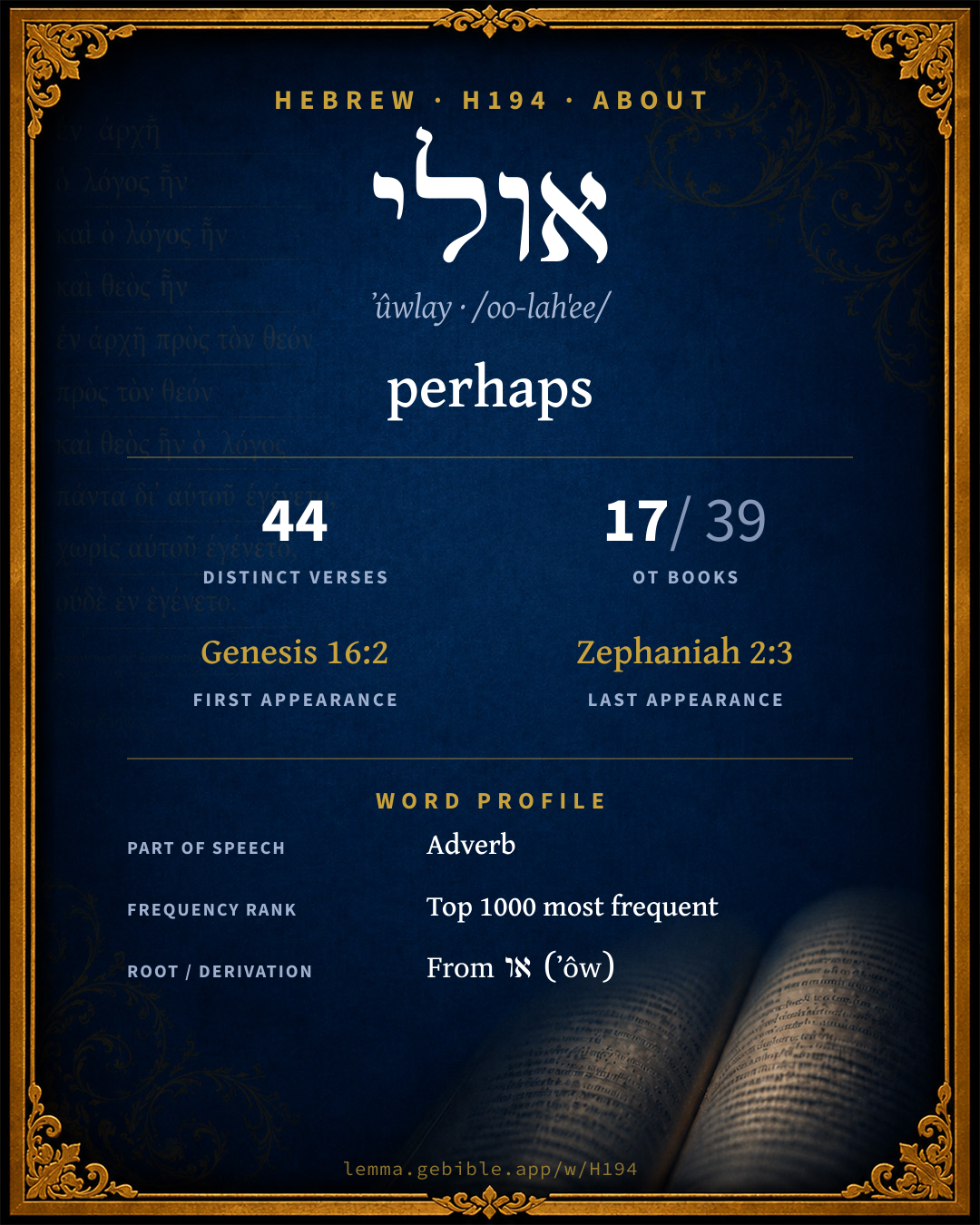
אוּלַי
perhaps
‘perhaps’ is one of 4 main senses fuller range ↓
Full lexicon entry — Brown-Driver-Briggs (BDB)
From Brown-Driver-Briggs (BDB)
Where this word appears
Grammar key — what these labels mean
Part of speech
- Adverb
- A word that modifies a verb, adjective, or other adverb.
Every verse where H194 appears — 44 distinct verses across 17 books. Click any verse to open its interlinear word-by-word view. Verse text shown in the World English Bible for context — . Each verse’s Hebrew form is shown with its reference; the English is not keyword-highlighted, since the data carries no word-level English alignment. Use “Compare translations” on any verse to read it across multiple English versions. This concordance covers the Hebrew Bible; Septuagint (Greek Old Testament) occurrences are not indexed here.
Genesis 12 verses
- Genesis 16:2 אוּלַ֥י adv Sarai said to Abram," See now, Yahweh has restrained me from bearing. Please go in to my handmaid. It may be that I will obtain children by her." Abram listened to the voice of Sarai.
- Genesis 18:24 אוּלַ֥י adv What if there are fifty righteous within the city? Will you consume and not spare the place for the fifty righteous who are therein?
- Genesis 18:28 א֠וּלַי adv What if there will lack five of the fifty righteous? Will you destroy all the city for lack of five?" He said, "I will not destroy it, if I find forty-five there."
- Genesis 18:29 אוּלַ֛י adv He spoke to him yet again, and said, "What if there are forty found there?" He said, "I will not do it for the forty's sake."
- Genesis 18:30 אוּלַ֛י adv He said, "Oh don't let the Lord be angry, and I will speak. What if there are thirty found there?" He said, "I will not do it, if I find thirty there."
- Genesis 18:31 אוּלַ֛י adv He said, "See now, I have taken it on myself to speak to the Lord. What if there are twenty found there?" He said, "I will not destroy it for the twenty's sake."
- Genesis 18:32 אוּלַ֛י adv He said, "Oh don't let the Lord be angry, and I will speak yet but this once. What if ten are found there?" He said, "I will not destroy it for the ten's sake."
- Genesis 24:5 אוּלַי֙ adv The servant said to him, "What if the woman isn't willing to follow me to this land? Must I bring your son again to the land you came from?"
- Genesis 24:39 אֻלַ֛י adv I said to my master, 'What if the woman will not follow me?'
- Genesis 27:12 אוּלַ֤י adv What if my father touches me? I will seem to him as a deceiver, and I would bring a curse on myself, and not a blessing."
- Genesis 32:20 אוּלַ֖י adv You shall say, 'Not only that, but behold, your servant, Jacob, is behind us.'" For, he said, "I will appease him with the present that goes before me, and afterward I will see his face. Perhaps he will accept me."
- Genesis 43:12 אוּלַ֥י adv and take double money in your hand, with the money that was returned in the mouth of your sacks carry again in your hand. Perhaps it was an oversight.
Exodus 1 verse
Numbers 5 verses
- Numbers 22:6 אוּלַ֤י adv Please come now therefore curse me this people; for they are too mighty for me: peradventure I shall prevail, that we may strike them, and that I may drive them out of the land; for I know that he whom you bless is blessed, and he whom you curse is cursed.
- Numbers 22:11 אוּלַ֥י adv Behold, the people that is come out of Egypt, it covers the surface of the earth: now, come curse me them; peradventure I shall be able to fight against them, and shall drive them out.
- Numbers 22:33 אוּלַי֙ adv and the donkey saw me, and turned aside before me these three times: unless she had turned aside from me, surely now I had even slain you, and saved her alive.
- Numbers 23:3 אוּלַ֞י adv Balaam said to Balak, Stand by your burnt offering, and I will go: perhaps Yahweh will come to meet me; and whatever he shows me I will tell you. He went to a bare height.
- Numbers 23:27 אוּלַ֤י adv Balak said to Balaam, Come now, I will take you to another place; peradventure it will please God that you may curse me them from there.
Joshua 2 verses
- Joshua 9:7 אוּלַ֗י adv The men of Israel said to the Hivites, What if you dwell among us; and how shall we make a covenant with you?
- Joshua 14:12 אוּלַ֨י adv Now therefore give me this hill-country, of which Yahweh spoke in that day; for you heard in that day how the Anakim were there, and cities great and fortified: it may be that Yahweh will be with me, and I shall drive them out, as Yahweh spoke.
1 Samuel 3 verses
- 1 Samuel 6:5 אוּלַ֗י adv Therefore you shall make images of your tumors, and images of your mice that mar the land; and you shall give glory to the God of Israel: peradventure he will lighten his hand from off you, and from off your gods, and from off your land.
- 1 Samuel 9:6 אוּלַי֙ adv He said to him, See now, there is in this city a man of God, and he is a man who is held in honor; all that he says comes surely to pass: now let us go there; peradventure he can tell us concerning our journey whereon we go.
- 1 Samuel 14:6 אוּלַ֛י adv Jonathan said to the young man who bore his armor, Come, and let us go over to the garrison of these uncircumcised: it may be that Yahweh will work for us; for there is no restraint to Yahweh to save by many or by few.
2 Samuel 2 verses
- 2 Samuel 14:15 אוּלַ֛י adv Now therefore seeing that I have come to speak this word to my lord the king, it is because the people have made me afraid: and your handmaid said, I will now speak to the king; it may be that the king will perform the request of his servant.
- 2 Samuel 16:12 אוּלַ֛י adv It may be that Yahweh will look on the wrong done to me, and that Yahweh will requite me good for [his] cursing of me this day.
1 Kings 3 verses
- 1 Kings 18:5 אוּלַ֣י adv Ahab said to Obadiah, Go through the land, to all the springs of water, and to all the brooks: peradventure we may find grass and save the horses and mules alive, that we not lose all the animals.
- 1 Kings 18:27 אוּלַ֛י adv It happened at noon, that Elijah mocked them, and said, Cry aloud; for he is a god: either he is musing, or he is gone aside, or he is on a journey, or peradventure he sleeps and must be awakened.
- 1 Kings 20:31 אוּלַ֖י adv His servants said to him, See now, we have heard that the kings of the house of Israel are merciful kings: let us, we pray you, put sackcloth on our loins, and ropes on our heads, and go out to the king of Israel: peradventure he will save your life.
2 Kings 1 verse
Job 1 verse
Isaiah 2 verses
- Isaiah 37:4 אוּלַ֡י adv It may be Yahweh your God will hear the words of Rabshakeh, whom the king of Assyria his master has sent to defy the living God, and will rebuke the words which Yahweh your God has heard. Therefore lift up your prayer for the remnant that is left.
- Isaiah 47:12 אוּלַ֛י אוּלַ֥י adv adv Stand now with your enchantments, and with the multitude of your sorceries, in which you have labored from your youth; if so be you shall be able to profit, if so be you may prevail.
Jeremiah 6 verses
- Jeremiah 20:10 אוּלַ֤י adv For I have heard the defaming of many, terror on every side. Denounce, and we will denounce him, [say] all my familiar friends, those who watch for my fall; peradventure he will be persuaded, and we shall prevail against him, and we shall take our revenge on him.
- Jeremiah 21:2 אוּלַי֩ adv Please inquire of Yahweh for us; for Nebuchadrezzar king of Babylon makes war against us: peradventure Yahweh will deal with us according to all his wondrous works, that he may go up from us.
- Jeremiah 26:3 אוּלַ֣י adv It may be they will listen, and turn every man from his evil way; that I may repent me of the evil which I purpose to do to them because of the evil of their doings.
- Jeremiah 36:3 אוּלַ֤י adv It may be that the house of Judah will hear all the evil which I purpose to do to them; that they may return every man from his evil way; that I may forgive their iniquity and their sin.
- Jeremiah 36:7 אוּלַ֞י adv It may be they will present their supplication before Yahweh, and will return everyone from his evil way; for great is the anger and the wrath that Yahweh has pronounced against this people.
- Jeremiah 51:8 אוּלַ֖י adv Babylon is suddenly fallen and destroyed: wail for her; take balm for her pain, if so be she may be healed.
Lamentations 1 verse
Ezekiel 1 verse
Hosea 1 verse
Amos 1 verse
Jonah 1 verse
Zephaniah 1 verse
About this entry
At a glance — auto-summarized from this page’s data, not written by a person. Every figure links to its source below. This summary describes the numbers; it doesn’t interpret them.
At its core, אולי (ʼûwlay) means “perhaps.” Not a single-sense word: explore its full sense range. It turns up in 44 verses across 17 books, a moderately common footprint. The word gravitates to Genesis (27%), then Jeremiah and Numbers. It first appears in Genesis 16:2. Each statement above links to its evidence; the full detail follows below.
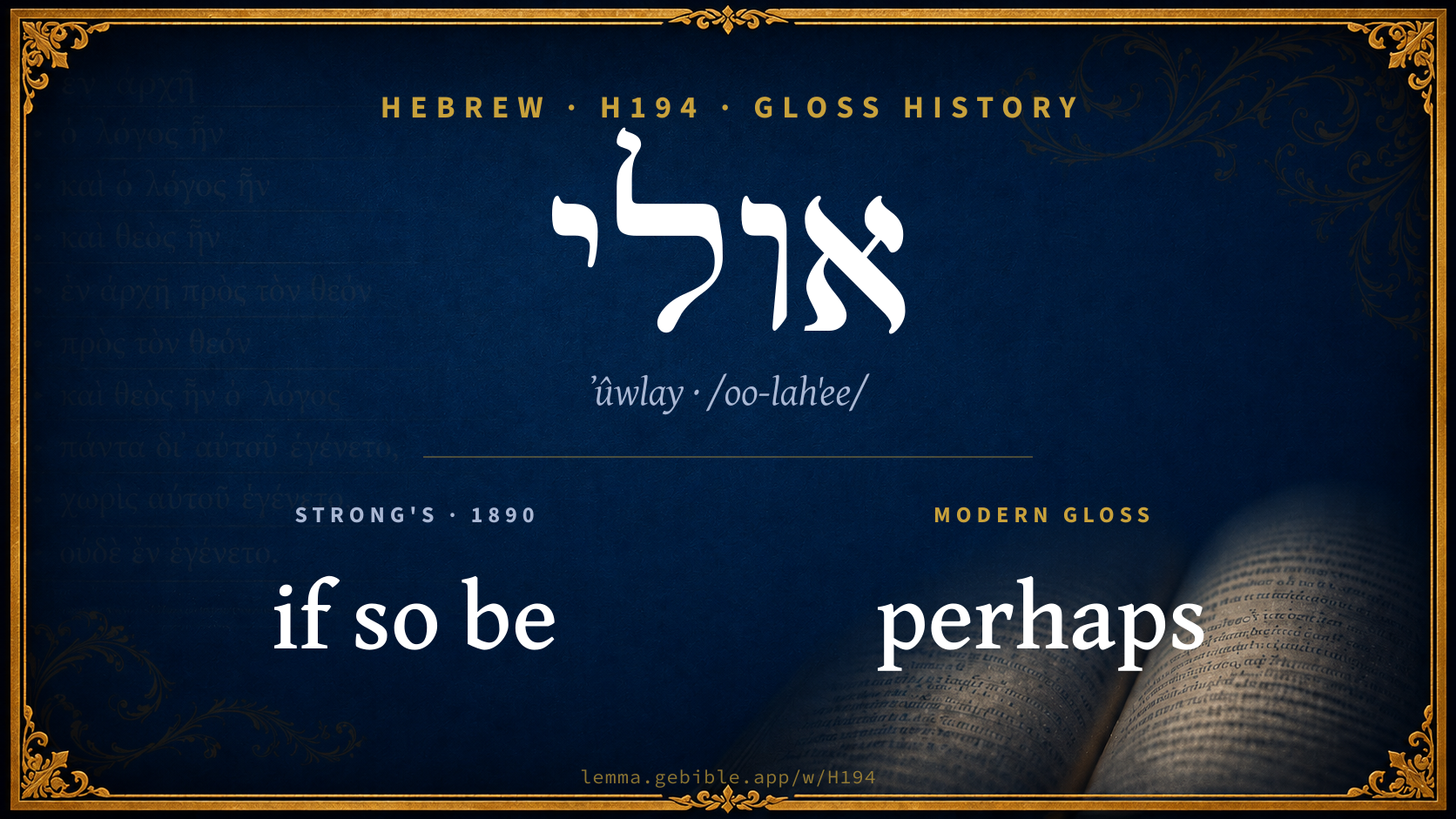
Gloss history
Strong's 1890 vs modern scholarship
About this word
Strong's H194 catalogs a Hebrew word from the Hebrew Old Testament.
These counts are not copied from any lexicon or concordance. They are computed here, from the morphology-tagged Hebrew Old Testament. What Lemma adds →
- 44
- distinct verses
- The word appears in 44 distinct verses.
- 17 / 39
- OT books
- The word appears in 17 of 39 Old Testament books.
- #810
- by frequency
- Top 1000 most frequent Hebrew words (rank 810 of 8,640 Hebrew words by occurrence).
View all 44 occurrences in the concordance →
By section of the Old Testament
By traditional corpus
Conventional, traditional groupings — biblical authorship is debated, so this is a traditional corpus grouping, not an authorship claim. Each share is this word’s portion of its verses in that division of the Hebrew canon. Each figure is a share of the word’s 44 distinct verses.
- Prophets (Nevi'im) 24 verses · 55%
- Torah (Pentateuch) 18 verses · 41%
- Writings (Ketuvim) 2 verses · 5%
How translations render this word
Counts come from each version’s own published word-to-Strong’s tagging or interlinear alignment — an approximate guide to how each version renders this word, not a word-level alignment the data otherwise carries. Because each total is that version’s own tagged count, the per-version totals vary from one another and need not match the appearance or distinct-verse counts above. These counts may also differ from a printed concordance because Lemma counts each distinctly tagged rendering and does not collapse phrase taggings into a single head-word total. This is a fixed set of word-tagged versions (KJV, ASV, BSB, ULT) and does not change with the reading translation you choose elsewhere. Each version’s license is shown beside its name below (and on Sources).
BDB lists this Strong’s number as 2 distinct words (homographs). Each count above pools all of them and is not split by sense — see the Senses section below. A low-frequency rendering may belong to a different one of those words, not the primary meaning.
- King James Version†: May be 3×, Peradventure 3×
- American Standard Version†: May be 3×, Peradventure 3×
- Berean Standard Bible†: Perhaps 32×, If 5×, Suppose 5×
- unfoldingWord Literal Text†: Perhaps 31×, Suppose 9×
King James Version Public Domain
Renders H194 across 11† tagged occurrences — most commonly:
Plus 5 renderings that appear only once — usually multi-word phrases or single function words the recovered tagging swept in, not distinct renderings.
American Standard Version Public Domain
Renders H194 across 11† tagged occurrences — most commonly:
Plus 5 renderings that appear only once — usually multi-word phrases or single function words the recovered tagging swept in, not distinct renderings.
Berean Standard Bible Public Domain
Renders H194 across 45† tagged occurrences — most commonly:
Plus 1 rendering that appears only once — usually multi-word phrases or single function words the recovered tagging swept in, not distinct renderings.
unfoldingWord Literal Text CC BY-SA 4.0
Renders H194 across 42† tagged occurrences — most commonly:
Plus 2 renderings that appear only once — usually multi-word phrases or single function words the recovered tagging swept in, not distinct renderings.
Senses in the full BDB
What do BDB’s symbols mean?
BDB uses these scholarly abbreviations:
| Symbol | Meaning |
|---|---|
| 𝔊 | the Septuagint (the ancient Greek translation, LXX) |
| 𝔙 | the Vulgate (the Latin translation) |
| 𝔖 | the Syriac version (the Peshitta) |
| 𝔗 | the Targum (the Aramaic translation) |
| ψ | the Psalms |
| √ | root (the underlying root or stem) |
| ‖ | parallel passage (a synonymous or contrasted parallel) |
| † | the dagger: every passage where the word occurs is cited |
The 3 senses and sub-senses the full Brown-Driver-Briggs lexicon distinguishes for this word, in lexicon order (not ranked by frequency), with BDB’s own verbatim wording and sub-sense lettering. Shown in Hebrew script with BDB’s own scholarly abbreviations. The condensed entry is in the Lexicon Entry tab. See also the Forms in the corpus table below.
אולי I fl. Ulai, Eulaeus (Assyrian Ulâi, cf. DlPa 329 Gr. Εὐλαιος) only אוּלָ֑י, river of Elam Dn 8
אולי II and (Gn 24
- 1. peradventure, perhaps; usually expressing a hope, as Gn 16:2 Nu 22:6, 11; 23:3 1 S 6:5 Je 20:10; but also a fear or doubt, as Gn 27:12 Jb 1:5, sq. לֹא Gn 24:5, 39; in mockery Is 47:12; Je 51:8. e.g. Genesis 16:2
- 2. followed by another clause ἀσυνδέτως, it expresses virtually the protasis = if peradventure Gn 18:24, 28 (cf. v 29–32) Ho 8:7 the blade shall yield no meal; אוּלַי יַעֲשֶׂה זָרִים יִבְלָעֻהוּ if perchance it yield strangers shall swallow it up. e.g. Genesis 18:24
- 3. in Nu 22:33 לוּלֵי (q.v.) must be read; unless she had turned aside from me, surely, etc. e.g. Numbers 22:33
Senses from the full Brown-Driver-Briggs lexicon (Brown, Driver, Briggs; Oxford 1906 — public domain), digitized via Sefaria, supplemented by the OpenScriptures HebrewLexicon (CC BY 4.0). Full attribution on Sources.
Word origin
I. n.pr.fl. Ulai, Eulaeus (Assyrian Ulâi, cf. DlPa 329 Gr. Εὐλαιος) only אוּלָ֑י, river of Elam Dn 8:2, 16; = (at least in lower part) mod. Karûn (old Pasitigris) v. DlPa 177.189.329; in upper part perhaps also = mod. Kerkhah (= Choaspes), which was formerly connected with Karûn not far from Susa (LoftusTrav. & Researches, 423 ff Schaff-Herz.iii. 2178, art. Shushan).
II. and (Gn 24:39) אֻלַי adv. (perhaps from אוֹ & לַי = לֵי, לֵא, as in לוּלֵא, = or not?)
— Brown-Driver-Briggs (Oxford 1906, public domain), digitized via Sefaria, supplemented by the OpenScriptures HebrewLexicon (CC BY 4.0). See Sources.
Derived from או (ʼôw) (H176).
Forms in the corpus
The 13 distinct written forms H194 takes in the Hebrew Bible, most frequent first — each parse links to that state’s occurrences in the concordance. Hebrew forms include their vowel points and cantillation, so a single lemma takes many written forms.
| Form | Parsing | Example | Uses |
|---|---|---|---|
| אוּלַ֛י | Adverb | Genesis 18:29 | 9 |
| אוּלַ֥י | Adverb | Exodus 32:30 | 6 |
| אוּלַ֤י | Adverb | Genesis 27:12 | 5 |
| אוּלַי֙ | Adverb | Genesis 24:5 | 5 |
| אוּלַ֖י | Adverb | Genesis 32:20 | 4 |
| אוּלַ֣י | Adverb | Ezekiel 12:3 | 4 |
| אוּלַ֗י | Adverb | Amos 5:15 | 3 |
| אוּלַ֞י | Adverb | Jeremiah 36:7 | 3 |
| אוּלַ֡י | Adverb | 2 Kings 19:4 | 2 |
| א֠וּלַי | Adverb | Genesis 18:28 | 1 |
| אֻלַ֛י | Adverb | Genesis 24:39 | 1 |
| אוּלַ֨י | Adverb | Joshua 14:12 | 1 |
| אוּלַי֩ | Adverb | Jeremiah 21:2 | 1 |
Same root — word family
Other BDB entries built from the same root as H194, grouped by Strong’s listed origin. These share a root / origin per the lexicon — not necessarily a shared meaning. Each links to that word’s own entry.
Derives from
Derived from this word
Proper names from this root
People and places named from this root — a name, not an additional meaning of the word.
Compare all same-root words → 1 of the same-root words is a proper name (a person or place). They share a root, not necessarily a meaning.
Septuagint verse parallels
This word appears in 42 verses that also exist in the Greek Old Testament (Septuagint), out of the 44 Hebrew verses it occurs in. You can read those verses in Greek by switching the Old Testament edition to the Septuagint.
Read these verses in the Septuagint
- Genesis 16:2
- Exodus 32:30
- Numbers 22:6
- Joshua 9:7
- 1 Samuel 6:5
- 2 Samuel 14:15
- 1 Kings 18:5
- 2 Kings 19:4
- Job 1:5
- Isaiah 37:4
- Jeremiah 20:10
- Ezekiel 12:3
This is a verse-level parallel only — the same verses exist in both the Hebrew and Greek Old Testaments. No word-level Hebrew↔Greek correspondence is claimed: the data carries no such alignment, so no Greek word is shown as this Hebrew word’s translation. Coverage is not total — the Septuagint omits the deuterocanon and renumbers the Psalms, so some Hebrew verses have no direct Greek parallel.