
1 Samuel 20:10

Hebrew (Westminster Leningrad Codex) 1 Samuel 20:10 appears in the Hebrew Old Testament. The text above is from the Westminster Leningrad Codex. Each word links to its Strong’s number, a concise gloss, and parsing drawn from the Open Scriptures Hebrew Bible morphology. Click any word for its full Brown-Driver-Briggs (BDB) entry.
Download image
Cite this verse

1 Samuel 20:10 (World English Bible). Public Domain. Lemma interlinear Bible study tool, https://lemma.gebible.app/v/1-samuel/20/10.

Show BibTeX & RIS
BibTeX
RIS
English Translation
Then said David to Jonathan, Who shall tell me if perchance your father answer you roughly?
World English Bible · Public Domain
Download a study sheet

One document with this verse’s original text, its word-by-word gloss line, the meaning frame, cross-references with their text, attributed commentary, and full source and license credits — printable, and it pastes into notes with its structure intact.

This verse Autodidact and up

Study sheet (.html) Plain text (.txt)

A passage Seminary Student

Up to 50 verses in one chapter. A passage sheet keeps up to 6 commentary sources and 12 cross-references per verse, in the order this page ranks them, and says so on the sheet whenever that leaves anything out. Ask for a single verse and you get the Autodidact verse sheet above.

Everything on this page stays free to read, with no account — the sheet is a download of what is already on screen, not access to it.

Want to remove ads? Support Godless Engineer
Compare translations 3

The same verse in 3 English versions, stacked beneath the original-language interlinear above. Click any original word for its lexicon entry.

Each is an independent rendering of the whole verse — the interlinear is not word-aligned to these translations.

Highlighted words mark where these versions differ — a whole-verse word diff, not a word-by-word alignment.

  • World English Bible Public Domain
    Then said David to Jonathan, Who shall tell me if perchance your father answer you roughly?
  • King James Version Public Domain
    Then said David to Jonathan, Who shall tell me? or what if thy father answer thee roughly?
  • unfoldingWord Literal Text CC BY-SA 4.0
    And David said to Jonathan, “Who will declare to me whether what your father answers you harsh?”

unfoldingWord Literal Text — © unfoldingWord, licensed CC BY-SA 4.0. Word-aligned USFM3 via Door43 (git.door43.org/unfoldingWord/en_ult).

Versions to compare (up to 4)

3 of 4 selected

Show all 18 translations

Every available English version of this verse, each an independent rendering of the whole verse.

  • World English Bible Public Domain
    Then said David to Jonathan, Who shall tell me if perchance your father answer you roughly?
  • Berean Standard Bible Public Domain
    Then David asked Jonathan, “Who will tell me if your father answers you harshly?”
  • Majority Standard Bible Public Domain
    Then David asked Jonathan, “Who will tell me if your father answers you harshly?”
  • King James Version Public Domain
    Then said David to Jonathan, Who shall tell me? or what if thy father answer thee roughly?
  • American Standard Version (1901) Public Domain
    Then said David to Jonathan, Who shall tell me if perchance thy father answer thee roughly?
  • Revised Version (1885) Public Domain
    Then said David to Jonathan, Who shall tell me if perchance thy father answer thee roughly?
  • Geneva Bible (1599) Public Domain
    Then said Dauid to Ionathan, Who shall tell me? how shall I knowe, if thy father answere thee cruelly?
  • Douay-Rheims (1899) Public Domain
    And David answered Jonathan: Who shall bring me word, if thy father should answer thee harshly concerning me?
  • Young's Literal Translation Public Domain
    And David saith unto Jonathan, `Who doth declare to me? or what `if' thy father doth answer thee sharply?'
  • Literal Standard Version CC BY-SA 4.0
    And David says to Jonathan, “Who declares [it] to me? Or what [if] your father answers you sharply?”
  • Unlocked Literal Bible CC BY-SA 4.0
    Then David said to Jonathan, “Who will tell me if by chance your father should answer you roughly?”
  • unfoldingWord Literal Text CC BY-SA 4.0
    And David said to Jonathan, “Who will declare to me whether what your father answers you harsh?”
  • Darby Bible Public Domain
    Then said David to Jonathan, Who shall tell me? or what if thy father answer thee roughly?
  • World Messianic Bible Public Domain
    Then David said to Jonathan, “Who will tell me if your father answers you roughly?”
  • Webster's Bible Public Domain
    Then said David to Jonathan, Who shall tell me? or what if thy father shall answer thee roughly?
  • Free Bible Version CC BY-SA 4.0
    “So who's going to let me know if your father gives you a nasty answer?” David asked.
  • Bible in Basic English Public Domain
    Then David said to Jonathan, Who will give me word if your father gives you a rough answer?
  • JPS Tanakh (1917) Public Domain
    Then said David to Jonathan: 'Who shall tell me if perchance thy father answer thee roughly?'

Literal Standard Version (2020), Covenant Press — licensed CC BY-SA 4.0. Text via the HelloAO Bible API (eBible.org). Unlocked Literal Bible (unfoldingWord) — licensed CC BY-SA 4.0. Text via the HelloAO Bible API (eBible.org). unfoldingWord Literal Text — © unfoldingWord, licensed CC BY-SA 4.0. Word-aligned USFM3 via Door43 (git.door43.org/unfoldingWord/en_ult). Free Bible Version, Dr. Jonathan Gallagher — licensed CC BY-SA 4.0. Text via the HelloAO Bible API (eBible.org).

Word by word

More ways to search: Search by grammar → Find every occurrence → Compare this word →

Practice this passage: Drill this verse → Learn its vocabulary →

קָשָֽׁה
qâsheh
H7186
“hard”
Adjective, Adjective, Feminine, Singular, Absolute
Part of Speech
Adjective
Type
Adjective
Gender
Feminine
Number
Singular
State
Absolute
Full BDB Definition

Origin: from H7185

TWOT: 2085a

hard, cruel, severe, obstinate - hard, difficult - severe - fierce, intense, vehement - stubborn, stiff of neck, stiff-necked - rigorous (of battle)
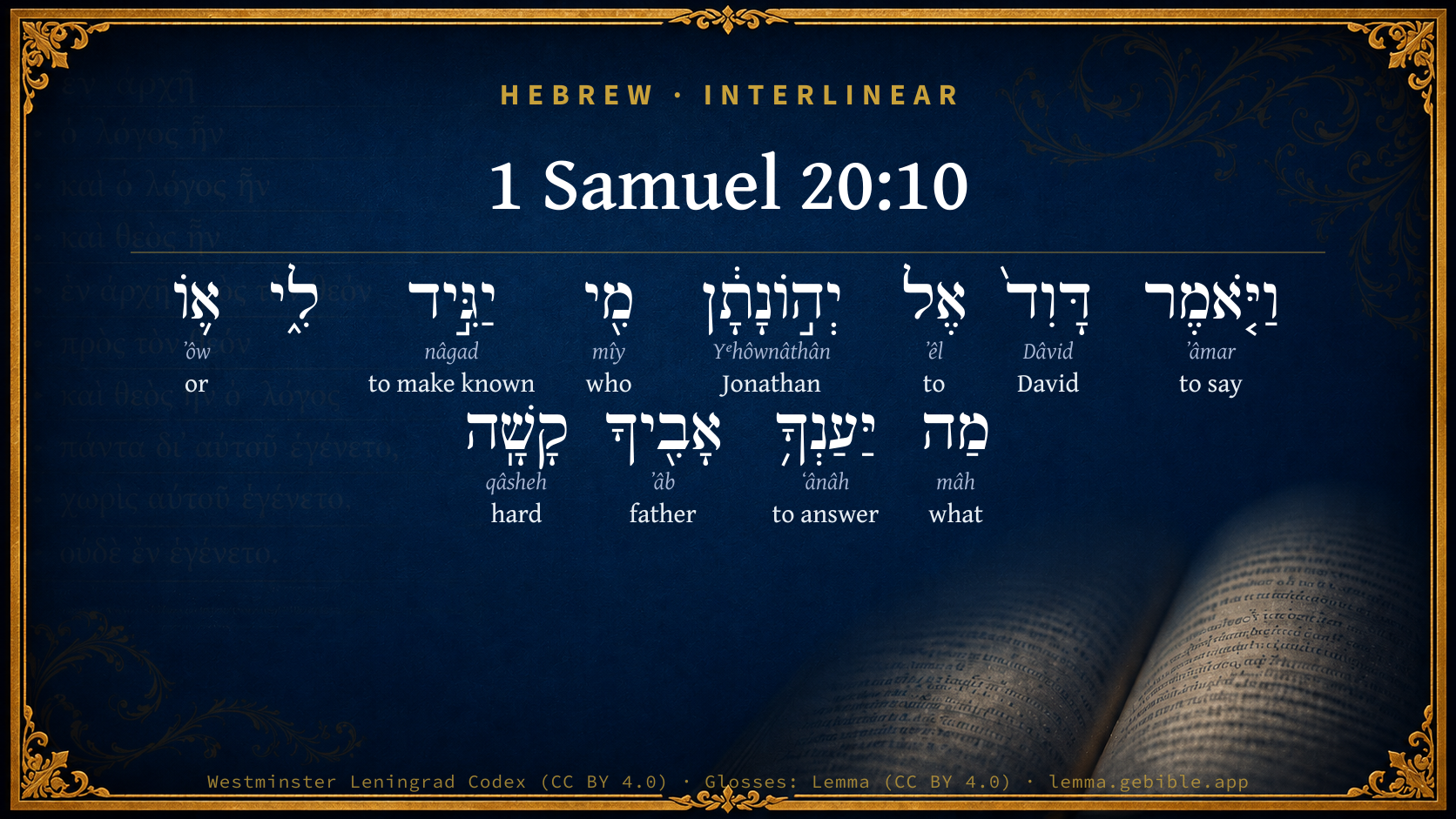
  1. וַיֹּ֤אמֶר ʼâmar H559 “and · to say” Conjunction + Verb, Qal, Sequential Imperfect, 3rd Person, Masculine, Singular
  2. דָּוִד֙ Dâvid H1732 “David” Noun, Proper
  3. אֶל ʼêl H413 “to” Preposition
  4. יְה֣וֹנָתָ֔ן Yᵉhôwnâthân H3083 “Jonathan” Noun, Proper
  5. מִ֖י mîy H4310 “who” Particle, Interrogative
  6. יַגִּ֣יד nâgad H5046 “to make known” Verb, Hiphil, Imperfect, 3rd Person, Masculine, Singular
  7. א֛וֹ ʼôw H176 “or” Conjunction
  8. מַה mâh H4100 “what” Particle, Interrogative
  9. יַּעַנְךָ֥ ʻânâh H6030 “to answer · you” Verb, Qal, Imperfect, 3rd Person, Masculine, Singular + Suffix, Personal, 2nd Person, Masculine, Singular
  10. אָבִ֖יךָ ʼâb H1 “father · your” Noun, Common, Masculine, Singular, Construct + Suffix, Personal, 2nd Person, Masculine, Singular

About this verse

These counts appear in no published source. They are computed here, from the morphology-tagged text and Lemma’s own curated glosses. What Lemma adds →

12
words
11
distinct lemmas
Historical
section

Shared distinctive vocabulary

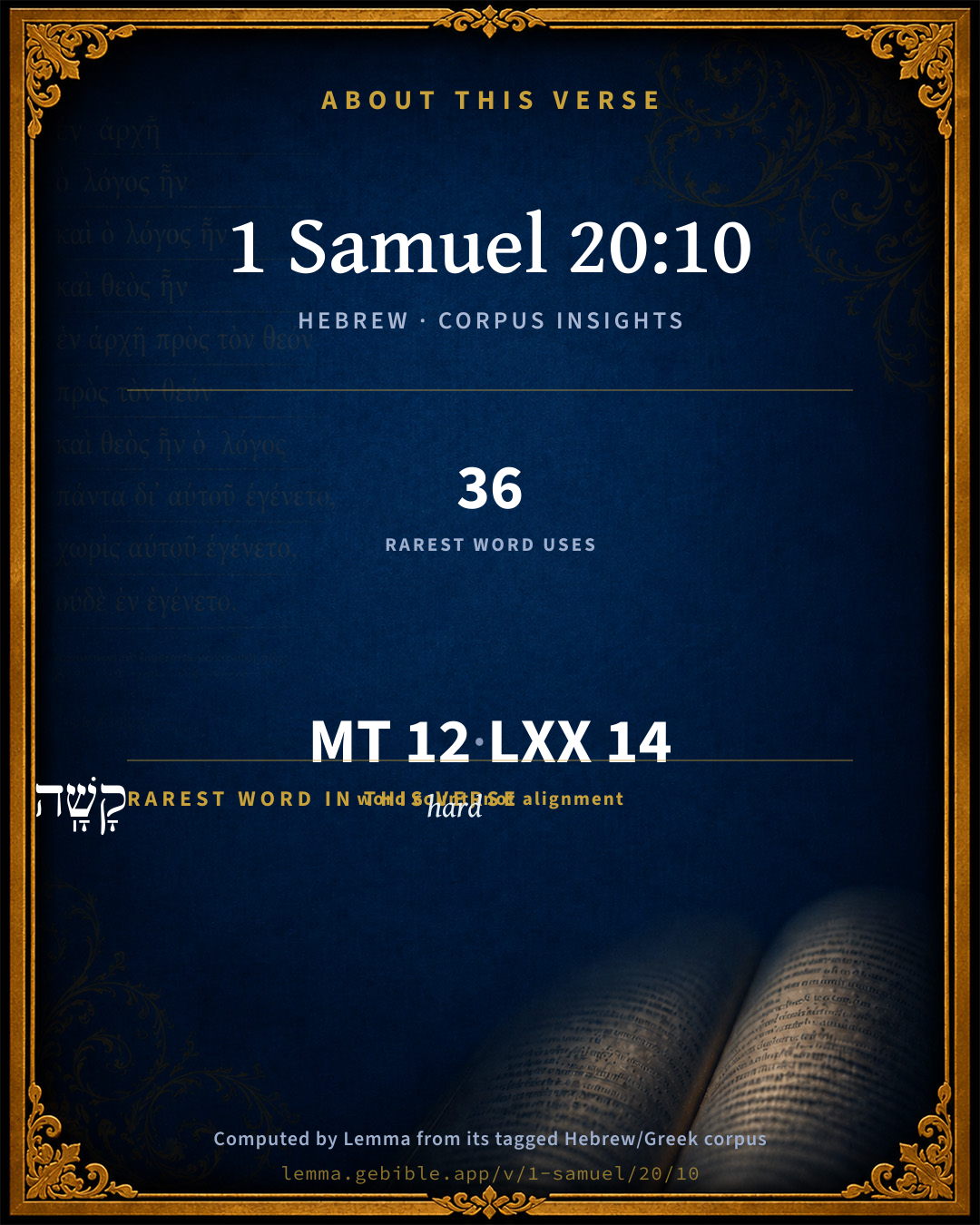
קָשָֽׁה hard H7186 occurs in 36 verses of the Hebrew Bible. Also found in:

Grammatical profile

  • 3 verbs
  • 3 nouns
  • 1 adjective
  • 2 prepositions
  • 1 conjunction
  • 2 particles

Verb forms

  • וַיֹּ֤אמֶר Qal · Sequential Imperfect
  • יַגִּ֣יד Hiphil · Imperfect
  • יַּעַנְךָ֥ Qal · Imperfect

Hebrew & Septuagint length

In English translation the verse runs 16 words from the Hebrew and 15 from the Septuagint (LXX English) — closely comparable.

A rough comparison of the two English renderings, which tokenize alike — not a word-level alignment.

Word counts can differ between the Hebrew and the Greek without any difference in meaning — e.g. the Hebrew direct-object marker אֵת has no separate Greek word, and Greek often adds the article ὁ.

In the original languages it is 12 Hebrew tokens and 14 Greek tokens — but the two are counted differently (Hebrew bundles its prefixes and suffixes into one token; the Greek is in lemma form), so that isn’t a like-for-like length.

Cross-references

8

Topical passages linked to 1 Samuel 20:10 in the Treasury of Scripture Knowledge — connected by theme and wording, ordered by reader-vote popularity; previews shown in the World English Bible.

  • Genesis 42:7 Joseph saw his brothers, and he recognized them, but acted like a stranger to them, and spoke roughly with them. He said to them, "Where did you come from?" They said, "From the land of Canaan to buy food."
  • Genesis 42:30 "The man, the lord of the land, spoke roughly with us, and took us for spies of the country.
  • 1 Samuel 20:30–34 Then Saul's anger was kindled against Jonathan, and he said to him, You son of a perverse rebellious woman, don't I know that you have chosen the son of Jesse to your own shame, and to the shame of your mother's nakedness?
  • 1 Samuel 25:10 Nabal answered David's servants, and said, Who is David? and who is the son of Jesse? there are many servants now-a-days who break away every man from his master.
  • 1 Samuel 25:14 But one of the young men told Abigail, Nabal's wife, saying, Behold, David sent messengers out of the wilderness to Greet our master; and he railed at them.
  • 1 Samuel 25:17 Now therefore know and consider what you will do; for evil is determined against our master, and against all his house: for he is such a worthless fellow that one can't speak to him.
  • 1 Kings 12:13 The king answered the people roughly, and forsook the counsel of the old men which they had given him,
  • Proverbs 18:23 The poor plead for mercy, But the rich answer harshly.

Cross-references courtesy of OpenBible.info (CC BY 4.0).

Hebrew and Greek witnesses Masoretic Hebrew ↔ Greek Septuagint

The same verse in the two great witnesses to the Old Testament, shown verse-for-verse.

These are two independent witnesses, not word-aligned to each other, and the Septuagint is shown in lemma (dictionary) form.

Hebrew 1 Samuel 20:10 Masoretic · Westminster Leningrad Codex

וַיֹּ֤אמֶר דָּוִד֙ אֶל יְה֣וֹנָתָ֔ן מִ֖י יַגִּ֣יד לִ֑י א֛וֹ מַה יַּעַנְךָ֥ אָבִ֖יךָ קָשָֽׁה

Then said David to Jonathan, Who shall tell me if perchance your father answer you roughly?

World English Bible · Public Domain

Greek LXX 1 Samuel 20:10 Septuagint · lemma form

καί εἶπον δαυίδ πρός ιωναθαν τίς ἀποἀγγέλλω ἐγώ ἐάν ἀποκρίνω ὁ πατήρ σύ σκληρῶς

And David said to Jonathan, Who can tell me if your father should answer roughly?

LXX2012 (modern English Septuagint) · Public Domain

Hebrew: Westminster Leningrad Codex (CC BY 4.0). Greek: Septuagint (public domain); English from LXX2012 (modern English Septuagint) (Public Domain). How the Septuagint differs from the Hebrew →

Targum (Aramaic paraphrase)

1

The Targum is the ancient Jewish Aramaic paraphrase of the Hebrew Scriptures — an interpretive translation, not the Hebrew text itself. Onkelos (literal) and Pseudo-Jonathan (expansive) render the Torah, and Jonathan the Prophets. Coverage is partial: where no permissively-licensed English translation exists for a verse, only the Aramaic is shown. This is verse-level text, not a word-by-word alignment to the Hebrew.

  1. Targum Jonathan Prophets (Joshua–Malachi)
    וַאֲמַר דָוִד לִיהוֹנָתָן מַן יְחַוֵי לִי אוֹ דִלְמָא יְתֵבִנָךְ אֲבוּךְ פִּתְגָמִין קָשִׁין:

    (no public-domain English translation for this verse)

    Targum Jonathan — Aramaic: “Mikraot Gedolot” (public domain). English: “Sefaria Community Translation” (CC0 1.0 (public-domain dedication)); “London "Chaldee Paraphrase," 1871” (public domain). Text via Sefaria.

Commentary

Notes on 1 Samuel 20:10 from classic Christian and Jewish commentators (each source and its license shown beneath its notes). The classic Christian expositions comment on the surrounding passage and are grouped to its opening verse, so a note may address several verses; the Jewish commentaries on the Tanakh (Rashi and others) are per-verse, so they appear only where the commentator wrote on this verse.

Lemma curates 59 commentaries, every one of them public domain or Creative Commons licensed, each selected and text-cleaned for this edition rather than reprinted as found. About our sources →

Trapp's Complete Commentary

John Trapp

1Sa 20:10 Then said David to Jonathan, Who shall tell me? or what [if] thy father answer thee roughly?

Ver. 10. Who shall tell me?] Since thou canst neither come, nor send to me with any safety.

If thy father answer thee roughly.] As indeed he did, Et tristoribus dictis atrocia facta coniungebat, as Tacitus saith of Tiberius; he spake stones, and threw daggers. {1Sa 20:30; 1Sa 20:33}

John Trapp, A Commentary or Exposition upon All the Books of the Old and New Testament (1647–1656) — public domain. Text from a community e-Sword module.

The Biblical Illustrator

Joseph S. Exell

1Sa_20:10

What if thy father answer thee roughly?

A word for the persecuted

I. Our first point is, what you may do, what there is a possibility of you doing, should your friends answer you roughly.

1. You may by-and-by be offended. I mean that you may leave Christ altogether, because you cannot bear his cross.

2. Or, it may happen to you that, instead of being by-and-by offended, you may continue for awhile, but you may gradually give way, and at last yield altogether. There are many among us who could bear to lose our heads at a stroke for Christ, but to be burned at a slow fire--ah, that would try us!

3. But if left to ourselves we may fall into what is as bad as open apostasy. When we find the father, or the wife, or the friend answering us roughly, we may make a pitiful compromise between Christ and the world.

4. I will tell you what you may do also, and I pray that the Holy Spirit may lead you to do it. You may take up humbly, but firmly, this decided stand:--If my father answer me roughly he must do so, but I have another Father who is in heaven and I shall appeal to him. If the world condemn me, I shall accept its condemnation.

II. What the trial will do for us if we are helped to bear up under it. What if thy father answer thee roughly?

1. First, it will grieve us. It is by no means pleasant to be opposed in doing right by those who ought to help us in it. It is very painful to flesh and blood to go contrary to those we love.

2. The opposition of your friends will try your sincerity. If you are a hypocrite you will soon yield to opposition.

3. The rough answers of opponents will try your faith. You say you believe in Jesus: now we shall see if you do, for if you cannot bear a little trial from men and women, surely you will not be able to bear the worse trials from the devil and his angels. If you cannot bear the trials of life, how will you endure the ordeals of death?

4. Persecution will try your love to Jesus. If you really love Him you will cheerfully stand in the pillory of reproach with Him. Your valiant soldier in quiet barracks at home could fight, no doubt, but how do you know till he has passed through a campaign?

5. The rough answers of those who should be your friends will keep us awake. I think it was Erskine who used to say, Lord, deliver me from a sleepy devil.

6. Such afflictions drive you to your knees.

7. Trials from the enemies of Jesus confirm our faith. Those who are never tried usually possess a poor, tottering faith, but trial, especially persecution, is like the rough March wind which goes howling through the forest, and while the young oaks are almost torn up by the roots at first, it loosens the soil for them, and they send out more rootlets, till they get such a firm grip that they defy the hurricane.

8. Rough speeches, too, will have this good effect, upon genuine Christians, it will lead them to plead for those who utter them.

9. Certainly opposition has another good effect, that it drives those subject to it into the truly separated path; they are known to be Christians, and proclaimed as such by their revilers.

10. One good effect of being persecuted at home is this, it makes you gentler abroad.

III. How should you behave under the trial?

1. Never court opposition.

2. Endure whatever you have to endure with the greatest possible meekness.

3. After bearing with meekness return good for evil. For cruel words return warmer love and increased kindness. The most renowned weapon for a Christian to fight his antagonists with is that of overcoming evil with good.

4. Here let, me also remark that to this gentle endurance there must be added by the persecuted Christian much exactness of life.

IV. In doing all this what comfort may you expect.

1. You may have this for your comfort, that the persecutor is in Gods hands. He cannot do more than God lets him, and if God permits him to annoy, you may cheerfully bear it.

2. Next, remember, if you keep your conscience clear it is a great joy. Rough answers outside need not trouble you while within there is the answer of a good conscience towards God. Injure your conscience and you lose that consolation; preserve it from evil and you must be happy.

3. Remember that by patiently enduring and persevering you will have fellowship with the grandest spirits that ever lived.

4. Remember, too, that if you have extraordinary troubles Jesus will be doubly near to you.

5. You have the sweet thought also that you are doing more good where you are than if you were placed altogether among the godly. (C. H. Spurgeon.)

The Biblical Illustrator, edited by Joseph S. Exell (c. 1880s–1900s) — public domain. Text from a community e-Sword module.

Geneva Bible (1599)

Geneva Bible translators

If thy father do favor me.

Geneva Bible (1599) marginal notes — public domain. Text via Bolls.life.

Adam Clarke's Commentary

Verse 10. Who shall tell me?] Who shall give me the necessary information? What means wilt thou use to convey this intelligence to me?

Adam Clarke's Commentary on the Bible (1810–1826) — public domain. Text from a community e-Sword/MySword module.

Ellicott's Commentary for English Readers

(10) Who shall tell me? or what if thy father answer thee roughly?—The language in the original is here very abrupt and involved. Evidently the very words uttered in the memorable scene by the excited and sorrowful friends are remembered and reported.

The “if” supplied in the English Version probably is nearest the meaning intended to be conveyed by the broken, agitated words. Another rendering is, “If thy father shall answer thee harshly, who will declare it to me?”

“These questions of David were suggested by a correct estimate of the circumstances—namely, that Saul’s suspicions would lead him to the conclusion that there was some understanding between Jonathan and David, and that he would take steps, in consequence, to prevent Jonathan from making David acquainted with the result of his conversation with Saul.”—Keil.

In the next verse Jonathan leads David into a solitary spot—“the field”—where, before saying their last words together, they might agree upon some secret sign by means of which Saul’s real mind towards David might be communicated, if necessary, by Jonathan to his friend.

A Bible Commentary for English Readers, edited by Charles John Ellicott (1878–1897) — public domain. Text from a community e-Sword module.

The Cambridge Bible for Schools and Colleges

gen. ed. J. J. S. Perowne

10. Who shall tell me, &c.] The double question answers to Jonathan’s double promise in 1Sa_20:12-13, that he will let David know the result in either event. But perhaps the words should be rendered simply, who shall tell me if haply thy father answer thee roughly?

The Cambridge Bible for Schools and Colleges (gen. ed. J. J. S. Perowne; Cambridge University Press, 1878–1918) — public domain. Text from a community e-Sword module.

John Gill's Exposition

Then said David to Jonathan, who shall tell me?.... The disposition of Saul's mind towards him, whether he gave a kind answer to the report of Jonathan concerning him:

or what if thy father answer thee roughly? or hard words, as the Targum, whether he answers in a kind, loving, and smooth manner, or whether in a rough and angry one: the question is here, how he should be informed of this, since especially, if in the latter, it would not be safe for Jonathan to come himself to him, nor could he well trust the message with any other. Abarbinel thinks, that the first of these expressions is by way of question, who should declare to him his father's will and intention, whether good or bad: and the latter by way of outcry, woe unto me, if thy father should answer thee roughly; I greatly fear he will chide thee for my sake; my heart will be filled with sorrow if thou shouldest suffer reproach and rebuke on my account.

John Gill's Exposition of the Whole Bible (1746–1763) — public domain (CC PDM 1.0). Text via the HelloAO Bible API.

Matthew Poole's English Annotations

By what means or messenger shall I understand this? for peradventure thou wilt not be able to come to me thyself.

Matthew Poole's English Annotations on the Holy Bible (1683–1685) — public domain. Text from a community e-Sword/MySword module.

The Pulpit Commentary

Who shall tell me? or what if, etc. The if is an insertion of the A.V Really David"s question is very involved and ungrammatical, as was natural in his excited state. It may be translated, "Who will tell me (or, how shall I know) what rough answer thy father will give thee?" But some Jewish authorities render, "Who will tell me if so be that thy father give thee a rough answer?"

The Pulpit Commentary (1880–1919), ed. H.D.M. Spence-Jones & Joseph S. Exell — public domain. Text from a community e-Sword module.

unfoldingWord translationNotes

Door43 World Missions Community

translationWords

Jonathan

unfoldingWord translationNotes — © Distant Shores Media and the Door43 World Missions Community, licensed CC BY-SA 4.0. Source: git.door43.org/Door43/en_tn.

Rashi

Rabbi Shlomo Yitzchaki (Rashi)

Who will tell me. In the place where I will hide.

Rashi on the Tanakh — English translations: “The Judaica Press complete Tanach with Rashi, translated by A. J. Rosenberg” (CC BY 4.0); “Pentateuch with Rashi's commentary by M. Rosenbaum and A.M. Silbermann, 1929-1934” (public domain); “The Metsudah Tanach series, Lakewood, N.J” (CC BY 4.0); and “The Book of Joshua, Metsudah Publications, 1997” (CC BY 4.0). Text via Sefaria.

Lesson kit

Teaching starters — assembled from the data on this page, not authored interpretation. Every prompt links to the verse data it draws on. Edit before teaching.

1 Samuel, in the Historical, opens this verse with 12 words (11 distinct Hebrew lemmas). Its most distinctive word is qâsheh (“hard”). A historical commentator’s framing appears above. Read the whole chapter for the surrounding context.

Discussion questions

  1. What does “hard” (qâsheh) contribute to the verse as a whole?
  2. How does Genesis 42:7, which shares the word «hard», read alongside this verse?
  3. These translations render this verse differently. What is at stake in choosing one wording over another?
  4. «וַיֹּ֤אמֶר» is a Qal Sequential Imperfect verb. How does that grammatical form shape the action described?
  5. Compare how Trapp's Complete Commentary and The Biblical Illustrator read this verse. Where do they agree or differ?

Things to notice

Reading settings

Reading text

Shown beneath each verse's original-language words.

Old Testament
Old Testament edition

Read the OT as the Masoretic Hebrew (MT) or the Greek Septuagint (LXX).

English shown for the Greek Septuagint (in the Hebrew ↔ Greek comparison).

Comparing translations? Open the Compare panel on any verse page to stack up to four side by side.