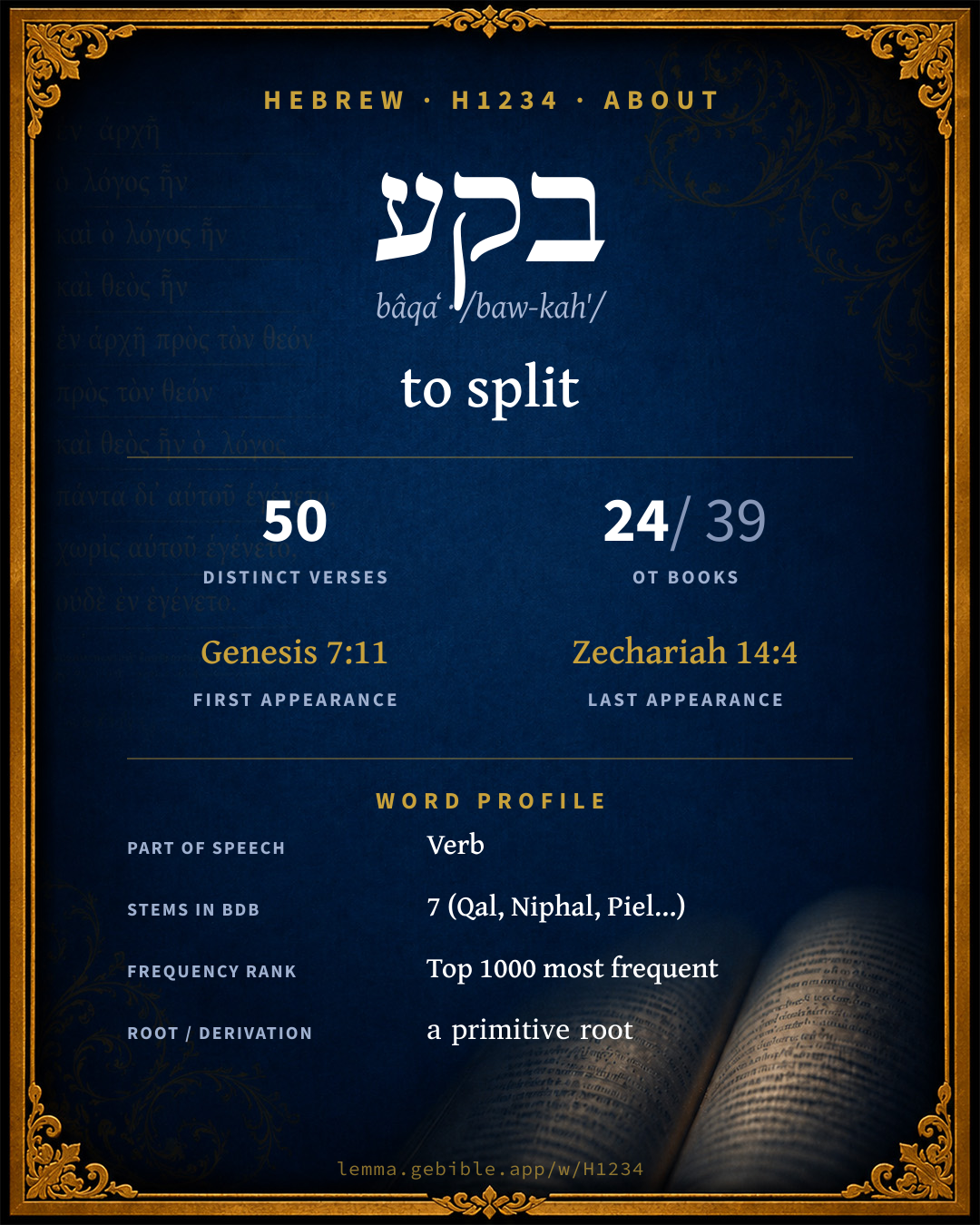
בָּקַע
to split
also: cleave, break open, divide, break through fuller range ↓
Full lexicon entry — Brown-Driver-Briggs (BDB)
From Brown-Driver-Briggs (BDB)
Where this word appears
See every Qal verb in the Hebrew Bible →
Grammar key — what these labels mean
Part of speech
- Verb
- An action or state-of-being word.
Stem
- Niphal
- Usually the simple passive or reflexive of the Qal (“he was written”). Here: ‘be cleft’
- Qal
- The basic, simple active stem — the plain form of the verb (“he wrote”). Here: ‘cleave’
- Piel
- An intensive or resultative active stem.
- Pual
- The passive counterpart of the Piel.
- Hiphil
- The causative active stem (“he caused / brought about”).
- Hophal
- The passive counterpart of the Hiphil (“he was caused to…”).
- Hithpael
- The reflexive or reciprocal stem (the subject acts on itself).
Form
- Sequential Imperfect
- An imperfect with prefixed waw — the standard past-narrative form (waw-consecutive imperfect).
- Perfect
- A completed action or state — Hebrew marks aspect (completeness) more than strict tense (“he wrote”).
- Imperfect
- An incomplete, ongoing, or future action (“he will / would write”).
- Participle Active
- A verbal adjective expressing ongoing or characteristic action (“writing / one who writes”).
- Sequential Perfect
- A perfect with prefixed waw continuing a preceding imperfect or command (waw-consecutive perfect).
- Participle Passive
- A verbal adjective expressing action received (“written”).
- Imperative
- A direct command (“write!”).
- Infinitive Construct
- A bound verbal noun, frequently with prepositions (“to write / in writing”).
State
- Absolute
- The independent form of a noun, not bound to a following word.
Person
- 3rd Person
- The one spoken about (“he / she / it / they”).
- 2nd Person
- The one addressed (“you”).
- 1st Person
- The speaker (“I / we”).
Gender
- Feminine
- Grammatically feminine.
- Common
- Either gender — not distinguished for this form.
- Masculine
- Grammatically masculine.
Number
- Singular
- One.
- Plural
- More than one (in Hebrew, generally three or more).
Grammatical forms 34 distinct
- Verb, Niphal, Sequential Imperfect, 3rd Person, Feminine, Singular 4 times (8%)
- Verb, Niphal, Perfect, 3rd Person, Common, Plural 4 times (8%)
- Verb, Qal, Sequential Imperfect, 3rd Person, Masculine, Plural 3 times (6%)
- Verb, Qal, Participle Active, Masculine, Singular, Absolute 3 times (6%)
- Verb, Qal, Sequential Imperfect, 3rd Person, Masculine, Singular 2 times (4%)
- Verb, Niphal, Imperfect, 3rd Person, Masculine, Singular 2 times (4%)
- Verb, Piel, Imperfect, 2nd Person, Masculine, Singular 2 times (4%)
- Verb, Piel, Perfect, 3rd Person, Masculine, Singular 2 times (4%)
+26 more forms (29 occurrences)
Parsed forms decoded from the imported morphology (morphhb / Westminster Leningrad Codex — WLC text public domain, morphhb tagging CC BY 4.0), counted across 51 parsed occurrences — not distinct verses.
Every verse where H1234 appears — 50 distinct verses across 24 books. Click any verse to open its interlinear word-by-word view. Verse text shown in the World English Bible for context — . Each verse’s Hebrew form is shown with its reference; the English is not keyword-highlighted, since the data carries no word-level English alignment. Use “Compare translations” on any verse to read it across multiple English versions. This concordance covers the Hebrew Bible; Septuagint (Greek Old Testament) occurrences are not indexed here.
Genesis 2 verses
- Genesis 7:11 נִבְקְעוּ֙ Niphal pf 3cp In the six hundredth year of Noah's life, in the second month, on the seventeenth day of the month, on the same day all the fountains of the great deep were burst open, and the sky's windows were opened.
- Genesis 22:3 וַ/יְבַקַּע֙ conj + Piel wimpf 3ms Abraham rose early in the morning, and saddled his donkey, and took two of his young men with him, and Isaac his son. He split the wood for the burnt offering, and rose up, and went to the place of which God had told him.
Exodus 2 verses
- Exodus 14:16 וּ/בְקָעֵ֑/הוּ conj + Qal impv 2ms + sfx pers 3ms Lift up your rod, and stretch out your hand over the sea, and divide it: and the children of Israel shall go into the midst of the sea on dry ground.
- Exodus 14:21 וַ/יִּבָּקְע֖וּ conj + Niphal wimpf 3mp Moses stretched out his hand over the sea, and Yahweh caused the sea to go back by a strong east wind all the night, and made the sea dry land, and the waters were divided.
Numbers 1 verse
Joshua 2 verses
- Joshua 9:4 וּ/מְבֻקָּעִ֖ים conj + Pual ptcp.pass mp they also resorted to a ruse, and went and made as if they had been ambassadors, and took old sacks on their donkeys, and wine-skins, old and torn and bound up,
- Joshua 9:13 הִתְבַּקָּ֑עוּ Hithpael pf 3cp and these wine-skins, which we filled, were new; and, behold, they are torn: and these our garments and our shoes are become old by reason of the very long journey.
Judges 1 verse
1 Samuel 1 verse
2 Samuel 1 verse
1 Kings 1 verse
2 Kings 5 verses
- 2 Kings 2:24 וַ/תְּבַקַּ֣עְנָה conj + Piel wimpf 3fp He looked behind him and saw them, and cursed them in the name of Yahweh. There came forth two she-bears out of the wood, and mauled forty-two lads of them.
- 2 Kings 3:26 לְ/הַבְקִ֛יעַ prep + Hiphil inf.cs When the king of Moab saw that the battle was too severe for him, he took with him seven hundred men who drew sword, to break through to the king of Edom; but they could not.
- 2 Kings 8:12 תְּבַקֵּֽעַ Piel impf 2ms Hazael said, Why weeps my lord? He answered, Because I know the evil that you will do to the children of Israel: their strongholds will you set on fire, and their young men will you kill with the sword, and will dash in pieces their little ones, and rip up their women with child.
- 2 Kings 15:16 בִּקֵּֽעַ Piel pf 3ms Then Menahem struck Tiphsah, and all who were therein, and the borders of it, from Tirzah: because they didn't open to him, therefore he struck it; and all the women therein who were with child he ripped up.
- 2 Kings 25:4 וַ/תִּבָּקַ֣ע conj + Niphal wimpf 3fs Then a breach was made in the city, and all the men of war [fled] by night by the way of the gate between the two walls, which was by the king's garden (now the Chaldeans were against the city round about); and [the king] went by the way of the Arabah.
1 Chronicles 1 verse
2 Chronicles 3 verses
- 2 Chronicles 21:17 וַ/יִּבְקָע֔וּ/הָ conj + Qal wimpf 3mp + sfx pers 3fs and they came up against Judah, and broke into it, and carried away all the substance that was found in the king's house, and his sons also, and his wives; so that there was never a son left him, save Jehoahaz, the youngest of his sons.
- 2 Chronicles 25:12 נִבְקָֽעוּ Niphal pf 3cp [other] ten thousand did the children of Judah carry away alive, and brought them to the top of the rock, and cast them down from the top of the rock, so that they all were broken in pieces.
- 2 Chronicles 32:1 לְ/בִקְעָ֥/ם prep + Qal inf.cs + sfx pers 3mp After these things, and this faithfulness, Sennacherib king of Assyria came, and entered into Judah, and encamped against the fortified cities, and thought to win them for himself.
Nehemiah 1 verse
Job 3 verses
- Job 26:8 נִבְקַ֖ע Niphal pf 3ms He binds up the waters in his thick clouds, And the cloud is not burst under them.
- Job 28:10 בִּקֵּ֑עַ Piel pf 3ms He cuts out channels among the rocks. His eye sees every precious thing.
- Job 32:19 יִבָּקֵֽעַ Niphal impf 3ms Behold, my breast is as wine which has no vent; Like new wineskins it is ready to burst.
Psalms 4 verses
- Psalms 74:15 בָ֭קַעְתָּ Qal pf 2ms You opened up spring and stream. You dried up mighty rivers.
- Psalms 78:13 בָּ֣קַע Qal pf 3ms He split the sea, and caused them to pass through; He made the waters stand as a heap.
- Psalms 78:15 יְבַקַּ֣ע Piel impf 3ms He split rocks in the wilderness, And gave them drink abundantly as out of the depths.
- Psalms 141:7 וּ/בֹקֵ֣עַ conj + Qal ptcp.act ms "As when one plows and breaks up the earth, Our bones are scattered at the mouth of Sheol."
Proverbs 1 verse
Ecclesiastes 1 verse
Isaiah 7 verses
- Isaiah 7:6 וְ/נַבְקִעֶ֖/נָּה conj + Hiphil impf 1cp + sfx pers 3fs "Let's go up against Judah, and tear it apart, and let's divide it among ourselves, and set up a king in the midst of it, even the son of Tabeel."
- Isaiah 34:15 וּ/בָקְעָ֖ה conj + Qal wpf 3fs There shall the dart-snake make her nest, and lay, and hatch, and gather under her shade; yes, there shall the kites be gathered, everyone with her mate.
- Isaiah 35:6 נִבְקְע֤וּ Niphal pf 3cp Then shall the lame man leap as a hart, and the tongue of the mute shall sing; for in the wilderness shall waters break out, and streams in the desert.
- Isaiah 48:21 וַ/יִּ֨בְקַע conj + Qal wimpf 3ms They didn't thirst when he led them through the deserts; he caused the waters to flow out of the rock for them; he split the rock also, and the waters gushed out.
- Isaiah 58:8 יִבָּקַ֤ע Niphal impf 3ms Then shall your light break forth as the morning, and your healing shall spring forth speedily; and your righteousness shall go before you; the glory of Yahweh shall by your rearward.
- Isaiah 59:5 בִּקֵּ֔עוּ תִּבָּקַ֥ע Piel pf 3cp Qal impf 3fs They hatch adders' eggs, and weave the spider's web: he who eats of their eggs dies; and that which is crushed breaks out into a viper.
- Isaiah 63:12 בּ֤וֹקֵֽעַ Qal ptcp.act ms who caused his glorious arm to go at the right hand of Moses? who divided the waters before them, to make himself an everlasting name?
Jeremiah 2 verses
- Jeremiah 39:2 הָבְקְעָ֖ה Hophal pf 3fs in the eleventh year of Zedekiah, in the fourth month, the ninth day of the month, a breach was made in the city),
- Jeremiah 52:7 וַ/תִּבָּקַ֣ע conj + Niphal wimpf 3fs Then a breach was made in the city, and all the men of war fled, and went forth out of the city by night by the way of the gate between the two walls, which was by the king's garden; (now the Chaldeans were against the city round about;) and they went toward the Arabah.
Ezekiel 5 verses
- Ezekiel 13:11 תְּבַקֵּֽעַ Piel impf 3fs tell those who daub it with whitewash, that it shall fall: there shall be an overflowing shower; and you, great hailstones, shall fall; and a stormy wind shall tear it.
- Ezekiel 13:13 וּ/בִקַּעְתִּ֥י conj + Piel wpf 1cs Therefore thus says the Lord Yahweh: I will even tear it with a stormy wind in my wrath; and there shall be an overflowing shower in my anger, and great hailstones in wrath to consume it.
- Ezekiel 26:10 מְבֻקָּעָֽה Pual ptcp.pass fs By reason of the abundance of his horses their dust shall cover you: your walls shall shake at the noise of the horsemen, and of the wagons, and of the chariots, when he shall enter into your gates, as men enter into a city in which is made a breach.
- Ezekiel 29:7 וּ/בָקַעְתָּ֥ conj + Qal wpf 2ms When they took hold of you by your hand, you did break, and did tear all their shoulders; and when they leaned on you, you broke, and mad all their loins to be at a stand.
- Ezekiel 30:16 לְ/הִבָּקֵ֑עַ prep + Niphal inf.cs I will set a fire in Egypt: Sin shall be in great anguish, and No shall be broken up; and Memphis [shall have] adversaries in the day-time.
Hosea 2 verses
- Hosea 13:8 תְּבַקְּעֵֽ/ם Piel impf 3fs + sfx pers 3mp I will meet them like a bear that is bereaved of her cubs, And will tear the covering of their heart. And there I will devour them like a lioness. The wild animal will tear them.
- Hosea 13:16 יְבֻקָּֽעוּ Pual impf 3mp Samaria will bear her guilt; For she has rebelled against her God. They will fall by the sword. Their infants will be dashed in pieces, And their pregnant women will be ripped open."
Amos 1 verse
Micah 1 verse
Habakkuk 1 verse
Zechariah 1 verse
About this entry
At a glance — auto-summarized from this page’s data, not written by a person. Every figure links to its source below. This summary describes the numbers; it doesn’t interpret them.
“to split” is the headline sense of the Hebrew verb בקע (bâqaʻ). Read the stem: it spans 7 stems, including Qal and Niphal. It appears 50 verses across 24 books of the Hebrew Bible, among its moderately common vocabulary. Scripture first uses it in Genesis 7:11. It shares a root with בקיע, בקע and בקעה. See the sense tree, 50-verse concordance, and the renderings breakdown below.
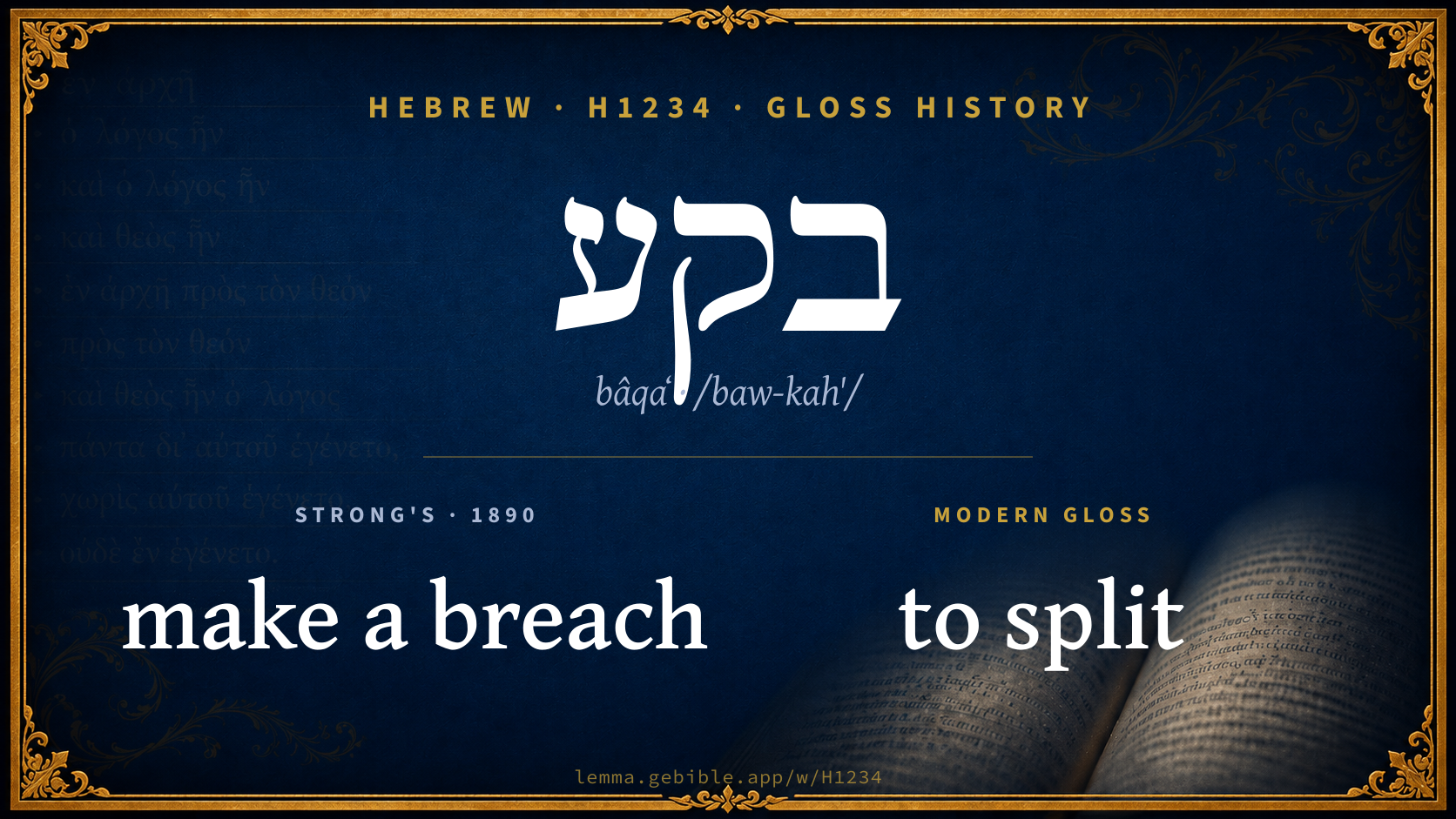
Gloss history
Strong's 1890 vs modern scholarship
About this word
Strong's H1234 catalogs a Hebrew word from the Hebrew Old Testament.
These counts are not copied from any lexicon or concordance. They are computed here, from the morphology-tagged Hebrew Old Testament. What Lemma adds →
- 50
- distinct verses
- The word appears in 50 distinct verses.
- 24 / 39
- OT books
- The word appears in 24 of 39 Old Testament books.
- #723
- by frequency
- Top 1000 most frequent Hebrew words (rank 723 of 8,640 Hebrew words by occurrence).
View all 50 occurrences in the concordance →
By section of the Old Testament
By traditional corpus
Conventional, traditional groupings — biblical authorship is debated, so this is a traditional corpus grouping, not an authorship claim. Each share is this word’s portion of its verses in that division of the Hebrew canon. Each figure is a share of the word’s 50 distinct verses.
- Prophets (Nevi'im) 31 verses · 62%
- Writings (Ketuvim) 14 verses · 28%
- Torah (Pentateuch) 5 verses · 10%
How translations render this word
Counts come from each version’s own published word-to-Strong’s tagging or interlinear alignment — an approximate guide to how each version renders this word, not a word-level alignment the data otherwise carries. Because each total is that version’s own tagged count, the per-version totals vary from one another and need not match the appearance or distinct-verse counts above. These counts may also differ from a printed concordance because Lemma counts each distinctly tagged rendering and does not collapse phrase taggings into a single head-word total. This is a fixed set of word-tagged versions (KJV, ASV, BSB, ULT) and does not change with the reading translation you choose elsewhere. Each version’s license is shown beside its name below (and on Sources).
- King James Version: Was broken up 3×, Brake through 2×, Clave 2×
- American Standard Version: Breach 3×, He clave 3×, Brake through 2×
- Berean Standard Bible: He split 4×, Was breached 3×, Broke 2×
- unfoldingWord Literal Text: And 5×, Torn 2×, You split open 2×
King James Version Public Domain
Renders H1234 across 51 tagged occurrences — most commonly:
Plus 38 renderings that appear only once — usually multi-word phrases or single function words the recovered tagging swept in, not distinct renderings.
American Standard Version Public Domain
Renders H1234 across 51 tagged occurrences — most commonly:
Plus 39 renderings that appear only once — usually multi-word phrases or single function words the recovered tagging swept in, not distinct renderings.
Berean Standard Bible Public Domain
Renders H1234 across 51 tagged occurrences — most commonly:
Plus 38 renderings that appear only once — usually multi-word phrases or single function words the recovered tagging swept in, not distinct renderings.
unfoldingWord Literal Text CC BY-SA 4.0
Renders H1234 across 58 tagged occurrences — most commonly:
Plus 49 renderings that appear only once — usually multi-word phrases or single function words the recovered tagging swept in, not distinct renderings.
11 senses and sub-senses in the full BDB
Hebrew verbs can shift meaning by stem (binyan): Qal is the basic action, Niphal is often passive or reflexive, Piel often intensifies or makes it factitive, and Hiphil is typically causative. The senses below are grouped under the stem BDB assigns to each. This entry also uses Pual (the passive of Piel), Hophal (the passive of Hiphil), and Hithpael (reflexive or reciprocal).
What do BDB’s symbols mean?
BDB uses these scholarly abbreviations:
| Symbol | Meaning |
|---|---|
| 𝔊 | the Septuagint (the ancient Greek translation, LXX) |
| 𝔙 | the Vulgate (the Latin translation) |
| 𝔖 | the Syriac version (the Peshitta) |
| 𝔗 | the Targum (the Aramaic translation) |
| ψ | the Psalms |
| √ | root (the underlying root or stem) |
| ‖ | parallel passage (a synonymous or contrasted parallel) |
| † | the dagger: every passage where the word occurs is cited |
The 11 senses and sub-senses the full Brown-Driver-Briggs lexicon distinguishes for this word, in lexicon order (not ranked by frequency), with BDB’s own verbatim wording and sub-sense lettering. Shown in Hebrew script with BDB’s own scholarly abbreviations. The condensed entry is in the Lexicon Entry tab. See also the Forms in the corpus table below.
Qal
- Pf. בָּקַע ψ 78:13, בָּֽקְעָה Is 34:15, בָּקַעְתָּ Ne 9;11 ψ 74:15, וּבָֽקַעְתָּ֫ Ez 29:7; Impf. וַיִּבְקַע Ju 15:19 Is 48:21, וַיִּבְקְעוּ 2 S 23:16 = 1 Ch 11:18, וַיִּבְקָעוּהָ 2 Ch 21:17; Imv. וּבְקָעֵהוּ Ex 14:16; Inf. cstr. sf. בִּקְעָם Am 1:13 2 Ch 32:1; Pt. act. בּוֹקֵעַ Is 63:12 Ec 10:9, בֹּקֵעַ ψ 141:7;— e.g. Psalms 78:13
- 1. cleave, cleave open, sq. acc. Ju 15:19 God cleft open the hollow (הַמַּכְתֵּשׁ), and water came out, cf. Is 48:21 (obj. צוּר), also ψ 74:15 bring forth by cleaving, obj. מַעְיָן וָנָחַ֑ל, all three of divine operation; cleave or rip open pregnant women Am 1:13; of a broken staff, tearing the shoulder Ez 29:7 (but read כַּף hand for כָּתֵף, 𝔊 𝔙 Sm (?) Co); cleave wood Ec 10:9 (‖ מַסִּיעַ אֲבָנִים); of ploughing (furrowing) the earth ψ 141:7 (‖ פֹּלֵחַ; in sim.); especially of dividing the sea, Ex 14:16 (P) Ne 9:11 ψ 78:13, cf. Is 63:12, obj. מַיִם;—in all these subj. י׳ except Ex 14:16 where he commands Moses; of hatching out (a brood, but no obj. expr.) Is 34:15, subj. קִפּוֹז arrow-snake. e.g. Judges 15:19
- 2. break through or into, sq. בְּ 2 S 23:16 = 1 Ch 11:18; sq. acc. 2 Ch 21:17 וַיַּעֲלוּ בִיהוּדָה וַיִּבְקָעוּהָ; also 32:1, obj. suff. ref. to cities, ויאמר לְבִקְעָם אֵלָיו and he thought to break into them and so bring them unto himself. e.g. 2 Samuel 23:16
Niphal
- Pf. נִבְקַע Jb 26:8 Zc 14:4 (וְ consec.); נִבְקְעוּ Gn 7:11 Is 35:6, נִבְקָ֑עוּ 2 Ch 25:11 Pr 3:20; Impf. יִבָּקַע Is 58:8, יִבָּקֵ֑עַ Jb 32:19; 3 fs. תִּבָּקַע Is 59:5, וַתִּבָּקַע Nu 16:31 + 3 times; Inf. cstr. לְהִבָּקֵעַ Ez 30:16;— e.g. Job 26:8
- 1. be cleft, rent open, subj. the ground, הָֽאֲדָמָה Nu 16:31 (J), הָאָרֶץ 1 K 1:40 (hyperb.) mountain Zc 14:4; burst open, of men hurled from rock 2 Ch 25:12; of cloud beneath its weight of water Jb 26:8; hyperb. of belly full of words seeking a vent, Jb 32:19 like new wine-skins it will burst open; so of the water-receptacles (מעינות) of the great deep, at the flood Gn 7:11, of the water-masses themselves, תהומות Pr 3:20, מים ונחלים Is 35:6; also of the Red Sea, וַיִּבָּקְעוּ המים Ex 14:21; of light breaking forth Is 58:8 (fig.); of serpent’s egg hatching out as a viper Is 59:5 הַזּוּרֶה תִּבָּקַע אֶפְעֶה. e.g. Numbers 16:31
- 2. be broken into, of city captured by breaches in walls 2 K 25:4 = Je 52:7, Ez 30:16. e.g. 2 Kings 25:4
Piel
- Pf. בִּקֵּעַ 2 K 15:16 Jb 28:10, וּבִקַּעְתִּ֫י Ez 13:13, בִּקֵּ֑עוּ Is 59:5; Impf. יְבַקַּע ψ 78:15, וַיְבַקַּע Gn 22:3; 3 fs. תְּבַקֵּעַ Ez 13:11, תְּבַקְּעֵם Ho 13:8; 2 ms. תְּבַקַּע־ Hb 3:9, תְּבַקֵּ֑עַ 2 K 8:12; 2 fpl. וַתְּבַקַּעְנָה 2 K 2:24;—cleave, cut to pieces, or rend open (often more complete or more violent than Qal), sq. acc., of cleaving wood Gn 22:3 i.e. cut it up for burning, so 1 S 6:14; of ripping open pregnant women 2 K 8:12; 15:16; of tearing in pieces children 2 K 2:24; cf. also Ho 13:8 (fig.); of cleaving open rocks, to bring forth water ψ 78:15 (subj God); of cutting mining-shafts Jb 28:10 בַּצּוּרוֹת יְאֹרִים בּ׳; נְהָרוֹת תְּבַקַּע־אָ֑רֶץ Hb 3:9 into rivers thou cleavest (the) earth; break through or down (a wall, but no obj. expr.), Ez 13:11 רוּחַ סְעָרוֹת תְּבַקֵּ֑עַ (but Co תִּבָּקֵעַ), cf. v 13 וּבִקַּעְתִּי רוּחַ סְעָרוֹת בַּחֲמָתִי of hatching eggs Is 59:5 בֵּיצֵי צִפְעוֹנִי בִּקֵּ֑עוּ (fig.) e.g. 2 Kings 15:16
Pual
- Impf. יְבֻקָּ֑עוּ Ho 14:1; Pt. מְבֻקָּעָה Ez 26:10, מְבֻקָּעִים Jos 9:4;—be ripped open, of women Ho 14:1 (vb. of masc. form); rent, of old wine-skins Jos 9:4; broken into, of a city in whose walls a breach has been made Ez 26:10. e.g. Hosea 14:1
Hiphil
- Impf. 1 pl. sf. וְנַבְקִעֶנָּה Is 7:6; Inf. cstr. לְהַבְקִיעַ 2 K 3:26;—break into, sq. sf. ref. to Judah, Is 7:6 ונב׳ אֵלֵינוּ let us break into it, lay it open, and so bring it unto ourselves (cf. Qal 2 Ch 32:1); break through (abs.) with sword, שֹׁלֵף חֶרֶב לְהַבְקִיעַ אֶל־מֶלֶךְ אֱדוֹם 2 K 3:26. e.g. Isaiah 7:6
Hophal
- Pf. 3 fs. הָבְקְעָה הָעִיר Je 39:2 the city was broken into, entrance was made by a breach. e.g. Jeremiah 39:2
Hithpael
- Pf. הִתְבַּקָּ֑עוּ Jos 9:13, Impf. יִתְבּקָּ֑עוּ Mi 1:4;—burst (themselves) open, of wine-skins Jos 9:13; cleave asunder, of valleys Mi 1:4. e.g. Joshua 9:13
Senses from the full Brown-Driver-Briggs lexicon (Brown, Driver, Briggs; Oxford 1906 — public domain), digitized via Sefaria, supplemented by the OpenScriptures HebrewLexicon (CC BY 4.0). Full attribution on Sources.
Word origin
vb. cleave, break open or through (NH id., MI15 מבקע השחרת from break of dawn; Aramaic בְּקַע; cf. Ethiopic በቍዐ profit, be useful, orig. findere, aperire, Di)—
— Brown-Driver-Briggs (Oxford 1906, public domain), digitized via Sefaria, supplemented by the OpenScriptures HebrewLexicon (CC BY 4.0). See Sources.
Origin: a primitive root
Jastrow Dictionary
A second Hebrew/Aramaic lexicon for comparison, covering Aramaic and post-biblical (Talmudic, Targumic, Midrashic) usage that the biblical-Hebrew BDB does not. Matched by lemma rather than by Strong’s number, so a lemma may carry more than one Jastrow headword (shown separately below), and the entries cover usage well beyond the Bible.
בָּקַע
- , v. בְּקָא)
- 1. to split, chop; to break through. B. Mets. 99ᵃ בָּ׳ בו; (Kidd. 47ᵇ בִּיקַּע) if he chopped wood with it. Gen. R. s. 55, end; Koh. R. to X, 9; II, 23, v. בְּקִיעָה. Ex. R. s. 21 אני בוֹקֵעַ להם וכ׳ I am going to split the sea for them; a. fr.—Lam. R. to II, 2 בקעו בחיילותיו וכ׳ broke through the lines of N.’s armies; Y. Taan. IV, 69ᵇ top ברחו לתוך.
- 2. to cross, make a short cut, pass over. Y. Pes. I, 27ᵇ bot. חצר שהרבים בּוֹקְעִין וכ׳ a court which people use for crossing. Erub. 16ᵇ; Sabb. 101ᵇ (a low wall) שהגדיים וכ׳ ב׳ over which the kids pass; v. בִּקְעָה.
- 3. (cmp. בִּצְבֵּץ) to break through the ground, esp. as a legal fiction for a levitical impurity the cause of which is underground, but which affects the things above and beneath. Ohol. VI, 6 טומאה בּוֹקַעַת וכ׳ the impurity breaks through the ground and rises, and breaks through and goes down; a. fr.—Koh. R. III, 16 היה הדם בו׳ ועולה the blood broke through and rose. Midr. Till. to Ps. LXXVIII, 45 ב׳ את הצור, ב׳ בצור break through (take root in) the rock; a. fr.
- to be split, to burst open. Ib. הסיפין נבקעין וכ׳ the door sells were burst before them. Ib. נ׳ הספל מאליו the vessel went to pieces of itself. Gen. R. s. 55, end זכה להִבָּקַע הים וכ׳ he was rewarded by the sea being divided before the children of Israel. Ḥull. 14ᵇ שמא יִבָּקַע הנוד the wine bottle may burst; a. fr.
- 1. to split, chop, tear. Kidd. 47ᵇ, v. supra. Y. Bets. I, 60ᵃ bot.; Y. Ab. Zar. II, 41ᶜ bot. שביקעו (שבקעו) להם וכ׳ of whose flocks the wolves had torn more than &c. Bets. IV, 3 אין מְבַקְּעִין וכ׳ one must not split woods (on Holy Days) etc. Sifré Deut. 183 (ref. to Deut. XIX, 5) מן העץ המְבַקֵּעַ from the splitting wood (the handle), opp. העץ המִתְבַּקֵּעַ the split wood (the tree). Tanḥ. Vayetse 9 בַּקְּעִי וכ׳ chop thou &c.—Part. pass. מְבוּקָּע. Ab. Zar. 65ᵇ מְבוּקָּעוֹת grapes burst open. e.g. Deuteronomy 19:5
- 2. to jam in, wedge. Sabb. 67ᵇ המְבַקַּעַת ביצים (Rashi Var. המקבעת, Ms. M. עצים) one who squeezes egg-shells &c. (a superstitious practice; Tosef. ib. VI (VII), 18 הנותנת בצים … בכותל).
- 1. to cut, clear. Shebi. IV, 5 המַבְקִיעַ בזתים וכ׳ he who cuts olive-trees down (in the Sabbath year) must not cover the stump with ground.
- 2. to lead a line crosswise. Y. Kil. III, 28ᵈ top להַבְקִיעַ וכ׳ to plant four rows across a valley from end to end.
- to be split; to burst, break. Sifré Deut. 183, v. supra.—Sabb. XVI, 5. Cant. R. to VI, 4.
בֶּקַע
- [a split,] beka, a weight and a coin, equal to half a Shekel. Gen. R. s. 84; a. e.
A Dictionary of the Targumim, the Talmud Babli and Yerushalmi, and the Midrashic Literature (Marcus Jastrow; London, Luzac, 1903) — Public Domain. Digitized via Sefaria. Digitized via Sefaria. Full attribution on Sources.
Forms in the corpus
The 48 distinct written forms H1234 takes in the Hebrew Bible, most frequent first — each parse links to that stem’s occurrences in the concordance. Hebrew forms include their vowel points and cantillation, so a single lemma takes many written forms.
Same root — word family
Other BDB entries built from the same root as H1234, grouped by Strong’s listed origin. These share a root / origin per the lexicon — not necessarily a shared meaning. Each links to that word’s own entry.
Derived from this word
Compare all same-root words → They share a root, not necessarily a meaning.
Septuagint verse parallels
This word appears in 46 verses that also exist in the Greek Old Testament (Septuagint), out of the 50 Hebrew verses it occurs in. You can read those verses in Greek by switching the Old Testament edition to the Septuagint.
Read these verses in the Septuagint
- Genesis 7:11
- Exodus 14:16
- Numbers 16:31
- Joshua 9:4
- Judges 15:19
- 1 Samuel 6:14
- 2 Samuel 23:16
- 1 Kings 1:40
- 2 Kings 2:24
- 1 Chronicles 11:18
- 2 Chronicles 21:17
- Job 26:8
This is a verse-level parallel only — the same verses exist in both the Hebrew and Greek Old Testaments. No word-level Hebrew↔Greek correspondence is claimed: the data carries no such alignment, so no Greek word is shown as this Hebrew word’s translation. Coverage is not total — the Septuagint omits the deuterocanon and renumbers the Psalms, so some Hebrew verses have no direct Greek parallel.