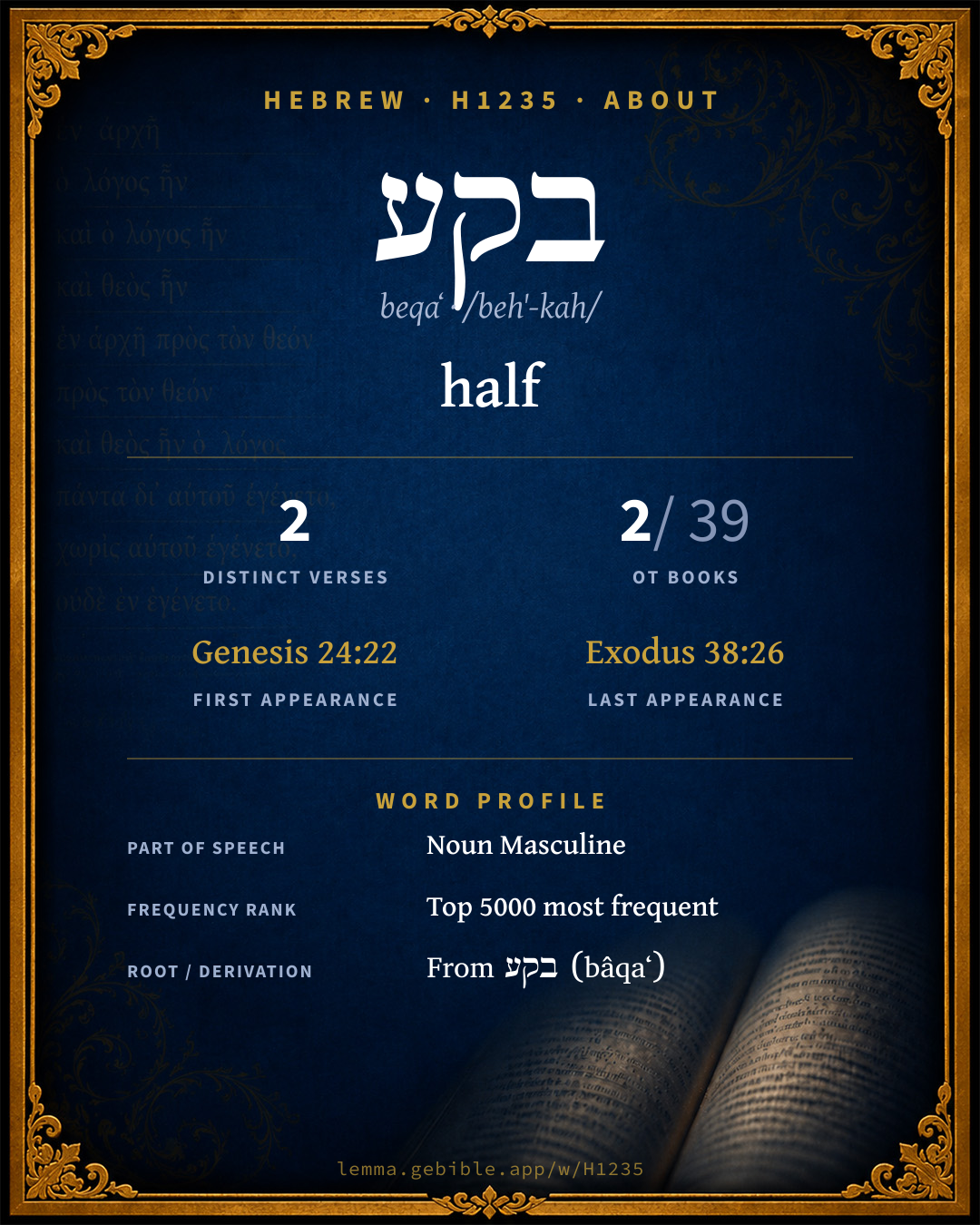
בֶּ֫קַע
half
‘half’ is one of 2 main senses fuller range ↓
Full lexicon entry — Brown-Driver-Briggs (BDB)
From Brown-Driver-Briggs (BDB)
Where this word appears
Grammar key — what these labels mean
Part of speech
- Noun
- A naming word — a person, place, thing, or idea.
Noun type
- Common
- A common noun — a general class of person, place, or thing (“king,” “city,” “water”), not a specific name.
State
- Absolute
- The independent form of a noun, not bound to a following word.
Gender
- Masculine
- Grammatically masculine.
Number
- Singular
- One.
Every verse where H1235 appears — 2 distinct verses across 2 books. Click any verse to open its interlinear word-by-word view. Verse text shown in the World English Bible for context — . Each verse’s Hebrew form is shown with its reference; the English is not keyword-highlighted, since the data carries no word-level English alignment. Use “Compare translations” on any verse to read it across multiple English versions. This concordance covers the Hebrew Bible; Septuagint (Greek Old Testament) occurrences are not indexed here.
Genesis 1 verse
Exodus 1 verse
About this entry
At a glance — auto-summarized from this page’s data, not written by a person. Every figure links to its source below. This summary describes the numbers; it doesn’t interpret them.
בקע — transliterated beqaʻ — is a Hebrew noun carrying the sense “half.” With only 2 verses it sits in the long tail of Hebrew Bible vocabulary. Its uses cluster heavily in Genesis (50% of all occurrences). It first appears in Genesis 24:22. Its lexical range runs to 2 senses. See the sense tree, 2-verse concordance, and the renderings breakdown below.
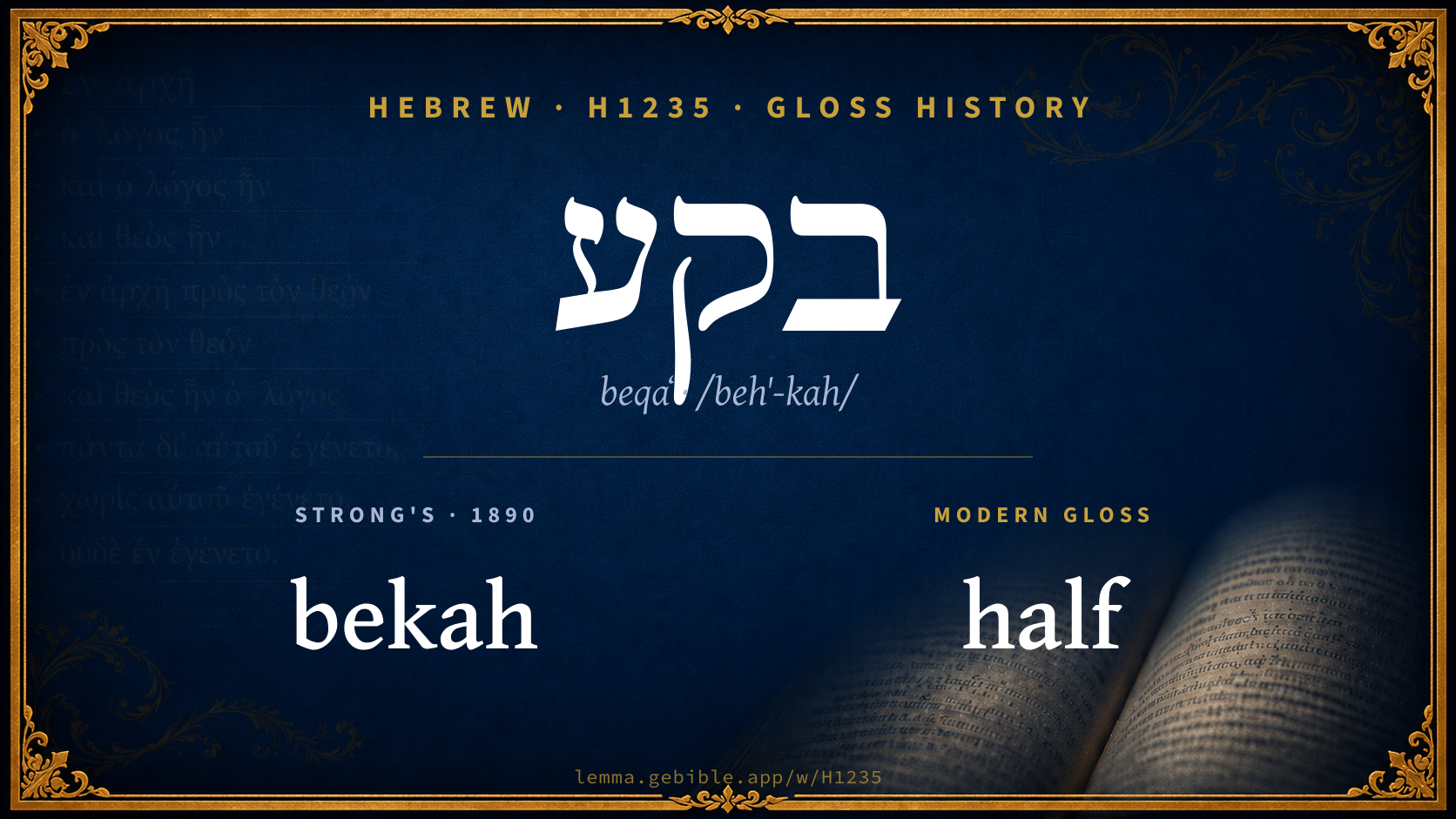
Gloss history
Strong's 1890 vs modern scholarship
About this word
Strong's H1235 catalogs a Hebrew word from the Hebrew Old Testament.
These counts are not copied from any lexicon or concordance. They are computed here, from the morphology-tagged Hebrew Old Testament. What Lemma adds →
- 2
- distinct verses
- The word appears in 2 distinct verses.
- 2 / 39
- OT books
- The word appears in 2 of 39 Old Testament books.
- #4,807
- by frequency
- Top 5000 most frequent Hebrew words (rank 4,807 of 8,640 Hebrew words by occurrence).
View all 2 occurrences in the concordance →
By traditional corpus
Conventional, traditional groupings — biblical authorship is debated, so this is a traditional corpus grouping, not an authorship claim. Each share is this word’s portion of its verses in that division of the Hebrew canon. Each figure is a share of the word’s 2 distinct verses.
- Torah (Pentateuch) 2 verses · 100%
How translations render this word
Counts come from each version’s own published word-to-Strong’s tagging or interlinear alignment — an approximate guide to how each version renders this word, not a word-level alignment the data otherwise carries. Because each total is that version’s own tagged count, the per-version totals vary from one another and need not match the appearance or distinct-verse counts above. These counts may also differ from a printed concordance because Lemma counts each distinctly tagged rendering and does not collapse phrase taggings into a single head-word total. This is a fixed set of word-tagged versions (KJV, ASV, BSB, ULT) and does not change with the reading translation you choose elsewhere. Each version’s license is shown beside its name below (and on Sources).
- King James Version: Bekah 1×, Half a shekel 1×
- American Standard Version: Beka 1×, Half a shekel 1×
- Berean Standard Bible: Beka 2×
- unfoldingWord Literal Text: Beka 2×
King James Version Public Domain
Renders H1235 across 2 tagged occurrences — most commonly:
American Standard Version Public Domain
Renders H1235 across 2 tagged occurrences — most commonly:
Berean Standard Bible Public Domain
Renders H1235 across 2 tagged occurrences — most commonly:
unfoldingWord Literal Text CC BY-SA 4.0
Renders H1235 across 2 tagged occurrences — most commonly:
Senses in BDB
The 2 senses BDB distinguishes for this word, in lexicon order (not ranked by frequency or importance). The full entry — with sub-senses — is in the Lexicon Entry tab.
- half, part also called " shekel of the sanctuary" or " holy shekel"
- half a shekel (metonymy) There appears to be at least three different shekels…
Word origin
n.[m.] fraction, half, i.e. half-shekel, a weight; בֶּקַע מִשְׁקָלוֹ Gn 24:22, cf. Hesychius in LagGes. Abh. 199, 1. 18 βακαίον [Lag βέκαον] μέτρον τι; v. also בֶּקַע Ex 38:26 (= מַחֲצִית הַשֶּׁקֶל).
— Brown-Driver-Briggs (Oxford 1906, public domain), digitized via Sefaria, supplemented by the OpenScriptures HebrewLexicon (CC BY 4.0). See Sources.
Derived from בקע (bâqaʻ) (H1234) — to split.
Jastrow Dictionary
A second Hebrew/Aramaic lexicon for comparison, covering Aramaic and post-biblical (Talmudic, Targumic, Midrashic) usage that the biblical-Hebrew BDB does not. Matched by lemma rather than by Strong’s number, so a lemma may carry more than one Jastrow headword (shown separately below), and the entries cover usage well beyond the Bible.
בָּקַע
- , v. בְּקָא)
- 1. to split, chop; to break through. B. Mets. 99ᵃ בָּ׳ בו; (Kidd. 47ᵇ בִּיקַּע) if he chopped wood with it. Gen. R. s. 55, end; Koh. R. to X, 9; II, 23, v. בְּקִיעָה. Ex. R. s. 21 אני בוֹקֵעַ להם וכ׳ I am going to split the sea for them; a. fr.—Lam. R. to II, 2 בקעו בחיילותיו וכ׳ broke through the lines of N.’s armies; Y. Taan. IV, 69ᵇ top ברחו לתוך.
- 2. to cross, make a short cut, pass over. Y. Pes. I, 27ᵇ bot. חצר שהרבים בּוֹקְעִין וכ׳ a court which people use for crossing. Erub. 16ᵇ; Sabb. 101ᵇ (a low wall) שהגדיים וכ׳ ב׳ over which the kids pass; v. בִּקְעָה.
- 3. (cmp. בִּצְבֵּץ) to break through the ground, esp. as a legal fiction for a levitical impurity the cause of which is underground, but which affects the things above and beneath. Ohol. VI, 6 טומאה בּוֹקַעַת וכ׳ the impurity breaks through the ground and rises, and breaks through and goes down; a. fr.—Koh. R. III, 16 היה הדם בו׳ ועולה the blood broke through and rose. Midr. Till. to Ps. LXXVIII, 45 ב׳ את הצור, ב׳ בצור break through (take root in) the rock; a. fr.
- to be split, to burst open. Ib. הסיפין נבקעין וכ׳ the door sells were burst before them. Ib. נ׳ הספל מאליו the vessel went to pieces of itself. Gen. R. s. 55, end זכה להִבָּקַע הים וכ׳ he was rewarded by the sea being divided before the children of Israel. Ḥull. 14ᵇ שמא יִבָּקַע הנוד the wine bottle may burst; a. fr.
- 1. to split, chop, tear. Kidd. 47ᵇ, v. supra. Y. Bets. I, 60ᵃ bot.; Y. Ab. Zar. II, 41ᶜ bot. שביקעו (שבקעו) להם וכ׳ of whose flocks the wolves had torn more than &c. Bets. IV, 3 אין מְבַקְּעִין וכ׳ one must not split woods (on Holy Days) etc. Sifré Deut. 183 (ref. to Deut. XIX, 5) מן העץ המְבַקֵּעַ from the splitting wood (the handle), opp. העץ המִתְבַּקֵּעַ the split wood (the tree). Tanḥ. Vayetse 9 בַּקְּעִי וכ׳ chop thou &c.—Part. pass. מְבוּקָּע. Ab. Zar. 65ᵇ מְבוּקָּעוֹת grapes burst open. e.g. Deuteronomy 19:5
- 2. to jam in, wedge. Sabb. 67ᵇ המְבַקַּעַת ביצים (Rashi Var. המקבעת, Ms. M. עצים) one who squeezes egg-shells &c. (a superstitious practice; Tosef. ib. VI (VII), 18 הנותנת בצים … בכותל).
- 1. to cut, clear. Shebi. IV, 5 המַבְקִיעַ בזתים וכ׳ he who cuts olive-trees down (in the Sabbath year) must not cover the stump with ground.
- 2. to lead a line crosswise. Y. Kil. III, 28ᵈ top להַבְקִיעַ וכ׳ to plant four rows across a valley from end to end.
- to be split; to burst, break. Sifré Deut. 183, v. supra.—Sabb. XVI, 5. Cant. R. to VI, 4.
בֶּקַע
- [a split,] beka, a weight and a coin, equal to half a Shekel. Gen. R. s. 84; a. e.
A Dictionary of the Targumim, the Talmud Babli and Yerushalmi, and the Midrashic Literature (Marcus Jastrow; London, Luzac, 1903) — Public Domain. Digitized via Sefaria. Digitized via Sefaria. Full attribution on Sources.
Forms in the corpus
The 2 distinct written forms H1235 takes in the Hebrew Bible, most frequent first — each parse links to that state’s occurrences in the concordance. Hebrew forms include their vowel points and cantillation, so a single lemma takes many written forms.
| Form | Parsing | Example | Uses |
|---|---|---|---|
| בֶּ֖קַע | Noun, Common, Masculine, Singular, Absolute | Genesis 24:22 | 1 |
| בֶּ֚קַע | Noun, Common, Masculine, Singular, Absolute | Exodus 38:26 | 1 |
Same root — word family
Other BDB entries built from the same root as H1235, grouped by Strong’s listed origin. These share a root / origin per the lexicon — not necessarily a shared meaning. Each links to that word’s own entry.
Derives from
Shares the same root
Compare all same-root words → They share a root, not necessarily a meaning.
Septuagint verse parallels
This word appears in 2 verses that also exist in the Greek Old Testament (Septuagint), out of the 2 Hebrew verses it occurs in. You can read those verses in Greek by switching the Old Testament edition to the Septuagint.
Read these verses in the Septuagint
This is a verse-level parallel only — the same verses exist in both the Hebrew and Greek Old Testaments. No word-level Hebrew↔Greek correspondence is claimed: the data carries no such alignment, so no Greek word is shown as this Hebrew word’s translation. Coverage is not total — the Septuagint omits the deuterocanon and renumbers the Psalms, so some Hebrew verses have no direct Greek parallel.