
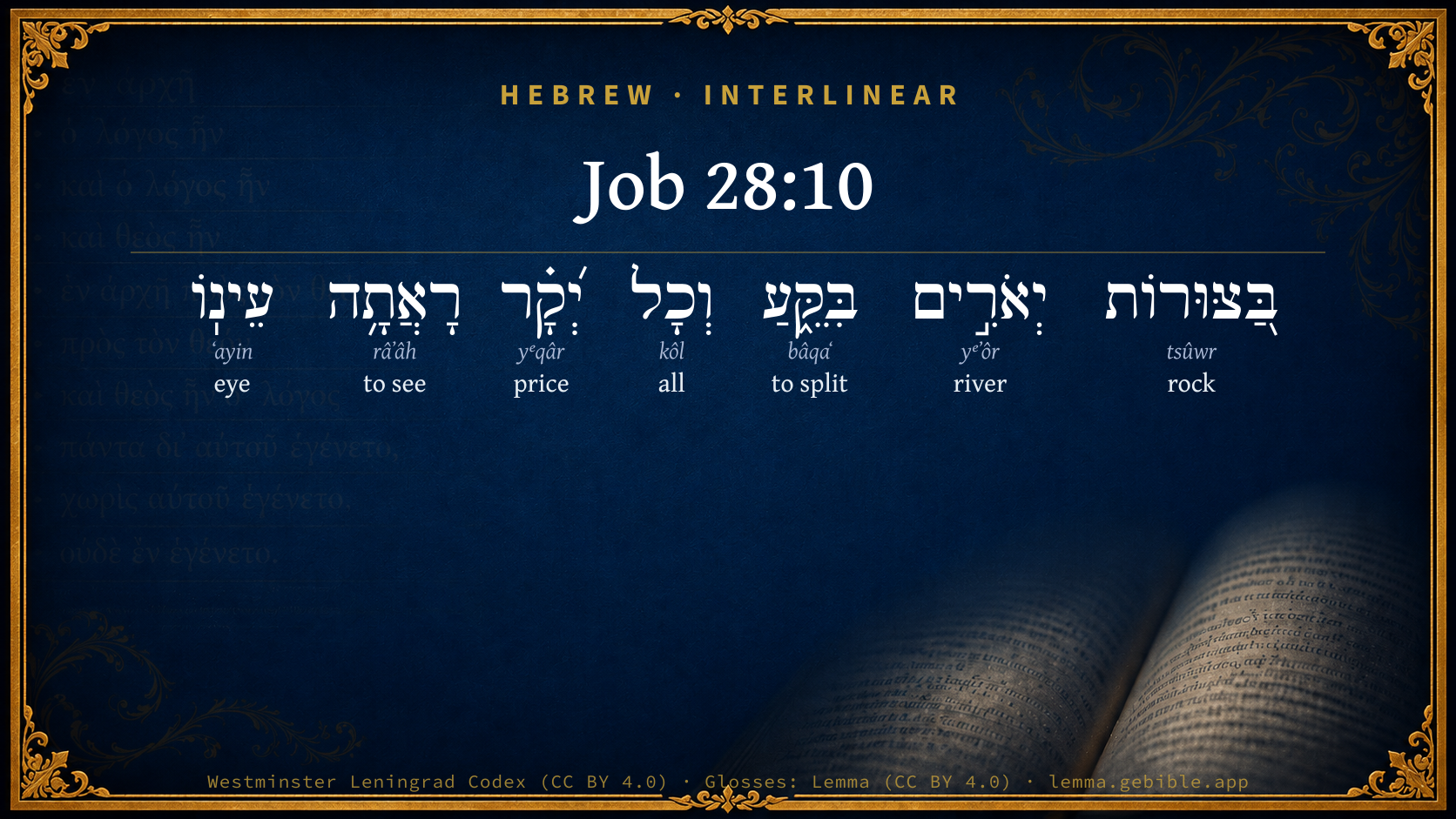
Job 28:10

Hebrew (Westminster Leningrad Codex) Job 28:10 appears in the Hebrew Old Testament. The text above is from the Westminster Leningrad Codex. Each word links to its Strong’s number, a concise gloss, and parsing drawn from the Open Scriptures Hebrew Bible morphology. Click any word for its full Brown-Driver-Briggs (BDB) entry.
Download image
Cite this verse

Job 28:10 (World English Bible). Public Domain. Lemma interlinear Bible study tool, https://lemma.gebible.app/v/job/28/10.

Show BibTeX & RIS
BibTeX
RIS
English Translation
He cuts out channels among the rocks. His eye sees every precious thing.
World English Bible · Public Domain
Download a study sheet

One document with this verse’s original text, its word-by-word gloss line, the meaning frame, cross-references with their text, attributed commentary, and full source and license credits — printable, and it pastes into notes with its structure intact.

This verse Autodidact and up

Study sheet (.html) Plain text (.txt)

A passage Seminary Student

Up to 50 verses in one chapter. A passage sheet keeps up to 6 commentary sources and 12 cross-references per verse, in the order this page ranks them, and says so on the sheet whenever that leaves anything out. Ask for a single verse and you get the Autodidact verse sheet above.

Everything on this page stays free to read, with no account — the sheet is a download of what is already on screen, not access to it.

Want to remove ads? Support Godless Engineer
Compare translations 3

The same verse in 3 English versions, stacked beneath the original-language interlinear above. Click any original word for its lexicon entry.

Each is an independent rendering of the whole verse — the interlinear is not word-aligned to these translations.

Highlighted words mark where these versions differ — a whole-verse word diff, not a word-by-word alignment.

  • World English Bible Public Domain
    He cuts out channels among the rocks. His eye sees every precious thing.
  • King James Version Public Domain
    He cutteth out rivers among the rocks; and his eye seeth every precious thing.
  • unfoldingWord Literal Text CC BY-SA 4.0
    He cuts out channels among the rocks, and his eye sees every valuable thing.

unfoldingWord Literal Text — © unfoldingWord, licensed CC BY-SA 4.0. Word-aligned USFM3 via Door43 (git.door43.org/unfoldingWord/en_ult).

Versions to compare (up to 4)

3 of 4 selected

Show all 18 translations

Every available English version of this verse, each an independent rendering of the whole verse.

  • World English Bible Public Domain
    He cuts out channels among the rocks. His eye sees every precious thing.
  • Berean Standard Bible Public Domain
    He hews out channels in the rocks, and his eyes spot every treasure.
  • Majority Standard Bible Public Domain
    He hews out channels in the rocks, and his eyes spot every treasure.
  • King James Version Public Domain
    He cutteth out rivers among the rocks; and his eye seeth every precious thing.
  • American Standard Version (1901) Public Domain
    He cutteth out channels among the rocks; And his eye seeth every precious thing.
  • Revised Version (1885) Public Domain
    He cutteth out channels among the rocks; and his eye seeth every precious thing.
  • Geneva Bible (1599) Public Domain
    He breaketh riuers in the rockes, and his eye seeth euery precious thing.
  • Douay-Rheims (1899) Public Domain
    In the rocks he hath cut out rivers, and his eye hath seen every precious thing.
  • Young's Literal Translation Public Domain
    Among rocks, brooks he hath cleaved, And every precious thing hath his eye seen.
  • Literal Standard Version CC BY-SA 4.0
    Among rocks, he has cleaved brooks, || And his eye has seen every precious thing.
  • Unlocked Literal Bible CC BY-SA 4.0
    He cuts out channels among the rocks; his eye sees every valuable thing there.
  • unfoldingWord Literal Text CC BY-SA 4.0
    He cuts out channels among the rocks, and his eye sees every valuable thing.
  • Darby Bible Public Domain
    He cutteth out channels in the rocks, and his eye seeth every precious thing.
  • World Messianic Bible Public Domain
    He cuts out channels among the rocks. His eye sees every precious thing.
  • Webster's Bible Public Domain
    He cutteth out rivers among the rocks; and his eye seeth every precious thing.
  • Free Bible Version CC BY-SA 4.0
    They tunnel through the rock, looking carefully for every precious stone.
  • Bible in Basic English Public Domain
    He makes deep ways, cut through the rock, and his eye sees everything of value.
  • JPS Tanakh (1917) Public Domain
    He cutteth out channels among the rocks; and his eye seeth every precious thing.

Literal Standard Version (2020), Covenant Press — licensed CC BY-SA 4.0. Text via the HelloAO Bible API (eBible.org). Unlocked Literal Bible (unfoldingWord) — licensed CC BY-SA 4.0. Text via the HelloAO Bible API (eBible.org). unfoldingWord Literal Text — © unfoldingWord, licensed CC BY-SA 4.0. Word-aligned USFM3 via Door43 (git.door43.org/unfoldingWord/en_ult). Free Bible Version, Dr. Jonathan Gallagher — licensed CC BY-SA 4.0. Text via the HelloAO Bible API (eBible.org).

Word by word

More ways to search: Search by grammar → Find every occurrence → Compare this word →

Practice this passage: Drill this verse → Learn its vocabulary →

About this verse

These counts appear in no published source. They are computed here, from the morphology-tagged text and Lemma’s own curated glosses. What Lemma adds →

7
words
7
distinct lemmas
Wisdom
section

Notable vocabulary

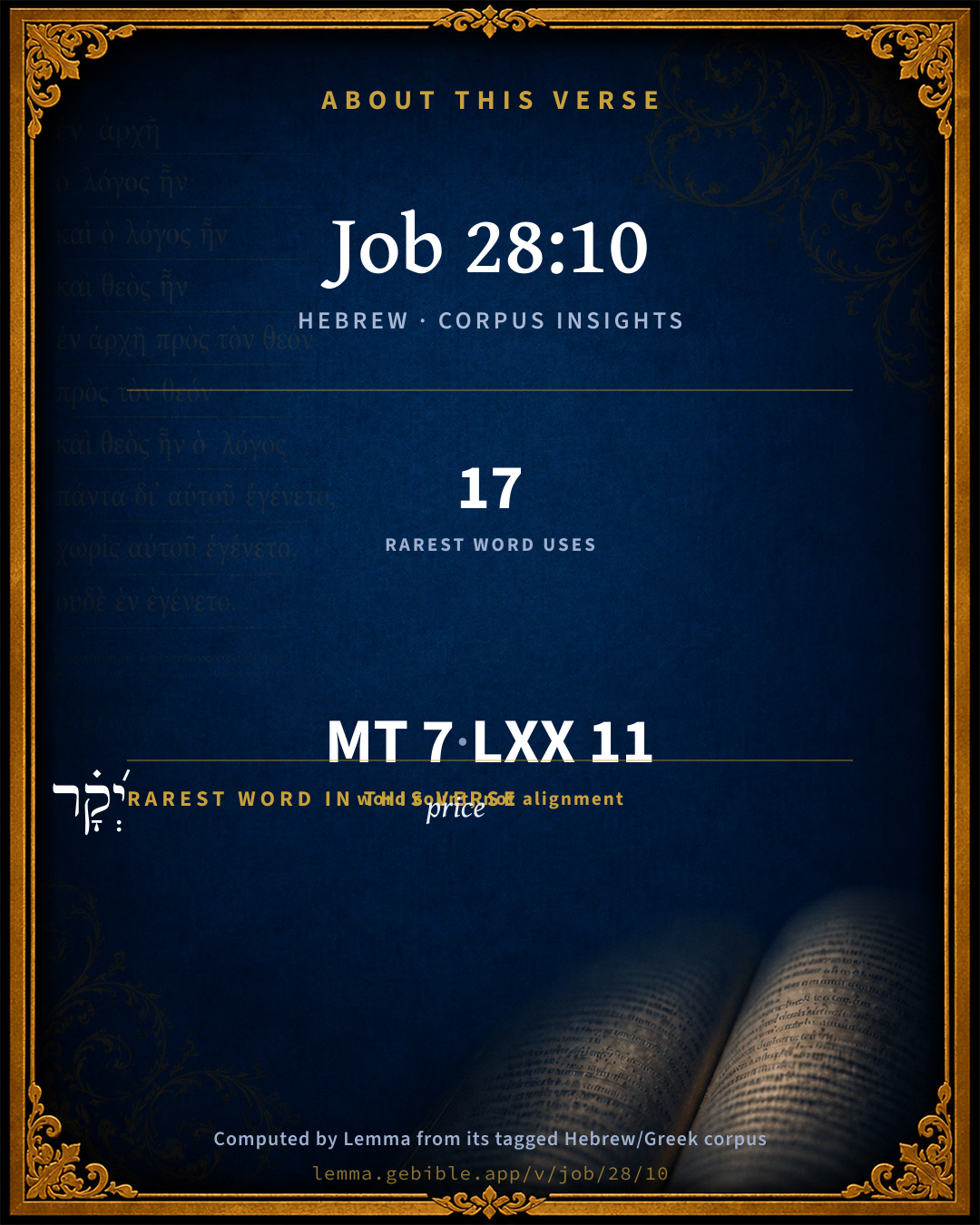
The rarest word here is יְ֝קָ֗ר price H3366 — appearing just 17 times in the whole Hebrew Bible.

Shared distinctive vocabulary

יְ֝קָ֗ר price H3366 occurs in 15 verses of the Hebrew Bible. Also found in:

Grammatical profile

  • 2 verbs
  • 5 nouns

Verb forms

  • בִּקֵּ֑עַ Piel · Perfect
  • רָאֲתָ֥ה Qal · Perfect

Hebrew & Septuagint length

In English translation the verse runs 13 words from the Hebrew and 16 from the Septuagint (LXX English) — closely comparable.

A rough comparison of the two English renderings, which tokenize alike — not a word-level alignment.

Word counts can differ between the Hebrew and the Greek without any difference in meaning — e.g. the Hebrew direct-object marker אֵת has no separate Greek word, and Greek often adds the article ὁ.

In the original languages it is 7 Hebrew tokens and 11 Greek tokens — but the two are counted differently (Hebrew bundles its prefixes and suffixes into one token; the Greek is in lemma form), so that isn’t a like-for-like length.

Cross-references

3

Topical passages linked to Job 28:10 in the Treasury of Scripture Knowledge — connected by theme and wording, ordered by reader-vote popularity; previews shown in the World English Bible.

  • Proverbs 14:23 In all hard work there is profit, But the talk of the lips leads only to poverty.
  • Proverbs 24:4 By knowledge the rooms are filled With all rare and beautiful treasure.
  • Habakkuk 3:9 You uncovered your bow. You called for your sworn arrows. Selah. You split the earth with rivers.

Cross-references courtesy of OpenBible.info (CC BY 4.0).

Hebrew and Greek witnesses Masoretic Hebrew ↔ Greek Septuagint

The same verse in the two great witnesses to the Old Testament, shown verse-for-verse.

These are two independent witnesses, not word-aligned to each other, and the Septuagint is shown in lemma (dictionary) form.

Hebrew Job 28:10 Masoretic · Westminster Leningrad Codex

בַּ֭צּוּרוֹת יְאֹרִ֣ים בִּקֵּ֑עַ וְכָל יְ֝קָ֗ר רָאֲתָ֥ה עֵינֽוֹ

He cuts out channels among the rocks. His eye sees every precious thing.

World English Bible · Public Domain

Greek LXX Job 28:10 Septuagint · lemma form

δίνη δέ ποταμός ῥήγνυμι πᾶς δέ ἔντιμος ὁράω ἐγώ ὁ ὀφθαλμός

and he has interrupted the whirlpools of rivers, and my eye has seen every precious thing.

LXX2012 (modern English Septuagint) · Public Domain

Hebrew: Westminster Leningrad Codex (CC BY 4.0). Greek: Septuagint (public domain); English from LXX2012 (modern English Septuagint) (Public Domain). How the Septuagint differs from the Hebrew →

Commentary

Notes on Job 28:10 from classic Christian and Jewish commentators (each source and its license shown beneath its notes). The classic Christian expositions comment on the surrounding passage and are grouped to its opening verse, so a note may address several verses; the Jewish commentaries on the Tanakh (Rashi and others) are per-verse, so they appear only where the commentator wrote on this verse.

Lemma curates 59 commentaries, every one of them public domain or Creative Commons licensed, each selected and text-cleaned for this edition rather than reprinted as found. About our sources →

Trapp's Complete Commentary

John Trapp

Job 28:10 He cutteth out rivers among the rocks; and his eye seeth every precious thing.

Ver. 10. He cutteth out rivers among the rocks] i.e. By cleaving hardest rocks, he draws in store of water to wash the inward parts of the earth, that he may see what gold lieth hidden there; as also, to wash and purge his metals, which require much washing. This is the work of his hands. And then for his eye, and as a reward of his labour (for the diligent hand maketh rich, Pro 10:4, and in all labour there is profit, Pro 14:23).

His eye seeth every precious thing] Heb. Every price; or, All preciousness. Whatsoever is rare, so Tremellius rendereth it. His house is filled with all precious and pleasant riches, Pro 24:4. Dii laboribus omnia vendunt, said the heathens, God sells all good things to men for their pains taking.

John Trapp, A Commentary or Exposition upon All the Books of the Old and New Testament (1647–1656) — public domain. Text from a community e-Sword module.

The Biblical Illustrator

Joseph S. Exell

Job_28:10

His eye seeth every precious thing.

Every precious thing

These words refer to the miner who digs for the treasure hidden in the earth. He finds the vein of silver, and the place for the gold. But if mans eye sees the precious things, let us think how God sees them.

I. He sees the promise and possibility. There are many things of which, at a glance, men can see the worth; things that proclaim themselves loudly. Some things only the genius can see. The gold is in the quartz, but invisible. And what a poor thing is humanity! How hard it is to find in many people any promise of any goodness, any possibility of any worth. But lo! our God bends over us, and to Him this humanity is infinitely precious. To Him it is a pearl of great price, for which He hath given all, that He may purchase it for His own. This is the glory of our God; this is the meaning of His salvation--that He sees in humanity an infinite worth, that which He can uplift and beautify and transform into His own very image and likeness.

II. He sees the effort and will, where others see only the poor result. God does not measure what we bring to Him, He weighs it. He knows what it cost.

III. He sees the great result, where we see but the process. God sees for Joseph the throne of Egypt; the sceptre of that great nation is in his hand. But what does Joseph see when carried off by the Midianites? Thus is it ever that God sees the glorious result when we see but the dreary processes. He hears the joyous shout of harvest home, where we have only the chill earth and the darkness of the grave. This is our safety and our blessedness--to give ourselves to Him who knows how to turn us to the beat account, and to let Him have His own way with us perfectly. (Mark Guy Pearse.)

The Biblical Illustrator, edited by Joseph S. Exell (c. 1880s–1900s) — public domain. Text from a community e-Sword module.

Jamieson, Fausset & Brown

Robert Jamieson, A. R. Fausset & David Brown

He cuts channels to drain off the waters, which hinder his mining; and when the waters are gone, he he is able to see the precious things in the earth.

Jamieson, Fausset & Brown — Commentary Critical and Explanatory on the Whole Bible (1871) — public domain (CC PDM 1.0). Text via the HelloAO Bible API.

Adam Clarke's Commentary

Verse 10. He cutteth out rivers among the rocks] He cuts canals, adits, c., in the rocks, and drives levels under ground, in order to discover loads or veins of ore. These are often continued a great way under ground and may be poetically compared to rivers, channels, or canals.

His eye seeth every precious thing.] He sinks those shafts, and drives those levels, in order to discover where the precious minerals lie, of which he is in pursuit.

Adam Clarke's Commentary on the Bible (1810–1826) — public domain. Text from a community e-Sword/MySword module.

The Cambridge Bible for Schools and Colleges

gen. ed. J. J. S. Perowne

10. cutteth out rivers] The word “rivers” is that commonly used to denote the canals into which the Nile was divided, and might be translated canals or channels. Such canals might be intended for drawing off the water accumulating in the mine. The second clause suggests, however, that the word rather means passages or galleries, cut in order to pursue the vein, for it is said, “his eye seeth every precious thing.”

The Cambridge Bible for Schools and Colleges (gen. ed. J. J. S. Perowne; Cambridge University Press, 1878–1918) — public domain. Text from a community e-Sword module.

John Gill's Exposition

He cutteth out rivers among the rocks,.... By cleaving rocks asunder in order to find out things of value in the cliffs of them; or by cutting his way through them, the miner opens a course for rivers and floods of water, to drain off from his mines, and so can go on with his works more comfortably, and with success; though sometimes they sink through high rocks, till they go so far below their basis, that they can go no further for water, in some places forty or fifty fathom deep (i):

and his eye seeth every precious thing; in the cliffs of the rock, or at the bottom of the rivers and floods, as they go off, or in the mines he digs, even gold or silver, or precious stones: hence came the fable of Lynceus, and from him the phrase of Lyncean eyes (k), who was said to see all things under the earth, because he was the first that searched for metals, as brass, silver, &c. and in search of them carried lamps, or links, under the earth (l). This verse is also by some ascribed to God, who is said to cleave the fountain and the flood, and to dry up mighty rivers; and also to open rivers in high places, in hills, mountains, and rocks, as well as sometimes in the middle of the valleys, Psa 74:15; and who, in a spiritual sense, has cut out and opened the river of his pure love and grace, which flows from the throne of God and the Lamb; and the fulness of grace in Christ, which is as rivers of water in a dry land; and the graces of the Spirit in his people, which flow out of them as rivers of living water; and his word and ordinances in his church, which are the rivers of pleasure he makes his saints to drink of in it: and his eye of omniscience, which sees all things in particular, sees all the precious things in nature; the precious things of heaven, and earth, and sea; the precious things brought forth by the sun and moon; and the precious tidings of the ancient mountains and everlasting hills, the gold, silver, and precious stones that lie hid in the bowels of them, Deu 33:13; and who also sees all precious persons, and things, in a spiritual sense; he beholds his precious Son, his precious blood, righteousness, and sacrifice, with delight and pleasure; and his eye of love, grace, and mercy, upon the precious sons of Zion, comparable to fine gold, jewels, and precious stones; and sees all the precious graces of the Spirit in them, with acceptance and good will.

(i) Philos. Transaet. abridged, vol. 2. p. 469. (k) Horat. Sermon. l. 1. Satyr. 2. v. 90. (l) Palaephat. de Incredib. c. 10.

John Gill's Exposition of the Whole Bible (1746–1763) — public domain (CC PDM 1.0). Text via the HelloAO Bible API.

Albert Barnes' Notes on the Bible

He cutteth out rivers among the rocks - That is, in his operations of mining, he cuts channels for the water to flow off through the rocks. This was done, as it is now, for the purpose of drawing off the water that accumulates in mines.

His eye seeth every precious thing - Every valuable mineral or precious stone that lies imbedded in the rocks. It is evident from this, that mining operations were carried to a considerable extent in the time of Job. The art of thus penetrating the earth, and laying open its secret treasures, indicate an advanced stage of society - a stage much removed from barbarism.

Albert Barnes' Notes on the Bible (1834–1885) — public domain. Text from a community e-Sword/MySword module.

Haydock's Catholic Bible Commentary

Rivers. Or, the waters lodged in the mines. (Menochius) --- He hath even cut canals through the hardest rocks, (Haydock) and sunk wells. (Calmet)

George Leo Haydock (1774–1849), Haydock's Catholic Family Bible and Commentary, 1859 edition — public domain. Excludes Psalms (Douay-Rheims chapter numbering differs from Protestant) and Deuterocanonical books (Catholic canon only).

Matthew Poole's English Annotations

He maketh channels among the rocks to convey away that water which was breaking in upon him, and if not thus diverted, would have spoiled his work; of which See Poole "Job 28:4". Having with great art and indefatigable industry broke through all difficulties, he at last arriveth at his end, and finds out those precious treasures which he sought for.

Matthew Poole's English Annotations on the Holy Bible (1683–1685) — public domain. Text from a community e-Sword/MySword module.

Whedon's Commentary on the Bible

Daniel D. Whedon

10. Rivers — In the sense of canals or water-courses. The fact that the word יאר, here used, is of Egyptian origin, (the word aur of the hieroglyphics, signifying river,) is an indication that Job may be describing the Egyptian mines and mode of mining, perhaps those in the Sinaitic districts, either in the wady Magharah or that of Sarabit. “To wash the ruins,” says Pliny, “they bring rivers from the tops of mountains a hundred miles off. They carry aqueducts over the valleys, and sometimes hew a way for those pipes THROUGH THE ROCKS.”

Daniel D. Whedon (gen. ed.), Commentary on the Old and New Testaments (1874–1909) — public domain. Text from a community e-Sword module.

The Pulpit Commentary

He cutteth out rivers among the rocks. Some understand this of man"s general ability to cut canals and tunnels, and change the course of rivers. But the allusion is more probably to the works undertaken in mines for the carrying off of the water from them. Diodorus says that when subterranean springs were tapped in mines, which threatened to flood them, it was usual to construct ducts, or tunnels, by which the inconvenient liquid might be carried off to a lower level (Diod. Siculus, 5:37. And his eye seeth every precious thing. Nothing escapes his notice. Even as he constructs these duets he has his eye open to note any signs of mineral wealth, of metals or of precious stones, that occur along the line of his excavation.

The Pulpit Commentary (1880–1919), ed. H.D.M. Spence-Jones & Joseph S. Exell — public domain. Text from a community e-Sword module.

John Wesley's Explanatory Notes

Seeth - Even those which no human art or industry was ever able to discover. 12. That wisdom - Man hath one kind of wisdom, to discover the works of nature, and to perform the operations of art; but as for that sublime wisdom which consists in the knowledge of God and ourselves, no man can discover this, but by the special gift of God.

John Wesley, Explanatory Notes Upon the Whole Bible (1754–1765) — public domain. Text via the GEBible commentary corpus.

Rashi

Rabbi Shlomo Yitzchaki (Rashi)

In the rocks, He split rivers He refers back to the beginning of his topic, that he said that everything has a source. He split the rocks for the source of the rivers, and so, “His eye saw every precious thing,” whence it would emerge for the creatures, [as He did for Israel; He struck a rock and its water flowed.]

Rashi on the Tanakh — English translations: “The Judaica Press complete Tanach with Rashi, translated by A. J. Rosenberg” (CC BY 4.0); “Pentateuch with Rashi's commentary by M. Rosenbaum and A.M. Silbermann, 1929-1934” (public domain); “The Metsudah Tanach series, Lakewood, N.J” (CC BY 4.0); and “The Book of Joshua, Metsudah Publications, 1997” (CC BY 4.0). Text via Sefaria.

Lesson kit

Teaching starters — assembled from the data on this page, not authored interpretation. Every prompt links to the verse data it draws on. Edit before teaching.

Job, in the Wisdom, opens this verse with 7 words (7 distinct Hebrew lemmas). Its most distinctive word is yᵉqâr (“price”). A historical commentator’s framing appears above. Read the whole chapter for the surrounding context.

Discussion questions

  1. The word yᵉqâr carries the sense “price.” How does it shape the verse?
  2. Esther 1:4 shares the word «price» with this verse. How do the two illuminate each other?
  3. These translations render this verse differently; the difference is in the English rendering, not the original. What questions does that raise?
  4. The verb «בִּקֵּ֑עַ» is Piel Perfect. How does its form color the action?
  5. Reading how Trapp's Complete Commentary and The Biblical Illustrator read this verse, where do the two commentators agree and where do they part?

Things to notice

Reading settings

Reading text

Shown beneath each verse's original-language words.

Old Testament
Old Testament edition

Read the OT as the Masoretic Hebrew (MT) or the Greek Septuagint (LXX).

English shown for the Greek Septuagint (in the Hebrew ↔ Greek comparison).

Comparing translations? Open the Compare panel on any verse page to stack up to four side by side.