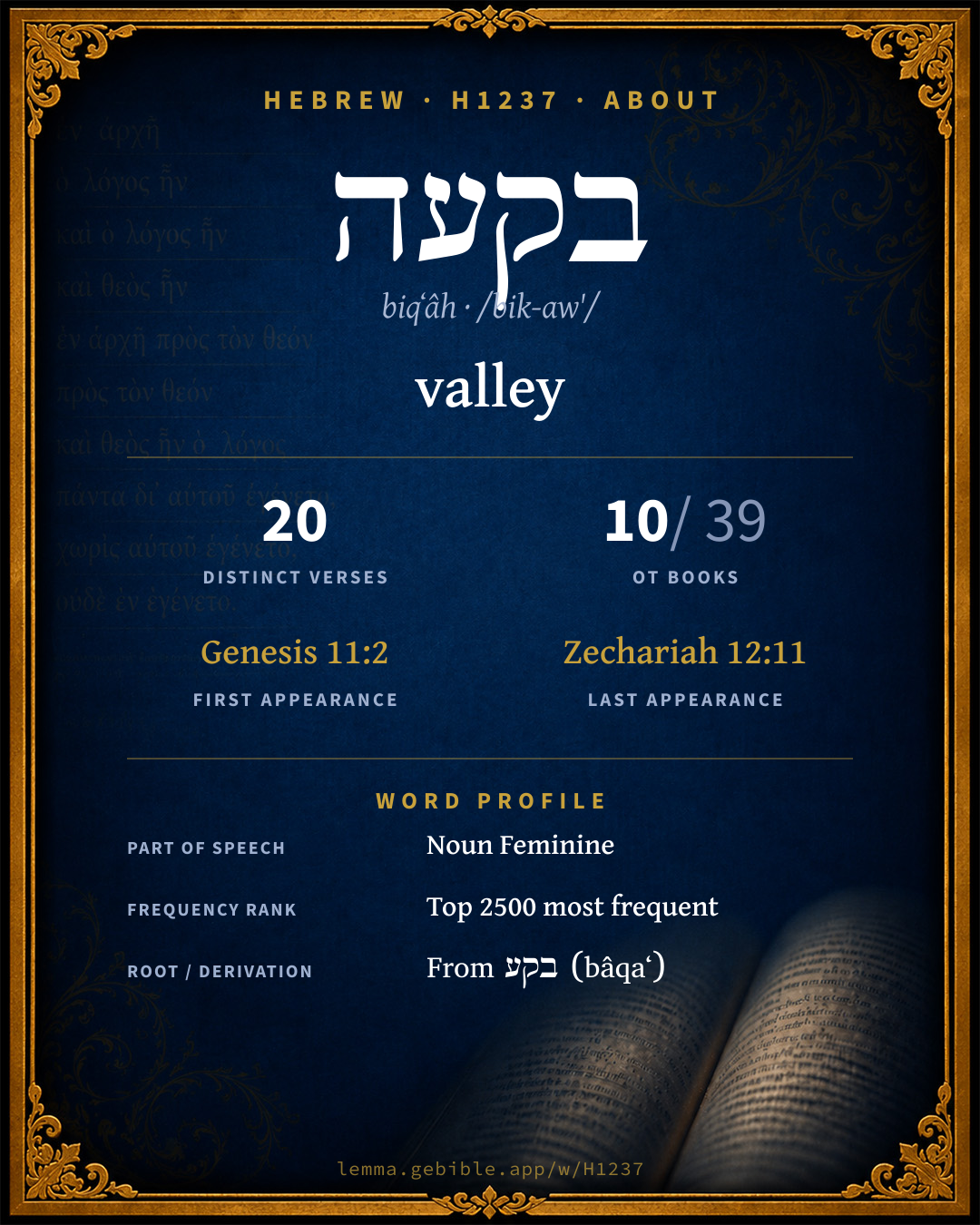
בִּקְעָה
valley
‘valley’ is one of 2 main senses fuller range ↓
Full lexicon entry — Brown-Driver-Briggs (BDB)
From Brown-Driver-Briggs (BDB)
Where this word appears
See every Absolute-state word in the Hebrew Bible →
Grammar key — what these labels mean
Part of speech
- Noun
- A naming word — a person, place, thing, or idea.
Noun type
- Common
- A common noun — a general class of person, place, or thing (“king,” “city,” “water”), not a specific name.
- Proper
- A name of a specific person, place, or people (e.g. Abraham, Zion, Israel).
State
- Construct
- A noun bound to a following noun in a possessive / “of” relationship (the construct chain).
- Absolute
- The independent form of a noun, not bound to a following word.
Gender
- Feminine
- Grammatically feminine.
Number
- Singular
- One.
- Plural
- More than one (in Hebrew, generally three or more).
Grammatical forms
- Noun, Common, Feminine, Singular, Absolute 9 times (45%)
- Noun, Common, Feminine, Singular, Construct 7 times (35%)
- Noun, Common, Feminine, Plural, Absolute 3 times (15%)
- Noun, Proper 1 time (5%)
Parsed forms decoded from the imported morphology (morphhb / Westminster Leningrad Codex — WLC text public domain, morphhb tagging CC BY 4.0), counted across 20 parsed occurrences — not distinct verses.
Every verse where H1237 appears — 20 distinct verses across 10 books. Click any verse to open its interlinear word-by-word view. Verse text shown in the World English Bible for context — . Each verse’s Hebrew form is shown with its reference; the English is not keyword-highlighted, since the data carries no word-level English alignment. Use “Compare translations” on any verse to read it across multiple English versions. This concordance covers the Hebrew Bible; Septuagint (Greek Old Testament) occurrences are not indexed here.
Genesis 1 verse
Deuteronomy 3 verses
- Deuteronomy 8:7 בַּ/בִּקְעָ֖ה prep det + n c fs For Yahweh your God brings you into a good land, a land of brooks of water, of springs and springs, flowing forth in valleys and hills;
- Deuteronomy 11:11 וּ/בְקָעֹ֑ת conj + n c fp but the land, where you go over to possess it, is a land of hills and valleys, [and] drinks water of the rain of the sky,
- Deuteronomy 34:3 בִּקְעַ֧ת n c fs cs and the South, and the Plain of the valley of Jericho the city of palm trees, to Zoar.
Joshua 3 verses
- Joshua 11:8 בִּקְעַ֥ת n c fs cs Yahweh delivered them into the hand of Israel, and they struck them, and chased them to great Sidon, and to Misrephoth Maim, and to the valley of Mizpeh eastward; and they struck them, until they left them none remaining.
- Joshua 11:17 בְּ/בִקְעַ֣ת prep + n c fs cs from Mount Halak, that goes up to Seir, even to Baal Gad in the valley of Lebanon under Mount Hermon: and all their kings he took, and struck them, and put them to death.
- Joshua 12:7 בְּ/בִקְעַ֣ת prep + n c fs cs These are the kings of the land whom Joshua and the children of Israel struck beyond the Jordan westward, from Baal Gad in the valley of Lebanon even to Mount Halak, that goes up to Seir; and Joshua gave it to the tribes of Israel for a possession according to their divisions;
2 Chronicles 1 verse
Nehemiah 1 verse
Psalms 1 verse
Isaiah 3 verses
- Isaiah 40:4 לְ/בִקְעָֽה prep + n c fs Every valley shall be exalted, and every mountain and hill shall be made low; and the uneven shall be made level, and the rough places a plain:
- Isaiah 41:18 בְּקָע֖וֹת n c fp I will open rivers on the bare heights, and springs in the midst of the valleys; I will make the wilderness a pool of water, and the dry land springs of water.
- Isaiah 63:14 בַּ/בִּקְעָ֣ה prep det + n c fs As the cattle that go down into the valley, the Spirit of Yahweh caused them to rest; so did you lead your people, to make yourself a glorious name.
Ezekiel 5 verses
- Ezekiel 3:22 הַ/בִּקְעָ֔ה ptcl def.art + n c fs The hand of Yahweh was there on me; and he said to me, Arise, go forth into the plain, and I will there talk with you.
- Ezekiel 3:23 הַ/בִּקְעָה֒ ptcl def.art + n c fs Then I arose, and went forth into the plain: and, behold, the glory of Yahweh stood there, as the glory which I saw by the river Chebar; and I fell on my face.
- Ezekiel 8:4 בַּ/בִּקְעָֽה prep det + n c fs Behold, the glory of the God of Israel was there, according to the appearance that I saw in the plain.
- Ezekiel 37:1 הַ/בִּקְעָ֑ה ptcl def.art + n c fs The hand of Yahweh was on me, and he brought me out in the Spirit of Yahweh, and set me down in the midst of the valley; and it was full of bones.
- Ezekiel 37:2 הַ/בִּקְעָ֔ה ptcl def.art + n c fs He caused me to pass by them round about: and, behold, there were very many in the open valley; and, behold, they were very dry.
Amos 1 verse
Zechariah 1 verse
About this entry
At a glance — auto-summarized from this page’s data, not written by a person. Every figure links to its source below. This summary describes the numbers; it doesn’t interpret them.
The Hebrew noun בקעה centers on the idea of “valley.” Where the King James Version says “valley,” newer translations reach for “valley of” (unfoldingWord Literal Text); the renderings breakdown has the detail. It appears 20 verses across 10 books of the Hebrew Bible, among its uncommon vocabulary. The word gravitates to Ezekiel (25%), then Deuteronomy and Joshua. The lexicon spreads it across several senses; see its full sense range. For the data behind this summary, explore the sense tree and the renderings breakdown below.
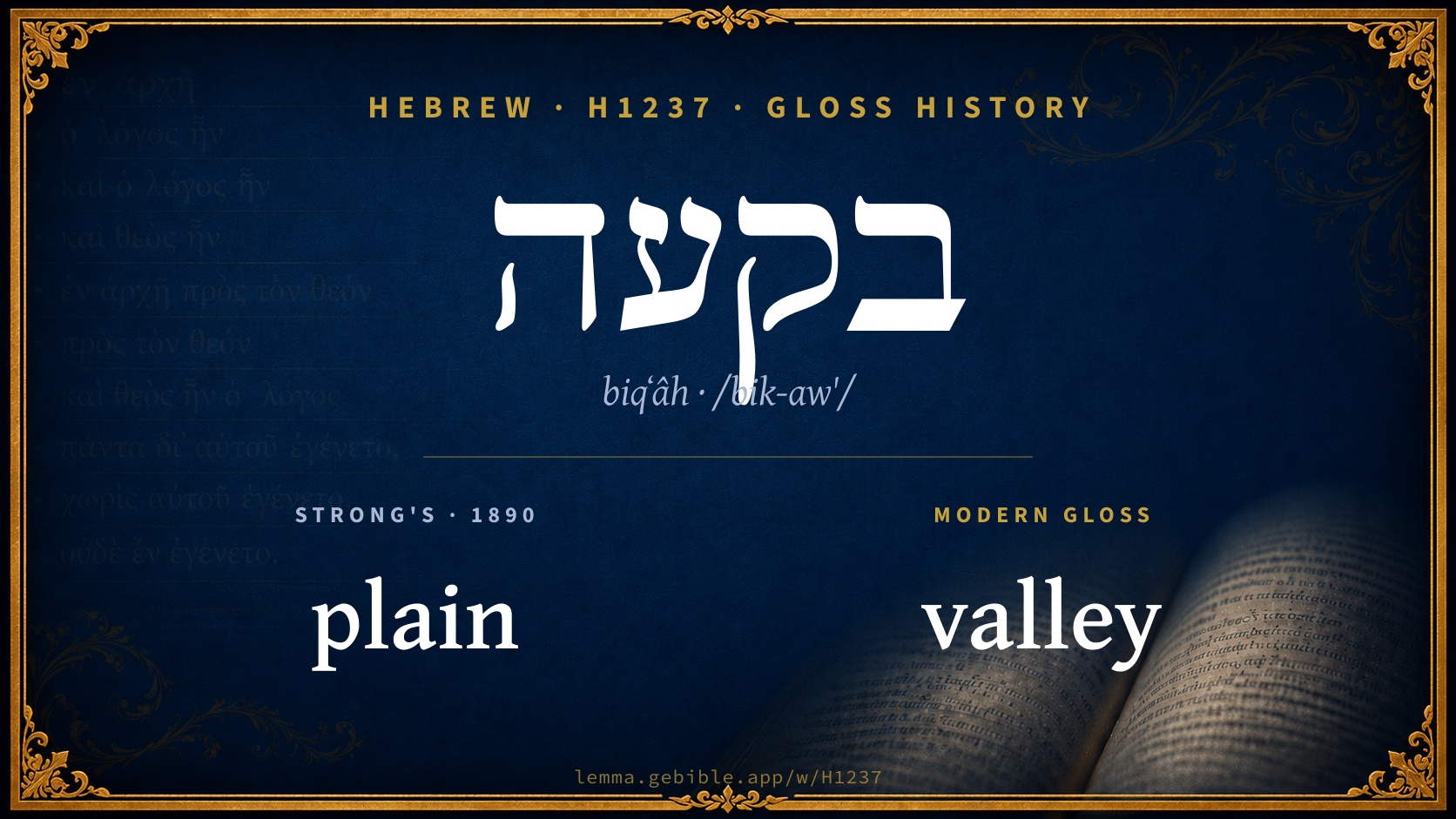
Gloss history
Strong's 1890 vs modern scholarship
About this word
Strong's H1237 catalogs a Hebrew word from the Hebrew Old Testament.
These counts are not copied from any lexicon or concordance. They are computed here, from the morphology-tagged Hebrew Old Testament. What Lemma adds →
- 20
- distinct verses
- The word appears in 20 distinct verses.
- 10 / 39
- OT books
- The word appears in 10 of 39 Old Testament books.
- #1,513
- by frequency
- Top 2500 most frequent Hebrew words (rank 1,513 of 8,640 Hebrew words by occurrence).
View all 20 occurrences in the concordance →
Most concentrated in
- Ezekiel 5 verses 25%
- Deuteronomy 3 verses 15%
- Joshua 3 verses 15%
By section of the Old Testament
By traditional corpus
Conventional, traditional groupings — biblical authorship is debated, so this is a traditional corpus grouping, not an authorship claim. Each share is this word’s portion of its verses in that division of the Hebrew canon. Each figure is a share of the word’s 20 distinct verses.
- Prophets (Nevi'im) 13 verses · 65%
- Torah (Pentateuch) 4 verses · 20%
- Writings (Ketuvim) 3 verses · 15%
How translations render this word
Counts come from each version’s own published word-to-Strong’s tagging or interlinear alignment — an approximate guide to how each version renders this word, not a word-level alignment the data otherwise carries. Because each total is that version’s own tagged count, the per-version totals vary from one another and need not match the appearance or distinct-verse counts above. These counts may also differ from a printed concordance because Lemma counts each distinctly tagged rendering and does not collapse phrase taggings into a single head-word total. This is a fixed set of word-tagged versions (KJV, ASV, BSB, ULT) and does not change with the reading translation you choose elsewhere. Each version’s license is shown beside its name below (and on Sources).
- King James Version: Valley 9×, Plain 7×, Valleys 4×
- American Standard Version: Valley 10×, Plain 6×, Valleys 4×
- Berean Standard Bible: Plain 8×, Valley 7×, Valleys 3×
- unfoldingWord Literal Text: Valley of 5×, Plain 4×, Valleys 4×
King James Version Public Domain
Renders H1237 across 20 tagged occurrences — most commonly:
American Standard Version Public Domain
Renders H1237 across 20 tagged occurrences — most commonly:
Berean Standard Bible Public Domain
Renders H1237 across 20 tagged occurrences — most commonly:
Plus 2 renderings that appear only once — usually multi-word phrases or single function words the recovered tagging swept in, not distinct renderings.
unfoldingWord Literal Text CC BY-SA 4.0
Renders H1237 across 20 tagged occurrences — most commonly:
Plus 2 renderings that appear only once — usually multi-word phrases or single function words the recovered tagging swept in, not distinct renderings.
Senses in the full BDB
What do BDB’s symbols mean?
BDB uses these scholarly abbreviations:
| Symbol | Meaning |
|---|---|
| 𝔊 | the Septuagint (the ancient Greek translation, LXX) |
| 𝔙 | the Vulgate (the Latin translation) |
| 𝔖 | the Syriac version (the Peshitta) |
| 𝔗 | the Targum (the Aramaic translation) |
| ψ | the Psalms |
| √ | root (the underlying root or stem) |
| ‖ | parallel passage (a synonymous or contrasted parallel) |
| † | the dagger: every passage where the word occurs is cited |
The 2 senses and sub-senses the full Brown-Driver-Briggs lexicon distinguishes for this word, in lexicon order (not ranked by frequency), with BDB’s own verbatim wording and sub-sense lettering. Shown in Hebrew script with BDB’s own scholarly abbreviations. The condensed entry is in the Lexicon Entry tab. See also the Forms in the corpus table below.
- 1. valley (opp. הַר mountain) Dt 8:7 11:11 cf. Is 41:18; also 63:14 כַּבְּהֵמָה בַּבִּקְעָה תֵרֵד in creation-poem ψ 104:8 יַעֲלוּ הָרִים יֵרֽדוּ בְקָעוֹת. e.g. Deuteronomy 8:7
- 2. plain (sometimes valley-plain, broad valley) Gn 11:2; also Ez 3:22, 23; 8:4; 37:1, 2 (עַל־פְּנֵי הַבּ׳) as level, opp. הָֽרְכָסִים Is 40:4 (‖ מִישׁוֹר); elsewhere cstr., mostly with n.pr. Dt 34:3 ב׳ יְרֵחוֹ (appos. הַכִּכָּר), ב׳ מִצְפֶּה Jos 11:8, ב׳ הַלְּבָנוֹן 11:17; 12:7, ב׳ מִגִדּוֹ 2 Ch 35:22 cf. Zc 12:11, ב׳ אוֹנוֹ Ne 6:2; ב׳־אָוֶן Am 1:5 plain of idolatry = Baalbek (Damascus, according to Wetzst in DeJes 3, 702; 𝔊 πέδιον Ὤν). e.g. Genesis 11:2
Senses from the full Brown-Driver-Briggs lexicon (Brown, Driver, Briggs; Oxford 1906 — public domain), digitized via Sefaria, supplemented by the OpenScriptures HebrewLexicon (CC BY 4.0). Full attribution on Sources.
Word origin
n.f. valley (cleft), plain—abs. ב׳ Gn 11:2 + 8 times; cstr. בִּקְעַת Dt 34:3 + 7 times; pl. בְּקָעוֹת Is 41:18 ψ 104:8; בְּקָעֹת Dt 11:11;—
— Brown-Driver-Briggs (Oxford 1906, public domain), digitized via Sefaria, supplemented by the OpenScriptures HebrewLexicon (CC BY 4.0). See Sources.
Derived from בקע (bâqaʻ) (H1234) — to split.
Jastrow Dictionary
A second Hebrew/Aramaic lexicon for comparison, covering Aramaic and post-biblical (Talmudic, Targumic, Midrashic) usage that the biblical-Hebrew BDB does not. Matched by lemma rather than by Strong’s number, so a lemma may carry more than one Jastrow headword (shown separately below), and the entries cover usage well beyond the Bible.
בִּקְעָה
- cut, notch, whence valley, plane; a group of fields; v. בָּאגִא; esp. a short cut for farm-laborers &c. Toh. VI, 7, a. e. הב׳ בימות החמה וכ׳ the path through the fields in summer-time (when used by field laborers) is considered as private ground with regard to Sabbath laws, as public with regard to levitical purity. B. Bath. 61ᵇ when one sells … a field בב׳ גדולה within a large group of fields (all belonging to the seller). Ib. (in a place) where they call לשדה ש׳ ולב׳ ב׳ a field sadeh and an estate bikah; a. fr.—Trnsf. an unguarded field, moral danger. Erub. 6ᵃ; 100ᵇ; Ḥull. 110ᵃ רב ב׳ מצא וכ׳ Rab found an unguarded field and fenced it in, i.e. found people transgressing the law in ignorance and instituted preventive regulations.—Pl. בְּקָעוֹת. Gen. R. s. 98.—2) (constr.) בִּקְעַת pr. n. pl. Valley of—, as ב׳ יזרעאל, ב׳ ידים &c., for all of which see the respective determinants.
A Dictionary of the Targumim, the Talmud Babli and Yerushalmi, and the Midrashic Literature (Marcus Jastrow; London, Luzac, 1903) — Public Domain. Digitized via Sefaria. Digitized via Sefaria. Full attribution on Sources.
Forms in the corpus
The 16 distinct written forms H1237 takes in the Hebrew Bible, most frequent first — each parse links to that state’s occurrences in the concordance. Hebrew forms include their vowel points and cantillation, so a single lemma takes many written forms.
Same root — word family
Other BDB entries built from the same root as H1237, grouped by Strong’s listed origin. These share a root / origin per the lexicon — not necessarily a shared meaning. Each links to that word’s own entry.
Derives from
Shares the same root
Derived from this word
Compare all same-root words → Showing 4 of 5 — not the complete family. They share a root, not necessarily a meaning.
Septuagint verse parallels
This word appears in 19 verses that also exist in the Greek Old Testament (Septuagint), out of the 20 Hebrew verses it occurs in. You can read those verses in Greek by switching the Old Testament edition to the Septuagint.
Read these verses in the Septuagint
- Genesis 11:2
- Deuteronomy 8:7
- Joshua 11:8
- 2 Chronicles 35:22
- Psalms 104:8
- Isaiah 40:4
- Ezekiel 3:22
- Amos 1:5
- Zechariah 12:11
This is a verse-level parallel only — the same verses exist in both the Hebrew and Greek Old Testaments. No word-level Hebrew↔Greek correspondence is claimed: the data carries no such alignment, so no Greek word is shown as this Hebrew word’s translation. Coverage is not total — the Septuagint omits the deuterocanon and renumbers the Psalms, so some Hebrew verses have no direct Greek parallel.