
Hosea 13:16

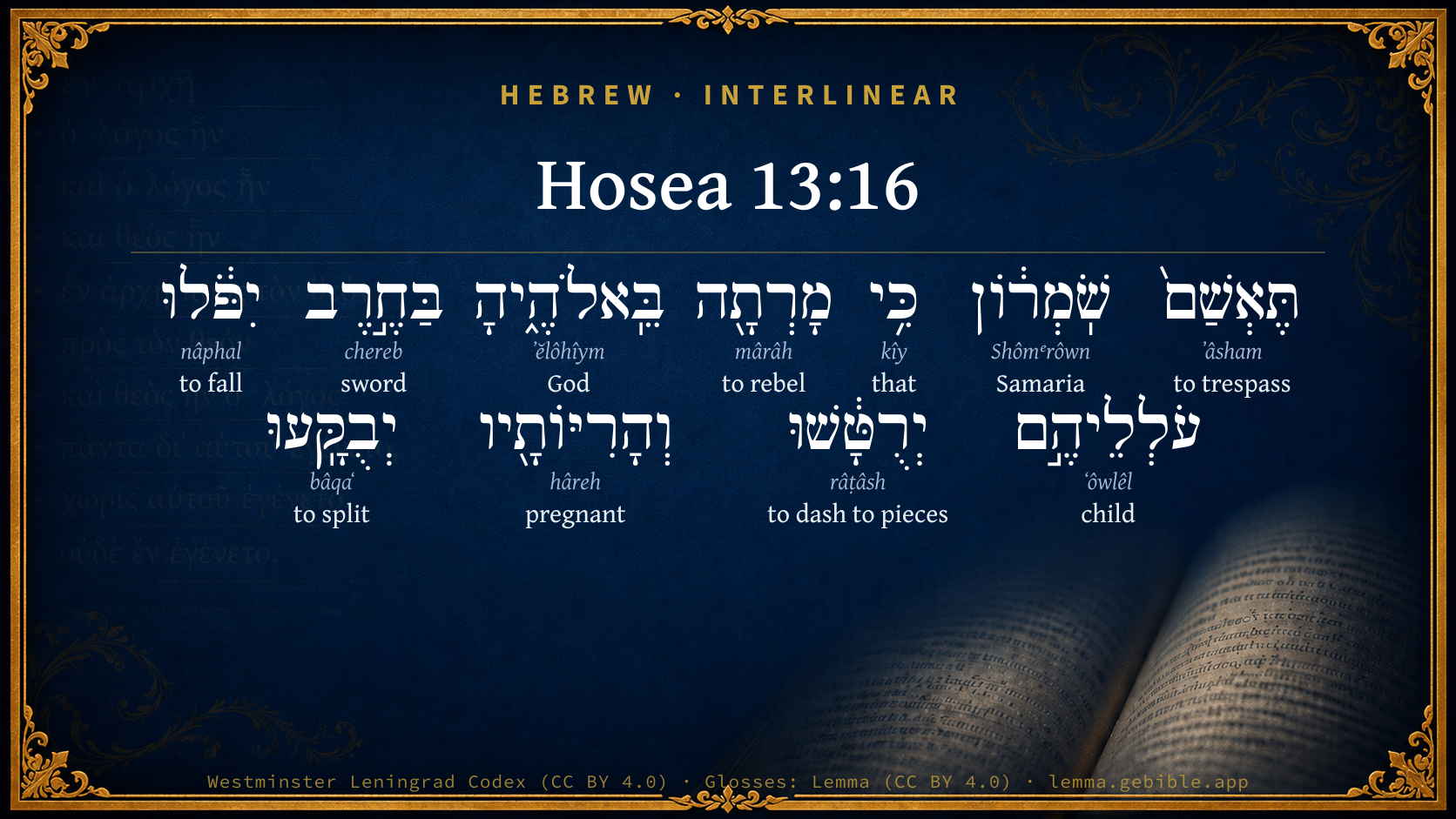
Hebrew (Westminster Leningrad Codex) Hosea 13:16 appears in the Hebrew Old Testament. The text above is from the Westminster Leningrad Codex. Each word links to its Strong’s number, a concise gloss, and parsing drawn from the Open Scriptures Hebrew Bible morphology. Click any word for its full Brown-Driver-Briggs (BDB) entry.
Download image
Cite this verse

Hosea 13:16 (World English Bible). Public Domain. Lemma interlinear Bible study tool, https://lemma.gebible.app/v/hosea/13/16.

Show BibTeX & RIS
BibTeX
RIS
English Translation
Samaria will bear her guilt; For she has rebelled against her God. They will fall by the sword. Their infants will be dashed in pieces, And their pregnant women will be ripped open."
World English Bible · Public Domain
Download a study sheet

One document with this verse’s original text, its word-by-word gloss line, the meaning frame, cross-references with their text, attributed commentary, and full source and license credits — printable, and it pastes into notes with its structure intact.

This verse Autodidact and up

Study sheet (.html) Plain text (.txt)

A passage Seminary Student

Up to 50 verses in one chapter. A passage sheet keeps up to 6 commentary sources and 12 cross-references per verse, in the order this page ranks them, and says so on the sheet whenever that leaves anything out. Ask for a single verse and you get the Autodidact verse sheet above.

Everything on this page stays free to read, with no account — the sheet is a download of what is already on screen, not access to it.

Want to remove ads? Support Godless Engineer
Compare translations 3

The same verse in 3 English versions, stacked beneath the original-language interlinear above. Click any original word for its lexicon entry.

Each is an independent rendering of the whole verse — the interlinear is not word-aligned to these translations.

Highlighted words mark where these versions differ — a whole-verse word diff, not a word-by-word alignment.

  • World English Bible Public Domain
    Samaria will bear her guilt; For she has rebelled against her God. They will fall by the sword. Their infants will be dashed in pieces, And their pregnant women will be ripped open."
  • King James Version Public Domain
    Samaria shall become desolate; for she hath rebelled against her God: they shall fall by the sword: their infants shall be dashed in pieces, and their women with child shall be ripped up.
  • unfoldingWord Literal Text CC BY-SA 4.0
    Samaria will bear guilt, for she has rebelled against her God. By the sword they will fall; their young children will be dashed to pieces, and his pregnant women will be ripped open.

unfoldingWord Literal Text — © unfoldingWord, licensed CC BY-SA 4.0. Word-aligned USFM3 via Door43 (git.door43.org/unfoldingWord/en_ult).

Versions to compare (up to 4)

3 of 4 selected

Show all 14 translations

Every available English version of this verse, each an independent rendering of the whole verse.

  • World English Bible Public Domain
    Samaria will bear her guilt; For she has rebelled against her God. They will fall by the sword. Their infants will be dashed in pieces, And their pregnant women will be ripped open."
  • Berean Standard Bible Public Domain
    Samaria will bear her guilt because she has rebelled against her God. They will fall by the sword; their little ones will be dashed to pieces, and their pregnant women ripped open.
  • Majority Standard Bible Public Domain
    Samaria will bear her guilt because she has rebelled against her God. They will fall by the sword; their little ones will be dashed to pieces, and their pregnant women ripped open.
  • King James Version Public Domain
    Samaria shall become desolate; for she hath rebelled against her God: they shall fall by the sword: their infants shall be dashed in pieces, and their women with child shall be ripped up.
  • American Standard Version (1901) Public Domain
    Samaria shall bear her guilt; for she hath rebelled against her God: they shall fall by the sword; their infants shall be dashed in pieces, and their women with child shall be ripped up.
  • Revised Version (1885) Public Domain
    Samaria shall bear her guilt; for she hath rebelled against her God: they shall fall by the sword; their infants shall be dashed in pieces, and their women with child shall be ripped up.
  • Young's Literal Translation Public Domain
    Become desolate doth Samaria, Because she hath rebelled against her God, By sword they do fall, Their sucklings are dashed in pieces, And its pregnant ones are ripped up!
  • Literal Standard Version CC BY-SA 4.0
    Samaria becomes desolate, || Because she has been rebellious against her God, || They fall by sword, || Their sucklings are dashed in pieces, || And its pregnant ones are ripped up!”
  • Unlocked Literal Bible CC BY-SA 4.0
    Samaria will be guilty, for she has rebelled against her God. They will fall by the sword; their young children will be dashed to pieces, and their pregnant women will be ripped open.
  • unfoldingWord Literal Text CC BY-SA 4.0
    Samaria will bear guilt, for she has rebelled against her God. By the sword they will fall; their young children will be dashed to pieces, and his pregnant women will be ripped open.
  • Darby Bible Public Domain
    Samaria shall bear her guilt; for she hath rebelled against her God: they shall fall by the sword; their infants shall be dashed in pieces, and their women with child shall be ripped up.
  • World Messianic Bible Public Domain
    Samaria will bear her guilt, for she has rebelled against her God. They will fall by the sword. Their infants will be dashed in pieces, and their pregnant women will be ripped open.”
  • Free Bible Version CC BY-SA 4.0
    The people of Samaria will have to bear the consequences of their guilt, because they rebelled against their God. They will be slaughtered by the sword; their children will be dashed to the ground; their pregnant women will be ripped open.
  • JPS Tanakh (1917) Public Domain
    (14-1) Samaria shall bear her guilt, for she hath rebelled against her God; they shall fall by the sword; their infants shall be dashed in pieces, and their women with child shall be ripped up.

Literal Standard Version (2020), Covenant Press — licensed CC BY-SA 4.0. Text via the HelloAO Bible API (eBible.org). Unlocked Literal Bible (unfoldingWord) — licensed CC BY-SA 4.0. Text via the HelloAO Bible API (eBible.org). unfoldingWord Literal Text — © unfoldingWord, licensed CC BY-SA 4.0. Word-aligned USFM3 via Door43 (git.door43.org/unfoldingWord/en_ult). Free Bible Version, Dr. Jonathan Gallagher — licensed CC BY-SA 4.0. Text via the HelloAO Bible API (eBible.org).

Word by word

More ways to search: Search by grammar → Find every occurrence → Compare this word →

Practice this passage: Drill this verse → Learn its vocabulary →

יְרֻטָּ֔שׁוּ
râṭâsh
H7376
“to dash to pieces”
Verb, Pual, Imperfect, 3rd Person, Masculine, Plural
Part of Speech
Verb
Stem
Pual
Form
Imperfect
Person
3rd Person
Gender
Masculine
Number
Plural
Full BDB Definition

Origin: a primitive root

TWOT: 2158

to dash to pieces - (Piel) to dash in pieces - (Pual) to be dashed in pieces
  1. תֶּאְשַׁם֙ ʼâsham H816 “to trespass” Verb, Qal, Imperfect, 3rd Person, Feminine, Singular
  2. שֹֽׁמְר֔וֹן Shômᵉrôwn H8111 “Samaria” Noun, Proper
  3. כִּ֥י kîy H3588 “that” Conjunction
  4. מָרְתָ֖ה mârâh H4784 “to rebel” Verb, Qal, Perfect, 3rd Person, Feminine, Singular
  5. בֵּֽאלֹהֶ֑יהָ ʼĕlôhîym H430 “in/at · God(s) · her” Preposition + Noun, Common, Masculine, Plural, Construct + Suffix, Personal, 3rd Person, Feminine, Singular
  6. בַּחֶ֣רֶב chereb H2719 “in/at the · sword” Preposition, Determined + Noun, Common, Feminine, Singular, Absolute
  7. יִפֹּ֔לוּ nâphal H5307 “to fall” Verb, Qal, Imperfect, 3rd Person, Masculine, Plural
  8. עֹלְלֵיהֶ֣ם ʻôwlêl H5768 “children · their” Noun, Common, Masculine, Plural, Construct + Suffix, Personal, 3rd Person, Masculine, Plural
  9. וְהָרִיּוֹתָ֖יו hâreh H2030 “and · pregnant · his” Conjunction + Adjective, Adjective, Feminine, Plural, Construct + Suffix, Personal, 3rd Person, Masculine, Singular
  10. יְבֻקָּֽעוּ bâqaʻ H1234 “to split” Verb, Pual, Imperfect, 3rd Person, Masculine, Plural

About this verse

These counts appear in no published source. They are computed here, from the morphology-tagged text and Lemma’s own curated glosses. What Lemma adds →

11
words
11
distinct lemmas
Prophets
section

Notable vocabulary

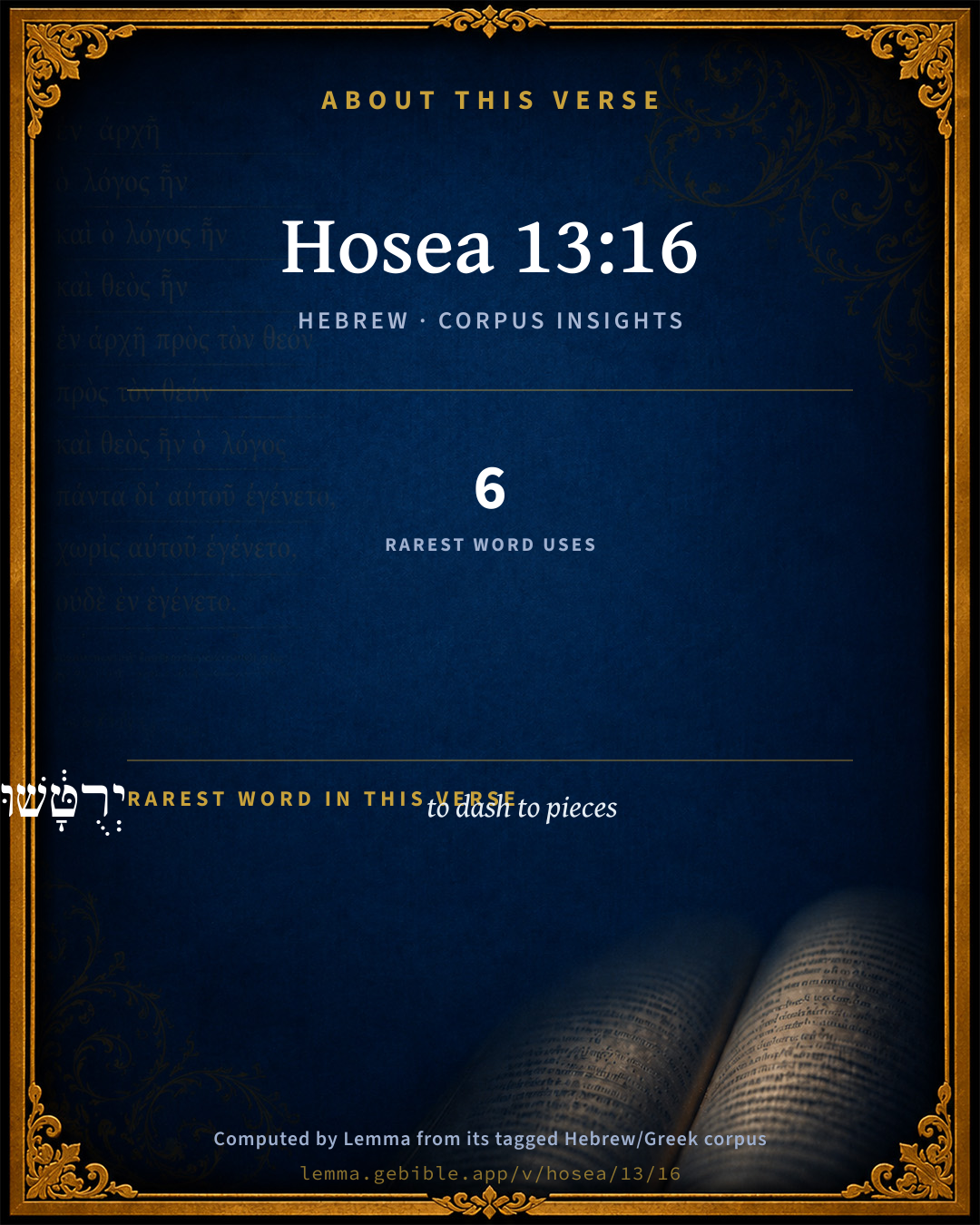
The rarest word here is יְרֻטָּ֔שׁוּ to dash to pieces H7376 — appearing just 6 times in the whole Hebrew Bible.

Shared distinctive vocabulary

יְרֻטָּ֔שׁוּ to dash to pieces H7376 occurs in 6 verses of the Hebrew Bible. Also found in:

Grammatical profile

  • 5 verbs
  • 4 nouns
  • 1 adjective
  • 1 conjunction

Verb forms

  • תֶּאְשַׁם֙ Qal · Imperfect
  • מָרְתָ֖ה Qal · Perfect
  • יִפֹּ֔לוּ Qal · Imperfect
  • יְרֻטָּ֔שׁוּ Pual · Imperfect
  • יְבֻקָּֽעוּ Pual · Imperfect

Cross-references

21

Topical passages linked to Hosea 13:16 in the Treasury of Scripture Knowledge — connected by theme and wording, ordered by reader-vote popularity; previews shown in the World English Bible.

  • 2 Kings 8:12 Hazael said, Why weeps my lord? He answered, Because I know the evil that you will do to the children of Israel: their strongholds will you set on fire, and their young men will you kill with the sword, and will dash in pieces their little ones, and rip up their women with child.
  • 2 Kings 15:16 Then Menahem struck Tiphsah, and all who were therein, and the borders of it, from Tirzah: because they didn't open to him, therefore he struck it; and all the women therein who were with child he ripped up.
  • Psalms 137:8–9 Daughter of Babylon, doomed to destruction, He will be happy who rewards you, As you have served us.
  • Isaiah 13:16 Their infants also shall be dashed in pieces before their eyes; their houses shall be rifled, and their wives ravished.
  • Amos 1:13 Thus says Yahweh: "For three transgressions of the children of Ammon, yes, for four, I will not turn away its punishment; Because they have ripped open the pregnant women of Gilead, That they may enlarge their border.
  • Nahum 3:10 Yet was she carried away. She went into captivity. Her young children also were dashed in pieces at the head of all the streets, and they cast lots for her honorable men, and all her great men were bound in chains.
  • 2 Kings 17:6 In the ninth year of Hoshea the king of Assyria took Samaria, and carried Israel away to Assyria, and placed them in Halah, and on the Habor, the river of Gozan, and in the cities of the Medes.
  • 2 Kings 17:18 Therefore Yahweh was very angry with Israel, and removed them out of his sight: there was none left but the tribe of Judah only.
  • 2 Kings 19:9–11 When he heard say of Tirhakah king of Ethiopia, Behold, he is come out to fight against you, he sent messengers again to Hezekiah, saying,
  • Isaiah 7:8–9 For the head of Syria is Damascus, and the head of Damascus is Rezin; and within sixty-five years Ephraim shall be broken in pieces, so that it shall not be a people;
  • Isaiah 8:4 For before the child shall have knowledge to cry, My father, and, My mother, the riches of Damascus and the spoil of Samaria shall be carried away before the king of Assyria.
  • Isaiah 17:3 The fortress shall cease from Ephraim, and the kingdom from Damascus, and the remnant of Syria; they shall be as the glory of the children of Israel, says Yahweh of Hosts.
  • Hosea 7:14 They haven't cried to me with their heart, But they howl on their beds. They assemble themselves for grain and new wine. They turn away from me.
  • Hosea 10:2 Their heart is divided. Now they will be found guilty. He will demolish their altars. He will destroy their sacred stones.
  • Hosea 10:14–15 Therefore a battle roar will arise among your people, And all your fortresses will be destroyed, As Shalman destroyed Beth Arbel in the day of battle. The mother was dashed in pieces with her children.
  • Hosea 11:6 The sword will fall on their cities, And will consume their gate bars, And will put an end to their plans.
  • Amos 3:9–4:1 Proclaim in the palaces at Ashdod, And in the palaces in the land of Egypt, And say, "Assemble yourselves on the mountains of Samaria, And see what unrest is in her, And what oppression is among them."
  • Amos 6:1–8 Woe to those who are at ease in Zion, And to those who are secure on the mountain of Samaria, The notable men of the chief of the nations, To whom the house of Israel come!
  • Amos 9:1 I saw the Lord standing beside the altar, and he said, "Strike the tops of the pillars, that the thresholds may shake; and break them in pieces on the head of all of them; and I will kill the last of them with the sword: there shall not one of them flee away, and there shall not one of them escape.
  • Micah 1:4 The mountains melt under him, And the valleys split apart, Like wax before the fire, Like waters that are poured down a steep place.
  • Micah 6:16 For the statutes of Omri are kept, And all the works of the house of Ahab. You walk in their counsels, That I may make you a ruin, And her inhabitants a hissing; And you will bear the reproach of my people."

Cross-references courtesy of OpenBible.info (CC BY 4.0).

Hebrew and Greek witnesses Masoretic Hebrew ↔ Greek Septuagint

The same verse in the two great witnesses to the Old Testament, shown verse-for-verse.

These are two independent witnesses, not word-aligned to each other, and the Septuagint is shown in lemma (dictionary) form.

Hebrew Hosea 13:16 Masoretic · Westminster Leningrad Codex

תֶּאְשַׁם֙ שֹֽׁמְר֔וֹן כִּ֥י מָרְתָ֖ה בֵּֽאלֹהֶ֑יהָ בַּחֶ֣רֶב יִפֹּ֔לוּ עֹלְלֵיהֶ֣ם יְרֻטָּ֔שׁוּ וְהָרִיּוֹתָ֖יו יְבֻקָּֽעוּ

Samaria will bear her guilt; For she has rebelled against her God. They will fall by the sword. Their infants will be dashed in pieces, And their pregnant women will be ripped open."

World English Bible · Public Domain

On this verse, The Pulpit Commentary discusses the Septuagint’s reading. Read the note in Commentary ↓

Hebrew: Westminster Leningrad Codex (CC BY 4.0). Greek: Septuagint (public domain); English from a public-domain English Septuagint. How the Septuagint differs from the Hebrew →

Commentary

Notes on Hosea 13:16 from classic Christian and Jewish commentators (each source and its license shown beneath its notes). The classic Christian expositions comment on the surrounding passage and are grouped to its opening verse, so a note may address several verses; the Jewish commentaries on the Tanakh (Rashi and others) are per-verse, so they appear only where the commentator wrote on this verse.

Lemma curates 59 commentaries, every one of them public domain or Creative Commons licensed, each selected and text-cleaned for this edition rather than reprinted as found. About our sources →

Trapp's Complete Commentary

John Trapp

Hos 13:16 Samaria shall become desolate; for she hath rebelled against her God: they shall fall by the sword: their infants shall be dashed in pieces, and their women with child shall be ripped up.

Ver. 16. Samaria shall become desolate] Here many begin the fourteenth chapter, but not so well; for this verse evidently cohereth with the former, and showeth that Ephraim shall not only be plundered, but butchered by the Assyrian by their own default. "Samaria shall become desolate," or be found guilty, rea peragetur, (as the Chaldee hath it, and the words may bear). How can she be otherwise, whereas

she hath rebelled against her God] She hath embittered him, or bitterly provoked him to wrath, {as Hos 12:14} {See Trapp on "Hos 12:14"} who therefore sent in the Assyrian to desolate her: "that bitter and hasty nation, to march through the breadth of the land, to possess the dwellingplaces that were not theirs," Hab 1:6. This was a bitter affliction, but behold a worse:

They shall fall by the sword] They shall lose not their land only, and the treasure of all their pleasant vessels, as Hos 13:15, but their dearest lives, which to save a man will gladly part with all that he hath, Job 2:4, or submit to any servile employment, as the Gibeonites in Joshua’s days did; who were willing to take hard on as slaves and underlings rather than to be cut off with the rest of the Canaanites.

Their infants shall be dashed in pieces] Sept. τα υποτιτθια αυτων, their sucklings, that are ordinarily spared for their innocence, ignorence, &c. See Hos 10:14, with the note; and consider that infants are not so innocent (though they have yet done neither good nor evil) but that God may justly inflict upon them all torments here, and tortures in hell, for the guilt of original sin that cleaveth to their natures. Howbeit this excuseth not the barbarous cruelty of his executioners, who shall be surely and suitably punished, Psa 137:8.

And their women with child shall be ripped up] Of this kind of savage inhumanity, see Amo 1:13 2Ki 8:12; 2Ki 15:16, where you shall find that the tyrant Menahem ripped the infants of Tiphsah out of their mothers’ bellies, because their fathers opened not the gates unto him. The like cruelty was exercised in the Sicilian Vespers and Parisian Massacre, by those Romish Edomites; maugre whose malice Ephraim is yet fruitful, the Church flourisheth.

Sanguine fundata est Ecclesia, sanguine crescit.

By blood the church is established, by blood she thrives.

John Trapp, A Commentary or Exposition upon All the Books of the Old and New Testament (1647–1656) — public domain. Text from a community e-Sword module.

Albert Barnes' Notes on the Bible

Samaria shall become desolate - Or “shall bear her iniquity.” Her iniquity should now find her out, and rest upon her. Of this, “desolation” was, in God’s judgments, the consequence. Samaria, “the nursery of idolatry and rebellion against God,” the chief in pride should be chief in punishment. “For she hath rebelled against her God.” It aggravated her sin, that He “against” whom “she rebelled,” was “her” own “God.” He who had chosen her to be His, and made Himself her God; who had showed Himself “her” God in the abundance of His loving-kindness, from the deliverance out of Egypt to that day. This her desolation, it is again said, should be Complete. Hope remains, if the people of a generation are cut off; yet not only should these fall by the sword; those already born were to be dashed in pieces; those as yet unborn were to be sought out for destruction, even in their mother’s womb. Such atrocities were common then. Elisha foretold to Hazael that he would perpetrate both cruelties 2Ki 8:12, Shalmaneser clashed the young children in pieces 2Ki 10:14, as did the conqueror of NoAmmon Nah 3:10, and the Babylonians Psa 137:9 afterward. The children of Ammon ripped up the women with child in Gilead Amo 1:13, and the usurper Menahem in Tiphsah and its coasts 2Ki 15:16. Isaiah prophesies that Babylon should undergo, in its turn, the same as to its children Isa 13:16, and the Psalmist pronounces God’s blessing on its destroyer who should so requite him Psa 137:9.

Such was to be the end of the pride, the ambition, the able policy, the wars, the oppressions, the luxury, the self-enjoyment, and, in all, the rebellion of Samaria against “her” God. She has stood the more in opposition to God, the nearer she might have been to Him, and “bare her iniquity.” As a city of God’s people, it was never restored. The spot, in its pagan colonists, with which Assyrian policy repopulated it 2Ki 17:24, was still the abode of a mingled religion. Corruption clung, by inheritance, to its site. This too was destroyed by John Hyrcanus. “He effaced thee marks that it had ever been a city” . It was rebuilt by the Romans, after Pompey had taken Jerusalem . Herod reenclosed a circuit of two miles and a half of the ancient site, fortified it strongly, as a check on the Jews; repopulated it, partly with some who had served in his wars, partly with the people around; gave them lands, revived their idolatry by replacing their poor temple by one remarkable for size and beauty, in an area of a furlong and a half; and called the place Sebaste in honor of his pagan patron, Augustus .

A coin of Nero, struck there, bears the figure (it is thought) of its old idol, Ashtaroth . Jerome says, that John the Baptist was buried there . The pagan, who were encouraged in such desecrations by Julian the Apostate , opened the tomb, burned the bones, and scattered the dust . The city became a Christian See, and its Bishops were present at the four first General Councils . It is now but a poor village, connected with the strongly-fortified town of Herod by its pagan name Sebastieh, a long avenue of broken pillars, and the tomb of the great Forerunner . Of the ancient capital of Ephraim, not even a ruin speaks.

The prophet closes this portion of his prophecy, as other prophets so often do, with the opposite end of the righteous and the wicked. He had spoken of the victory over death, the irrevocable purpose of God for good to his own; then he speaks of utter final destruction. Then when the mercy of God shall be shown to the uttermost, and the victory over sin and death shall be accomplished, then shall all the pomp of the its riches, joys, luxuries, elegance, glory, dignity; perish and not a wreck be left behind of all which once dazzled the eyes of people, for which they forsook their God, and sold themselves to evil and the evil one.

Albert Barnes' Notes on the Bible (1834–1885) — public domain. Text from a community e-Sword/MySword module.

Joseph Benson's Commentary

Hos 13:16. Samaria shall become desolate, for she hath rebelled, &c. — The prophet foretels the final destruction of Samaria, for her idolatry and other impieties, by Shalmaneser, king of Assyria. Their infants shall be dashed in pieces, &c. — These were the barbarous practices of conquerors when they took cities by storm, or put all to the sword without distinction of age or sex: see the margin.

Joseph Benson's Commentary on the Old and New Testaments (1811–1818) — public domain. Text from a community e-Sword module.

Tyndale Open Study Notes

Tyndale Open Resources

13:16 In 722 BC, Assyria captured Samaria, the capital of the northern kingdom (2 Kgs 17:5-6). Thousands died during the three-year siege, and thousands more were sent into exile. This was because they rebelled against their God. • The horrible practice of killing pregnant women is also mentioned in Amos 1:13 and 2 Kgs 15:16.

Tyndale Open Study Notes — © Tyndale Open Resources, licensed CC BY-SA 4.0. Text via the HelloAO Bible API.

Jamieson, Fausset & Brown

Robert Jamieson, A. R. Fausset & David Brown

This verse and Hos 13:15 foretell the calamities about to befall Israel before her restoration (Hos 13:14), owing to her impenitence.

her God--the greatest aggravation of her rebellion, that it was against her God (Hos 13:4).

infants . . . dashed in pieces, &c.-- (Kg2 8:12; Kg2 15:16; Amo 1:13).

Next: Hosea Chapter 14

Jamieson, Fausset & Brown — Commentary Critical and Explanatory on the Whole Bible (1871) — public domain (CC PDM 1.0). Text via the HelloAO Bible API.

Adam Clarke's Commentary

Verse 16. Samaria shall become desolate] This was the capital of the Israelitish kingdom. What follows is a simple prophetic declaration of the cruelties which should be exercised upon this hapless people by the Assyrians in the sackage of the city.

Adam Clarke's Commentary on the Bible (1810–1826) — public domain. Text from a community e-Sword/MySword module.

John Calvin's Commentaries

This is the conclusion of the discourse: this verse has then been improperly separated from the former chapter ; for the Prophet enters not here on a new subject, but only confirms what he had said of the ultimate destruction of Samaria and of the whole kingdom. Samaria then shall be desolated; as though he said “I have already often denounced on you what you believe not, that destruction is nigh at hand; of this be now persuaded; but if you believe not, God will yet execute what he has determined, and what he now pronounces by my mouth.” At the same time he adds the cause, For they have provoked their God That they might not complain that they were severely dealt with, he says, that they only suffered the punishment which they deserved. He also specifies the kind of destruction that was to be, They shall fall by the sword, their children shall be dashed in pieces, and their pregnant women shall be torn asunder, that the child may be extracted from the womb. In saying that the citizens of Samaria, and the inhabitants of the whole country, shall fall by the sword, he doubtless intimates that God would make use of this kind of punishment by sending for enemies who would consign them to destruction.

We now then see what is included in the words of the Prophet. He first shows that it was all over with Samaria and the whole kingdom of Israel; as God could by no means bring them to repentance, he would now take vengeance on so desperate an obstinacy. He afterwards shows that God would do this justly, because he had been provoked; and, lastly, he shows what kind their punishment would be. That they might not think that the Assyrians would come by chance, the Prophet says that this army, which was to invade and destroy the country of Samaria, would be, as it were, conducted by the hand of God; for though the Assyrians wished to extend their own borders, and were influenced by their own avarice and cupidity, yet God would use them as instruments to execute his own judgement; and that they might know how dreadful the vengeance would be, he relates two kinds of evils, — that their children would be dashed in pieces, and that their women would be rent asunder, and their offspring extracted from their wombs. Even to speak of this is horrible; and it is what never takes place, except when enemies are greatly enraged and extremely provoked. We now then comprehend the meaning of the Prophet.

But if any one objects and says, that infants, and babes as yet concealed in the wombs of their mothers, deserve not such a grievous punishment, as they have not hitherto merited such a thing; it may be answered, that the whole human race are guilty before God, so that infants though not yet come forth to the light, are yet included as being under guilt; so that God cannot be charged with cruelty, though he may use his own right towards them. And further, we hear what he declares in many places, that he will devolve the sins of parents on their children. Since it is so, let us learn to acquiesce in these awful judgements of God, though very repugnant to our feelings; for we know that we must not contend with God, and that it would be extreme presumption to do so; nay, it would be impious audacity. Though then the reason for this punishment may not appear to us, we ought yet reverently to regard this judgement of God. We may moreover thus reason — If infants be not spared, even those as yet hid in the mother’s womb, what will become of adults? what will become of the old, who through their whole life have continued to provoke the vengeance of God? The Lord no doubt intended by these words to terrify those godless despisers of his word, with whom he had to do. “How great a judgement,” he says, “hangs over you, and how tremendous! since your infants shall not be exempted: for I shall involve you in the same judgement, when they shall be dashed against the stones, after having been drawn out of their mothers’ womb. When such a dreadful punishment shall be inflicted on them, what shall be done to you? for the cause of the evil exists in you.” We have now then explained this verse. Then follows an exhortation.

John Calvin's Commentaries (1540-1563) — public domain. Text from the Calvin Translation Society English edition (1840s-50s) via the Christian Classics Ethereal Library (ccel.org). Calvin's coverage is partial (roughly two-thirds of the Bible); uncommented books and verses are honest gaps, never fabricated. The 19th-century editor's footnotes and remarks are omitted so the notes are faithfully Calvin's own voice.

The Cambridge Bible for Schools and Colleges

gen. ed. J. J. S. Perowne

16. become desolate] Rather, be dealt with as guilty (as Hos_10:2).

their infants, &c.] Rather, their children (those of an age to play, comp. Jer_6:11; Jer_9:20). The same barbarities were predicted in Hos_10:14. Such a fate would be simply retributive justice (see 2Ki_15:16).

The Cambridge Bible for Schools and Colleges (gen. ed. J. J. S. Perowne; Cambridge University Press, 1878–1918) — public domain. Text from a community e-Sword module.

John Gill's Exposition

Samaria shall become desolate,.... With this verse the fourteenth chapter begins in the Hebrew copies, and in the Targum, and in many versions; but seems better to conclude the present chapter; since it is in close connection with Hos 13:15, and explains the figurative expressions there used. Samaria was the head of Ephraim, Isa 7:9; or the metropolis of the ten tribes of Israel; whose desolation is here prophesied of, and was accomplished by Shalmaneser king of Assyria, signified by the east wind; by whom it was not only besieged and taken, but very probably its houses were demolished, its walls broken down, and razed to the very foundation; see Kg2 17:5; and, as this was the head city, it may be put for all the rest, and even for the whole land, which was at the same time laid waste. The Targum is,

"Samaria shall be guilty;''

that is, shall be found guilty of many sins; her transgression shall be revealed, as Jarchi, become manifest by the just punishment inflicted on her;

for she hath rebelled against her God; and bitterly provoked him to wrath and anger, as the word (u) signifies; by relinquishing him and his worship, and by serving idols, the calves at Dan and Bethel, Baal and other idols; when the Lord was their God, not only by creation, as of all men, but by the choice he made of them, and the covenant he made with them; by a national adoption of them, attended with various blessings and privileges, and by their profession of him; all which were an aggravation of their rebellion against him;

they shall fall by the sword: the inhabitants of Samaria, and of the land, particularly the men thereof; and especially their armed men, their men of war, that fought for them, and defended them; these should fall by the sword of the Assyrian;

their children shall be dashed to pieces; against stones, walls, and pavements; who should have perpetuated their name to future ages, and inherited their possessions:

and their women with child shall be ripped up; things which are often done by cruel enemies, when cities are sacked and plundered; and which Shalmaneser might be provoked unto by the perfidy of the king of Israel, and by the city of Samaria holding out a three years' siege. This, though we have no account of as done at that time, yet no doubt was; even as the same things are predicted of Jerusalem by the Chaldeans, and which were to be done to them, in retaliation for them, though there is no narrative of them; see Psa 137:8.

(u) "ad amaritudinem concitavit", V. L. "significat amaricare, vel amaritudine replere", Rivet.

Next: Hosea Chapter 14

John Gill's Exposition of the Whole Bible (1746–1763) — public domain (CC PDM 1.0). Text via the HelloAO Bible API.

Matthew Poole's English Annotations

Samaria, the chief or royal city of the kingdom of Israel,

shall become desolate; besieged, taken, plundered, and sacked, probably it was razed to the foundation, by the Assyrians, provoked by the treachery first, and by the obstinacy next, of Hoshea, maintaining the siege against Shalmaneser three years, 2Ki 17:5.

Rebelled against her God; both cast off his worship and set up idolatry, and also shook off the yoke of David’s house and set up new kings, and maintained both long against God.

They, the inhabitants of Samaria, and also the subjects of the kingdom of Israel, shall fall by the sword; be cut off in war by the prevailing arms of the king of Assyria.

Their infants shall be dashed in pieces; a most barbarous piece of cruelty, yet usually practised in those countries when they were enraged against a people.

Their women with child shall be ripped up; another kind of like or greater inhumanity. Thus Shalman raged against Arbel in the day of battle, and this confirms what the prophet saith Hos 10:14. And this was no doubt executed upon Samaria when it was taken, so their springs (women and children, which are as fountains) were all dried up.

Matthew Poole's English Annotations on the Holy Bible (1683–1685) — public domain. Text from a community e-Sword/MySword module.

The Pulpit Commentary

Samaria shall become desolate; for she hath rebelled against her God. Others translate shall atone, i.e. bear guilt or punishment. In the latter sense it is from to atone or suffer the punishment of contracted guilt; in the former sense it is from and it is translated accordingly by afanisyhdetai in the LXX, and pereat by Jerome; so also Aben Ezra: "It shall be laid waste;" Kimchi: "The aleph has sehwa alone, and the signification "desolation," and so the dwellers therein shall be made desolate." He thus intimates that aleph, having schaa alone without seghol, does not belong to the root, which is not (for its future would be but Rashi, however, understands it in the sense of "atone," or "find out her guiltiness;" he says, "From now will her guilt manifest itself." The reason of Samaria being thus mentioned is not only that it was the capital of the northern kingdom, but, as Kimchi says, "it confirmed Israel in the worship of the calves; for if the kings had been good, they would have brought back Israel to what was good." The ki assigns the reason of Samaria"s desolation or guilt; it was rebellion against Jehovah, for Samaria was the seat and center of idolatry, and hence it spread throughout the land. They shall fall by the sword: their infants shall be dashed in pieces, and their women with child shall be ripped up. The destruction thus described was to be complete. The present population would perish by the sword; the future progeny would be extinguished and all posterity cut off. Not only the children already born, but those unborn, were devoted to destruction; and all this in the most savage and barbarous manner. The word llewO (from ll, to meddle, gratify one"s self, indulge one"s caprice) presents childhood on the side of playfulness or petulance. The pronominal suffix attached to yrh refers to the city; and the feminine noun itself, forming subject to verbs in the masculine, arises from the fact that the feminine of the imperfect plural becomes rarer; or because the feminine plural only gradually distinguishes itself by a peculiar form from the masculine. The cruelties here specified may have been occasioned by those of the same kind with which Menahem King of Samaria smote Tiphsah. On that occasion "all the women therein that were with child he ripped up". (compare, for the cruel practice, "Iliad," 2Ki_8:12 and 2Ki_15:16)

Rebellion against God.

Samaria here is no doubt put for the Israelitish kingdom, of which that city was the capital. The seat of government concentrates within itself the various elements of the national life. If there be profligacy, ambition, cruelty, treachery, self-seeking, in a nation, these qualities will be preeminently apparent in the capital. Israel, in the person of her monarch and her capital, "rebelled against her God.

I THE SYMPTOMS OF REBELLION. These are:

1. The defiance of rightful authority. When God"s Name is profaned, and God"s laws are violated, and God"s threatenings are despised, this is a sign that those who are bound to be loyal subjects are so far from fulfilling their obligations that they are in rebellion.

2. The substitution of another authority for that of the Supreme. Whether this be an idol, or a hierarchy of pagan deities, or some selfish, carnal, worldly principle, is of little consequence; the allegiance has been transferred.

II THE WICKEDNESS OF REBELLION. Samaria"s special sin was in rebelling against her God. It is the consideration that God has done everything for us; that he has regarded us as his own, and treated us with bounty, forbearance; and loving-kindness, that, in a word, he has every claim upon us; it is this that brings home the charge of rebellion, and exhibits it in all its heinousness.

III THE END OF REBELLION. This must be either

(1) submission with true repentance, or

(2) conquest and destruction. The Lord shall have the defiant rebels in derision, and break them with a rod of iron. T.

The Pulpit Commentary (1880–1919), ed. H.D.M. Spence-Jones & Joseph S. Exell — public domain. Text from a community e-Sword module.

Keil & Delitzsch

C. F. Keil & F. Delitzsch

(Heb. Bibl. Hos 14:1). "Samaria will atone, because it has rebelled against its God: they will fall by the sword; their children will be dashed to pieces, and its women with child ripped up." אשׁם, to atone, to bear the guilt, i.e., the punishment. It is not equivalent to shâmēm in Eze 6:6, although, as a matter of fact, the expiation consisted in the conquest and devastation of Samaria by Shalmanezer. The subject to yippelū (will fall) is the inhabitants of Samaria. The suffix to הריּותיו (its women, etc.) refers to the nation. The form הריּה is one derived from הרה, for הרה (Ewald, 189, c). The construction with the masculine verb יבקּעוּ, in the place of the feminine, is an anomaly, which may be explained from the fact that feminine formations from the plur. imperf. are generally very rare (see Ewald, 191, b). For the fact itself, compare Hos 10:14; Kg2 8:12; Kg2 15:16; Amo 1:13.

Keil & Delitzsch — Biblical Commentary on the Old Testament (1861–1891) — public domain (CC PDM 1.0). Text via the HelloAO Bible API. (Old Testament only.)

unfoldingWord translationNotes

Door43 World Missions Community

General Information:

Hosea the prophet is speaking.

Samaria will be guilty, for she has rebelled against her God

Here "Samaria" refers to the people in the city of Samaria who are guilty of rebelling against God. (See: Metonymy)

They will fall

Here to "fall" represents dying. (See: Euphemism)

by the sword

Here the "sword" represents the enemy soldiers who used swords in battle. (See: Metonymy)

their young children will be dashed to pieces, and their pregnant women will be ripped open

These phrases can be put into the active voice. AT: "the enemy will dash their young children to pieces, and they will rip open the pregnant women" (See: Active or Passive)

translationWords

Samaria

guilt

rebel

God

sword

unfoldingWord translationNotes — © Distant Shores Media and the Door43 World Missions Community, licensed CC BY-SA 4.0. Source: git.door43.org/Door43/en_tn.

Lesson kit

Teaching starters — assembled from the data on this page, not authored interpretation. Every prompt links to the verse data it draws on. Edit before teaching.

Hosea, in the Prophets, opens this verse with 11 words (11 distinct Hebrew lemmas). Its most distinctive word is râṭâsh (“to dash to pieces”). A historical commentator’s framing appears above. Read the whole chapter for the surrounding context.

Discussion questions

  1. How does “to dash to pieces” (râṭâsh) shape what this verse is saying?
  2. How does 2 Kings 8:12, which shares the word «to dash to pieces», read alongside this verse?
  3. These translations render this verse differently. What is at stake in choosing one wording over another?
  4. «תֶּאְשַׁם֙» is a Qal Imperfect verb. How does that grammatical form shape the action described?
  5. Compare how Trapp's Complete Commentary and Albert Barnes' Notes on the Bible read this verse. Where do they agree or differ?

Things to notice

Reading settings

Reading text

Shown beneath each verse's original-language words.

Old Testament
Old Testament edition

Read the OT as the Masoretic Hebrew (MT) or the Greek Septuagint (LXX).

English shown for the Greek Septuagint (in the Hebrew ↔ Greek comparison).

Comparing translations? Open the Compare panel on any verse page to stack up to four side by side.