Isaiah 59:5

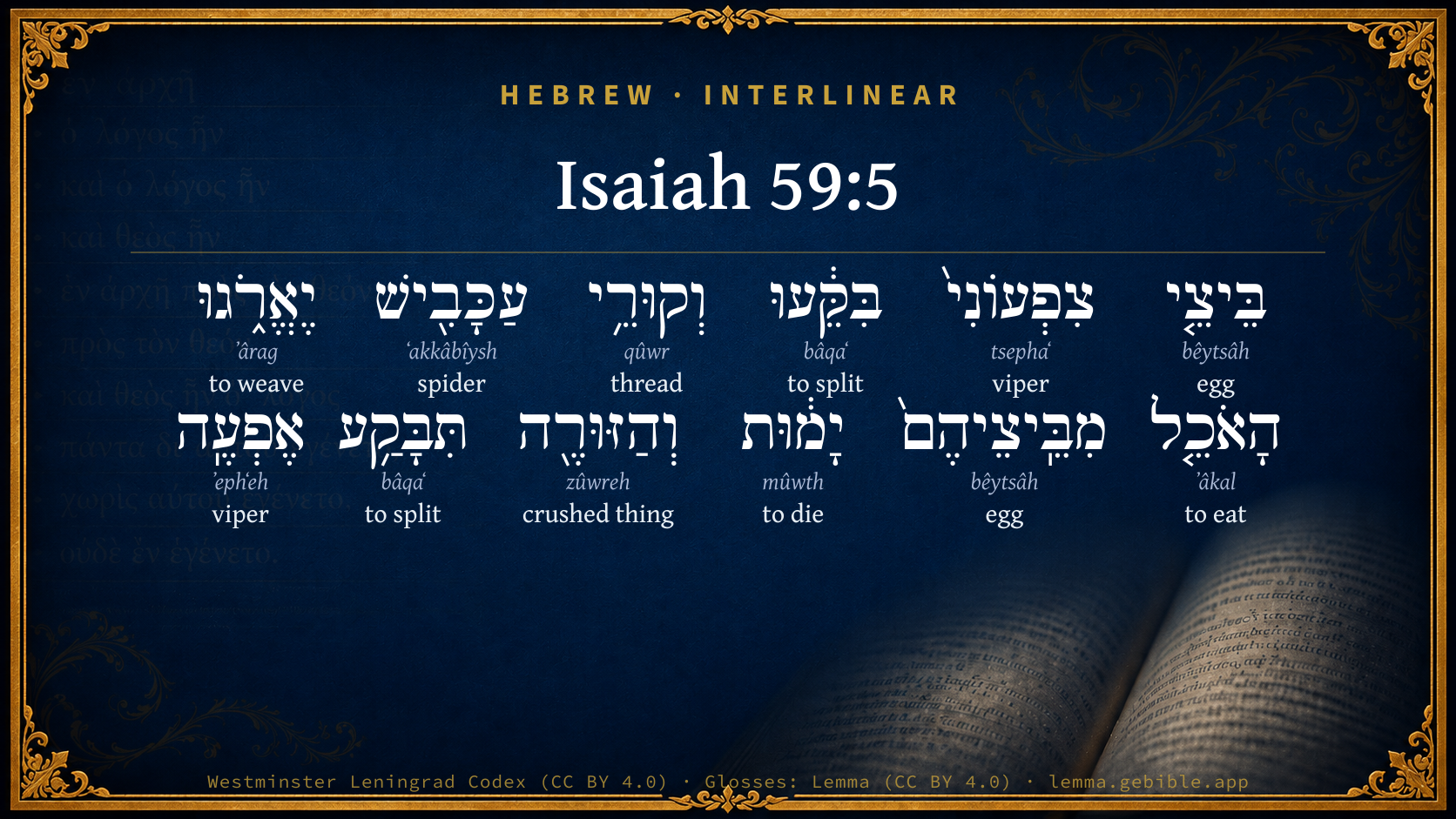
Hebrew (Westminster Leningrad Codex) Isaiah 59:5 appears in the Hebrew Old Testament. The text above is from the Westminster Leningrad Codex. Each word links to its Strong’s number, a concise gloss, and parsing drawn from the Open Scriptures Hebrew Bible morphology. Click any word for its full Brown-Driver-Briggs (BDB) entry.
Download image
Cite this verse

Isaiah 59:5 (World English Bible). Public Domain. Lemma interlinear Bible study tool, https://lemma.gebible.app/v/isaiah/59/5.

Show BibTeX & RIS
BibTeX
RIS
English Translation
They hatch adders' eggs, and weave the spider's web: he who eats of their eggs dies; and that which is crushed breaks out into a viper.
World English Bible · Public Domain
Highlights
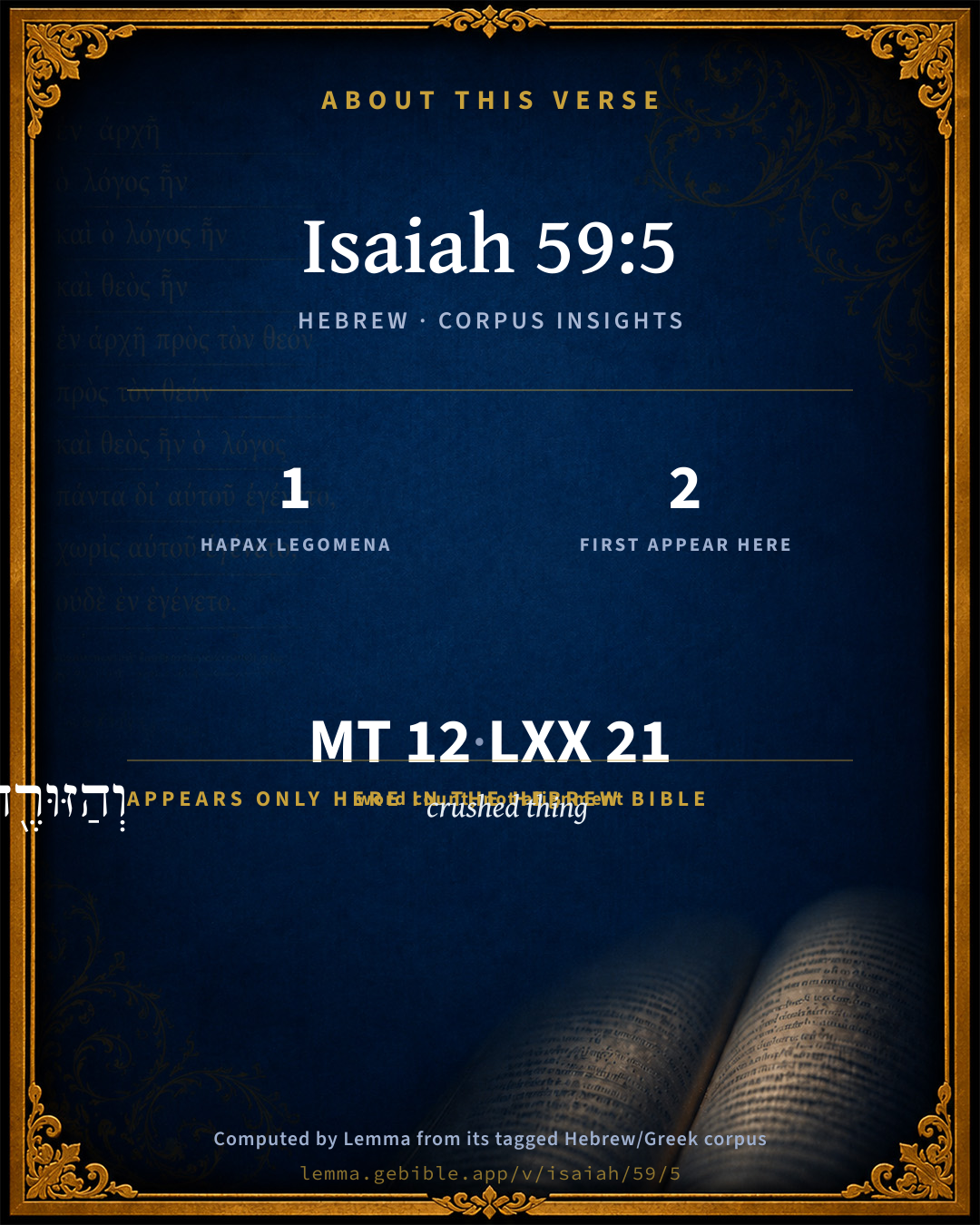
  • 1 hapax legomenon — only here in the Hebrew Bible
  • 2 first appearances in the Hebrew Bible
Full analysis ↓
Download a study sheet

One document with this verse’s original text, its word-by-word gloss line, the meaning frame, cross-references with their text, attributed commentary, and full source and license credits — printable, and it pastes into notes with its structure intact.

This verse Autodidact and up

Study sheet (.html) Plain text (.txt)

A passage Seminary Student

Up to 50 verses in one chapter. A passage sheet keeps up to 6 commentary sources and 12 cross-references per verse, in the order this page ranks them, and says so on the sheet whenever that leaves anything out. Ask for a single verse and you get the Autodidact verse sheet above.

Everything on this page stays free to read, with no account — the sheet is a download of what is already on screen, not access to it.

Want to remove ads? Support Godless Engineer
Compare translations 3

The same verse in 3 English versions, stacked beneath the original-language interlinear above. Click any original word for its lexicon entry.

Each is an independent rendering of the whole verse — the interlinear is not word-aligned to these translations.

Highlighted words mark where these versions differ — a whole-verse word diff, not a word-by-word alignment.

  • World English Bible Public Domain
    They hatch adders' eggs, and weave the spider's web: he who eats of their eggs dies; and that which is crushed breaks out into a viper.
  • King James Version Public Domain
    They hatch cockatrice' eggs, and weave the spider's web: he that eateth of their eggs dieth, and that which is crushed breaketh out into a viper.
  • unfoldingWord Literal Text CC BY-SA 4.0
    They hatch the eggs of a viper, and they weave the webs of a spider. The one eating of their eggs dies; when one is crushed, an adder hatches.

unfoldingWord Literal Text — © unfoldingWord, licensed CC BY-SA 4.0. Word-aligned USFM3 via Door43 (git.door43.org/unfoldingWord/en_ult).

Versions to compare (up to 4)

3 of 4 selected

Show all 18 translations

Every available English version of this verse, each an independent rendering of the whole verse.

  • World English Bible Public Domain
    They hatch adders' eggs, and weave the spider's web: he who eats of their eggs dies; and that which is crushed breaks out into a viper.
  • Berean Standard Bible Public Domain
    They hatch the eggs of vipers and weave a spider’s web. Whoever eats their eggs will die; crack one open, and a viper is hatched.
  • Majority Standard Bible Public Domain
    They hatch the eggs of vipers and weave a spider’s web. Whoever eats their eggs will die; crack one open, and a viper is hatched.
  • King James Version Public Domain
    They hatch cockatrice' eggs, and weave the spider's web: he that eateth of their eggs dieth, and that which is crushed breaketh out into a viper.
  • American Standard Version (1901) Public Domain
    They hatch adders' eggs, and weave the spider's web: he that eateth of their eggs dieth; and that which is crushed breaketh out into a viper.
  • Revised Version (1885) Public Domain
    They hatch basilisks’ eggs, and weave the spider’s web: he that eateth of their eggs dieth, and that which is crushed breaketh out into a viper.
  • Geneva Bible (1599) Public Domain
    They hatch cockatrice egges, and weaue the spiders webbe: he that eateth of their egges, dieth, and that which is trode vpon, breaketh out into a serpent.
  • Douay-Rheims (1899) Public Domain
    They have broken the eggs of asps, and have woven the webs of spiders: he that shall eat of their eggs, shall die: and that which is brought out, shall be hatched into a basilisk.
  • Young's Literal Translation Public Domain
    Eggs of a viper they have hatched, And webs of a spider they weave, Whoso is eating their eggs doth die, And the crushed hatcheth a viper.
  • Literal Standard Version CC BY-SA 4.0
    They have hatched eggs of a viper, || And weave webs of a spider, || Whoever is eating their eggs dies, and the crushed hatches a viper.
  • Unlocked Literal Bible CC BY-SA 4.0
    They hatch eggs of a poisonous snake and weave a spider's web. Whoever eats of their eggs dies, and if an egg is crushed, it hatches into a poisonous snake.
  • unfoldingWord Literal Text CC BY-SA 4.0
    They hatch the eggs of a viper, and they weave the webs of a spider. The one eating of their eggs dies; when one is crushed, an adder hatches.
  • Darby Bible Public Domain
    They hatch serpents' eggs, and weave the spider's web: he that eateth of their eggs dieth, and that which is crushed breaketh out into a viper.
  • World Messianic Bible Public Domain
    They hatch adders’ eggs and weave the spider’s web. He who eats of their eggs dies; and that which is crushed breaks out into a viper.
  • Webster's Bible Public Domain
    They hatch cockatrice eggs, and weave the spider's web: he that eateth of their eggs dieth, and that which is crushed breaketh out into a viper.
  • Free Bible Version CC BY-SA 4.0
    They hatch viper's eggs, and weave a spider's web. If you eat their eggs you'll die; if you crush their eggs you'll only hatch snakes.
  • Bible in Basic English Public Domain
    They give birth to snake's eggs, and make spider's threads: whoever takes their eggs for food comes to his death, and the egg which is crushed becomes a poison-snake.
  • JPS Tanakh (1917) Public Domain
    They hatch basilisks' eggs, and weave the spider's web; he that eateth of their eggs dieth, and that which is crushed breaketh out into a viper.

Literal Standard Version (2020), Covenant Press — licensed CC BY-SA 4.0. Text via the HelloAO Bible API (eBible.org). Unlocked Literal Bible (unfoldingWord) — licensed CC BY-SA 4.0. Text via the HelloAO Bible API (eBible.org). unfoldingWord Literal Text — © unfoldingWord, licensed CC BY-SA 4.0. Word-aligned USFM3 via Door43 (git.door43.org/unfoldingWord/en_ult). Free Bible Version, Dr. Jonathan Gallagher — licensed CC BY-SA 4.0. Text via the HelloAO Bible API (eBible.org).

Word by word

More ways to search: Search by grammar → Find every occurrence → Compare this word →

Practice this passage: Drill this verse → Learn its vocabulary →

וְהַזּוּרֶ֖ה
zûwreh
H2116
“and · the · crushed thing”
Conjunction + Particle, Definite Article + Verb, Qal, Participle Passive, Feminine, Singular, Absolute
Part of Speech
Conjunction + Particle + Verb
Stem
Qal
Form
Participle Passive
Gender
Feminine
Number
Singular
State
Absolute
Full BDB Definition

Origin: from H2115

TWOT: 543

a thing that is crushed
  1. בֵּיצֵ֤י bêytsâh H1000 “eggs of” Noun, Common, Feminine, Plural, Construct
  2. צִפְעוֹנִי֙ tsephaʻ H6848 “viper” Noun, Common, Masculine, Singular, Absolute
  3. בִּקֵּ֔עוּ bâqaʻ H1234 “to split” Verb, Piel, Perfect, 3rd Person, Common, Plural
  4. וְקוּרֵ֥י qûwr H6980 “and · threads of” Conjunction + Noun, Common, Masculine, Plural, Construct
  5. עַכָּבִ֖ישׁ ʻakkâbîysh H5908 “spider” Noun, Common, Masculine, Singular, Absolute
  6. יֶאֱרֹ֑גוּ ʼârag H707 “to weave” Verb, Qal, Imperfect, 3rd Person, Masculine, Plural
  7. הָאֹכֵ֤ל ʼâkal H398 “the · eating” Particle, Definite Article + Verb, Qal, Participle Active, Masculine, Singular, Absolute
  8. מִבֵּֽיצֵיהֶם֙ bêytsâh H1000 “from · eggs · their” Preposition + Noun, Common, Feminine, Plural, Construct + Suffix, Personal, 3rd Person, Masculine, Plural
  9. יָמ֔וּת mûwth H4191 “to die” Verb, Qal, Imperfect, 3rd Person, Masculine, Singular
  10. תִּבָּקַ֥ע bâqaʻ H1234 “to split” Verb, Qal, Imperfect, 3rd Person, Feminine, Singular
  11. אֶפְעֶֽה ʼephʻeh H660 “viper” Noun, Common, Masculine, Singular, Absolute

About this verse

These counts appear in no published source. They are computed here, from the morphology-tagged text and Lemma’s own curated glosses. What Lemma adds →

12
words
10
distinct lemmas
Prophets
section

Notable vocabulary

1 hapax legomenon — a word that appears only here in the entire Hebrew Bible:

  • וְהַזּוּרֶ֖ה crushed thing H2116

First appearance in Scripture

These words make their first canonical appearance in the Hebrew Bible here:

  • וְקוּרֵ֥י thread H6980
  • וְהַזּוּרֶ֖ה crushed thing H2116

Shared distinctive vocabulary

וְקוּרֵ֥י thread H6980 occurs in 2 verses of the Hebrew Bible. Also found in:

Grammatical profile

  • 6 verbs
  • 6 nouns

Verb forms

  • בִּקֵּ֔עוּ Piel · Perfect
  • יֶאֱרֹ֑גוּ Qal · Imperfect
  • הָאֹכֵ֤ל Qal · Participle Active
  • יָמ֔וּת Qal · Imperfect
  • וְהַזּוּרֶ֖ה Qal · Participle Passive
  • תִּבָּקַ֥ע Qal · Imperfect

Repetition

Words recur within this verse — often emphatic in Hebrew:

  • בֵּיצֵ֤י egg H1000 ×2
  • בִּקֵּ֔עוּ to split H1234 ×2

Hebrew & Septuagint length

In English translation the verse runs 26 words from the Hebrew and 32 from the Septuagint (LXX English) — closely comparable.

A rough comparison of the two English renderings, which tokenize alike — not a word-level alignment.

Word counts can differ between the Hebrew and the Greek without any difference in meaning — e.g. the Hebrew direct-object marker אֵת has no separate Greek word, and Greek often adds the article ὁ.

In the original languages it is 12 Hebrew tokens and 21 Greek tokens — but the two are counted differently (Hebrew bundles its prefixes and suffixes into one token; the Greek is in lemma form), so that isn’t a like-for-like length.

Cross-references

5

Topical passages linked to Isaiah 59:5 in the Treasury of Scripture Knowledge — connected by theme and wording, ordered by reader-vote popularity; previews shown in the World English Bible.

  • Matthew 3:7 But when he saw many of the Pharisees and Sadducees coming for his baptism, he said to them, "You offspring of vipers, who warned you to flee from the wrath to come?
  • Isaiah 14:29 Don't rejoice, O Philistia, all of you, because the rod that struck you is broken; for out of the serpent's root shall come forth an adder, and his fruit shall be a fiery flying serpent.
  • Job 8:14 Whose confidence shall break apart, Whose trust is a spider's web.
  • Proverbs 23:32 In the end, it bites like a snake, And poisons like a viper.
  • Matthew 12:34 You offspring of vipers, how can you, being evil, speak good things? For out of the abundance of the heart, the mouth speaks.

Cross-references courtesy of OpenBible.info (CC BY 4.0).

Hebrew and Greek witnesses Masoretic Hebrew ↔ Greek Septuagint

The same verse in the two great witnesses to the Old Testament, shown verse-for-verse.

These are two independent witnesses, not word-aligned to each other, and the Septuagint is shown in lemma (dictionary) form.

Hebrew Isaiah 59:5 Masoretic · Westminster Leningrad Codex

בֵּיצֵ֤י צִפְעוֹנִי֙ בִּקֵּ֔עוּ וְקוּרֵ֥י עַכָּבִ֖ישׁ יֶאֱרֹ֑גוּ הָאֹכֵ֤ל מִבֵּֽיצֵיהֶם֙ יָמ֔וּת וְהַזּוּרֶ֖ה תִּבָּקַ֥ע אֶפְעֶֽה

They hatch adders' eggs, and weave the spider's web: he who eats of their eggs dies; and that which is crushed breaks out into a viper.

World English Bible · Public Domain

Greek LXX Isaiah 59:5 Septuagint · lemma form

ᾠόν ἀσπίς ῥήγνυμι καί ἱστός ἀράχνη ὑφαίνω καί ὁ μέλλω ὁ ᾠόν αὐτός ἐσθίω συντρίβω οὔριος εὑρίσκω καί ἐν αὐτός βασιλίσκος

They have hatched asps' eggs, and weave a spider's web: and he that is going to eat of their eggs, having crushed an addled egg, has found also in it a basilisk.

LXX2012 (modern English Septuagint) · Public Domain

On this verse, The Cambridge Bible for Schools and Colleges discusses the Septuagint’s reading. Read the note in Commentary ↓

Hebrew: Westminster Leningrad Codex (CC BY 4.0). Greek: Septuagint (public domain); English from LXX2012 (modern English Septuagint) (Public Domain). How the Septuagint differs from the Hebrew →

Targum (Aramaic paraphrase)

1

The Targum is the ancient Jewish Aramaic paraphrase of the Hebrew Scriptures — an interpretive translation, not the Hebrew text itself. Onkelos (literal) and Pseudo-Jonathan (expansive) render the Torah, and Jonathan the Prophets. Coverage is partial: where no permissively-licensed English translation exists for a verse, only the Aramaic is shown. This is verse-level text, not a word-by-word alignment to the Hebrew.

  1. Targum Jonathan Prophets (Joshua–Malachi)
    הָא כְבֵיעֵי חֵיוִי חוּרְמְנִין מְפַרְתִין וּכְקַוִין דְעַכּוֹבִיתָא מָחַיָא דְמַן דְאָכִיל מִבֵּיעֵיהוֹן מָאֵית וּמְשַׁחְנָן וּמַפְקָן חֵיוָן חוּרְמְנִין מְפַרְתִין:

    Behold, they hatch as it were eggs of a basilisk; they are like the threads which the spiders weave: he that eateth of their eggs and when they are hatched, they bring forth the flying serpents.

    Targum Jonathan — Aramaic: “Mikraot Gedolot” (public domain). English: “Sefaria Community Translation” (CC0 1.0 (public-domain dedication)); “London "Chaldee Paraphrase," 1871” (public domain). Text via Sefaria.

Commentary

Notes on Isaiah 59:5 from classic Christian and Jewish commentators (each source and its license shown beneath its notes). The classic Christian expositions comment on the surrounding passage and are grouped to its opening verse, so a note may address several verses; the Jewish commentaries on the Tanakh (Rashi and others) are per-verse, so they appear only where the commentator wrote on this verse.

Lemma curates 59 commentaries, every one of them public domain or Creative Commons licensed, each selected and text-cleaned for this edition rather than reprinted as found. About our sources →

The Cambridge Bible for Schools and Colleges

gen. ed. J. J. S. Perowne

5. cockatrice’ eggs] or basilisks’ eggs. See on ch. Isa_11:8. The figure is expanded in the latter part of the verse, and the meaning seems to be that the persons spoken of brood over and bring to maturity projects of wickedness, whose effects are almost equally fatal to those who acquiesce in them and to those who oppose them.

he that eateth of their eggs] (cf. Deu_32:33) i.e. either he who enters into their schemes, or he who is their victim.

that which is crushed … viper] Should one try to stamp out one of their diabolical plots, its deadly nature will only be the more clearly manifested.

5–8. These verses differ somewhat in character from Isa_59:3 f., and are regarded by Duhm and Cheyne as a quotation from some Psalm or collection of proverbs. In point of fact the first part of Isa_59:7 appears in Pro_1:16, but probably as an interpolation, since the verse is wanting in the LXX. On the other hand, Isa_59:7-8 are partly reproduced in the LXX. recension of Psa_14:3, as in Rom_3:10 ff. These facts do not by themselves raise any presumption against the genuineness of the passage in this discourse; and the first image of Isa_59:5 connects itself naturally enough with the conclusion of Isa_59:4. It must be admitted, however, that the description can only apply to a limited class of utter reprobates, and there is some difficulty in conceiving that it can be the continuation of Isa_59:3-4, which contain perfectly definite and intelligible accusations against a whole community.

The Cambridge Bible for Schools and Colleges (gen. ed. J. J. S. Perowne; Cambridge University Press, 1878–1918) — public domain. Text from a community e-Sword module.

Trapp's Complete Commentary

John Trapp

Isa 59:5 They hatch cockatrice’ eggs, and weave the spider’s web: he that eateth of their eggs dieth, and that which is crushed breaketh out into a viper.

Ver. 5. They hatch cockatrice’ eggs,] i.e., Poisonous and pernicious designs; there are that interpret it of false doctrines, as destruetive to men’s souls, as cockatrice’ eggs eaten, or but broken, would be to their bodies. As the bird that sitteth on the serpent’s eggs, by breaking and hatching them, bringeth forth a perilous brood to her own destruction, so here.

And weave the spider’s web.] Good for nothing but to catch flies. The natural man is ever either weaving spider’s webs, which are futiles and fragiles, or hatching cockatrice’ eggs. Vanity or villany is his whole study and practice.

John Trapp, A Commentary or Exposition upon All the Books of the Old and New Testament (1647–1656) — public domain. Text from a community e-Sword module.

The Biblical Illustrator

Joseph S. Exell

Isa_59:5-6

They hatch cockatrice eggs

Wicked devices

I.

THE DEVICES OF THY. WICKED.

1. Like eggs--productive.

2. Like cockatrice eggs--injurious.

3. Like spiders webs--frail, useless.

II. THEIR EFFECT.

1. Upon others--mischief, death.

2. Upon themselves--disappointment, retribution. (J. Lyth, D. D.)

The schemes of the ungodly

The meaning seems to be that the persons spoken of brood over and bring to maturity projects of wickedness, whose effects are almost equally fatal to those who acquiesce in them and to those who oppose them. He that eateth of their eggs, i.e either he who enters into their schemes or he who is their victim. That which is crushed breaketh out into a viper. Should one try to stamp out one of their diabolical plans, its deadly nature will only be the more clearly manifested. Verse 6 is the development of the second image of Isa_59:5, the point of comparison being the uselessness for any good social end of the schemes devised by the ungodly. (Prof. J. Skinner, D. D.)

And weave the spiders web:--

Hypocritical religion

See the spiders web and behold in it a most suggestive picture of the hypocrites religion.

1. It is meant to catch his prey; the spider fattens himself on flies. Foolish persons are easily entrapped by the loud professions of pretenders, and even the more judicious cannot always escape.

2. A spiders web is a marvel of skill; look at it and admire the cunning hunters wiles. Is not a deceivers religion equally wonderful? How does he make so barefaced a lie appear to be a truth.

3. A spiders web comes all from the creatures own bowels. Even so hypocrites find their hope and trust within themselves.

4. But a spiders web is very frail. Hypocritical cobwebs will soon come down when the broom of destruction begins its purifying work.

5. Which reminds us of one more thought, viz that such cobwebs are not to be endured in the Lords house. (C. H. Spurgeon.)

Spiders webs

As the spider weaveth her web to catch the smaller flies, so do they lay their plots to take the poorer sort of people, and them which are most destitute of friends. (W. Day, M. A.)

The Biblical Illustrator, edited by Joseph S. Exell (c. 1880s–1900s) — public domain. Text from a community e-Sword module.

Joseph Benson's Commentary

Isa 59:5-6. They hatch cockatrice’ eggs — They contrive and execute wicked purposes and practices, whereby sure and sudden destruction is brought upon themselves and others. Of the cockatrice, or basilisk, as it should rather be rendered, see on Isa 14:29. One kind is put for any venomous creature. The speech is proverbial, signifying, by these eggs, mischievous designs, and by hatching them their putting them in practice. And weave the spider’s web — Another proverbial speech, whereby is signified, both how by their plots they weaved nets, laid snares industriously with great pains and artifice, to entrap or entangle others; and also how their designs would come to nothing, as the spider’s web is soon swept away. He that eateth of their eggs — That converses and joins with them in their mischievous designs, and partakes of the fruits thereof; dieth — Is seduced into destructive errors and vices, or involved in ruin. And that which is crushed — In order that it may be eaten; breaketh out into a viper — A poisonous viper proceeds from it. The more any one partakes of their counsels, the more he is infected, such a deadly poison lies imbodied in them. Their webs shall not become garments — Though they are finely wrought, yet they are too thin and weak to be of any use; that is, their contrivances and deep designs shall not advantage them. Neither shall they cover themselves, &c. — Their works shall neither cover nor defend the actors. Their works are works of iniquity — Of injustice, whereby they grieve, vex, and injure their brethren. And the act of violence is in their hands — They exercise themselves in all acts of violence and oppression.

Joseph Benson's Commentary on the Old and New Testaments (1811–1818) — public domain. Text from a community e-Sword module.

Tyndale Open Study Notes

Tyndale Open Resources

59:5-6 The images of deadly snakes and spiders’ webs represent plans designed to destroy others’ lives and relationships.

Tyndale Open Study Notes — © Tyndale Open Resources, licensed CC BY-SA 4.0. Text via the HelloAO Bible API.

Geneva Bible (1599)

Geneva Bible translators

They are profitable to no purpose.

Whatsoever cometh from them is poison, and bringeth death.

Geneva Bible (1599) marginal notes — public domain. Text via Bolls.life.

Jamieson, Fausset & Brown

Robert Jamieson, A. R. Fausset & David Brown

cockatrice--probably the basilisk serpent, cerastes. Instead of crushing evil in the egg, they foster it.

spider's web--This refers not to the spider's web being made to entrap, but to its thinness, as contrasted with substantial "garments," as Isa 59:6 shows. Their works are vain and transitory (Job 8:14; Pro 11:18).

eateth . . . their eggs--he who partakes in their plans, or has anything to do with them, finds them pestiferous.

that which is crushed--The egg, when it is broken, breaketh out as a viper; their plans, however specious in their undeveloped form like the egg, when developed, are found pernicious. Though the viper is viviparous (from which "vi-per" is derived), yet during gestation, the young are included in eggs, which break at the birth [BOCHART]; however, metaphors often combine things without representing everything to the life.

Jamieson, Fausset & Brown — Commentary Critical and Explanatory on the Whole Bible (1871) — public domain (CC PDM 1.0). Text via the HelloAO Bible API.

Ellicott's Commentary for English Readers

(5) They hatch cockatrice’ eggs.—Better, basilisk’s, as in Isa_14:29. The schemes of the evil-doers are displayed in their power for evil and their impotence for good. To “eat of the eggs,” which are assumed to be poisonous, is to fall in with their schemes, and so be ruined: to “crush” them is to oppose and so to rouse a more venomous opposition. Men break the egg, and the living viper darts forth to attack them.

A Bible Commentary for English Readers, edited by Charles John Ellicott (1878–1897) — public domain. Text from a community e-Sword module.

John Gill's Exposition

They hatch cockatrice eggs, and weave the spider's web,.... Invent false doctrines according to their own fancies, which may seem fair and plausible, but are poisonous and pernicious; as the "eggs of the cockatrice", which may look like, and may be taken for, the eggs of creatures fit to eat; and spin out of their brains a fine scheme of things, but which are as thin, and as useless, and unprofitable, as "the spider's web"; and serve only to ensnare and entangle the minds of men, and will not stand before the word of God which sweeps them away at once; particularly of this kind is the doctrine of justification by the works of men, which are like the spider's web, spun out of its own bowels; so these are from themselves, as the doctrine of them is a device of man, and is not of God:

he that eateth of their eggs dieth: as a man that eats of cockatrice eggs dies immediately, being rank poison; so he that approves of false doctrines, receives them, and feeds upon them, dies spiritually and eternally; these are damnable doctrines, which bring upon men swift destruction; they are poisonous, and eat as do a canker, and destroy the souls of men:

and that which is crushed breaketh out into a viper; or "cockatrice"; so Kimchi and Ben Melech take it to be the same creature as before, which goes by different names; and the words seem to require this sense; however, it cannot be the creature we call the viper, since that is not oviparous, but viviparous, lays not eggs, but brings forth its young; though both Aristotle (w) and Pliny (x), at the same time they say it is viviparous, yet observe that it breeds eggs within itself, which are of one colour, and soft like fishes. The Targum renders it "flying serpents": the sense is, that if a man is cautious, and does not eat of the cockatrice eggs, but sets his foot on them, and crushes them, out comes the venomous creature, and he is in danger of being hurt by it; so a man that does not embrace false doctrines, and escapes eternal death by them, but tramples upon them, opposes them, and endeavours to crush and destroy them, yet he is exposed to and brings upon himself calumnies, reproach, and persecution.

(w) Hist. Animal. l. 5. c. 34. (x) Nat. Hist. I. 10. c. 62.

John Gill's Exposition of the Whole Bible (1746–1763) — public domain (CC PDM 1.0). Text via the HelloAO Bible API.

Albert Barnes' Notes on the Bible

They hatch cockatrice’ eggs - Margin, ‘Adders’.’ On the meaning of the word rendered here ‘cockatrice,’ see the notes at Isa 11:8. Some poisonous serpent is intended, probably the adder, or the serpent known among the Greeks as the basilisk, or cerastes. This figurative expression is designed to show the evil nature and tendency of their works. They were as if they should carefully nourish the eggs of a venomous serpent. Instead of crushing them with the foot and destroying them, they took pains to hatch them, and produce a venomous race of reptiles. Nothing can more forcibly describe the wicked character and plans of sinners than the language used here - plans that are as pernicious, loathsome, and hateful as the poisonous serpents that spread death and ruin and alarm everywhere.

And weave the spider’s web - This phrase, in itself, may denote, as some have understood it, that they formed plans designed to seize upon and destroy others, as spiders weave their web for the purpose of catching and destroying insects. But the following verse shows that the language is used rather with reference to the tenuity and gossamer character of the web, than with any such designs. Their works were like the web of the spider. They bore the same relation to true piety which the web of the spider did to substantial and comfortable raiment. They were vain and useless. The word rendered here ‘web’ properly denotes the cross-threads in weaving, the woof or filling; and is probably derived from a word signify ing a cross-beam (see Rosenmuller in loc; also Bochart, Hieroz. ii. 4. 23).

He that eateth of their eggs dieth - That is, he who partakes of their counsels, or of the plans which they form, shall perish. Calvin says that the meaning is, that ‘whosoever had anything to do with them would find them destructive and pestiferous.’ Similar phrases, comparing the plans of the wicked with the eggs and the brood of the serpent, are common in the East. ‘It is said,’ says Roberts, speaking of India, ‘of the plans of a decidedly wicked and talented man, “That wretch! he hatches serpents’ eggs.” “Beware of the fellow, his eggs are nearly hatched.” “Ah, my friend, touch not that affair, meddle not with that matter; there is a serpent in the shell.”’

And that which is crushed breaketh out into a viper - On the meaning of the word rendered here ‘viper,’ see the notes at Isa 30:6. Margin, ‘Sprinkled, is as if there brake out a viper. Jerome renders it, ‘Which if pierced, breaks out into a basilisk.’ The Septuagint renders it, ‘And he who was about to eat of their eggs having broken one that was putrid (συντρίψας οὔριον suntripsas ourion), found in it a basilisk (βασόλισκον basiliskon). ‘The difference of translation in the text and the margin of the common version has arisen from the fact that the translators supposed that the word used here (זוּרה zûrâh) might be derived from זרה zârâh, to sprinkle, or to scatter. But it is formed from the word זור zûr, to squeeze, to press, to crush; and in Job 39:15, is applied to the fact that the ostrich might crush her eggs with her foot. The sense here is, that when their plans were developed, they would be found to be evil and pernacious - as when an egg should be broken open, a venomous setpent would come forth. The viper, it is true, brings forth its young alive, or is a viviparous animal. But Bochart has remarked, that though it produces its young in this manner, yet that during the period of gestation the young are included in eggs which are broken at the birth. This is a very impressive illustration of the character and plans of the wicked. The serpents here referred to are among the most venomous and destructive that are known. And the comparison here includes two points -

1. That their plans resembled the egg of the serpent. The nature of the egg cannot be easily known by an inspection. It may have a strong resemblance to those which would produce some inoffensive and even useful animals. It is only when it is hatched that its true nature is fully developed. So it is with the plans of the wicked. When forming, their true nature may not be certainly known, and it may not be easy to determine their real character.

2. Their plans, when developed, are like the poisonous and destructive production of the serpent’s egg. The true nature is then seen; and it is ruinous, pernicious, and evil.

Albert Barnes' Notes on the Bible (1834–1885) — public domain. Text from a community e-Sword/MySword module.

Haydock's Catholic Bible Commentary

Basilisk, or viper. (Calmet) --- The young ones "burst through the viper’s sides." (Pliny, [Natural History?] x. 62.) --- So the works of the wicked are useless or destructive.

George Leo Haydock (1774–1849), Haydock's Catholic Family Bible and Commentary, 1859 edition — public domain. Excludes Psalms (Douay-Rheims chapter numbering differs from Protestant) and Deuterocanonical books (Catholic canon only).

Matthew Poole's English Annotations

They hatch cockatrice eggs; or adder, or basilisk; one kind put for any venomous creature; a proverbial speech, signifying by these eggs mischievous designs, and by hatching them their putting them in practice: this is to show that mischief is natural to them, and they can do no otherwise, poison is natural to these eggs.

Weave the spider’s web; another proverbial speech, whereby is taught, both how by their plots they weave nets, lay snares industriously, with great pains and artifice, whereby they may entangle and involve their poor neighbours in intricacies and perplexities, and so devour them, as the spider weaves her web to catch flies, and then to feed on them; and also how that they contrive nothing but what will tend to their own ruin, as the issue of the viper is the death of the mother, and they and their designs will come to nothing, and not answer their end, as the spider’s web is soon swept away, and is seen no more, which doth well agree with what follows.

He that eateth of their eggs dieth: here is a catachrestical allusion, noting that he who hath commerce with them, and approves their counsels, which are the eggs which they hatch, will be poisoned with them.

And that which is crushed breaketh out into a viper: if and be copulative here, then the sense is either, If any seek to crush and disappoint their plots, or if they be sprinkled or dispersed abroad, (as the margin seems to favour,) they will seek his ruin, will be as a viper to him. But if and be causal, as it often is, and may be here, then the sense is, q.d. He dieth, because the eggs being crushed, a poisonous viper proceeds from it; the more you partake of their counsels, the more you are infected, there lies such a dreadful poison embodied in them.

Matthew Poole's English Annotations on the Holy Bible (1683–1685) — public domain. Text from a community e-Sword/MySword module.

Whedon's Commentary on the Bible

Daniel D. Whedon

5, 6. Cockatrice’s eggs — Hatched into basilisks, (see Isa_11:8;) a fabulous reptile — its gaze supposed to be fatal, its eggs, as food, certainly poisonous. The reference is to a popular, not a scientific, conception of a certain not well-known reptile, and is employed to characterize strongly the people’s evil works. So of the next figure.

The spider’s web — An emblem of the people’s acts of enticing and ruining others. The further point of the figure is, that the “spider’s web” is too gauzy as a covering to conceal wicked plans against others. Flimsy sophistry cannot hide pretended righteousness.

Daniel D. Whedon (gen. ed.), Commentary on the Old and New Testaments (1874–1909) — public domain. Text from a community e-Sword module.

The Pulpit Commentary

They hatch cockatrice" eggs. (On the cockatrice, see the comment upon Isa_11:8) The meaning here is that the people gave themselves to brooding on and hatching purposes which were as pernicious and destructive as the eggs of venomous serpents. And weave the spider"s web; i.e. "their purposes were as flimsy and unsubstantial as the web of the spider." He that eateth, etc. If a man partake of their plans, he becomes morally as bad as they, and is smitten with spiritual death. If an attempt be made to "crush" and destroy their plans, the only result is the premature birth of a viper.

The Pulpit Commentary (1880–1919), ed. H.D.M. Spence-Jones & Joseph S. Exell — public domain. Text from a community e-Sword module.

John Wesley's Explanatory Notes

Cockatrice eggs - One kind put for any venomous creature, a proverbial speech signifying by these eggs mischievous designs, and by hatching them, their putting them in practice. Web - Another proverbial speech whereby is taught, both how by their plots they weave nets, lay snares industriously with great pains and artifice. And also how their designs will come to nothing, as the spider's web is soon swept away.

John Wesley, Explanatory Notes Upon the Whole Bible (1754–1765) — public domain. Text via the GEBible commentary corpus.

J. A. Alexander on Isaiah

Joseph Addison Alexander

“Eggs of the basilisk they have hatched, and webs of the spider they will spin (or weave); the (one) eating of their eggs shall die, and the crushed (egg) shall hatch out a viper.” The figure of the serpent is substantially the same as in Isa 14:29. (Compare #Deu 32:33). The precise varieties intended are of little exegetical importance. The figure of the spider’s web is added to express the idea both of hurtfulness and futility. (See Job 8:14).

Joseph Addison Alexander, The Prophecies of Isaiah (1846–1847; New York: Scribner, 1870–1878) — public domain. Text from a community e-Sword module.

unfoldingWord translationNotes

Door43 World Missions Community

General Information:

Isaiah continues speaking to the people of Israel about the evil they do using the metaphors of poisonous snakes and spider's webs.

They hatch eggs of a poisonous snake

Eggs of a poisonous snake hatch into more dangerous snakes. "Poisonous snakes" represents evil the people do that harms more and more. AT: "They make evil that spreads out to make more evil" (See: Metaphor)

weave a spider's web

This represents the deeds of the people that are useless. AT: "produce things and activities that are useless" (See: Metaphor)

Whoever eats of their eggs dies, and if an egg is crushed, it hatches into a poisonous snake

Eating a poisonous egg will kill the one that eats it and represents self-destruction. Breaking the egg allows the young poisonous snake to hatch and represents spreading destruction. AT: "The activities they do will destroy them and will spread destruction to others" (See: Metaphor)

if an egg is crushed

This can be stated in active form. AT: "if someone crushes an egg" (See: Active or Passive)

Their webs cannot be used for garments, nor can they cover themselves with their works

This means their sinful deeds cannot be covered and hidden, just as a web cannot serve as clothing and cover someone. AT: "Their evil deeds will be exposed as useless" (See: Metaphor)

Their webs cannot be used for garments

This can be stated in active form. AT: "They cannot clothe themselves with their webs" (See: Active or Passive)

deeds of violence are in their hands

"Hands" represents the ability and power to do these things and therefore their responsibility. AT: "they are fully responsible for the violence they do" (See: Metonymy)

translationWords

serpent

works

sin

hand

unfoldingWord translationNotes — © Distant Shores Media and the Door43 World Missions Community, licensed CC BY-SA 4.0. Source: git.door43.org/Door43/en_tn.

Rashi

Rabbi Shlomo Yitzchaki (Rashi)

vipers a species of harmful snake.

hatched Heb. בִּקְּעוּ, eskloterant in O.F. That is to say that they committed ugly deeds, from which they did not benefit.

and...spider webs Irajjne in O.F., spider, and קוּרֵי is ordiojjrs in O.F., warp. קוּרֵי are the implements of the weaver, those upon which the warp is mounted. Menahem (Machbereth Menahem p. 158) classifies it in the class of קוֹרוֹת, beams, since the spider mounts the warp of his weavings on beams.

and what hatches Heb. וְהַזּוּרֶה. Jonathan renders: וּמְשַׁחְנָן, an expression of warming, called in O.F. kover [couve], hatching when one warms them, it emerges from them when he cracks the shell. The original meaning of וְהַזּוּרֶה is an expression of pressing to extract what is absorbed within. Comp. (Jud. 6:38) “And pressed (וַיָּזַר) the fleece.” The pressing of this one is its hatching.

viper Heb. אֶפְעֶה, a species of snake that is harmful, so will nothing result from their deeds but evil.

Rashi on the Tanakh — English translations: “The Judaica Press complete Tanach with Rashi, translated by A. J. Rosenberg” (CC BY 4.0); “Pentateuch with Rashi's commentary by M. Rosenbaum and A.M. Silbermann, 1929-1934” (public domain); “The Metsudah Tanach series, Lakewood, N.J” (CC BY 4.0); and “The Book of Joshua, Metsudah Publications, 1997” (CC BY 4.0). Text via Sefaria.

Ibn Ezra

Rabbi Abraham ibn Ezra

They hatch, etc. They are compared with the cockatrice’s eggs, when they open themselves.

וקורי עכביש The web of the work of a spider.

Of their eggs. Of the eggs of the cockatrice.

וְהַזּוּרֶה And that which is crushed. It is an irregular form; the Segol under ר is substituted for Kamez, as in ולנה and it shall remain (Zec. 5:4.) זורה is participle passive; comp. מולים circumcised (Jos. 5:5); סוגה set about (Songs 7:2). As to its meaning comp. ויזר and he pressed (Jud. 6:38). If one presses the egg, the cockatrice breaks through and comes out. אפעה Viper. Comp. 30:6

Ibn Ezra on the Tanakh — English translations: “Sefaria Community Translation” (CC0 1.0 (public-domain dedication)); “Yalkut, Sifsei Chachomim Chumash, Metsudah Publications, 2009” (CC BY 4.0); and “Commentary of Ibn Ezra on Isaiah - trans. by M. Friedlander, 1873” (public domain). Text via Sefaria.

Lesson kit

Teaching starters — assembled from the data on this page, not authored interpretation. Every prompt links to the verse data it draws on. Edit before teaching.

Isaiah, in the Prophets, opens this verse with 12 words (10 distinct Hebrew lemmas). Its most distinctive word is zûwreh (“crushed thing”). A historical commentator’s framing appears above. Read the whole chapter for the surrounding context.

Discussion questions

  1. The word zûwreh carries the sense “crushed thing.” How does it shape the verse?
  2. This verse holds 1 word here found nowhere else in the Hebrew Bible. What might the rare word draw attention to?
  3. 2 words here appear for the first time in Scripture. What is being introduced at this debut?
  4. Isaiah 59:6 shares the word «thread» with this verse. How do the two illuminate each other?
  5. “egg” occurs 2× in this one verse. What is the effect of the repetition?
  6. These translations render this verse differently. What is at stake in choosing one wording over another?
  7. The verb «בִּקֵּ֔עוּ» is Piel Perfect. How does its form color the action?
  8. Reading how The Cambridge Bible for Schools and Colleges and Trapp's Complete Commentary read this verse, where do the two commentators agree and where do they part?

Things to notice

  • 1 word in this verse appears nowhere else in the Hebrew Bible.
  • 2 words make their first canonical appearance in Scripture here.
  • This verse counts 12 Hebrew ↔ 21 Greek words.
  • These translations choose different wording for 21 words in this verse.
  • “egg” occurs 2× in this single verse.

Reading settings

Reading text

Shown beneath each verse's original-language words.

Old Testament
Old Testament edition

Read the OT as the Masoretic Hebrew (MT) or the Greek Septuagint (LXX).

English shown for the Greek Septuagint (in the Hebrew ↔ Greek comparison).

Comparing translations? Open the Compare panel on any verse page to stack up to four side by side.