Isaiah 48:21

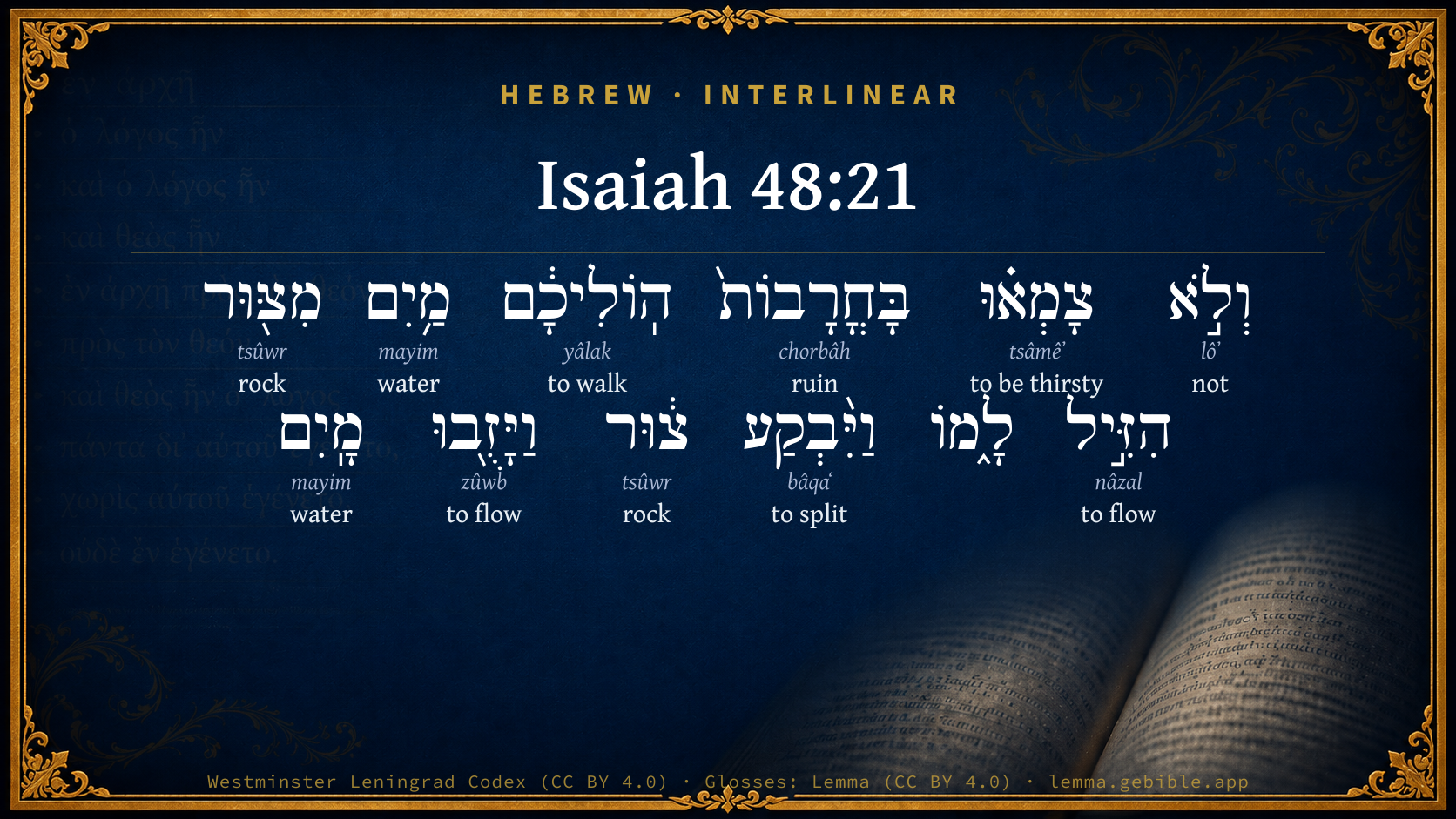
Hebrew (Westminster Leningrad Codex) Isaiah 48:21 appears in the Hebrew Old Testament. The text above is from the Westminster Leningrad Codex. Each word links to its Strong’s number, a concise gloss, and parsing drawn from the Open Scriptures Hebrew Bible morphology. Click any word for its full Brown-Driver-Briggs (BDB) entry.
Download image
Cite this verse

Isaiah 48:21 (World English Bible). Public Domain. Lemma interlinear Bible study tool, https://lemma.gebible.app/v/isaiah/48/21.

Show BibTeX & RIS
BibTeX
RIS
English Translation
They didn't thirst when he led them through the deserts; he caused the waters to flow out of the rock for them; he split the rock also, and the waters gushed out.
World English Bible · Public Domain
Download a study sheet

One document with this verse’s original text, its word-by-word gloss line, the meaning frame, cross-references with their text, attributed commentary, and full source and license credits — printable, and it pastes into notes with its structure intact.

This verse Autodidact and up

Study sheet (.html) Plain text (.txt)

A passage Seminary Student

Up to 50 verses in one chapter. A passage sheet keeps up to 6 commentary sources and 12 cross-references per verse, in the order this page ranks them, and says so on the sheet whenever that leaves anything out. Ask for a single verse and you get the Autodidact verse sheet above.

Everything on this page stays free to read, with no account — the sheet is a download of what is already on screen, not access to it.

Want to remove ads? Support Godless Engineer
Compare translations 3

The same verse in 3 English versions, stacked beneath the original-language interlinear above. Click any original word for its lexicon entry.

Each is an independent rendering of the whole verse — the interlinear is not word-aligned to these translations.

Highlighted words mark where these versions differ — a whole-verse word diff, not a word-by-word alignment.

  • World English Bible Public Domain
    They didn't thirst when he led them through the deserts; he caused the waters to flow out of the rock for them; he split the rock also, and the waters gushed out.
  • King James Version Public Domain
    And they thirsted not when he led them through the deserts: he caused the waters to flow out of the rock for them: he clave the rock also, and the waters gushed out.
  • unfoldingWord Literal Text CC BY-SA 4.0
    And they did not thirst he led them in desolations. He made waters flow from the rock for them, and he split the rock, and waters gushed out. q1

unfoldingWord Literal Text — © unfoldingWord, licensed CC BY-SA 4.0. Word-aligned USFM3 via Door43 (git.door43.org/unfoldingWord/en_ult).

Versions to compare (up to 4)

3 of 4 selected

Show all 18 translations

Every available English version of this verse, each an independent rendering of the whole verse.

  • World English Bible Public Domain
    They didn't thirst when he led them through the deserts; he caused the waters to flow out of the rock for them; he split the rock also, and the waters gushed out.
  • Berean Standard Bible Public Domain
    They did not thirst when He led them through the deserts; He made water flow for them from the rock; He split the rock, and water gushed out.
  • Majority Standard Bible Public Domain
    They did not thirst when He led them through the deserts; He made water flow for them from the rock; He split the rock, and water gushed out.
  • King James Version Public Domain
    And they thirsted not when he led them through the deserts: he caused the waters to flow out of the rock for them: he clave the rock also, and the waters gushed out.
  • American Standard Version (1901) Public Domain
    And they thirsted not when he led them through the deserts; he caused the waters to flow out of the rock for them; he clave the rock also, and the waters gushed out.
  • Revised Version (1885) Public Domain
    And they thirsted not when he led them through the deserts: he caused the waters to flow out of the rock for them: he clave the rock also, and the waters gushed out.
  • Geneva Bible (1599) Public Domain
    And they were not thirstie: hee led them through the wildernesse: hee caused the waters to flowe out of the rocke for them: for he claue the rocke, and the water gushed out.
  • Douay-Rheims (1899) Public Domain
    They thirsted not in the desert, when he led them out: he brought forth water out of the rock for them, and he clove the rock, and the waters gushed out.
  • Young's Literal Translation Public Domain
    And they have not thirsted in waste places, He hath caused them to go on, Waters from a rock he hath caused to flow to them, Yea, he cleaveth a rock, and flow do waters.
  • Literal Standard Version CC BY-SA 4.0
    And they have not thirsted in wastelands, || He has caused them to go on, || He has caused waters from a rock to flow to them, || Indeed, he cleaves a rock, and waters flow.
  • Unlocked Literal Bible CC BY-SA 4.0
    They did not thirst when he led them through the deserts; he made the water to flow out of the rock for them; he split open the rock, and the waters gushed out.
  • unfoldingWord Literal Text CC BY-SA 4.0
    And they did not thirst he led them in desolations. He made waters flow from the rock for them, and he split the rock, and waters gushed out. q1
  • Darby Bible Public Domain
    And they thirsted not when he led them through the deserts; he caused the waters to flow out of the rock for them; yea, he clave the rock, and the waters gushed out.
  • World Messianic Bible Public Domain
    They didn’t thirst when he led them through the deserts. He caused the waters to flow out of the rock for them. He also split the rock and the waters gushed out.
  • Webster's Bible Public Domain
    And they thirsted not, when he led them through the deserts: he caused the waters to flow out of the rock for them: he cleaved the rock also, and the waters gushed out.
  • Free Bible Version CC BY-SA 4.0
    They weren't thirsty when he led them through the desert—he made water come out of the rock for them. He split the rock open and water poured out.
  • Bible in Basic English Public Domain
    They had no need of water when he was guiding them through the waste lands: he made water come out of the rock for them: the rock was parted and the waters came flowing out.
  • JPS Tanakh (1917) Public Domain
    And they thirsted not when He led them through the deserts; He caused the waters to flow out of the rock for them; He cleaved the rock also, and the waters gushed out.'

Literal Standard Version (2020), Covenant Press — licensed CC BY-SA 4.0. Text via the HelloAO Bible API (eBible.org). Unlocked Literal Bible (unfoldingWord) — licensed CC BY-SA 4.0. Text via the HelloAO Bible API (eBible.org). unfoldingWord Literal Text — © unfoldingWord, licensed CC BY-SA 4.0. Word-aligned USFM3 via Door43 (git.door43.org/unfoldingWord/en_ult). Free Bible Version, Dr. Jonathan Gallagher — licensed CC BY-SA 4.0. Text via the HelloAO Bible API (eBible.org).

Word by word

More ways to search: Search by grammar → Find every occurrence → Compare this word →

Practice this passage: Drill this verse → Learn its vocabulary →

צָמְא֗וּ
tsâmêʼ
H6770
“to be thirsty”
Verb, Qal, Perfect, 3rd Person, Common, Plural
Part of Speech
Verb
Stem
Qal
Form
Perfect
Person
3rd Person
Gender
Common
Number
Plural
Full BDB Definition

Origin: a primitive root

TWOT: 1926

(Qal) to be thirsty
  1. וְלֹ֣א lôʼ H3808 “and · not” Conjunction + Particle, Negative
  2. בָּחֳרָבוֹת֙ chorbâh H2723 “in/at · ruins” Preposition + Noun, Common, Feminine, Plural, Absolute
  3. הֽוֹלִיכָ֔ם yâlak H3212 “to walk · them” Verb, Hiphil, Perfect, 3rd Person, Masculine, Singular + Suffix, Personal, 3rd Person, Masculine, Plural
  4. מַ֥יִם mayim H4325 “water(s)” Noun, Common, Masculine, Plural, Absolute
  5. מִצּ֖וּר tsûwr H6697 “from · rock” Preposition + Noun, Common, Masculine, Singular, Absolute
  6. הִזִּ֣יל nâzal H5140 “to flow” Verb, Hiphil, Perfect, 3rd Person, Masculine, Singular
  7. וַיִּ֨בְקַע bâqaʻ H1234 “and · to split” Conjunction + Verb, Qal, Sequential Imperfect, 3rd Person, Masculine, Singular
  8. צ֔וּר tsûwr H6697 “rock” Noun, Common, Masculine, Singular, Absolute
  9. וַיָּזֻ֖בוּ zûwb H2100 “and · to flow” Conjunction + Verb, Qal, Sequential Imperfect, 3rd Person, Masculine, Plural
  10. מָֽיִם mayim H4325 “water(s)” Noun, Common, Masculine, Plural, Absolute

About this verse

These counts appear in no published source. They are computed here, from the morphology-tagged text and Lemma’s own curated glosses. What Lemma adds →

12
words
9
distinct lemmas
Prophets
section

Notable vocabulary

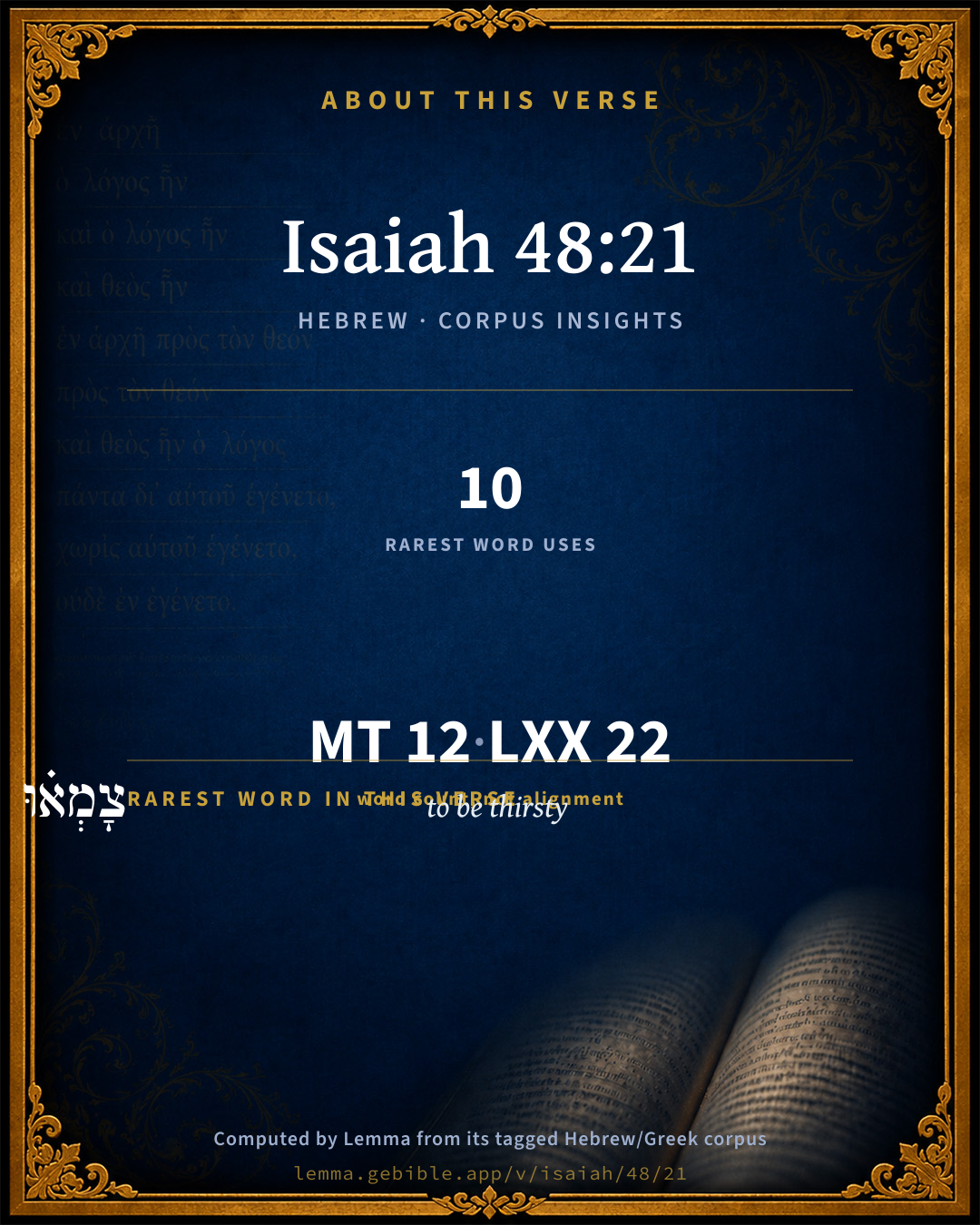
The rarest word here is צָמְא֗וּ to be thirsty H6770 — appearing just 10 times in the whole Hebrew Bible.

Shared distinctive vocabulary

צָמְא֗וּ to be thirsty H6770 occurs in 10 verses of the Hebrew Bible. Also found in:

Grammatical profile

  • 5 verbs
  • 5 nouns
  • 1 preposition
  • 1 particle

Verb forms

  • צָמְא֗וּ Qal · Perfect
  • הֽוֹלִיכָ֔ם Hiphil · Perfect
  • הִזִּ֣יל Hiphil · Perfect
  • וַיִּ֨בְקַע Qal · Sequential Imperfect
  • וַיָּזֻ֖בוּ Qal · Sequential Imperfect

Repetition

Words recur within this verse — often emphatic in Hebrew:

  • מַ֥יִם water H4325 ×2
  • מִצּ֖וּר rock H6697 ×2

Hebrew & Septuagint length

In English translation the verse runs 32 words from the Hebrew and 39 from the Septuagint (LXX English) — closely comparable.

A rough comparison of the two English renderings, which tokenize alike — not a word-level alignment.

Word counts can differ between the Hebrew and the Greek without any difference in meaning — e.g. the Hebrew direct-object marker אֵת has no separate Greek word, and Greek often adds the article ὁ.

In the original languages it is 12 Hebrew tokens and 22 Greek tokens — but the two are counted differently (Hebrew bundles its prefixes and suffixes into one token; the Greek is in lemma form), so that isn’t a like-for-like length.

Cross-references

12

Topical passages linked to Isaiah 48:21 in the Treasury of Scripture Knowledge — connected by theme and wording, ordered by reader-vote popularity; previews shown in the World English Bible.

  • Psalms 105:41 He opened the rock, and waters gushed out. They ran as a river in the dry places.
  • Isaiah 43:19–20 Behold, I will do a new thing; now shall it spring forth; shall you not know it? I will even make a way in the wilderness, and rivers in the desert.
  • Isaiah 41:17–18 The poor and needy seek water, and there is none, and their tongue fails for thirst; I, Yahweh, will answer them, I, the God of Israel, will not forsake them.
  • Exodus 17:6 Behold, I will stand before you there on the rock in Horeb. You shall strike the rock, and water will come out of it, that the people may drink." Moses did so in the sight of the elders of Israel.
  • Numbers 20:11 Moses lifted up his hand, and struck the rock with his rod twice: and water came forth abundantly, and the congregation drank, and their cattle.
  • Psalms 78:20 Behold, he struck the rock, so that waters gushed out, Streams overflowed. Can he give bread also? Will he provide flesh for his people?"
  • Isaiah 35:6–7 Then shall the lame man leap as a hart, and the tongue of the mute shall sing; for in the wilderness shall waters break out, and streams in the desert.
  • Nehemiah 9:15 and gave them bread from the sky for their hunger, and brought forth water for them out of the rock for their thirst, and commanded those who they should go in to possess the land which you had sworn to give them.
  • Isaiah 30:25 There shall be on every lofty mountain, and on every high hill, brooks [and] streams of waters, in the day of the great slaughter, when the towers fall.
  • Psalms 78:15 He split rocks in the wilderness, And gave them drink abundantly as out of the depths.
  • Isaiah 49:10 They shall not hunger nor thirst; neither shall the heat nor sun strike them: for he who has mercy on them will lead them, even by springs of water will he guide them.
  • Jeremiah 31:9 They shall come with weeping; and with petitions will I lead them: I will cause them to walk by rivers of waters, in a straight way in which they shall not stumble; for I am a father to Israel, and Ephraim is my firstborn.

Cross-references courtesy of OpenBible.info (CC BY 4.0).

Hebrew and Greek witnesses Masoretic Hebrew ↔ Greek Septuagint

The same verse in the two great witnesses to the Old Testament, shown verse-for-verse.

These are two independent witnesses, not word-aligned to each other, and the Septuagint is shown in lemma (dictionary) form.

Hebrew Isaiah 48:21 Masoretic · Westminster Leningrad Codex

וְלֹ֣א צָמְא֗וּ בָּחֳרָבוֹת֙ הֽוֹלִיכָ֔ם מַ֥יִם מִצּ֖וּר הִזִּ֣יל לָ֑מוֹ וַיִּ֨בְקַע צ֔וּר וַיָּזֻ֖בוּ מָֽיִם

They didn't thirst when he led them through the deserts; he caused the waters to flow out of the rock for them; he split the rock also, and the waters gushed out.

World English Bible · Public Domain

Greek LXX Isaiah 48:21 Septuagint · lemma form

καί ἐάν διψάω διά ἔρημος ἄγω αὐτός ὕδωρ ἐκ πέτρα ἐκἄγω αὐτός σχίζω πέτρα καί ῥέω ὕδωρ καί πίνω ὁ λαός ἐγώ

And if they shall thirst, he shall lead them through the desert; he shall bring forth water to them out of the rock: the rock shall be cloven, and the water shall flow forth, and my people shall drink.

LXX2012 (modern English Septuagint) · Public Domain

Hebrew: Westminster Leningrad Codex (CC BY 4.0). Greek: Septuagint (public domain); English from LXX2012 (modern English Septuagint) (Public Domain). How the Septuagint differs from the Hebrew →

Targum (Aramaic paraphrase)

1

The Targum is the ancient Jewish Aramaic paraphrase of the Hebrew Scriptures — an interpretive translation, not the Hebrew text itself. Onkelos (literal) and Pseudo-Jonathan (expansive) render the Torah, and Jonathan the Prophets. Coverage is partial: where no permissively-licensed English translation exists for a verse, only the Aramaic is shown. This is verse-level text, not a word-by-word alignment to the Hebrew.

  1. Targum Jonathan Prophets (Joshua–Malachi)
    וְלָא אַצְחֵינוּן בְּחָרְבָתָא דַבְּרִינוּן מַיָא מִטוּנְרָא אַפִּיק לְהוֹ וּבְזַע טִינְרָא וּנְגוּדוּ מַיָא:

    He will not suffer them to thirst in the desert; He will guide them; He will cause water to flow for them from the rock: yea, He will cleave the rock, and the waters shall gush out.

    Targum Jonathan — Aramaic: “Mikraot Gedolot” (public domain). English: “Sefaria Community Translation” (CC0 1.0 (public-domain dedication)); “London "Chaldee Paraphrase," 1871” (public domain). Text via Sefaria.

Commentary

Notes on Isaiah 48:21 from classic Christian and Jewish commentators (each source and its license shown beneath its notes). The classic Christian expositions comment on the surrounding passage and are grouped to its opening verse, so a note may address several verses; the Jewish commentaries on the Tanakh (Rashi and others) are per-verse, so they appear only where the commentator wrote on this verse.

Lemma curates 59 commentaries, every one of them public domain or Creative Commons licensed, each selected and text-cleaned for this edition rather than reprinted as found. About our sources →

Trapp's Complete Commentary

John Trapp

Isa 48:21 And they thirsted not [when] he led them through the deserts: he caused the waters to flow out of the rock for them: he clave the rock also, and the waters gushed out.

Ver. 21. And they thirsted not when he led, &c.] Your fathers did not of old: nor shall you now in your return homeward. The Jews tell us of many miracles then wrought also, but we read of no such matter in Ezra; and we know that God’s pilgrims shall want no necessary accommodation: that he will be sure to see to.

John Trapp, A Commentary or Exposition upon All the Books of the Old and New Testament (1647–1656) — public domain. Text from a community e-Sword module.

Tyndale Open Study Notes

Tyndale Open Resources

48:21 not thirsty . . . rock . . . water gushed: These reminders of God’s provision in the Exodus provide a fitting summary of what he would do to rescue Israel from captivity in Babylon (see Num 20:11).

Tyndale Open Study Notes — © Tyndale Open Resources, licensed CC BY-SA 4.0. Text via the HelloAO Bible API.

Geneva Bible (1599)

Geneva Bible translators

He showeth that it shall be as easy to deliver them, as he did their fathers out of Egypt.

Geneva Bible (1599) marginal notes — public domain. Text via Bolls.life.

Jamieson, Fausset & Brown

Robert Jamieson, A. R. Fausset & David Brown

Ezra, in describing the return, makes no mention of God cleaving the rock for them in the desert [KIMCHI]. The circumstances, therefore, of the deliverance from Egypt (Exo 17:6; Num 20:11; Psa 78:15; Psa 105:41) and of that from Babylon, are blended together; the language, while more immediately referring to the latter deliverance, yet, as being blended with circumstances of the former not strictly applicable to the latter, cannot wholly refer to either, but to the mystic deliverance of man under Messiah, and literally to the final restoration of Israel.

Jamieson, Fausset & Brown — Commentary Critical and Explanatory on the Whole Bible (1871) — public domain (CC PDM 1.0). Text via the HelloAO Bible API.

Adam Clarke's Commentary

Verse 21. They thirsted not - through the deserts] Kimchi has a surprising observation upon this place: "If the prophecy,' says he, "relates to the return from the Babylonish captivity, as it seems to do, it is to be wondered how it comes to pass, that in the Book of Ezra, in which he gives an account of their return, no mention is made that such miracles were wrought for them; as, for instance, that God clave the rock for them in the desert." It is really much to be wondered, that one of the most learned and judicious of the Jewish expositors of the Old Testament, having advanced so far in a large Comment on Isaiah, should appear to be totally ignorant of the prophet's manner of writing; of the parabolic style, which prevails in the writings of all the prophets, and more particularly in the prophecy of Isaiah, which abounds throughout in parabolical images from the beginning to the end; from "Hear, O heavens, and give ear, O earth," to "the worm and the fire" in the last verse. And how came he to keep his wonderment to himself so long? Why did he not expect that the historian should have related how, as they passed through the desert, cedars, pines, and olive-trees shot up at once on the side of the way to shade them; and that instead of briers and brambles the acacia and the myrtle sprung up under their feet, according to God's promises, Isa 41:19; Isa 55:13? These and a multitude of the like parabolical or poetical images, were never intended to be understood literally. All that the prophet designed in this place, and which he has executed in the most elegant manner, was an amplification and illustration of the gracious care and protection of God vouchsafed to his people in their return from Babylon, by an allusion to the miraculous exodus from Egypt. See De S. Poesi, Hebr. Prael. ix.

Adam Clarke's Commentary on the Bible (1810–1826) — public domain. Text from a community e-Sword/MySword module.

Ellicott's Commentary for English Readers

(21) He caused the waters to flow . . .—A dead prosaic literalism makes men wonder that there is no record of such wonders on the return from Babylon. A truer insight recognises that the “water out of the rock” is, as ever, the symbol of spiritual refreshment (Isa_41:17-19; Isa_43:19-20; Joh_4:10).

A Bible Commentary for English Readers, edited by Charles John Ellicott (1878–1897) — public domain. Text from a community e-Sword module.

The Cambridge Bible for Schools and Colleges

gen. ed. J. J. S. Perowne

21. These are still words of the ransomed people. The allusions are to the miracles in the wilderness of Sinai (cf. Exo_17:6; Num_20:11) which are represented as having been repeated during the desert journey of the returning exiles.

The Cambridge Bible for Schools and Colleges (gen. ed. J. J. S. Perowne; Cambridge University Press, 1878–1918) — public domain. Text from a community e-Sword module.

John Gill's Exposition

And they thirsted not when he led them through the deserts,.... As when he led the people of Israel through the wilderness to Canaan's land, though they sometimes thirsted for want of water, yet they were supplied with it, by which their thirst was extinguished, to which the reference here is. So when they came out of Babylon, and passed through the waste and desert places which lay between that and Judea, they were supplied with all necessaries. Thus the apostles of Christ, when they travelled through the Gentile world, comparable to a desert, publishing redemption and salvation by Christ, had every needful supply, both of temporal and spiritual things; they lacked not any thing. In like manner the people of God, while they pass through the wilderness of this world to the heavenly glory, are furnished and refreshed with living water out of the fountain and fulness of grace in Christ, of which if a man drink, he shall thirst no more, Joh 4:14, Isa 49:10, he caused the waters to flow out of the rock for thee; that is, for the Israelites in the wilderness, when they were come out of Egypt, and wanted water, Exo 17:6,

he clave the rock also, and the waters gushed out; Psa 78:15, the rock was a type of Christ, from whom the living waters of grace flow, to the support, supply, comfort, and refreshment of the saints in this world, Co1 10:4. Grace is often signified by waters, because purifying and cleansing, reviving and refreshing, softening and fructifying, and an extinguisher of thirst: their gushing out denotes the abundance of it, which is received from Christ, not only at first conversion, in the regeneration and quickening of men; in the pardon of their sins, and the justification of their persons; but in the large communications of grace, after made, for the supply of their wants: and all which come from Christ the Rock, that is higher than they, from whence their bread is given them, and their waters are sure unto them; and who is the Rock of their refuge and salvation: and the cleaving of this Rock may signify his sufferings and death; his being smitten, bruised, and broken for his people, that they may partake of his grace, and the blessings of it.

John Gill's Exposition of the Whole Bible (1746–1763) — public domain (CC PDM 1.0). Text via the HelloAO Bible API.

Albert Barnes' Notes on the Bible

And they thirsted not - This is a part of that for which they would be called to celebrate his name. It was not merely that he had redeemed them, but that he had abundantly provided for their needs in the desert, and guided them safe through the pathless wilderness to their own land (see the notes at Isa 35:6-7; Isa 41:17-18).

He caused the waters to flow out of the rock for them - The allusion here is undoubtedly to the fact that God caused the waters to flow out of the rock that Moses smote in the wilderness Exo 17:6; Num 20:11. This is not to be regarded as literally true that God would, in like manner, smite the rocks and cause waters to flow by miracle on their return from Babylon. There is no record that any such event took place, and it is not necessary so to understand this passage. It is a part of the triumphant song which they are represented as singing after their return to their own land. In that song, they celebrate his gracious interposition in language that was familiar to them, and by illustrations that were well known. They therefore speak of his mercy to them as if he had smitten the rock in the desert on their return, and caused the waters to flow; and the sense is, that his mercy to them then was similar to his goodness to their fathers when he led them to the land of promise. He met all their necessities; and his gracious interposition was experienced all the way as really as though he had smitten the rock, or caused cool and refreshing fountains to break out in the desert.

Albert Barnes' Notes on the Bible (1834–1885) — public domain. Text from a community e-Sword/MySword module.

Haydock's Catholic Bible Commentary

Out. Their return was facilitated. This may easily be applied (Calmet) to the conversion of the Gentiles. (St. Jerome)

George Leo Haydock (1774–1849), Haydock's Catholic Family Bible and Commentary, 1859 edition — public domain. Excludes Psalms (Douay-Rheims chapter numbering differs from Protestant) and Deuterocanonical books (Catholic canon only).

Matthew Poole's English Annotations

This is part of the matter which the Jews are obliged to declare to all people, as they have opportunity, to wit, that God took the same care of them in their return from Babylon to Canaan, which was through many dry and desolate places, as he did in their march from Egypt to Canaan.

They thirsted not, & c., i.e. they shall not thirst. He speaks of things to come, as if they were already past or present, as the prophets commonly do.

Matthew Poole's English Annotations on the Holy Bible (1683–1685) — public domain. Text from a community e-Sword/MySword module.

The Pulpit Commentary

They thirsted not. (comp. Isa_43:19, and the comment ad loc) The literal meaning is not to be altogether excluded. We have no historical account of the journey made by the bulk of the exiles who returned with Zerubbabel; but they must almost certainly have experienced difficulties with respect to water; and it is quite possible that a miraculous supply was vouchsafed to them. Most commentators, however, are content to explain both this and the earlier passage as merely "symbolical." The Israelites they say had spiritual refreshment on their homeward journey, by God"s goodness, constantly.

The Pulpit Commentary (1880–1919), ed. H.D.M. Spence-Jones & Joseph S. Exell — public domain. Text from a community e-Sword module.

John Wesley's Explanatory Notes

They thirsted not - They shall not thirst. He speaks of things to come, as if they were already past.

John Wesley, Explanatory Notes Upon the Whole Bible (1754–1765) — public domain. Text via the GEBible commentary corpus.

J. A. Alexander on Isaiah

Joseph Addison Alexander

“And they thirsted not in the deserts (through which) He made them go. Water from a well He made to flow for them; and He clave the rock, and waters gushed out.” There is evident reference here to the miraculous supply of water in the journey through the wilderness (Exo 17:6; Num 20:11; Psa 78:15). It might even seem as if the writer meant to state these facts historically. Such at least would be the simpler exposition of his words, which would then contain a reference to the Exodus from Egypt, as the great historical example of deliverance. As if he had said, ‘Relate how God of old redeemed his servant Jacob out of Egypt, and led him through the wilderness, and slaked his thirst with water from the solid rock.’ Most interpreters, however, are agreed in applying the words to the deliverance from Babylon.

Joseph Addison Alexander, The Prophecies of Isaiah (1846–1847; New York: Scribner, 1870–1878) — public domain. Text from a community e-Sword module.

unfoldingWord translationNotes

Door43 World Missions Community

They did not thirst ... the waters gushed out

This refers to an event in the history of the people of Israel when Yahweh took care of them while they lived in the desert after escaping Egypt.

translationWords

desert

peace

evil

Yahweh

unfoldingWord translationNotes — © Distant Shores Media and the Door43 World Missions Community, licensed CC BY-SA 4.0. Source: git.door43.org/Door43/en_tn.

Ibn Ezra

Rabbi Abraham ibn Ezra

Out of the rock. Where no water had been before.

ויזבו And gushed out. Comp. זב running (Lev. 15:2)

Ibn Ezra on the Tanakh — English translations: “Sefaria Community Translation” (CC0 1.0 (public-domain dedication)); “Yalkut, Sifsei Chachomim Chumash, Metsudah Publications, 2009” (CC BY 4.0); and “Commentary of Ibn Ezra on Isaiah - trans. by M. Friedlander, 1873” (public domain). Text via Sefaria.

Lesson kit

Teaching starters — assembled from the data on this page, not authored interpretation. Every prompt links to the verse data it draws on. Edit before teaching.

Isaiah, in the Prophets, opens this verse with 12 words (9 distinct Hebrew lemmas). Its most distinctive word is tsâmêʼ (“to be thirsty”). A historical commentator’s framing appears above. Read the whole chapter for the surrounding context.

Discussion questions

  1. What does “to be thirsty” (tsâmêʼ) contribute to the verse as a whole?
  2. Exodus 17:3 shares the word «to be thirsty» with this verse. How do the two illuminate each other?
  3. “water” occurs 2× in this one verse. What is the effect of the repetition?
  4. These translations render this verse differently; the difference is in the English rendering, not the original. What questions does that raise?
  5. The verb «צָמְא֗וּ» is Qal Perfect. How does its form color the action?
  6. Reading how Trapp's Complete Commentary and Tyndale Open Study Notes read this verse, where do the two commentators agree and where do they part?

Things to notice

Reading settings

Reading text

Shown beneath each verse's original-language words.

Old Testament
Old Testament edition

Read the OT as the Masoretic Hebrew (MT) or the Greek Septuagint (LXX).

English shown for the Greek Septuagint (in the Hebrew ↔ Greek comparison).

Comparing translations? Open the Compare panel on any verse page to stack up to four side by side.