
Psalms 78:15

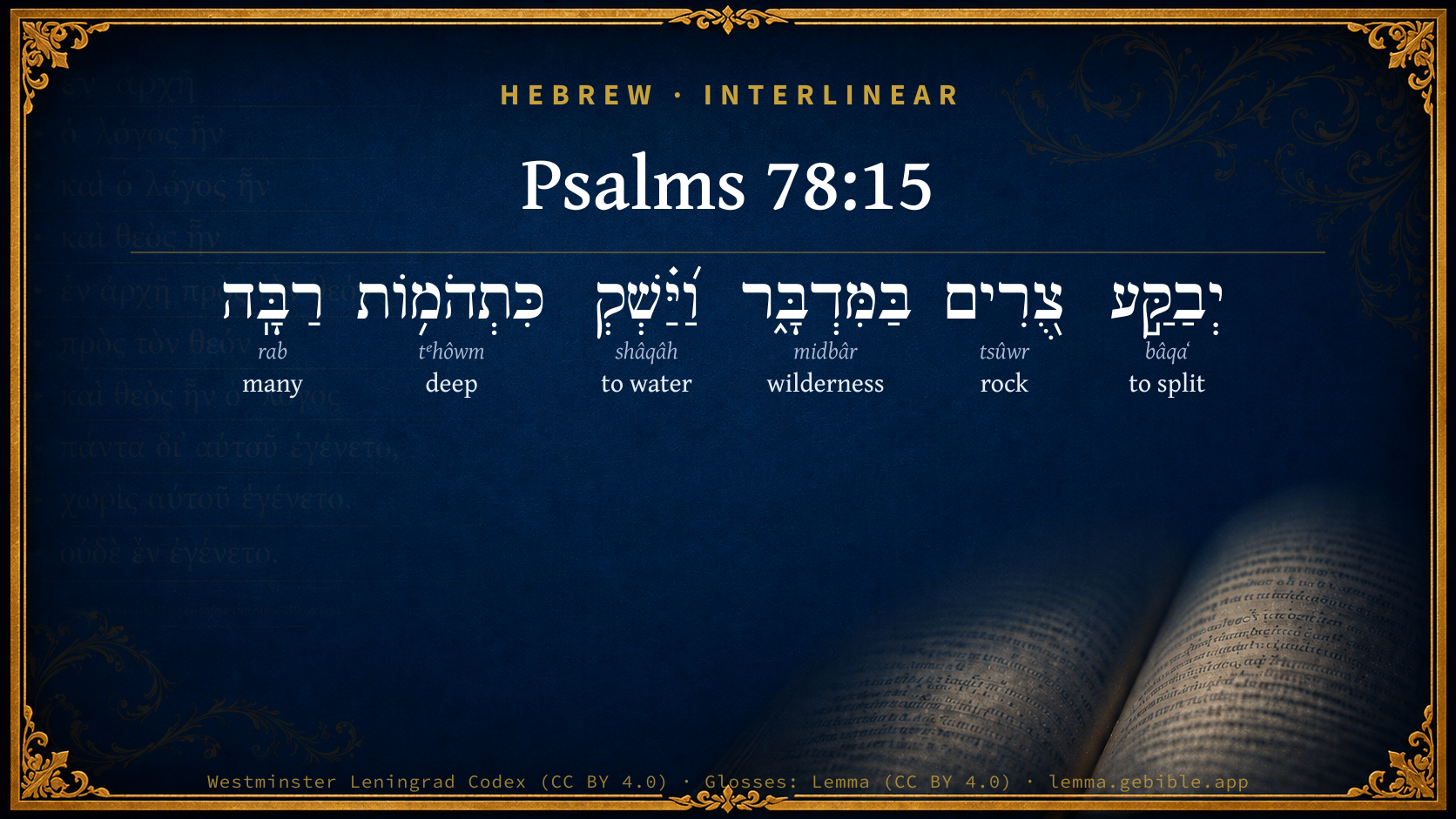
Hebrew (Westminster Leningrad Codex) Psalms 78:15 appears in the Hebrew Old Testament. The text above is from the Westminster Leningrad Codex. Each word links to its Strong’s number, a concise gloss, and parsing drawn from the Open Scriptures Hebrew Bible morphology. Click any word for its full Brown-Driver-Briggs (BDB) entry.
Download image
Cite this verse

Psalms 78:15 (World English Bible). Public Domain. Lemma interlinear Bible study tool, https://lemma.gebible.app/v/psalms/78/15.

Show BibTeX & RIS
BibTeX
RIS
English Translation
He split rocks in the wilderness, And gave them drink abundantly as out of the depths.
World English Bible · Public Domain
Download a study sheet

One document with this verse’s original text, its word-by-word gloss line, the meaning frame, cross-references with their text, attributed commentary, and full source and license credits — printable, and it pastes into notes with its structure intact.

This verse Autodidact and up

Study sheet (.html) Plain text (.txt)

A passage Seminary Student

Up to 50 verses in one chapter. A passage sheet keeps up to 6 commentary sources and 12 cross-references per verse, in the order this page ranks them, and says so on the sheet whenever that leaves anything out. Ask for a single verse and you get the Autodidact verse sheet above.

Everything on this page stays free to read, with no account — the sheet is a download of what is already on screen, not access to it.

Want to remove ads? Support Godless Engineer
Compare translations 3

The same verse in 3 English versions, stacked beneath the original-language interlinear above. Click any original word for its lexicon entry.

Each is an independent rendering of the whole verse — the interlinear is not word-aligned to these translations.

Highlighted words mark where these versions differ — a whole-verse word diff, not a word-by-word alignment.

  • World English Bible Public Domain
    He split rocks in the wilderness, And gave them drink abundantly as out of the depths.
  • King James Version Public Domain
    He clave the rocks in the wilderness, and gave them drink as out of the great depths.
  • unfoldingWord Literal Text CC BY-SA 4.0
    He split open the rocks in the wilderness, and he gave drink abundantly as the deep.

unfoldingWord Literal Text — © unfoldingWord, licensed CC BY-SA 4.0. Word-aligned USFM3 via Door43 (git.door43.org/unfoldingWord/en_ult).

Versions to compare (up to 4)

3 of 4 selected

Show all 18 translations

Every available English version of this verse, each an independent rendering of the whole verse.

  • World English Bible Public Domain
    He split rocks in the wilderness, And gave them drink abundantly as out of the depths.
  • Berean Standard Bible Public Domain
    He split the rocks in the wilderness and gave them drink as abundant as the seas.
  • Majority Standard Bible Public Domain
    He split the rocks in the wilderness and gave them drink as abundant as the seas.
  • King James Version Public Domain
    He clave the rocks in the wilderness, and gave them drink as out of the great depths.
  • American Standard Version (1901) Public Domain
    He clave rocks in the wilderness, And gave them drink abundantly as out of the depths.
  • Revised Version (1885) Public Domain
    He clave rocks in the wilderness, and gave them drink abundantly as out of the depths.
  • Geneva Bible (1599) Public Domain
    He claue the rockes in the wildernes, and gaue them drinke as of the great depths.
  • Douay-Rheims (1899) Public Domain
    He struck the rock in the wilderness: and gave them to drink, as out of the great deep.
  • Young's Literal Translation Public Domain
    He cleaveth rocks in a wilderness, And giveth drink -- as the great deep.
  • Literal Standard Version CC BY-SA 4.0
    He cleaves rocks in a wilderness, || And gives drink—as the great deep.
  • Unlocked Literal Bible CC BY-SA 4.0
    He split the rocks in the wilderness, and he gave them water abundantly, enough to fill the depths of the sea.
  • unfoldingWord Literal Text CC BY-SA 4.0
    He split open the rocks in the wilderness, and he gave drink abundantly as the deep.
  • Darby Bible Public Domain
    He clave rocks in the wilderness, and gave [them] drink as out of the depths, abundantly;
  • World Messianic Bible Public Domain
    He split rocks in the wilderness, and gave them drink abundantly as out of the depths.
  • Webster's Bible Public Domain
    He cleaved the rocks in the wilderness, and gave them drink as out of the great depths.
  • Free Bible Version CC BY-SA 4.0
    He split open rocks in the desert to give his people plenty to drink, water as deep as the ocean.
  • Bible in Basic English Public Domain
    The rocks of the waste land were broken by his power, and he gave them drink as out of the deep waters.
  • JPS Tanakh (1917) Public Domain
    He cleaved rocks in the wilderness, and gave them drink abundantly as out of the great deep.

Literal Standard Version (2020), Covenant Press — licensed CC BY-SA 4.0. Text via the HelloAO Bible API (eBible.org). Unlocked Literal Bible (unfoldingWord) — licensed CC BY-SA 4.0. Text via the HelloAO Bible API (eBible.org). unfoldingWord Literal Text — © unfoldingWord, licensed CC BY-SA 4.0. Word-aligned USFM3 via Door43 (git.door43.org/unfoldingWord/en_ult). Free Bible Version, Dr. Jonathan Gallagher — licensed CC BY-SA 4.0. Text via the HelloAO Bible API (eBible.org).

Word by word

More ways to search: Search by grammar → Find every occurrence → Compare this word →

Practice this passage: Drill this verse → Learn its vocabulary →

About this verse

These counts appear in no published source. They are computed here, from the morphology-tagged text and Lemma’s own curated glosses. What Lemma adds →

6
words
6
distinct lemmas
Wisdom
section

Shared distinctive vocabulary

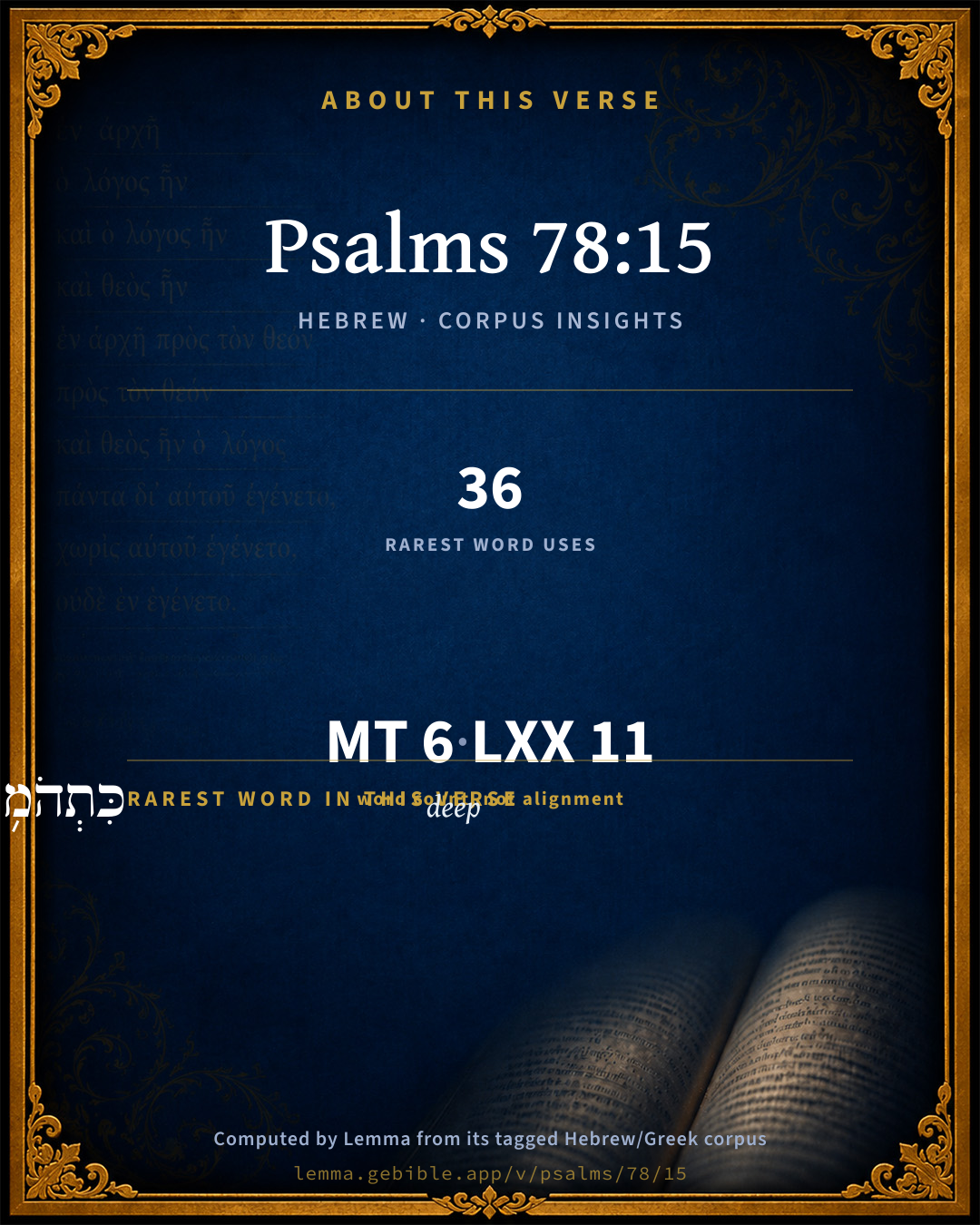
כִּתְהֹמ֥וֹת deep H8415 occurs in 35 verses of the Hebrew Bible. Also found in:

Grammatical profile

  • 2 verbs
  • 3 nouns
  • 1 adjective

Verb forms

  • יְבַקַּ֣ע Piel · Imperfect
  • וַ֝יַּ֗שְׁקְ Hiphil · Sequential Imperfect

Hebrew & Septuagint length

In English translation the verse runs 16 words from the Hebrew and 16 from the Septuagint (LXX English) — the same length.

A rough comparison of the two English renderings, which tokenize alike — not a word-level alignment.

Word counts can differ between the Hebrew and the Greek without any difference in meaning — e.g. the Hebrew direct-object marker אֵת has no separate Greek word, and Greek often adds the article ὁ.

In the original languages it is 6 Hebrew tokens and 11 Greek tokens — but the two are counted differently (Hebrew bundles its prefixes and suffixes into one token; the Greek is in lemma form), so that isn’t a like-for-like length.

Cross-references

11

Topical passages linked to Psalms 78:15 in the Treasury of Scripture Knowledge — connected by theme and wording, ordered by reader-vote popularity; previews shown in the World English Bible.

  • Exodus 17:6 Behold, I will stand before you there on the rock in Horeb. You shall strike the rock, and water will come out of it, that the people may drink." Moses did so in the sight of the elders of Israel.
  • Numbers 20:11 Moses lifted up his hand, and struck the rock with his rod twice: and water came forth abundantly, and the congregation drank, and their cattle.
  • Psalms 105:41 He opened the rock, and waters gushed out. They ran as a river in the dry places.
  • 1 Corinthians 10:4 and all drank the same spiritual drink. For they drank of a spiritual rock that followed them, and the rock was Christ.
  • Psalms 114:8 Who turned the rock into a pool of water, The flint into a spring of waters.
  • Isaiah 41:18 I will open rivers on the bare heights, and springs in the midst of the valleys; I will make the wilderness a pool of water, and the dry land springs of water.
  • Isaiah 43:20 The animals of the field shall honor me, the jackals and the ostriches; because I give waters in the wilderness, and rivers in the desert, to give drink to my people, my chosen,
  • Isaiah 48:21 They didn't thirst when he led them through the deserts; he caused the waters to flow out of the rock for them; he split the rock also, and the waters gushed out.
  • Revelation 22:1 He showed me a river of water of life, clear as crystal, proceeding out of the throne of God and of the Lamb,
  • Revelation 22:17 The Spirit and the bride say, "Come!" He who hears, let him say, "Come!" He who is thirsty, let him come. He who desires, let him take the water of life freely.
  • John 7:37–38 Now on the last and greatest day of the feast, Jesus stood and cried out, "If anyone is thirsty, let him come to me and drink!

Cross-references courtesy of OpenBible.info (CC BY 4.0).

Hebrew and Greek witnesses Masoretic Hebrew ↔ Greek Septuagint

The same verse in the two great witnesses to the Old Testament, shown verse-for-verse.

You’re reading Greek Psalm 77 (Hebrew Psalm 78). The Septuagint counts the superscription, so verse numbers can differ from the Hebrew — chapter-level alignment, not verse-by-verse. Numbering follows Rahlfs.

These are two independent witnesses, not word-aligned to each other, and the Septuagint is shown in lemma (dictionary) form.

Hebrew Psalms 78:15 Masoretic · Westminster Leningrad Codex

יְבַקַּ֣ע צֻ֭רִים בַּמִּדְבָּ֑ר וַ֝יַּ֗שְׁקְ כִּתְהֹמ֥וֹת רַבָּֽה

He split rocks in the wilderness, And gave them drink abundantly as out of the depths.

World English Bible · Public Domain

Greek LXX Greek Psalm 77:15 Septuagint · lemma form

διαῥήγνυμι πέτρα ἐν ἔρημος καί ποτίζω αὐτός ὡς ἐν ἄβυσσος πολύς

he clave a rock in the wilderness, and made them drink as in a great deep.

LXX2012 (modern English Septuagint) · Public Domain

Hebrew: Westminster Leningrad Codex (CC BY 4.0). Greek: Septuagint (public domain); English from LXX2012 (modern English Septuagint) (Public Domain). How the Septuagint differs from the Hebrew →

Commentary

Notes on Psalms 78:15 from classic Christian and Jewish commentators (each source and its license shown beneath its notes). The classic Christian expositions comment on the surrounding passage and are grouped to its opening verse, so a note may address several verses; the Jewish commentaries on the Tanakh (Rashi and others) are per-verse, so they appear only where the commentator wrote on this verse.

Lemma curates 59 commentaries, every one of them public domain or Creative Commons licensed, each selected and text-cleaned for this edition rather than reprinted as found. About our sources →

Trapp's Complete Commentary

John Trapp

Psa 78:15 He clave the rocks in the wilderness, and gave [them] drink as [out of] the great depths.

Ver. 15. He clave the rocks] And set them abroach, both that in Rephidim, Exo 17:1-8, and the other in Kadesh, Num 20:1-13 Moses Nehamides, on Exo 17:1-8, saith, that the old Jewish doctors held that the rock of Rephidim not only yielded waters like a river all those forty years wherein they were in the wilderness, but followed them also there whithersoever they went. This agreeth well with that of the apostle St Paul, 1Co 10:4, who sweetly allegorizeth this history.

As out of the great depths] i.e. In great abundance, Ad satietatem usque. Rocks sooner yield fire than water; but what cannot God do?

John Trapp, A Commentary or Exposition upon All the Books of the Old and New Testament (1647–1656) — public domain. Text from a community e-Sword module.

The Biblical Illustrator

Joseph S. Exell

Psa_78:15-16

He clave the rocks in the wilderness, and gave them drink as out of the great depths.

Streams from the rock

I. Consider thy rock as a representation of Christ.

1. What does a rock remind us of?

(1) Solidity and firmness. Christ is the same, yesterday, to-day, and for ever.

(2) Power of defence. Christ is mighty to save. Able to save to the uttermost.

(3) Power of support. Upon this rock I will build My Church.

(4) Power of refreshment. This is desirable; but bow is it with regard to Christians as to their relation to Christ? By believing they enter into rest; they feel a peace that passeth all understanding; in all their afflictions, tribulations, and trials, whether personal or relative, they find here the shadow of a great rock in a weary land.

2. We pass from the image to its condition; we mean with regard to its being smitten. And how did the Lord Jesus become the author of eternal salvation unto all them that obey Him? Not only by the dignity of His nature, though this was necessary; not only by the innocence of His life, though this was necessary; and not only by the perfection of His righteousness, but by suffering and by death: He was wounded for our transgressions, etc.

3. It was not only smitten, but smitten by Moses--a type of the law. The Lord laid on Him the iniquity of us all. He redeemed us from the curse of the law, etc.

4. The last article of conformity is the result, for from this rock, as Smitten by Moses, streams flowed. He brought streams also out of the rock.

II. To survey some of the fine streams which flowed from it.

1. The promises. These are exceeding great and precious--exceeding great, because of their contents; exceeding precious to the Christian, because of the estimation they are held in by him. All these are Yea and Amen in Christ Jesus.

2. Pardoning mercy. His blood cleanseth from all sin.

3. Sanctifying grace. If any man be in Christ he is a new creature.

4. Spiritual consolation. It is I, be not afraid.

5. Future blessedness. Fulness of joy. Eye hath not seen, etc.

III. The quality of these streams.

1. They were marvellous and unlikely. Who ever saw a stream of water rising out of a flinty rock? How much more supernatural is the stream of redemption!

2. They were gratuitous. He did not deal with them according to their sine, nor reward them after their iniquity, but furnished them with those supplies they needed. And how was it with us? for they were an exact counterpart of us. It was not by works of righteousness that we have done that He saved us, but by the washing of regeneration, and renewing of the Holy Ghost; thus showing the exceeding riches of His grace in His kindness towards us by Christ Jesus.

3. They were copious (verse16). So in regard to the waters of life, there is enough and to spare; enough for you, enough for others, enough for all. Ho, every one that thirsteth; come ye to the waters.

4. They were constant, at least enough so to furnish an exact representation of the waters of salvation, for you have heard how far the reality has the pre-eminence. This rock in its streams followed them partially, and only for a while; and the people moved on in another direction, leaving these streams, and then they thirsted again. But it is true, perfectly true, without any exception, that this rock, or the streams thereof, follow Christians in all their travels in the wilderness, and it will never leave them, nor forsake them. When they look forward, therefore, they may say with holy confidence, Surely goodness and mercy shall follow me all the days of my life; and the meanest of them feels assured that he shall dwell for ever in Gods house above. (W. Jay.)

The Biblical Illustrator, edited by Joseph S. Exell (c. 1880s–1900s) — public domain. Text from a community e-Sword module.

J. A. Alexander on Psalms

Joseph Addison Alexander

15. (Psa 78:15) He cleaves rocks in the wilderness, and gives them drink as a great deep. This last is a hyperbolical description of an abundant flow of water in the desert. Some account for it by supposing an allusion to the flood, from the account of which (Gen 7:11) some of the expressions are borrowed. The verse has reference to both miraculous supplies of this kind, one in the first, and one in the last year of the error in the wilderness. See Exo 17:6, Num 20:8.

Joseph Addison Alexander, The Psalms Translated and Explained (1850) — public domain. Text from a community e-Sword module.

John Calvin's Commentaries

15. He clave the rocks in the wilderness. The Psalmist produces another evidence of the fatherly love by which God testified the greatness of the care which he exercised about the welfare of this people. It is not simply said that God gave them drink, but that he did this in a miraculous manner. Streams, it is true, sometimes issue from rocks, but the rock which Moses smote was completely dry. Whence it is evident, that the water was not brought forth from any spring, but that it was made to flow from the profoundest deeps, as if it had been said, from the very center of the earth. Those, therefore, who have interpreted this passage as meaning, that the Israelites drank in the bottomless deeps, because the waters flowed in great abundance, have failed in giving the true explanation. Moses, in his history of the miracle, rather enhances its greatness, by intimating, that God commanded those waters to come gushing from the remotest veins.

The same truth is confirmed in the following verse, in which it is stated, that where there had not been a single drop of water before there was a large and mighty river. Had there only sprung out of the rock a small rivulet, ungodly men might have had some apparent ground for cavilling at, and underrating the goodness of God, but when the water gushed out in such copious abundance all on a sudden, who does not see that the ordinary course of nature was changed, rather than that some vein or spring which lay hidden in the earth was opened?

John Calvin's Commentaries (1540-1563) — public domain. Text from the Calvin Translation Society English edition (1840s-50s) via the Christian Classics Ethereal Library (ccel.org). Calvin's coverage is partial (roughly two-thirds of the Bible); uncommented books and verses are honest gaps, never fabricated. The 19th-century editor's footnotes and remarks are omitted so the notes are faithfully Calvin's own voice.

Ellicott's Commentary for English Readers

(15) And gave . . .—Literally, and gave them to drink as it were a great deep, or as we might say, “oceans of drink”—a poetical exaggeration; or are we rather to think of the gift of water as produced by striking or boring through the rock to the great ocean on which the earth was supposed to rest?

A Bible Commentary for English Readers, edited by Charles John Ellicott (1878–1897) — public domain. Text from a community e-Sword module.

The Cambridge Bible for Schools and Colleges

gen. ed. J. J. S. Perowne

15, 16. He clave rocks in the wilderness,

And gave them drink as out of the depths abundantly:

And he brought forth streams out of a cliff.

Two different words are used, with reference to the two occasions upon which the Israelites were miraculously supplied with water: first in Rephidim at the beginning of their journey when Moses was commanded to smite ‘the rock’ (Exo_17:6), and secondly, in Kadesh, at the close of their wanderings, when Moses smote ‘the cliff,’ to which he was commanded to speak (Num_20:8 ff.). The depths are the reservoirs of water hidden in the earth (Psa_33:7; Gen_7:11; Deu_8:7).

The Cambridge Bible for Schools and Colleges (gen. ed. J. J. S. Perowne; Cambridge University Press, 1878–1918) — public domain. Text from a community e-Sword module.

John Gill's Exposition

He brought streams also out of the rock,.... Which is expressed in the singular number, as also in Psa 78:20, because the children of Israel were not come to Kadesh, and the second rock was not smitten when they lusted after flesh, and murmured against God, and tempted him, as is after related:

and caused waters to run down like rivers; from the descent of the rock, which followed them all the way in the wilderness; this was a most marvellous thing, that water should flow from a flinty rock upon striking it, from whence fire rather than water might have been expected; and that it should flow in such great abundance, and that from a rock in a wilderness.

John Gill's Exposition of the Whole Bible (1746–1763) — public domain (CC PDM 1.0). Text via the HelloAO Bible API.

Albert Barnes' Notes on the Bible

He clave the rocks in the wilderness - There were two occasions on which the rock was smitten for water; one Exo 17:6 at Mount Horeb, shortly after they came out of Egypt; and the other Num 20:11, when they had nearly ceased their wanderings in the wilderness. Hence, the plural term (rocks) is used here.

And gave them drink as out of the great depths - As if he had formed a lake or an ocean, furnishing an inexhaustible supply.

Albert Barnes' Notes on the Bible (1834–1885) — public domain. Text from a community e-Sword/MySword module.

Matthew Poole's English Annotations

Rocks; he useth the plural number, because it was twice done; once in Rephidim, Exo 17:6, and again in Kadesh, Num 20:1,11.

The great depths; in great abundance.

Matthew Poole's English Annotations on the Holy Bible (1683–1685) — public domain. Text from a community e-Sword/MySword module.

The Treasury of David

Charles H. Spurgeon

Ver. 15. He clave the rocks in the wilderness. Moses was the instrument, but the Lord did it all. Twice he made the flint a gushing rill. What can he not do?

And gave them drink as out of the great depths, --as though it gushed from earth's innermost reservoirs. The streams were so fresh, so copious, so constant, that they seemed to well up from the earth's primeval fountains, and to leap at once from "the deep which coucheth beneath." Here was a divine supply for Israel's urgent need, and such an one as ought to have held them for ever in unwavering fidelity to their wonder working God.

Ver. 15. The rocks. They were typical of Christ, 1Co 10:4; who is frequently compared to one for height, strength, and duration, shade, shelter, and protection; and is called the "Rock of Israel, " the "Rock of offence to both houses of Israel, "the "Rock of salvation, "the "Rock of refuge, "the "Rock of strength, "the "Rock that is higher than, "the saints, and on which the church is built, and who is "the shadow of a great rock in a weary land." John Gill.

Ver. 15. Gave them drink as out of the great depths. As if he had formed a lake or an ocean, furnishing an inexhaustible supply. Albert Barnes.

Ver. 15-16. Divine supplies seasonable, plentiful, of the best, marvellous.

Psalms 78:16*

Ver. 15-16. Divine supplies seasonable, plentiful, of the best, marvellous.

Charles H. Spurgeon's The Treasury of David (1869–1885) — public domain. Psalms only. Text from a community e-Sword/MySword module.

Whedon's Commentary on the Bible

Daniel D. Whedon

15. Rocks—The plural indicates that the psalmist compresses into one the two miracles, the first at Horeb in the first year after the exodus, (Exo_17:6,) and the second in the fortieth year, at Kadesh, Num_20:1; Num_20:11.

Great depths—The Hebrew word signifies ocean depths, abyss, as in Gen_1:2. Both at Sinai and Kadesh vast quantities of water were required; at the former place because of the length of their stay there, and at the latter because there were fewer natural supplies. This is specially true if we locate Kadesh, with Dr. Robinson, at Ain el-Weibeh in the Arabah, in the southeast limit of Palestine, though this feature of the case would be much relieved if we adopt Mr. Palmer’s hypothesis, and locate Kadesh at Ain Gadis, (“a name which, in meaning and etymology, is identical with the Kadesh of the Bible,”) seventy miles south by west from Ain el-Weibeh, in a region well cultivated in ancient times.

Daniel D. Whedon (gen. ed.), Commentary on the Old and New Testaments (1874–1909) — public domain. Text from a community e-Sword module.

The Pulpit Commentary

Vers. 15, 16. He clave the rocks in the wilderness; rather, he clave rocks. The word has no article. The reference is probably to both Exo_17:6 and Num_20:8-11. And gave them drink as out of the great depths; rather, "and gave them drink abundantly, as out of the depths" (so Cheyne and the Revised Version). On the abundance of the water, see Num_20:11, and compare the next verse: He brought streams also out of the rock, and caused waters to run down like rivers.

The rock. (Cf. 1Co_10:4 Nu 20) What rock was this? Travellers have described such rock; but we do not know that it was this one. But we do know that it existed; that the waters which flowed from it followed Israel; which is what Paul means by saying that the "rock followed them;" and that this rock was a type of Christ not Christ himself, but a type of him. Note

I THE RESEMBLANCE BETWEEN CHRIST AND THE ROCK,

1. In nature. A rock is like Christ; it is stable, solid, fit for a foundation. A rock may be a great defence. "Be thou my strong Rock, a House of defence to cover me." A refreshing shade. "The shadow of a great rock," etc.

2. In the fact that the rock was smitten ere the waters flowed out.

3. Moses, the Laws representative, was the smiter. And to obey the Law, Christ was smitten.

II THE STREAMS WHICH FLOWED FROM IT. These tell of what from Christ flow to us pardoning mercy, sanctifying grace, spiritual consolation, eternal life. And as those streams, so these are free, satisfying, copious, constant.

III THE INQUIRIES SUGGESTED. Have we drunk of them? If not, do so. Are we drinking of them? Invite others. S.C.

The Pulpit Commentary (1880–1919), ed. H.D.M. Spence-Jones & Joseph S. Exell — public domain. Text from a community e-Sword module.

John Wesley's Explanatory Notes

Wilderness - In Rephidim, and again in Kadesh.

John Wesley, Explanatory Notes Upon the Whole Bible (1754–1765) — public domain. Text via the GEBible commentary corpus.

unfoldingWord translationNotes

Door43 World Missions Community

He split

"God split"

enough to fill the depths of the sea

This is probably hyperbole. AT: "more water than they could possibly drink" (See: Hyperbole and Generalization)

streams

small rivers

translationWords

desert

unfoldingWord translationNotes — © Distant Shores Media and the Door43 World Missions Community, licensed CC BY-SA 4.0. Source: git.door43.org/Door43/en_tn.

Rashi

Rabbi Shlomo Yitzchaki (Rashi)

He split rocks (Exod. 17:6): “and you shall strike the rock.”

and He gave them to drink as [from] great deeps in the great deeps. Even as they went through the midst of the sea, whose waters are salty, He sweetened fountains for them in the midst of the sea.

Rashi on the Tanakh — English translations: “The Judaica Press complete Tanach with Rashi, translated by A. J. Rosenberg” (CC BY 4.0); “Pentateuch with Rashi's commentary by M. Rosenbaum and A.M. Silbermann, 1929-1934” (public domain); “The Metsudah Tanach series, Lakewood, N.J” (CC BY 4.0); and “The Book of Joshua, Metsudah Publications, 1997” (CC BY 4.0). Text via Sefaria.

Lesson kit

Teaching starters — assembled from the data on this page, not authored interpretation. Every prompt links to the verse data it draws on. Edit before teaching.

Psalms, in the Wisdom, opens this verse with 6 words (6 distinct Hebrew lemmas). Its most distinctive word is tᵉhôwm (“deep”). A historical commentator’s framing appears above. Read the whole chapter for the surrounding context.

Discussion questions

  1. How does “deep” (tᵉhôwm) shape what this verse is saying?
  2. How does Genesis 1:2, which shares the word «deep», read alongside this verse?
  3. These translations render this verse differently; the difference is in the English rendering, not the original. What questions does that raise?
  4. «יְבַקַּ֣ע» is a Piel Imperfect verb. How does that grammatical form shape the action described?
  5. Compare how Trapp's Complete Commentary and The Biblical Illustrator read this verse. Where do they agree or differ?

Things to notice

Reading settings

Reading text

Shown beneath each verse's original-language words.

Old Testament
Old Testament edition

Read the OT as the Masoretic Hebrew (MT) or the Greek Septuagint (LXX).

English shown for the Greek Septuagint (in the Hebrew ↔ Greek comparison).

Comparing translations? Open the Compare panel on any verse page to stack up to four side by side.