
Hosea 13:8

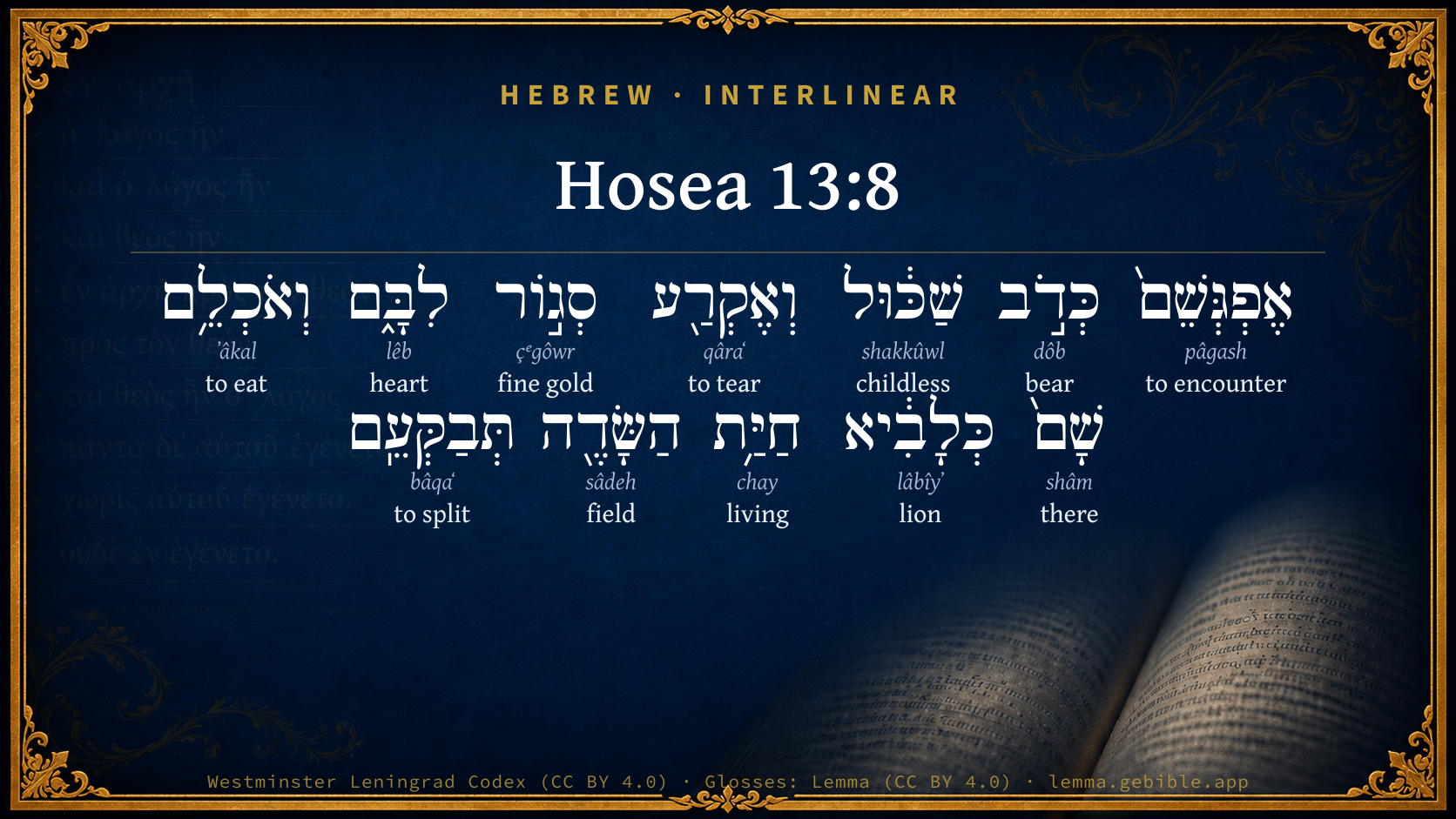
Hebrew (Westminster Leningrad Codex) Hosea 13:8 appears in the Hebrew Old Testament. The text above is from the Westminster Leningrad Codex. Each word links to its Strong’s number, a concise gloss, and parsing drawn from the Open Scriptures Hebrew Bible morphology. Click any word for its full Brown-Driver-Briggs (BDB) entry.
Download image
Cite this verse

Hosea 13:8 (World English Bible). Public Domain. Lemma interlinear Bible study tool, https://lemma.gebible.app/v/hosea/13/8.

Show BibTeX & RIS
BibTeX
RIS
English Translation
I will meet them like a bear that is bereaved of her cubs, And will tear the covering of their heart. And there I will devour them like a lioness. The wild animal will tear them.
World English Bible · Public Domain
Download a study sheet

One document with this verse’s original text, its word-by-word gloss line, the meaning frame, cross-references with their text, attributed commentary, and full source and license credits — printable, and it pastes into notes with its structure intact.

This verse Autodidact and up

Study sheet (.html) Plain text (.txt)

A passage Seminary Student

Up to 50 verses in one chapter. A passage sheet keeps up to 6 commentary sources and 12 cross-references per verse, in the order this page ranks them, and says so on the sheet whenever that leaves anything out. Ask for a single verse and you get the Autodidact verse sheet above.

Everything on this page stays free to read, with no account — the sheet is a download of what is already on screen, not access to it.

Want to remove ads? Support Godless Engineer
Compare translations 3

The same verse in 3 English versions, stacked beneath the original-language interlinear above. Click any original word for its lexicon entry.

Each is an independent rendering of the whole verse — the interlinear is not word-aligned to these translations.

Highlighted words mark where these versions differ — a whole-verse word diff, not a word-by-word alignment.

  • World English Bible Public Domain
    I will meet them like a bear that is bereaved of her cubs, And will tear the covering of their heart. And there I will devour them like a lioness. The wild animal will tear them.
  • King James Version Public Domain
    I will meet them as a bear that is bereaved of her whelps, and will rend the caul of their heart, and there will I devour them like a lion: the wild beast shall tear them.
  • unfoldingWord Literal Text CC BY-SA 4.0
    I will encounter them like a bereaved bear, and I will tear open the enclosure of their heart. And I will devour them there like a lioness; the beast of the field will rip them open.

unfoldingWord Literal Text — © unfoldingWord, licensed CC BY-SA 4.0. Word-aligned USFM3 via Door43 (git.door43.org/unfoldingWord/en_ult).

Versions to compare (up to 4)

3 of 4 selected

Show all 18 translations

Every available English version of this verse, each an independent rendering of the whole verse.

  • World English Bible Public Domain
    I will meet them like a bear that is bereaved of her cubs, And will tear the covering of their heart. And there I will devour them like a lioness. The wild animal will tear them.
  • Berean Standard Bible Public Domain
    Like a bear robbed of her cubs I will attack them, and I will tear open their chests. There I will devour them like a lion, like a wild beast would tear them apart.
  • Majority Standard Bible Public Domain
    Like a bear robbed of her cubs I will attack them, and I will tear open their chests. There I will devour them like a lion, like a wild beast tearing them apart.
  • King James Version Public Domain
    I will meet them as a bear that is bereaved of her whelps, and will rend the caul of their heart, and there will I devour them like a lion: the wild beast shall tear them.
  • American Standard Version (1901) Public Domain
    I will meet them as a bear that is bereaved of her whelps, and will rend the caul of their heart; and there will I devour them like a lioness; the wild beast shall tear them.
  • Revised Version (1885) Public Domain
    I will meet them as a bear that is bereaved of her whelps, and will rend the caul of their heart: and there will I devour them like a lion; the wild beast shall tear them.
  • Geneva Bible (1599) Public Domain
    I will meete them, as a beare that is robbed of her whelpes, and I will breake the kall of their heart, and there will I deuoure them like a lion: the wilde beast shall teare them.
  • Douay-Rheims (1899) Public Domain
    I will meet them as a bear that is robbed of her whelps, and I will rend the inner parts of their liver: and I will devour them there as a lion, the beast of the field shall tear them.
  • Young's Literal Translation Public Domain
    I do meet them as a bereaved bear, And I rend the enclosure of their heart.
  • Literal Standard Version CC BY-SA 4.0
    I meet them as a bereaved bear, || And I tear the enclosure of their heart, || And I consume them there as a lioness, || A beast of the field tears them.
  • Unlocked Literal Bible CC BY-SA 4.0
    I will attack them as a bear that is robbed of her cubs. I will rip open their chests, and there I will devour them as a lion, as a wild beast would tear them to pieces.
  • unfoldingWord Literal Text CC BY-SA 4.0
    I will encounter them like a bereaved bear, and I will tear open the enclosure of their heart. And I will devour them there like a lioness; the beast of the field will rip them open.
  • Darby Bible Public Domain
    I will meet them as a bear bereaved of her [whelps], and will rend the covering of their heart, and there will I devour them like a lioness: the beast of the field shall tear them.
  • World Messianic Bible Public Domain
    I will meet them like a bear that is bereaved of her cubs, and will tear the covering of their heart. There I will devour them like a lioness. The wild animal will tear them.
  • Webster's Bible Public Domain
    I will meet them as a bear that is bereaved of her whelps, and will rend the caul of their heart, and there will I devour them like a lion: the wild beast shall tear them.
  • Free Bible Version CC BY-SA 4.0
    I will be like a mother bear whose cubs have been taken, I will rip out their hearts. I shall devour them like a lion, like a wild beast I will tear them apart.
  • Bible in Basic English Public Domain
    I will come face to face with them like a bear whose young ones have been taken from her, and their inmost hearts will be broken; there the dogs will make a meal of them; they will be wounded by the beasts of the field.
  • JPS Tanakh (1917) Public Domain
    I will meet them as a bear that is bereaved of her whelps, and will rend the enclosure of their heart; and there will I devour them like a lioness; the wild beast shall tear them.

Literal Standard Version (2020), Covenant Press — licensed CC BY-SA 4.0. Text via the HelloAO Bible API (eBible.org). Unlocked Literal Bible (unfoldingWord) — licensed CC BY-SA 4.0. Text via the HelloAO Bible API (eBible.org). unfoldingWord Literal Text — © unfoldingWord, licensed CC BY-SA 4.0. Word-aligned USFM3 via Door43 (git.door43.org/unfoldingWord/en_ult). Free Bible Version, Dr. Jonathan Gallagher — licensed CC BY-SA 4.0. Text via the HelloAO Bible API (eBible.org).

Word by word

More ways to search: Search by grammar → Find every occurrence → Compare this word →

Practice this passage: Drill this verse → Learn its vocabulary →

סְג֣וֹר
çᵉgôwr
H5458
“fine gold of”
Noun, Common, Masculine, Singular, Construct
Part of Speech
Noun
Type
Common
Gender
Masculine
Number
Singular
State
Construct
Full BDB Definition

Origin: from H5462

TWOT: 1462a

enclosure, encasement, fine gold
  1. אֶפְגְּשֵׁם֙ pâgash H6298 “to encounter · them” Verb, Qal, Imperfect, 1st Person, Common, Singular + Suffix, Personal, 3rd Person, Masculine, Plural
  2. כְּדֹ֣ב dôb H1677 “like/as · bear” Preposition + Noun, Common, Masculine, Singular, Absolute
  3. שַׁכּ֔וּל shakkûwl H7909 “childless” Adjective, Adjective, Masculine, Singular, Absolute
  4. וְאֶקְרַ֖ע qâraʻ H7167 “and · to tear” Conjunction + Verb, Qal, Imperfect, 1st Person, Common, Singular
  5. לִבָּ֑ם lêb H3820 “heart · their” Noun, Common, Masculine, Singular, Construct + Suffix, Personal, 3rd Person, Masculine, Plural
  6. וְאֹכְלֵ֥ם ʼâkal H398 “and · to eat · them” Conjunction + Verb, Qal, Imperfect, 1st Person, Common, Singular + Suffix, Personal, 3rd Person, Masculine, Plural
  7. שָׁם֙ shâm H8033 “there” Adverb
  8. כְּלָבִ֔יא lâbîyʼ H3833 “like/as · lion” Preposition + Noun, Common, Both, Singular, Absolute
  9. חַיַּ֥ת chay H2416 “living of” Noun, Common, Feminine, Singular, Construct
  10. הַשָּׂדֶ֖ה sâdeh H7704 “the · field” Particle, Definite Article + Noun, Common, Masculine, Singular, Absolute
  11. תְּבַקְּעֵֽם bâqaʻ H1234 “to split · them” Verb, Piel, Imperfect, 3rd Person, Feminine, Singular + Suffix, Personal, 3rd Person, Masculine, Plural

About this verse

These counts appear in no published source. They are computed here, from the morphology-tagged text and Lemma’s own curated glosses. What Lemma adds →

12
words
12
distinct lemmas
Prophets
section

Notable vocabulary

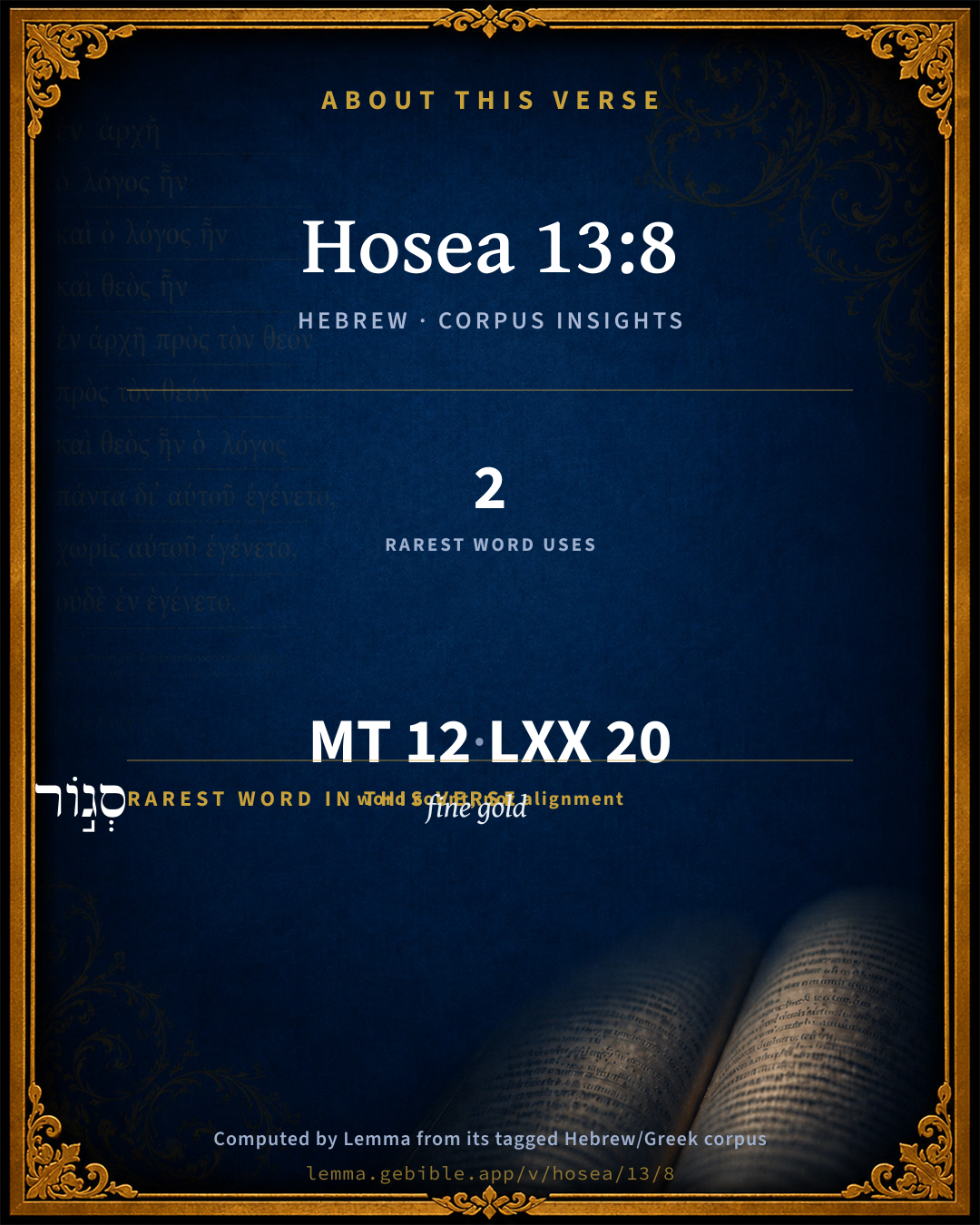
The rarest word here is סְג֣וֹר fine gold H5458 — appearing just 2 times in the whole Hebrew Bible.

Shared distinctive vocabulary

סְג֣וֹר fine gold H5458 occurs in 2 verses of the Hebrew Bible. Also found in:

Grammatical profile

  • 4 verbs
  • 6 nouns
  • 1 adjective
  • 1 adverb

Verb forms

  • אֶפְגְּשֵׁם֙ Qal · Imperfect
  • וְאֶקְרַ֖ע Qal · Imperfect
  • וְאֹכְלֵ֥ם Qal · Imperfect
  • תְּבַקְּעֵֽם Piel · Imperfect

Hebrew & Septuagint length

In English translation the verse runs 36 words from the Hebrew and 45 from the Septuagint (LXX English) — closely comparable.

A rough comparison of the two English renderings, which tokenize alike — not a word-level alignment.

Word counts can differ between the Hebrew and the Greek without any difference in meaning — e.g. the Hebrew direct-object marker אֵת has no separate Greek word, and Greek often adds the article ὁ.

In the original languages it is 12 Hebrew tokens and 20 Greek tokens — but the two are counted differently (Hebrew bundles its prefixes and suffixes into one token; the Greek is in lemma form), so that isn’t a like-for-like length.

Cross-references

8

Topical passages linked to Hosea 13:8 in the Treasury of Scripture Knowledge — connected by theme and wording, ordered by reader-vote popularity; previews shown in the World English Bible.

  • 2 Samuel 17:8 Hushai said moreover, You know your father and his men, that they are mighty men, and they are fierce in their minds, as a bear robbed of her cubs in the field; and your father is a man of war, and will not lodge with the people.
  • Isaiah 5:29 Their roaring will be like a lioness. They will roar like young lions. Yes, they shall roar, And seize their prey and carry it off, And there will be no one to deliver.
  • Psalms 50:22 "Now consider this, you who forget God, Lest I tear you into pieces, and there be none to deliver.
  • Psalms 80:13 The boar out of the wood ravages it. The wild animals of the field feed on it.
  • Proverbs 17:12 Let a bear robbed of her cubs meet a man, Rather than a fool in his folly.
  • Isaiah 56:9 All you animals of the field, come to devour, [yes], all you animals in the forest.
  • Jeremiah 12:9 Is my heritage to me as a speckled bird of prey? are the birds of prey against her round about? go you, assemble all the animals of the field, bring them to devour.
  • Amos 9:1–3 I saw the Lord standing beside the altar, and he said, "Strike the tops of the pillars, that the thresholds may shake; and break them in pieces on the head of all of them; and I will kill the last of them with the sword: there shall not one of them flee away, and there shall not one of them escape.

Cross-references courtesy of OpenBible.info (CC BY 4.0).

Hebrew and Greek witnesses Masoretic Hebrew ↔ Greek Septuagint

The same verse in the two great witnesses to the Old Testament, shown verse-for-verse.

These are two independent witnesses, not word-aligned to each other, and the Septuagint is shown in lemma (dictionary) form.

Hebrew Hosea 13:8 Masoretic · Westminster Leningrad Codex

אֶפְגְּשֵׁם֙ כְּדֹ֣ב שַׁכּ֔וּל וְאֶקְרַ֖ע סְג֣וֹר לִבָּ֑ם וְאֹכְלֵ֥ם שָׁם֙ כְּלָבִ֔יא חַיַּ֥ת הַשָּׂדֶ֖ה תְּבַקְּעֵֽם

I will meet them like a bear that is bereaved of her cubs, And will tear the covering of their heart. And there I will devour them like a lioness. The wild animal will tear them.

World English Bible · Public Domain

Greek LXX Hosea 13:8 Septuagint · lemma form

ἀποἀντάω αὐτός ὡς ἄρκος ἀπορέω καί διαῥήγνυμι συγκλεισμός καρδία αὐτός καί καταἐσθίω αὐτός ἐκεῖ σκύμνος δρυμός θηρίον ἀγρός διασπάω αὐτός

I will meet them by the way of the Assyrians, as a she-bear excited, and I will rend the caul of their heart, and the lions' whelps of the thicket shall devour them there; the wild beasts of the field shall rend them in pieces.

LXX2012 (modern English Septuagint) · Public Domain

Hebrew: Westminster Leningrad Codex (CC BY 4.0). Greek: Septuagint (public domain); English from LXX2012 (modern English Septuagint) (Public Domain). How the Septuagint differs from the Hebrew →

Targum (Aramaic paraphrase)

1

The Targum is the ancient Jewish Aramaic paraphrase of the Hebrew Scriptures — an interpretive translation, not the Hebrew text itself. Onkelos (literal) and Pseudo-Jonathan (expansive) render the Torah, and Jonathan the Prophets. Coverage is partial: where no permissively-licensed English translation exists for a verse, only the Aramaic is shown. This is verse-level text, not a word-by-word alignment to the Hebrew.

  1. Targum Jonathan Prophets (Joshua–Malachi)
    עֲרַע מֵימְרִי בְהוֹן כְּדוֹב מַתְכַּל וְתַבְרֵית רְשַׁע לִבְּהוֹן וּקְטַלְתִּנוּן תַּמָן כִּבְנֵי אַרְיְוָן כְּחֵוַת שִׁנָא דִמְבַזְעָא שֵׁצֵתִינוּן:

    (no public-domain English translation for this verse)

    Targum Jonathan — Aramaic: “Mikraot Gedolot” (public domain). English: “Sefaria Community Translation” (CC0 1.0 (public-domain dedication)); “London "Chaldee Paraphrase," 1871” (public domain). Text via Sefaria.

Commentary

Notes on Hosea 13:8 from classic Christian and Jewish commentators (each source and its license shown beneath its notes). The classic Christian expositions comment on the surrounding passage and are grouped to its opening verse, so a note may address several verses; the Jewish commentaries on the Tanakh (Rashi and others) are per-verse, so they appear only where the commentator wrote on this verse.

Lemma curates 59 commentaries, every one of them public domain or Creative Commons licensed, each selected and text-cleaned for this edition rather than reprinted as found. About our sources →

Trapp's Complete Commentary

John Trapp

Hos 13:8 I will meet them as a bear [that is] bereaved [of her whelps], and will rend the caul of their heart, and there will I devour them like a lion: the wild beast shall tear them.

Ver. 8. I mill meet them as a bear bereaved of her whelps] Surgit hic oratio. The bear is more cruel than the lion, for the lion is said to spare the prostrate; but the bear falleth foul upon all, yea, upon dead carcases. See Amo 5:9 cf. 2Sa 17:8 Pro 17:12. See also what work the two bears made upon the forty-two children, 2Ki 2:24.

And will rend the caul of their heart] The pericardium, {a} that fat heart of theirs, Hos 13:6, that hoof upon their hearts which the Word could not pierce through, that filthy foreskin that grew to their uncircumcised hearts.

There will I devour them like a lion] Once more like a lion ( לביא), ut immanis leo, for the word is not the same as before; as a lion, that is, in heart, and that loves to suck the blood, and the fat that is about the heart. "There will I devour them," that is, in their cities and houses, where they hold themselves safest; as the lions dealt by those mongrel colonies that made a mixture of religions, 2Ki 17:25.

The wild beast shall tear them] When they but stir anywhere abroad; so that there shall be no safety, no peace to him that goes out, or to him that cometh in, 2Ch 15:5, but

“ crudelis ubique

Luetus, ubique pavor, et plurima mortis imago. ”

"Let us therefore have grace, whereby we may serve God with reverence and godly fear: for even our God" (and not the God of the Jews only) "is a consuming fire," Heb 12:28-29, is a devouring lion, is a furious leopard, a raging bear; yea, put all the dreadfulness of all the creatures in the world together, it is all to be found in the wrath of God, even the quintessence of all. Hence that of the Psalmist, "Who knoweth the power of thine anger? even according to thy fear, so is thy wrath," Psa 90:11; as who should say, Let a man fear thy displeasure never so much, he is sure to feel thee much more, if once he fall into thy fingers. Now a fearful man can fancy vast and terrible fears, as ramping lions, ravenous leopards, fire, sword, racks, scalding lead, burning pitch, running bell metal, all this in extremity, and that to all eternity: and yet all these are but as a painted fire in comparison of the unconceivable and unsupportable wrath of God.

{a} The membranous sac, consisting of an outer fibrous and an inner serous layer, which encloses the heart and the commencements of the great vessels. Also applied to the sac enveloping or enclosing the heart or corresponding organ in certain invertebrates. D

John Trapp, A Commentary or Exposition upon All the Books of the Old and New Testament (1647–1656) — public domain. Text from a community e-Sword module.

Jamieson, Fausset & Brown

Robert Jamieson, A. R. Fausset & David Brown

"Writers on the natures of beasts say that none is more savage than a she bear, when bereaved of her whelps" [JEROME].

caul of . . . heart--the membrane enclosing it: the pericardium.

there--"by the way" (Hos 13:7).

Jamieson, Fausset & Brown — Commentary Critical and Explanatory on the Whole Bible (1871) — public domain (CC PDM 1.0). Text via the HelloAO Bible API.

Adam Clarke's Commentary

Verse 8. As a bear - bereaved] This is a figure to denote excessive ferocity. 2Sa 17:8, where a remarkable instance is given.

And will rend the caul of their heart] Every savage beast goes first to the seat of the blood when it has seized its prey; as in this fluid they delight more than in the most delicate parts of the flesh.

There will I devour them like a lion] לביא labi, the old strong lion; drinking the blood, tearing the flesh, and breaking the bones to extract the marrow.

The wild beast shall tear them] Probably this refers to the chakal or jackal, who frequently hunts down the prey, which the lion takes the liberty to devour, while the jackal stands by, and afterwards picks the bones. Hence he has been called the lion's PROVIDER, and the lion's waiting-man.

Adam Clarke's Commentary on the Bible (1810–1826) — public domain. Text from a community e-Sword/MySword module.

John Calvin's Commentaries

But he afterwards adds, I will rend, or will tear, the inclosure of their heart. They who understand the enclosure of the heart to be their obstinate hardness, seem to refine too much on the words of the Prophet. We know, indeed, that the Prophets sometimes use this mode of speaking; for they call that a hard heart, or a heart covered with fatness, which is not pliant, and does not willingly receive sound doctrine. But the Prophet rather alludes to the savageness of the bear, when he says, I will rend or tear in pieces the membrane of the heart, and will devour you as a lion. For it is the most cruel kind of death, when the lion with his claws and teeth aims at the heart itself and tears the bowels of man. The Prophet therefore intended to set forth this most cruel kind of death. “I will therefore,” he says, “tear asunder the pericardium, or the enclosure of the heart.” I do not at the same time say, that the Prophet does not allude to the hardness of the people, while he retains his own similitude.

And the beast of the field shall rend them He speaks now without a similitude; for God means that all the wild beasts would be his ministers to execute his judgement. “I will then send all the beasts of the field to rend and tear them, so that nothing among them shall remain safe.” We now see the purport of this passage, and to what use it ought to be applied. If we are by nature so slothful, yea, and careless, and when God does not stir us up, we indulge our own delusions, we ought to notice those figurative representations which tend to shake off from us our tardiness and show to us how dreadful the judgement of God is. For the same purpose are those metaphors respecting the eternal fire and the worm that never dies. For Gods seeing the feelings of men to be so torpid has in Scripture applied those things which may correct their sluggishness. Whenever then God puts on a character not his own, let us know that it is through our fault; for we suffer him not to deal with us according to his own nature, inasmuch as we are intractable. Let us go on —

John Calvin's Commentaries (1540-1563) — public domain. Text from the Calvin Translation Society English edition (1840s-50s) via the Christian Classics Ethereal Library (ccel.org). Calvin's coverage is partial (roughly two-thirds of the Bible); uncommented books and verses are honest gaps, never fabricated. The 19th-century editor's footnotes and remarks are omitted so the notes are faithfully Calvin's own voice.

Ellicott's Commentary for English Readers

(8) The same imagery is continued to describe the destructive wrath of the Lord. “The caul of the heart” means here the covering of the heart, not the pericardium, but the breast in which the claws of the beast are fastened.

A Bible Commentary for English Readers, edited by Charles John Ellicott (1878–1897) — public domain. Text from a community e-Sword module.

The Cambridge Bible for Schools and Colleges

gen. ed. J. J. S. Perowne

8. as a dear] A striking but uncommon comparison. Comp. Lam_3:10.

the caul of their heart] Rather, the enclosure of their heart, i.e., not the pericardium, which is what the Authorized Version appears to have supposed, but the breast.

as a lion] Most render, as a lioness; but this is at any rate uncertain. There is nothing as in Job_4:11 specially to suggest the female. The masculine undoubtedly occurs in Psa_57:5 (Hebr.). The root-idea is probably voracity; but unfortunately there is no cognate in Assyrian. The numerous words for lion in Hebrew are as trouble-some to express in English, as the translators of the Sept. found them in Greek (Sept. here has σκύμνοι δρυμοῦ).

The Cambridge Bible for Schools and Colleges (gen. ed. J. J. S. Perowne; Cambridge University Press, 1878–1918) — public domain. Text from a community e-Sword module.

John Gill's Exposition

I will meet them as a bear that is bereaved of her whelps,.... Which is a fierce cruel creature at any time, but especially when this is its case, being very fond of its whelps; and having taken a great deal of pains to lick them into form, as Kimchi and Ben Melech observe, it is the more enraged at the loss of them, and therefore falls upon man or beast it meets with the utmost fury: the phrase is expressive of the fiercest rage; see Pro 17:12;

and will rend the caul of their hearts: the pericardium, which is a membrane or skin that encloses the heart, and which when pierced is immediate death: perhaps some respect is had to the closing of their hearts to God, the hardness of them against him and his ways, and their inattention to his word; and now he will open them, not in a way of grace and mercy, but of wrath and fury; as a bear, when it seizes a man, sticks his claws in his breast, tears it open, and makes his way at once to the heart, fetches it out, and sucks his blood:

and there will I devour them like a lion; either in their cities and houses, when taken by the enemy; or in the way, in which they would be observed; or in their captivity: or there may be put for then, and so denotes the time when he would be all this to them before mentioned, and then he would utterly destroy them:

the wild beast shall tear them: which literally is one of God's sore judgments, but here figuratively designs the Assyrian, and who is meant as the instrument of God's vengeance in all the other expressions; and is sometimes compared to a lion, and that as concerned with Israel; see Jer 50:17; which is much better than by these four sorts of creatures to understand the four monarchies which Israel suffered by. The Targum is,

"my word shall meet them as a bear bereaved, and I will break the wickedness of their hearts, &c.''

John Gill's Exposition of the Whole Bible (1746–1763) — public domain (CC PDM 1.0). Text via the HelloAO Bible API.

Albert Barnes' Notes on the Bible

As a bear bereaved of her whelps - The Syrian bear is fiercer than the brown bears to which we are accustomed. It attacks flocks 1Sa 17:34, and even oxen . The fierceness of the she-bear, “bereaved of her whelps,” became a proverb (2Sa 17:8; Pro 17:12; and here). : “They who have written on the nature of wild beasts, say that none is more savage than the she-bear, when she has lost her whelps or lacks food.” It blends wonderfully most touching love and fierceness. It tenderly protects its wounded whelps, reckless of its life, so that it may bring them off, and it turns fiercely on their destroyer. Its love for them becomes fury against their injurer. Much more shall God avenge those who destroy His sons and daughters, leading and enticing them into sin and destruction of body and soul.

Rend the caul of - (what encloses) their heart that is, the pericardium. They had closed their hearts against God. Their punishment is pictured by the rending open of the closed heart, by the lion which is said to go instinctively straight to the heart, tears it out, and sucks the blood . Fearful will it be in the Day of Judgment, when the sinner’s heart is laid open, with all the foul, cruel, malicious, defiled, thoughts which it harbored and concealed, against the will of God. “It is a fearful thing to fall into the hands of the living God” Heb 10:31.

And there will I devour them - “There,” where they sinned, shall they be punished. “The wild beast shall tear them.” What God does, He does mostly through instruments, and what His instruments do, they do fulfilling His will through their own blind will or appetite. Hitherto, He had spoken, as being Himself their punisher, although laying aside, as it were, all His tenderness; now, lest the thought, that still it was He, the God of love who punished, should give them hope, He says, “the wild beast shall devour them.” He gives them up, as it were, out of His own hands to the destroyer.

Albert Barnes' Notes on the Bible (1834–1885) — public domain. Text from a community e-Sword/MySword module.

Haydock's Catholic Bible Commentary

Whelps; with the greatest fury, 2 Kings xvii. 8. --- Inner. Hebrew, "what encloses the heart;" or, I will break their hard heart. (Calmet)

George Leo Haydock (1774–1849), Haydock's Catholic Family Bible and Commentary, 1859 edition — public domain. Excludes Psalms (Douay-Rheims chapter numbering differs from Protestant) and Deuterocanonical books (Catholic canon only).

Matthew Poole's English Annotations

I will meet them; I know their haunts, their walks, I will not fail to meet them there.

As a bear bereaved of her whelps; robbed of her whelps, newly taken away, which makes her mad with rage; so great rage is proverbially expressed. Pro 17:12.

Will rend the caul of their heart; first kill, next tear in pieces, pull out the very heart: it is probable this fierce creature may by instinct hasten to tear up the prey, that it may drink the blood before it run to waste.

There will I devour them, where I find them and seize them, like the hungry and fearless lion, which feasts on his prey where he caught it, draws it not into his den, but devoureth it immediately.

Like a lion; an old lion, that hath his great teeth, his grinders, and hath still whelps, Gen 49:9; fierce and terrible, that will either call in his whelps to divide the prey, or drag the prey to his den for them: and what hope of any thing to be spared, when you fall into such hands?

The wild beast shall tear them: it is said of the lion, that he calls by his roaring the wild beasts together to the prey when he hath taken it; so you shall be devoured by the whole troop of wild beasts. Or it may be a general threat added to those particular ones before, every wild beast shall prey upon them. All this God executed on them by the Assyrians, who in their fierceness, cruelty, greediness, and courage answered the character here given to them: the particular resemblances I leave to any, who may easily suit them.

Matthew Poole's English Annotations on the Holy Bible (1683–1685) — public domain. Text from a community e-Sword/MySword module.

The Pulpit Commentary

I will meet them as a bear that is bereaved of her whelps, and will rend the caul of their heart. The noun bdo is epicene, that is, the one form serves for both genders, as here the masculine includes the feminine, and is used as such. Of all animals, Jerome says, the she-bear is the fiercest, either when robbed of her whelps or in want of food. Seghor being that which encloses the heart, is either the pericardium, the immediate and proper enclosure of the heart, or the breast itself. The reference is to a beast of prey which seizes its victim by the breast and tears it open, so that the heart is exposed. The verb is akin to gp, the meaning of the root-syllable gp, to meet, strike, being the same in both. Such is the continuation of the picture of the threatened punishment. The picture of the severity of the Divine judgment here presented is very terrible. Kimchi remarks on this picture: "A bear robbed, whose young ones they have slain, which is bereft and bitter in spirit, if it find man or beast rends it speedily." Some understand the verse figuratively, as though it meant will rend their obstinate heart," the enclosure of the heart being equivalent to a shut or obstinate heart, as, in ver. 5 of this same chapter, "a land of drought" is pretty much the same as "a dry or parched land." Thus the Chaldee translates, "I have broken the wickedness of their heart. And there will I devour them like a lion: the wild beast shall tear them. Sham there refers

(1) to al-derekh of the preceding verse; or,

(2) as Kimchi explains it, as referring to their cities: "There in their cities shall I destroy them by pestilence and by the sword of the enemy, like the lion that teareth without pity;" or,

(3) more simply still, "there on the spot." The tji equivalent to hTa, is the wild beast as opposed to ybi, domestic animals. While some were to be destroyed by famine and pestilence, others would perish by the wild beast of the field. "Also," says Kimchi, "shall the wild beast of the field rend them outside (i.e. outside their cities), as, "I will also send wild beasts among you, which shall rob you of your children, and destroy your cattle, and make you few in number.

The Pulpit Commentary (1880–1919), ed. H.D.M. Spence-Jones & Joseph S. Exell — public domain. Text from a community e-Sword module.

John Wesley's Explanatory Notes

Rent - First kill, then tear in pieces, and pull out the very heart.

John Wesley, Explanatory Notes Upon the Whole Bible (1754–1765) — public domain. Text via the GEBible commentary corpus.

Rashi

Rabbi Shlomo Yitzchaki (Rashi)

as a bereaving bear Heb. שַׁכּוּל. Like שּׁוֹכֵל, as you say חָנּוּן, gracious, and רַחוּם, merciful, so שַּׁכּוּל, i.e., entirely attired with bereavements and ready to bereave people.

and I will rend the enclosure of their heart like the habit of the bear, which holds its nails on the chest and rends until the heart. Another explanation: the enclosure of the heart Their heart which is closed from understanding to return to Me.

Rashi on the Tanakh — English translations: “The Judaica Press complete Tanach with Rashi, translated by A. J. Rosenberg” (CC BY 4.0); “Pentateuch with Rashi's commentary by M. Rosenbaum and A.M. Silbermann, 1929-1934” (public domain); “The Metsudah Tanach series, Lakewood, N.J” (CC BY 4.0); and “The Book of Joshua, Metsudah Publications, 1997” (CC BY 4.0). Text via Sefaria.

Lesson kit

Teaching starters — assembled from the data on this page, not authored interpretation. Every prompt links to the verse data it draws on. Edit before teaching.

Hosea, in the Prophets, opens this verse with 12 words (12 distinct Hebrew lemmas). Its most distinctive word is çᵉgôwr (“fine gold”). A historical commentator’s framing appears above. Read the whole chapter for the surrounding context.

Discussion questions

  1. How does “fine gold” (çᵉgôwr) shape what this verse is saying?
  2. Job 28:15 shares the word «fine gold» with this verse. How do the two illuminate each other?
  3. The translations on this page render this verse differently — a whole-verse word diff, not a word-by-word alignment. What might account for the different wordings?
  4. The verb «אֶפְגְּשֵׁם֙» is Qal Imperfect. How does its form color the action?
  5. Reading how Trapp's Complete Commentary and Jamieson, Fausset & Brown read this verse, where do the two commentators agree and where do they part?

Things to notice

Reading settings

Reading text

Shown beneath each verse's original-language words.

Old Testament
Old Testament edition

Read the OT as the Masoretic Hebrew (MT) or the Greek Septuagint (LXX).

English shown for the Greek Septuagint (in the Hebrew ↔ Greek comparison).

Comparing translations? Open the Compare panel on any verse page to stack up to four side by side.