Micah 1:4

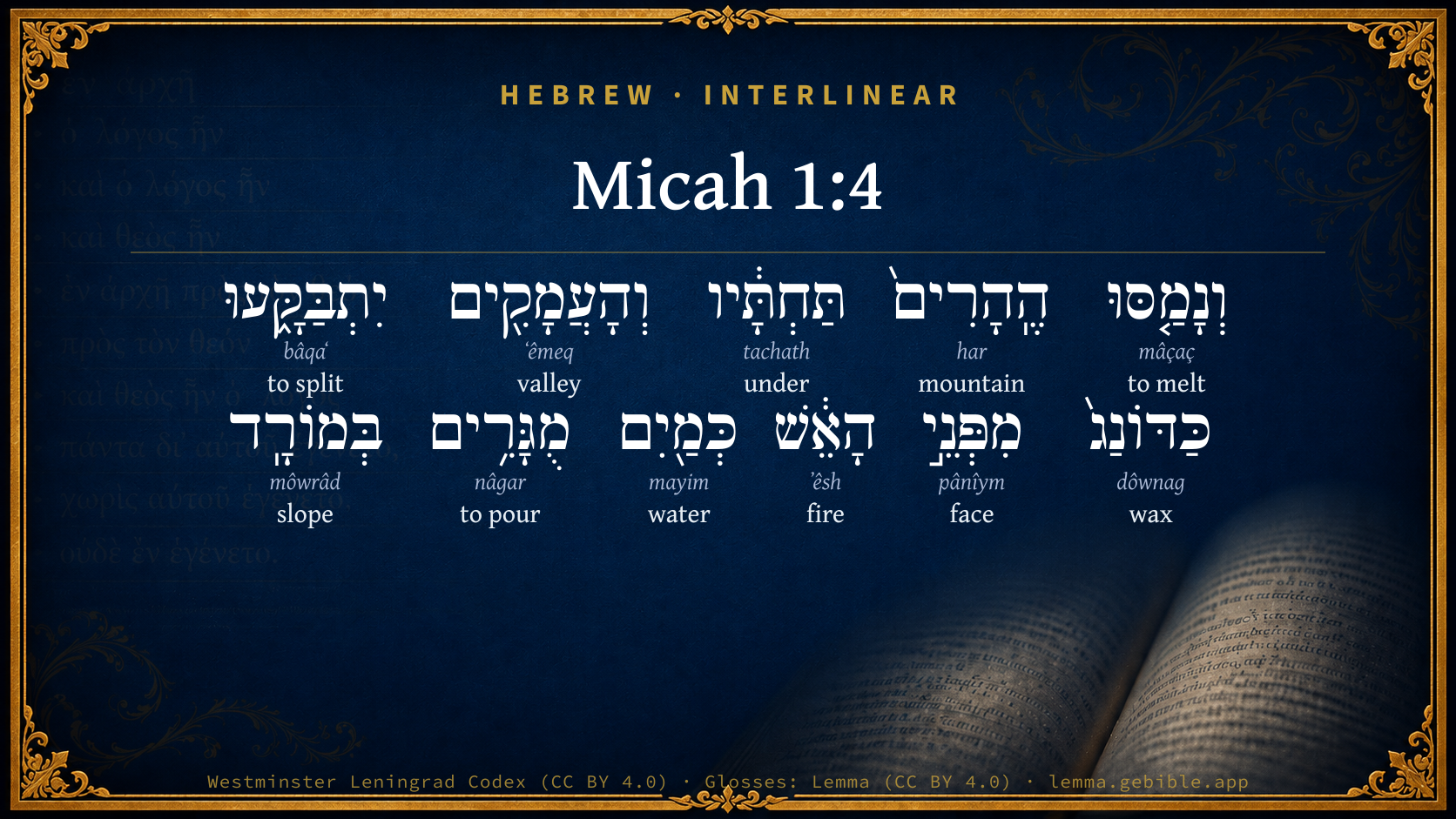
Hebrew (Westminster Leningrad Codex) Micah 1:4 appears in the Hebrew Old Testament. The text above is from the Westminster Leningrad Codex. Each word links to its Strong’s number, a concise gloss, and parsing drawn from the Open Scriptures Hebrew Bible morphology. Click any word for its full Brown-Driver-Briggs (BDB) entry.
Download image
Cite this verse

Micah 1:4 (World English Bible). Public Domain. Lemma interlinear Bible study tool, https://lemma.gebible.app/v/micah/1/4.

Show BibTeX & RIS
BibTeX
RIS
English Translation
The mountains melt under him, And the valleys split apart, Like wax before the fire, Like waters that are poured down a steep place.
World English Bible · Public Domain
Download a study sheet

One document with this verse’s original text, its word-by-word gloss line, the meaning frame, cross-references with their text, attributed commentary, and full source and license credits — printable, and it pastes into notes with its structure intact.

This verse Autodidact and up

Study sheet (.html) Plain text (.txt)

A passage Seminary Student

Up to 50 verses in one chapter. A passage sheet keeps up to 6 commentary sources and 12 cross-references per verse, in the order this page ranks them, and says so on the sheet whenever that leaves anything out. Ask for a single verse and you get the Autodidact verse sheet above.

Everything on this page stays free to read, with no account — the sheet is a download of what is already on screen, not access to it.

Want to remove ads? Support Godless Engineer
Compare translations 3

The same verse in 3 English versions, stacked beneath the original-language interlinear above. Click any original word for its lexicon entry.

Each is an independent rendering of the whole verse — the interlinear is not word-aligned to these translations.

Highlighted words mark where these versions differ — a whole-verse word diff, not a word-by-word alignment.

  • World English Bible Public Domain
    The mountains melt under him, And the valleys split apart, Like wax before the fire, Like waters that are poured down a steep place.
  • King James Version Public Domain
    And the mountains shall be molten under him, and the valleys shall be cleft, as wax before the fire, and as the waters that are poured down a steep place.
  • unfoldingWord Literal Text CC BY-SA 4.0
    And the mountains will melt under him, and the valleys will split open, like wax from the face of the fire, like waters poured down a steep place.

unfoldingWord Literal Text — © unfoldingWord, licensed CC BY-SA 4.0. Word-aligned USFM3 via Door43 (git.door43.org/unfoldingWord/en_ult).

Versions to compare (up to 4)

3 of 4 selected

Show all 18 translations

Every available English version of this verse, each an independent rendering of the whole verse.

  • World English Bible Public Domain
    The mountains melt under him, And the valleys split apart, Like wax before the fire, Like waters that are poured down a steep place.
  • Berean Standard Bible Public Domain
    The mountains will melt beneath Him, and the valleys will split apart, like wax before the fire, like water rushing down a slope.
  • Majority Standard Bible Public Domain
    The mountains will melt beneath Him, and the valleys will split apart, like wax before the fire, like water rushing down a slope.
  • King James Version Public Domain
    And the mountains shall be molten under him, and the valleys shall be cleft, as wax before the fire, and as the waters that are poured down a steep place.
  • American Standard Version (1901) Public Domain
    And the mountains shall be melted under him, and the valleys shall be cleft, as wax before the fire, as waters that are poured down a steep place.
  • Revised Version (1885) Public Domain
    And the mountains shall be molten under him, and the valleys shall be cleft, as wax before the fire, as waters that are poured down a steep place.
  • Geneva Bible (1599) Public Domain
    And the mountaines shall melt vnder him (so shall the valleys cleaue) as waxe before the fire, and as the waters that are powred downewarde.
  • Douay-Rheims (1899) Public Domain
    And the mountains shall be melted under him: and the valleys shall be cleft, as wax before the fire, and as waters that run down a steep place.
  • Young's Literal Translation Public Domain
    Melted have been the mountains under Him, And the valleys do rend themselves, As wax from the presence of fire, As waters cast down by a slope.
  • Literal Standard Version CC BY-SA 4.0
    The mountains have been melted under Him, || And the valleys split themselves, || As wax from the presence of fire, || As waters cast down by a slope.
  • Unlocked Literal Bible CC BY-SA 4.0
    The mountains will melt under him; the valleys will break apart, like wax before fire, like waters that are poured down a steep place.
  • unfoldingWord Literal Text CC BY-SA 4.0
    And the mountains will melt under him, and the valleys will split open, like wax from the face of the fire, like waters poured down a steep place.
  • Darby Bible Public Domain
    And the mountains shall be melted under him, and the valleys shall be cleft, as wax before the fire, as waters poured down a steep place.
  • World Messianic Bible Public Domain
    The mountains melt under him, and the valleys split apart like wax before the fire, like waters that are poured down a steep place.
  • Webster's Bible Public Domain
    And the mountains shall be melted under him, and the valleys shall be cleft, as wax before the fire, and as the waters that are poured down a steep place.
  • Free Bible Version CC BY-SA 4.0
    The mountains melt beneath him, the valleys burst apart, like wax in front of a fire, like water rushing down a slope. All this is happening because of the rebellion of the descendants of Jacob, the sins of the people of Israel.
  • Bible in Basic English Public Domain
    And the mountains will be turned to water under him, and the deep valleys will be broken open, like wax before the fire, like waters flowing down a slope.
  • JPS Tanakh (1917) Public Domain
    And the mountains shall be molten under Him, and the valleys shall be cleft, as wax before the fire, as waters that are poured down a steep place.

Literal Standard Version (2020), Covenant Press — licensed CC BY-SA 4.0. Text via the HelloAO Bible API (eBible.org). Unlocked Literal Bible (unfoldingWord) — licensed CC BY-SA 4.0. Text via the HelloAO Bible API (eBible.org). unfoldingWord Literal Text — © unfoldingWord, licensed CC BY-SA 4.0. Word-aligned USFM3 via Door43 (git.door43.org/unfoldingWord/en_ult). Free Bible Version, Dr. Jonathan Gallagher — licensed CC BY-SA 4.0. Text via the HelloAO Bible API (eBible.org).

Word by word

More ways to search: Search by grammar → Find every occurrence → Compare this word →

Practice this passage: Drill this verse → Learn its vocabulary →

כַּדּוֹנַג֙
dôwnag
H1749
“like/as the · wax”
Preposition, Determined + Noun, Common, Masculine, Singular, Absolute
Part of Speech
Preposition + Noun
Type
Common
Gender
Masculine
Number
Singular
State
Absolute
Full BDB Definition

Origin: of uncertain derivation

TWOT: 444a

wax (always figurative 'of melting')
  1. וְנָמַ֤סּוּ mâçaç H4549 “and · to melt” Conjunction + Verb, Niphal, Sequential Perfect, 3rd Person, Common, Plural
  2. הֶֽהָרִים֙ har H2022 “the · mountains” Particle, Definite Article + Noun, Common, Masculine, Plural, Absolute
  3. תַּחְתָּ֔יו tachath H8478 “under · him” Preposition + Suffix, Personal, 3rd Person, Masculine, Singular
  4. וְהָעֲמָקִ֖ים ʻêmeq H6010 “and · the · valleys” Conjunction + Particle, Definite Article + Noun, Common, Masculine, Plural, Absolute
  5. יִתְבַּקָּ֑עוּ bâqaʻ H1234 “to split” Verb, Hithpael, Imperfect, 3rd Person, Masculine, Plural
  6. מִפְּנֵ֣י pânîym H6440 “from · face(s) of” Preposition + Noun, Common, Both, Plural, Construct
  7. הָאֵ֔שׁ ʼêsh H784 “the · fire” Particle, Definite Article + Noun, Common, Both, Singular, Absolute
  8. כְּמַ֖יִם mayim H4325 “like/as · water(s)” Preposition + Noun, Common, Masculine, Plural, Absolute
  9. מֻגָּרִ֥ים nâgar H5064 “poured” Verb, Hophal, Participle Passive, Masculine, Plural, Absolute
  10. בְּמוֹרָֽד môwrâd H4174 “in/at · slope” Preposition + Noun, Common, Masculine, Singular, Absolute

About this verse

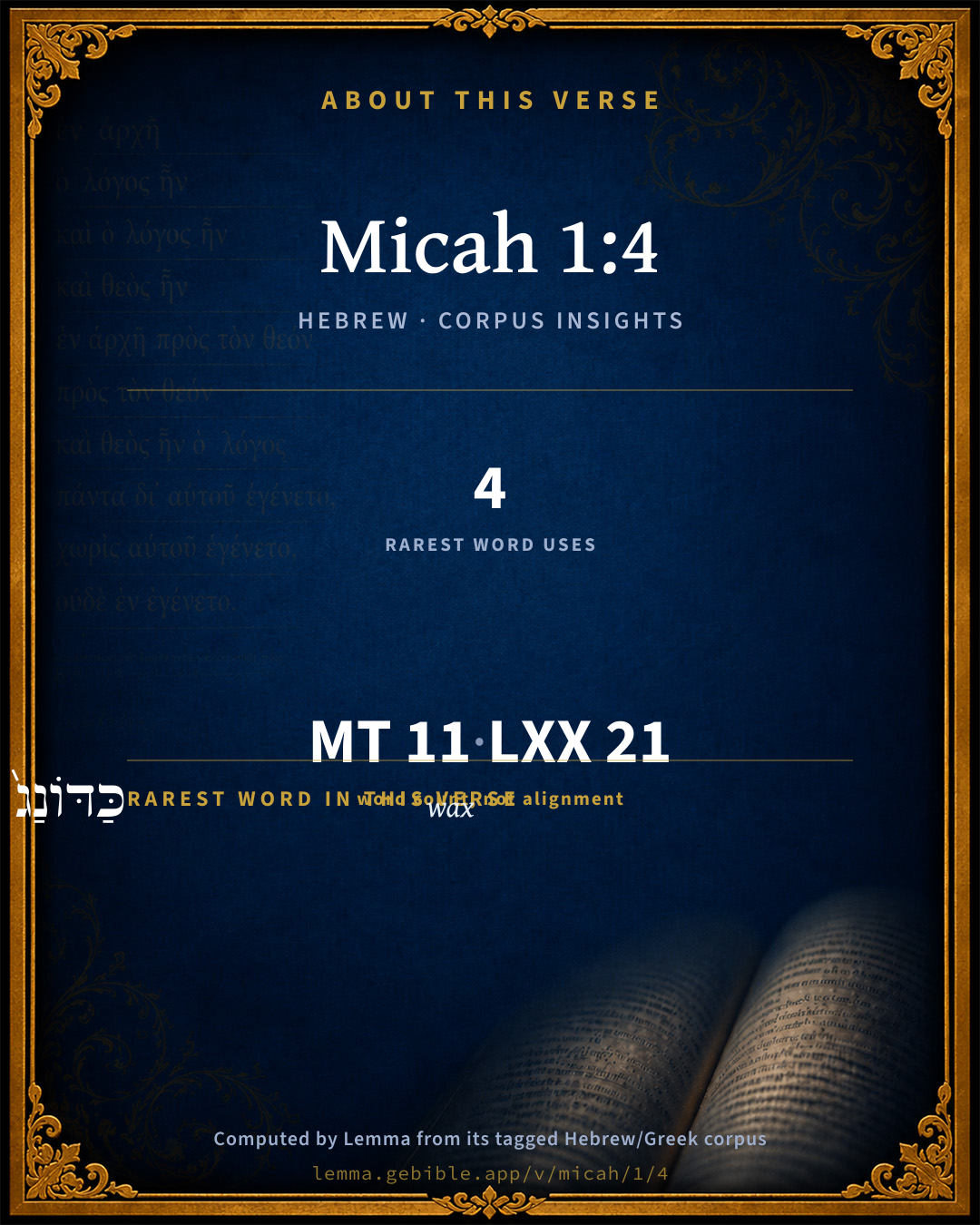
These counts appear in no published source. They are computed here, from the morphology-tagged text and Lemma’s own curated glosses. What Lemma adds →

11
words
11
distinct lemmas
Prophets
section

Notable vocabulary

The rarest word here is כַּדּוֹנַג֙ wax H1749 — appearing just 4 times in the whole Hebrew Bible.

Shared distinctive vocabulary

כַּדּוֹנַג֙ wax H1749 occurs in 4 verses of the Hebrew Bible. Also found in:

Grammatical profile

  • 3 verbs
  • 7 nouns
  • 1 preposition

Verb forms

  • וְנָמַ֤סּוּ Niphal · Sequential Perfect
  • יִתְבַּקָּ֑עוּ Hithpael · Imperfect
  • מֻגָּרִ֥ים Hophal · Participle Passive

Hebrew & Septuagint length

In English translation the verse runs 24 words from the Hebrew and 25 from the Septuagint (LXX English) — closely comparable.

A rough comparison of the two English renderings, which tokenize alike — not a word-level alignment.

Word counts can differ between the Hebrew and the Greek without any difference in meaning — e.g. the Hebrew direct-object marker אֵת has no separate Greek word, and Greek often adds the article ὁ.

In the original languages it is 11 Hebrew tokens and 21 Greek tokens — but the two are counted differently (Hebrew bundles its prefixes and suffixes into one token; the Greek is in lemma form), so that isn’t a like-for-like length.

Cross-references

11

Topical passages linked to Micah 1:4 in the Treasury of Scripture Knowledge — connected by theme and wording, ordered by reader-vote popularity; previews shown in the World English Bible.

  • Nahum 1:5 The mountains quake before him, and the hills melt away. The earth trembles at his presence, yes, the world, and all who dwell in it.
  • Psalms 97:5 The mountains melt like wax at the presence of Yahweh, At the presence of the Lord of the whole earth.
  • Judges 5:4 Yahweh, when you went forth out of Seir, When you marched out of the field of Edom, The earth trembled, the sky also dropped, Yes, the clouds dropped water.
  • Isaiah 64:1–3 Oh that you would tear the heavens, that you would come down, that the mountains might quake at your presence,
  • Amos 9:5 For the Lord, Yahweh of Hosts, is he who touches the land and it melts, and all who dwell in it will mourn; and it will rise up wholly like the River, and will sink again, like the River of Egypt.
  • Habakkuk 3:6 He stood, and shook the earth. He looked, and made the nations tremble. The ancient mountains were crumbled. The age-old hills collapsed. His ways are eternal.
  • Habakkuk 3:10 The mountains saw you, and were afraid. The tempest of waters passed by. The deep roared and lifted up its hands on high.
  • Psalms 68:2 As smoke is driven away, So drive them away. As wax melts before the fire, So let the wicked perish at the presence of God.
  • Zechariah 14:4 His feet will stand in that day on the Mount of Olives, which is before Jerusalem on the east; and the Mount of Olives will be split in two, from east to west, making a very great valley. Half of the mountain will move toward the north, and half of it toward the south.
  • Revelation 20:11 I saw a great white throne, and him who sat on it, from whose face the earth and the heaven fled away. There was found no place for them.
  • 2 Peter 3:10–12 But the day of the Lord will come as a thief in the night; in which the heavens will pass away with a great noise, and the elements will be dissolved with fervent heat, and the earth and the works that are in it will be burned up.

Cross-references courtesy of OpenBible.info (CC BY 4.0).

Hebrew and Greek witnesses Masoretic Hebrew ↔ Greek Septuagint

The same verse in the two great witnesses to the Old Testament, shown verse-for-verse.

These are two independent witnesses, not word-aligned to each other, and the Septuagint is shown in lemma (dictionary) form.

Hebrew Micah 1:4 Masoretic · Westminster Leningrad Codex

וְנָמַ֤סּוּ הֶֽהָרִים֙ תַּחְתָּ֔יו וְהָעֲמָקִ֖ים יִתְבַּקָּ֑עוּ כַּדּוֹנַג֙ מִפְּנֵ֣י הָאֵ֔שׁ כְּמַ֖יִם מֻגָּרִ֥ים בְּמוֹרָֽד

The mountains melt under him, And the valleys split apart, Like wax before the fire, Like waters that are poured down a steep place.

World English Bible · Public Domain

Greek LXX Micah 1:4 Septuagint · lemma form

καί σαλεύω ὁ ὄρος ὑποκάτωθεν αὐτός καί ὁ κοιλάς τήκω ὡς κηρός ἀπό πρόσωπον πῦρ καί ὡς ὕδωρ καταφέρω ἐν κατάβασις

And the mountains shall be shaken under him, and the valleys shall melt like wax before the fire, and as water rushing down a declivity.

LXX2012 (modern English Septuagint) · Public Domain

On this verse, Haydock's Catholic Bible Commentary discusses the Septuagint’s reading. Read the note in Commentary ↓

Hebrew: Westminster Leningrad Codex (CC BY 4.0). Greek: Septuagint (public domain); English from LXX2012 (modern English Septuagint) (Public Domain). How the Septuagint differs from the Hebrew →

Targum (Aramaic paraphrase)

1

The Targum is the ancient Jewish Aramaic paraphrase of the Hebrew Scriptures — an interpretive translation, not the Hebrew text itself. Onkelos (literal) and Pseudo-Jonathan (expansive) render the Torah, and Jonathan the Prophets. Coverage is partial: where no permissively-licensed English translation exists for a verse, only the Aramaic is shown. This is verse-level text, not a word-by-word alignment to the Hebrew.

  1. Targum Jonathan Prophets (Joshua–Malachi)
    וְיִתְמְסוּן טוּרַיָא תְּחוֹתוֹהִי וּמֵשְׁרַיָא יִתְבַּזְעוּן כְּשָׁעִיתָא מִן קֳדָם נוּרָא כְּמַיָא דְאַשִׁידִין בְּמוֹדְרוֹן:

    (no public-domain English translation for this verse)

    Targum Jonathan — Aramaic: “Mikraot Gedolot” (public domain). English: “Sefaria Community Translation” (CC0 1.0 (public-domain dedication)); “London "Chaldee Paraphrase," 1871” (public domain). Text via Sefaria.

Commentary

Notes on Micah 1:4 from classic Christian and Jewish commentators (each source and its license shown beneath its notes). The classic Christian expositions comment on the surrounding passage and are grouped to its opening verse, so a note may address several verses; the Jewish commentaries on the Tanakh (Rashi and others) are per-verse, so they appear only where the commentator wrote on this verse.

Lemma curates 59 commentaries, every one of them public domain or Creative Commons licensed, each selected and text-cleaned for this edition rather than reprinted as found. About our sources →

Trapp's Complete Commentary

John Trapp

Mic 1:4 And the mountains shall be molten under him, and the valleys shall be cleft, as wax before the fire, [and] as the waters [that are] poured down a steep place.

Ver. 4. And the mountains shall be molten under him] This is to the self same sense; though men swell, in their own eyes, to the size of so many mountains; and though, gotten upon their hill of ice, they think they shall never be moved, Psa 30:6-7; yet, when God, with his devouring fire and everlasting burnings, comes in presence, these craggy mountains shall soon dissolve and melt as wax, they shall be as waters poured down a descent, they shall flow as a land flood. By which similitudes, and familiar comparisons, is notably set forth the irresistible wrath of God for the frightening of hard hearted sinners, that they may take hold of his strength, and make peace with him, Isa 27:5.

The valleys also shall be deft] The poorer sort also shall have their share in the common calamity. God will neither spare the high for their might, nor the base for their meanness, but lords and lowies together, shall be

as wax before the fire, &c.] Wax is a poor fence against fire, sticks and stubble against a strong torrent; so human force against Divine judgments.

John Trapp, A Commentary or Exposition upon All the Books of the Old and New Testament (1647–1656) — public domain. Text from a community e-Sword module.

Tyndale Open Study Notes

Tyndale Open Resources

1:4 The strong and apparently immovable mountains will melt at the Lord’s presence (see Ps 97:5). Nothing can stand against him.

Tyndale Open Study Notes — © Tyndale Open Resources, licensed CC BY-SA 4.0. Text via the HelloAO Bible API.

Jamieson, Fausset & Brown

Robert Jamieson, A. R. Fausset & David Brown

Imagery from earthquakes and volcanic agency, to describe the terrors which attend Jehovah's coming in judgment (compare Jdg 5:5). Neither men of high degree, as the mountains, nor men of low degree, as the valleys, can secure themselves or their land from the judgments of God.

as wax-- (Psa 97:5; compare Isa 64:1-3). The third clause, "as wax," &c.; answers to the first in the parallelism, "the mountains shall be molten"; the fourth, "as the waters," &c.; to the second, "the valleys shall be cleft." As wax melts by fire, so the mountains before God, at His approach; and as waters poured down a steep cannot stand but are diffused abroad, so the valleys shall be cleft before Jehovah.

Jamieson, Fausset & Brown — Commentary Critical and Explanatory on the Whole Bible (1871) — public domain (CC PDM 1.0). Text via the HelloAO Bible API.

John Calvin's Commentaries

And he afterwards adds, that this going forth of God would be terrible, Melt, he says, shall the mountains under him It hence appears, that the Prophet did not speak in the last verse of the departure of God, as though he was going to forsake his own temple, but that he, on the contrary, described his going forth from the temple, that he might ascend his tribunal and execute punishment on the whole people, and thus, in reality, prove that he would be a judge, because he had been very daringly despised. Hence he says, Melt shall the mountains under him, the valleys shall be rent, or cleave, as wax before the fire, as waters rolling into a lower place The Prophets do not often describe God in a manner so awful; but this representation is to be referred to the circumstance of this passage, for he sets forth God here as the judge of the people: it was therefore necessary that he should be exhibited as furnished and armed with powers that he might stake such vengeance on the Jews as they deserved. And other similar passages we shall hereafter meet with, and like to those which we found in Hosea. God then is said to melt the mountains, and he is said to strike the valleys with such terror that they cleave under him; in short, he is said so to terrify all elements, that the very mountains, however stony they may be, melt like wax or like waters which flow, — because he could not otherwise produce a real impression on a people so obstinate, and who, as it has been said, so flattered themselves even in their vices.

We may further easily learn what application to make of this truth in our day. We find the Papists boasting of the title Church, and, in a manner, with vain confidence, binding God to themselves, because they have baptism, though they have adulterated it with their superstitions; and then, they think that they have Christ, because they still retain the name of a Church. Had the Lord promised that his dwelling would be at Rome, we yet see how foolish and frivolous would be such boasting: for though the temple was at Jerusalem, yet the Lord went forth thence to punish the sins of the people, yea, even of the chosen people. We further know, that it is folly to bind God now to one place, for it is his will that his name should be celebrated without any difference through the whole world. Wheresoever, then, the voice of the Gospel sounds, God would have us to know that he is present there. What the Papists then proudly boast of — that Christ is joined to them — will turn out to their own condemnation; — why so? Because the Lord will prove that he is the avenger of so impious and shameful a profanation, as they not only presumptuously lay claim to his name, but also tear it in pieces, and contaminate it with their sacrilegious abominations.

Again, since God is said to melt the mountains with his presence, let us hence learn to rouse up all our feelings whenever God comes forth not that we may flee to a distance from him, but that we may reverently receive his word, so that he may afterwards appear to us a kind and reconciled Father. For when we become humble, and the pride and height of our flesh is subdued, he then immediately receives us, as it were, into his gentle bosom, and gives us an easy access to him, yea, he invites us to himself with all possible kindness. That the Lord then may thus kindly receive us, let us learn to fear as soon as he utters his voice: but let not this fear make us to flee away but only humble us, so that we may render true obedience to the word of the Lord. It follows —

John Calvin's Commentaries (1540-1563) — public domain. Text from the Calvin Translation Society English edition (1840s-50s) via the Christian Classics Ethereal Library (ccel.org). Calvin's coverage is partial (roughly two-thirds of the Bible); uncommented books and verses are honest gaps, never fabricated. The 19th-century editor's footnotes and remarks are omitted so the notes are faithfully Calvin's own voice.

Ellicott's Commentary for English Readers

(4) The mountains shall be molten.—The manifestations of the presence of God are taken from the description of the giving of the Law, when “the hills melted like wax at the presence of the Lord, at the presence of the Lord of the whole earth” (Psa_97:5). Dean Stanley refers the imagery to the memorable earthquake mentioned in Amo_1:1 :—“Mountains and valleys are cleft asunder, and melt as in a furnace; the earth heaving like the rising waters of the Nile; the sea bursting over the land; the ground shaking and sliding as, with a succession of shocks, its solid framework reels to and fro like a drunkard” (Jewish Church, Lect. 37).

A Bible Commentary for English Readers, edited by Charles John Ellicott (1878–1897) — public domain. Text from a community e-Sword module.

The Cambridge Bible for Schools and Colleges

gen. ed. J. J. S. Perowne

4. the mountains shall be molten …] The figure is that of a storm, but no ordinary storm. Lightning descends, and dissolves the very mountains, and torrents of rain scoop out channels in the valleys. Similar symbolic descriptions occur in Jdg_5:5, Isa_64:1, Hab_3:6; comp. Exo_19:18.

The Cambridge Bible for Schools and Colleges (gen. ed. J. J. S. Perowne; Cambridge University Press, 1878–1918) — public domain. Text from a community e-Sword module.

John Gill's Exposition

And the mountains shall be molten under him,.... As Sinai was when he descended on it, and as all nations will be at the general conflagration; but here the words are to be taken, not literally, but figuratively, for the kingdoms of Israel and Judah, and for the kings, and princes, and great men in them, that lifted up their heads as high, and thought themselves as secure, as mountains; yet when the judgments of God should fall upon them, their hearts would melt through fear under him; as well as all their glory and greatness depart from them, and they be no more what they were before, but levelled with the meanest subject:

and the valleys shall be cleft: have chasms made in them by the melting of the mountains, or by the flow of water from the hills: these may design the lower sort of people, who shall have their share in this calamity; the inhabitants of the valleys and country villages; who, though mean and low, shall be lower still, and lose that little substance, that liberty and those privileges, they had; as valleys may be cleft, and open, and sink into the lower parts of the earth; so it is signified that these people should be in a more depressed state and condition:

as wax before the fire; melts, and cannot stand the force of it; so the mountains should melt at the presence of the Lord; and kingdoms and states, and the greatest and mightiest of men in them, would not be able to stand before the fierceness of his wrath; see Psa 68:2;

and as the waters that are poured down a steep place; that run with great swiftness, force, and rapidity, and there is no stopping them; so should the judgments of God come down upon the lower sort of people, the inhabitants of the valleys; neither high nor low would escape the indignation of the Lord, or be able to stand against it, or stand up under it.

John Gill's Exposition of the Whole Bible (1746–1763) — public domain (CC PDM 1.0). Text via the HelloAO Bible API.

Albert Barnes' Notes on the Bible

And the mountains shall be molten under Him - It has been thought that this is imagery, taken from volcanic eruptions ; but, although there is a very remarkable volcanic district just outside of Gilead, it is not thought to have been active at times so late as these; nor were the people to whom the words were said, familiar with it. Fire, the real agent at the end of the world, is, meanwhile, the symbol of God’s anger, as being the most terrible of His instruments of destruction: whence God revealed Himself as a consuming fire Deu 4:24, and at this same time said by Isaiah; “For behold, the Lord will come with fire ... to render His anger with fury, and His rebuke with flames of fire” Isa 66:15.

And the valleys shall be cleft as wax before the fire - It seems natural that the mountains should be cleft; but the valleys , so low already! This speaks of a yet deeper dissolution; of lower depths beyond our sight or knowledge, into the very heart of the earth. Sanch.: “This should they fear, who will to be so low; who, so far from lifting themselves to heavenly things, pour out their affections on things of earth, meditate on and love earthly things, and forgetful of the heavenly, choose to fix their eyes on earth. These the wide gaping of the earth which they loved, shall swallow: to them the cleft valleys shall open an everlasting sepulchre, and, having received them, shall never part with them.”

Highest and lowest, first and last, shall perish before Him. The pride of the highest, kings and princes, priests and judges, shall sink and melt away beneath the weight and Majesty of His glory; the hardness of the lowest, which would not open itself to Him, shall be cleft in twain before Him.

As wax before the fire - (See Psa 97:5), melting away before Him by whom they were not softened, vanishing into nothingness. Metals melt, changing their form only; wax, so as to cease to be.

As the waters poured down - (As a stream or cataract, so the word means .)

A steep place - Down to the very edge, it is borne along, one strong, smooth, unbroken current; then, at once, it seems to gather its strength, for one great effort. But to what end? To fall, with the greater force, headlong, scattered in spray, foam and froth; dissipated, at times, into vapor, or reeling in giddy eddies, never to return. In Judea, where the autumn rains set in with great vehemence, the waters must have been often seen pouring in their little tumultuous brooklets down the mountain side , hastening to disappear, and disappearing the faster, the more vehemently they rolled along . Both images exhibit the inward emptiness of sinners, man’s utter helplessness before God. They need no outward impulse to their destruction. Jerome: “Wax endureth not the nearness of the fire, and the waters are carried headlong. So all of the ungodly, when the Lord cometh, shall be dissolved and disappear.” At the end of the world, they shall be gathered into bundles, and cast away.

Albert Barnes' Notes on the Bible (1834–1885) — public domain. Text from a community e-Sword/MySword module.

Haydock's Catholic Bible Commentary

Melted. Septuagint, "moved." (Haydock) --- Cleft, as it was to swallow up Core, (Numbers xvi. 31.) with the greatest ease.

George Leo Haydock (1774–1849), Haydock's Catholic Family Bible and Commentary, 1859 edition — public domain. Excludes Psalms (Douay-Rheims chapter numbering differs from Protestant) and Deuterocanonical books (Catholic canon only).

Matthew Poole's English Annotations

The mountains shall be molten: if literally understood, we know it hath been so: when God will kindle that fire which shall burn up the earth, and the works of it, as he will when he cometh finally to judge the world, it shall be done again. But figuratively mountains are mighty states and kingdoms, flourishing with prosperity, and which do think the foundation of this sure as mountains. So Amo 6:1,2; Hab 3:6; Isa 2:14, Or possibly these mountains may be, by a synecdoche, put for those who dwell on them, mountaineers, who were usually more fierce, secure hardy, and of difficult access, and therefore less regardful of threats and punishments.

Shall be molten under him: which way soever you take mountains, yet the effect of God’s powerful anger and justice shall be this, they shall be no more able to bear his indignation, or withstand it, than that which like wax melts before a strong fire.

The valleys; which either are emblems of the lower sort of men, or the men that dwell in the valleys with their cities built there, which might hope to escape the storm, lying more under covert. But such shall be the sweeping, searching, and rapid storm of God’s judgments, that no places, no persons shall either withstand or divert them.

Shall be cleft; or rent in sunder, broken up, as the word Gen 7:11, and slide away.

As wax, which doth easily and speedily dissolve, and run before the fire.

And as the waters that are poured down a steep place; which immediately spreads itself and runs down the precipice, not able to keep together in one body, but scattered one part from other, loseth itself without remedy; so shall the glory and strength of Samaria melt away before the fire of God’s displeasure executed by Shalmaneser, and by Sennacherib and Nebuchadnezzar on Judah.

Matthew Poole's English Annotations on the Holy Bible (1683–1685) — public domain. Text from a community e-Sword/MySword module.

The Pulpit Commentary

The description of God"s advent to judgment is founded on the idea of a terrible storm and earthquake, perhaps accompanied with volcanic eruption, though evidence of such eruptions in the historical period is not forthcoming. The description recalls the awful revelation at Sinai. (Ex 19) Shall be molten; either by the lightning or the showers of rain that descend from heaven. The mountains, the type of stability and strength, fall away at the presence of the Judge. Septuagint, saleuyhsetai , "shall be shaken;" Vulgate, consumentur. (Jud_1:5:4, 5 Psa_18:7, etc.; Psa_68:8 Psa_97:4, 5 Amo_9:5) Be cleft; Septuagint, takhsontai , "shall melt." The valleys shall be hollowed out into channels by the force of the water, which falls in torrents. As wax. (Psa_68:2 Psa_97:5) This belongs to the first clause, "the mountains," etc. As waters. This belongs to the second clause. The cloven plains shall melt away as waters disappear down a precipice. The idea that underlies this description is that the inanimate creation shares in the effects of the judgment on man, and is used as an instrument in his punishment.

The Pulpit Commentary (1880–1919), ed. H.D.M. Spence-Jones & Joseph S. Exell — public domain. Text from a community e-Sword module.

John Wesley's Explanatory Notes

Cleft - Or rent in sunder, broken up and slide away.

John Wesley, Explanatory Notes Upon the Whole Bible (1754–1765) — public domain. Text via the GEBible commentary corpus.

Rashi

Rabbi Shlomo Yitzchaki (Rashi)

like wax Heb. כַּדּוֹנַג. In mishnaic Hebrew, this is שַּׁעֲוָה

as water poured down a steep place Heb. מֻגָּרִים. Jonathan renders: poured down a steep place. מְגֻרִים is an expression of the running of water. Cf. (Lam. 3:49) “My eye trickles down (נִגְרָה)”; (Job 20:28) “Shall flow away (נִגָרוֹת) on the day of His wrath”; (ibid. 28:4) “He breaks open a water course from the place it flows (גָּר)”; (Ps. 75:9) “And He pours out (וַיַגֵּר) of this.”

Rashi on the Tanakh — English translations: “The Judaica Press complete Tanach with Rashi, translated by A. J. Rosenberg” (CC BY 4.0); “Pentateuch with Rashi's commentary by M. Rosenbaum and A.M. Silbermann, 1929-1934” (public domain); “The Metsudah Tanach series, Lakewood, N.J” (CC BY 4.0); and “The Book of Joshua, Metsudah Publications, 1997” (CC BY 4.0). Text via Sefaria.

Lesson kit

Teaching starters — assembled from the data on this page, not authored interpretation. Every prompt links to the verse data it draws on. Edit before teaching.

Micah, in the Prophets, opens this verse with 11 words (11 distinct Hebrew lemmas). Its most distinctive word is dôwnag (“wax”). A historical commentator’s framing appears above. Read the whole chapter for the surrounding context.

Discussion questions

  1. What does “wax” (dôwnag) contribute to the verse as a whole?
  2. How does Psalms 22:14, which shares the word «wax», read alongside this verse?
  3. The translations on this page render this verse differently — a whole-verse word diff, not a word-by-word alignment. What might account for the different wordings?
  4. «וְנָמַ֤סּוּ» is a Niphal Sequential Perfect verb. How does that grammatical form shape the action described?
  5. Compare how Trapp's Complete Commentary and Tyndale Open Study Notes read this verse. Where do they agree or differ?

Things to notice

Reading settings

Reading text

Shown beneath each verse's original-language words.

Old Testament
Old Testament edition

Read the OT as the Masoretic Hebrew (MT) or the Greek Septuagint (LXX).

English shown for the Greek Septuagint (in the Hebrew ↔ Greek comparison).

Comparing translations? Open the Compare panel on any verse page to stack up to four side by side.