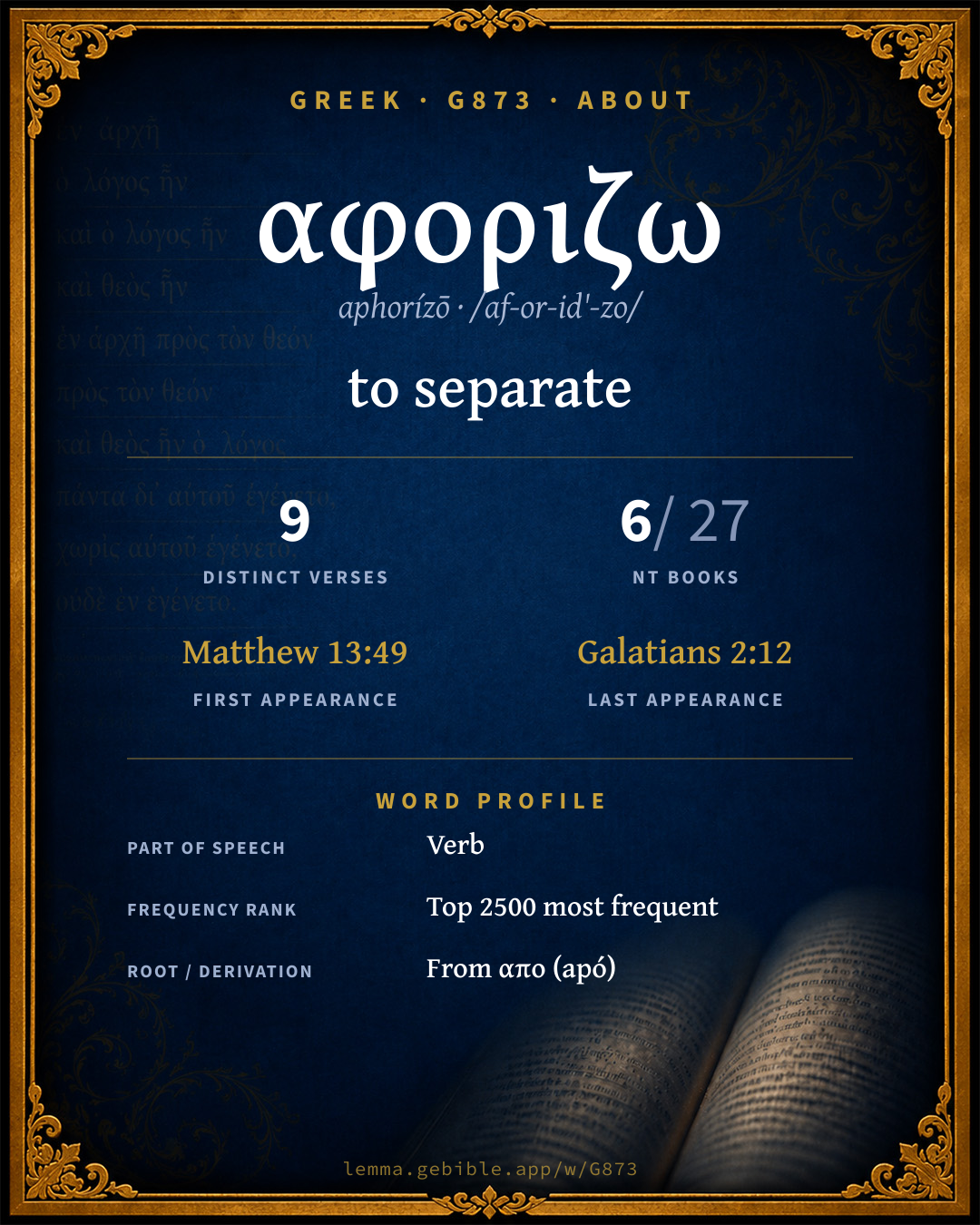
ἀφορίζω
to separate
Full lexicon entry — Thayer's Greek Lexicon
From Thayer's Greek Lexicon
Where this word appears
See every Aorist-tense verb in the Greek New Testament →
Grammar key — what these labels mean
Part of speech
- Verb
- An action or state-of-being word.
Tense
- Aorist
- Action viewed as a simple whole, without regard to duration — often past (perfective aspect).
- Future
- Action expected in future time.
- Imperfect
- Continuous or repeated action in past time (“was writing”).
- Present
- Ongoing or general action in present time (imperfective aspect).
- Perfect
- A completed past action with continuing present results.
Voice
- Active
- The subject performs the action.
- Passive
- The subject receives the action.
Mood
- Indicative
- States a fact or asks a factual question (the mood of reality).
- Imperative
- Expresses a command or request.
- Participle
- A verbal adjective (“writing,” “having written”).
- Subjunctive
- Expresses probability, purpose, or possibility (the mood of contingency).
Case
- Nominative
- The case of the subject (and the predicate nominative).
Person
- 3rd person
- The one spoken about (“he / she / it / they”).
- 2nd person
- The one addressed (“you”).
Gender
- Masculine
- Grammatically masculine.
Number
- Singular
- One.
- Plural
- More than one.
Grammatical forms 10 distinct
- Verb, Aorist, Active, Indicative, 3rd person, Singular 1 time (10%)
- Verb, Aorist, Active, Imperative, 2nd person, Plural 1 time (10%)
- Verb, Aorist, Active, Participle, Nominative, Singular, Masculine 1 time (10%)
- Verb, Aorist, Active, Subjunctive, 3rd person, Plural 1 time (10%)
- Verb, Aorist, Passive, Imperative, 2nd person, Plural 1 time (10%)
- Verb, Future, Active, Indicative, 3rd person, Plural, Attic form 1 time (10%)
- Verb, Future, Active, Indicative, 3rd person, Singular 1 time (10%)
- Verb, Imperfect, Active, Indicative, 3rd person, Singular 1 time (10%)
+2 more forms (2 occurrences)
Parsed forms decoded from the imported morphology (Robinson–Tischendorf, public domain), counted across 10 parsed occurrences — not distinct verses.
Every verse where G873 appears — 9 distinct verses across 6 books. Click any verse to open its interlinear word-by-word view. Verse text shown in the World English Bible for context — . Each verse’s Greek form is shown with its reference; the English is not keyword-highlighted, since the data carries no word-level English alignment. Use “Compare translations” on any verse to read it across multiple English versions. This concordance covers the Greek New Testament; Septuagint (Greek Old Testament) occurrences of this word are not indexed here.
Matthew 2 verses
- Matthew 13:49 ἀφοριοῦσιν fut act ind 3pl attic So will it be in the end of the world. The angels will come forth, and separate the wicked from among the righteous,
- Matthew 25:32 ἀφορίσει ἀφορίζει fut act ind 3sg pres act ind 3sg Before him all the nations will be gathered, and he will separate them one from another, as a shepherd separates the sheep from the goats.
Luke 1 verse
Acts 2 verses
- Acts 13:2 ἀφορίσατε aor act impv 2pl As they served the Lord and fasted, the Holy Spirit said, "Separate Barnabas and Saul for me, for the work to which I have called them."
- Acts 19:9 ἀφώρισεν aor act ind 3sg But when some were hardened and disobedient, speaking evil of the Way before the multitude, he departed from them, and separated the disciples, reasoning daily in the school of Tyrannus.
Romans 1 verse
2 Corinthians 1 verse
Galatians 2 verses
- Galatians 1:15 ἀφορίσας aor act ptcp nom sg masc But when it was the good pleasure of God, who separated me from my mother's womb, and called me through his grace,
- Galatians 2:12 ἀφώριζεν impf act ind 3sg For before some people came from James, he ate with the Gentiles. But when they came, he drew back and separated himself, fearing those who were of the circumcision.
About this entry
At a glance — auto-summarized from this page’s data, not written by a person. Every figure links to its source below. This summary describes the numbers; it doesn’t interpret them.
“to separate” is the headline sense of the Greek verb αφοριζω (aphorízō). Its earliest occurrence is Matthew 13:49. The Greek New Testament uses it across 9 verses — uncommon. Related forms include απο, απαγγελλω and απαγχομαι. See the sense tree, 9-verse concordance, and the renderings breakdown below.
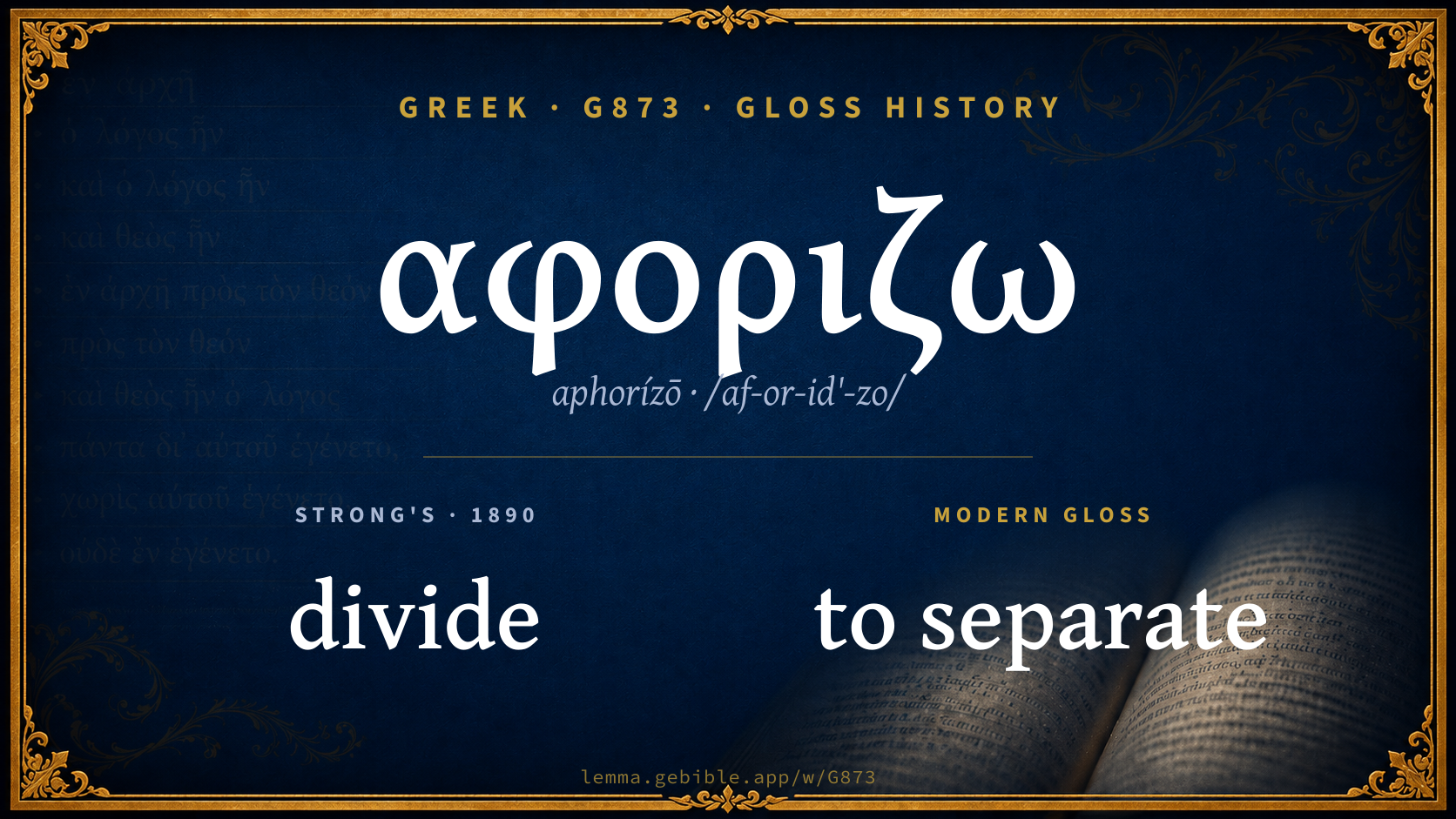
Gloss history
Strong's 1890 vs modern scholarship
About this word
Strong's G873 catalogs a Greek word from the Greek New Testament.
These counts are not copied from any lexicon or concordance. They are computed here, from the morphology-tagged Greek New Testament. What Lemma adds →
- 9
- distinct verses
- The word appears in 9 distinct verses.
- 6 / 27
- NT books
- The word appears in 6 of 27 New Testament books.
- #1,056
- by frequency
- Top 2500 most frequent Greek words (rank 1,056 of 5,347 Greek words by occurrence).
View all 9 occurrences in the concordance →
By section of the New Testament
By traditional corpus
Conventional, traditional groupings — biblical authorship is debated, so this is a traditional corpus grouping, not an authorship claim. Some books belong to more than one corpus (Luke is in both the Gospels and the Lukan corpus, and so on), so these shares overlap and need not total 100%. Each figure is a share of the word’s 9 distinct verses.
- Pauline corpus 4 verses · 44%
- Gospels 3 verses · 33%
- Lukan (Luke–Acts) 3 verses · 33%
How translations render this word
Counts come from each version’s own published word-to-Strong’s tagging or interlinear alignment — an approximate guide to how each version renders this word, not a word-level alignment the data otherwise carries. Because each total is that version’s own tagged count, the per-version totals vary from one another and need not match the appearance or distinct-verse counts above. These counts may also differ from a printed concordance because Lemma counts each distinctly tagged rendering and does not collapse phrase taggings into a single head-word total. This is a fixed set of word-tagged versions (KJV, ASV, BSB, ULT) and does not change with the reading translation you choose elsewhere. Each version’s license is shown beside its name below (and on Sources).
- King James Version: Separated 4×
- American Standard Version: Separated 4×
- Berean Standard Bible: Separate 2×, Set apart 2×
- unfoldingWord Literal Text: Apart 1×, Be separate 1×, Having set 1×
King James Version Public Domain
Renders G873 across 10 tagged occurrences — most commonly:
Plus 6 renderings that appear only once — usually multi-word phrases or single function words the recovered tagging swept in, not distinct renderings.
American Standard Version Public Domain
Renders G873 across 10 tagged occurrences — most commonly:
Plus 6 renderings that appear only once — usually multi-word phrases or single function words the recovered tagging swept in, not distinct renderings.
Berean Standard Bible Public Domain
Renders G873 across 10 tagged occurrences — most commonly:
Plus 6 renderings that appear only once — usually multi-word phrases or single function words the recovered tagging swept in, not distinct renderings.
unfoldingWord Literal Text CC BY-SA 4.0
Renders G873 across 11 tagged occurrences — most commonly:
Senses in Thayer's
The 1 sense Thayer's distinguishes for this word, in lexicon order (not ranked by frequency or importance). The full entry — with sub-senses — is in the Lexicon Entry tab.
- to mark off from others by boundaries, to limit, to separate
Word origin
Derived from απο (apó) (G575) — from.
Forms in the corpus
The 10 distinct written forms G873 takes in the Greek New Testament, most frequent first — each parse links to that tense’s occurrences in the concordance.
| Form | Parsing | Example | Uses |
|---|---|---|---|
| ἀφορίζει aphorízei | Verb, Present, Active, Indicative, 3rd person, Singular | Matthew 25:32 | 1 |
| ἀφορίσας aphorísas | Verb, Aorist, Active, Participle, Nominative, Singular, Masculine | Galatians 1:15 | 1 |
| ἀφορίσατε aphorísate | Verb, Aorist, Active, Imperative, 2nd person, Plural | Acts 13:2 | 1 |
| ἀφορίσει aphorísei | Verb, Future, Active, Indicative, 3rd person, Singular | Matthew 25:32 | 1 |
| ἀφορίσθητε aphorísthēte | Verb, Aorist, Passive, Imperative, 2nd person, Plural | 2 Corinthians 6:17 | 1 |
| ἀφορίσωσιν aphorísōsin | Verb, Aorist, Active, Subjunctive, 3rd person, Plural | Luke 6:22 | 1 |
| ἀφοριοῦσιν aphorioûsin | Verb, Future, Active, Indicative, 3rd person, Plural, Attic form | Matthew 13:49 | 1 |
| ἀφωρισμένος aphōrisménos | Verb, Perfect, Passive, Participle, Nominative, Singular, Masculine | Romans 1:1 | 1 |
| ἀφώριζεν aphṓrizen | Verb, Imperfect, Active, Indicative, 3rd person, Singular | Galatians 2:12 | 1 |
| ἀφώρισεν aphṓrisen | Verb, Aorist, Active, Indicative, 3rd person, Singular | Acts 19:9 | 1 |
Same root — word family
Other Thayer's entries built from the same root as G873, grouped by Strong’s listed origin. These share a root / origin per the lexicon — not necessarily a shared meaning. Each links to that word’s own entry.
Derives from
Shares the same root
- απαγγελλω apangéllō G518 to report
- απαγχομαι apánchomai G519 to strangle
- απαγω apágō G520 to lead away
- απαιρω apaírō G522 to take away
- απαιτεω apaitéō G523 to demand back
- απαλγεω apalgéō G524 to cease grieving
- απαλλασσω apallássō G525 to depart
- απαλλοτριοω apallotrióō G526 to estrange
- απανταω apantáō G528 to meet
- απαρνεομαι aparnéomai G533 to deny
- απαρτι apárti G534 henceforth
- απαρχη aparchḗ G536 to offer firstfruits
- απαυγασμα apaúgasma G541 brightness
- απειδω apeídō G542 to look away
- απειμι ápeimi G548 to depart
- απειμι ápeimi G549 to depart
- απειπομην apeipómēn G550 to declare
- απεκδεχομαι apekdéchomai G553 waiting for
- απεκδυομαι apekdýomai G554 to despoil
- απελαυνω apelaúnō G556 to drive away
- απελεγμος apelegmós G557 censure
- απελευθερος apeleútheros G558 freedman
- απελπιζω apelpízō G560 not despairing
- απεναντι apénanti G561 opposite
+85 more words share this root (not shown).
Compare all same-root words → Showing 4 of 111 — not the complete family. They share a root, not necessarily a meaning.
Septuagint usage
The same Greek word αφοριζω appears 85 times in the Greek Old Testament (Septuagint), across 63 verses in 12 books.
- 85
- LXX occurrences
- Tagged occurrences of this Greek word in the Septuagint.
- 63
- verses
- Distinct Septuagint verses containing this word.
- 12 / 39
- OT books
- The word appears in 12 of the 39 Old Testament books.
Sample Septuagint occurrences
- Genesis 2:10 ἀποὁρίζω
- Exodus 19:12 ἀποὁρίζω
- Leviticus 10:15 ἀποὁρίζω
- Numbers 8:11 ἀποὁρίζω
- Deuteronomy 4:41 ἀποὁρίζω
- Joshua 14:4 ἀποὁρίζω
- 2 Samuel 8:1 ἀποὁρίζω
- Psalms 67:10 ἀποὁρίζω
- Proverbs 8:27 ἀποὁρίζω
- Isaiah 29:22 ἀποὁρίζω
- Ezekiel 45:1 ἀποὁρίζω
- Malachi 2:3 ἀποὁρίζω
Septuagint occurrences (same lexeme)
Every verse where the same Strong’s number (G873) appears in the Greek Septuagint — showing the first 50 of 63. Verse text shown in the World English Bible for context; the Greek form is the matched word — the English is not keyword-highlighted.
- Genesis 2:10 ἀποὁρίζω A river went out of Eden to water the garden; and from there it was parted, and became four heads.
- Genesis 10:5 ἀποὁρίζω Of these were the isles of the nations divided in their lands, everyone after his language, after their families, in their nations.
- Exodus 19:12 ἀποὁρίζω You shall set bounds to the people round about, saying, 'Be careful that you don't go up onto the mountain, or touch its border. Whoever touches the mountain shall be surely put to death.
- Exodus 19:23 ἀποὁρίζω Moses said to Yahweh, "The people can't come up to Mount Sinai, for you charged us, saying, 'Set bounds around the mountain, and sanctify it.'"
- Exodus 29:24 ἀποὁρίζω You shall put all of this in Aaron's hands, and in his sons' hands, and shall wave them for a wave-offering before Yahweh.
- Exodus 29:26 ἀποὁρίζω "You shall take the breast of Aaron's ram of consecration, and wave it for a wave-offering before Yahweh: and it shall be your portion.
- Exodus 29:27 ἀποὁρίζω You shall sanctify the breast of the wave-offering, and the thigh of the heave-offering, which is waved, and which is heaved up, of the ram of consecration, even of that which is for Aaron, and of that which is for his sons:
- Leviticus 10:15 ἀποὁρίζω The heaved thigh and the waved breast they shall bring with the offerings made by fire of the fat, to wave it for a wave offering before Yahweh: and it shall be yours, and your sons' with you, as a portion forever; as Yahweh has commanded."
- Leviticus 13:4 ἀποὁρίζω If the bright spot is white in the skin of his body, and the appearance of it isn't deeper than the skin, and the hair of it hasn't turned white, then the priest shall isolate the infected person for seven days.
- Leviticus 13:5 ἀποὁρίζω The priest shall examine him on the seventh day, and, behold, if in his eyes the plague is arrested, and the plague hasn't spread in the skin, then the priest shall isolate him for seven more days.
- Leviticus 13:11 ἀποὁρίζω it is a chronic leprosy in the skin of his body, and the priest shall pronounce him unclean. He shall not isolate him, for he is unclean.
- Leviticus 13:21 ἀποὁρίζω But if the priest examines it, and, behold, there are no white hairs in it, and it isn't deeper than the skin, but is dim, then the priest shall isolate him seven days.
- Leviticus 13:26 ἀποὁρίζω But if the priest examines it, and, behold, there is no white hair in the bright spot, and it isn't lower than the skin, but is faded; then the priest shall isolate him seven days.
- Leviticus 13:31 ἀποὁρίζω If the priest examines the plague of itching, and, behold, its appearance isn't deeper than the skin, and there is no black hair in it, then the priest shall isolate him the person infected with itching seven days.
- Leviticus 13:33 ἀποὁρίζω then he shall be shaved, but he shall not shave the itch; and the priest shall shut him up who has the itch seven more days.
- Leviticus 13:50 ἀποὁρίζω The priest shall examine the plague, and isolate the plague seven days.
- Leviticus 13:54 ἀποὁρίζω then the priest shall command that they wash the thing in which the plague is, and he shall isolate it seven more days.
- Leviticus 14:12 ἀποὁρίζω "The priest shall take one of the male lambs, and offer him for a trespass offering, with the log of oil, and wave them for a wave offering before Yahweh.
- Leviticus 14:38 ἀποὁρίζω then the priest shall go out of the house to the door of the house, and shut up the house seven days.
- Leviticus 14:46 ἀποὁρίζω "Moreover he who goes into the house while it is shut up shall be unclean until the evening.
- Leviticus 20:25 ἀποὁρίζω "'You shall therefore make a distinction between the clean animal and the unclean, and between the unclean fowl and the clean: and you shall not make yourselves abominable by animal, or by bird, or by anything with which the ground teems, which I have separated from you as unclean for you.
- Leviticus 20:26 ἀποὁρίζω You shall be holy to me: for I, Yahweh, am holy, and have set you apart from the peoples, that you should be mine.
- Leviticus 25:34 ἀποὁρίζω But the field of the suburbs of their cities may not be sold; for it is their perpetual possession.
- Leviticus 27:21 ἀποὁρίζω but the field, when it goes out in the Jubilee, shall be holy to Yahweh, as a field devoted; it shall be owned by the priests.
- Numbers 8:11 ἀποὁρίζω and Aaron shall offer the Levites before Yahweh for a wave offering, on the behalf of the children of Israel, that it may be theirs to do the service of Yahweh.
- Numbers 12:14 ἀποὁρίζω Yahweh said to Moses, If her father had but spit in her face, shouldn't she be ashamed seven days? let her be shut up outside of the camp seven days, and after that she shall be brought in again.
- Numbers 12:15 ἀποὁρίζω Miriam was shut up outside of the camp seven days: and the people didn't travel until Miriam was brought in again.
- Numbers 15:20 ἀποὁρίζω Of the first of your dough you shall offer up a cake for a heave-offering: as the heave-offering of the threshing floor, so shall you heave it.
- Numbers 18:24 ἀποὁρίζω For the tithe of the children of Israel, which they offer as a heave-offering to Yahweh, I have given to the Levites for an inheritance: therefore I have said to them, Among the children of Israel they shall have no inheritance.
- Deuteronomy 4:41 ἀποὁρίζω Then Moses set apart three cities beyond the Jordan toward the sunrise;
- Joshua 14:4 ἀποὁρίζω For the children of Joseph were two tribes, Manasseh and Ephraim: and they gave no portion to the Levites in the land, save cities to dwell in, with the suburbs of it for their cattle and for their substance.
- Joshua 16:9 ἀποὁρίζω together with the cities which were set apart for the children of Ephraim in the midst of the inheritance of the children of Manasseh, all the cities with their villages.
- Joshua 21:13 ἀποὁρίζω To the children of Aaron the priest they gave Hebron with its suburbs, the city of refuge for the manslayer, and Libnah with its suburbs,
- Joshua 21:14 ἀποὁρίζω and Jattir with its suburbs, and Eshtemoa with its suburbs,
- Joshua 21:15 ἀποὁρίζω and Holon with its suburbs, and Debir with its suburbs,
- Joshua 21:16 ἀποὁρίζω and Ain with its suburbs, and Juttah with its suburbs, [and] Beth-shemesh with its suburbs; nine cities out of those two tribes.
- Joshua 21:17 ἀποὁρίζω Out of the tribe of Benjamin, Gibeon with its suburbs, Geba with its suburbs,
- Joshua 21:18 ἀποὁρίζω Anathoth with its suburbs, and Almon with its suburbs; four cities.
- Joshua 21:21 ἀποὁρίζω They gave them Shechem with its suburbs in the hill-country of Ephraim, the city of refuge for the manslayer, and Gezer with its suburbs,
- Joshua 21:22 ἀποὁρίζω and Kibzaim with its suburbs, and Beth Horon with its suburbs; four cities.
- Joshua 21:23 ἀποὁρίζω Out of the tribe of Dan, Elteke with its suburbs, Gibbethon with its suburbs,
- Joshua 21:24 ἀποὁρίζω Aijalon with its suburbs, Gath-rimmon with its suburbs; four cities.
- Joshua 21:25 ἀποὁρίζω Out of the half-tribe of Manasseh, Taanach with its suburbs, and Gath-rimmon with its suburbs; two cities.
- Joshua 21:26 ἀποὁρίζω All the cities of the families of the rest of the children of Kohath were ten with their suburbs.
- Joshua 21:27 ἀποὁρίζω To the children of Gershon, of the families of the Levites, out of the half-tribe of Manasseh [they gave] Golan in Bashan with its suburbs, the city of refuge for the manslayer, and Be-eshterah with its suburbs; two cities.
- Joshua 21:28 ἀποὁρίζω Out of the tribe of Issachar, Kishion with its suburbs, Daberath with its suburbs,
- Joshua 21:29 ἀποὁρίζω Jarmuth with its suburbs, En Gannim with its suburbs; four cities.
- Joshua 21:30 ἀποὁρίζω Out of the tribe of Asher, Mishal with its suburbs, Abdon with its suburbs,
- Joshua 21:31 ἀποὁρίζω Helkath with its suburbs, and Rehob with its suburbs; four cities.
- Joshua 21:32 ἀποὁρίζω Out of the tribe of Naphtali, Kedesh in Galilee with its suburbs, the city of refuge for the manslayer, and Hammothdor with its suburbs, and Kartan with its suburbs; three cities.
These are occurrences of the same Greek lexeme (G873) in the Septuagint — not a translation of any one Hebrew word. The store carries no word-level Hebrew↔Greek alignment, so no Hebrew original is asserted here. Counts come from the recovered LXX Strong's tagging — high-frequency vocabulary is well covered, while rare or late forms may be untagged — so they reflect tagged occurrences and may slightly undercount.