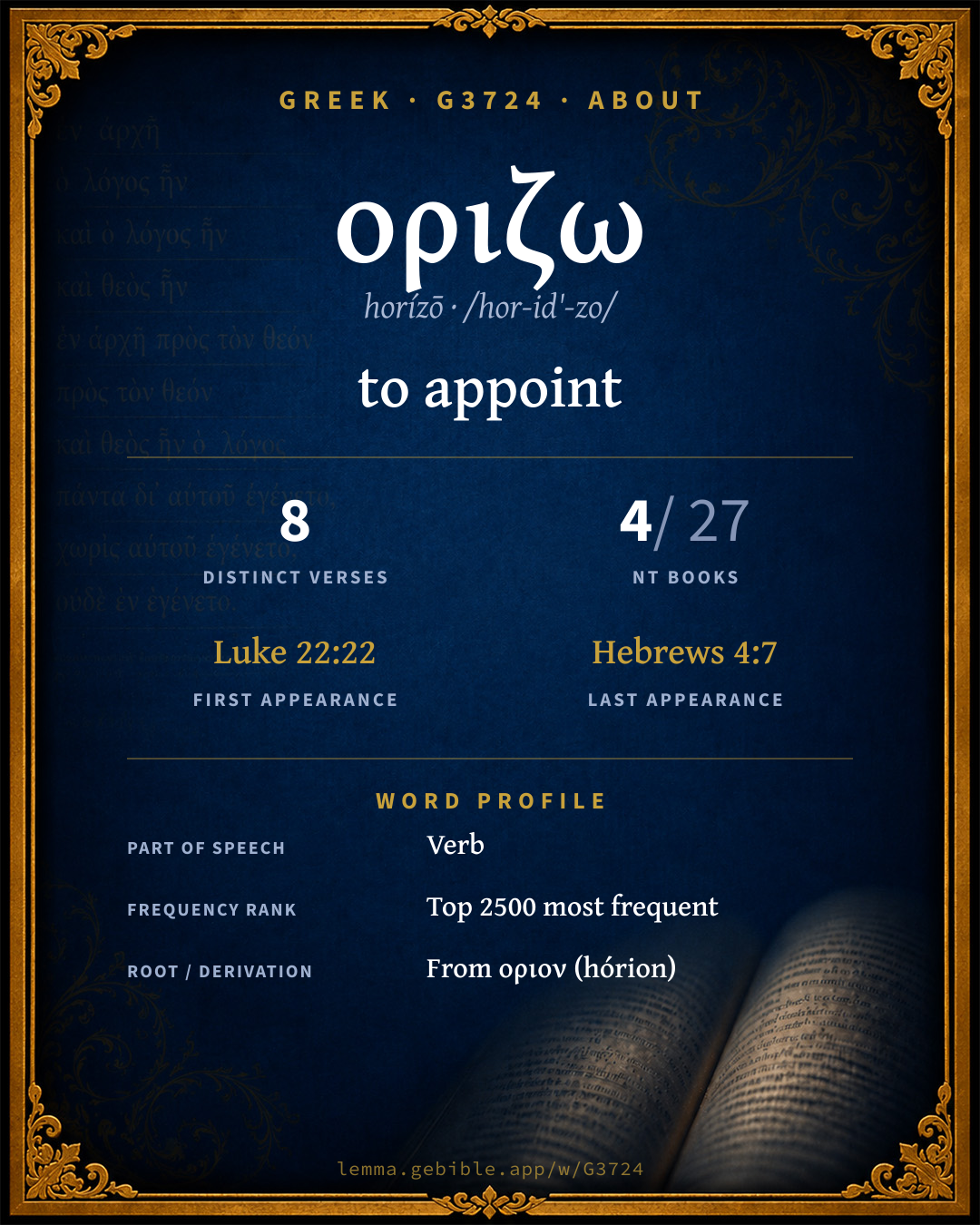
ὁρίζω
to appoint
Full lexicon entry — Thayer's Greek Lexicon
From Thayer's Greek Lexicon
Where this word appears
See every Aorist-tense verb in the Greek New Testament →
Grammar key — what these labels mean
Part of speech
- Verb
- An action or state-of-being word.
Tense
- Aorist
- Action viewed as a simple whole, without regard to duration — often past (perfective aspect).
- Present
- Ongoing or general action in present time (imperfective aspect).
- Perfect
- A completed past action with continuing present results.
Voice
- Active
- The subject performs the action.
- Passive
- The subject receives the action.
Mood
- Indicative
- States a fact or asks a factual question (the mood of reality).
- Participle
- A verbal adjective (“writing,” “having written”).
Case
- Nominative
- The case of the subject (and the predicate nominative).
- Genitive
- The case of source, possession, or “of” — answers “whose / from what.”
- Accusative
- The case of the direct object and of extent.
- Dative
- The case of the indirect object, means, or location — “to / for / with / in.”
Person
- 3rd person
- The one spoken about (“he / she / it / they”).
Gender
- Masculine
- Grammatically masculine.
- Neuter
- Grammatically neuter.
- Feminine
- Grammatically feminine.
Number
- Plural
- More than one.
- Singular
- One.
Grammatical forms
- Verb, Aorist, Active, Indicative, 3rd person, Plural 1 time (13%)
- Verb, Aorist, Active, Indicative, 3rd person, Singular 1 time (13%)
- Verb, Aorist, Active, Participle, Nominative, Singular, Masculine 1 time (13%)
- Verb, Aorist, Passive, Participle, Genitive, Singular, Masculine 1 time (13%)
- Verb, Present, Active, Indicative, 3rd person, Singular 1 time (13%)
- Verb, Perfect, Passive, Participle, Accusative, Singular, Neuter 1 time (13%)
- Verb, Perfect, Passive, Participle, Dative, Singular, Feminine 1 time (13%)
- Verb, Perfect, Passive, Participle, Nominative, Singular, Masculine 1 time (13%)
Parsed forms decoded from the imported morphology (Robinson–Tischendorf, public domain), counted across 8 parsed occurrences — not distinct verses.
Every verse where G3724 appears — 8 distinct verses across 4 books. Click any verse to open its interlinear word-by-word view. Verse text shown in the World English Bible for context — . Each verse’s Greek form is shown with its reference; the English is not keyword-highlighted, since the data carries no word-level English alignment. Use “Compare translations” on any verse to read it across multiple English versions. This concordance covers the Greek New Testament; Septuagint (Greek Old Testament) occurrences of this word are not indexed here.
Luke 1 verse
Acts 5 verses
- Acts 2:23 ὡρισμένῃ perf pass ptcp dat sg fem him, being delivered up by the determined counsel and foreknowledge of God, you have taken by the hand of lawless men, crucified and killed;
- Acts 10:42 ὡρισμένος perf pass ptcp nom sg masc He charged us to preach to the people and to testify that this is he who is appointed by God as the Judge of the living and the dead.
- Acts 11:29 ὥρισαν aor act ind 3pl As any of the disciples had plenty, each determined to send relief to the brothers who lived in Judea;
- Acts 17:26 ὁρίσας aor act ptcp nom sg masc He made from one blood every nation of men to dwell on all the surface of the earth, having determined appointed seasons, and the boundaries of their dwellings,
- Acts 17:31 ὥρισεν aor act ind 3sg because he has appointed a day in which he will judge the world in righteousness by the man whom he has ordained; of which he has given assurance to all men, in that he has raised him from the dead."
Romans 1 verse
Hebrews 1 verse
About this entry
At a glance — auto-summarized from this page’s data, not written by a person. Every figure links to its source below. This summary describes the numbers; it doesn’t interpret them.
οριζω (horízō) is a Greek verb most often rendered “to appoint.” Acts dominates its distribution — 5 of 8 verses. Spanning 8 verses in 4 books, it ranks among the uncommon words of the Greek New Testament. It first appears in Luke 22:22. Related forms include οριον, ορκος and οροθεσια. For the data behind this summary, explore the sense tree and the renderings breakdown below.
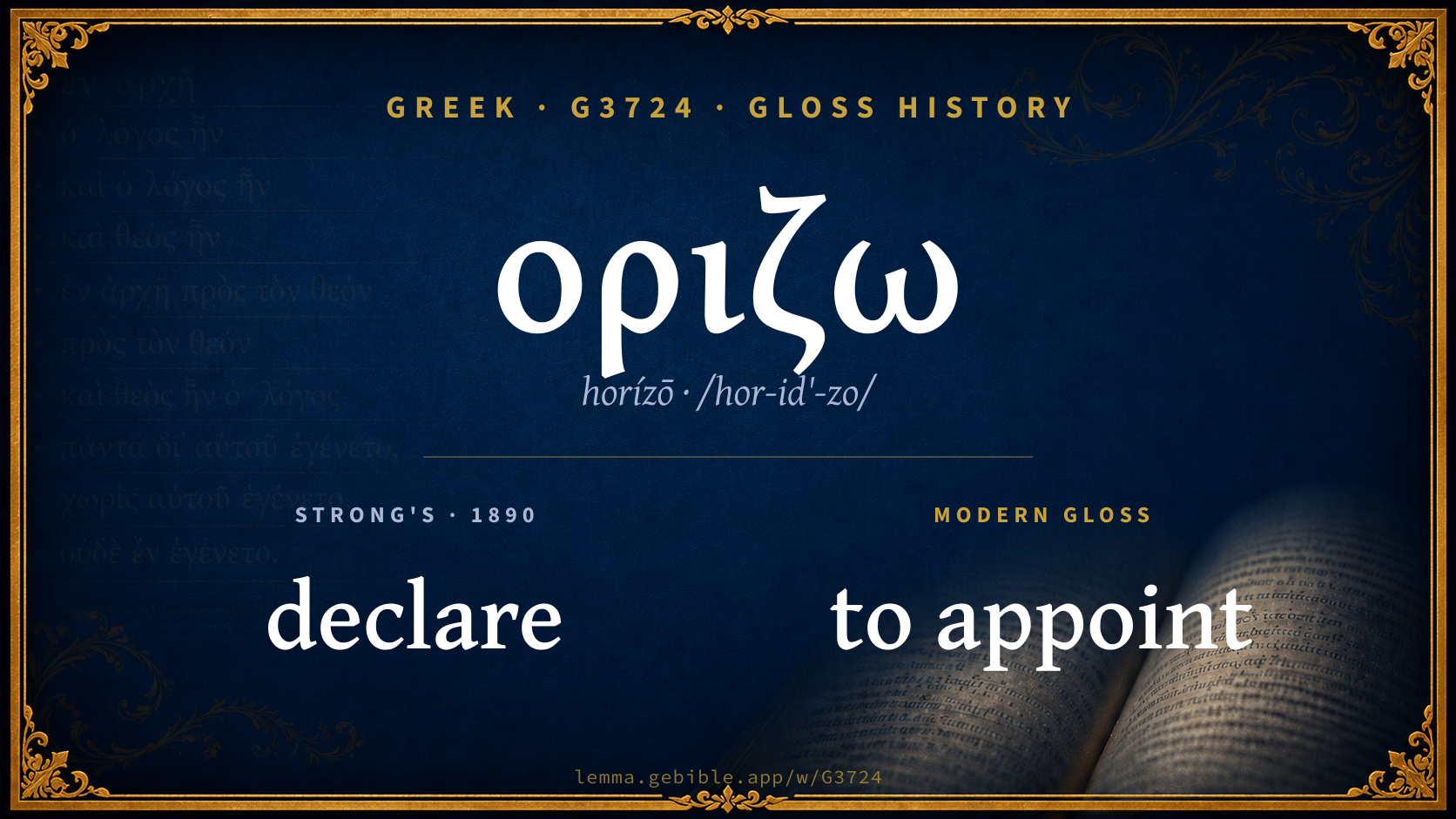
Gloss history
Strong's 1890 vs modern scholarship
About this word
Strong's G3724 catalogs a Greek word from the Greek New Testament.
These counts are not copied from any lexicon or concordance. They are computed here, from the morphology-tagged Greek New Testament. What Lemma adds →
- 8
- distinct verses
- The word appears in 8 distinct verses.
- 4 / 27
- NT books
- The word appears in 4 of 27 New Testament books.
- #1,240
- by frequency
- Top 2500 most frequent Greek words (rank 1,240 of 5,347 Greek words by occurrence).
View all 8 occurrences in the concordance →
By section of the New Testament
By traditional corpus
Conventional, traditional groupings — biblical authorship is debated, so this is a traditional corpus grouping, not an authorship claim. Some books belong to more than one corpus (Luke is in both the Gospels and the Lukan corpus, and so on), so these shares overlap and need not total 100%. Each figure is a share of the word’s 8 distinct verses.
- Lukan (Luke–Acts) 6 verses · 75%
- Gospels 1 verse · 13%
- Pauline corpus 1 verse · 13%
- Hebrews 1 verse · 13%
How translations render this word
Counts come from each version’s own published word-to-Strong’s tagging or interlinear alignment — an approximate guide to how each version renders this word, not a word-level alignment the data otherwise carries. Because each total is that version’s own tagged count, the per-version totals vary from one another and need not match the appearance or distinct-verse counts above. These counts may also differ from a printed concordance because Lemma counts each distinctly tagged rendering and does not collapse phrase taggings into a single head-word total. This is a fixed set of word-tagged versions (KJV, ASV, BSB, ULT) and does not change with the reading translation you choose elsewhere. Each version’s license is shown beside its name below (and on Sources).
- King James Version: Declared 1×, Determinate 1×, Determined 1×
- American Standard Version: Defineth 1×, Determinate 1×, Determined 1×
- Berean Standard Bible: Again designated 1×, Appointed 1×, Decided 1×
- unfoldingWord Literal Text: Chosen 1×, Determined 1×, Has been determined 1×
King James Version Public Domain
Renders G3724 across 8 tagged occurrences — most commonly:
American Standard Version Public Domain
Renders G3724 across 8 tagged occurrences — most commonly:
Berean Standard Bible Public Domain
Renders G3724 across 8 tagged occurrences — most commonly:
unfoldingWord Literal Text CC BY-SA 4.0
Renders G3724 across 9 tagged occurrences — most commonly:
Senses in Thayer's
The 1 sense Thayer's distinguishes for this word, in lexicon order (not ranked by frequency or importance). The full entry — with sub-senses — is in the Lexicon Entry tab.
- to mark out the boundaries or limits (of any place or thing) 1b to determine, appoint
Word origin
Derived from οριον (hórion) (G3725) — boundaries.
From G3725 ; to mark out or bound (horizon) that is (figuratively) to appoint decree specify : - declare determine limit ordain.
— Strong’s Exhaustive Concordance (1890), public domain.
Forms in the corpus
The 8 distinct written forms G3724 takes in the Greek New Testament, most frequent first — each parse links to that tense’s occurrences in the concordance.
| Form | Parsing | Example | Uses |
|---|---|---|---|
| ὁρίζει horízei | Verb, Present, Active, Indicative, 3rd person, Singular | Hebrews 4:7 | 1 |
| ὁρίσας horísas | Verb, Aorist, Active, Participle, Nominative, Singular, Masculine | Acts 17:26 | 1 |
| ὁρισθέντος horisthéntos | Verb, Aorist, Passive, Participle, Genitive, Singular, Masculine | Romans 1:4 | 1 |
| ὡρισμένον hōrisménon | Verb, Perfect, Passive, Participle, Accusative, Singular, Neuter | Luke 22:22 | 1 |
| ὡρισμένος hōrisménos | Verb, Perfect, Passive, Participle, Nominative, Singular, Masculine | Acts 10:42 | 1 |
| ὡρισμένῃ hōrisménē | Verb, Perfect, Passive, Participle, Dative, Singular, Feminine | Acts 2:23 | 1 |
| ὥρισαν hṓrisan | Verb, Aorist, Active, Indicative, 3rd person, Plural | Acts 11:29 | 1 |
| ὥρισεν hṓrisen | Verb, Aorist, Active, Indicative, 3rd person, Singular | Acts 17:31 | 1 |
Same root — word family
Other Thayer's entries built from the same root as G3724, grouped by Strong’s listed origin. These share a root / origin per the lexicon — not necessarily a shared meaning. Each links to that word’s own entry.
Derives from
Shares the same root
Compare all same-root words → They share a root, not necessarily a meaning.
Septuagint usage
The same Greek word οριζω appears 19 times in the Greek Old Testament (Septuagint), across 18 verses in 5 books.
- 19
- LXX occurrences
- Tagged occurrences of this Greek word in the Septuagint.
- 18
- verses
- Distinct Septuagint verses containing this word.
- 5 / 39
- OT books
- The word appears in 5 of the 39 Old Testament books.
Sample Septuagint occurrences
- Numbers 30:3 ὁρίζω
- Joshua 13:7 ὁρίζω
- Proverbs 16:26 ὁρίζω
- Ezekiel 47:20 ὁρίζω
- Daniel 6:13 ὁρίζω
Septuagint occurrences (same lexeme)
Every verse where the same Strong’s number (G3724) appears in the Greek Septuagint. Verse text shown in the World English Bible for context; the Greek form is the matched word — the English is not keyword-highlighted.
- Numbers 30:3 ὁρίζω Also when a woman vows a vow to Yahweh, and binds herself by a bond, being in her father's house, in her youth,
- Numbers 30:4 ὁρίζω and her father hears her vow, and her bond with which she has bound her soul, and her father holds his peace at her; then all her vows shall stand, and every bond with which she has bound her soul shall stand.
- Numbers 30:5 ὁρίζω But if her father disallow her in the day that he hears, none of her vows, or of her bonds with which she has bound her soul, shall stand: and Yahweh will forgive her, because her father disallowed her.
- Numbers 30:6 ὁρίζω If she be [married] to a husband, while her vows are on her, or the rash utterance of her lips, with which she has bound her soul,
- Numbers 30:7 ὁρίζω and her husband hear it, and hold his peace at her in the day that he hears it; then her vows shall stand, and her bonds with which she has bound her soul shall stand.
- Numbers 30:8 ὁρίζω But if her husband disallow her in the day that he hears it, then he shall make void her vow which is on her, and the rash utterance of her lips, with which she has bound her soul: and Yahweh will forgive her.
- Numbers 30:9 ὁρίζω But the vow of a widow, or of her who is divorced, [even] everything with which she has bound her soul, shall stand against her.
- Numbers 30:12 ὁρίζω But if her husband made them null and void in the day that he heard them, then whatever proceeded out of her lips concerning her vows, or concerning the bond of her soul, shall not stand: her husband has made them void; and Yahweh will forgive her.
- Numbers 34:6 ὁρίζω For the western border, you shall have the great sea and the border [of it]: this shall be your west border.
- Joshua 13:7 ὁρίζω Now therefore divide this land for an inheritance to the nine tribes, and the half-tribe of Manasseh.
- Joshua 13:27 ὁρίζω and in the valley, Beth Haram, and Beth Nimrah, and Succoth, and Zaphon, the rest of the kingdom of Sihon king of Heshbon, the Jordan and the border [of it], to the uttermost part of the sea of Chinnereth beyond the Jordan eastward.
- Joshua 15:12 ὁρίζω The west border was to the great sea, and the border [of it]. This is the border of the children of Judah round about according to their families.
- Joshua 18:20 ὁρίζω The Jordan was the border of it on the east quarter. This was the inheritance of the children of Benjamin, by the borders of it round about, according to their families.
- Joshua 23:4 ὁρίζω Behold, I have allotted to you these nations that remain, to be an inheritance for your tribes, from the Jordan, with all the nations that I have cut off, even to the great sea toward the going down of the sun.
- Proverbs 16:26 ὁρίζω The appetite of the laboring man labors for him; For his mouth urges him on.
- Proverbs 18:18 ὁρίζω The lot settles disputes, And keeps strong ones apart.
- Ezekiel 47:20 ὁρίζω The west side shall be the great sea, from the [south] border as far as over against the entrance of Hamath. This is the west side.
- Daniel 6:13 ὁρίζω Then answered they and said before the king, That Daniel, who is of the children of the captivity of Judah, doesn't regard you, O king, nor the interdict that you have signed, but makes his petition three times a day.
These are occurrences of the same Greek lexeme (G3724) in the Septuagint — not a translation of any one Hebrew word. The store carries no word-level Hebrew↔Greek alignment, so no Hebrew original is asserted here. Counts come from the recovered LXX Strong's tagging — high-frequency vocabulary is well covered, while rare or late forms may be untagged — so they reflect tagged occurrences and may slightly undercount.