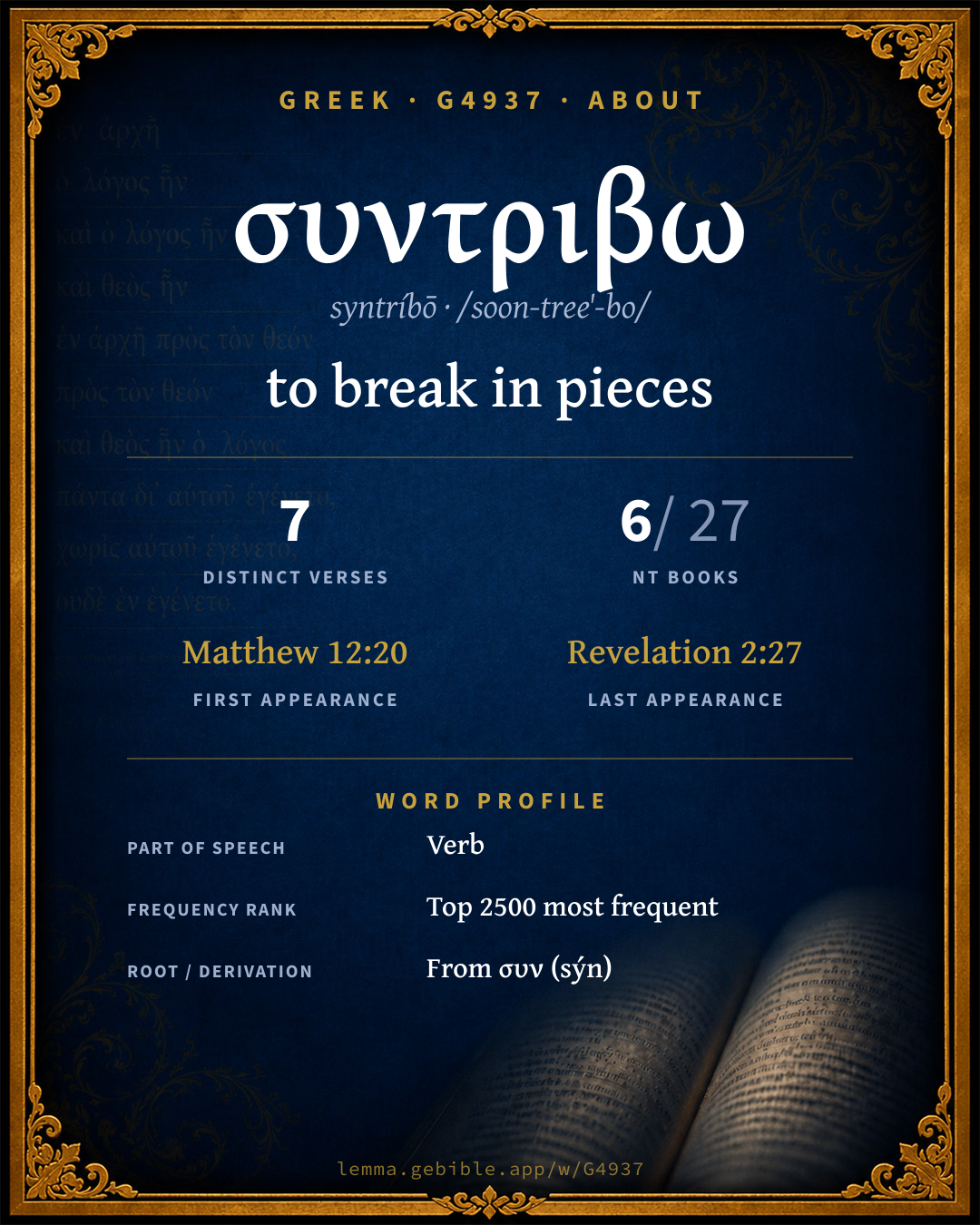
συντρίβω
to break in pieces
also: break, shiver fuller range ↓
Full lexicon entry — Thayer's Greek Lexicon
From Thayer's Greek Lexicon
Where this word appears
See every Future-tense verb in the Greek New Testament →
Grammar key — what these labels mean
Part of speech
- Verb
- An action or state-of-being word.
Tense
- Future
- Action expected in future time.
- Aorist
- Action viewed as a simple whole, without regard to duration — often past (perfective aspect).
- Present
- Ongoing or general action in present time (imperfective aspect).
- Perfect
- A completed past action with continuing present results.
Voice
- Passive
- The subject receives the action.
- Active
- The subject performs the action.
Mood
- Indicative
- States a fact or asks a factual question (the mood of reality).
- Participle
- A verbal adjective (“writing,” “having written”).
- Infinitive
- A verbal noun (“to write”), unmarked for person or number.
Case
- Nominative
- The case of the subject (and the predicate nominative).
- Accusative
- The case of the direct object and of extent.
Person
- 3rd person
- The one spoken about (“he / she / it / they”).
Gender
- Feminine
- Grammatically feminine.
- Neuter
- Grammatically neuter.
- Masculine
- Grammatically masculine.
Number
- Singular
- One.
Grammatical forms
- Verb, Future, Passive, Indicative, 3rd person, Singular 1 time (14%)
- Verb, Aorist, Active, Participle, Nominative, Singular, Feminine 1 time (14%)
- Verb, Future, Active, Indicative, 3rd person, Singular 1 time (14%)
- Verb, Present, Active, Participle, Nominative, Singular, Neuter 1 time (14%)
- Verb, Present, Passive, Indicative, 3rd person, Singular 1 time (14%)
- Verb, Perfect, Passive, Infinitive 1 time (14%)
- Verb, Perfect, Passive, Participle, Accusative, Singular, Masculine 1 time (14%)
Parsed forms decoded from the imported morphology (Robinson–Tischendorf, public domain), counted across 7 parsed occurrences — not distinct verses.
Every verse where G4937 appears — 7 distinct verses across 6 books. Click any verse to open its interlinear word-by-word view. Verse text shown in the World English Bible for context — . Each verse’s Greek form is shown with its reference; the English is not keyword-highlighted, since the data carries no word-level English alignment. Use “Compare translations” on any verse to read it across multiple English versions. This concordance covers the Greek New Testament; Septuagint (Greek Old Testament) occurrences of this word are not indexed here.
Matthew 1 verse
Mark 2 verses
- Mark 5:4 συντετρῖφθαι perf pass inf because he had been often bound with fetters and chains, and the chains had been torn apart by him, and the fetters broken in pieces. Nobody had the strength to tame him.
- Mark 14:3 συντρίψασα aor act ptcp nom sg fem While he was at Bethany, in the house of Simon the leper, as he sat at the table, a woman came having an alabaster jar of ointment of pure nard-- very costly. She broke the jar, and poured it over his head.
Luke 1 verse
John 1 verse
Romans 1 verse
Revelation 1 verse
About this entry
At a glance — auto-summarized from this page’s data, not written by a person. Every figure links to its source below. This summary describes the numbers; it doesn’t interpret them.
“to break in pieces” is the headline sense of the Greek verb συντριβω (syntríbō). Scripture first uses it in Matthew 12:20. It appears 7 verses across 6 books of the Greek New Testament, among its uncommon vocabulary. More than a quarter of its appearances fall in Mark. Not a single-sense word, it carries 3 senses, among them “break” and “shiver”. See the sense tree, 7-verse concordance, and the renderings breakdown below.
Gloss history
Strong's 1890 vs modern scholarship
About this word
Strong's G4937 catalogs a Greek word from the Greek New Testament.
These counts are not copied from any lexicon or concordance. They are computed here, from the morphology-tagged Greek New Testament. What Lemma adds →
- 7
- distinct verses
- The word appears in 7 distinct verses.
- 6 / 27
- NT books
- The word appears in 6 of 27 New Testament books.
- #1,358
- by frequency
- Top 2500 most frequent Greek words (rank 1,358 of 5,347 Greek words by occurrence).
View all 7 occurrences in the concordance →
By section of the New Testament
By traditional corpus
Conventional, traditional groupings — biblical authorship is debated, so this is a traditional corpus grouping, not an authorship claim. Some books belong to more than one corpus (Luke is in both the Gospels and the Lukan corpus, and so on), so these shares overlap and need not total 100%. Each figure is a share of the word’s 7 distinct verses.
- Gospels 5 verses · 71%
- Johannine 2 verses · 29%
- Lukan (Luke–Acts) 1 verse · 14%
- Pauline corpus 1 verse · 14%
- Revelation 1 verse · 14%
How translations render this word
Counts come from each version’s own published word-to-Strong’s tagging or interlinear alignment — an approximate guide to how each version renders this word, not a word-level alignment the data otherwise carries. Because each total is that version’s own tagged count, the per-version totals vary from one another and need not match the appearance or distinct-verse counts above. These counts may also differ from a printed concordance because Lemma counts each distinctly tagged rendering and does not collapse phrase taggings into a single head-word total. This is a fixed set of word-tagged versions (KJV, ASV, BSB, ULT) and does not change with the reading translation you choose elsewhere. Each version’s license is shown beside its name below (and on Sources).
- King James Version: Be broken 1×, Broken in pieces 1×, Brokenhearted 1×
- American Standard Version: Are broken to shivers 1×, Be broken 1×, Broken in pieces 1×
- Berean Standard Bible: Bruised 1×, Keeps mauling 1×, Shatter 1×
- unfoldingWord Literal Text: Are shattered 1×, Bruised 1×, Crushing 1×
King James Version Public Domain
Renders G4937 across 9 tagged occurrences — most commonly:
American Standard Version Public Domain
Renders G4937 across 8 tagged occurrences — most commonly:
Berean Standard Bible Public Domain
Renders G4937 across 7 tagged occurrences — most commonly:
unfoldingWord Literal Text CC BY-SA 4.0
Renders G4937 across 7 tagged occurrences — most commonly:
Senses in Thayer's
The 3 senses Thayer's distinguishes for this word, in lexicon order (not ranked by frequency or importance). The full entry — with sub-senses — is in the Lexicon Entry tab.
- break, to break in pieces, shiver
- to put Satan under foot and (as a conqueror) trample on him
- to break down, crush
Word origin
Derived from συν (sýn) (G4862) — with.
Forms in the corpus
The 7 distinct written forms G4937 takes in the Greek New Testament, most frequent first — each parse links to that tense’s occurrences in the concordance.
| Form | Parsing | Example | Uses |
|---|---|---|---|
| συντετριμμένον syntetrimménon | Verb, Perfect, Passive, Participle, Accusative, Singular, Masculine | Matthew 12:20 | 1 |
| συντετρῖφθαι syntetrîphthai | Verb, Perfect, Passive, Infinitive | Mark 5:4 | 1 |
| συντρίβεται syntríbetai | Verb, Present, Passive, Indicative, 3rd person, Singular | Revelation 2:27 | 1 |
| συντρίψασα syntrípsasa | Verb, Aorist, Active, Participle, Nominative, Singular, Feminine | Mark 14:3 | 1 |
| συντρίψει syntrípsei | Verb, Future, Active, Indicative, 3rd person, Singular | Romans 16:20 | 1 |
| συντριβήσεται syntribḗsetai | Verb, Future, Passive, Indicative, 3rd person, Singular | John 19:36 | 1 |
| συντρῖβον syntrîbon | Verb, Present, Active, Participle, Nominative, Singular, Neuter | Luke 9:39 | 1 |
Same root — word family
Other Thayer's entries built from the same root as G4937, grouped by Strong’s listed origin. These share a root / origin per the lexicon — not necessarily a shared meaning. Each links to that word’s own entry.
Derives from
Shares the same root
- κοινος koinós G2839 common
- συγγενης syngenḗs G4773 related by blood
- συγγνωμη syngnṓmē G4774 pardon
- συγκαθημαι synkáthēmai G4775 to sit together
- συγκαθιζω synkathízō G4776 to sit together
- συγκακοπαθεω synkakopathéō G4777 to suffer together
- συγκακουχεω synkakouchéō G4778 to be ill-treated together
- συγκαλεω synkaléō G4779 to call together
- συγκαλυπτω synkalýptō G4780 to cover completely
- συγκαμπτω synkámptō G4781 to bend together
- συγκαταβαινω synkatabaínō G4782 to go down with
- συγκατατιθεμαι synkatatíthemai G4784 to deposit together
- συγκαταψηφιζω synkatapsēphízō G4785 to vote against
- συγκεραννυμι synkeránnymi G4786 to mix together
- συγκλειω synkleíō G4788 to shut up
- συγκληρονομος synklēronómos G4789 joint heir
- συγκοινωνεω synkoinōnéō G4790 to share together
- συγκοινωνος synkoinōnós G4791 joint partner
- συγκομιζω synkomízō G4792 to collect together
- συγκρινω synkrínō G4793 to join together
- συγκυπτω synkýptō G4794 to bend together
- συγκυρια synkyría G4795 by chance
- συγχαιρω synchaírō G4796 to rejoice with
- συγχεω synchéō G4797 to disturb
+125 more words share this root (not shown).
Derived from this word
Compare all same-root words → Showing 4 of 152 — not the complete family. They share a root, not necessarily a meaning.
Septuagint usage
The same Greek word συντριβω appears 179 times in the Greek Old Testament (Septuagint), across 170 verses in 29 books.
- 179
- LXX occurrences
- Tagged occurrences of this Greek word in the Septuagint.
- 170
- verses
- Distinct Septuagint verses containing this word.
- 29 / 39
- OT books
- The word appears in 29 of the 39 Old Testament books.
Sample Septuagint occurrences
- Genesis 19:9 συντρίβω
- Exodus 9:25 συντρίβω
- Leviticus 6:21 συντρίβω
- Numbers 9:12 συντρίβω
- Deuteronomy 1:42 συντρίβω
- Joshua 7:5 συντρίβω
- Judges 2:2 συντρίβω
- 1 Samuel 4:18 συντρίβω
- 1 Kings 13:28 συντρίβω
- 2 Kings 1:18 συντρίβω
- 2 Chronicles 14:2 συντρίβω
- Ezra 12:13 συντρίβω
Septuagint occurrences (same lexeme)
Every verse where the same Strong’s number (G4937) appears in the Greek Septuagint — showing the first 50 of 170. Verse text shown in the World English Bible for context; the Greek form is the matched word — the English is not keyword-highlighted.
- Genesis 19:9 συντρίβω They said, "Stand back!" They said, "This one fellow came in to live as a foreigner, and he appoints himself a judge. Now will we deal worse with you, than with them!" They pressed hard on the man, even Lot, and drew near to break the door.
- Genesis 49:24 συντρίβω But his bow abode in strength, The arms of his hands were made strong, By the hands of the Mighty One of Jacob, (From there is the shepherd, the stone of Israel),
- Exodus 9:25 συντρίβω The hail struck throughout all the land of Egypt all that was in the field, both man and animal; and the hail struck every herb of the field, and broke every tree of the field.
- Exodus 12:10 συντρίβω You shall let nothing of it remain until the morning; but that which remains of it until the morning you shall burn with fire.
- Exodus 12:46 συντρίβω In one house shall it be eaten; you shall not carry forth anything of the flesh abroad out of the house; neither shall you break a bone of it.
- Exodus 15:3 συντρίβω Yahweh is a man of war. Yahweh is his name.
- Exodus 15:7 συντρίβω In the greatness of your excellency, you overthrow those who rise up against you: You send forth your wrath. It consumes them as stubble.
- Exodus 22:9 συντρίβω For every matter of trespass, whether it be for ox, for donkey, for sheep, for clothing, or for any kind of lost thing, about which one says, 'This is mine,' the cause of both parties shall come before God. He whom God condemns shall pay double to his neighbor.
- Exodus 22:13 συντρίβω If it is torn in pieces, let him bring it for evidence. He shall not make good that which was torn.
- Exodus 23:24 συντρίβω You shall not bow down to their gods, nor serve them, nor follow their practices, but you shall utterly overthrow them and demolish their pillars.
- Exodus 32:19 συντρίβω It happened, as soon as he came near to the camp, that he saw the calf and the dancing: and Moses' anger grew hot, and he threw the tablets out of his hands, and broke them beneath the mountain.
- Exodus 34:1 συντρίβω Yahweh said to Moses, "Chisel two stone tablets like the first: and I will write on the tablets the words that were on the first tablets, which you broke.
- Exodus 34:13 συντρίβω but you shall break down their altars, and dash in pieces their pillars, and you shall cut down their Asherim;
- Leviticus 6:21 συντρίβω It shall be made with oil in a baking pan. When it is soaked, you shall bring it in. You shall offer the meal offering in baked pieces for a sweet savor to Yahweh.
- Leviticus 11:33 συντρίβω Every earthen vessel, into which any of them falls, all that is in it shall be unclean, and you shall break it.
- Leviticus 15:12 συντρίβω "'The earthen vessel, which he who has the discharge touches, shall be broken; and every vessel of wood shall be rinsed in water.
- Leviticus 22:22 συντρίβω Blind, injured, maimed, having a wart, festering, or having a running sore, you shall not offer these to Yahweh, nor make an offering by fire of them on the altar to Yahweh.
- Leviticus 26:13 συντρίβω I am Yahweh your God, who brought you forth out of the land of Egypt, that you should not be their slaves; and I have broken the bars of your yoke, and made you go upright.
- Leviticus 26:19 συντρίβω I will break the pride of your power, and I will make your sky like iron, and your soil like brass;
- Numbers 9:12 συντρίβω They shall leave none of it until the morning, nor break a bone of it. According to all the statute of the Passover they shall keep it.
- Deuteronomy 1:42 συντρίβω Yahweh said to me, Tell them, Don't go up, neither fight; for I am not among you; lest you be struck before your enemies.
- Deuteronomy 7:5 συντρίβω But thus shall you deal with them: you shall break down their altars, and dash in pieces their pillars, and hew down their Asherim, and burn their engraved images with fire.
- Deuteronomy 9:17 συντρίβω I took hold of the two tables, and cast them out of my two hands, and broke them before your eyes.
- Deuteronomy 10:2 συντρίβω I will write on the tables the words that were on the first tables which you broke, and you shall put them in the ark.
- Deuteronomy 12:3 συντρίβω and you shall break down their altars, and dash in pieces their pillars, and burn their Asherim with fire; and you shall cut down the engraved images of their gods; and you shall destroy their name out of that place.
- Deuteronomy 28:7 συντρίβω Yahweh will cause your enemies who rise up against you to be struck before you: they shall come out against you one way, and shall flee before you seven ways.
- Deuteronomy 33:20 συντρίβω Of Gad he said, Blessed be he who enlarges Gad: He dwells as a lioness, Tears the arm, yes, the crown of the head.
- Joshua 7:5 συντρίβω The men of Ai struck of them about thirty-six men; and they chased them [from] before the gate even to Shebarim, and struck them at the descent; and the hearts of the people melted, and became as water.
- Joshua 10:10 συντρίβω Yahweh confused them before Israel, and he killed them with a great slaughter at Gibeon, and chased them by the way of the ascent of Beth Horon, and struck them to Azekah, and to Makkedah.
- Joshua 10:12 συντρίβω Then spoke Joshua to Yahweh in the day when Yahweh delivered up the Amorites before the children of Israel; and he said in the sight of Israel, Sun, stand you still on Gibeon; You, Moon, in the valley of Aijalon.
- Judges 2:2 συντρίβω and you shall make no covenant with the inhabitants of this land; you shall break down their altars. But you have not listened to my voice: why have you done this?
- Judges 7:20 συντρίβω The three companies blew the trumpets, and broke the pitchers, and held the torches in their left hands, and the trumpets in their right hands with which to blow; and they cried, The sword of Yahweh and of Gideon.
- Judges 14:6 συντρίβω The Spirit of Yahweh came mightily on him, and he tore him as he would have torn a kid; and he had nothing in his hand: but he didn't tell his father or his mother what he had done.
- 1 Samuel 4:18 συντρίβω It happened, when he made mention of the ark of God, that [Eli] fell from off his seat backward by the side of the gate; and his neck broke, and he died: for he was an old man, and heavy. He had judged Israel forty years.
- 1 Kings 13:28 συντρίβω He went and found his body cast in the way, and the donkey and the lion standing by the body: the lion had not eaten the body, nor torn the donkey.
- 1 Kings 16:28 συντρίβω So Omri slept with his fathers, and was buried in Samaria; and Ahab his son reigned in his place.
- 1 Kings 19:11 συντρίβω He said, Go forth, and stand on the mountain before Yahweh. Behold, Yahweh passed by, and a great and strong wind tore the mountains, and broke in pieces the rocks before Yahweh; but Yahweh was not in the wind: and after the wind an earthquake; but Yahweh was not in the earthquake:
- 1 Kings 21:37 συντρίβω
- 2 Kings 1:18 συντρίβω Now the rest of the acts of Ahaziah which he did, aren't they written in the book of the chronicles of the kings of Israel?
- 2 Kings 11:18 συντρίβω All the people of the land went to the house of Baal, and broke it down; his altars and his images broke they in pieces thoroughly, and killed Mattan the priest of Baal before the altars. The priest appointed officers over the house of Yahweh.
- 2 Kings 18:4 συντρίβω He removed the high places, and broke the pillars, and cut down the Asherah: and he broke in pieces the brazen serpent that Moses had made; for to those days the children of Israel did burn incense to it; and he called it Nehushtan.
- 2 Kings 23:14 συντρίβω He broke in pieces the pillars, and cut down the Asherim, and filled their places with the bones of men.
- 2 Kings 23:15 συντρίβω Moreover the altar that was at Bethel, and the high place which Jeroboam the son of Nebat, who made Israel to sin, had made, even that altar and the high place he broke down; and he burned the high place and beat it to dust, and burned the Asherah.
- 2 Kings 25:13 συντρίβω The pillars of brass that were in the house of Yahweh, and the bases and the brazen sea that were in the house of Yahweh, did the Chaldeans break in pieces, and carried the brass of them to Babylon.
- 2 Chronicles 14:2 συντρίβω Asa did that which was good and right in the eyes of Yahweh his God:
- 2 Chronicles 14:12 συντρίβω So Yahweh struck the Ethiopians before Asa, and before Judah; and the Ethiopians fled.
- 2 Chronicles 20:37 συντρίβω Then Eliezer the son of Dodavahu of Mareshah prophesied against Jehoshaphat, saying, Because you have joined yourself with Ahaziah, Yahweh has destroyed your works. The ships were broken, so that they were not able to go to Tarshish.
- 2 Chronicles 31:1 συντρίβω Now when all this was finished, all Israel who were present went out to the cities of Judah, and broke in pieces the pillars, and hewed down the Asherim, and broke down the high places and the altars out of all Judah and Benjamin, in Ephraim also and Manasseh, until they had destroyed them all. Then all the children of Israel returned, every man to his possession, into their own cities.
- 2 Chronicles 34:4 συντρίβω They broke down the altars of the Baals in his presence; and the sun-images that were on high above them he hewed down; and the Asherim, and the engraved images, and the molten images, he broke in pieces, and made dust of them, and strewed it on the graves [of those] who had sacrificed to them.
- Ezra 12:13 συντρίβω
These are occurrences of the same Greek lexeme (G4937) in the Septuagint — not a translation of any one Hebrew word. The store carries no word-level Hebrew↔Greek alignment, so no Hebrew original is asserted here. Counts come from the recovered LXX Strong's tagging — high-frequency vocabulary is well covered, while rare or late forms may be untagged — so they reflect tagged occurrences and may slightly undercount.