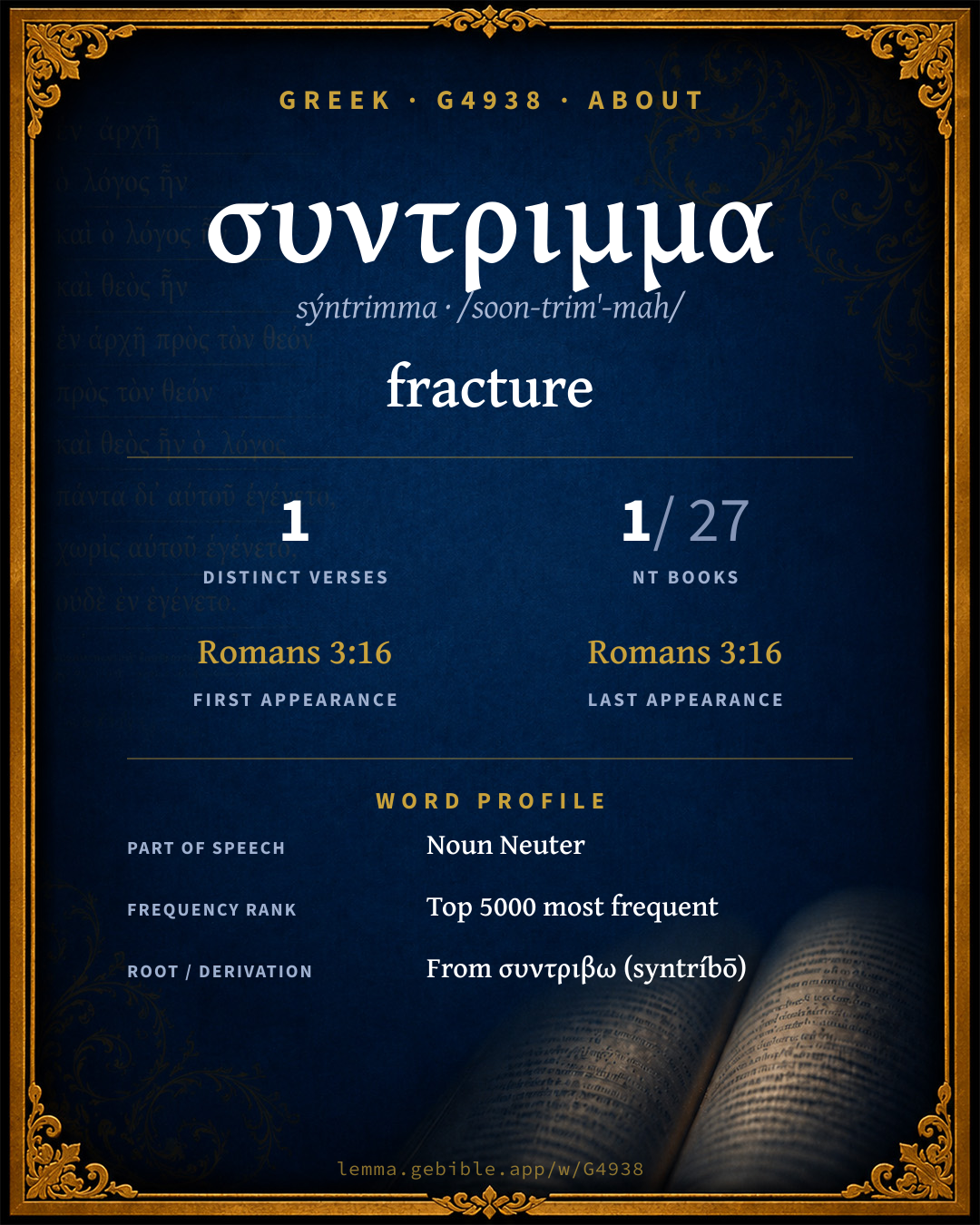
σύντριμμα
fracture
‘fracture’ is one of 2 main senses fuller range ↓
Full lexicon entry — Thayer's Greek Lexicon
From Thayer's Greek Lexicon
Where this word appears
Grammar key — what these labels mean
Part of speech
- Noun
- A naming word — a person, place, thing, or idea.
Case
- Nominative
- The case of the subject (and the predicate nominative).
Gender
- Neuter
- Grammatically neuter.
Number
- Singular
- One.
Every verse where G4938 appears — 1 distinct verse across 1 book. Click any verse to open its interlinear word-by-word view. Verse text shown in the World English Bible for context — . Each verse’s Greek form is shown with its reference; the English is not keyword-highlighted, since the data carries no word-level English alignment. Use “Compare translations” on any verse to read it across multiple English versions. This concordance covers the Greek New Testament; Septuagint (Greek Old Testament) occurrences of this word are not indexed here.
Romans 1 verse
About this entry
At a glance — auto-summarized from this page’s data, not written by a person. Every figure links to its source below. This summary describes the numbers; it doesn’t interpret them.
“fracture” is the headline sense of the Greek noun συντριμμα (sýntrimma). With only 1 verse it sits in the long tail of Greek New Testament vocabulary. It clusters heavily in Romans, which alone accounts for 100% of its uses. A true hapax — its single appearance is Romans 3:16. Catalogued under 2 senses, its meaning is not single-sense. See the sense tree, 1-verse concordance, and the renderings breakdown below.
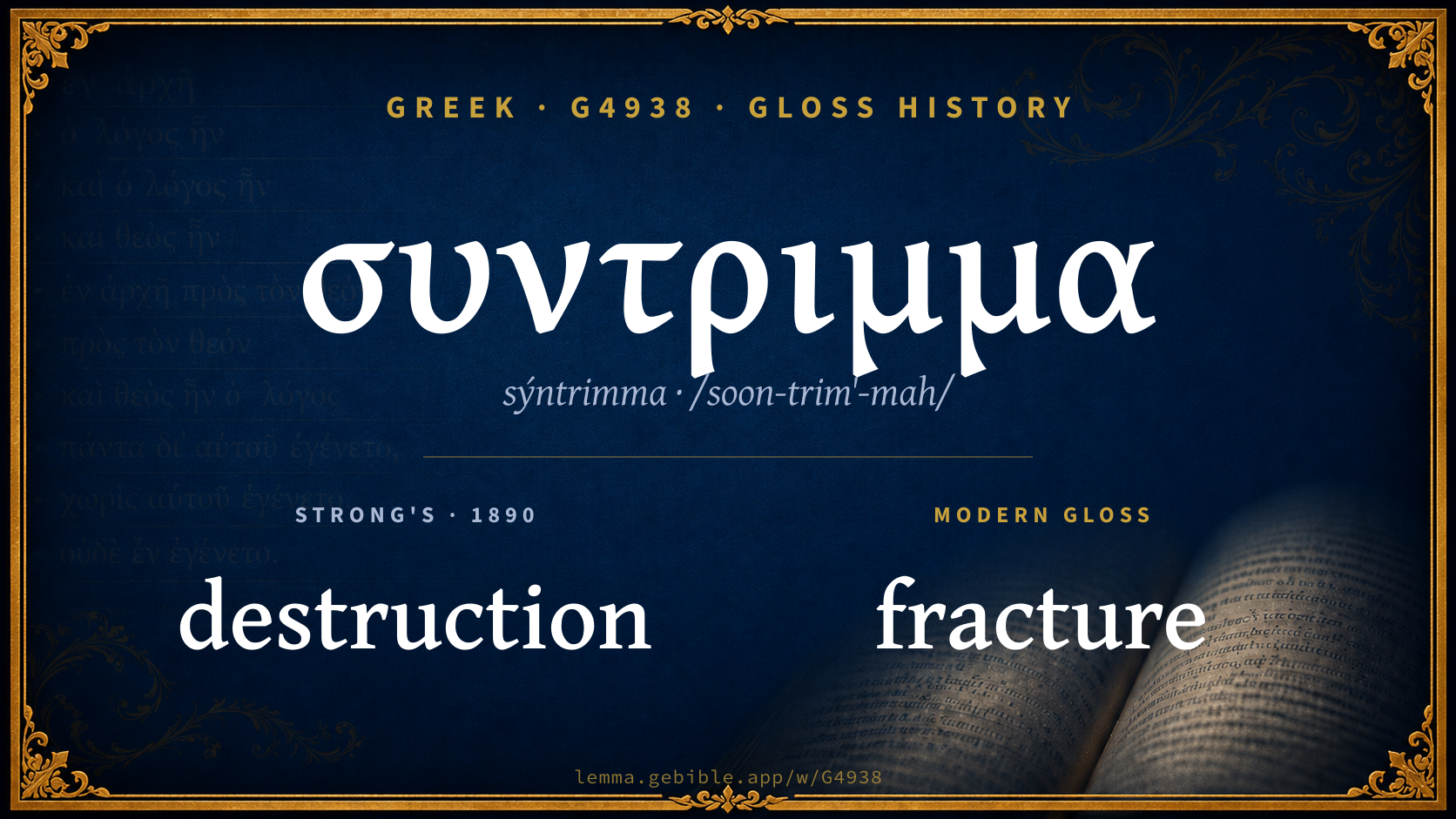
Gloss history
Strong's 1890 vs modern scholarship
About this word
Strong's G4938 catalogs a Greek word from the Greek New Testament.
These counts are not copied from any lexicon or concordance. They are computed here, from the morphology-tagged Greek New Testament. What Lemma adds →
- 1
- distinct verses
- The word appears in 1 distinct verse.
- 1 / 27
- NT books
- The word appears in 1 of 27 New Testament books.
- #3,503
- by frequency
- Top 5000 most frequent Greek words (rank 3,503 of 5,347 Greek words by occurrence).
View all 1 occurrence in the concordance →
Most concentrated in
- Romans 1 verse 100%
By section of the New Testament
By traditional corpus
Conventional, traditional groupings — biblical authorship is debated, so this is a traditional corpus grouping, not an authorship claim. Some books belong to more than one corpus (Luke is in both the Gospels and the Lukan corpus, and so on), so these shares overlap and need not total 100%. Each figure is a share of the word’s 1 distinct verse.
- Pauline corpus 1 verse · 100%
How translations render this word
Counts come from each version’s own published word-to-Strong’s tagging or interlinear alignment — an approximate guide to how each version renders this word, not a word-level alignment the data otherwise carries. Because each total is that version’s own tagged count, the per-version totals vary from one another and need not match the appearance or distinct-verse counts above. These counts may also differ from a printed concordance because Lemma counts each distinctly tagged rendering and does not collapse phrase taggings into a single head-word total. This is a fixed set of word-tagged versions (KJV, ASV, BSB, ULT) and does not change with the reading translation you choose elsewhere. Each version’s license is shown beside its name below (and on Sources).
- King James Version: Destruction 1×
- American Standard Version: Destruction 1×
- Berean Standard Bible: Ruin 1×
- unfoldingWord Literal Text: Destruction 1×
King James Version Public Domain
Renders G4938 across 1 tagged occurrence — most commonly:
American Standard Version Public Domain
Renders G4938 across 1 tagged occurrence — most commonly:
Berean Standard Bible Public Domain
Renders G4938 across 1 tagged occurrence — most commonly:
unfoldingWord Literal Text CC BY-SA 4.0
Renders G4938 across 1 tagged occurrence — most commonly:
Senses in Thayer's
The 2 senses Thayer's distinguishes for this word, in lexicon order (not ranked by frequency or importance). The full entry — with sub-senses — is in the Lexicon Entry tab.
- that which is broken or shattered, a fracture
- calamity, ruin, destruction
Word origin
Derived from συντριβω (syntríbō) (G4937) — to break in pieces.
From G4937 ; concussion or utter fracture (properly concretely) that is complete ruin : - destruction.
— Strong’s Exhaustive Concordance (1890), public domain.
Septuagint usage
The same Greek word συντριμμα appears 31 times in the Greek Old Testament (Septuagint), across 29 verses in 8 books.
- 31
- LXX occurrences
- Tagged occurrences of this Greek word in the Septuagint.
- 29
- verses
- Distinct Septuagint verses containing this word.
- 8 / 39
- OT books
- The word appears in 8 of the 39 Old Testament books.
Sample Septuagint occurrences
- Leviticus 21:19 σύντριμμα
- Job 9:17 σύντριμμα
- Psalms 13:3 σύντριμμα
- Proverbs 20:21 σύντριμμα
- Isaiah 15:5 σύντριμμα
- Jeremiah 3:22 σύντριμμα
- Lamentations 2:11 σύντριμμα
- Amos 9:9 σύντριμμα
Septuagint occurrences (same lexeme)
Every verse where the same Strong’s number (G4938) appears in the Greek Septuagint. Verse text shown in the World English Bible for context; the Greek form is the matched word — the English is not keyword-highlighted.
- Leviticus 21:19 σύντριμμα or a man who has an injured foot, or an injured hand,
- Leviticus 24:20 σύντριμμα fracture for fracture, eye for eye, tooth for tooth; as he has injured someone, so shall it be done to him.
- Job 9:17 σύντριμμα For he breaks me with a tempest, Multiplies my wounds without cause.
- Psalms 13:3 σύντριμμα Behold, and answer me, Yahweh, my God. Give light to my eyes, lest I sleep in death;
- Psalms 59:4 σύντριμμα I have done no wrong, yet they are ready to attack me. Rise up, behold, and help me!
- Psalms 146:3 σύντριμμα Don't put your trust in princes, Each a son of man in whom there is no help.
- Proverbs 20:21 σύντριμμα An inheritance quickly gained at the beginning, Won't be blessed in the end.
- Proverbs 23:29 σύντριμμα Who has woe? Who has sorrow? Who has strife? Who has complaints? Who has needless bruises? Who has bloodshot eyes?
- Isaiah 15:5 σύντριμμα My heart cries out for Moab; her nobles [flee] to Zoar, to Eglath Shelishiyah: for by the ascent of Luhith with weeping they go up; for in the way of Horonaim they raise up a cry of destruction.
- Isaiah 22:4 σύντριμμα Therefore said I, Look away from me, I will weep bitterly; don't labor to comfort me for the destruction of the daughter of my people.
- Isaiah 28:12 σύντριμμα to whom he said, This is the rest, give you rest to him who is weary; and this is the refreshing: yet they would not hear.
- Isaiah 30:14 σύντριμμα He shall break it as a potter's vessel is broken, breaking it in pieces without sparing; so that there shall not be found among the pieces of it a broken piece with which to take fire from the hearth, or to dip up water out of the cistern."
- Isaiah 30:26 σύντριμμα Moreover the light of the moon shall be as the light of the sun, and the light of the sun shall be sevenfold, as the light of seven days, in the day that Yahweh binds up the hurt of his people, and heals the stroke of their wound.
- Isaiah 51:19 σύντριμμα These two things have happened to you. Who will bemoan you? Desolation and destruction, and the famine and the sword; how shall I comfort you?
- Isaiah 59:7 σύντριμμα Their feet run to evil, and they make haste to shed innocent blood: their thoughts are thoughts of iniquity; desolation and destruction are in their paths.
- Isaiah 60:18 σύντριμμα Violence shall no more be heard in your land, desolation nor destruction within your borders; but you shall call your walls Salvation, and your gates Praise.
- Jeremiah 3:22 σύντριμμα Return, you backsliding children, I will heal your backsliding. Behold, we are come to you; for you are Yahweh our God.
- Jeremiah 6:14 σύντριμμα They have healed also the hurt of my people slightly, saying, Peace, peace; when there is no peace.
- Jeremiah 8:21 σύντριμμα For the hurt of the daughter of my people am I hurt: I mourn; dismay has taken hold on me.
- Jeremiah 10:19 σύντριμμα Woe is me because of my hurt! my wound is grievous: but I said, Truly this is [my] grief, and I must bear it.
- Jeremiah 14:17 σύντριμμα You shall say this word to them, Let my eyes run down with tears night and day, and let them not cease; for the virgin daughter of my people is broken with a great breach, with a very grievous wound.
- Jeremiah 17:18 σύντριμμα Let them be disappointed who persecute me, but let not me be disappointed; let them be dismayed, but don't let me be dismayed; bring on them the day of evil, and destroy them with double destruction.
- Jeremiah 31:3 σύντριμμα Yahweh appeared of old to me, [saying], Yes, I have loved you with an everlasting love: therefore with loving kindness have I drawn you.
- Jeremiah 31:5 σύντριμμα Again shall you plant vineyards on the mountains of Samaria; the planters shall plant, and shall enjoy [the fruit of it].
- Jeremiah 37:12 σύντριμμα then Jeremiah went forth out of Jerusalem to go into the land of Benjamin, to receive his portion there, in the midst of the people.
- Lamentations 2:11 σύντριμμα My eyes do fail with tears, my heart is troubled; My liver is poured on the earth, because of the destruction of the daughter of my people, Because the young children and the infants swoon in the streets of the city.
- Lamentations 3:48 σύντριμμα My eye runs down with streams of water, for the destruction of the daughter of my people.
- Lamentations 4:10 σύντριμμα The hands of the pitiful women have boiled their own children; They were their food in the destruction of the daughter of my people.
- Amos 9:9 σύντριμμα "For, behold, I will command, and I will sift the house of Israel among all the nations, as grain is sifted in a sieve, yet not the least kernel will fall on the earth.
These are occurrences of the same Greek lexeme (G4938) in the Septuagint — not a translation of any one Hebrew word. The store carries no word-level Hebrew↔Greek alignment, so no Hebrew original is asserted here. Counts come from the recovered LXX Strong's tagging — high-frequency vocabulary is well covered, while rare or late forms may be untagged — so they reflect tagged occurrences and may slightly undercount.