
2 Chronicles 14:12

Hebrew (Westminster Leningrad Codex) 2 Chronicles 14:12 appears in the Hebrew Old Testament. The text above is from the Westminster Leningrad Codex. Each word links to its Strong’s number, a concise gloss, and parsing drawn from the Open Scriptures Hebrew Bible morphology. Click any word for its full Brown-Driver-Briggs (BDB) entry.
Download image
Cite this verse

2 Chronicles 14:12 (World English Bible). Public Domain. Lemma interlinear Bible study tool, https://lemma.gebible.app/v/2-chronicles/14/12.

Show BibTeX & RIS
BibTeX
RIS
English Translation
So Yahweh struck the Ethiopians before Asa, and before Judah; and the Ethiopians fled.
World English Bible · Public Domain
Download a study sheet

One document with this verse’s original text, its word-by-word gloss line, the meaning frame, cross-references with their text, attributed commentary, and full source and license credits — printable, and it pastes into notes with its structure intact.

This verse Autodidact and up

Study sheet (.html) Plain text (.txt)

A passage Seminary Student

Up to 50 verses in one chapter. A passage sheet keeps up to 6 commentary sources and 12 cross-references per verse, in the order this page ranks them, and says so on the sheet whenever that leaves anything out. Ask for a single verse and you get the Autodidact verse sheet above.

Everything on this page stays free to read, with no account — the sheet is a download of what is already on screen, not access to it.

Want to remove ads? Support Godless Engineer
Compare translations 3

The same verse in 3 English versions, stacked beneath the original-language interlinear above. Click any original word for its lexicon entry.

Each is an independent rendering of the whole verse — the interlinear is not word-aligned to these translations.

Highlighted words mark where these versions differ — a whole-verse word diff, not a word-by-word alignment.

  • World English Bible Public Domain
    So Yahweh struck the Ethiopians before Asa, and before Judah; and the Ethiopians fled.
  • King James Version Public Domain
    So the LORD smote the Ethiopians before Asa, and before Judah; and the Ethiopians fled.
  • unfoldingWord Literal Text CC BY-SA 4.0
    And Yahweh struck down the Cushites before Asa and before Judah; and the Cushites fled.

unfoldingWord Literal Text — © unfoldingWord, licensed CC BY-SA 4.0. Word-aligned USFM3 via Door43 (git.door43.org/unfoldingWord/en_ult).

Versions to compare (up to 4)

3 of 4 selected

Show all 18 translations

Every available English version of this verse, each an independent rendering of the whole verse.

  • World English Bible Public Domain
    So Yahweh struck the Ethiopians before Asa, and before Judah; and the Ethiopians fled.
  • Berean Standard Bible Public Domain
    So the LORD struck down the Cushites before Asa and Judah, and the Cushites fled.
  • Majority Standard Bible Public Domain
    So the LORD struck down the Cushites before Asa and Judah, and the Cushites fled.
  • King James Version Public Domain
    So the LORD smote the Ethiopians before Asa, and before Judah; and the Ethiopians fled.
  • American Standard Version (1901) Public Domain
    So Jehovah smote the Ethiopians before Asa, and before Judah; and the Ethiopians fled.
  • Revised Version (1885) Public Domain
    So the LORD smote the Ethiopians before Asa, and before Judah; and the Ethiopians fled.
  • Geneva Bible (1599) Public Domain
    So the Lord smote the Ethiopians before Asa and before Iudah, and the Ethiopians fled.
  • Douay-Rheims (1899) Public Domain
    And the Lord terrified the Ethiopians before Asa and Juda: and the Ethiopians fled.
  • Young's Literal Translation Public Domain
    And Jehovah smiteth the Cushim before Asa, and before Judah, and the Cushim flee,
  • Literal Standard Version CC BY-SA 4.0
    And YHWH strikes the Cushim before Asa and before Judah, and the Cushim flee,
  • Unlocked Literal Bible CC BY-SA 4.0
    So Yahweh struck the Cushites before Asa and Judah; the Cushites fled.
  • unfoldingWord Literal Text CC BY-SA 4.0
    And Yahweh struck down the Cushites before Asa and before Judah; and the Cushites fled.
  • Darby Bible Public Domain
    And Jehovah smote the Ethiopians before Asa and before Judah; and the Ethiopians fled.
  • World Messianic Bible Public Domain
    So the LORD struck the Ethiopians before Asa and before Judah; and the Ethiopians fled.
  • Webster's Bible Public Domain
    So the LORD smote the Cushites before Asa, and before Judah; and the Cushites fled.
  • Free Bible Version CC BY-SA 4.0
    The Lord struck the Ethiopians in front of Asa and Judah, and the Ethiopians ran away.
  • Bible in Basic English Public Domain
    So the Lord sent fear on the Ethiopians before Asa and Judah; and the Ethiopians went in flight.
  • JPS Tanakh (1917) Public Domain
    (14-11) So the LORD smote the Ethiopians before Asa, and before Judah; and the Ethiopians fled.

Literal Standard Version (2020), Covenant Press — licensed CC BY-SA 4.0. Text via the HelloAO Bible API (eBible.org). Unlocked Literal Bible (unfoldingWord) — licensed CC BY-SA 4.0. Text via the HelloAO Bible API (eBible.org). unfoldingWord Literal Text — © unfoldingWord, licensed CC BY-SA 4.0. Word-aligned USFM3 via Door43 (git.door43.org/unfoldingWord/en_ult). Free Bible Version, Dr. Jonathan Gallagher — licensed CC BY-SA 4.0. Text via the HelloAO Bible API (eBible.org).

Word by word

More ways to search: Search by grammar → Find every occurrence → Compare this word →

Practice this passage: Drill this verse → Learn its vocabulary →

הַכּוּשִׁ֔ים
Kûwshîy
H3569
“the · Cushites”
Particle, Definite Article + Noun, Gentilic, Masculine, Plural, Absolute
Part of Speech
Particle + Noun
Type
Gentilic
Gender
Masculine
Number
Plural
State
Absolute
Full BDB Definition

Origin: patronymically from H3568

TWOT: 969a

Cushi or Ethiopian = see Cushan " their blackness" - one of the descendants of Cush the grandson of Noah through Ham and a member of that nation or people - one of Joab's couriers - (TWOT) Ethiopian
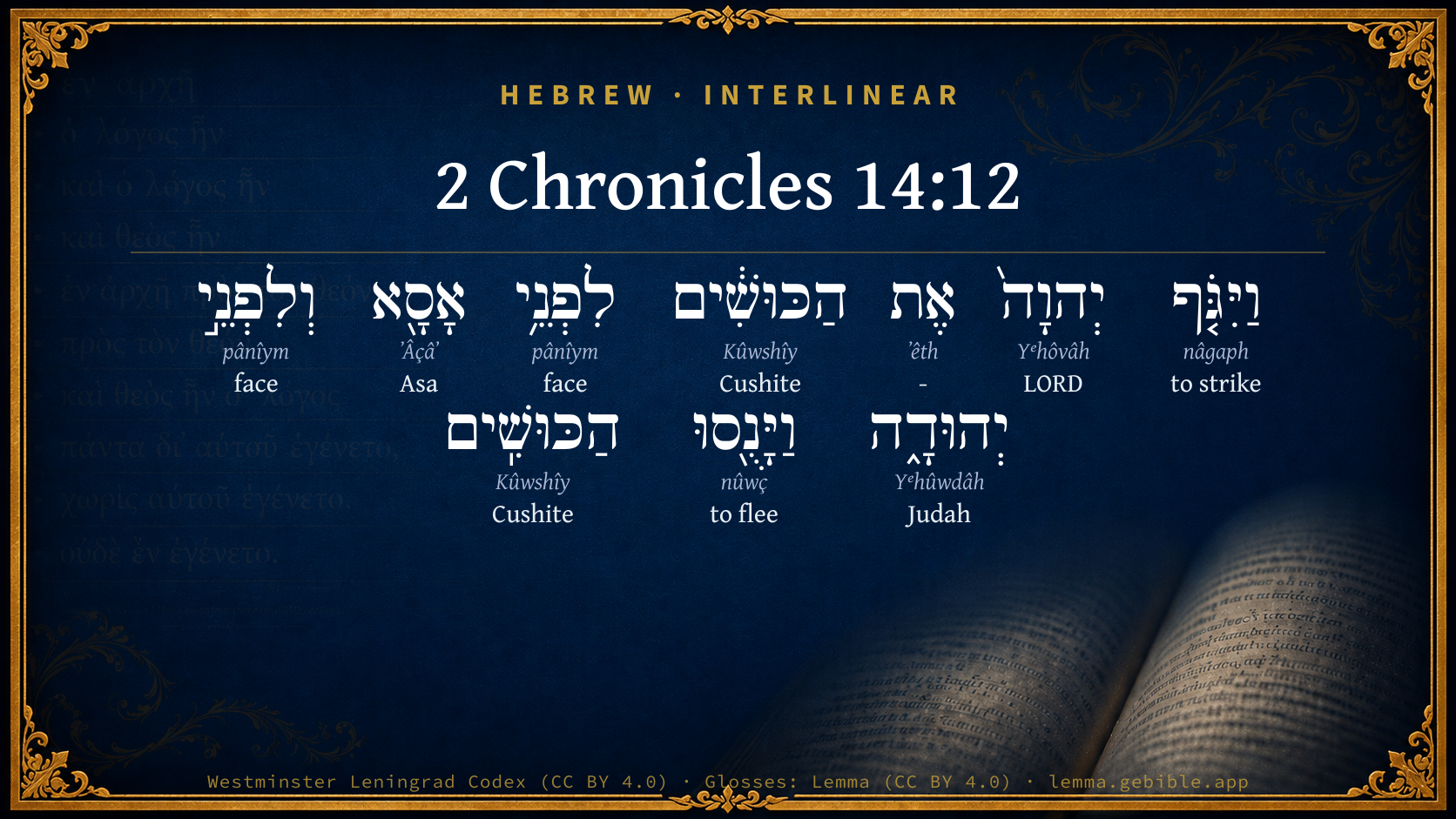
  1. וַיִּגֹּ֤ף nâgaph H5062 “and · to strike” Conjunction + Verb, Qal, Sequential Imperfect, 3rd Person, Masculine, Singular
  2. יְהוָה֙ Yᵉhôvâh H3068 “LORD” Noun, Proper
  3. אֶת ʼêth H853 “-” Particle, Direct Object
  4. לִפְנֵ֥י pânîym H6440 “to/for · face(s) of” Preposition + Noun, Common, Both, Plural, Construct
  5. אָסָ֖א ʼÂçâʼ H609 “Asa” Noun, Proper
  6. וְלִפְנֵ֣י pânîym H6440 “and · to/for · face(s) of” Conjunction + Preposition + Noun, Common, Both, Plural, Construct
  7. יְהוּדָ֑ה Yᵉhûwdâh H3063 “Judah” Noun, Proper
  8. וַיָּנֻ֖סוּ nûwç H5127 “and · to flee” Conjunction + Verb, Qal, Sequential Imperfect, 3rd Person, Masculine, Plural
  9. הַכּוּשִֽׁים Kûwshîy H3569 “the · Cushites” Particle, Definite Article + Noun, Gentilic, Masculine, Plural, Absolute

About this verse

These counts appear in no published source. They are computed here, from the morphology-tagged text and Lemma’s own curated glosses. What Lemma adds →

10
words
8
distinct lemmas
Historical
section

Notable vocabulary

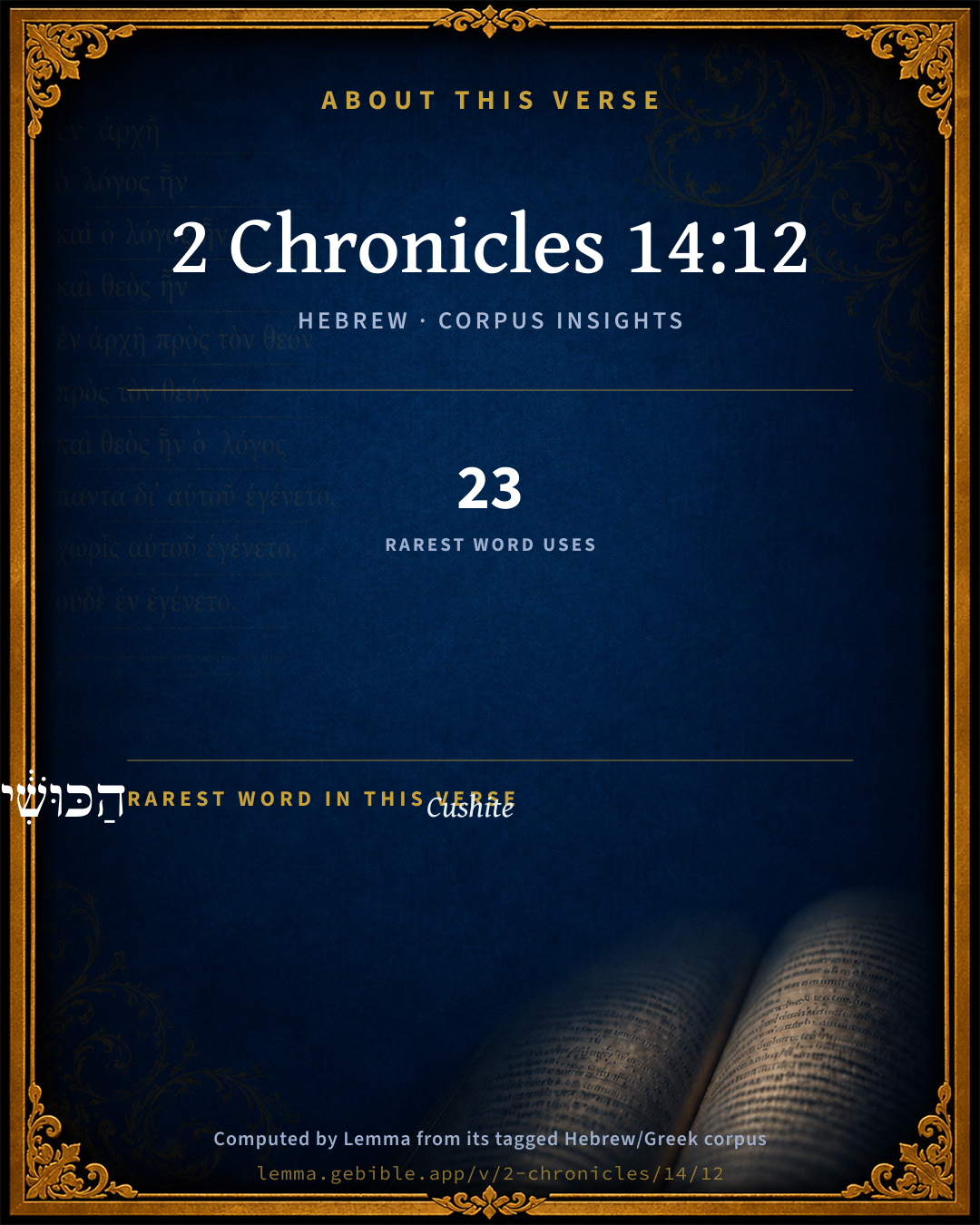
The rarest word here is הַכּוּשִׁ֔ים Cushite H3569 — appearing just 23 times in the whole Hebrew Bible.

Shared distinctive vocabulary

הַכּוּשִׁ֔ים Cushite H3569 occurs in 19 verses of the Hebrew Bible. Also found in:

Grammatical profile

  • 2 verbs
  • 7 nouns
  • 1 particle

Verb forms

  • וַיִּגֹּ֤ף Qal · Sequential Imperfect
  • וַיָּנֻ֖סוּ Qal · Sequential Imperfect

Repetition

Words recur within this verse — often emphatic in Hebrew:

  • הַכּוּשִׁ֔ים Cushite H3569 ×2
  • לִפְנֵ֥י face H6440 ×2

Hebrew & Septuagint length

In English translation the verse runs 14 words from the Hebrew and 12 from the Septuagint (LXX English) — closely comparable.

A rough comparison of the two English renderings, which tokenize alike — not a word-level alignment.

Word counts can differ between the Hebrew and the Greek without any difference in meaning — e.g. the Hebrew direct-object marker אֵת has no separate Greek word, and Greek often adds the article ὁ.

Cross-references

10

Topical passages linked to 2 Chronicles 14:12 in the Treasury of Scripture Knowledge — connected by theme and wording, ordered by reader-vote popularity; previews shown in the World English Bible.

  • 2 Chronicles 13:15 Then the men of Judah gave a shout: and as the men of Judah shouted, it happened, that God struck Jeroboam and all Israel before Abijah and Judah.
  • Exodus 14:25 He took off their chariot wheels, and they drove them heavily; so that the Egyptians said, "Let's flee from the face of Israel, for Yahweh fights for them against the Egyptians!"
  • Deuteronomy 28:7 Yahweh will cause your enemies who rise up against you to be struck before you: they shall come out against you one way, and shall flee before you seven ways.
  • Deuteronomy 32:39 See now that I, even I, am he, There is no god with me: I kill, and I make alive; I wound, and I heal; There is none who can deliver out of my hand.
  • Joshua 10:10 Yahweh confused them before Israel, and he killed them with a great slaughter at Gibeon, and chased them by the way of the ascent of Beth Horon, and struck them to Azekah, and to Makkedah.
  • Psalms 60:12 Through God we shall do valiantly, For it is he who will tread down our adversaries.
  • Psalms 136:17–18 To him who struck great kings; For his loving kindness endures forever;
  • 1 Corinthians 9:26 I therefore run like that, as not uncertainly. I fight like that, as not beating the air,
  • 1 Corinthians 15:57 But thanks be to God, who gives us the victory through our Lord Jesus Christ.
  • 2 Chronicles 20:22 When they began to sing and to praise, Yahweh set liers-in-wait against the children of Ammon, Moab, and Mount Seir, who had come against Judah; and they were struck.

Cross-references courtesy of OpenBible.info (CC BY 4.0).

Hebrew and Greek witnesses Masoretic Hebrew ↔ Greek Septuagint

The same verse in the two great witnesses to the Old Testament, shown verse-for-verse.

These are two independent witnesses, not word-aligned to each other, and the Septuagint is shown in lemma (dictionary) form.

Hebrew 2 Chronicles 14:12 Masoretic · Westminster Leningrad Codex

וַיִּגֹּ֤ף יְהוָה֙ אֶת הַכּוּשִׁ֔ים לִפְנֵ֥י אָסָ֖א וְלִפְנֵ֣י יְהוּדָ֑ה וַיָּנֻ֖סוּ הַכּוּשִֽׁים

So Yahweh struck the Ethiopians before Asa, and before Judah; and the Ethiopians fled.

World English Bible · Public Domain

Greek LXX 2 Chronicles 14:12 Septuagint · lemma form

καί καταδιώκω ασα καί ὁ λαός αὐτός ἕως γεδωρ καί πίπτω αἰθίοψ ὥστε μή εἰμί ἐν αὐτός περιποίησις ὅτι συντρίβω ἐνώπιον κύριος καί ἐναντίον ὁ δύναμις αὐτός καί σκυλεύω σκῦλον πολύς

And the Lord struck the Ethiopians before Juda; and the Ethiopians fled.

LXX2012 (modern English Septuagint) · Public Domain

On this verse, Haydock's Catholic Bible Commentary discusses the Septuagint’s reading. Read the note in Commentary ↓

Hebrew: Westminster Leningrad Codex (CC BY 4.0). Greek: Septuagint (public domain); English from LXX2012 (modern English Septuagint) (Public Domain). How the Septuagint differs from the Hebrew →

Commentary

Notes on 2 Chronicles 14:12 from classic Christian and Jewish commentators (each source and its license shown beneath its notes). The classic Christian expositions comment on the surrounding passage and are grouped to its opening verse, so a note may address several verses; the Jewish commentaries on the Tanakh (Rashi and others) are per-verse, so they appear only where the commentator wrote on this verse.

Lemma curates 59 commentaries, every one of them public domain or Creative Commons licensed, each selected and text-cleaned for this edition rather than reprinted as found. About our sources →

John Gill's Exposition

And Asa, and the people that were with him, pursued them unto Gerar,.... A city of the Philistines, Gen 20:1,

and the Ethiopians were overthrown, that they could not recover themselves; they were thrown into such a fright, and into so much confusion, that they could not put themselves in order, and rally again; or there fell such a vast number of them, that there were scarce any remaining alive, which seems to be the sense of the words used:

for they were destroyed before the Lord, and before his host; the army of Israel, which the Lord was, as it were, the Commander of, fought for, and led them in the pursuit, and gave them victory; or it may mean an host of angels, employed in destroying this great army; and so the Syriac and Arabic versions of Ch2 14:12 read,"the angel of the Lord smote the Ethiopians:"

and they carried away very much spoil; which they found in their camp, and with their slain; even much gold and silver, as Josephus (g) says.

(g) Ut supra, (Antiq. l. 8. c. 12.) sect. 2.

John Gill's Exposition of the Whole Bible (1746–1763) — public domain (CC PDM 1.0). Text via the HelloAO Bible API.

Trapp's Complete Commentary

John Trapp

2Ch 14:12 So the LORD smote the Ethiopians before Asa, and before Judah; and the Ethiopians fled.

Ver. 12. So the Lord smote the Ethiopians.] Egit in praecipitiurn, he tumbled them down headlong.

John Trapp, A Commentary or Exposition upon All the Books of the Old and New Testament (1647–1656) — public domain. Text from a community e-Sword module.

Joseph Benson's Commentary

2Ch 14:12-13. So the Lord smote the Ethiopians — Smote them with terror, and an unaccountable consternation, so that they fled, and knew not why or whither. Asa and the people pursued them unto Gerar — A city of the Philistines, who probably were confederate with them in this design. They were destroyed before the Lord — For who can stand before him? And before his host — The host of Israel, called God’s host, because owned by him as his people. They carried away very much spoil — From the slain, together with the plunder of their camp.

Joseph Benson's Commentary on the Old and New Testaments (1811–1818) — public domain. Text from a community e-Sword module.

Ellicott's Commentary for English Readers

(12) So the Lord smote . . . before Judah.—(Comp. 2Ch_13:15-16.) Thenius remarks that the words of 1Ki_15:15, about the spoils dedicated by Asa, help to establish the chronicler’s accounts of this victory and that of Abijah.

A Bible Commentary for English Readers, edited by Charles John Ellicott (1878–1897) — public domain. Text from a community e-Sword module.

The Cambridge Bible for Schools and Colleges

gen. ed. J. J. S. Perowne

12. the Lord smote] Cp. 2Ch_13:15. The use of The Name, Jehovah (translated The Lord), instead of the word “God” here and in 2Ch_14:13-14 is in favour of the suggestion that the Chronicler took this account from some earlier document.

the Ethiopians] Rather, the Cushites.

The Cambridge Bible for Schools and Colleges (gen. ed. J. J. S. Perowne; Cambridge University Press, 1878–1918) — public domain. Text from a community e-Sword module.

Albert Barnes' Notes on the Bible

The defeat of Zerah is one of the most remarkable events in the history of the Jews. On no other occasion did they meet in the field and overcome the forces of either of the two great monarchies between which they were placed. It was seldom that they ventured to resist, unless behind walls. Shishak, Sennacherib, Esarhaddon, Nebuchadnezzar, were either unopposed or only opposed in this way. On the one other occasion on which they took the field - under Josiah against Necho - their boldness issued in a most disastrous defeat 2Ch 35:20-24. Now, however, under Asa, they appear to have gained a complete victory over Egypt. The results which followed were nicest striking. The Southern power could not rally from the blow, and, for above three centuries made no further effort in this direction. Assyria, growing in strength, finally, under Sargon and Sennacherib, penetrated to Egypt itself. All fear of Egypt as an aggressive power ceased; and the Israelites learned instead to lean upon the Pharaohs for support (2Ki 17:4; 2Ki 18:21; Isa 30:2-4, etc.). Friendly ties alone connected the two countries: and it was not until 609 B.C. that an Egyptian force again entered Palestine with a hostile intention.

Albert Barnes' Notes on the Bible (1834–1885) — public domain. Text from a community e-Sword/MySword module.

Haydock's Catholic Bible Commentary

Terrified. Hebrew and Septuagint, "struck," as he had done Jeroboam, chap. xiii. 15. (Haydock)

George Leo Haydock (1774–1849), Haydock's Catholic Family Bible and Commentary, 1859 edition — public domain. Excludes Psalms (Douay-Rheims chapter numbering differs from Protestant) and Deuterocanonical books (Catholic canon only).

Whedon's Commentary on the Bible

Daniel D. Whedon

12. The Lord smote the Ethiopians — But not without the help of Asa and his Jewish and Benjamite forces. Jehovah inspired his people with faith and their enemies with terror, thus making the former doubly strong and the latter hopelessly weak and fearful.

“Egyptian monuments,” says R. Stuart Poole, “enable us to picture the general disposition of Zerah’s army. The chariots formed the first corps, in a single or double line; behind them, massed in phalanxes, were heavy armed troops; probably on the flanks stood archers and horsemen in lighter formations. Asa, marching down a valley, must have attacked in a heavy column, for none but the most highly disciplined troops can form line from column in the face of an enemy. His spearmen of Judah would compose this column; each bank of the valley would be occupied by the Benjamite archers, like those who came to David, ‘helpers of the war, armed with bows, and could use both the right hand and the left in hurling stones and shooting arrows out of a bow.’ 2Ch_12:1-2. No doubt the Ethiopian, confident in his numbers, disdained to attack the Hebrews, or clear the heights, but waited in the broad valley or the plain. From the account of Abijah’s defeat of Jeroboam, we may suppose that the priests sounded their trumpets, and the men of Judah descended with a shout. 2Ch_13:14-15. The hills and mountains were the favourite camping places of the Hebrews, who usually rushed down upon their more numerous or better disciplined enemies in the plains and valleys.” — SMITH’S Bible Dictionary.

Daniel D. Whedon (gen. ed.), Commentary on the Old and New Testaments (1874–1909) — public domain. Text from a community e-Sword module.

The Pulpit Commentary

So the Lord smote the Ethiopians. As little as the real work was of the army of Asa, so little is said of even the mere human method by which this great victory was obtained for Asa and Judah. Again and yet again, in the following two verses, the glory is given to "the Lord."

The Pulpit Commentary (1880–1919), ed. H.D.M. Spence-Jones & Joseph S. Exell — public domain. Text from a community e-Sword module.

John Wesley's Explanatory Notes

Smote - With terror, and an unaccountable consternation.

John Wesley, Explanatory Notes Upon the Whole Bible (1754–1765) — public domain. Text via the GEBible commentary corpus.

unfoldingWord translationNotes

Door43 World Missions Community

Yahweh struck the Cushites before Asa and Judah

God enabling the army of Judah to defeat the Cushites is spoken of as if God struck the Cushites. AT: "God enabled Asa and the army of Judah to defeat the Cushites" (See: Metaphor)

So many Cushites fell that they could not recover

Possible meanings are 1) "So many Cushites died that the army could not recover" or 2) "So many Cushites died that there were none who remained alive."

So many Cushites fell

Here to "fall" is a euphemism for dying in battle. AT: "So many Cushites died" (See: Euphemism)

for they were completely destroyed before Yahweh and his army

This can be stated in active form. AT: "for Yahweh's army completely destroyed them" (See: Active or Passive)

translationWords

Gerar

unfoldingWord translationNotes — © Distant Shores Media and the Door43 World Missions Community, licensed CC BY-SA 4.0. Source: git.door43.org/Door43/en_tn.

Lesson kit

Teaching starters — assembled from the data on this page, not authored interpretation. Every prompt links to the verse data it draws on. Edit before teaching.

2 Chronicles, in the Historical, opens this verse with 10 words (8 distinct Hebrew lemmas). Its most distinctive word is Kûwshîy (“Cushite”). A historical commentator’s framing appears above. Read the whole chapter for the surrounding context.

Discussion questions

  1. How does “Cushite” (Kûwshîy) shape what this verse is saying?
  2. 2 Samuel 18:21 shares the word «Cushite» with this verse. How do the two illuminate each other?
  3. “Cushite” occurs 2× in this one verse. What is the effect of the repetition?
  4. These translations render this verse differently; the difference is in the English rendering, not the original. What questions does that raise?
  5. The verb «וַיִּגֹּ֤ף» is Qal Sequential Imperfect. How does its form color the action?
  6. Reading how John Gill's Exposition and Trapp's Complete Commentary read this verse, where do the two commentators agree and where do they part?

Things to notice

  • These translations choose different wording for 7 words in this verse.
  • “Cushite” occurs 2× in this single verse.
  • 8 distinct Hebrew lemmas span 10 words in this verse.

Reading settings

Reading text

Shown beneath each verse's original-language words.

Old Testament
Old Testament edition

Read the OT as the Masoretic Hebrew (MT) or the Greek Septuagint (LXX).

English shown for the Greek Septuagint (in the Hebrew ↔ Greek comparison).

Comparing translations? Open the Compare panel on any verse page to stack up to four side by side.