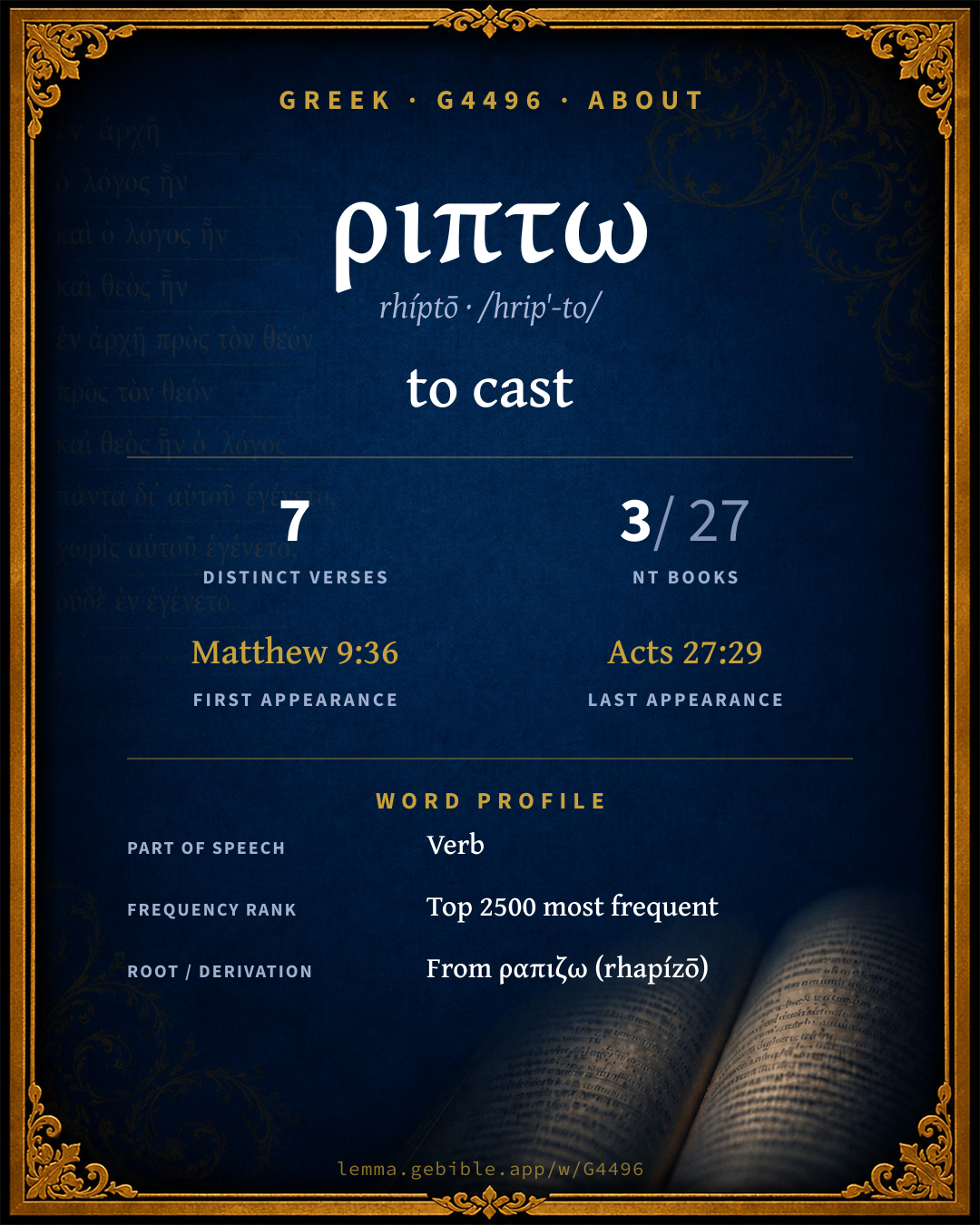
ῥίπτω
to cast
‘to cast’ is one of 5 main senses fuller range ↓
Full lexicon entry — Thayer's Greek Lexicon
From Thayer's Greek Lexicon
Where this word appears
See every Aorist-tense verb in the Greek New Testament →
Grammar key — what these labels mean
Part of speech
- Verb
- An action or state-of-being word.
Tense
- Aorist
- Action viewed as a simple whole, without regard to duration — often past (perfective aspect).
- Perfect
- A completed past action with continuing present results.
Voice
- Active
- The subject performs the action.
- Passive
- The subject receives the action.
Mood
- Indicative
- States a fact or asks a factual question (the mood of reality).
- Participle
- A verbal adjective (“writing,” “having written”).
Case
- Nominative
- The case of the subject (and the predicate nominative).
Person
- 3rd person
- The one spoken about (“he / she / it / they”).
Gender
- Masculine
- Grammatically masculine.
- Neuter
- Grammatically neuter.
Number
- Plural
- More than one.
- Singular
- One.
Every verse where G4496 appears in the Book of Matthew — 3 distinct verses. Click any verse to open its interlinear word-by-word view. Verse text shown in the World English Bible for context — . Each verse’s Greek form is shown with its reference; the English is not keyword-highlighted, since the data carries no word-level English alignment. Use “Compare translations” on any verse to read it across multiple English versions. This concordance covers the Greek New Testament; Septuagint (Greek Old Testament) occurrences of this word are not indexed here.
Matthew
- Matthew 9:36 ἐρριμμένοι perf pass ptcp nom pl masc But when he saw the multitudes, he was moved with compassion for them, because they were harassed and scattered, like sheep without a shepherd.
- Matthew 15:30 ἔριψαν aor act ind 3pl Great multitudes came to him, having with them the lame, blind, mute, maimed, and many others, and they put them down at his feet. He healed them,
- Matthew 27:5 ῥίψας aor act ptcp nom sg masc He threw down the pieces of silver in the sanctuary, and departed. He went away and hanged himself.
About this entry
At a glance — auto-summarized from this page’s data, not written by a person. Every figure links to its source below. This summary describes the numbers; it doesn’t interpret them.
At its core, ριπτω (rhíptō) means “to cast.” Catalogued under 5 senses, its meaning is not single-sense. Spanning 7 verses in 3 books, it ranks among the uncommon words of the Greek New Testament. Its uses concentrate in Matthew (43% of all occurrences). Scripture first uses it in Matthew 9:36. Dig into 7-verse concordance and the renderings breakdown below.
Gloss history
Strong's 1890 vs modern scholarship
About this word
Strong's G4496 catalogs a Greek word from the Greek New Testament.
These counts are not copied from any lexicon or concordance. They are computed here, from the morphology-tagged Greek New Testament. What Lemma adds →
- 7
- distinct verses
- The word appears in 7 distinct verses.
- 3 / 27
- NT books
- The word appears in 3 of 27 New Testament books.
- #1,358
- by frequency
- Top 2500 most frequent Greek words (rank 1,358 of 5,347 Greek words by occurrence).
View all 7 occurrences in the concordance →
By section of the New Testament
By traditional corpus
Conventional, traditional groupings — biblical authorship is debated, so this is a traditional corpus grouping, not an authorship claim. Some books belong to more than one corpus (Luke is in both the Gospels and the Lukan corpus, and so on), so these shares overlap and need not total 100%. Each figure is a share of the word’s 7 distinct verses.
- Gospels 5 verses · 71%
- Lukan (Luke–Acts) 4 verses · 57%
How translations render this word
Counts come from each version’s own published word-to-Strong’s tagging or interlinear alignment — an approximate guide to how each version renders this word, not a word-level alignment the data otherwise carries. Because each total is that version’s own tagged count, the per-version totals vary from one another and need not match the appearance or distinct-verse counts above. These counts may also differ from a printed concordance because Lemma counts each distinctly tagged rendering and does not collapse phrase taggings into a single head-word total. This is a fixed set of word-tagged versions (KJV, ASV, BSB, ULT) and does not change with the reading translation you choose elsewhere. Each version’s license is shown beside its name below (and on Sources).
- King James Version: Cast 1×, Day we cast out 1×, Down 1×
- American Standard Version: Day they cast out 1×, Down 1×, Ground 1×
- Berean Standard Bible: Be thrown 1×, Helpless 1×, Laid 1×
- unfoldingWord Literal Text: Having thrown 2×
King James Version Public Domain
Renders G4496 across 8 tagged occurrences — most commonly:
American Standard Version Public Domain
Renders G4496 across 7 tagged occurrences — most commonly:
Berean Standard Bible Public Domain
Renders G4496 across 7 tagged occurrences — most commonly:
unfoldingWord Literal Text CC BY-SA 4.0
Renders G4496 across 10 tagged occurrences — most commonly:
Plus 8 renderings that appear only once — usually multi-word phrases or single function words the recovered tagging swept in, not distinct renderings.
Senses in Thayer's
The 5 senses Thayer's distinguishes for this word, in lexicon order (not ranked by frequency or importance). The full entry — with sub-senses — is in the Lexicon Entry tab.
- to cast, throw
- throw down
- to cast forward or before
- to set down (with the suggestion of haste and want of care)
- to throw to the ground, prostrate
Word origin
Derived from ραπιζω (rhapízō) (G4474) — to strike.
A primary verb (perhaps rather akin to the base of G4474 through the idea of sudden motion ); to fling (properly with a quick toss thus differing from G906 which denotes a deliberate hurl; and from τείνω teinō (see in G1614 ) which indicates an extended projection); by qualification to deposit (as if a load); by extension to disperse : - cast (down out) scatter abroad throw.
— Strong’s Exhaustive Concordance (1890), public domain.
Forms in the corpus
The 6 distinct written forms G4496 takes in the Greek New Testament, most frequent first — each parse links to that tense’s occurrences in the concordance.
| Form | Parsing | Example | Uses |
|---|---|---|---|
| ἔριψαν éripsan | Verb, Aorist, Active, Indicative, 3rd person, Plural | Matthew 15:30 | 2 |
| ἐρριμμένοι errimménoi | Verb, Perfect, Passive, Participle, Nominative, Plural, Masculine | Matthew 9:36 | 1 |
| ἔρριπται érriptai | Verb, Perfect, Passive, Indicative, 3rd person, Singular | Luke 17:2 | 1 |
| ῥίψαν rhípsan | Verb, Aorist, Active, Participle, Nominative, Singular, Neuter | Luke 4:35 | 1 |
| ῥίψαντες rhípsantes | Verb, Aorist, Active, Participle, Nominative, Plural, Masculine | Acts 27:29 | 1 |
| ῥίψας rhípsas | Verb, Aorist, Active, Participle, Nominative, Singular, Masculine | Matthew 27:5 | 1 |
Same root — word family
Other Thayer's entries built from the same root as G4496, grouped by Strong’s listed origin. These share a root / origin per the lexicon — not necessarily a shared meaning. Each links to that word’s own entry.
Derives from
Shares the same root
Derived from this word
Compare all same-root words → Showing 4 of 7 — not the complete family. They share a root, not necessarily a meaning.
Septuagint usage
The same Greek word ριπτω appears 78 times in the Greek Old Testament (Septuagint), across 76 verses in 18 books.
- 78
- LXX occurrences
- Tagged occurrences of this Greek word in the Septuagint.
- 76
- verses
- Distinct Septuagint verses containing this word.
- 18 / 39
- OT books
- The word appears in 18 of the 39 Old Testament books.
Sample Septuagint occurrences
- Genesis 21:15 ῥίπτω
- Exodus 1:22 ῥίπτω
- Deuteronomy 9:17 ῥίπτω
- Joshua 8:29 ῥίπτω
- Judges 4:22 ῥίπτω
- 2 Samuel 11:21 ῥίπτω
- 1 Kings 13:24 ῥίπτω
- 2 Kings 2:16 ῥίπτω
- 2 Chronicles 30:14 ῥίπτω
- Ezra 19:11 ῥίπτω
- Job 16:11 ῥίπτω
- Psalms 87:6 ῥίπτω
Septuagint occurrences (same lexeme)
Every verse where the same Strong’s number (G4496) appears in the Greek Septuagint — showing the first 50 of 76. Verse text shown in the World English Bible for context; the Greek form is the matched word — the English is not keyword-highlighted.
- Genesis 21:15 ῥίπτω The water in the bottle was spent, and she cast the child under one of the shrubs.
- Genesis 37:20 ῥίπτω Come now therefore, and let's kill him, and cast him into one of the pits, and we will say, 'An evil animal has devoured him.' We will see what will become of his dreams."
- Genesis 37:24 ῥίπτω and they took him, and threw him into the pit. The pit was empty. There was no water in it.
- Exodus 1:22 ῥίπτω Pharaoh charged all his people, saying, "You shall cast every son who is born into the river, and every daughter you shall save alive."
- Exodus 4:3 ῥίπτω He said, "Throw it on the ground." He threw it on the ground, and it became a snake; and Moses ran away from it.
- Exodus 7:9 ῥίπτω "When Pharaoh speaks to you, saying, 'Perform a miracle!' then you shall tell Aaron, 'Take your rod, and cast it down before Pharaoh, that it become a serpent.'"
- Exodus 7:10 ῥίπτω Moses and Aaron went in to Pharaoh, and they did so, as Yahweh had commanded: and Aaron cast down his rod before Pharaoh and before his servants, and it became a serpent.
- Exodus 7:12 ῥίπτω For they cast down every man his rod, and they became serpents: but Aaron's rod swallowed up their rods.
- Exodus 15:1 ῥίπτω Then Moses and the children of Israel sang this song to Yahweh, and said, "I will sing to Yahweh, for he has triumphed gloriously: The horse and his rider he has thrown into the sea.
- Exodus 15:4 ῥίπτω Pharaoh's chariots and his host has he cast into the sea; His chosen captains are sunk in the Red Sea.
- Exodus 15:21 ῥίπτω Miriam answered them, "Sing to Yahweh, for he has triumphed gloriously: The horse and his rider he has thrown into the sea."
- Exodus 32:19 ῥίπτω It happened, as soon as he came near to the camp, that he saw the calf and the dancing: and Moses' anger grew hot, and he threw the tablets out of his hands, and broke them beneath the mountain.
- Exodus 32:24 ῥίπτω I said to them, 'Whoever has any gold, let them take it off:' so they gave it me; and I threw it into the fire, and out came this calf."
- Deuteronomy 9:17 ῥίπτω I took hold of the two tables, and cast them out of my two hands, and broke them before your eyes.
- Deuteronomy 9:21 ῥίπτω I took your sin, the calf which you had made, and burnt it with fire, and stamped it, grinding it very small, until it was as fine as dust: and I cast the dust of it into the brook that descended out of the mountain.
- Joshua 8:29 ῥίπτω The king of Ai he hanged on a tree until the evening: and at the going down of the sun Joshua commanded, and they took his body down from the tree, and cast it at the entrance of the gate of the city, and raised thereon a great heap of stones, to this day.
- Joshua 10:27 ῥίπτω It happened at the time of the going down of the sun, that Joshua commanded, and they took them down off the trees, and cast them into the cave in which they had hidden themselves, and laid great stones on the mouth of the cave, to this very day.
- Judges 4:22 ῥίπτω Behold, as Barak pursued Sisera, Jael came out to meet him, and said to him, Come, and I will show you the man whom you seek. He came to her; and, behold, Sisera lay dead, and the tent-pin was in his temples.
- Judges 9:53 ῥίπτω A certain woman cast an upper millstone on Abimelech's head, and broke his skull.
- Judges 15:17 ῥίπτω It happened, when he had made an end of speaking, that he cast away the jawbone out of his hand; and that place was called Ramath Lehi.
- 2 Samuel 11:21 ῥίπτω who struck Abimelech the son of Jerubbesheth? Didn't a woman cast an upper millstone on him from the wall, so that he died at Thebez? Why did you go so near the wall?' then shall you say, 'Your servant Uriah the Hittite is dead also.'"
- 2 Samuel 11:22 ῥίπτω So the messenger went, and came and shown David all that Joab had sent him for.
- 2 Samuel 18:17 ῥίπτω They took Absalom, and cast him into the great pit in the forest, and raised over him a very great heap of stones: and all Israel fled everyone to his tent.
- 2 Samuel 20:21 ῥίπτω The matter is not so: but a man of the hill-country of Ephraim, Sheba the son of Bichri by name, has lifted up his hand against the king, even against David; deliver him only, and I will depart from the city. The woman said to Joab, Behold, his head shall be thrown to you over the wall.
- 1 Kings 13:24 ῥίπτω When he was gone, a lion met him by the way, and killed him: and his body was cast in the way, and the donkey stood by it; the lion also stood by the body.
- 1 Kings 13:25 ῥίπτω Behold, men passed by, and saw the body cast in the way, and the lion standing by the body; and they came and told it in the city where the old prophet lived.
- 1 Kings 13:28 ῥίπτω He went and found his body cast in the way, and the donkey and the lion standing by the body: the lion had not eaten the body, nor torn the donkey.
- 2 Kings 2:16 ῥίπτω They said to him, See now, there are with your servants fifty strong men; let them go, we pray you, and seek your master, lest the Spirit of Yahweh has taken him up, and cast him on some mountain, or into some valley. He said, You shall not send.
- 2 Kings 2:21 ῥίπτω He went forth to the spring of the waters, and cast salt therein, and said, Thus says Yahweh, I have healed these waters; there shall not be from there any more death or miscarrying.
- 2 Kings 3:25 ῥίπτω They beat down the cities; and on every good piece of land they cast every man his stone, and filled it; and they stopped all the springs of water, and felled all the good trees, until in Kir Hareseth [only] they left the stones of it; however the men armed with slings went about it, and struck it.
- 2 Kings 6:6 ῥίπτω The man of God said, Where fell it? He shown him the place. He cut down a stick, and cast it in there, and made the iron to swim.
- 2 Kings 7:15 ῥίπτω They went after them to the Jordan: and, behold, all the way was full of garments and vessels, which the Syrians had cast away in their haste. The messengers returned, and told the king.
- 2 Kings 9:25 ῥίπτω Then said [Jehu] to Bidkar his captain, Take up, and cast him in the portion of the field of Naboth the Jezreelite; for remember how that, when I and you rode together after Ahab his father, Yahweh laid this burden on him:
- 2 Kings 9:26 ῥίπτω Surely I have seen yesterday the blood of Naboth, and the blood of his sons, says Yahweh; and I will requite you in this plat, says Yahweh. Now therefore take and cast him into the plat [of ground], according to the word of Yahweh.
- 2 Kings 10:25 ῥίπτω It happened, as soon as he had made an end of offering the burnt offering, that Jehu said to the guard and to the captains, Go in, and kill them; let none come forth. They struck them with the edge of the sword; and the guard and the captains cast them out, and went to the city of the house of Baal.
- 2 Kings 13:21 ῥίπτω It happened, as they were burying a man, that behold, they spied a band; and they cast the man into the tomb of Elisha: and as soon as the man touched the bones of Elisha, he revived, and stood up on his feet.
- 2 Kings 23:6 ῥίπτω He brought out the Asherah from the house of Yahweh, outside of Jerusalem, to the brook Kidron, and burned it at the brook Kidron, and beat it to dust, and cast the dust of it on the graves of the common people.
- 2 Kings 23:12 ῥίπτω The altars that were on the roof of the upper chamber of Ahaz, which the kings of Judah had made, and the altars which Manasseh had made in the two courts of the house of Yahweh, did the king break down, and beat [them] down from there, and cast the dust of them into the brook Kidron.
- 2 Chronicles 30:14 ῥίπτω They arose and took away the altars that were in Jerusalem, and all the altars for incense took they away, and cast them into the brook Kidron.
- 2 Chronicles 34:4 ῥίπτω They broke down the altars of the Baals in his presence; and the sun-images that were on high above them he hewed down; and the Asherim, and the engraved images, and the molten images, he broke in pieces, and made dust of them, and strewed it on the graves [of those] who had sacrificed to them.
- Ezra 19:11 ῥίπτω
- Ezra 19:26 ῥίπτω
- Ezra 23:8 ῥίπτω
- Job 16:11 ῥίπτω God delivers me to the ungodly, And casts me into the hands of the wicked.
- Psalms 87:6 ῥίπτω Yahweh will count, when he writes up the peoples, "This one was born there." Selah.
- Isaiah 14:19 ῥίπτω But you are cast forth away from your tomb like an abominable branch, clothed with the slain, who are thrust through with the sword, who go down to the stones of the pit; as a dead body trodden under foot.
- Isaiah 22:18 ῥίπτω He will surely wind you round and round, [and toss you] like a ball into a large country; there shall you die, and there shall be the chariots of your glory, you shame of your lord's house.
- Isaiah 33:12 ῥίπτω The peoples shall be as the burning of lime, as thorns cut down, that are burned in the fire.
- Isaiah 34:3 ῥίπτω Their slain also shall be cast out, and the stench of their dead bodies shall come up; and the mountains shall be melted with their blood.
- Jeremiah 14:16 ῥίπτω The people to whom they prophesy shall be cast out in the streets of Jerusalem because of the famine and the sword; and they shall have none to bury them-them, their wives, nor their sons, nor their daughters: for I will pour their wickedness on them.
These are occurrences of the same Greek lexeme (G4496) in the Septuagint — not a translation of any one Hebrew word. The store carries no word-level Hebrew↔Greek alignment, so no Hebrew original is asserted here. Counts come from the recovered LXX Strong's tagging — high-frequency vocabulary is well covered, while rare or late forms may be untagged — so they reflect tagged occurrences and may slightly undercount.