Mark 14:51

Greek (Tischendorf 8th ed.) Mark 14:51 appears in the Greek New Testament. The text above is from the Tischendorf 8th edition. Each word links to its Strong’s number and a concise gloss. Click any word for its full Thayer’s Greek Lexicon entry.
Download image
Cite this verse

Mark 14:51 (World English Bible). Public Domain. Lemma interlinear Bible study tool, https://lemma.gebible.app/v/mark/14/51.

Show BibTeX & RIS
BibTeX
RIS
English Translation
A certain young man followed him, having a linen cloth thrown around himself, over his naked body. The young men grabbed him,
World English Bible · Public Domain
Download a study sheet

One document with this verse’s original text, its word-by-word gloss line, the meaning frame, cross-references with their text, attributed commentary, and full source and license credits — printable, and it pastes into notes with its structure intact.

This verse Autodidact and up

Study sheet (.html) Plain text (.txt)

A passage Seminary Student

Up to 50 verses in one chapter. A passage sheet keeps up to 6 commentary sources and 12 cross-references per verse, in the order this page ranks them, and says so on the sheet whenever that leaves anything out. Ask for a single verse and you get the Autodidact verse sheet above.

Everything on this page stays free to read, with no account — the sheet is a download of what is already on screen, not access to it.

Want to remove ads? Support Godless Engineer
Compare translations 3

The same verse in 3 English versions, stacked beneath the original-language interlinear above. Click any original word for its lexicon entry.

Each is an independent rendering of the whole verse — the interlinear is not word-aligned to these translations.

Highlighted words mark where these versions differ — a whole-verse word diff, not a word-by-word alignment.

  • World English Bible Public Domain
    A certain young man followed him, having a linen cloth thrown around himself, over his naked body. The young men grabbed him,
  • King James Version Public Domain
    And there followed him a certain young man, having a linen cloth cast about his naked body; and the young men laid hold on him:
  • unfoldingWord Literal Text CC BY-SA 4.0
    And a certain young man was following him, wearing a linen garment over his naked body. And they seize him,

unfoldingWord Literal Text — © unfoldingWord, licensed CC BY-SA 4.0. Word-aligned USFM3 via Door43 (git.door43.org/unfoldingWord/en_ult).

Versions to compare (up to 4)

3 of 4 selected

Show all 19 translations

Every available English version of this verse, each an independent rendering of the whole verse.

  • World English Bible Public Domain
    A certain young man followed him, having a linen cloth thrown around himself, over his naked body. The young men grabbed him,
  • Berean Standard Bible Public Domain
    One young man who had been following Jesus was wearing a linen cloth around his body. They caught hold of him,
  • Majority Standard Bible Public Domain
    One young man who had been following Jesus was wearing a linen cloth around his body. The young men caught hold of him,
  • King James Version Public Domain
    And there followed him a certain young man, having a linen cloth cast about his naked body; and the young men laid hold on him:
  • American Standard Version (1901) Public Domain
    And a certain young man followed with him, having a linen cloth cast about him, over `his' naked `body': and they lay hold on him;
  • Revised Version (1885) Public Domain
    And a certain young man followed with him, having a linen cloth cast about him, over his naked body: and they lay hold on him;
  • Geneva Bible (1599) Public Domain
    And there followed him a certaine yong man, clothed in linnen vpon his bare bodie, and the yong men caught him.
  • Douay-Rheims (1899) Public Domain
    And a certain young man followed him, having a linen cloth cast about his naked body; and they laid hold on him.
  • Young's Literal Translation Public Domain
    and a certain young man was following him, having put a linen cloth about `his' naked body, and the young men lay hold on him,
  • Literal Standard Version CC BY-SA 4.0
    and a certain young man was following Him, having cast a linen cloth on [his] naked [body], and the young men lay hold on him,
  • Unlocked Literal Bible CC BY-SA 4.0
    A young man, wearing only a linen garment that was wrapped around him, was following Jesus. When the men seized him
  • unfoldingWord Literal Text CC BY-SA 4.0
    And a certain young man was following him, wearing a linen garment over his naked body. And they seize him,
  • Darby Bible Public Domain
    And a certain young man followed him with a linen cloth cast about his naked [body]; and [the young men] seize him;
  • World Messianic Bible Public Domain
    A certain young man followed him, having a linen cloth thrown around himself over his naked body. The young men grabbed him,
  • Webster's Bible Public Domain
    And there followed him a certain young man, having a linen cloth cast about his naked body; and the young men laid hold on him.
  • Free Bible Version CC BY-SA 4.0
    (One of his followers was a young man who was wearing only a linen garment.
  • Bible in Basic English Public Domain
    And a certain young man went after him, with only a linen cloth about his body; and they put their hands on him;
  • Text-Critical English NT CC BY 4.0
    Now a certain young man was following Jesus, wearing nothing but a linen cloth. The young men tried to seize him,
  • Tyndale New Testament (1534) Public Domain
    And ther folowed him a certeyne yonge man cloothed in lynnen apon the bare and the yongemen caught him

Literal Standard Version (2020), Covenant Press — licensed CC BY-SA 4.0. Text via the HelloAO Bible API (eBible.org). Unlocked Literal Bible (unfoldingWord) — licensed CC BY-SA 4.0. Text via the HelloAO Bible API (eBible.org). unfoldingWord Literal Text — © unfoldingWord, licensed CC BY-SA 4.0. Word-aligned USFM3 via Door43 (git.door43.org/unfoldingWord/en_ult). Free Bible Version, Dr. Jonathan Gallagher — licensed CC BY-SA 4.0. Text via the HelloAO Bible API (eBible.org).

Word by word

More ways to search: Search by grammar → Find every occurrence → Compare this word →

Practice this passage: Drill this verse → Learn its vocabulary →

συνηκολούθει
synakolouthéō
G4870
“to accompany”
Verb, Imperfect, Active, Indicative, 3rd person, Singular
Part of Speech
Verb
Tense
Imperfect
Voice
Active
Mood
Indicative
Person
3rd person
Number
Singular
Full Thayer's Definition

Origin: from G4862 and G190

TDNT: 04:36,3

1. to follow together with others, to accompany
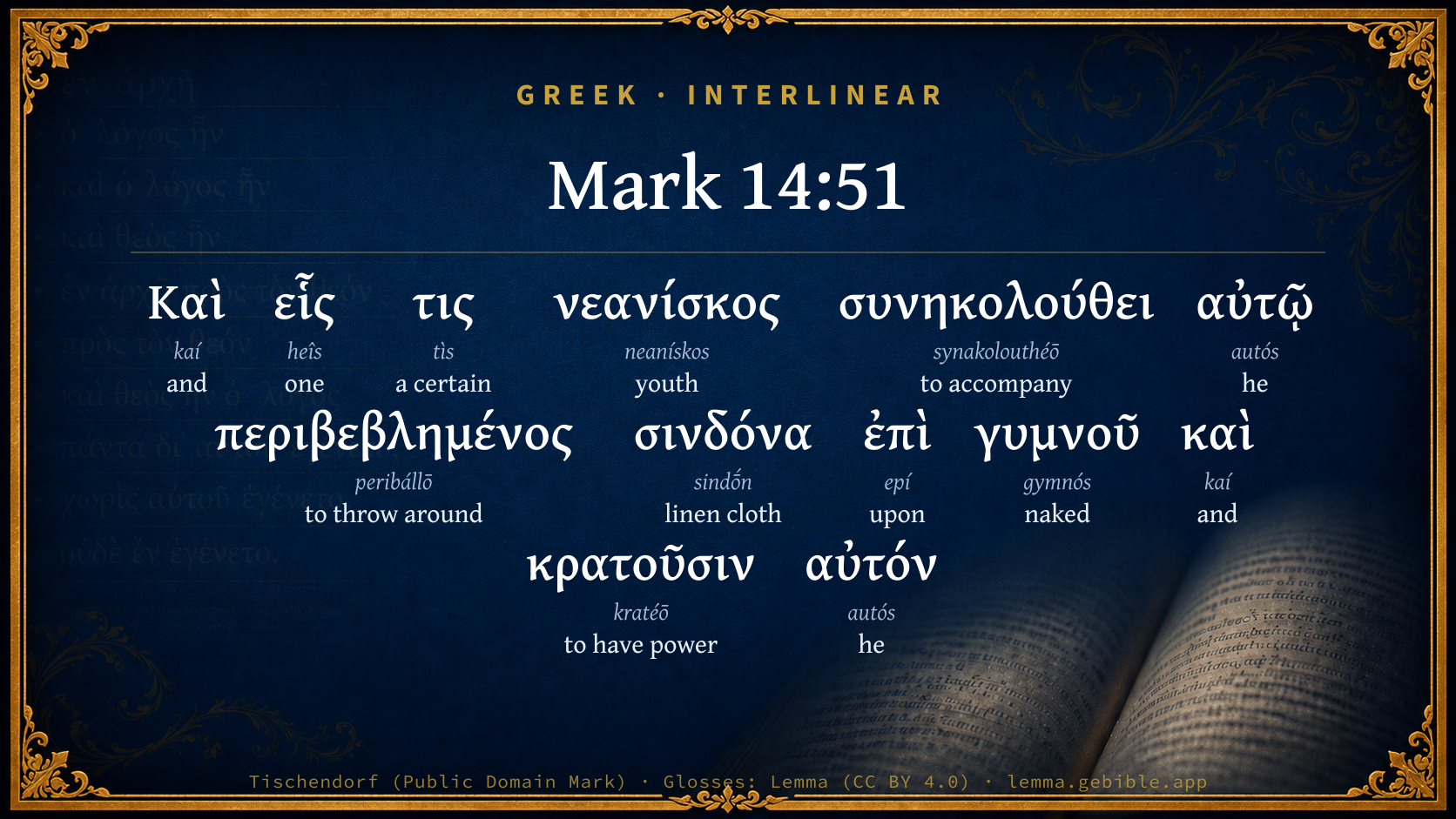
  1. Καὶ kaí G2532 “and” Conjunction
  2. εἷς heîs G1520 “one” Adjective, Nominative, Singular, Masculine
  3. τις tìs G5100 “a certain” Indefinite pronoun, Nominative, Singular, Masculine
  4. νεανίσκος neanískos G3495 “youth” Noun, Nominative, Singular, Masculine
  5. αὐτῷ autós G846 “he” Personal pronoun, Dative, Singular, Masculine
  6. περιβεβλημένος peribállō G4016 “to throw around” Verb, Perfect, Passive, Participle, Nominative, Singular, Masculine
  7. σινδόνα sindṓn G4616 “linen cloth” Noun, Accusative, Singular, Feminine
  8. ἐπὶ epí G1909 “upon” Preposition
  9. γυμνοῦ gymnós G1131 “naked” Adjective, Genitive, Singular, Neuter
  10. καὶ kaí G2532 “and” Conjunction
  11. κρατοῦσιν kratéō G2902 “to have power” Verb, Present, Active, Indicative, 3rd person, Plural
  12. αὐτόν autós G846 “he” Personal pronoun, Accusative, Singular, Masculine

About this verse

These counts appear in no published source. They are computed here, from the morphology-tagged text and Lemma’s own curated glosses. What Lemma adds →

13
words
11
distinct lemmas
Gospels
section

Notable vocabulary

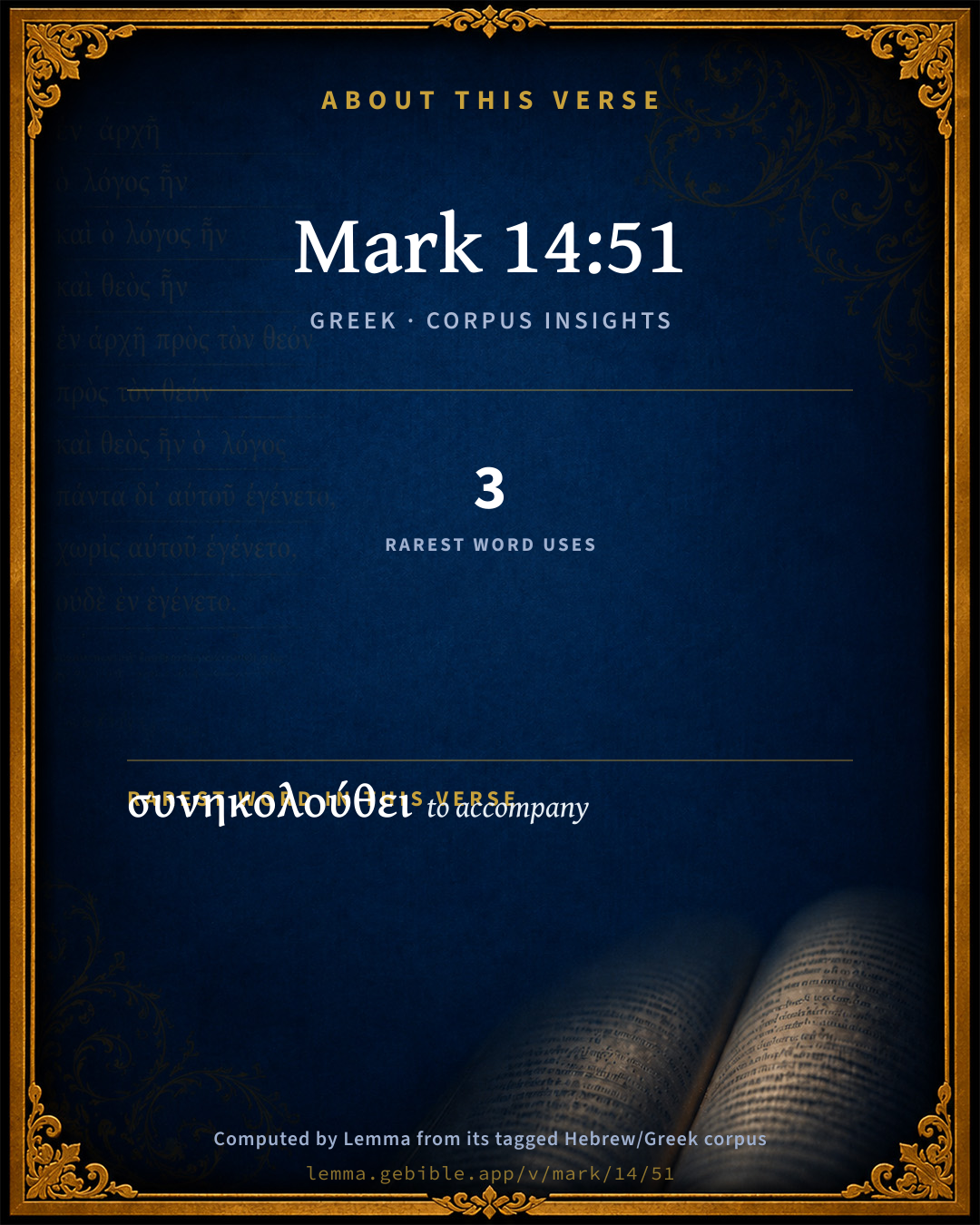
The rarest word here is συνηκολούθει to accompany G4870 — appearing just 3 times in the whole Greek New Testament.

Shared distinctive vocabulary

συνηκολούθει to accompany G4870 occurs in 3 verses of the Greek New Testament. Also found in:

Repetition

Words recur within this verse:

  • Καὶ and G2532 ×2
  • αὐτῷ he G846 ×2

Commentary

Notes on Mark 14:51 from classic Christian and Jewish commentators (each source and its license shown beneath its notes). The classic Christian expositions comment on the surrounding passage and are grouped to its opening verse, so a note may address several verses; the Jewish commentaries on the Tanakh (Rashi and others) are per-verse, so they appear only where the commentator wrote on this verse.

Lemma curates 59 commentaries, every one of them public domain or Creative Commons licensed, each selected and text-cleaned for this edition rather than reprinted as found. About our sources →

The Biblical Illustrator

Joseph S. Exell

Mar_14:51-52

And he left the linen cloth, and fled from them naked.

Haste in religion

It strikes me that this certain young man was none other than Mark himself. He was probably asleep; and, aroused by a great clamour, he asked what it was about. The information was speedily given-The guards have come to arrest Jesus of Nazareth. Moved by sudden impulse, not thinking of what he was doing, he rises from his bed, rushes down, pursues the troopers, dashes into the midst of their ranks, as though he alone would attempt the rescue, when all the disciples had fled. The moment they lay hold upon him his heroic spasm is over; his enthusiasm evaporates; he runs away, leaves the cloth that was loosely wrapped about his body behind, and makes his escape. There have been many who acted like Mark since then. First, however, you will say, Why suppose it to be Mark? I grant you it is merely a supposition, but yet it is supported by the strongest chain of probabilities. It was common among the evangelists to relate transactions in which they themselves took part without mentioning their own names. Whoever it was, the only person likely to know it was the man himself. I cannot think that anyone else would have been likely to tell it to Mark. Again, we know that such a transaction as this was quite in keeping with Marks common character: the evangel of Mark is the most impulsive of all the evangels. He is a man who does everything straightway; full of impulse, dash, fire, flash; the thing must be done, and done forthwith. Once more: the known life of John Mark tends to make it very probable that he would do such a thing as is referred to in the text. As soon as ever Paul and Barnabas set out on their missionary enterprise they were attended by Mark. As long as they were sailing across the blue waters, and as long as they were in the island of Cyprus, Mark stuck to them. Nay, while they travelled along the coast of Asia Minor, we find they had John Mark to be their minister; but the moment they went up into the inland countries, among the robbers and the mountain streams-as soon as ever the road began to be a little too rough, John Mark left them. His missionary zeal had oozed out. For these reasons, the supposition that it was John Mark appears to me not to be utterly baseless.

I. Here is hasty following. John Mark does not wait to robe himself, but just as he is, he dashes out for the defence of his Lord. Without a moments thought, taking no sort of consideration, down he goes into the cold night air to try and deliver his Master. Fervent zeal waited not for chary prudence. There was something good and something bad in this, something to admire as well as something to censure. Beloved, it is a good and right thing for us to follow Christ, and to follow Him at once; and it is a brave thing to follow Him when His other disciples forsake Him and flee. Would that all professors of religion had the intrepidity of Mark! The most of men are too slow; fast enough in the world, but, ah! how slow in the things of God! Of all people that dilly-dally in this world, I think professed servants of God are the most drowsy and fuddling. How slothful are the ungodly, too, in Divine things; tell them they are sick, they hasten to a surgeon; tell them that their title deeds are about to be attacked, and they will defend them with legal power; but tell them, in Gods name, that their soul is in danger, and they think it matters so little, and is of so small import, that they will wait on, and wait on, and wait on, and doubtless continue to wait on till they find themselves lost forever. The warnings of the gospel all bid you shun procrastination. I do beseech you fly to Jesus, and fly to Jesus now, though even it should be in the hurry of John Mark. I change my note. There is a haste that we most reprove. The precipitate running of Mark suggests an admonition that should put you on your guard. I am afraid some people make a hasty profession through the persuasion of friends. Nor are there a mere few who get their religion through excitement. This furnishes another example of injudicious haste. Many profess Christ and think to follow Him without counting the cost. They had never sought Gods strength; they had never been emptied of their own works and their own conceits; consequently, in their best estate they were vanity; they were like the snail that melts as it crawls, and not like the snowflake upon the Alps, which gathers strength in its descent, till it becomes a ponderous avalanche. God make you not meteors or shooting stars, but stars fixed in their places. I want you to resemble, not the ignis fatuus of the morass, but the steady beacon of the rock. There is a phosphorescence that creeps over the summer sea, but who is ever lighted by it to the port of peace? And there is a phosphorescence which comes over some mens minds. Very bright it seems, but it is of no value; it brings no man to heaven.

II. It remains for me to notice the hasty running away. Some who run well at first have hardly breath enough to keep the pace up, and so turn aside for a little comfortable ease, and do not get into the road again. There are two kinds of desertion which we denounce as hasty running away; the one temporary, the other final. Think what a fool Mark made of himself. Here he comes; here is your hero. What wonders he is going to do! Here is a Samson for you. Perhaps he will slay his thousand men. But, no; he runs away before he strikes a single blow. He has not even courage enough to be taken prisoner. How everybody in the crowd must have laughed at the venturesome coward-at the dastardly bravo! Therefore abstain from these inconsistencies for your own characters sake. Besides, how much damage you do the Church! And think what must be the dying bed of an apostate. Did you ever read of the groans of Spira? That was a book circulated about the time of the Reformation-a book so terrible that even a man of iron could scarcely read it. Spira knew the gospel, but yet went back to the Church of Rome. His conscience woke on his dying bed, and his cries and shrieks were too terrible to be endured by his nurses; and as to his language, it was despair written out at full length in capital letters. My eminent predecessor, Mr. Benjamin Keach, published a like narrative of the death of John Child, who became a minister of the gospel, but afterwards went back to the Church from which he seceded, and died in the most frightful despair. May God deliver you from the death bed of any man who has lived a professed Christian, and dies an apostate from the faith! But what must be the apostates doom when his naked soul goes before God? (C. H. Spurgeon.)

The Biblical Illustrator, edited by Joseph S. Exell (c. 1880s–1900s) — public domain. Text from a community e-Sword module.

Joseph Benson's Commentary

Mar 14:51-52. There followed him a certain young man — The ancients, or at least many of them, supposed, that the young man here mentioned by Mark was one of the apostles; though Grotius wonders how they could entertain such an idea, and apprehends it was some youth who lodged in a country-house, near the garden, who ran out in a hurry to see what was the matter, in his night vestment, or in his shirt, as we should express it. Dr. Macknight thinks it might be “the proprietor of the garden, who, being awakened with the noise, came out in the linen cloth in which he had been lying, cast around his naked body, and, having a respect for Jesus, followed him, forgetting the dress he was in.” And the young men — Οι ανεανισκο, a common denomination for soldiers, among the Greeks. “Though this incident, recorded by Mark, may not appear of great moment, it is, in my opinion,” says Dr. Campbell, “one of those circumstances we call picturesque, which, though in a manner unconnected with the story, enlivens the narrative. It must have been late in the night when (as has been very probably conjectured) some young man, whose house lay near the garden, being roused out of sleep by the noise of the soldiers and armed retinue passing by, got up, stimulated by curiosity, wrapped himself (as Casaubon supposes) in the cloth in which he had been sleeping, and ran after them. This is such an incident as is very likely to have happened, but most unlikely to have been invented.” Laid hold on him — Who was only suspected to be Christ’s disciple; but were not permitted to touch them who really were so!

Joseph Benson's Commentary on the Old and New Testaments (1811–1818) — public domain. Text from a community e-Sword module.

Tyndale Open Study Notes

Tyndale Open Resources

14:51-52 The account of Jesus’ arrest ends with this comment about an unnamed young man. There does not seem to be any theological reason for Mark to record this incident. The explanation that it is an autobiographical detail about Mark is as good as any.

Tyndale Open Study Notes — © Tyndale Open Resources, licensed CC BY-SA 4.0. Text via the HelloAO Bible API.

Bengel's Gnomon

Johann Albrecht Bengel

Mar 14:51. Σινδόνα, a linen cloth) He was therefore rich, Mat 11:8.—ἐπὶ γυμνοῦ, upon his naked) viz. body. He had perhaps by this time gone to bed.—κρατοῦσιν, lay hold) He had not been desired to follow. No one tried to apprehend the disciples: this young man was apprehended by either the armed men or others.[3]

[3] The Germ. Vers. approves of the omission of the subject οἱ νεανίσκο., though that omission has been less approved of by the margin of the larger Ed. and of Ed. 2.—E. B. It is omitted in BC corrected later, DLΔac Memph. Syr. Vulg. However AP supports the words with Rec. Text.—ED. and TRANSL.

Bengel's Gnomon of the New Testament — English translation (T&T Clark, Edinburgh, 1860) — public domain. Text from a community e-Sword module.

Expositor's Greek Testament

ed. W. Robertson Nicoll

Mar 14:51 introduces a little anecdote peculiar to Mk., the story of an unknown friend, not one of the Twelve, who had joined the company, and did not fly with the rest. συνηκολούθει α ., was following Jesus; when He was being led away, and after the disciples had fled. περι βεβλημένος σινδόνα ἐπὶ γυμνοῦ : this suggests that the youth, on hearing some sudden report, rose out of his bed and rushed out in his night-shirt, or, being absolutely naked, hurriedly threw about his body a loose cotton or linen sheet. The statement that on being laid hold of he cast off the garment favours the latter alternative.

The Expositor's Greek Testament, edited by W. Robertson Nicoll (1897–1910) — public domain. Text from a community e-Sword module.

Geneva Bible (1599)

Geneva Bible translators

Under pretence of godliness, all things are lawful to such as do violence against Christ.

Which he cast about him, when he hearing that stir in the night suddenly ran forth: whereby we may understand with how great licentiousness these villains violently set upon him.

Geneva Bible (1599) marginal notes — public domain. Text via Bolls.life.

Adam Clarke's Commentary

Verse 51. A certain young man] Probably raised from his sleep by the noise which the rabble made who came to apprehend Jesus, having wrapped the sheet or some of the bed-clothing about him, became thereby the more conspicuous: on his appearing, he was seized; but as they had no way of holding him, but only by the cloth which was wrapped round him, he disengaged himself from that, and so escaped out of their hands. This circumstance is not related by any other of the evangelists.

Adam Clarke's Commentary on the Bible (1810–1826) — public domain. Text from a community e-Sword/MySword module.

Ellicott's Commentary for English Readers

(51) And there followed him a certain young man.—The remarkable incident that follows is narrated by St. Mark only. It had clearly made a deep impression on the minds of some of the disciples (probably enough, on that of Peter), from whom, directly or indirectly, the report came. Who it was that appeared in this strange fashion we are left to conjecture. Some have supposed that it was St. Mark himself, but for this there is obviously no ground but the fact that this Evangelist alone records it. A careful examination of the facts suggests another conclusion as probable. (1) The man was “young,” and the self-same term is applied to the ruler who had great possessions (Mat_19:20). (2) He had apparently been sleeping, or, it may be, watching, not far from Gethsemane, with the linen sheet wrapped round him, and had been roused by the approach of the officers and the crowd. This suggests one who lived somewhere on the Mount of Olives, and so far points to Lazarus or Simon of Bethany, as the only two conspicuous disciples in that neighbourhood. (3) He was one who so loved our Lord that he went on following Him when all the disciples forsook Him and fled, and this also was what might be expected from Lazarus. On the supposition suggested in (1), he was now obeying almost literally the command, “Take up thy cross, and follow Me.” (See Notes on Mat_19:16-22.) (4) He was one whom the officers (the words “the young men” are omitted in the better MSS.) were eager to seize, when they allowed all the disciples to go their way, and this agrees with the command which had been given by the priests, that they should take and kill Lazarus also (Joh_12:10). (5) As the “linen sheet” or sindôn (see Note on Mat_27:59) was especially used for the burial of the dead, it is conceivable, on this supposition, that what had been the winding-sheet of the dead Lazarus had been kept and used by him in memory of his resurrection. (6) On the hypothesis thus suggested, the suppression of the name stands on the same footing as that of the name of the sister of Lazarus, who poured the precious ointment on our Lord’s head at Bethany (Mat_26:7, Mar_14:3), whom the Evangelists must have known, but whom they mention simply as a “woman.” Their lips were sealed as to the family of Bethany until the circumstances, whatever they may have been, that called for silence had passed away. It is obvious that so far as this identity is established it suggests many thoughts of profound interest. What had seemed impossible to men had proved possible with God. He who had gone away sorrowful because he had great possessions, had given freely to the poor (see Notes on Mat_26:6; Mat_26:9), and had proved more faithful than the Twelve, and so the last had become the first.

A Bible Commentary for English Readers, edited by Charles John Ellicott (1878–1897) — public domain. Text from a community e-Sword module.

The Cambridge Bible for Schools and Colleges

gen. ed. J. J. S. Perowne

51. a certain young man] This forms an episode as characteristic of St Mark as that of the two disciples journeying to Emmaus is of St Luke. Some have conjectured he was the owner of the garden of Gethsemane; others Lazarus (see Professor Plumptre’s Article on “Lazarus” in Smith’s Bible Dict.); others Joses, the brother of the Lord; others, a youth of the family where Jesus had eaten the Passover. It is far more probable that it was St Mark himself, the son of Mary, the friend of St Peter. The minuteness of the details given points to him. Only one well acquainted with the scene from personal knowledge, probably as an eyewitness, would have introduced into his account of it so slight and seemingly so trivial an incident as this.

having a linen cloth] He had probably been roused from sleep, or just preparing to retire to rest in a house somewhere in the valley of Kidron, and he had nothing to cover him except the sindôn or upper garment, but in spite of this he ventured in his excitement to press on amongst the crowd. The word sindôn in Mat_27:59, Mar_15:46 and Luk_23:53 is applied to the fine linen, which Joseph of Arimathæa bought for the Body of Jesus. The LXX. use the word in Jdg_14:12 and in Pro_31:24 for “fine under garments.”

the young men] This is omitted by Lachmann, Tischendorf, and Tregelles. The crowd was probably astonished at the strange apparition.

The Cambridge Bible for Schools and Colleges (gen. ed. J. J. S. Perowne; Cambridge University Press, 1878–1918) — public domain. Text from a community e-Sword module.

John Gill's Exposition

And Peter followed him afar off,.... And did another disciple, perhaps John; Joh 18:15, who having somewhat recovered themselves from their fright, turned back, and followed Jesus, and the company that led him away; keeping at some distance, that they might not be observed, and exposed to danger; and proceeded till they came to Jerusalem, and to the place where the sanhedrim were convened; and the other disciple went in along with Jesus; and Peter afterwards, by his means, got in:

even into the palace of the high priest; being let in by her that kept the door, at the motion of the other disciple

and he sat with the servants; as if he was one of them, and had no concern with Jesus:

and warmed himself at the fire; or "light", as the Greek word signifies, and answers to the Hebrew word by which both: light and fire are expressed; of which, take an instance or two, in the room of many (g):

"a murderer that strikes, his neighbour with a stone, or with iron, and plunges him into water, or into "fire", so that he cannot get out, and dies, is guilty.''

Again (h), a

"book which "fire", takes hold upon on one side, he puts, water on the other; and if it is quenched, it is quenched; if the "fire" takes hold on both sides, he opens it, and reads in it; and if it is quenched, it is quenched: a cloak which "fire" takes hold upon on one side, he puts water on the other side; and if it is quenched, it is quenched; if the "fire" takes hold on it on both sides, he takes, it and wraps himself in it, and if it is quenched, it is quenched.''

So we read (i) of , "the fire of hell"; and Ur of the Chaldees has its name from the fire, that was worshipped there, as a symbol of the sun: and fire was the or "light", created on the first day, Gen 1:3; See Gill on Mat 26:58.

(g) Misn. Sanhedrin, c 9. sect 1. (h) T. Hieros. Sabbat, fol. 15. 4. & T. Bab. Sabbat, fol. 120. 1. Vid. Misn. Avoda Zara, c. 5. sect. 12. (i) T. Bab. Chagiga, fol. 27. 1.

John Gill's Exposition of the Whole Bible (1746–1763) — public domain (CC PDM 1.0). Text via the HelloAO Bible API.

Trapp's Complete Commentary

John Trapp

48 And Jesus answered and said unto them, Are ye come out, as against a thief, with swords and with staves to take me?

49 I was daily with you in the temple teaching, and ye took me not: but the scriptures must be fulfilled.

50 And they all forsook him, and fled.

51 And there followed him a certain young man, having a linen cloth cast about his naked body; and the young men laid hold on him:

Ver. 51. And there followed him a certain young man] That this was St John, Calvin counts a fancy. He might be one well affected to Christ, who, bearing the noise, came to see the news, and hardly escaped with the skin of his teeth; such is the rudeness and rage of persecutors.

John Trapp, A Commentary or Exposition upon All the Books of the Old and New Testament (1647–1656) — public domain. Text from a community e-Sword module.

Haydock's Catholic Bible Commentary

This probably was the owner, or the son of the owner of the garden, who hearing the tumult came to see what was the cause. It must have been a young man from the Greek word neaniskos. (Tirinus)

George Leo Haydock (1774–1849), Haydock's Catholic Family Bible and Commentary, 1859 edition — public domain. Excludes Psalms (Douay-Rheims chapter numbering differs from Protestant) and Deuterocanonical books (Catholic canon only).

Matthew Poole's English Annotations

This part of the history is only recorded by Mark. What hath made some affirm that this was St. John I cannot tell. John was one of the eleven that were with Christ when Judas came, and though we find him asleep a little before, yet we read not that he was gone to bed, nor can conceive there was any at or near the place. The garment in which he was, in all probability, was a night garment. It is certain it was a loose garment, he could not else, when he was apprehended, have so soon quit himself of it; and being quit of that it seemeth he was quit of all, for the text saith he

fled from them naked; nor doth the text give him the honour to call him a disciple of Christ at large. Probably it was some young man who, being in his bed, and hearing the noise of the multitude going by his lodging with swords and staves, got up, slipped on his night garment, and followed them, to see what the matter was; and they having apprehended Christ, he followed them. And possibly his unusual habit made them take the more notice of him, staying when the disciples were all fled. Nor can the reason be well given why Mark should record such a passage, unless it were to tell us what we must expect from the rage of persecutors, viz. that our own innocency should not defend us. This young man was not concerned in Christ, only came as a spectator, without any arms. But the sword of persecution useth not to distinguish perfectly. The basilisk (they say) will fly at the picture of a man.

Matthew Poole's English Annotations on the Holy Bible (1683–1685) — public domain. Text from a community e-Sword/MySword module.

Whedon's Commentary on the Bible

Daniel D. Whedon

51. Followed him a certain young man — The incident of this young man occurs very briefly, and is narrated apparently for no purpose whatever. The only solution, certainly the best, is the supposition that it was no other than Mark himself. Mark was at this time a young man, living probably in Jerusalem with his mother; was more or less a follower of Jesus, and very likely to be present, from his interest in our Lord, during these awful transactions. That he should not name himself is very naturally explained, on the same principle of personal delicacy as induced the evangelist John to allude to himself in the third person. As John naturally styles himself the disciple whom Jesus loved, so Mark could as naturally style himself a certain young man. Very likely the Christians of that day knew who the certain young man was. There followed him — From this clause it is plain, that the supposition of some commentators, that this was an indifferent young man, accidentally awakened by the tumult, is untenable. He is a follower; and he does not follow them, that is, the crowd, but him. Jesus is the object of his interest. It must, therefore, have been some friend of Jesus, pressing after him to ascertain what was to be his fate. A linen cloth — A wrapper thrown over his undressed body. Doubtless this was the aba, an outer cloth thrown over the dress, and used even in sleep to enwrap the body. See on Mat_5:40. The young men — The young men who formed a part of the company who apprehended Jesus. This use of the word to signify soldiers is common, both in Greek and Latin.

Daniel D. Whedon (gen. ed.), Commentary on the Old and New Testaments (1874–1909) — public domain. Text from a community e-Sword module.

The Pulpit Commentary

And a certain young man followed with him, having a linen cloth cast about him, over his naked body: and they lay hold on him. St. Mark is the only evangelist who mentions this incident; and there seems good reason for supposing that he here describes what happened to himself. Such is the mode in which St. John refers to himself in his Gospel, and where there can be no doubt that he is speaking of himself. If the conclusion in an earlier part of this commentary be correct, that it was at the house to which John Mark belonged that our Lord celebrated the Passover, and from whence he went out to the Mount of Olives; what more probable than that Mark had been with him on that occasion, and had perhaps a presentiment that something was about to happen to him? What more likely than that the crowd who took Jesus may have passed by this house, and that Mark may have been roused from his bed (it was now a late hour) by the tumult. Having a linen cloth (sindona ) cast about his naked body. The sindon was a fine linen cloth, indicating that he belonged to a family in good circumstances. It is an unusual word. In every other place of the New Testament where it is used it refers to the garment or shroud used to cover the bodies of the dead. The sindon is supposed to take its name from Sidon, where the particular kind of linen was manufactured of which the garment was made. It was a kind of light cloak frequently worn in hot weather.

The Pulpit Commentary (1880–1919), ed. H.D.M. Spence-Jones & Joseph S. Exell — public domain. Text from a community e-Sword module.

John Wesley's Explanatory Notes

A young man - It does not appear, that he was one of Christ's disciples. Probably hearing an unusual noise, he started up out of his bed, not far from the garden, and ran out with only the sheet about him, to see what was the matter. And the young men laid hold on him - Who was only suspected to be Christ's disciple: but could not touch them who really were so.

John Wesley, Explanatory Notes Upon the Whole Bible (1754–1765) — public domain. Text via the GEBible commentary corpus.

Burkitt's Expository Notes on the New Testament

William Burkitt

Here we have the history of our Saviour’s examination before the high-priest and council, who set up all night to arraign and try the holy and innocent Jesus; for, lest his death should look like a downright murder, they allow him a mock-trial, and abuse the law by perverting it to injustice and bloodshed. Accordingly false witnesses are suborned, who depose that they heard him say, he would destroy the temple, and build it again in three days.

It is not in the power of the greatest innocence to protect the most innocent and holy person from slander and false accusation; yea, no person is so innocent and good, whom false witnesses may not condemn.

Observe, 2. Our Lord’s meekness and patience, his silence under all these wicked suggestions and false accusations: Jesus held his peace, and answered nothing, Mar 14:61.

Guilt is naturally clamorous and impatient; but innocency is silent, and careless of misreports.

Learn hence, That to bear the revilings, contradictions, and false accusations, of men with a silent and submissive spirit, is an excellent and Christ-like temper. Our Lord stood before his unjust judge, and false accusers even as a sheep before the shearer, dumb, and not opening his mouth; even then when a trial for his life was managed most maliciously and illegally against him: When he was reviled, he reviled not again; when he suffered, he threatened not.

May the same humble mind and forgiving spirit be in us, which was also in Christ Jesus!

Observe, 3. That although our Saviour was silent, and made no reply to the false witnesses; yet now, when the question was solemnly put by the high-priest, Art thou the Christ, the Son of the Blessed? He answered I am.

Thence learn, That although we are not obliged by every ensnaring question to make answer, yet we are bound faithfully to own, and freely to confess, the truth, when solemnly called thereunto: when our silence will be interpreted a denial of the truth, a dishonour to God, a reproach and scandal to our brethren, it will be a great sin to hold our peace; and we must not be silent, though our confession of the truth hazards our liberty, yea, our life. Christ knew that his answer would cost him his life, yet he durst not but give it: Art thou the Son of the Blessed? Jesus said, I am.

Observe, 4. The crime which the high-priest pronounces our Saviour to be guilty of that of blasphemy; He hath spoken blasphemy. Hereupon the highpriest rends his clothes: it being usual with the Jews so to do, both to show their sorrow for it, and great detestation of it, and indignation against it.

Observe, 5. The vile affronts and horrid abuses which the enemies of our Saviour put upon him, they spit in his face, they blindfold him, they smite him with their hands, and in contempt and mockery bid him prophesy who it was that smote him. Verily, there is no degree of contempt, no mark of shame, no kind of suffering, which we ought to decline, or stick at for Christ’s sake, who hid not his face from shame and spitting upon our account.

Observe, 6. The high priest rends his clothes at Christ’s telling him, Ye shall see the Son of man sitting on God’s right hand, and coming in the clouds of heaven. Mar 14:62. And well might his clothes and his heart rend also. It was as if our Lord had said, "I that am now your prisoner, shall shortly be your judge. I now stand at your bar; and, ere long, you must stand at my tribunal. Those eyes of yours that now see me in the form of a servant, shall behold me in the clouds, at the right hand of your God, and my Father."

William Burkitt's Expository Notes on the New Testament (1700–1703) — public domain. Text from a community e-Sword module.

unfoldingWord translationNotes

Door43 World Missions Community

linen

cloth made from the fibers of a flax plant

that was wrapped around him

This can be stated in active form. AT: "that he had wrapped around himself" (See: Active or Passive)

When the men seized him

"When the men seized that man"

he left the linen garment

As the man was trying to run away, the others would have grabbed at his clothing, trying to stop him.

translationWords

seize

unfoldingWord translationNotes — © Distant Shores Media and the Door43 World Missions Community, licensed CC BY-SA 4.0. Source: git.door43.org/Door43/en_tn.

Cambridge Greek Testament for Schools and Colleges

51. νεανίσκος τις ([3235][3236][3237][3238] rather than εἷς τις νεαν. ([3239][3240][3241] etc.). [3242] has νεαν. δέ τις. συνηκολούθει ([3243][3244][3245][3246] rather ἠκολούθει ([3247] or συνηκολούθησεν ([3248]) or ἠκολούθησεν ([3249] [3250][3251][3252][3253][3254][3255][3256] omit οἱ νεανίσκοι. [3257][3258][3259][3260] omit ἀπʼ αὐτῶν.

[3235] Codex Sinaiticus. 4th cent. Discovered by Tischendorf in 1859 at the Monastery of St Katharine on Mount Sinai. Now at St Petersburg. The whole Gospel, ending at Mar 16:8. Photographic facsimile, 1911.

[3236] Codex Vaticanus. 4th cent., but perhaps a little later than א. In the Vatican Library almost since its foundation by Pope Nicolas V., and one of its greatest treasures. The whole Gospel, ending at Mar 16:8. Photographic facsimile, 1889.

[3237] Codex Ephraemi. 5th cent. A palimpsest: the original writing has been partially rubbed out, and the works of Ephraem the Syrian have been written over it; but a great deal of the original writing has been recovered; of Mark we have Mar 1:17 to Mar 6:31, Mar 8:5 to Mar 12:29, Mar 13:19 to Mar 16:20. In the National Library at Paris.

[3238] Codex Regius. 8th cent. An important witness. At Paris. Contains Mar 1:1 to Mar 10:15; Mar 10:30 to Mar 15:1; Mar 15:20 to Mar 16:20, but the shorter ending is inserted between Mar 16:8 and Mar 16:9, showing that the scribe preferred it to the longer one.

[3239] Codex Alexandrinus. 5th cent. Brought by Cyril Lucar, Patriarch of Constantinople, from Alexandria, and afterwards presented by him to King Charles I. in 1628. In the British Museum. The whole Gospel. Photographic facsimile, 1879.

[3240] Codex Basiliensis. 8th cent. At Basle.

[3241] Codex Boreelianus. Once in the possession of John Boreel. 9th cent. At Utrecht. Contains Mk 1–41; Mar 2:8-23; Mar 3:5 to Mar 11:6; Mar 11:27 to Mar 14:54; Mar 15:6-39; Mar 16:19-20.

[3242] Codex Bezae. 6th cent. Has a Latin translation (d) side by side with the Greek text, and the two do not quite always agree. Presented by Beza to the University Library of Cambridge in 1581. Remarkable for its frequent divergences from other texts. Contains Mark, except Mar 16:15-20, which has been added by a later hand. Photographic facsimile, 1899.

[3243] Codex Sinaiticus. 4th cent. Discovered by Tischendorf in 1859 at the Monastery of St Katharine on Mount Sinai. Now at St Petersburg. The whole Gospel, ending at Mar 16:8. Photographic facsimile, 1911.

[3244] Codex Vaticanus. 4th cent., but perhaps a little later than א. In the Vatican Library almost since its foundation by Pope Nicolas V., and one of its greatest treasures. The whole Gospel, ending at Mar 16:8. Photographic facsimile, 1889.

[3245] Codex Ephraemi. 5th cent. A palimpsest: the original writing has been partially rubbed out, and the works of Ephraem the Syrian have been written over it; but a great deal of the original writing has been recovered; of Mark we have Mar 1:17 to Mar 6:31, Mar 8:5 to Mar 12:29, Mar 13:19 to Mar 16:20. In the National Library at Paris.

[3246] Codex Regius. 8th cent. An important witness. At Paris. Contains Mar 1:1 to Mar 10:15; Mar 10:30 to Mar 15:1; Mar 15:20 to Mar 16:20, but the shorter ending is inserted between Mar 16:8 and Mar 16:9, showing that the scribe preferred it to the longer one.

[3247] Codex Bezae. 6th cent. Has a Latin translation (d) side by side with the Greek text, and the two do not quite always agree. Presented by Beza to the University Library of Cambridge in 1581. Remarkable for its frequent divergences from other texts. Contains Mark, except Mar 16:15-20, which has been added by a later hand. Photographic facsimile, 1899.

[3248] Codex Sangallensis. 9th or 10th cent. Contains the Gospels nearly complete, with an interlinear Latin translation. The text of Mark is specially good, agreeing often with CL. At St Gall.

[3249] odex Alexandrinus. 5th cent. Brought by Cyril Lucar, Patriarch of Constantinople, from Alexandria, and afterwards presented by him to King Charles I. in 1628. In the British Museum. The whole Gospel. Photographic facsimile, 1879.

[3250] Codex Sinaiticus. 4th cent. Discovered by Tischendorf in 1859 at the Monastery of St Katharine on Mount Sinai. Now at St Petersburg. The whole Gospel, ending at Mar 16:8. Photographic facsimile, 1911.

[3251] Codex Vaticanus. 4th cent., but perhaps a little later than א. In the Vatican Library almost since its foundation by Pope Nicolas V., and one of its greatest treasures. The whole Gospel, ending at Mar 16:8. Photographic facsimile, 1889.

[3252] Codex Ephraemi. 5th cent. A palimpsest: the original writing has been partially rubbed out, and the works of Ephraem the Syrian have been written over it; but a great deal of the original writing has been recovered; of Mark we have Mar 1:17 to Mar 6:31, Mar 8:5 to Mar 12:29, Mar 13:19 to Mar 16:20. In the National Library at Paris.

[3253] An asterisk denotes that the word is not found elsewhere in N.T., and such words are included in the index, even if there is no note on them in the commentary.

[3254] Codex Bezae. 6th cent. Has a Latin translation (d) side by side with the Greek text, and the two do not quite always agree. Presented by Beza to the University Library of Cambridge in 1581. Remarkable for its frequent divergences from other texts. Contains Mark, except Mar 16:15-20, which has been added by a later hand. Photographic facsimile, 1899.

[3255] Codex Regius. 8th cent. An important witness. At Paris. Contains Mar 1:1 to Mar 10:15; Mar 10:30 to Mar 15:1; Mar 15:20 to Mar 16:20, but the shorter ending is inserted between Mar 16:8 and Mar 16:9, showing that the scribe preferred it to the longer one.

[3256] Codex Sangallensis. 9th or 10th cent. Contains the Gospels nearly complete, with an interlinear Latin translation. The text of Mark is specially good, agreeing often with CL. At St Gall.

[3257] Codex Sinaiticus. 4th cent. Discovered by Tischendorf in 1859 at the Monastery of St Katharine on Mount Sinai. Now at St Petersburg. The whole Gospel, ending at Mar 16:8. Photographic facsimile, 1911.

[3258] Codex Vaticanus. 4th cent., but perhaps a little later than א. In the Vatican Library almost since its foundation by Pope Nicolas V., and one of its greatest treasures. The whole Gospel, ending at Mar 16:8. Photographic facsimile, 1889.

[3259] Codex Ephraemi. 5th cent. A palimpsest: the original writing has been partially rubbed out, and the works of Ephraem the Syrian have been written over it; but a great deal of the original writing has been recovered; of Mark we have Mar 1:17 to Mar 6:31, Mar 8:5 to Mar 12:29, Mar 13:19 to Mar 16:20. In the National Library at Paris.

[3260] Codex Regius. 8th cent. An important witness. At Paris. Contains Mar 1:1 to Mar 10:15; Mar 10:30 to Mar 15:1; Mar 15:20 to Mar 16:20, but the shorter ending is inserted between Mar 16:8 and Mar 16:9, showing that the scribe preferred it to the longer one.

51. καὶ νεανίσκος τις. See crit. note. This strange incident has so little to do with the narrative, and is so out of harmony with the tone of it, that we wonder why it was inserted. It cannot be part of Peter’s reminiscences, for he had fled before it occurred, and he would not regard the matter as instructive. It can hardly be part of the story which he habitually told, and it would not be likely to be part of the primitive tradition. The patristic guess that the young man was St John is excluded by the fact that he had already fled. James, the Lord’s brother, is less improbable, but has little to recommend it. Much more probably the young man was the Evangelist himself. This hypothesis gives an adequate reason for the insertion of the incident. The matter was of intense interest to him, and some who read his Gospel would know who was meant. He does not give his name, for he does not wish to pose as the one adherent of Jesus who did not fly until an attempt was made to arrest him. If the Evangelist was the son of “the goodman” in whose house the Paschal meal was celebrated (see on Mar 14:14), then his appearance at this crisis is intelligible. The house was near Gethsemane, and the noise and lights of the band led by Judas may have awakened Mark, who—taking the first thing that came to hand as a covering—ran out to see what was happening. As his father knew Jesus (Mar 14:14) and was perhaps a disciple, Mark would be greatly interested, even if he were not himself a disciple. All this hangs together very well, but the evidence for it is slender. The suggestion that the incident is given as a specimen of the animosity of Christ’s foes against anyone who seemed to sympathize with Him, is not very convincing. As in the case of “the father of Alexander and Rufus” (Mar 15:21), the Evangelist seems to assume that some of his readers will know who is meant; but it is the interest to himself that causes the adventure of the young man to be recorded. Zahn, Introd. to N.T. II. p. 494; Mk “paints a small picture of himself in the corner of his work.”

σινδόνα. This may mean either an article of clothing or a coverlet caught up to serve as clothing. Of the perfect housewife (Pro 31:24) it is said σινδόνας ἐποίησεν καὶ ἀπέδοτο, which Toy explains as “probably a square piece of cloth that could be used as an outer garment or as a night-dress”; and Moore thinks that the 30 linen garments which Samson wagered (Jdg 14:12) were “rectangular pieces of fine and therefore costly linen stuff, which might be worn as an outer garment, or as a night-wrapper.” The Talmud says that such a piece of linen might be used as a curtain or a shroud. We may conjecture with Bengel that a young man who had a σινδών as a wrapper came from a well-to-do household. Cf. Act 12:8.

Cambridge Greek Testament for Schools and Colleges (Cambridge University Press, 1896; 21 vols, various authors incl. Carr, Maclear, Plummer, Farrar, Lumby, Moule, M. R. James, Simcox) — public domain. Text from a community e-Sword module.

Alford’s Greek Testament

Henry Alford

51.] It is impossible to determine, and therefore idle to enquire, who this was. Epiphanius, Hær. lxxviii. 13, vol. i. (ii., Migne) p. 1045, in recounting the traditional austerities of James the brother of the Lord, says, ὃς χιτώνιον δεύτερον οὐκ ἐνεδύσατο ὃς τριβωνίῳ ἐκέχρητο λίνῳ μονωτἀτῳ, καθάπερ ἐν εὐαγγελίῳ φησὶν Ἔφυγεν ὁ νεανίας καὶ ἀφῆκε τὴν σινδόνα ἣν ἦν περιβεβλημένος. Chrys. al. supposed it to have been St. John: alii aliter. It seems to have been some attached disciple of the Lord (probably well known to the readers of Mark), who had gone to rest, and had been aroused by the intelligence. The disciples were not laid hold of:—this person perhaps was throwing some obstacle in the way of the removal of Jesus: or he may have been laid hold of merely in wantonness, from his unusual garb.

γυμνοῦ does not require σώματος to be supplied, but γυμνόν is a neuter substantive: see on this usage generally Kühner, Gramm. ii. p. 118.

Henry Alford, The Greek Testament (1849–1861) — public domain. Text from a community e-Sword module.

International Critical Commentary

51. νεανίσκος τις συνηκολούθει—a certain young man accompanied him. This is a singular episode in the tragedy of our Lord’s betrayal, and it is still more singular that it should have found its way into the account, forming, as it does, a picturesque incident, but not an essential of the event. The linen cloth was a sheet which he had thrown around him, when he got out of his bed, probably aroused by the stir which the crowd made when it passed by his house. Evidently he was a disciple, but his hasty dress shows that he was not one of the twelve. The failure to mention his name does not show that it was unknown to Mk.; see v. 47. Rather, this, together with the mention of an event otherwise so trivial, might easily point to Mk. himself as the person.

νεανίσκος τις, instead of εἶς τις νεανίσκος, Treg. WH. RV. א BCDL, mss. Lat. Vet. Vulg. Egyptt. Pesh. συνηκολούθει, accompanied, instead of ἠκολοῦθει, followed, Tisch. Treg. WH. RV. א BCL.

International Critical Commentary — older volumes (1896–1929), various authors — public domain. Text from a community e-Sword module.

Vincent's Word Studies in the New Testament

Marvin R. Vincent

Linen cloth [σινδονα] . The probable derivation is from jIndov, an Indian : India being the source from which came this fine fabric used for wrapping dead bodies, and in which Christ 's body was enveloped. See Mt 27:59; Mr 14:46; Luk 23:53.

Marvin R. Vincent, Word Studies in the New Testament (1887–1900) — public domain. Text from a community e-Sword/MySword module.

Lesson kit

Teaching starters — assembled from the data on this page, not authored interpretation. Every prompt links to the verse data it draws on. Edit before teaching.

Mark, in the Gospels, opens this verse with 13 words (11 distinct Greek lemmas). Its most distinctive word is synakolouthéō (“to accompany”). A historical commentator’s framing appears above. Read the whole chapter for the surrounding context.

Discussion questions

  1. The word synakolouthéō carries the sense “to accompany.” How does it shape the verse?
  2. Mark 5:37 shares the word «to accompany» with this verse. How do the two illuminate each other?
  3. “and” occurs 2× in this one verse. What is the effect of the repetition?
  4. These translations render this verse differently; the difference is in the English rendering, not the original. What questions does that raise?
  5. Reading how The Biblical Illustrator and Joseph Benson's Commentary read this verse, where do the two commentators agree and where do they part?

Things to notice

Reading settings

Reading text

Shown beneath each verse's original-language words.

Old Testament
Old Testament edition

Read the OT as the Masoretic Hebrew (MT) or the Greek Septuagint (LXX).

English shown for the Greek Septuagint (in the Hebrew ↔ Greek comparison).

Comparing translations? Open the Compare panel on any verse page to stack up to four side by side.