Revelation 19:8

Greek (Tischendorf 8th ed.) Revelation 19:8 appears in the Greek New Testament. The text above is from the Tischendorf 8th edition. Each word links to its Strong’s number and a concise gloss. Click any word for its full Thayer’s Greek Lexicon entry.
Download image
Cite this verse

Revelation 19:8 (World English Bible). Public Domain. Lemma interlinear Bible study tool, https://lemma.gebible.app/v/revelation/19/8.

Show BibTeX & RIS
BibTeX
RIS
English Translation
It was given to her that she would array herself in bright, pure, fine linen: for the fine linen is the righteous acts of the saints.
World English Bible · Public Domain
Download a study sheet

One document with this verse’s original text, its word-by-word gloss line, the meaning frame, cross-references with their text, attributed commentary, and full source and license credits — printable, and it pastes into notes with its structure intact.

This verse Autodidact and up

Study sheet (.html) Plain text (.txt)

A passage Seminary Student

Up to 50 verses in one chapter. A passage sheet keeps up to 6 commentary sources and 12 cross-references per verse, in the order this page ranks them, and says so on the sheet whenever that leaves anything out. Ask for a single verse and you get the Autodidact verse sheet above.

Everything on this page stays free to read, with no account — the sheet is a download of what is already on screen, not access to it.

Want to remove ads? Support Godless Engineer
Compare translations 3

The same verse in 3 English versions, stacked beneath the original-language interlinear above. Click any original word for its lexicon entry.

Each is an independent rendering of the whole verse — the interlinear is not word-aligned to these translations.

Highlighted words mark where these versions differ — a whole-verse word diff, not a word-by-word alignment.

  • World English Bible Public Domain
    It was given to her that she would array herself in bright, pure, fine linen: for the fine linen is the righteous acts of the saints.
  • King James Version Public Domain
    And to her was granted that she should be arrayed in fine linen, clean and white: for the fine linen is the righteousness of saints.
  • unfoldingWord Literal Text CC BY-SA 4.0
    and it has been granted to her that she might be dressed in bright, clean fine linen.” (For fine linen is the righteous acts of the saints.)

unfoldingWord Literal Text — © unfoldingWord, licensed CC BY-SA 4.0. Word-aligned USFM3 via Door43 (git.door43.org/unfoldingWord/en_ult).

Versions to compare (up to 4)

3 of 4 selected

Show all 19 translations

Every available English version of this verse, each an independent rendering of the whole verse.

  • World English Bible Public Domain
    It was given to her that she would array herself in bright, pure, fine linen: for the fine linen is the righteous acts of the saints.
  • Berean Standard Bible Public Domain
    She was given clothing of fine linen, bright and pure.” For the fine linen she wears is the righteous acts of the saints.
  • Majority Standard Bible Public Domain
    She was given clothing of fine linen, bright and pure.” For the fine linen she wears is the righteous acts of the saints.
  • King James Version Public Domain
    And to her was granted that she should be arrayed in fine linen, clean and white: for the fine linen is the righteousness of saints.
  • American Standard Version (1901) Public Domain
    And it was given unto her that she should array herself in fine linen, bright `and' pure: for the fine linen is the righteous acts of the saints.
  • Revised Version (1885) Public Domain
    And it was given unto her that she should array herself in fine linen, bright and pure: for the fine linen is the righteous acts of the saints.
  • Geneva Bible (1599) Public Domain
    And to her was granted, that she should be arayed with pure fine linnen and shining, for the fine linnen is the righteousnesse of Saintes.
  • Douay-Rheims (1899) Public Domain
    And it is granted to her that she should clothe herself with fine linen, glittering and white. For the fine linen are the justifications of saints.
  • Young's Literal Translation Public Domain
    and there was given to her that she may be arrayed with fine linen, pure and shining, for the fine linen is the righteous acts of the saints.'
  • Literal Standard Version CC BY-SA 4.0
    and there was given to her that she may be clothed with fine linen, pure and radiant, for the fine linen is the righteous acts of the holy ones.”
  • Unlocked Literal Bible CC BY-SA 4.0
    She was permitted to be dressed in bright and clean fine linen” (for fine linen is the righteous acts of the saints).
  • unfoldingWord Literal Text CC BY-SA 4.0
    and it has been granted to her that she might be dressed in bright, clean fine linen.” (For fine linen is the righteous acts of the saints.)
  • Darby Bible Public Domain
    And it was given to her that she should be clothed in fine linen, bright [and] pure; for the fine linen is the righteousnesses of the saints.
  • World Messianic Bible Public Domain
    It was given to her that she would array herself in bright, pure, fine linen, for the fine linen is the righteous acts of the holy ones.
  • Webster's Bible Public Domain
    And to her was granted that she should be arrayed in fine linen, clean and white: for the fine linen is the righteousness of saints.
  • Free Bible Version CC BY-SA 4.0
    She was given fine linen to wear, white and clean. (Fine linen represents the good works of believers.)
  • Bible in Basic English Public Domain
    And to her it was given to be clothed in delicate linen, clean and shining: for the clean linen is the righteousness of the saints.
  • Text-Critical English NT CC BY 4.0
    It has been granted to her to be clothed with fine linen, bright and pure.” For the fine linen represents the righteous acts of the saints.
  • Tyndale New Testament (1534) Public Domain
    And to her was graunted that she shulde be arayed with pure and goodly raynes. For the raynes is the ryghtewesnes of saynctes.

Literal Standard Version (2020), Covenant Press — licensed CC BY-SA 4.0. Text via the HelloAO Bible API (eBible.org). Unlocked Literal Bible (unfoldingWord) — licensed CC BY-SA 4.0. Text via the HelloAO Bible API (eBible.org). unfoldingWord Literal Text — © unfoldingWord, licensed CC BY-SA 4.0. Word-aligned USFM3 via Door43 (git.door43.org/unfoldingWord/en_ult). Free Bible Version, Dr. Jonathan Gallagher — licensed CC BY-SA 4.0. Text via the HelloAO Bible API (eBible.org).

Word by word

More ways to search: Search by grammar → Find every occurrence → Compare this word →

Practice this passage: Drill this verse → Learn its vocabulary →

βύσσινον
býssinos
G1039
“fine linen”
Adjective, Accusative, Singular, Neuter
Part of Speech
Adjective
Case
Accusative
Number
Singular
Gender
Neuter
Full Thayer's Definition

Origin: from G1040

TDNT: None

1. a fine linen (garment) 2. made of fine linen
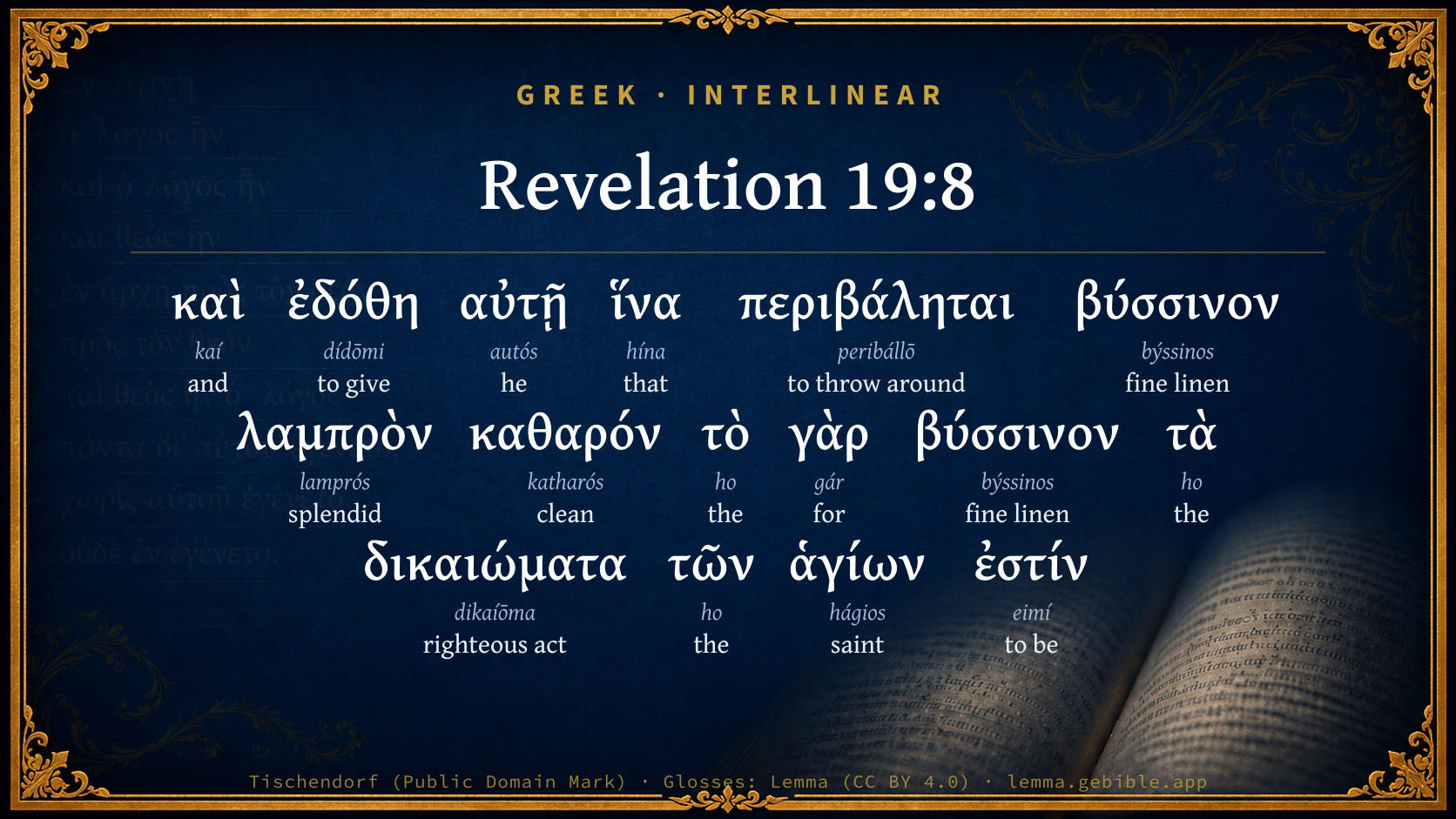
  1. καὶ kaí G2532 “and” Conjunction
  2. ἐδόθη dídōmi G1325 “to give” Verb, Aorist, Passive, Indicative, 3rd person, Singular
  3. αὐτῇ autós G846 “he” Personal pronoun, Dative, Singular, Feminine
  4. ἵνα hína G2443 “that” Conjunction
  5. περιβάληται peribállō G4016 “to throw around” Verb, Aorist, Middle, Subjunctive, 3rd person, Singular
  6. λαμπρὸν lamprós G2986 “splendid” Adjective, Accusative, Singular, Neuter
  7. καθαρόν katharós G2513 “clean” Adjective, Accusative, Singular, Neuter
  8. τὸ ho G3588 “the” Article, Nominative, Singular, Neuter
  9. γὰρ gár G1063 “for” Conjunction
  10. βύσσινον býssinos G1039 “fine linen” Adjective, Nominative, Singular, Neuter
  11. τὰ ho G3588 “the” Article, Nominative, Plural, Neuter
  12. δικαιώματα dikaíōma G1345 “righteous act” Noun, Nominative, Plural, Neuter
  13. τῶν ho G3588 “the” Article, Genitive, Plural, Masculine
  14. ἁγίων hágios G40 “saint” Adjective, Genitive, Plural, Masculine
  15. ἐστίν eimí G1510 “to be” Verb, Present, Active, Indicative, 3rd person, Singular

About this verse

These counts appear in no published source. They are computed here, from the morphology-tagged text and Lemma’s own curated glosses. What Lemma adds →

16
words
13
distinct lemmas
Revelation
section

Notable vocabulary

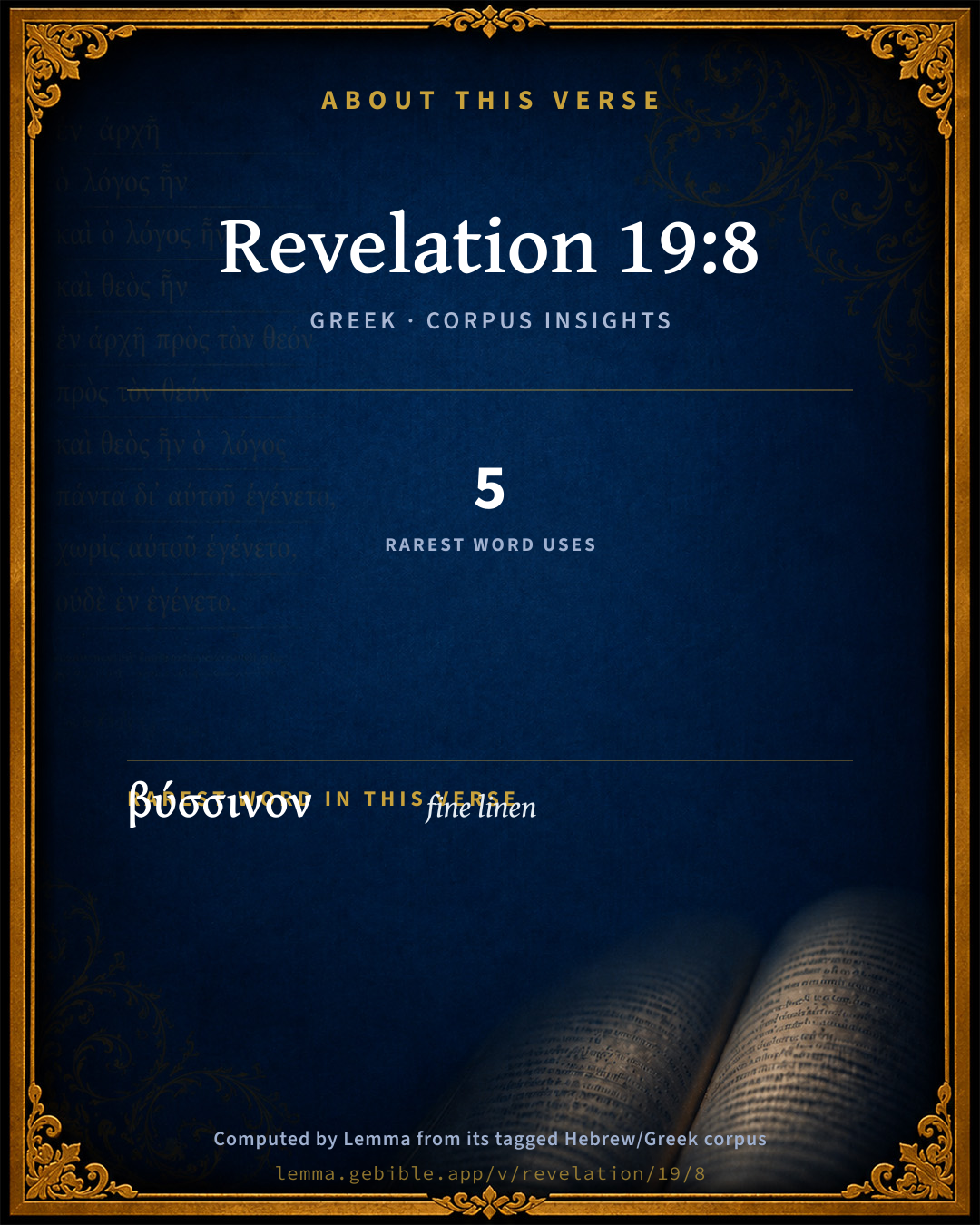
The rarest word here is βύσσινον fine linen G1039 — appearing just 5 times in the whole Greek New Testament.

Shared distinctive vocabulary

βύσσινον fine linen G1039 occurs in 4 verses of the Greek New Testament. Also found in:

Repetition

Words recur within this verse:

  • βύσσινον fine linen G1039 ×2
  • τὸ the G3588 ×3

Cross-references

16

Topical passages linked to Revelation 19:8 in the Treasury of Scripture Knowledge — connected by theme and wording, ordered by reader-vote popularity; previews shown in the World English Bible.

  • Isaiah 61:10 I will greatly rejoice in Yahweh, my soul shall be joyful in my God; for he has clothed me with the garments of salvation, he has covered me with the robe of righteousness, as a bridegroom decks himself with a garland, and as a bride adorns herself with her jewels.
  • Revelation 7:13–14 One of the elders answered, saying to me, "These who are arrayed in white robes, who are they, and from where did they come?"
  • Psalms 132:9 Let your priest be clothed with righteousness. Let your saints shout for joy!"
  • Ephesians 5:26–27 that he might sanctify it, having cleansed it by the washing of water with the word,
  • Ezekiel 16:10 I clothed you also with embroidered work, and shod you with sealskin, and I girded you about with fine linen, and covered you with silk.
  • Matthew 22:12 and he said to him, 'Friend, how did you come in here not wearing wedding clothing?' He was speechless.
  • Mark 9:3 His clothing became glistening, exceedingly white, like snow, such as no launderer on earth can whiten them.
  • Romans 13:14 But put on the Lord Jesus Christ, and make no provision for the flesh, for its lusts.
  • Revelation 3:4–5 Nevertheless you have a few names in Sardis that did not defile their garments. They will walk with me in white, for they are worthy.
  • Revelation 3:18 I counsel you to buy from me gold refined by fire, that you may become rich; and white garments, that you may clothe yourself, and that the shame of your nakedness may not be revealed; and eye salve to anoint your eyes, that you may see.
  • Revelation 15:4 Who wouldn't fear you, Lord, And glorify your name? For you only are holy. For all the nations will come and worship before you. For your righteous acts have been revealed."
  • Psalms 45:13–14 The princess inside is all glorious. Her clothing is interwoven with gold.
  • Luke 24:4 It happened, while they were greatly perplexed about this, behold, two men stood by them in dazzling clothing.
  • Acts 1:10 While they were looking steadfastly into the sky as he went, behold, two men stood by them in white clothing,
  • Romans 3:22 even the righteousness of God through faith in Jesus Christ to all and on all those who believe. For there is no distinction,
  • Matthew 17:2 He was transfigured before them. His face shone like the sun, and his garments became as white as the light.

Cross-references courtesy of OpenBible.info (CC BY 4.0).

Commentary

Notes on Revelation 19:8 from classic Christian and Jewish commentators (each source and its license shown beneath its notes). The classic Christian expositions comment on the surrounding passage and are grouped to its opening verse, so a note may address several verses; the Jewish commentaries on the Tanakh (Rashi and others) are per-verse, so they appear only where the commentator wrote on this verse.

Lemma curates 59 commentaries, every one of them public domain or Creative Commons licensed, each selected and text-cleaned for this edition rather than reprinted as found. About our sources →

Tyndale Open Study Notes

Tyndale Open Resources

19:8 finest . . . linen: See study note on 15:5-6. • the good deeds of God’s holy people: See Eph 2:8-10; 2 Tim 3:16-17; Jas 2:18-22.

Tyndale Open Study Notes — © Tyndale Open Resources, licensed CC BY-SA 4.0. Text via the HelloAO Bible API.

Bengel's Gnomon

Johann Albrecht Bengel

Rev 19:8. Γὰρ, for) A particle of explanation, as Rev 19:10.

Bengel's Gnomon of the New Testament — English translation (T&T Clark, Edinburgh, 1860) — public domain. Text from a community e-Sword module.

Expositor's Greek Testament

ed. W. Robertson Nicoll

Rev 19:8 . “Yea, she is (has been) permitted to put on” (for διδόναι ἵνα cf. Rev 9:5 , Mar 10:37 ), epexegetic of ἡτοιμ . ἑαυτήν (Isa 61:10 ). “Uides hic cultum gravem ut matronae, non pompaticum qualis meretricis ante (Rev 17:4 ) descriptus,” Grot. In the following gloss (see above) the rare use of δικαιώματα (= “righteous deeds”) is paralleled by Bar 2:19 ( τὰ δικ . τῶν πατέρων ) and by an incidental employment of the sing in this sense by Paul (see on Rom 5:18 ). Moral purity and activity, which are the conditions of future and final bliss, are (as in Rev 7:14 , Rev 14:4 ) defined as the outcome of human effort, although of course their existence must be referred to God ( ἐδόθη ), and their success to the aid of Christ ( loc. cit. ); see on Rev 1:4-6 . Ignatius similarly ( Eph. 10.) describes the saints as “robed entirely in the commandments of Christ”. The connexion of thought is the same as that in Mat 21:43 ; Mat 22:2 ; Mat 22:11-14 . For 8 b see the fontal passage from Sohar (cited by Gfrörer, ii. 184, 185): traditum est, quod opera bona ab homine hoc in mundo peracta, fiant ipsi uestis pretiosa in mundo illo.

The Expositor's Greek Testament, edited by W. Robertson Nicoll (1897–1910) — public domain. Text from a community e-Sword module.

Geneva Bible (1599)

Geneva Bible translators

Good works which are lively testimonies of faith.

As an ensign of Kingly and priestly dignity: which dignity Christ bestoweth upon us, Rev. 1:6.

This is a gift given by the husband for marriage sake and a most choice ornament, which Christ bestoweth upon us, as upon his spouse.

Geneva Bible (1599) marginal notes — public domain. Text via Bolls.life.

Jamieson, Fausset & Brown

Robert Jamieson, A. R. Fausset & David Brown

granted--Though in one sense she "made herself ready," having by the Spirit's work in her put on "the wedding garment," yet in the fullest sense it is not she, but her Lord, who makes her ready by "granting to her that she be arrayed in fine linen." It is He who, by giving Himself for her, presents her to Himself a glorious Church, not having spot, but holy and without blemish. It is He also who sanctifies her, naturally vile and without beauty, with the washing of water by the word, and puts His own comeliness on her, which thus becomes hers.

clean and white--so ANDREAS. But A and B transpose. Translate, "bright and pure"; at once brilliantly splendid and spotless as in the bride herself.

righteousness--Greek, "righteousnesses"; distributively used. Each saint must have this righteousness: not merely be justified, as if the righteousness belonged to the Church in the aggregate; the saints together have righteousnesses; namely, He is accounted as "the Lord our righteousness" to each saint on his believing, their robes being made white in the blood of the Lamb. The righteousness of the saint is not, as ALFORD erroneously states, inherent, but is imputed: if it were otherwise, Christ would be merely enabling the sinner to justify himself. Rom 5:18 is decisive on this. Compare Article XI, Church of England. The justification already given to the saints in title and unseen possession, is now GIVEN them in manifestation: they openly walk with Christ in white. To this, rather than to their primary justification on earth, the reference is here. Their justification before the apostate world, which had persecuted them, contrasts with the judgment and condemnation of the harlot. "Now that the harlot has fallen, the woman triumphs" [AUBERLEN]. Contrast with the pure fine linen (indicating the simplicity and purity) of the bride, the tawdry ornamentation of the harlot. Babylon, the apostate Church, is the antithesis to new Jerusalem, the transfigured Church of God. The woman (Rev 12:1-6), the harlot (Rev 17:1-7), the bride (Rev 19:1-10), are the three leading aspects of the Church.

Jamieson, Fausset & Brown — Commentary Critical and Explanatory on the Whole Bible (1871) — public domain (CC PDM 1.0). Text via the HelloAO Bible API.

Adam Clarke's Commentary

Verse 8. Arrayed in fine linen] A prediction that the Church should become more pure in her doctrines, more pious in her experience, and more righteous in her conduct, than she had ever been from her formation.

The fine linen here spoken of is not the righteousness of Christ imputed to believers, for it is here called the righteousness of the saints-that which the grace and Spirit of Christ has wrought in them.

Adam Clarke's Commentary on the Bible (1810–1826) — public domain. Text from a community e-Sword/MySword module.

Ellicott's Commentary for English Readers

(8) And to her was granted . . .—Better, And it was given to her that she should be clothed in fine linen, bright, pure; for the fine linen is the righteousness (or, righteousnesses; the word is plural) of the saints. This verse is not to be taken as part of the song. The song closes with the announcement that the Lamb’s wife has made herself ready. Then follows the explanation of this readiness: she is adorned in fine linen. Her apparel is in contrast to the harlot: it is not purple and scarlet (Rev_17:4; Rev_18:16), but pure white. The symbol is explained: “the fine linen is the righteousness (or, righteousnesses) of the saints.” The raiment is that which strikes the eye: it has its character, and it indicates the character of the wearer. The harlot attracts by ostentatious colours, the tokens of qualities more conspicuous than abiding, more dazzling than helpful; the Lamb’s wife is robed in pure and stainless white, the token of those high, moral, spiritual qualities by which she has been known. The source of these righteousnesses is divine: it is given to her to be so arrayed. It is no fictitious righteousness: it is real, it is hers, though it would never have been hers but for Him without whom she can do nothing (comp. Joh_15:4-5, and Php_3:8-10): and it is through the wearing of this white flower of a blameless life that she has borne witness for her Lord, and against the spirit of harlotry and sin (Mat_7:16-18).

A Bible Commentary for English Readers, edited by Charles John Ellicott (1878–1897) — public domain. Text from a community e-Sword module.

The Cambridge Bible for Schools and Colleges

gen. ed. J. J. S. Perowne

8. And to her was granted] Better, it was given to her—the form is the same as recurs so often throughout the vision, from Rev_6:2 onwards. This being so, it is not likely that this clause still forms part of the proclamation of the voice: it is the Seer’s description of the “making herself ready” which the voice proclaimed.

clean and white] The epithets should be transposed, and “and” omitted, bright clean fine linen.

the righteousness] Rather, the righteous acts. Every good work done by every single saint goes to make up the perfect glory of the Church as it shall be when at last complete. The doctrine of the Communion of Saints is contained in, or follows from, that of the holy Catholic Church.

The Cambridge Bible for Schools and Colleges (gen. ed. J. J. S. Perowne; Cambridge University Press, 1878–1918) — public domain. Text from a community e-Sword module.

John Gill's Exposition

And to her was granted that she should be arrayed in fine linen,.... Or "Byssine": the "Byssus", of which fine linen is made, is said to grow on a tree, in height like to a poplar, and its leaves like a willow, and to be brought out of Judea into Egypt, which the Egyptians used in most of their holy things (q). A dress neat and modest, and not like the attire of the whore of Rome, Rev 17:4 and this is said to be

clean and white, and is interpreted in the next clause:

for the fine linen is the righteousness of saints, or "righteousnesses"; not good works, or their own righteousness; for though these are evidences of faith, by which the saints are justified, and are what God has prepared for them, that they should walk in them; yet these are not comparable to fine linen, clean and white, but are like filthy rags, and cannot justify in the sight of God; but the righteousness of Christ is meant, and justification by that; for that is the only justifying righteousness of the saints: and though it is but one, yet it may be called "righteousnesses", or "justifications", in the plural number; partly because of the several seasons in which the act of justification passes, first in God's mind from eternity, next on Christ as the surety, when he rose from the dead, and on all the elect in him, and then in the consciences of the saints when they believe, and the sentence of it will be notified and declared to men and angels at the last judgment; and partly because of the many persons that are justified by it, as also because of the excellency of it; so the Jews use the word in the plural number: the Targumist on Zac 3:4 paraphrases the text, "I will clothe thee" "with righteousnesses" (r); upon which words Jarchi has this note,

"change of beautiful garments is all one as if it had been said "righteousnesses": and because sin is like to filthy garments, righteousness is like to garments beautiful and white.''

Christ's righteousness may be compared to fine linen, clean and white, because of its spotless purity; those that are arrayed with it being unblamable and irreprovable, and without spot and blemish, and without fault before the throne; with this the Jewish church will be clothed; all the Lord's people will be righteous, they will have on the best robe, and wedding garment, which was despised by the Jews in Christ's time, who refused to come to the marriage feast; and their being arrayed with it will be owing to the grace of Christ, who grants it; and so Christ's righteousness is called the gift of righteousness, the free gift, and gift by grace, and abundance of grace; and faith, which receives it, and puts it on, is the gift of God, Rom 5:15. Not only the garment is a gift of grace, but the putting of it on is a grant from Christ, and what he himself does, Isa 61:10.

(q) Philostrat. Vita Apollon. l. 2. c. 9. Vid. Apul. Apolog. p. 225. Pausan. l. 5. sive Eliac. p. 294. (r) See Isa. lxi. 10. & Targum in Hos. x. 12.

John Gill's Exposition of the Whole Bible (1746–1763) — public domain (CC PDM 1.0). Text via the HelloAO Bible API.

Trapp's Complete Commentary

John Trapp

8 And to her was granted that she should be arrayed in fine linen, clean and white: for the fine linen is the righteousness of saints.

Ver. 8. And to her was granted] It is here clear (saith Bernard) that there shall be as great difference between the state of God’s Church now, and that which is to come after Rome’s ruin, as between the time of honourable persons only betrothed, and the high, joyful, and glorious day of their public marrying; as between the time of a king coming on to his kingdom, and his actual and powerful reigning as king indeed.

That she should be arrayed] This also is given her, as well as her rich raiment; which she can no more put on by herself than she can purchase it.

Clean and white] Or, pure and bright. Pure, saith one, because imputed righteousness is pure indeed, and hath no spot in it; but not bright; you can see no great matter in it; it maketh no great show before men (as inherent righteousness doth, Mat 5:16), but before God. A man may be very much defiled and subject to many scandals, and yet be clothed with the garment of imputed righteousness.

The righteousness of saints] Gr. righteousnesses, that twofold righteousness, imputed and imparted.

John Trapp, A Commentary or Exposition upon All the Books of the Old and New Testament (1647–1656) — public domain. Text from a community e-Sword module.

Albert Barnes' Notes on the Bible

And to her was granted - It is not said here by whom this was granted, but it is perhaps implied that this was conferred by the Saviour himself on his bride.

That she should be arrayed in fine linen, clean and white - See the notes on Rev 3:4-5, Rev 3:18; Rev 7:13. White has, perhaps, in all countries been the usual color of the bridal dress - as an emblem of innocence.

For the fine linen is the righteousness of saints - Represents the righteousness of the saints; or is an emblem of it. It should be remarked, however, that it is implied here, as it is everywhere in the Scriptures, that this is not their own righteousness, for it is said that this was “given” to the bride - to the saints. It is the gracious bestowment of their Lord; and the reference here must be to that righteousness which they obtain by faith - the righteousness which results from justification through the merits of the Redeemer. Of this Paul speaks, when he says Phi 3:9, “And be found in him, not having mine own righteousness, which is of the law, but what is through the faith of Christ, the righteousness which is of God by faith.” Compare the notes on Rom 3:25-26.

Albert Barnes' Notes on the Bible (1834–1885) — public domain. Text from a community e-Sword/MySword module.

Haydock's Catholic Bible Commentary

Fine linen. The symbol of justification, or the good works and merit of her holy members; the most pleasing attire in which she can present herself to the Lamb. Her robe is glittering and white, because she has been purified as silver in a furnace, and washed white in the waters of tribulation and persecution. (Pastorini) --- The fine linen, or byssus, here mentioned, is, according to Calmet, a kind of silk produced by a shell-fish, called pinna; though the same learned commentator allows that the Greek authors use this word for fine linen.

George Leo Haydock (1774–1849), Haydock's Catholic Family Bible and Commentary, 1859 edition — public domain. Excludes Psalms (Douay-Rheims chapter numbering differs from Protestant) and Deuterocanonical books (Catholic canon only).

Matthew Poole's English Annotations

And to her was granted; that is, to the Lamb’s wife, whether Jews or Gentiles, or both.

That she should be arrayed in fine linen, clean and white; that she should be clothed with the righteousness of Christ, reckoned to her for righteousness. This

is the righteosness of the saints; called the righteousness of God, Rom 1:17; a righteousness through the faith of Christ, Phi 3:9; called righteousness, in the Greek, because there are many saints to be clothed with it; and because it is imputed both for justification and sanctificaion, not to excuse us from holiness, but to make up our defects.

Matthew Poole's English Annotations on the Holy Bible (1683–1685) — public domain. Text from a community e-Sword/MySword module.

The Pulpit Commentary

And to her was granted that she should be arrayed in fine linen, clean and white; and it was given unto her that she should array herself in fine linen, bright and pure. The double nature of the process is here set forth. "It was given her," the power comes from God, (cf. Rev_13:5, etc.) and yet "she arrays herself;" the action is still voluntary. (On "white linen," see on Rev_4:4 Rev_7:9 Rev_15:6) The following words are a sufficient commentary. This verse appears to contain the words of the writer, the heavenly song having ceased at the end of ver. 7. For the fine linen is the righteousness of saints; the righteous acts of the saints. That is, their former righteousness, exhibited in fidelity to God and hostility to the world, obtained and retained by the grace of God, now forms their chief glory. So "their works do follow them". (Rev_14:13)

The "linen" of Scripture.

"For the fine linen is the righteousness of saints." There are highways and byways of the Bible. Many think they have exhausted the Scriptures when they have traversed the King"s highway. But there are, as many a delighted traveller has found, byways less known, and far less frequented paths, which yield up to the explorer knowledge and beauty and good which they were ignorant of before. The land of Scripture is a glorious land. There is no region upon earth, however endowed with well nigh all forms and possibilities of the beautiful, that can compare, for variety and sublimity, for loveliness and richness, to the Word of God. But whilst we may be familiar with its main features, if we will be at the pains to search out its less-trodden paths and its hidden nooks and corners if we may so speak, it is wonderful what fresh interest and instruction may be often gained. Now, one of those more diligent searchers of the Bible (B. W. Newton) has noted the fact that there are three different kinds of linen spoken of in Scripture, and that the vestments made from them were worn on specific and appointed occasions; so that each kind of linen had its religious significance. Let us try and see what that was. Now, of this familiar fabric there were three different kinds.

1. The ordinary material, which gives the name to all varieties of it. The Greeks translated the Hebrew word and called it linon , as we also call it. Now, in four books of the Bible this common and inferior variety of linen is referred to. In Leviticus, twice.

(1) When the priest is renewing the fire upon the altar, that it may not go out. (Lev_6:10) He comes in the early morning, gathers up the ashes, etc. In doing this he was to wear a particular dress made of this linen.

(2) On the great Day of Atonement, (Le 16) Aaron and his sons are not to be arrayed in their "garments of glory and beauty," but in their plainest attire. Hence they were to put on vestments of this linen. In Ezekiel, (Eze_9:2, Eze_9:3, 11 10:2, 6, 7) where the vision of Jerusalem"s coming desolation is given. Ezekiel sees a man with an ink horn by his side, who is in company with five others. Their mission is to execute God"s vengeance; his, to report of it. Now, this man is dressed in this linen. Six times (see verses given) attention is called to this fact. In Daniel, (Dan_10:5) where a similar vision is recorded, the Divine messenger is dressed in like manner, and foretells the judgments of God. Then, in Rev_15:6, "the seven angels, having the seven last plagues," are arrayed in this linen.

2. Then there is a second and superior kind of this fabric, and of this we have a twofold mention. It is distinguished from the former by being called "fine linen," or "fine twisted linen." It was made not merely of a finer thread, but was composed of six threads twisted, and therefore called "fine twined linen." Now, this fabric formed the vestments of the chief and other priests when arrayed in their "garments of glory and beauty". (Exo_39:27) Then it was used also (Exo_26:1) for the hangings of the tabernacle, in the most holy place. There were ten of these, all made of this fine twined linen.

3. And there is a third and choicest kind of all, and to this we have several references. It was a most costly fabric, and of such fine and skilful manufacture that its whiteness came to have a "glistering," a bright and dazzling, appearance. It was of great value, and used only by monarchs and the very wealthy, or upon great occasions. As

(1) when David brought up the ark to Jerusalem from the house of Obededom, he was clothed, so we read, (1Ch_15:27) in a robe of this magnificent texture. There was a splendid procession, and all the tokens of the gladness and triumph which filled the hearts of king, people, and priests. David "danced before the Lord," thus vested in royal and priestly array.

(2) At the dedication of the temple by Solomon (2Ch_5:12) the priests were similarly arrayed.

(3) So in Mordecai"s triumph, (Est_8:15) there were put upon him royal apparel of blue and white, a great crown of gold, and a garment of fine linen. Now, our version, neither in the Old Testament nor in the New, ever distinguishes this most beautiful fabric from the others named above; but both in the Hebrew and Greek Scriptures it is clearly defined by the use of an entirely different word.

(4) In our Lord"s transfiguration, he was seen by the three disciples in raiment "white and glistering." This is probably an allusion to the known appearance of that rare and costly fabric of which we are now speaking.

(5) Finally, in our text, it is again named as the raiment of the redeemed. Now, on all these observe:

(a) That in each case there is an essential oneness. That which was worn was in substance the same in all. It was "linen, white and clean," which was on the priest when tending the altar fire, and on the Day of Atonement, as truly as when arrayed in their pontificals, their garments of glory and beauty, or as in the hangings of the most holy place. And so, too, in the raiment of the redeemed. It is essentially the same in all. Different in texture, but one in substance.

(b) When any particular form of this fabric is spoken of, it is always connected with one class of circumstances. The first is always associated with the ideas of sorrow, sin, judgment (cf. supra). The second, with the idea of God"s gracious acceptance. The priest is arrayed in garments of glory and beauty, to symbolize the honour and joy which are his as God"s accepted priest. And in the tabernacle hangings the same idea is set forth. The third, with glad triumph and glory won (cf. instances). Therefore inquire

I WHAT IS TAUGHT BY THE ESSENTIAL ONENESS OF THE FABRIC IN ALL ITS FORMS? In all there is the "linen, white and clean." This, therefore, tells of the common and essential qualification of all believers to be clothed with righteousness. And as it is "put on," something not inherent, but external, it shadows forth the righteousness which is ours in Christ, "who is made unto us Righteousness," who is "the Lord our Righteousness." Every one of us, in whatever stage of the Christian career at its beginning or at its consummation has his acceptance not in himself, but in Christ. He is "all and in all." "Him first, him midst, him last, and without end." That is the declaration of Scripture, of conscience, of right reason, of Christ"s people always and everywhere, and of this symbol of the" linen, white and clean.

II WHAT BY ITS VARIETIES? They tell of the different circumstances in which the believer is found.

1. The first tells of him as conscious of sin. He is a believer, a saved soul his raiment proven that; but when conscious of sin, garments of glory and beauty would be out of place.

(1) Thus, when conscious of sin"s magnitude and amount, as on the annual Day of Atonement, when Israel was commanded "to afflict their souls," the priests were to wear these vestments. And so before the altar, as the believer before the cross.

(2) Or of sin"s awful consequences. See Ezekiel; Daniel; seven angels (cf. supra). There, again, this raiment. Yes, if we be Christ"s, we shall often, daily, in our hours of confession and penitential prayer, be thus vested spiritually. But this not "the sorrow of the world," but that "godly sorrow" which worketh eternal life.

2. The second, as conscious of Christ. He is not only accepted, but conscious of it. Hence he wears the "garments of glory and beauty." It was fitting the priest should; it is fitting that we, when realizing that we are Christ"s and he ours, should in heart be vested thus. The symbolic "fine linen" clothed his limbs, the seat of his strength; was in the most holy place; was worn as a fair mitre upon his head; all this telling how his daily life, his approaches to God, his intercessions for others, were accepted of God. May not a man"s heart sing for joy, may he not spiritually put on this "fine linen," when he knows that he and all he does is accepted of the Lord?

3. As possessed of eternal glory. The source of his blessedness still the same, but now he realizes all he had anticipated. And, moreover, the righteousness which it was given him to put on has become a righteousness in him, and has developed in "righteous acts;" for so the Revised Version renders our text: "The fine linen is the righteous acts of the saints." It would be false to Scripture, to conscience, and to fact, to teach that all the righteousness needed for the bride of the Lamb is one that is put on as a vestment. No; it is one formed within also, and expressed in "righteous acts in that "holiness without which no man shall see the Lord.

Would we wear that splendid vestment at the last? Then see to it that we wear the plain one now. S.C.

The Pulpit Commentary (1880–1919), ed. H.D.M. Spence-Jones & Joseph S. Exell — public domain. Text from a community e-Sword module.

John Wesley's Explanatory Notes

And it is given to her - By God. The bride is all holy men, the whole invisible church. To be arrayed in fine linen, white and clean - This is an emblem of the righteousness of the saints - Both of their justification and sanctification.

John Wesley, Explanatory Notes Upon the Whole Bible (1754–1765) — public domain. Text via the GEBible commentary corpus.

Scofield Reference Notes

C. I. Scofield

righteousness

The garment is Scripture is a symbol of righteousness. In the bad ethical sense it symbolizes self-righteousness (e.g) Isa 64:6; Php 3:6-8 the best that a moral and religious man under law could do). In the good ethical sense the garment symbolizes "the righteousness of God.. .upon all them that believe."

(See Scofield "Rom 3:21").

The Scofield Reference Bible (1917 edition), notes by C. I. Scofield — public domain. Text from a community e-Sword module.

The People's New Testament

B. W. Johnson

8, 9. To her was granted. By divine grace. That she should be arrayed. She must be arrayed in spotless white. What this white raiment is not left in doubt. It is woven by the pure and holy lives of the saints.

B. W. Johnson's The People's New Testament with Notes (1889–1891) — public domain. Electronic text from the Christian Classics Ethereal Library (CCEL) ThML edition.

Cambridge Greek Testament for Schools and Colleges

8. καὶ ἐδόθη αὐτῇ. “It was given to her”—the form is the same as recurs so often throughout the vision, from Rev 6:2 onwards. This being so, it is not likely that this clause still forms part of the proclamation of the voice: it is the Seer’s description of the “making herself ready” which the voice proclaimed.

τὰ δικαιώματα, “righteous acts.” Every good work done by every single saint goes to make up the perfect glory of the Church as it shall be when at last complete. The doctrine of the Communion of Saints is contained in, or follows from, that of the holy Catholic Church.

Cambridge Greek Testament for Schools and Colleges (Cambridge University Press, 1896; 21 vols, various authors incl. Carr, Maclear, Plummer, Farrar, Lumby, Moule, M. R. James, Simcox) — public domain. Text from a community e-Sword module.

Vincent's Word Studies in the New Testament

Marvin R. Vincent

Fine linen [βυσσινον] . See on Luk 16:19. The four vestments of the ordinary Jewish priest were made of linen or byssus. Their symbolic meaning depended in part on the whiteness and luster of their substance [καθαρον και λαμπρον πυρε ανδ βριγητ] .

Righteousness [δικαιωματα] . More strictly, as Rev. righteous acts.

Marvin R. Vincent, Word Studies in the New Testament (1887–1900) — public domain. Text from a community e-Sword/MySword module.

Lesson kit

Teaching starters — assembled from the data on this page, not authored interpretation. Every prompt links to the verse data it draws on. Edit before teaching.

Revelation, in the Revelation, opens this verse with 16 words (13 distinct Greek lemmas). Its most distinctive word is býssinos (“fine linen”). A historical commentator’s framing appears above. Read the whole chapter for the surrounding context.

Discussion questions

  1. How does “fine linen” (býssinos) shape what this verse is saying?
  2. How does Revelation 18:12, which shares the word «fine linen», read alongside this verse?
  3. What does the repetition of “fine linen” (2× in this one verse) do in this verse?
  4. The translations on this page render this verse differently — a whole-verse word diff, not a word-by-word alignment. What might account for the different wordings?
  5. Compare how Tyndale Open Study Notes and Bengel's Gnomon read this verse. Where do they agree or differ?

Things to notice

  • These translations choose different wording for 18 words in this verse.
  • “fine linen” occurs 2× in this single verse.
  • 13 distinct Greek lemmas span 16 words in this verse.

Reading settings

Reading text

Shown beneath each verse's original-language words.

Old Testament
Old Testament edition

Read the OT as the Masoretic Hebrew (MT) or the Greek Septuagint (LXX).

English shown for the Greek Septuagint (in the Hebrew ↔ Greek comparison).

Comparing translations? Open the Compare panel on any verse page to stack up to four side by side.