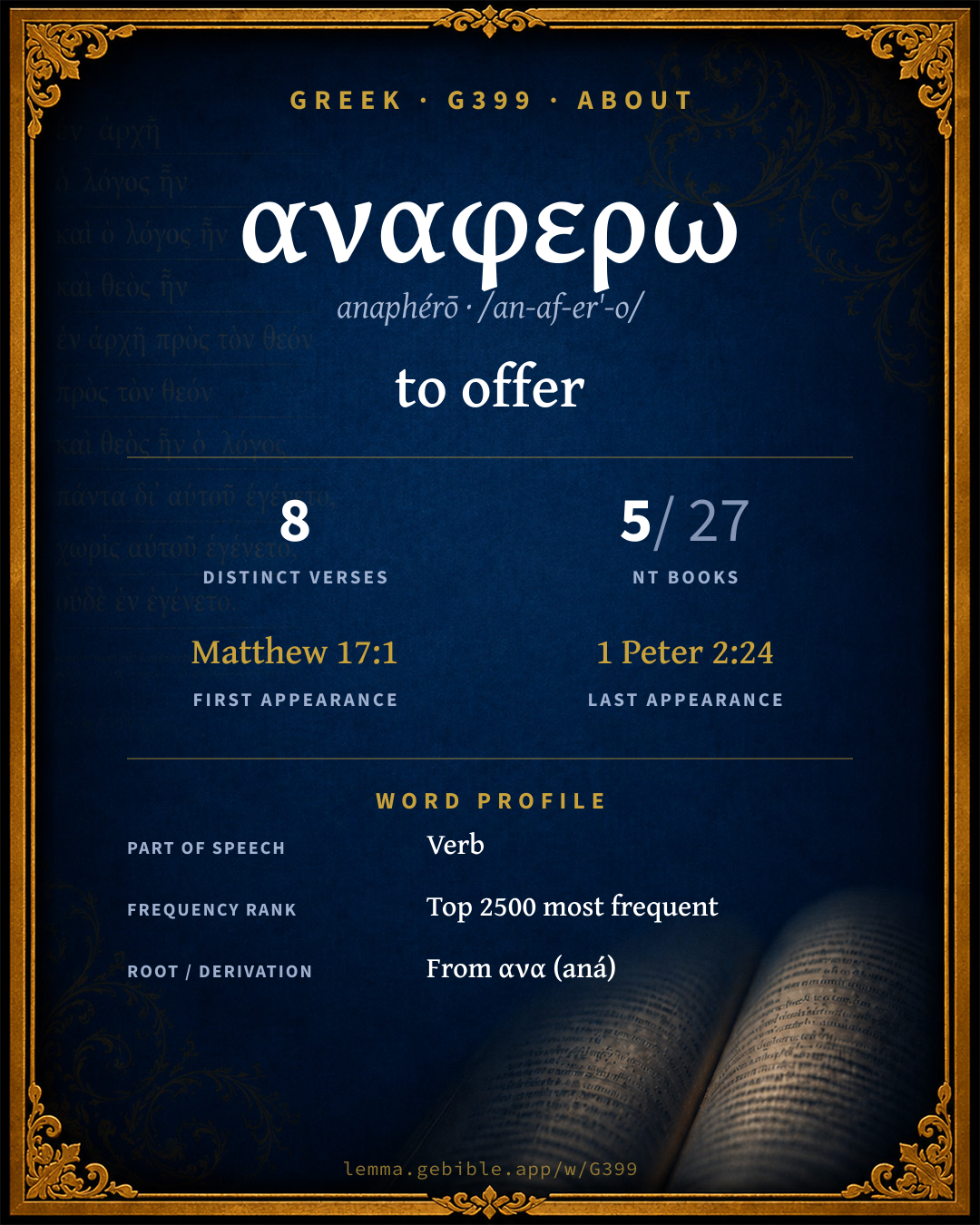
ἀναφέρω
to offer
‘to offer’ is one of 3 main senses fuller range ↓
Full lexicon entry — Thayer's Greek Lexicon
From Thayer's Greek Lexicon
Where this word appears
See every Aorist-tense verb in the Greek New Testament →
Grammar key — what these labels mean
Part of speech
- Verb
- An action or state-of-being word.
Tense
- Present
- Ongoing or general action in present time (imperfective aspect).
- Aorist
- Action viewed as a simple whole, without regard to duration — often past (perfective aspect).
Voice
- Active
- The subject performs the action.
Mood
- Indicative
- States a fact or asks a factual question (the mood of reality).
- Infinitive
- A verbal noun (“to write”), unmarked for person or number.
- Participle
- A verbal adjective (“writing,” “having written”).
- Subjunctive
- Expresses probability, purpose, or possibility (the mood of contingency).
Case
- Nominative
- The case of the subject (and the predicate nominative).
Person
- 3rd person
- The one spoken about (“he / she / it / they”).
- 1st person
- The speaker (“I / we”).
Gender
- Masculine
- Grammatically masculine.
Number
- Singular
- One.
- Plural
- More than one.
Grammatical forms
- Verb, Present, Active, Indicative, 3rd person, Singular 2 times (25%)
- Verb, Aorist, Active, Infinitive 2 times (25%)
- Verb, Aorist, Active, Indicative, 3rd person, Singular 1 time (13%)
- Verb, Aorist, Active, Participle, Nominative, Singular, Masculine 1 time (13%)
- Verb, Present, Active, Infinitive 1 time (13%)
- Verb, Present, Active, Subjunctive, 1st person, Plural 1 time (13%)
Parsed forms decoded from the imported morphology (Robinson–Tischendorf, public domain), counted across 8 parsed occurrences — not distinct verses.
Every verse where G399 appears — 8 distinct verses across 5 books. Click any verse to open its interlinear word-by-word view. Verse text shown in the World English Bible for context — . Each verse’s Greek form is shown with its reference; the English is not keyword-highlighted, since the data carries no word-level English alignment. Use “Compare translations” on any verse to read it across multiple English versions. This concordance covers the Greek New Testament; Septuagint (Greek Old Testament) occurrences of this word are not indexed here.
Matthew 1 verse
Mark 1 verse
Hebrews 3 verses
- Hebrews 7:27 ἀναφέρειν pres act inf who doesn't need, like those high priests, to daily offer up sacrifices, first for his own sins, and then for the sins of the people. For this he did once for all, when he offered up himself.
- Hebrews 9:28 ἀνενεγκεῖν aor act inf so Christ also, having been once offered to bear the sins of many, will appear a second time, without sin, to those who are eagerly waiting for him for salvation.
- Hebrews 13:15 ἀναφέρωμεν pres act subj 1pl Through him, then, let us offer up a sacrifice of praise to God continually, that is, the fruit of lips which make confession to his name.
James 1 verse
1 Peter 2 verses
- 1 Peter 2:5 ἀνενέγκαι aor act inf You also, as living stones, are built up as a spiritual house, to be a holy priesthood, to offer up spiritual sacrifices, acceptable to God through Jesus Christ.
- 1 Peter 2:24 ἀνήνεγκεν aor act ind 3sg who his own self bore our sins in his body on the tree, that we, having died to sins, might live to righteousness; by whose stripes you were healed.
About this entry
At a glance — auto-summarized from this page’s data, not written by a person. Every figure links to its source below. This summary describes the numbers; it doesn’t interpret them.
αναφερω — transliterated anaphérō — is a Greek verb carrying the sense “to offer.” Debuting at Matthew 17:1, it then recurs through the corpus. It appears 8 verses across 5 books of the Greek New Testament, among its uncommon vocabulary. More than a third of its appearances fall in Hebrews. Its lexical range runs to 3 senses. Each statement above links to its evidence; the full detail follows below.
Gloss history
Strong's 1890 vs modern scholarship

About this word
Strong's G399 catalogs a Greek word from the Greek New Testament.
These counts are not copied from any lexicon or concordance. They are computed here, from the morphology-tagged Greek New Testament. What Lemma adds →
- 8
- distinct verses
- The word appears in 8 distinct verses.
- 5 / 27
- NT books
- The word appears in 5 of 27 New Testament books.
- #1,240
- by frequency
- Top 2500 most frequent Greek words (rank 1,240 of 5,347 Greek words by occurrence).
View all 8 occurrences in the concordance →
By section of the New Testament
By traditional corpus
Conventional, traditional groupings — biblical authorship is debated, so this is a traditional corpus grouping, not an authorship claim. Some books belong to more than one corpus (Luke is in both the Gospels and the Lukan corpus, and so on), so these shares overlap and need not total 100%. Each figure is a share of the word’s 8 distinct verses.
- Hebrews 3 verses · 38%
- General (Catholic) Epistles 3 verses · 38%
- Gospels 2 verses · 25%
How translations render this word
Counts come from each version’s own published word-to-Strong’s tagging or interlinear alignment — an approximate guide to how each version renders this word, not a word-level alignment the data otherwise carries. Because each total is that version’s own tagged count, the per-version totals vary from one another and need not match the appearance or distinct-verse counts above. These counts may also differ from a printed concordance because Lemma counts each distinctly tagged rendering and does not collapse phrase taggings into a single head-word total. This is a fixed set of word-tagged versions (KJV, ASV, BSB, ULT) and does not change with the reading translation you choose elsewhere. Each version’s license is shown beside its name below (and on Sources).
- King James Version: Offer up 2×, Up 2×
- American Standard Version: Bringeth 2×, Offer up 2×, Up 2×
- Berean Standard Bible: Led them up 2×
- unfoldingWord Literal Text: Brings 2×, Offer up 2×, Up 2×
King James Version Public Domain
Renders G399 across 12 tagged occurrences — most commonly:
Plus 8 renderings that appear only once — usually multi-word phrases or single function words the recovered tagging swept in, not distinct renderings.
American Standard Version Public Domain
Renders G399 across 12 tagged occurrences — most commonly:
Plus 6 renderings that appear only once — usually multi-word phrases or single function words the recovered tagging swept in, not distinct renderings.
Berean Standard Bible Public Domain
Renders G399 across 10 tagged occurrences — most commonly:
Plus 8 renderings that appear only once — usually multi-word phrases or single function words the recovered tagging swept in, not distinct renderings.
unfoldingWord Literal Text CC BY-SA 4.0
Renders G399 across 13 tagged occurrences — most commonly:
Plus 7 renderings that appear only once — usually multi-word phrases or single function words the recovered tagging swept in, not distinct renderings.
Senses in Thayer's
The 3 senses Thayer's distinguishes for this word, in lexicon order (not ranked by frequency or importance). The full entry — with sub-senses — is in the Lexicon Entry tab.
- to carry or bring up, to lead up
- to put upon the altar, to bring to the altar, to offer
- to lift up one's self, to take upon one's self
Word origin
Derived from ανα (aná) (G303) — among.
Forms in the corpus
The 7 distinct written forms G399 takes in the Greek New Testament, most frequent first — each parse links to that tense’s occurrences in the concordance.
| Form | Parsing | Example | Uses |
|---|---|---|---|
| ἀναφέρει anaphérei | Verb, Present, Active, Indicative, 3rd person, Singular | Matthew 17:1 | 2 |
| ἀνήνεγκεν anḗnenken | Verb, Aorist, Active, Indicative, 3rd person, Singular | 1 Peter 2:24 | 1 |
| ἀναφέρειν anaphérein | Verb, Present, Active, Infinitive | Hebrews 7:27 | 1 |
| ἀναφέρωμεν anaphérōmen | Verb, Present, Active, Subjunctive, 1st person, Plural | Hebrews 13:15 | 1 |
| ἀνενέγκαι anenénkai | Verb, Aorist, Active, Infinitive | 1 Peter 2:5 | 1 |
| ἀνενέγκας anenénkas | Verb, Aorist, Active, Participle, Nominative, Singular, Masculine | James 2:21 | 1 |
| ἀνενεγκεῖν anenenkeîn | Verb, Aorist, Active, Infinitive | Hebrews 9:28 | 1 |
Same root — word family
Other Thayer's entries built from the same root as G399, grouped by Strong’s listed origin. These share a root / origin per the lexicon — not necessarily a shared meaning. Each links to that word’s own entry.
Derives from
Shares the same root
- αναβαινω anabaínō G305 to ascend
- αναβαλλομαι anabállomai G306 to delay
- αναβιβαζω anabibázō G307 to draw up
- αναβλεπω anablépō G308 to look up
- αναβοαω anaboáō G310 to cry out
- αναγγελλω anangéllō G312 to announce
- αναγενναω anagennáō G313 to be born again
- αναγινωσκω anaginṓskō G314 to recognize
- αναγκη anánkē G318 necessity
- αναγνωριζομαι anagnōrízomai G319 to recognize
- αναγω anágō G321 to lead up
- αναδεικνυμι anadeíknymi G322 to proclaim
- αναδεχομαι anadéchomai G324 to take up
- αναδιδωμι anadídōmi G325 to give forth
- αναζαω anazáō G326 to live again
- αναζητεω anazētéō G327 to search out
- αναζωννυμι anazṓnnymi G328 to gird up
- αναζωπυρεω anazōpyréō G329 to inflame
- αναθαλλω anathállō G330 to sprout up
- αναθεωρεω anatheōréō G333 to observe
- αναιρεω anairéō G337 to take away
- ανακαθιζω anakathízō G339 to sit up
- ανακαινιζω anakainízō G340 to renew
- ανακαινοω anakainóō G341 to make new
+51 more words share this root (not shown).
Compare all same-root words → Showing 4 of 77 — not the complete family. They share a root, not necessarily a meaning.
Septuagint usage
The same Greek word αναφερω appears 142 times in the Greek Old Testament (Septuagint), across 137 verses in 19 books.
- 142
- LXX occurrences
- Tagged occurrences of this Greek word in the Septuagint.
- 137
- verses
- Distinct Septuagint verses containing this word.
- 19 / 39
- OT books
- The word appears in 19 of the 39 Old Testament books.
Sample Septuagint occurrences
- Genesis 8:20 ἀναφέρω
- Exodus 13:19 ἀναφέρω
- Leviticus 2:16 ἀναφέρω
- Numbers 5:26 ἀναφέρω
- Deuteronomy 1:17 ἀναφέρω
- Judges 6:26 ἀναφέρω
- 1 Samuel 2:19 ἀναφέρω
- 2 Samuel 1:24 ἀναφέρω
- 1 Kings 2:35 ἀναφέρω
- 2 Kings 3:27 ἀναφέρω
- 1 Chronicles 15:3 ἀναφέρω
- 2 Chronicles 1:4 ἀναφέρω
Septuagint occurrences (same lexeme)
Every verse where the same Strong’s number (G399) appears in the Greek Septuagint — showing the first 50 of 137. Verse text shown in the World English Bible for context; the Greek form is the matched word — the English is not keyword-highlighted.
- Genesis 8:20 ἀναφέρω Noah built an altar to Yahweh, and took of every clean animal, and of every clean bird, and offered burnt offerings on the altar.
- Genesis 22:2 ἀναφέρω He said, "Now take your son, your only son, whom you love, even Isaac, and go into the land of Moriah. Offer him there for a burnt offering on one of the mountains which I will tell you of."
- Genesis 22:13 ἀναφέρω Abraham lifted up his eyes, and looked, and saw that behind him was a ram caught in the thicket by his horns. Abraham went and took the ram, and offered him up for a burnt offering instead of his son.
- Genesis 31:39 ἀναφέρω That which was torn of animals, I didn't bring to you. I bore the loss of it. Of my hand you required it, whether stolen by day or stolen by night.
- Genesis 40:10 ἀναφέρω and in the vine were three branches. It was as though it budded, its blossoms shot forth, and the clusters of it brought forth ripe grapes.
- Genesis 50:25 ἀναφέρω Joseph took an oath of the children of Israel, saying, "God will surely visit you, and you shall carry up my bones from here."
- Exodus 13:19 ἀναφέρω Moses took the bones of Joseph with him, for he had made the children of Israel swear, saying, "God will surely visit you, and you shall carry up my bones away from here with you."
- Exodus 18:19 ἀναφέρω Listen now to my voice. I will give you counsel, and God be with you. You represent the people before God, and bring the causes to God.
- Exodus 18:22 ἀναφέρω Let them judge the people at all times. It shall be that every great matter they shall bring to you, but every small matter they shall judge themselves. So shall it be easier for you, and they shall share the load with you.
- Exodus 18:26 ἀναφέρω They judged the people at all times. They brought the hard causes to Moses, but every small matter they judged themselves.
- Exodus 19:8 ἀναφέρω All the people answered together, and said, "All that Yahweh has spoken we will do." Moses reported the words of the people to Yahweh.
- Exodus 24:5 ἀναφέρω He sent young men of the children of Israel, who offered burnt offerings and sacrificed peace-offerings of oxen to Yahweh.
- Exodus 29:18 ἀναφέρω You shall burn the whole ram on the altar: it is a burnt offering to Yahweh; it is a sweet savor, an offering made by fire to Yahweh.
- Exodus 29:25 ἀναφέρω You shall take them from their hands, and burn them on the altar on the burnt offering, for a sweet savor before Yahweh: it is an offering made by fire to Yahweh.
- Exodus 30:9 ἀναφέρω You shall offer no strange incense on it, nor burnt offering, nor meal-offering; and you shall pour no drink-offering on it.
- Exodus 30:20 ἀναφέρω When they go into the tent of meeting, they shall wash with water, that they not die; or when they come near to the altar to minister, to burn an offering made by fire to Yahweh.
- Leviticus 2:16 ἀναφέρω The priest shall burn as its memorial, part of its bruised grain, and part of its oil, along with all its frankincense: it is an offering made by fire to Yahweh.
- Leviticus 3:5 ἀναφέρω Aaron's sons shall burn it on the altar on the burnt offering, which is on the wood that is on the fire: it is an offering made by fire, of a sweet savor to Yahweh.
- Leviticus 3:11 ἀναφέρω The priest shall burn it on the altar: it is the food of the offering made by fire to Yahweh.
- Leviticus 3:14 ἀναφέρω He shall offer from it as his offering, an offering made by fire to Yahweh; the fat that covers the innards, and all the fat that is on the innards,
- Leviticus 3:16 ἀναφέρω The priest shall burn them on the altar: it is the food of the offering made by fire, for a sweet savor; all the fat is Yahweh's.
- Leviticus 4:10 ἀναφέρω as it is taken off of the ox of the sacrifice of peace offerings. The priest shall burn them on the altar of burnt offering.
- Leviticus 4:19 ἀναφέρω All its fat he shall take from it, and burn it on the altar.
- Leviticus 4:26 ἀναφέρω All its fat he shall burn on the altar, like the fat of the sacrifice of peace offerings; and the priest shall make atonement for him concerning his sin, and he will be forgiven.
- Leviticus 4:31 ἀναφέρω All its fat he shall take away, like the fat is taken away from off of the sacrifice of peace offerings; and the priest shall burn it on the altar for a sweet savor to Yahweh; and the priest shall make atonement for him, and he will be forgiven.
- Leviticus 6:8 ἀναφέρω Yahweh spoke to Moses, saying,
- Leviticus 6:19 ἀναφέρω Yahweh spoke to Moses, saying,
- Leviticus 7:5 ἀναφέρω and the priest shall burn them on the altar for an offering made by fire to Yahweh: it is a trespass offering.
- Leviticus 7:31 ἀναφέρω The priest shall burn the fat on the altar, but the breast shall be Aaron's and his sons'.
- Leviticus 8:16 ἀναφέρω He took all the fat that was on the innards, and the cover of the liver, and the two kidneys, and their fat; and Moses burned it on the altar.
- Leviticus 8:20 ἀναφέρω He cut the ram into its pieces; and Moses burned the head, and the pieces, and the fat.
- Leviticus 8:21 ἀναφέρω He washed the innards and the legs with water; and Moses burned the whole ram on the altar. It was a burnt offering for a sweet savor. It was an offering made by fire to Yahweh; as Yahweh commanded Moses.
- Leviticus 8:27 ἀναφέρω He put all these in Aaron's hands and in his sons' hands, and waved them for a wave offering before Yahweh.
- Leviticus 8:28 ἀναφέρω Moses took them from their hands, and burned them on the altar on the burnt offering. They were a consecration for a sweet savor. It was an offering made by fire to Yahweh.
- Leviticus 9:10 ἀναφέρω but the fat, and the kidneys, and the cover from the liver of the sin offering, he burned upon the altar; as Yahweh commanded Moses.
- Leviticus 9:20 ἀναφέρω and they put the fat upon the breasts, and he burned the fat on the altar:
- Leviticus 14:20 ἀναφέρω and the priest shall offer the burnt offering and the meal offering on the altar. The priest shall make atonement for him, and he shall be clean.
- Leviticus 16:25 ἀναφέρω The fat of the sin offering he shall burn on the altar.
- Leviticus 17:5 ἀναφέρω This is to the end that the children of Israel may bring their sacrifices, which they sacrifice in the open field, that they may bring them to Yahweh, to the door of the Tent of Meeting, to the priest, and sacrifice them for sacrifices of peace offerings to Yahweh.
- Leviticus 17:6 ἀναφέρω The priest shall sprinkle the blood on the altar of Yahweh at the door of the Tent of Meeting, and burn the fat for a sweet savor to Yahweh.
- Leviticus 23:11 ἀναφέρω and he shall wave the sheaf before Yahweh, to be accepted for you. On the next day after the Sabbath the priest shall wave it.
- Numbers 5:26 ἀναφέρω The priest shall take a handful of the meal offering, as the memorial of it, and burn it on the altar, and afterward shall make the woman drink the water.
- Numbers 14:33 ἀναφέρω Your children shall be wanderers in the wilderness forty years, and shall bear your prostitution, until your dead bodies be consumed in the wilderness.
- Numbers 18:17 ἀναφέρω But the firstborn of a cow, or the firstborn of a sheep, or the firstborn of a goat, you shall not redeem; they are holy: you shall sprinkle their blood on the altar, and shall burn their fat for an offering made by fire, for a sweet savor to Yahweh.
- Numbers 23:2 ἀναφέρω Balak did as Balaam had spoken; and Balak and Balaam offered on every altar a bull and a ram.
- Numbers 23:30 ἀναφέρω Balak did as Balaam had said, and offered up a bull and a ram on every altar.
- Deuteronomy 1:17 ἀναφέρω You shall not show partiality in judgment; you shall hear the small and the great alike; you shall not be afraid of the face of man; for the judgment is God's: and the cause that is too hard for you, you shall bring to me, and I will hear it.
- Deuteronomy 12:13 ἀναφέρω Take heed to yourself that you don't offer your burnt offerings in every place that you see;
- Deuteronomy 12:14 ἀναφέρω but in the place which Yahweh shall choose in one of your tribes, there you shall offer your burnt offerings, and there you shall do all that I command you.
- Deuteronomy 12:27 ἀναφέρω and you shall offer your burnt offerings, the flesh and the blood, on the altar of Yahweh your God; and the blood of your sacrifices shall be poured out on the altar of Yahweh your God; and you shall eat the flesh.
These are occurrences of the same Greek lexeme (G399) in the Septuagint — not a translation of any one Hebrew word. The store carries no word-level Hebrew↔Greek alignment, so no Hebrew original is asserted here. Counts come from the recovered LXX Strong's tagging — high-frequency vocabulary is well covered, while rare or late forms may be untagged — so they reflect tagged occurrences and may slightly undercount.