
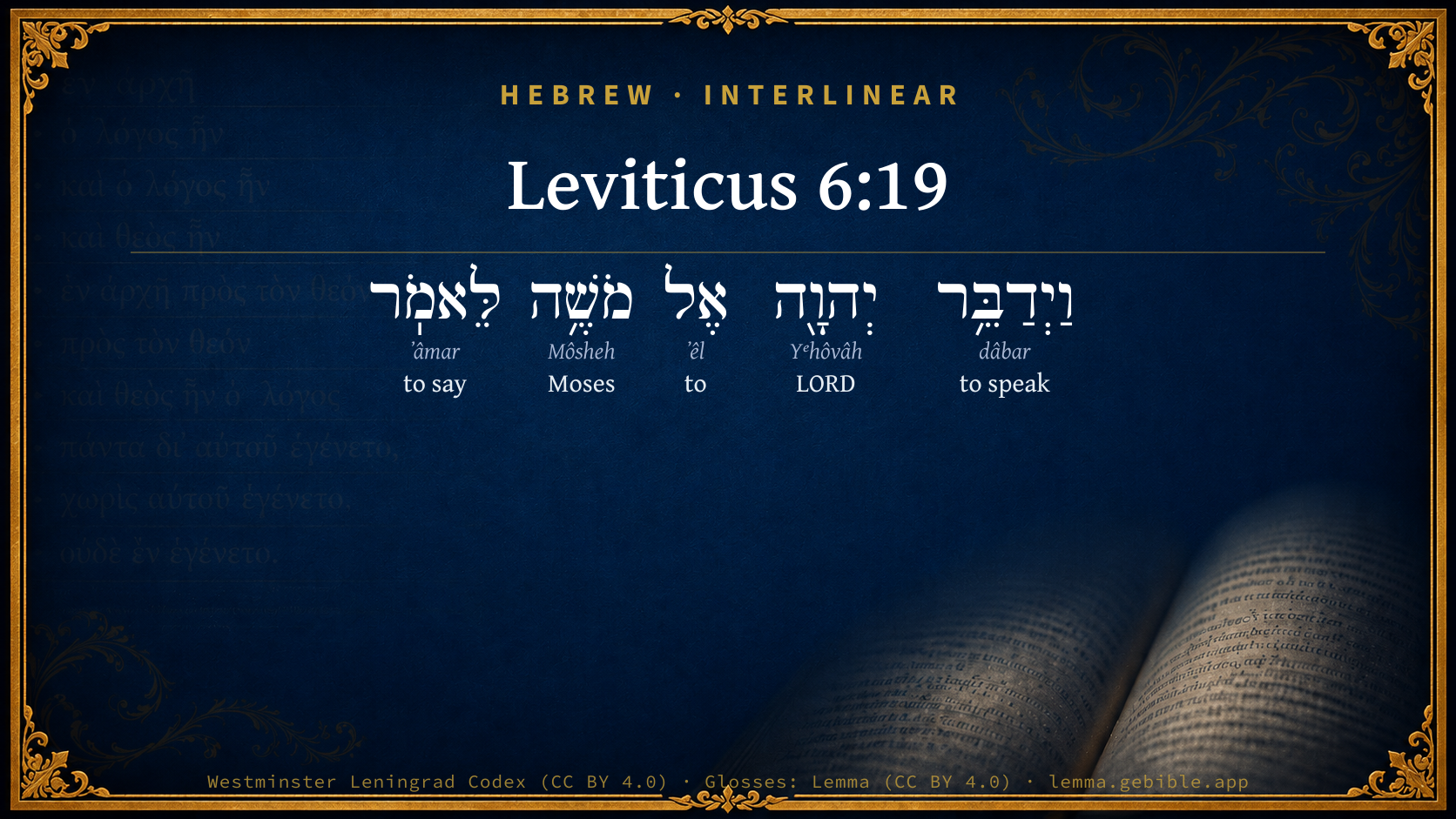
Leviticus 6:19

Hebrew (Westminster Leningrad Codex) Leviticus 6:19 appears in the Hebrew Old Testament. The text above is from the Westminster Leningrad Codex. Each word links to its Strong’s number, a concise gloss, and parsing drawn from the Open Scriptures Hebrew Bible morphology. Click any word for its full Brown-Driver-Briggs (BDB) entry.
Download image
Cite this verse

Leviticus 6:19 (World English Bible). Public Domain. Lemma interlinear Bible study tool, https://lemma.gebible.app/v/leviticus/6/19.

Show BibTeX & RIS
BibTeX
RIS
English Translation
Yahweh spoke to Moses, saying,
World English Bible · Public Domain
Download a study sheet

One document with this verse’s original text, its word-by-word gloss line, the meaning frame, cross-references with their text, attributed commentary, and full source and license credits — printable, and it pastes into notes with its structure intact.

This verse Autodidact and up

Study sheet (.html) Plain text (.txt)

A passage Seminary Student

Up to 50 verses in one chapter. A passage sheet keeps up to 6 commentary sources and 12 cross-references per verse, in the order this page ranks them, and says so on the sheet whenever that leaves anything out. Ask for a single verse and you get the Autodidact verse sheet above.

Everything on this page stays free to read, with no account — the sheet is a download of what is already on screen, not access to it.

Want to remove ads? Support Godless Engineer
Compare translations 3

The same verse in 3 English versions, stacked beneath the original-language interlinear above. Click any original word for its lexicon entry.

Each is an independent rendering of the whole verse — the interlinear is not word-aligned to these translations.

Highlighted words mark where these versions differ — a whole-verse word diff, not a word-by-word alignment.

  • World English Bible Public Domain
    Yahweh spoke to Moses, saying,
  • King James Version Public Domain
    And the LORD spake unto Moses, saying,
  • unfoldingWord Literal Text CC BY-SA 4.0
    And Yahweh spoke to Moses, saying,

unfoldingWord Literal Text — © unfoldingWord, licensed CC BY-SA 4.0. Word-aligned USFM3 via Door43 (git.door43.org/unfoldingWord/en_ult).

Versions to compare (up to 4)

3 of 4 selected

Show all 18 translations

Every available English version of this verse, each an independent rendering of the whole verse.

  • World English Bible Public Domain
    Yahweh spoke to Moses, saying,
  • Berean Standard Bible Public Domain
    Then the LORD said to Moses,
  • Majority Standard Bible Public Domain
    Then the LORD said to Moses,
  • King James Version Public Domain
    And the LORD spake unto Moses, saying,
  • American Standard Version (1901) Public Domain
    And Jehovah spake unto Moses, saying,
  • Revised Version (1885) Public Domain
    And the LORD spake unto Moses, saying,
  • Geneva Bible (1599) Public Domain
    Agayne the Lord spake vnto Moses, saying,
  • Douay-Rheims (1899) Public Domain
    And the Lord spoke to Moses, saying:
  • Young's Literal Translation Public Domain
    And Jehovah speaketh unto Moses, saying,
  • Literal Standard Version CC BY-SA 4.0
    And YHWH speaks to Moses, saying,
  • Unlocked Literal Bible CC BY-SA 4.0
    So Yahweh spoke to Moses again, saying,
  • unfoldingWord Literal Text CC BY-SA 4.0
    And Yahweh spoke to Moses, saying,
  • Darby Bible Public Domain
    And Jehovah spoke to Moses, saying,
  • World Messianic Bible Public Domain
    The LORD spoke to Moses, saying,
  • Webster's Bible Public Domain
    \\6:26\\The priest that offereth it for sin shall eat it: in the holy place shall it be eaten, in the court of the tabernacle of the congregation.
  • Free Bible Version CC BY-SA 4.0
    The Lord told Moses,
  • Bible in Basic English Public Domain
    The priest by whom it is offered for sin, is to take it for his food in a holy place, in the open space of the Tent of meeting.
  • JPS Tanakh (1917) Public Domain
    (6-12) And the LORD spoke unto Moses, saying:

Literal Standard Version (2020), Covenant Press — licensed CC BY-SA 4.0. Text via the HelloAO Bible API (eBible.org). Unlocked Literal Bible (unfoldingWord) — licensed CC BY-SA 4.0. Text via the HelloAO Bible API (eBible.org). unfoldingWord Literal Text — © unfoldingWord, licensed CC BY-SA 4.0. Word-aligned USFM3 via Door43 (git.door43.org/unfoldingWord/en_ult). Free Bible Version, Dr. Jonathan Gallagher — licensed CC BY-SA 4.0. Text via the HelloAO Bible API (eBible.org).

Word by word

More ways to search: Search by grammar → Find every occurrence → Compare this word →

Practice this passage: Drill this verse → Learn its vocabulary →

About this verse

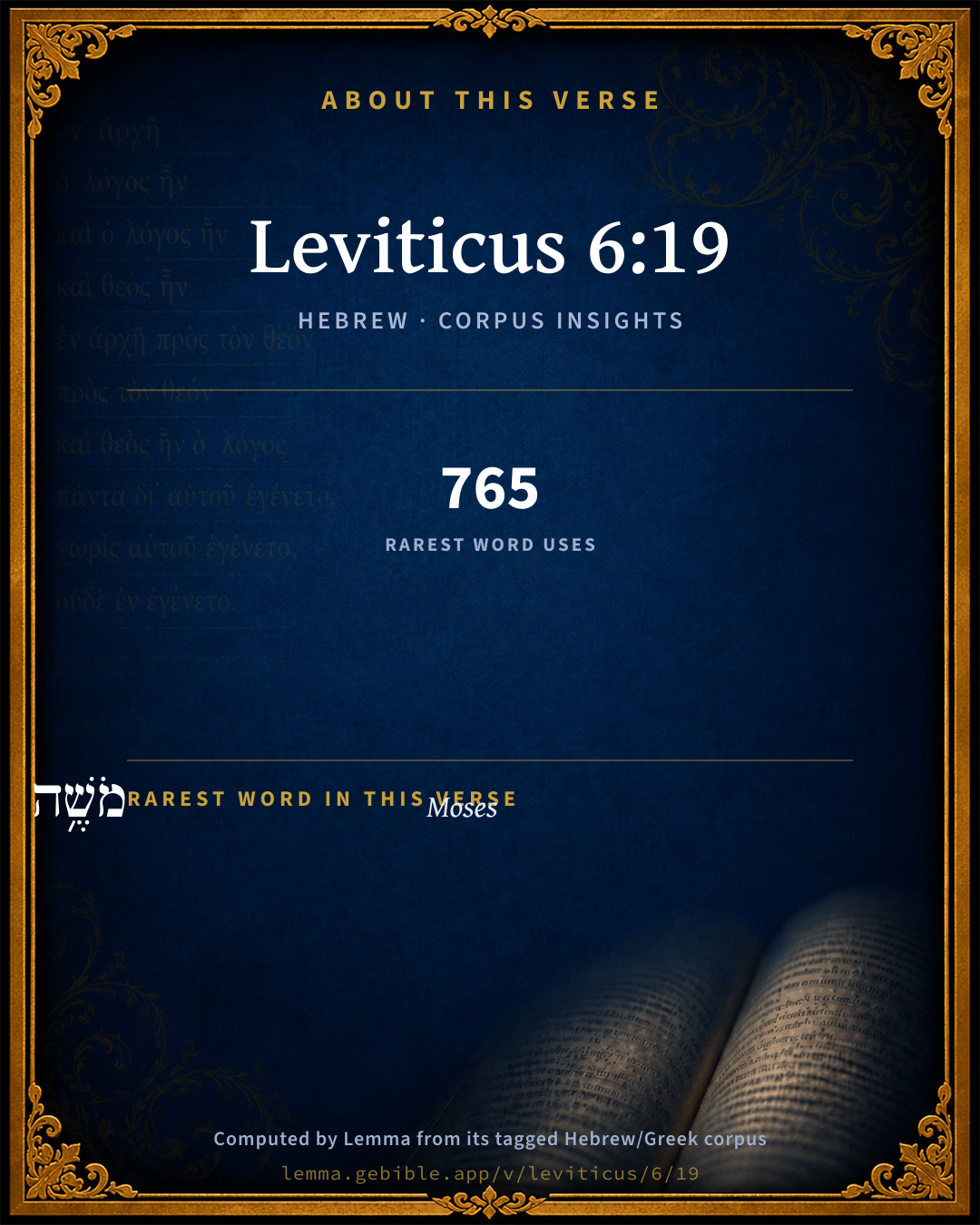
These counts appear in no published source. They are computed here, from the morphology-tagged text and Lemma’s own curated glosses. What Lemma adds →

5
words
5
distinct lemmas
Pentateuch
section

Grammatical profile

  • 2 verbs
  • 2 nouns
  • 1 preposition

Verb forms

  • וַיְדַבֵּ֥ר Piel · Sequential Imperfect
  • לֵּאמֹֽר Qal · Infinitive Construct

Hebrew & Septuagint length

In English translation the verse runs 5 words from the Hebrew and 7 from the Septuagint (LXX English) — closely comparable.

A rough comparison of the two English renderings, which tokenize alike — not a word-level alignment.

Word counts can differ between the Hebrew and the Greek without any difference in meaning — e.g. the Hebrew direct-object marker אֵת has no separate Greek word, and Greek often adds the article ὁ.

Hebrew and Greek witnesses Masoretic Hebrew ↔ Greek Septuagint

The same verse in the two great witnesses to the Old Testament, shown verse-for-verse.

These are two independent witnesses, not word-aligned to each other, and the Septuagint is shown in lemma (dictionary) form.

Hebrew Leviticus 6:19 Masoretic · Westminster Leningrad Codex

וַיְדַבֵּ֥ר יְהוָ֖ה אֶל מֹשֶׁ֥ה לֵּאמֹֽר

Yahweh spoke to Moses, saying,

World English Bible · Public Domain

Greek LXX Leviticus 6:19 Septuagint · lemma form

ὁ ἱερεύς ὁ ἀναφέρω αὐτός ἐσθίω αὐτός ἐν τόπος ἅγιος βιβρώσκω ἐν αὐλή ὁ σκηνή ὁ μαρτύριον

And the Lord spoke to Moses, saying,

LXX2012 (modern English Septuagint) · Public Domain

On this verse, The Cambridge Bible for Schools and Colleges discusses the Septuagint’s reading. Read the note in Commentary ↓

Hebrew: Westminster Leningrad Codex (CC BY 4.0). Greek: Septuagint (public domain); English from LXX2012 (modern English Septuagint) (Public Domain). How the Septuagint differs from the Hebrew →

Targum (Aramaic paraphrase)

2

The Targum is the ancient Jewish Aramaic paraphrase of the Hebrew Scriptures — an interpretive translation, not the Hebrew text itself. Onkelos (literal) and Pseudo-Jonathan (expansive) render the Torah, and Jonathan the Prophets. Coverage is partial: where no permissively-licensed English translation exists for a verse, only the Aramaic is shown. This is verse-level text, not a word-by-word alignment to the Hebrew.

  1. Targum Onkelos Torah (Genesis–Deuteronomy)
    כַּהֲנָא דִמְכַפֵּר בִּדְמַהּ יֵיכְלִנַהּ בַּאֲתַר קַדִישׁ תִּתְאֲכֵל בְּדָרַת מַשְׁכַּן זִמְנָא

    (no public-domain English translation for this verse)

    Targum Onkelos — Aramaic: “Onkelos Genesis” (public domain); “Onkelos Exodus” (public domain); “Onkelos Leviticus” (public domain); “Onkelos Numbers” (public domain); “Onkelos Deuteronomy” (public domain). English: “Sefaria Community Translation” (CC0 1.0 (public-domain dedication)); “J.W. Etheridge. The Targums of Onkelos and Jonathan Ben Uzziel on the Pentateuch. London: Longmans, Green, 1862” (public domain). Text via Sefaria.

  2. Targum Pseudo-Jonathan Torah (Genesis–Deuteronomy)
    כַּהֲנָא דִי מְכַפֵּר בְּאַדְמָא יֵיכְלוּנָהּ בַּאֲתַר קַדִישׁ תִּתְאָכֵל בְּדָרַת מַשְׁכַּן זִימְנָא

    The priest who maketh atonement with blood may eat of it in the holy place; it shall be eaten in the court of the tabernacle of ordinance;

    Targum Pseudo-Jonathan — Aramaic: “Targum Jonathan on Genesis” (public domain); “Targum Jonathan on Exodus” (public domain); “Targum Jonathan on Leviticus” (public domain); “Targum Jonathan on Numbers” (public domain); “Targum Jonathan on Deuteronomy” (public domain). English: “The Targum of Jonathan ben Uzziel, trans. J. W. Etheridge, London, 1862” (public domain). Text via Sefaria.

Commentary

Notes on Leviticus 6:19 from classic Christian and Jewish commentators (each source and its license shown beneath its notes). The classic Christian expositions comment on the surrounding passage and are grouped to its opening verse, so a note may address several verses; the Jewish commentaries on the Tanakh (Rashi and others) are per-verse, so they appear only where the commentator wrote on this verse.

Lemma curates 59 commentaries, every one of them public domain or Creative Commons licensed, each selected and text-cleaned for this edition rather than reprinted as found. About our sources →

Ellicott's Commentary for English Readers

(19) And the Lord spake unto Moses.—The new law, which is here introduced with this special formula (see Lev_6:8), gives directions about the meat offering which the high priest is to bring on his consecration to the pontifical office (Lev_6:19-23). It naturally follows the sacrificial instructions given for the priests in the preceding section.

A Bible Commentary for English Readers, edited by Charles John Ellicott (1878–1897) — public domain. Text from a community e-Sword module.

The Cambridge Bible for Schools and Colleges

gen. ed. J. J. S. Perowne

(3) The Meal-Offering of the high priest (19–23) 1[48]

[48] This section is omitted by the Alexandrine MS. of the LXX. The omission is probably accidental, and caused by the fact that sections 19–23 and 24–30 begin with the same words.

These verses differ from the other precepts with reference to sacrifice in Lev_6:7 to Lev_7:21. They are not introduced by the words ‘This is the law of …,’ and addressed through Moses to Aaron and his sons, but are spoken directly to Moses (note the verbs in the 2nd person in Lev_6:21). The command to present the Meal-Offering implies that Moses was officiating as priest, and he is represented as discharging this function during the seven days in which Aaron and his sons were consecrated; after that period all sacrificial acts were performed by Aaron and his sons (cp. chs. 8 and 9). The words ‘in the day when he [Aaron] is anointed’ (19) also connect the offering with the ceremony of consecration, and with the first of the seven days, or, if the words ‘in the day when’ be taken as ‘at the time when’ (cp. Gen_2:4), with the period of seven days. Neither in the detailed account of this consecration given in ch. 8 nor in the directions contained in Exodus 29 is there any reference to the offering enjoined in Lev_6:21.

Note on Lev_6:19-23

According to Jewish practice in the second temple, the high priest offered a minḥah every day during his tenure of office (Sir_45:14) at his own expense (Jos. Ant. iii. 10. 7). He brought the whole tenth part in the morning and divided it into two portions for the morning and evening. If the high priest after offering the morning portion were to die the remaining evening portion was not to be offered, but a fresh whole tenth part was to be brought, from which the half for the evening was taken, and the two unused halves were to be destroyed (Tal. Bab. Menaḥoth 50 b). This offering of the high priest was regarded as made, not on his behalf alone, but for himself and the priesthood. It was called minḥath ḥǎbittîm, ‘the minchah of baked pieces.’ The word ḥǎbittîm occurs once in 1Ch_9:31, and is from the same root as maḥǎbath, the ‘baking pan’ of Lev_2:5, Lev_6:21 [Heb. 14], and Lev_7:9, used for the Meal-Offering.

Beside this daily offering of the high priest, every priest, at the commencement of his ministry, used to offer a Meal-Offering like that of the high priest, but instead of dividing it into two parts, to be offered in the morning and in the evening, it was offered all at one time. This oblation was called minḥath ḥinnûḳ, ‘meal offering of initiation.’

In the present state of the text, reference is made to two offerings:

(1) An offering to be brought by Moses (cp. Lev_6:19; Lev_6:21).

(2) An offering to be brought by Aaron’s successors in the high priestly office (Lev_6:22).

If two such offerings are enjoined, it seems probable that some further discrimination between them would have been made. Two suggestions may be offered, each involving a slight modification of the text:

(a) The introductory sentence in Lev_6:19 may have contained the additional clause ‘Speak unto’ or ‘Command Aaron and his sons, saying,’ as in Lev_6:9; Lev_6:25. The instructions in Lev_6:21 would then be addressed to Aaron, and the change of person in the verbs, though abrupt, is not without parallels in other parts of the legislation.

(b) The verbs in Lev_6:21 may have been originally in the third person, and the verse would then refer to an offering by Aaron.

In either case, the whole passage would be interpreted with reference to an offering brought by Aaron and his successors, such as that described in Josephus and in the Mishna. Whether in Lev_6:22 (the general rule about the Meal-Offering of the priest) there is any reference to the minḥath ḥinnûḳ is a question to which no definite answer can be given.

The difficulty raised by the words ‘in the day when he is anointed’ (see note introducing these four verses) is increased if the text be amended as suggested above. It is very doubtful whether these words can be considered as equivalent to ‘at the commencement of his ministry,’ and even if such an interpretation (admitted by some commentators) be allowed, the account of Aaron’s first sacrifices as recorded in ch. 9 makes no mention of an offering such as that here described. Moreover the words imply an offering brought once rather than perpetually (Lev_6:20 and see note there). Most modern commentators reject the words, considering them as a later gloss, and inconsistent with the description of the offering as perpetual. Some who retain them interpret ‘in the day when’ as ‘from the time that,’ i.e. in the day when and after.

The Cambridge Bible for Schools and Colleges (gen. ed. J. J. S. Perowne; Cambridge University Press, 1878–1918) — public domain. Text from a community e-Sword module.

Tyndale Open Study Notes

Tyndale Open Resources

6:19-23 These instructions applied only to the grain portion of the ordination offering (see 2:1-16; for the rest of the ordination offering, see 8:22-32).

Tyndale Open Study Notes — © Tyndale Open Resources, licensed CC BY-SA 4.0. Text via the HelloAO Bible API.

John Gill's Exposition

This is the offering of Aaron and his sons,.... That is, of such of them as succeeded him in the high priesthood, as appears from Lev 6:22 so Aben Ezra, of him, or of one of his sons in his room; though some think the common priests offered the following oblation at the time of their initiation into their office, though they were not anointed as the high priest was, nor obliged as he to continue the offering daily:

which they shall offer unto the Lord in the day when he is anointed; when he, or any of his sons in his stead, were anointed, for as yet he himself was not; see Lev 8:2 some, as Aben Ezra observes, think that "in", is instead of "from", and that the sense is, that Aaron, or his successor, and every of them, were to offer the following offering perpetually from the time of their being anointed, and put into the office of the high priest, and which certainly was the case, as appears by what follows:

the tenth part of an ephah of fine flour for a meat offering perpetual; which was an omer, and as much as a man could eat in one day; and this the high priest offered every day, as long as he lived, or was in his office, and that at his own expense, as Josephus says (p), not altogether, but in the following manner:

half of it in the morning, and half of it at night; so that this constantly returned as the morning and evening sacrifices did, and followed them. Jarchi says of this, that it was the common meat offering at the consecration of a priest, but the high priest offered it every day; and it appears from the Misnic writers (q) that this meat offering consisted of twelve cakes, the same number as those of the shewbread; the same phrase, a "perpetual statute", being used of one as the other; and six of these were offered in the morning, and six at evening; and this as the daily sacrifice had the same mystical meaning, and respected the continual efficacy of the sacrifice of Christ.

(p) Antiqu. l. 3. c. 10. sect. 7. (q) Misn. Menachot, c. 6. sect. 5. & Maimon. & Bartenora in ib.

John Gill's Exposition of the Whole Bible (1746–1763) — public domain (CC PDM 1.0). Text via the HelloAO Bible API.

Haydock's Catholic Bible Commentary

CHAPTER VI.

George Leo Haydock (1774–1849), Haydock's Catholic Family Bible and Commentary, 1859 edition — public domain. Excludes Psalms (Douay-Rheims chapter numbering differs from Protestant) and Deuterocanonical books (Catholic canon only).

The Pulpit Commentary

Vers. 19-23. The meat offering of the high priest at his institution. This was to be not of uncooked flour, but in the form of a pancake, made out of one-tenth of an ephah of flour. It, of course, accompanied the burnt offering appointed for the occasion. Half of it was burnt in the morning, that is, at the morning sacrifice, and half thereof at night, that is, the other half at the evening sacrifice, none being reserved for consumption by the priests. This meat offering, having first been offered at the consecration of Aaron, was afterwards to be offered at the consecration of each succeeding high priest, the expression Aaron and his sons meaning here the successive high priests. The statement that the offering is to be perpetual, has led to the belief that it was made every day by the high priest, from the time of his consecration onwards, and there is thought to be an allusion to this sacrifice in Ecc 45:14; but the more probable opinion is that it was only made on the day of consecration, that is, on the first day that he was qualified to act as high priest.

Vers. 19-23. Ministerial function, and obligation.

This instruction is supplementary to that given in Exodus 29. We may gather from it

I THAT ENTRANCE ON SACRED WORK SHOULD BE ACCOMPANIED WITH SPECIAL SOLEMNITIES. The commencement of any ministry may well be attended with such observances as shall impress upon the mind the sanctity and. weight of the obligations which are incurred.

II THAT THE ACCEPTANCE OF SACRED OBLIGATIONS SHOULD BE REGARDED AS A TIME FOR THANKFULNESS AS WELL AS SERIOUSNESS OF SPIRIT. The priest was to bring a "meat offering fine flour and oil (verses 20, 21) the token of gratitude for God"s bountiful provision. There are, in truth, few things for which we have such reason to be thankful to God as for his providential guidance to that post for which we are fitted, at which we can usefully expend our powers; more particularly if this be one in close connection with his service.

III THAT THOSE WHO HOLD SACRED OFFICES ARE, WITH ALL THE PEOPLE OF GOD, STEWARDS OF THEIR SECULAR POSSESSIONS. The priest, as well as the layman in Israel, was to bring his meat offering. He, too, was indebted to the Divine Sovereign for all temporal blessings, and should make suitable acknowledgment of his debt. Those who now serve in sacred things, in the gospel of the Saviour, are men who receive and hold secular as well as spiritual treasures, and they, too, have their obligations, which they must not disregard.

IV THAT WHAT WE GIVE TO GOD AND HIS CAUSE SHOULD BE GIVEN ABSOLUTELY, WITHOUT THOUGHT OF RETURN. The people gave their offerings, part being burnt and the rest being the portion of the priests; but every "meat offering for the priest was to be wholly burnt: it was not to be eaten" (verse 23). The priests were not to take back again for their own use that which they had presented to God. What they offered was to be given wholly, utterly, with no thought of receiving it again. When we give to our brother, we do best when we are "hoping for nothing again". (Luk_6:35) When we give to God, either in worship or in contribution to his cause and kingdom, we do best when we are filled with a sense of his immeasurable goodness to us, and with a desire to do something to his praise. We should feel that

(1) it is a high honour to be allowed to give anything to him, and that

(2) the utmost we can give is a poor tribute indeed when presented to him who gave himself for us. C.

Vers. 19-23. The high priest"s offering in the day when he is anointed a perpetual meat offering; offered not during the days of the anointing, but when it was completed, and it was wholly burnt. Fine flour baked as an oil-cake; not a bleeding sacrifice, therefore, but only a thank offering, to denote that expiation was always made, and the high priest offered the fruits of sanctification. This may be viewed

I Is ITS TYPICAL APPLICATION TO THE LORD JESUS CHRIST.

1. His entire consecration to his mediatorial office.

2. His personal perfection as needing no expiation, offering only the fine flour of his unspotted humanity, mingled with the oil of the Spirit of God, and with the fire of actual human experience applied to it.

3. His acceptance by the Father on our behalf; "wholly burnt.

II IN ITS LESSER APPLICATION TO THE MINISTRY OF THE SANCTUARY.

1. The true ordination not a mere human rite, but a Divine acceptance of personal consecration. "I have chosen you," said Jesus, "and ordained you.

2. The minister of God should offer his fine flour, his highest gifts his intellect, culture, sifted knowledge, prepared thought, tie should put nothing which he himself has not toiled to make worthy on the altar.

3. With all we present, the oil of grace must be mingled, and it must be prepared by actual fire of experience. No man can teach and minister spiritual blessings to others who is not himself practically acquainted with the truth.

4. "Every meat offering for the priest shall be wholly burnt: it shall not be eaten." No ministry can be divinely blessed which is not fulfilled in the spirit of single-hearted, self-consuming devotion. We must hate our life for Christ"s sake, and take up his cross, if we are to follow him. R.

The Pulpit Commentary (1880–1919), ed. H.D.M. Spence-Jones & Joseph S. Exell — public domain. Text from a community e-Sword module.

Keil & Delitzsch

C. F. Keil & F. Delitzsch

The Meat-Offering of the Priests is introduced, as a new law, with a special formula, and is inserted here in its proper place in the sacrificial instructions given for the priests, as it would have been altogether out of place among the general laws for the laity. In "the day of his anointing" (המּשׁח, construed as a passive with the accusative as in Gen 4:18), Aaron and his sons were to offer a corban as "a perpetual meat-offering" (minchah, in the absolute instead of the construct state: cf. Exo 29:42; Num 28:6; see Ges. 116, 6, Note b); and this was to be done in all future time by "the priest who was anointed of his sons in his stead," that is to say, by every high priest at the time of his consecration. "In the day of his anointing:" when the anointing was finished, the seven were designated as "the day," like the seven days of creation in Gen 2:4. This minchah was not offered during the seven days of the anointing itself, but after the consecration was finished, i.e., in all probability, as the Jewish tradition assumes, at the beginning of the eighth day, when the high priest entered upon his office, viz., along with the daily morning sacrifices (Exo 29:38-39), and before the offering described in Lev 9. It then continued to be offered, as "a perpetual minchah," every morning and evening during the whole term of his office, according to the testimony of the book of Wis. (45:14, where we cannot suppose the daily burnt-offering to be intended) and also of Josephus (Ant. 3:10, 7).

(Note: Vid., Lundius, jd. Heiligthmer, B. 3, c 9, 17 and 19; Thalhofer ut supra, p. 139; and Delitzsch on the Epistle to the Hebrews. The text evidently enjoins the offering of this minchah upon Aaron alone; for though Aaron and his sons are mentioned in Lev 6:13, as they were consecrated together, in Lev 6:15 the priest anointed of his sons in Aaron's stead, i.e., the successor of Aaron in the high-priesthood, is commanded to offer it. Consequently the view maintained by Maimonides, Abarbanel, and others, which did not become general even among the Rabbins, viz., that every ordinary priest was required to offer this meat-offering when entering upon his office, has no solid foundation in the law (see Selden de success. in pontif. ii. c. 9; L' Empereur ad Middoth 1, 4, Not. 8; and Thalhofer, p. 150).)

It was to consist of the tenth of an ephah of fine flour, one half of which was to be presented in the morning, the other in the evening; - not as flour, however, but made in a pan with oil, "roasted" and פּתּים מנחת ני תּפי ("broken pieces of a minchah of crumbs"), i.e., in broken pieces, like a minchah composed of crumbs. מרבּכת (Lev 6:14 and Ch1 23:29) is no doubt synonymous with מרבּכת סלת, and to be understood as denoting fine flour sufficiently burned or roasted in oil; the meaning mixed or mingled does not harmonise with Lev 7:12, where the mixing or kneading with oil is expressed by בּשּׁמן בּלוּלת. The hapax legomenon תּפיני signifies either broken or baked, according as we suppose the word to be derived from the Arabic 'afana diminuit, or, as Gesenius and the Rabbins do, from אפה to bake, a point which can hardly be decided with certainty. This minchah, which was also instituted as a perpetual ordinance, was to be burnt entirely upon the altar, like every meat-offering presented by a priest, because it belonged to the category of the burnt-offerings, and of these meat-offerings the offerer himself had no share (Lev 2:3, Lev 2:10). Origen observes in his homil. iv. in Levit.: In caeteris quidem praeceptis pontifex in offerendis sacrificiis populo praebet officium, in hoc vero mandato quae propria sunt curat et quod ad se spectat exequitur. It is also to be observed that the high priest was to offer only a bloodless minchah for himself, and not a bleeding sacrifice, which would have pointed to expiation. As the sanctified of the Lord, he was to draw near to the Lord every day with a sacrificial gift, which shadowed forth the fruits of sanctification.

Keil & Delitzsch — Biblical Commentary on the Old Testament (1861–1891) — public domain (CC PDM 1.0). Text via the HelloAO Bible API. (Old Testament only.)

Kretzmann's Popular Commentary

Paul E. Kretzmann

The offering of Consecration

v. 19. And the Lord spake unto Moses, saying,

v. 20. This is the offering of Aaron and of his sons which they shall offer unto the Lord in the day when he is anointed, when he was ordained and inducted into office, it being his daily sacrifice: the tenth part of an ephah of fine flour for a meat-offering perpetual, half of it in the morning and half thereof at night; it was the high priest’s daily oblation, in order to maintain his fellowship with God.

v. 21. In a pan it shall be made with oil; and when it is baken, thou shalt bring it in, roasted or fried;and the baken pieces of the meat-offering shalt thou offer for a sweet savor unto the Lord, the sacrifice in its finished form being broken in pieces in the act of offering.

v. 22. And the priest of his sons that is anointed in his stead shall offer it, this solemn ceremony being one of the first acts of every new high priest; it is a statute forever unto the Lord; it shall be wholly burned, for it was considered a part of a burnt offering, and in those the worshiper had no part.

v. 23. For every meat-offering for the priest shall be wholly burned; it shall not be eaten. The priest himself being the worshiper, the entire oblation went to the Lord.

Paul E. Kretzmann, Popular Commentary of the Bible (1921–1924) — public domain. Text from a community e-Sword module.

unfoldingWord translationNotes

Door43 World Missions Community

when each son is anointed

It is implied that they will be anointed when they become priests. The full meaning of this statement can be made clear. This can also be stated in active form. AT: "when he anoints each son, ordaining them as priests" (See: Assumed Knowledge and Implicit Information andActive or Passive)

a tenth part of an ephah

An ephah is 22 liters. One-tenth of an ephah is about 2 liters. (See: Biblical Volume)

a tenth

This is one part of ten equal parts. (See: Fractions)

translationWords

Yahweh

Moses

sacrifice

Aaron

anoint

tenth

grain offering

unfoldingWord translationNotes — © Distant Shores Media and the Door43 World Missions Community, licensed CC BY-SA 4.0. Source: git.door43.org/Door43/en_tn.

Rashi

Rabbi Shlomo Yitzchaki (Rashi)

המחטא אתה means the priest who performs those rites connected with it (i. e. those connected with the sprinkling of the blood), he is called the מחטא because it is through him that it becomes a sin-offering.

המחטא אתה יאכלנה THE PRIEST THAT OFFERETH IT MAY EAT IT — i. e., the priest who is fitted to carry out the rite (so that the words denote: Any priest who may offer it as a sin-offering may eat of it; they do not refer to that priest alone who offered it). Thus there is excluded a priest who is unclean (and therefore unfitted) when the blood is sprinkled — that he has no share in the flesh. One cannot say that Scripture here forbids the eating of it to ANY priests (i. e. even to clean priests) except him who sprinkles the blood, because, you see, it is stated later on (v. 22), “All the males among the priests may eat thereof” (cf. Zevachim 99a).

Rashi on the Tanakh — English translations: “The Judaica Press complete Tanach with Rashi, translated by A. J. Rosenberg” (CC BY 4.0); “Pentateuch with Rashi's commentary by M. Rosenbaum and A.M. Silbermann, 1929-1934” (public domain); “The Metsudah Tanach series, Lakewood, N.J” (CC BY 4.0); and “The Book of Joshua, Metsudah Publications, 1997” (CC BY 4.0). Text via Sefaria.

Lesson kit

Teaching starters — assembled from the data on this page, not authored interpretation. Every prompt links to the verse data it draws on. Edit before teaching.

Leviticus, in the Pentateuch, opens this verse with 5 words (5 distinct Hebrew lemmas). Its most distinctive word is Môsheh (“Moses”). A historical commentator’s framing appears above. Read the whole chapter for the surrounding context.

Discussion questions

  1. What does “Moses” (Môsheh) contribute to the verse as a whole?
  2. The translations on this page render this verse differently — a whole-verse word diff, not a word-by-word alignment. What might account for the different wordings?
  3. The verb «וַיְדַבֵּ֥ר» is Piel Sequential Imperfect. How does its form color the action?
  4. Reading how Ellicott's Commentary for English Readers and The Cambridge Bible for Schools and Colleges read this verse, where do the two commentators agree and where do they part?

Things to notice

Reading settings

Reading text

Shown beneath each verse's original-language words.

Old Testament
Old Testament edition

Read the OT as the Masoretic Hebrew (MT) or the Greek Septuagint (LXX).

English shown for the Greek Septuagint (in the Hebrew ↔ Greek comparison).

Comparing translations? Open the Compare panel on any verse page to stack up to four side by side.