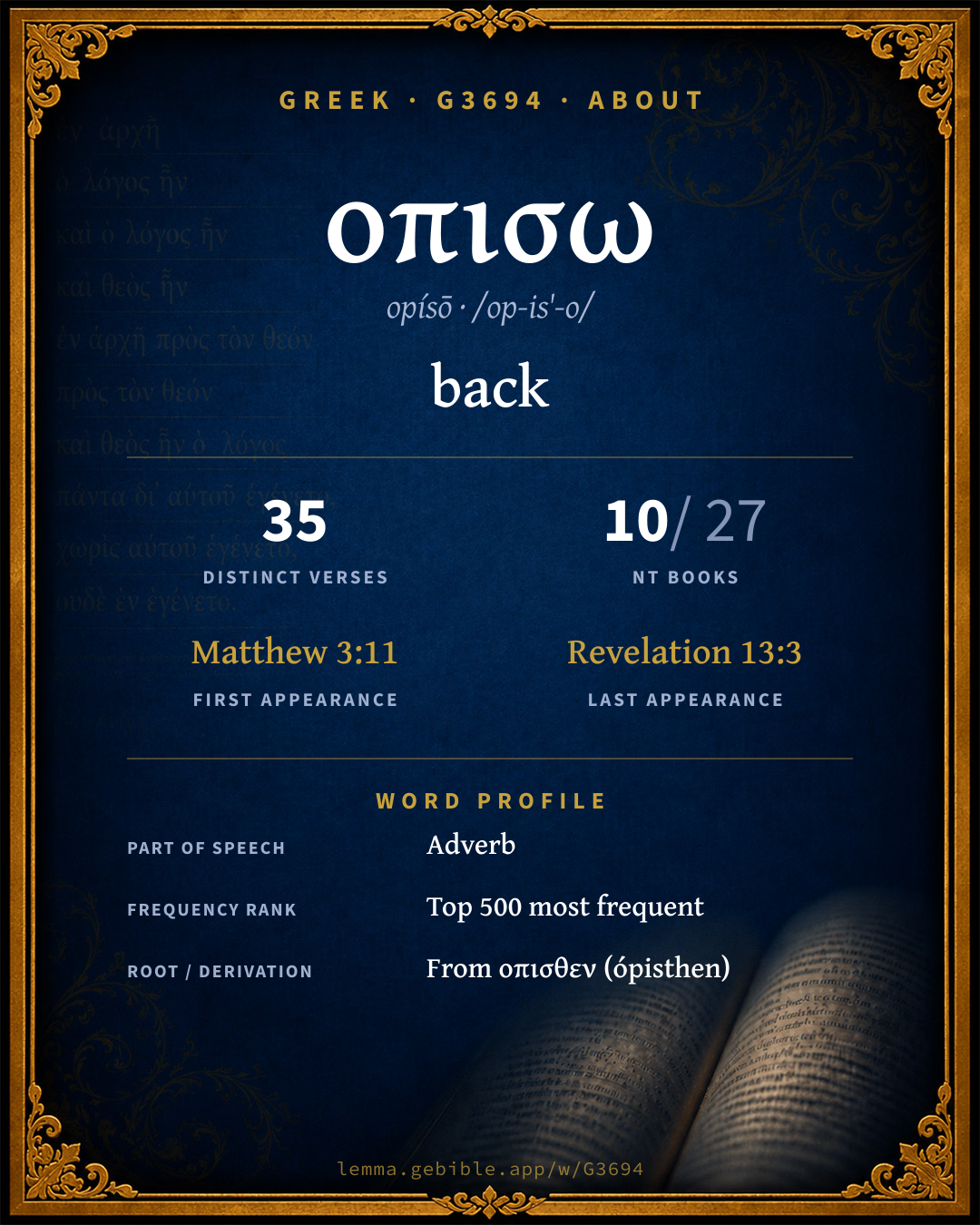
ὄπίσω
back
Full lexicon entry — Thayer's Greek Lexicon
From Thayer's Greek Lexicon
Where this word appears
Grammar key — what these labels mean
Part of speech
- Adverb
- A word that modifies a verb, adjective, or other adverb.
Every verse where G3694 appears in the Book of 1 Timothy — 1 distinct verse. Click any verse to open its interlinear word-by-word view. Verse text shown in the World English Bible for context — . Each verse’s Greek form is shown with its reference; the English is not keyword-highlighted, since the data carries no word-level English alignment. Use “Compare translations” on any verse to read it across multiple English versions. This concordance covers the Greek New Testament; Septuagint (Greek Old Testament) occurrences of this word are not indexed here.
1 Timothy
About this entry
At a glance — auto-summarized from this page’s data, not written by a person. Every figure links to its source below. This summary describes the numbers; it doesn’t interpret them.
“back” is the headline sense of the Greek verb οπισω (opísō). First canonically at Matthew 3:11, it enters the text early. It turns up in 35 verses across 10 books, a moderately common footprint. From the same root come οπισθεν and οψε. See the sense tree, 35-verse concordance, and the renderings breakdown below.
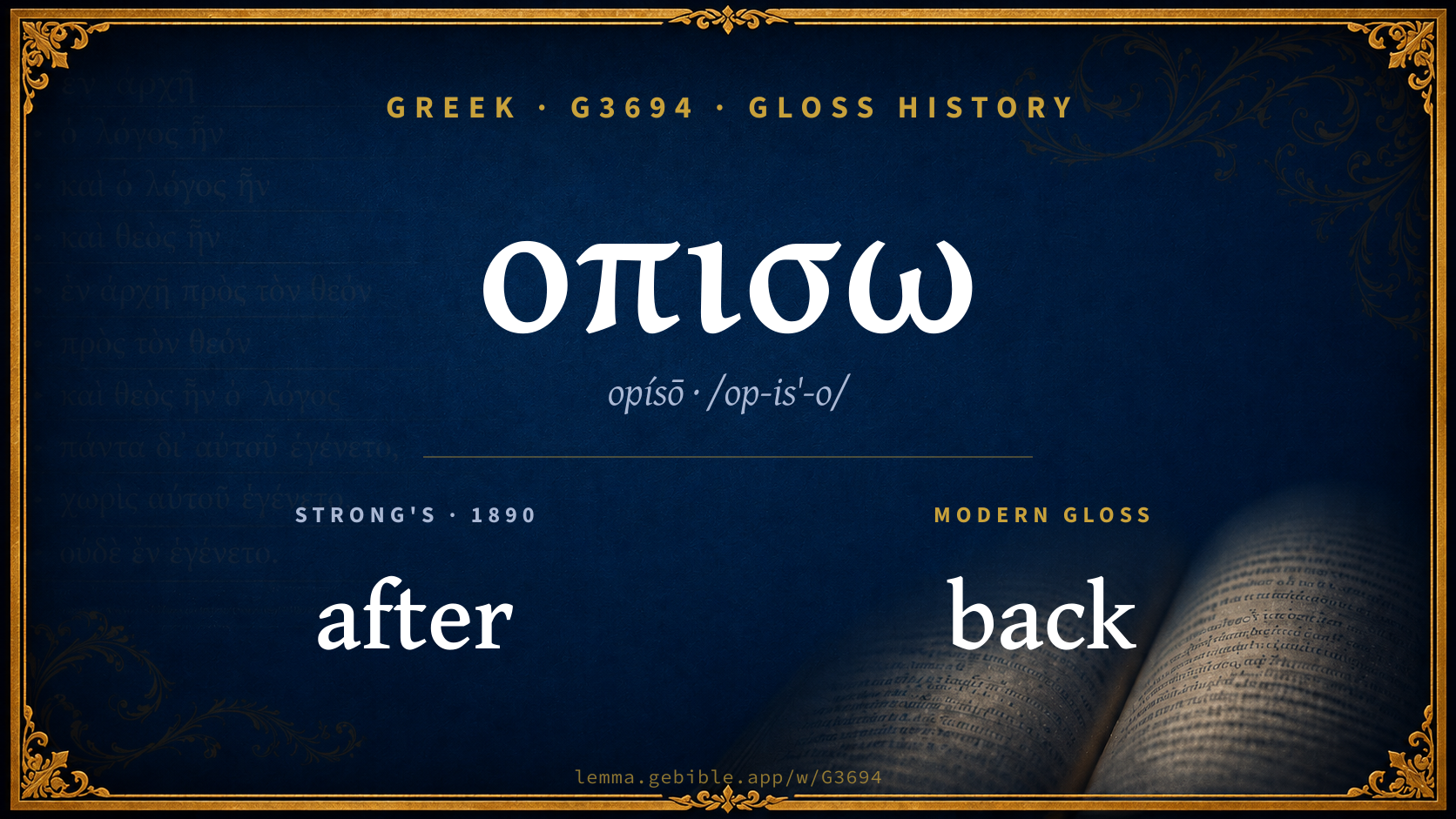
Gloss history
Strong's 1890 vs modern scholarship
About this word
Strong's G3694 catalogs a Greek word from the Greek New Testament.
These counts are not copied from any lexicon or concordance. They are computed here, from the morphology-tagged Greek New Testament. What Lemma adds →
- 35
- distinct verses
- The word appears in 35 distinct verses.
- 10 / 27
- NT books
- The word appears in 10 of 27 New Testament books.
- #419
- by frequency
- Top 500 most frequent Greek words (rank 419 of 5,347 Greek words by occurrence).
View all 35 occurrences in the concordance →
By section of the New Testament
By traditional corpus
Conventional, traditional groupings — biblical authorship is debated, so this is a traditional corpus grouping, not an authorship claim. Some books belong to more than one corpus (Luke is in both the Gospels and the Lukan corpus, and so on), so these shares overlap and need not total 100%. Each figure is a share of the word’s 35 distinct verses.
- Gospels 26 verses · 74%
- Johannine 10 verses · 29%
- Lukan (Luke–Acts) 9 verses · 26%
- Revelation 3 verses · 9%
- Pauline corpus 2 verses · 6%
- General (Catholic) Epistles 2 verses · 6%
How translations render this word
Counts come from each version’s own published word-to-Strong’s tagging or interlinear alignment — an approximate guide to how each version renders this word, not a word-level alignment the data otherwise carries. Because each total is that version’s own tagged count, the per-version totals vary from one another and need not match the appearance or distinct-verse counts above. These counts may also differ from a printed concordance because Lemma counts each distinctly tagged rendering and does not collapse phrase taggings into a single head-word total. This is a fixed set of word-tagged versions (KJV, ASV, BSB, ULT) and does not change with the reading translation you choose elsewhere. Each version’s license is shown beside its name below (and on Sources).
- King James Version: After 22×, Behind 5×, Back 3×
- American Standard Version: After 21×, Behind 5×, Back 3×
- Berean Standard Bible: After 12×, Behind 4×, Back 2×
- unfoldingWord Literal Text: After 23×, Behind 8×
King James Version Public Domain
Renders G3694 across 31 tagged occurrences — most commonly:
Plus 1 rendering that appears only once — usually multi-word phrases or single function words the recovered tagging swept in, not distinct renderings. Not rendered by a distinct English word in 5 further occurrences.
American Standard Version Public Domain
Renders G3694 across 35 tagged occurrences — most commonly:
Plus 6 renderings that appear only once — usually multi-word phrases or single function words the recovered tagging swept in, not distinct renderings.
Berean Standard Bible Public Domain
Renders G3694 across 25 tagged occurrences — most commonly:
Plus 7 renderings that appear only once — usually multi-word phrases or single function words the recovered tagging swept in, not distinct renderings. Not rendered by a distinct English word in 10 further occurrences.
unfoldingWord Literal Text CC BY-SA 4.0
Renders G3694 across 35 tagged occurrences — most commonly:
Plus 4 renderings that appear only once — usually multi-word phrases or single function words the recovered tagging swept in, not distinct renderings.
Senses in Thayer's
The 1 sense Thayer's distinguishes for this word, in lexicon order (not ranked by frequency or importance). The full entry — with sub-senses — is in the Lexicon Entry tab.
- back, behind, after, afterwards
Word origin
Derived from οπισθεν (ópisthen) (G3693) — behind.
From the same as G3693 with enclitic of direction; to the back that is aback (as adverb or preposition of time or place; or as noun): - after back (-ward) (+ get) behind + follow.
— Strong’s Exhaustive Concordance (1890), public domain.
Same root — word family
Other Thayer's entries built from the same root as G3694, grouped by Strong’s listed origin. These share a root / origin per the lexicon — not necessarily a shared meaning. Each links to that word’s own entry.
Derives from
Derived from this word
Compare all same-root words → They share a root, not necessarily a meaning.
Septuagint usage
The same Greek word οπισω appears 328 times in the Greek Old Testament (Septuagint), across 302 verses in 30 books.
- 328
- LXX occurrences
- Tagged occurrences of this Greek word in the Septuagint.
- 302
- verses
- Distinct Septuagint verses containing this word.
- 30 / 39
- OT books
- The word appears in 30 of the 39 Old Testament books.
Sample Septuagint occurrences
- Genesis 8:8 ὀπίσω
- Exodus 14:4 ὀπίσω
- Leviticus 17:7 ὀπίσω
- Numbers 3:23 ὀπίσω
- Deuteronomy 4:3 ὀπίσω
- Joshua 2:5 ὀπίσω
- Judges 1:6 ὀπίσω
- Ruth 1:15 ὀπίσω
- 1 Samuel 6:12 ὀπίσω
- 2 Samuel 1:7 ὀπίσω
- 1 Kings 1:6 ὀπίσω
- 2 Kings 2:24 ὀπίσω
Septuagint occurrences (same lexeme)
Every verse where the same Strong’s number (G3694) appears in the Greek Septuagint — showing the first 50 of 302. Verse text shown in the World English Bible for context; the Greek form is the matched word — the English is not keyword-highlighted.
- Genesis 8:8 ὀπίσω He sent forth a dove from him, to see if the waters were abated from off the surface of the ground,
- Genesis 14:14 ὀπίσω When Abram heard that his relative was taken captive, he led forth his trained men, born in his house, three hundred and eighteen, and pursued as far as Dan.
- Genesis 19:6 ὀπίσω Lot went out to them to the door, and shut the door after him.
- Genesis 19:17 ὀπίσω It came to pass, when they had taken them out, that he said, "Escape for your life! Don't look behind you, neither stay anywhere in the plain. Escape to the mountain, lest you be consumed!"
- Genesis 19:26 ὀπίσω But his wife looked back from behind him, and she became a pillar of salt.
- Genesis 24:5 ὀπίσω The servant said to him, "What if the woman isn't willing to follow me to this land? Must I bring your son again to the land you came from?"
- Genesis 31:23 ὀπίσω He took his relatives with him, and pursued after him seven days' journey. He overtook him in the mountain of Gilead.
- Genesis 31:36 ὀπίσω Jacob was angry, and argued with Laban. Jacob answered Laban, "What is my trespass? What is my sin, that you have hotly pursued after me?
- Genesis 32:19 ὀπίσω He commanded also the second, and the third, and all that followed the herds, saying, "This is how you shall speak to Esau, when you find him.
- Genesis 32:20 ὀπίσω You shall say, 'Not only that, but behold, your servant, Jacob, is behind us.'" For, he said, "I will appease him with the present that goes before me, and afterward I will see his face. Perhaps he will accept me."
- Genesis 32:21 ὀπίσω So the present passed over before him: and he himself lodged that night in the camp.
- Genesis 33:2 ὀπίσω He put the handmaids and their children in front, Leah and her children after, and Rachel and Joseph at the rear.
- Genesis 35:5 ὀπίσω They traveled: and a terror of God was on the cities that were round about them, and they didn't pursue the sons of Jacob.
- Genesis 41:19 ὀπίσω and, behold, seven other cattle came up after them, poor and very ill-favored and lean-fleshed, such as I never saw in all the land of Egypt for ugliness.
- Genesis 41:27 ὀπίσω The seven lean and ill-favored cattle that came up after them are seven years, and also the seven empty heads of grain blasted with the east wind; they will be seven years of famine.
- Genesis 44:4 ὀπίσω When they had gone out of the city, and were not yet far off, Joseph said to his steward, "Up, follow after the men. When you overtake them, ask them, 'Why have you rewarded evil for good?
- Genesis 49:17 ὀπίσω Dan will be a serpent in the way, An adder in the path, That bites the horse's heels, So that his rider falls backward.
- Exodus 14:4 ὀπίσω I will harden Pharaoh's heart, and he will follow after them; and I will get honor over Pharaoh, and over all his host; and the Egyptians shall know that I am Yahweh." They did so.
- Exodus 14:8 ὀπίσω Yahweh hardened the heart of Pharaoh king of Egypt, and he pursued after the children of Israel; for the children of Israel went out with a high hand.
- Exodus 14:9 ὀπίσω The Egyptians pursued after them: all the horses and chariots of Pharaoh, his horsemen, and his army; and overtook them encamping by the sea, beside Pihahiroth, before Baal Zephon.
- Exodus 14:10 ὀπίσω When Pharaoh drew near, the children of Israel lifted up their eyes, and behold, the Egyptians were marching after them; and they were very afraid. The children of Israel cried out to Yahweh.
- Exodus 14:17 ὀπίσω I, behold, I will harden the hearts of the Egyptians, and they shall go in after them: and I will get myself honor over Pharaoh, and over all his host, over his chariots, and over his horsemen.
- Exodus 14:19 ὀπίσω The angel of God, who went before the camp of Israel, moved and went behind them; and the pillar of cloud moved from before them, and stood behind them.
- Exodus 14:23 ὀπίσω The Egyptians pursued, and went in after them into the midst of the sea: all of Pharaoh's horses, his chariots, and his horsemen.
- Exodus 14:28 ὀπίσω The waters returned, and covered the chariots and the horsemen, even all Pharaoh's army that went in after them into the sea. There remained not so much as one of them.
- Exodus 15:20 ὀπίσω Miriam the prophetess, the sister of Aaron, took a tambourine in her hand; and all the women went out after her with tambourines and with dances.
- Exodus 26:12 ὀπίσω The overhanging part that remains of the curtains of the tent, the half curtain that remains, shall hang over the back of the tent.
- Exodus 26:22 ὀπίσω For the far part of the tent westward you shall make six boards.
- Exodus 33:23 ὀπίσω then I will take away my hand, and you will see my back; but my face shall not be seen."
- Exodus 34:15 ὀπίσω Don't make a covenant with the inhabitants of the land, lest they play the prostitute after their gods, and sacrifice to their gods, and one call you and you eat of his sacrifice;
- Exodus 34:16 ὀπίσω and you take of their daughters to your sons, and their daughters play the prostitute after their gods, and make your sons play the prostitute after their gods.
- Leviticus 17:7 ὀπίσω They shall no more sacrifice their sacrifices to the goat idols, after which they play the prostitute. This shall be a statute forever to them throughout their generations.'
- Leviticus 20:6 ὀπίσω "'The person that turns to those who are mediums, and to the wizards, to play the prostitute after them, I will even set my face against that person, and will cut him off from among his people.
- Numbers 3:23 ὀπίσω The families of the Gershonites shall encamp behind the tabernacle westward.
- Numbers 15:39 ὀπίσω and it shall be to you for a fringe, that you may look on it, and remember all the commandments of Yahweh, and do them; and that you not follow after your own heart and your own eyes, after which you use to play the prostitute;
- Numbers 25:8 ὀπίσω and he went after the man of Israel into the pavilion, and thrust both of them through, the man of Israel, and the woman through her body. So the plague was stayed from the children of Israel.
- Numbers 32:11 ὀπίσω Surely none of the men who came up out of Egypt, from twenty years old and upward, shall see the land which I swore to Abraham, to Isaac, and to Jacob; because they have not wholly followed me:
- Numbers 32:12 ὀπίσω save Caleb the son of Jephunneh the Kenizzite, and Joshua the son of Nun; because they have wholly followed Yahweh.
- Deuteronomy 4:3 ὀπίσω Your eyes have seen what Yahweh did because of Baal Peor; for all the men who followed Baal Peor, Yahweh your God has destroyed them from the midst of you.
- Deuteronomy 6:14 ὀπίσω You shall not go after other gods, of the gods of the peoples who are round about you;
- Deuteronomy 8:19 ὀπίσω It shall be, if you shall forget Yahweh your God, and walk after other gods, and serve them, and worship them, I testify against you this day that you shall surely perish.
- Deuteronomy 11:4 ὀπίσω and what he did to the army of Egypt, to their horses, and to their chariots; how he made the water of the Red Sea to overflow them as they pursued after you, and how Yahweh has destroyed them to this day;
- Deuteronomy 11:30 ὀπίσω Aren't they beyond the Jordan, behind the way of the going down of the sun, in the land of the Canaanites who dwell in the Arabah, over against Gilgal, beside the oaks of Moreh?
- Deuteronomy 13:5 ὀπίσω That prophet, or that dreamer of dreams, shall be put to death, because he has spoken rebellion against Yahweh your God, who brought you out of the land of Egypt, and redeemed you out of the house of bondage, to draw you aside out of the way which Yahweh your God commanded you to walk in. So shall you put away the evil from the midst of you.
- Deuteronomy 19:6 ὀπίσω lest the avenger of blood pursue the manslayer, while his heart is hot, and overtake him, because the way is long, and strike him mortally; whereas he was not worthy of death, inasmuch as he didn't hate him in time past.
- Deuteronomy 24:20 ὀπίσω When you beat your olive tree, you shall not go over the boughs again: it shall be for the foreigner, for the fatherless, and for the widow.
- Deuteronomy 24:21 ὀπίσω When you gather [the grapes of] your vineyard, you shall not glean it after you: it shall be for the foreigner, for the fatherless, and for the widow.
- Deuteronomy 25:18 ὀπίσω how he met you by the way, and struck the hindmost of you, all who were feeble behind you, when you were faint and weary; and he didn't fear God.
- Deuteronomy 28:14 ὀπίσω and shall not turn aside from any of the words which I command you this day, to the right hand, or to the left, to go after other gods to serve them.
- Deuteronomy 31:16 ὀπίσω Yahweh said to Moses, Behold, you shall sleep with your fathers; and this people will rise up, and play the prostitute after the strange gods of the land, where they go to be among them, and will forsake me, and break my covenant which I have made with them.
These are occurrences of the same Greek lexeme (G3694) in the Septuagint — not a translation of any one Hebrew word. The store carries no word-level Hebrew↔Greek alignment, so no Hebrew original is asserted here. Counts come from the recovered LXX Strong's tagging — high-frequency vocabulary is well covered, while rare or late forms may be untagged — so they reflect tagged occurrences and may slightly undercount.