1 Timothy 5:15

Greek (Tischendorf 8th ed.) 1 Timothy 5:15 appears in the Greek New Testament. The text above is from the Tischendorf 8th edition. Each word links to its Strong’s number and a concise gloss. Click any word for its full Thayer’s Greek Lexicon entry.
Download image
Cite this verse

1 Timothy 5:15 (World English Bible). Public Domain. Lemma interlinear Bible study tool, https://lemma.gebible.app/v/1-timothy/5/15.

Show BibTeX & RIS
BibTeX
RIS
English Translation
For already some have turned aside after Satan.
World English Bible · Public Domain
Download a study sheet

One document with this verse’s original text, its word-by-word gloss line, the meaning frame, cross-references with their text, attributed commentary, and full source and license credits — printable, and it pastes into notes with its structure intact.

This verse Autodidact and up

Study sheet (.html) Plain text (.txt)

A passage Seminary Student

Up to 50 verses in one chapter. A passage sheet keeps up to 6 commentary sources and 12 cross-references per verse, in the order this page ranks them, and says so on the sheet whenever that leaves anything out. Ask for a single verse and you get the Autodidact verse sheet above.

Everything on this page stays free to read, with no account — the sheet is a download of what is already on screen, not access to it.

Want to remove ads? Support Godless Engineer
Compare translations 3

The same verse in 3 English versions, stacked beneath the original-language interlinear above. Click any original word for its lexicon entry.

Each is an independent rendering of the whole verse — the interlinear is not word-aligned to these translations.

Highlighted words mark where these versions differ — a whole-verse word diff, not a word-by-word alignment.

  • World English Bible Public Domain
    For already some have turned aside after Satan.
  • King James Version Public Domain
    For some are already turned aside after Satan.
  • unfoldingWord Literal Text CC BY-SA 4.0
    For already some have turned away after Satan.

unfoldingWord Literal Text — © unfoldingWord, licensed CC BY-SA 4.0. Word-aligned USFM3 via Door43 (git.door43.org/unfoldingWord/en_ult).

Versions to compare (up to 4)

3 of 4 selected

Show all 19 translations

Every available English version of this verse, each an independent rendering of the whole verse.

  • World English Bible Public Domain
    For already some have turned aside after Satan.
  • Berean Standard Bible Public Domain
    For some have already turned aside to follow Satan.
  • Majority Standard Bible Public Domain
    For some have already turned aside to follow Satan.
  • King James Version Public Domain
    For some are already turned aside after Satan.
  • American Standard Version (1901) Public Domain
    for already some are turned aside after Satan.
  • Revised Version (1885) Public Domain
    for already some are turned aside after Satan.
  • Geneva Bible (1599) Public Domain
    For certaine are alreadie turned backe after Satan.
  • Douay-Rheims (1899) Public Domain
    For some are already turned aside after Satan.
  • Young's Literal Translation Public Domain
    for already certain did turn aside after the Adversary.
  • Literal Standard Version CC BY-SA 4.0
    for some already turned aside after Satan.
  • Unlocked Literal Bible CC BY-SA 4.0
    For some have already turned aside after Satan.
  • unfoldingWord Literal Text CC BY-SA 4.0
    For already some have turned away after Satan.
  • Darby Bible Public Domain
    For already some have turned aside after Satan.
  • World Messianic Bible Public Domain
    For already some have turned away after Satan.
  • Webster's Bible Public Domain
    For some are already turned aside after Satan.
  • Free Bible Version CC BY-SA 4.0
    However, some have already gone the way of Satan.
  • Bible in Basic English Public Domain
    For even now some are turned away to Satan.
  • Text-Critical English NT CC BY 4.0
    For some have already turned away to follow Satan.
  • Tyndale New Testament (1534) Public Domain
    For many of them are all redy turned bake and are gone after Satan.

Literal Standard Version (2020), Covenant Press — licensed CC BY-SA 4.0. Text via the HelloAO Bible API (eBible.org). Unlocked Literal Bible (unfoldingWord) — licensed CC BY-SA 4.0. Text via the HelloAO Bible API (eBible.org). unfoldingWord Literal Text — © unfoldingWord, licensed CC BY-SA 4.0. Word-aligned USFM3 via Door43 (git.door43.org/unfoldingWord/en_ult). Free Bible Version, Dr. Jonathan Gallagher — licensed CC BY-SA 4.0. Text via the HelloAO Bible API (eBible.org).

Word by word

More ways to search: Search by grammar → Find every occurrence → Compare this word →

Practice this passage: Drill this verse → Learn its vocabulary →

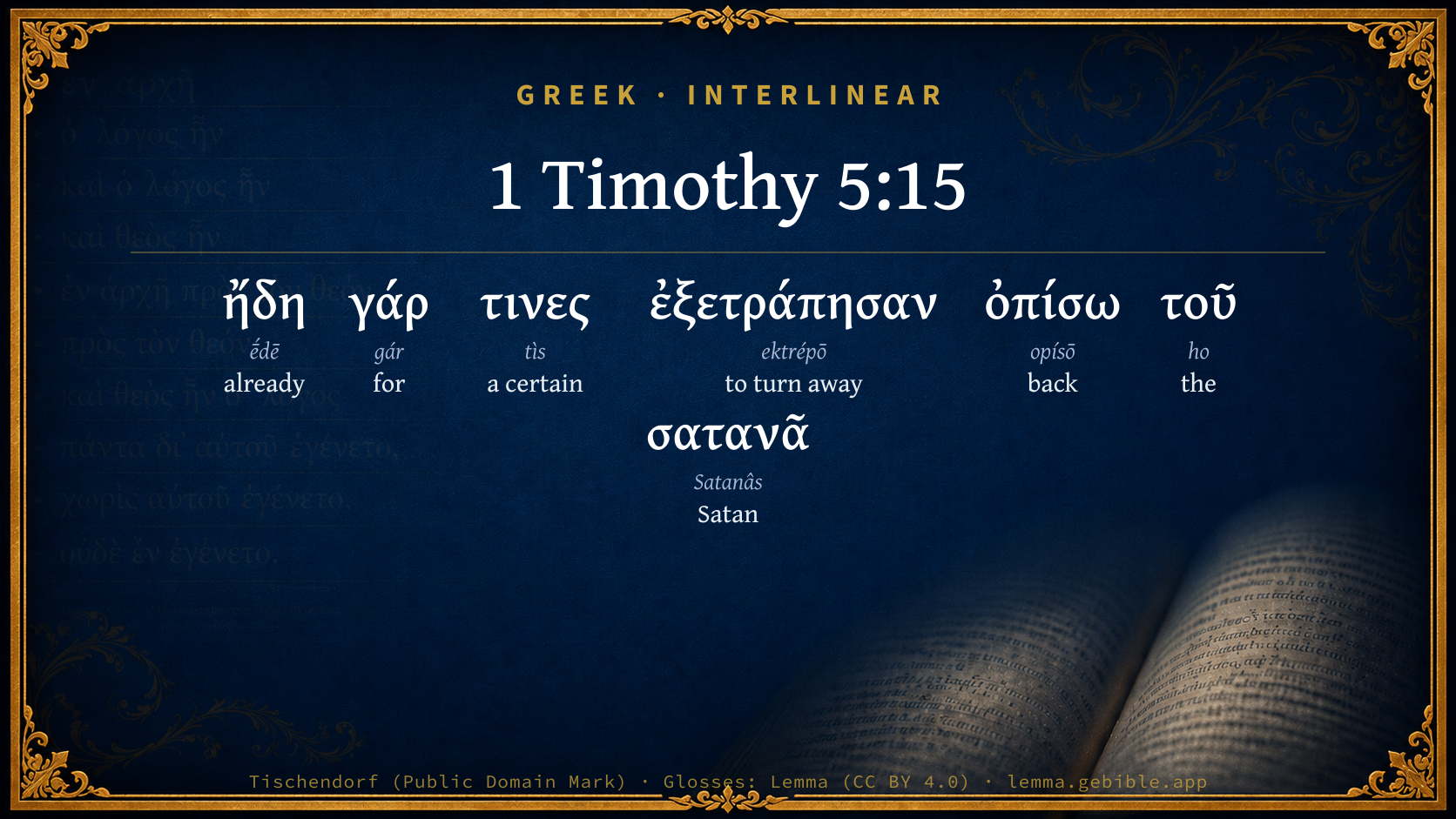
ἐξετράπησαν
ektrépō
G1624
“to turn away”
Verb, Aorist, Passive, Indicative, 3rd person, Plural
Part of Speech
Verb
Tense
Aorist
Voice
Passive
Mood
Indicative
Person
3rd person
Number
Plural
Full Thayer's Definition

Origin: from G1537 and the base of G5157

TDNT: None

1. to turn or twist out a. in a medical sense used of dislocated limbs 2. to turn off or aside 3. to be turned aside 4. to turn aside 5. to turn away from, to shun a thing, to avoid meeting or associating with one
  1. ἤδη ḗdē G2235 “already” Adverb
  2. γάρ gár G1063 “for” Conjunction
  3. τινες tìs G5100 “a certain” Indefinite pronoun, Nominative, Plural, Masculine
  4. ὀπίσω opísō G3694 “back” Adverb
  5. τοῦ ho G3588 “the” Article, Genitive, Singular, Masculine
  6. σατανᾶ Satanâs G4567 “Satan” Noun, Genitive, Singular, Masculine

About this verse

These counts appear in no published source. They are computed here, from the morphology-tagged text and Lemma’s own curated glosses. What Lemma adds →

7
words
7
distinct lemmas
Pauline Epistles
section

Notable vocabulary

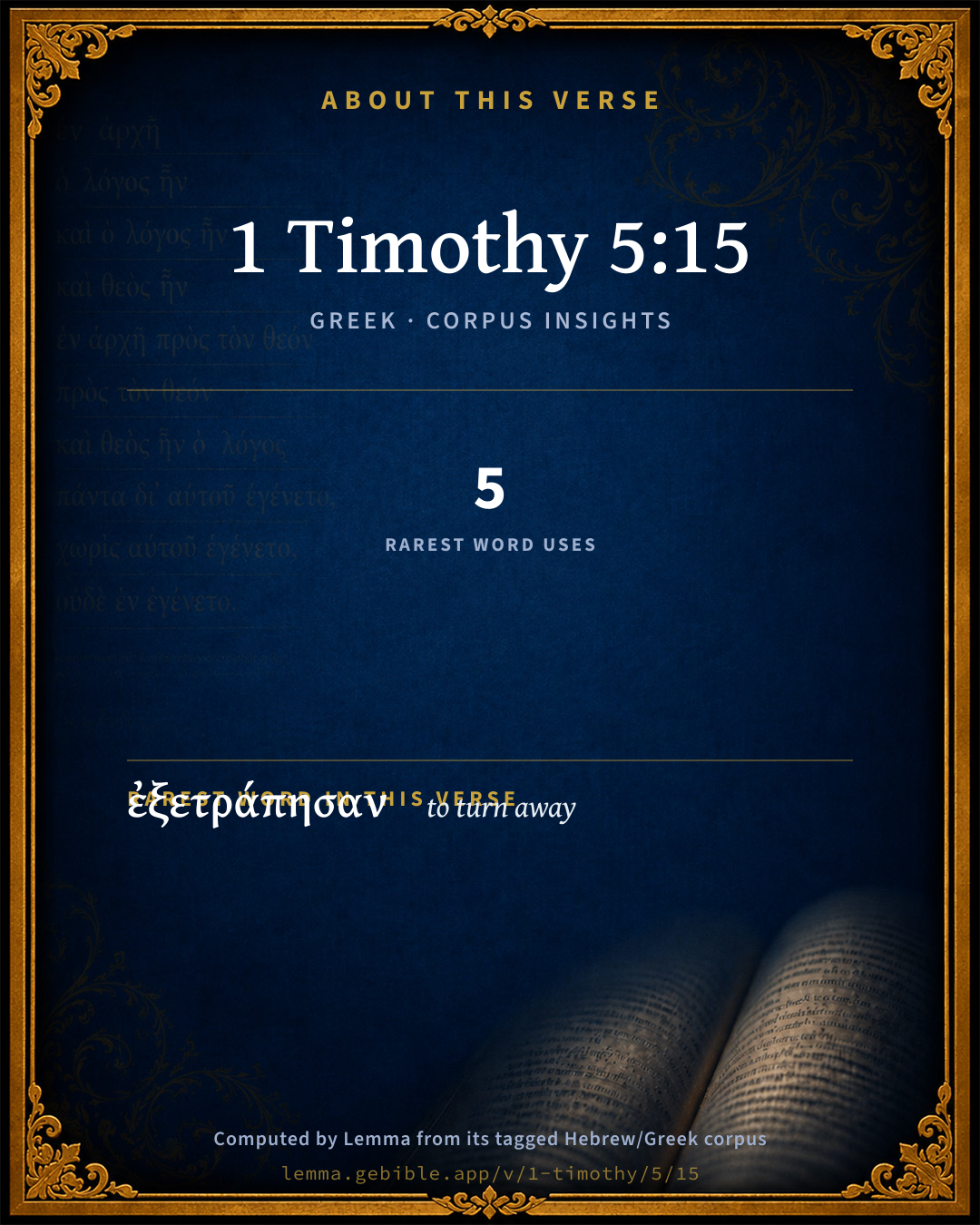
The rarest word here is ἐξετράπησαν to turn away G1624 — appearing just 5 times in the whole Greek New Testament.

Shared distinctive vocabulary

ἐξετράπησαν to turn away G1624 occurs in 5 verses of the Greek New Testament. Also found in:

Cross-references

12

Topical passages linked to 1 Timothy 5:15 in the Treasury of Scripture Knowledge — connected by theme and wording, ordered by reader-vote popularity; previews shown in the World English Bible.

  • 2 Peter 2:2 Many will follow their immoral ways, and as a result, the way of the truth will be maligned.
  • Jude 1:4–5 For there are certain men who crept in secretly, even those who were long ago written about for this condemnation: ungodly men, turning the grace of our God into lasciviousness, and denying our only Master, God, and Lord, Jesus Christ.
  • 2 Peter 2:20–22 For if, after they have escaped the defilement of the world through the knowledge of the Lord and Savior Jesus Christ, they are again entangled therein and overcome, the last state has become worse with them than the first.
  • 1 Timothy 1:20 of whom is Hymenaeus and Alexander; whom I delivered to Satan, that they might be taught not to blaspheme.
  • 1 John 2:19 They went out from us, but they didn't belong to us; for if they had belonged to us, they would have continued with us. But they left, that they might be revealed that none of them belong to us.
  • Philippians 3:18–19 For many walk, of whom I told you often, and now tell you even weeping, as the enemies of the cross of Christ,
  • 2 Timothy 4:10 for Demas left me, having loved this present world, and went to Thessalonica; Crescens to Galatia, and Titus to Dalmatia.
  • Matthew 4:10 Then Jesus said to him, "Get behind me, Satan! For it is written, 'You shall worship the Lord your God, and him only shall you serve.'"
  • 2 Timothy 1:15 This you know, that all who are in Asia turned away from me; of whom are Phygelus and Hermogenes.
  • 2 Timothy 2:18 men who have erred concerning the truth, saying that the resurrection is already past, and overthrowing the faith of some.
  • 2 Peter 3:16 as also in all of his letters, speaking in them of these things. In those are some things hard to be understood, which the ignorant and unsettled twist, as they also do to the other Scriptures, to their own destruction.
  • Revelation 12:9 The great dragon was thrown down, the old serpent, he who is called the devil and Satan, the deceiver of the whole world. He was thrown down to the earth, and his angels were thrown down with him.

Cross-references courtesy of OpenBible.info (CC BY 4.0).

Commentary

Notes on 1 Timothy 5:15 from classic Christian and Jewish commentators (each source and its license shown beneath its notes). The classic Christian expositions comment on the surrounding passage and are grouped to its opening verse, so a note may address several verses; the Jewish commentaries on the Tanakh (Rashi and others) are per-verse, so they appear only where the commentator wrote on this verse.

Lemma curates 59 commentaries, every one of them public domain or Creative Commons licensed, each selected and text-cleaned for this edition rather than reprinted as found. About our sources →

Tyndale Open Study Notes

Tyndale Open Resources

5:15 now follow Satan: They had committed apostasy, renouncing Christ, probably in connection with the false teachers (1:6-7; cp. 3:6-7; Heb 2:1) and their self-indulgence (1 Tim 5:6, 13).

Tyndale Open Study Notes — © Tyndale Open Resources, licensed CC BY-SA 4.0. Text via the HelloAO Bible API.

Bengel's Gnomon

Johann Albrecht Bengel

1Ti 5:15. Ἤδη, already) A particle used for the purpose of appealing to experience.—τινὲς, some) rashly professing widowhood.—ἐξετράπησαν, have been turned aside) and thereby have given occasion to calumny.—ὀπίσω τοῦ Σατανᾶ, after Satan) who turned them aside from Christ.

Bengel's Gnomon of the New Testament — English translation (T&T Clark, Edinburgh, 1860) — public domain. Text from a community e-Sword module.

Meyer's Critical & Exegetical Commentary

Heinrich August Wilhelm Meyer

1Ti_5:15. Reason for the injunction given: ἤδη γάρ τινες ἐξετράπησαν ὀπίσω τοῦ σατανᾶ.

τινές, viz. widows; ἐξετράπησαν κ.τ.λ.; comp. 1Ti_1:6; ὀπίσω, comp. Act_5:37; Act_20:30 : they have turned away, viz. from the Christian path of life, and have followed Satan. This does not necessarily mean a formal apostasy from Christianity, or a connection with the heretics; it may also mean yielding oneself up to an un-Christian, carnal life (Wiesinger). This arose from their not living in accordance with the rule laid down by the apostle.

On ἤδη, Bengel rightly remarks: particula provocandi ad experientiam. De Wette is quite unjustified in asserting that Paul could not yet have had such an experience.

Meyer — Critical and Exegetical Commentary on the New Testament — English translation by Peter Christie, edited by Frederick Crombie (T&T Clark, 1880) — public domain. Text from a community e-Sword module.

Expositor's Greek Testament

ed. W. Robertson Nicoll

1Ti 5:15 . τινες : See note on 1Ti 1:3 .

ἐξετράπησαν ὀπίσω τοῦ Σ .: This is a pregnant phrase, meaning “ They have turned out of the way [of life and light] and have followed after Satan ”. “The prepositional use of ὀπίσω , which is foreign to profane writers, takes its origin from the LXX (Hebr. אַחֲרֵי )” (Blass, Gram . p. 129). The primary phrase is ἔρχεσθαι [also ἀκολουθεῖν or πορεύεσθαι ] ὀπίσω τινός . For ὀπίσω in an unfavourable sense cf. Luk 21:8 , Joh 12:19 , Act 5:37 ; Act 20:30 , 2Pe 2:10 , Jud 1:7 , Rev 13:3 . The phrase, no doubt, refers to something worse than a second marriage.

The Expositor's Greek Testament, edited by W. Robertson Nicoll (1897–1910) — public domain. Text from a community e-Sword module.

Jamieson, Fausset & Brown

Robert Jamieson, A. R. Fausset & David Brown

For--For in the case of some this result has already ensued; "Some (widows) are already turned aside after Satan," the seducer (not by falling away from the faith in general, but) by such errors as are stigmatized in Ti1 5:11-13, sexual passion, idleness, &c., and so have given occasion of reproach (Ti1 5:14). "Satan finds some mischief still for the idle hands to do."

Jamieson, Fausset & Brown — Commentary Critical and Explanatory on the Whole Bible (1871) — public domain (CC PDM 1.0). Text via the HelloAO Bible API.

Adam Clarke's Commentary

Verse 15. For some are already turned aside] Some of these young widows, for he appears to be still treating of them, are turned aside to idolatry, to follow Satan instead of Christ. Slight deviations, in the first instance, from a right line, may lead at last to an infinite distance from Christ.

Adam Clarke's Commentary on the Bible (1810–1826) — public domain. Text from a community e-Sword/MySword module.

John Calvin's Commentaries

15 For some have already turned aside It is certain, that there is no ordinance so holy that some evil may not arise out of it through the wickedness of men. Yet those things which are necessary ought to remain unmoved, whatever may happen to them, although the sky should fall. But when we are at liberty to choose either way, and when this or that has been found by experience to be advantageous, it is a matter of prudence to lay aside what was formerly approved, as in the present case. It was not at all necessary that women, who were still young, should be admitted into the rank of widows; experience shewed that it was dangerous and hurtful; and, therefore, Paul justly advises to take care for the future that nothing of this kind may happen.

If the revolt of some women was regarded by him as a sufficiently strong argument for seeking a universal remedy, how many arguments would the Papists have for abolishing their filthy celibacy, if they had any regard to edification! But they choose rather to strangle millions of souls by the cruel cords of a wicked and diabolical law than to loose a single knot; and this makes it evident how widely their cruelty differs from the holy zeal of Paul.

After Satan The expression is worthy of notice; because no one can turn aside from Christ, in the smallest degree, without following Satan; for he has dominion over all who do not belong to Christ. We learn from this how destructive is turning aside from the right course, since, from being children of God, it makes us slaves of Satan, and, by withdrawing us from the government of Christ, places Satan over us as our guide.

John Calvin's Commentaries (1540-1563) — public domain. Text from the Calvin Translation Society English edition (1840s-50s) via the Christian Classics Ethereal Library (ccel.org). Calvin's coverage is partial (roughly two-thirds of the Bible); uncommented books and verses are honest gaps, never fabricated. The 19th-century editor's footnotes and remarks are omitted so the notes are faithfully Calvin's own voice.

Ellicott's Commentary for English Readers

(15) For some are already turned aside.—It was the backsliding of these “nameless” ones, probably, which had been the immediate occasion of these directions to Timothy. Although these unhappy sisters had worked such great mischief to the cause of Christ, still St. Paul, with his tender grace and love, forbore to mention any by name. They had undertaken a task too severe for them to carry out, and had miserably failed. He spares these poor erring sisters, but directs the chief pastor of the Church at Ephesus, how to guard against such fatal results for the future.

After Satan.—They had swerved from the narrow, thorny road of self-denial which they had chosen for themselves, and perhaps dreading, after their public profession, to form afresh any legal marriage ties, had followed that downward path of sensuality which surely leads to Satan.

A Bible Commentary for English Readers, edited by Charles John Ellicott (1878–1897) — public domain. Text from a community e-Sword module.

The Cambridge Bible for Schools and Colleges

gen. ed. J. J. S. Perowne

15. some are … turned aside] Some of the younger widows who had been placed upon the roll had thus been led astray; St Paul was not merely theorising in 1Ti_5:11-13. The aorist here is rightly rendered ‘are turned’ according to the account given in 1Ti_5:10.

The Cambridge Bible for Schools and Colleges (gen. ed. J. J. S. Perowne; Cambridge University Press, 1878–1918) — public domain. Text from a community e-Sword module.

John Gill's Exposition

For some are already turned aside after Satan. Meaning some of those younger widows, whom the apostle knew, and had observed to have departed from the faith they first professed, and turned their backs on Christ, and gave themselves up to carnal lusts and pleasures, and an idle and impure life and conversation, walked according to the course of this world, and the prince of it, by whom they were led captive at his will; for so everyone that apostatizes from a profession of Christ, and follows either false teachers, and their doctrines, as the Gnostics, that condemned marriage, or any sinful and impure way of life, may be said to turn aside after Satan; and as that apostle knew this to be fact, from his own observation, he therefore gives the above advice.

For some are already turned aside after Satan. Meaning some of those younger widows, whom the apostle knew, and had observed to have departed from the faith they first professed, and turned their backs on Christ, and gave themselves up to carnal lusts and pleasures, and an idle and impure life and conversation, walked according to the course of this world, and the prince of it, by whom they were led captive at his will; for so everyone that apostatizes from a profession of Christ, and follows either false teachers, and their doctrines, as the Gnostics, that condemned marriage, or any sinful and impure way of life, may be said to turn aside after Satan; and as that apostle knew this to be fact, from his own observation, he therefore gives the above advice.

1 Timothy 5:16

ti1 5:16

ti1 5:16

ti1 5:16If any man or woman that believeth have widows,.... That is, if any member of a church, whether a brother or a sister, have mothers or grandmothers, or any near relations widows, in mean circumstances, and incapable of taking care of themselves:

let them relieve them; out of their own substance; which is what the apostle before calls showing piety at home, and requiting their own parents:

and let not the church be charged; or burdened with the maintenance of them:

that it may relieve them that are widows indeed; that the church may be in a better capacity, its stock not being expended on others, to supply the wants of those who are really widows; who have neither husbands, nor children, nor any relations, to provide for them; nor anything in the world to support themselves with.

John Gill's Exposition of the Whole Bible (1746–1763) — public domain (CC PDM 1.0). Text via the HelloAO Bible API.

Trapp's Complete Commentary

John Trapp

15 For some are already turned aside after Satan.

Ver. 15. Turned aside after Satan] Revolted from Christian religion, going out of God’s blessing into the world’s warm sun. These could not choose unto themselves a worse condition.

John Trapp, A Commentary or Exposition upon All the Books of the Old and New Testament (1647–1656) — public domain. Text from a community e-Sword module.

Albert Barnes' Notes on the Bible

For some are already turned aside after Satan - That is, some young widows. The meaning is, that in the respects above mentioned 1Ti 5:13, they had followed the great Tempter, rather than the Lord Jesus. This is stated as a reason why they should not be admitted into the number of the widows who were to be maintained at the expense of the church, and to whom the care of the younger female members was to be committed.

Albert Barnes' Notes on the Bible (1834–1885) — public domain. Text from a community e-Sword/MySword module.

Haydock's Catholic Bible Commentary

For some are already turned aside after Satan, by breaking the vows they had made. "Yet it does not follow, (says St. Augustine in the same place [de Bono viduitatis, chap. viii.]) that they who abstain not from such sins may marry after their vows. They might indeed marry before they vowed; but this being done, unless they keep them they justly incur damnation." "Why is it, (says he again, on Psalm. lxxv.) they made void their first faith? but that they made vows, and kept them not. But let not this (says he) make you abstain from such vows, for you are not to comply with them by your own strength; you will fall, if you presume on yourselves; but if you confide in him to whom you made these vows, you will securely comply with them." How different was the doctrine and practice of the first and chief of the late pretended reformers, who were many of them apostates after such vows? (Witham)

George Leo Haydock (1774–1849), Haydock's Catholic Family Bible and Commentary, 1859 edition — public domain. Excludes Psalms (Douay-Rheims chapter numbering differs from Protestant) and Deuterocanonical books (Catholic canon only).

Matthew Poole's English Annotations

We have scandals enough already, we had need take as good heed as we can that we have no more; some young women already are apostatized (and, possibly, for the sake or by the occasion of such marriages) to Judaism or paganism; or, it may be, to a loose and lewd course of life, not suiting the profession of Christianity.

If any man or woman that believeth have widows; if any men or women that are Christians have any widows that are nearly related to them, if themselves be able,

let them relieve them, and let not the church be charged; and not turn off that natural duty which they owe to their parents, or near relations, to relieve them, to the church, which hath others enough to look after, and upon which there lies only a moral and Christian obligation.

That it may relieve them that are widows indeed; that so the alms of the church may go to relieve those only who are perfectly desolate, having neither husbands nor any other near relations to provide for them.

Matthew Poole's English Annotations on the Holy Bible (1683–1685) — public domain. Text from a community e-Sword/MySword module.

Whedon's Commentary on the Bible

Daniel D. Whedon

15. Some—The apostle has obviously drawn his picture from actual life. Indeed, the when they wax wanton of 1Ti_5:11 implies that such was the character of the women of the period that it would be the probable course of all alike; and that nothing but marriage or age was likely to keep them in order.

Daniel D. Whedon (gen. ed.), Commentary on the Old and New Testaments (1874–1909) — public domain. Text from a community e-Sword module.

The Pulpit Commentary

Already some are for some are already, A.V Some. This is generally understood of some widows who had already given occasion to the adversary to speak reproachfully, by turning aside from the path of Christian virtue which they had begun to walk in, and following Satan who had beguiled them into the path of vice and folly. But the words are capable of another meaning, equally arising kern the preceding verse, viz. that some have already followed the example of Satan, "the accuser of the brethren," and have begun to revile Christianity, taking occasion from the conduct of some who were called Christians. These revilers might be not unbelieving Jews or heathen, but apostate or heretical Jews like those of whom the same verb (ejktrepesqai) is used in 1Ti_1:6 and 2Ti_4:4. In something of the same spirit St. Paul called Elymas the sorcerer a child of the devil," because he sought to turn away Sergius Paulus from the faith, probably by speaking evil of Barnabas and Saul.

The Pulpit Commentary (1880–1919), ed. H.D.M. Spence-Jones & Joseph S. Exell — public domain. Text from a community e-Sword module.

John Wesley's Explanatory Notes

Some - Widows. Have turned aside after Satan - Who has drawn them from Christ.

John Wesley, Explanatory Notes Upon the Whole Bible (1754–1765) — public domain. Text via the GEBible commentary corpus.

Cambridge Greek Testament for Schools and Colleges

15. ἐξετράπησάν τινες is the order in AFG g; txt אCD2KLP d f &c.

15. ἤδη γάρ τινες ἐξετράπησαν ὀπίσω τοῦ σατανᾶ, for already some are turned aside after Satan. To support his advice (βούλομαι κ.τ.λ.) St Paul adduces the weighty argument of past experience (γάρ). Some ecclesiastical widows have already proved unfaithful to their pledges to the heavenly Bridegroom and have followed the seducer, Satan. It has been argued that this indicates that the ordo viduarum had been in existence for a considerable time, and that thus the date of the Epistle must be postponed to a period subsequent to St Paul’s labours; but (a) it must be remembered that the experience to which appeal is made is not necessarily confined to the Church at Ephesus, but extends over all the Christian communities known to St Paul, and (b) ἥδη, ‘already,’ seems to indicate that the order had not been long established, for disorders had arisen before they might naturally have been expected.

ἐξετράπησαν, i.e. swerved from the path of virtue. See note on 1Ti 1:5.

ὀπίσω τοῦ σατανᾶ. Cp. Act 20:30 (in the speech of St Paul to the Ephesian elders) ἀποσπᾷν τοὺς μαθητὰς ὀπίσω ἑαυτῶν.

Cambridge Greek Testament for Schools and Colleges (Cambridge University Press, 1896; 21 vols, various authors incl. Carr, Maclear, Plummer, Farrar, Lumby, Moule, M. R. James, Simcox) — public domain. Text from a community e-Sword module.

International Critical Commentary

15. ἤδη] cf. οὕτω ταχέως, Gal 1:6; ἐξετράπησαν, cf. 1:6, turned out of the true path (cf. the “Two Ways”) from following the true leader (Mat 16:24 εἴ τις θέλει ὀπίσω μου ἐλθεῖν) to follow false teachers (Act 20:30 τοῦ ἀποσπᾶν τοὺς μαθητὰς ὀπίσω αὐτῶν), nay, the great opponent himself, i.e. by second marriage after the promise of perpetual widowhood; or by such lives as those described in 13, cf. 2Ti 3:6.

International Critical Commentary — older volumes (1896–1929), various authors — public domain. Text from a community e-Sword module.

Lesson kit

Teaching starters — assembled from the data on this page, not authored interpretation. Every prompt links to the verse data it draws on. Edit before teaching.

1 Timothy, in the Pauline Epistles, opens this verse with 7 words (7 distinct Greek lemmas). Its most distinctive word is ektrépō (“to turn away”). A historical commentator’s framing appears above. Read the whole chapter for the surrounding context.

Discussion questions

  1. The word ektrépō carries the sense “to turn away.” How does it shape the verse?
  2. 1 Timothy 1:6 shares the word «to turn away» with this verse. How do the two illuminate each other?
  3. These translations render this verse differently; the difference is in the English rendering, not the original. What questions does that raise?
  4. Reading how Tyndale Open Study Notes and Bengel's Gnomon read this verse, where do the two commentators agree and where do they part?

Things to notice

Reading settings

Reading text

Shown beneath each verse's original-language words.

Old Testament
Old Testament edition

Read the OT as the Masoretic Hebrew (MT) or the Greek Septuagint (LXX).

English shown for the Greek Septuagint (in the Hebrew ↔ Greek comparison).

Comparing translations? Open the Compare panel on any verse page to stack up to four side by side.