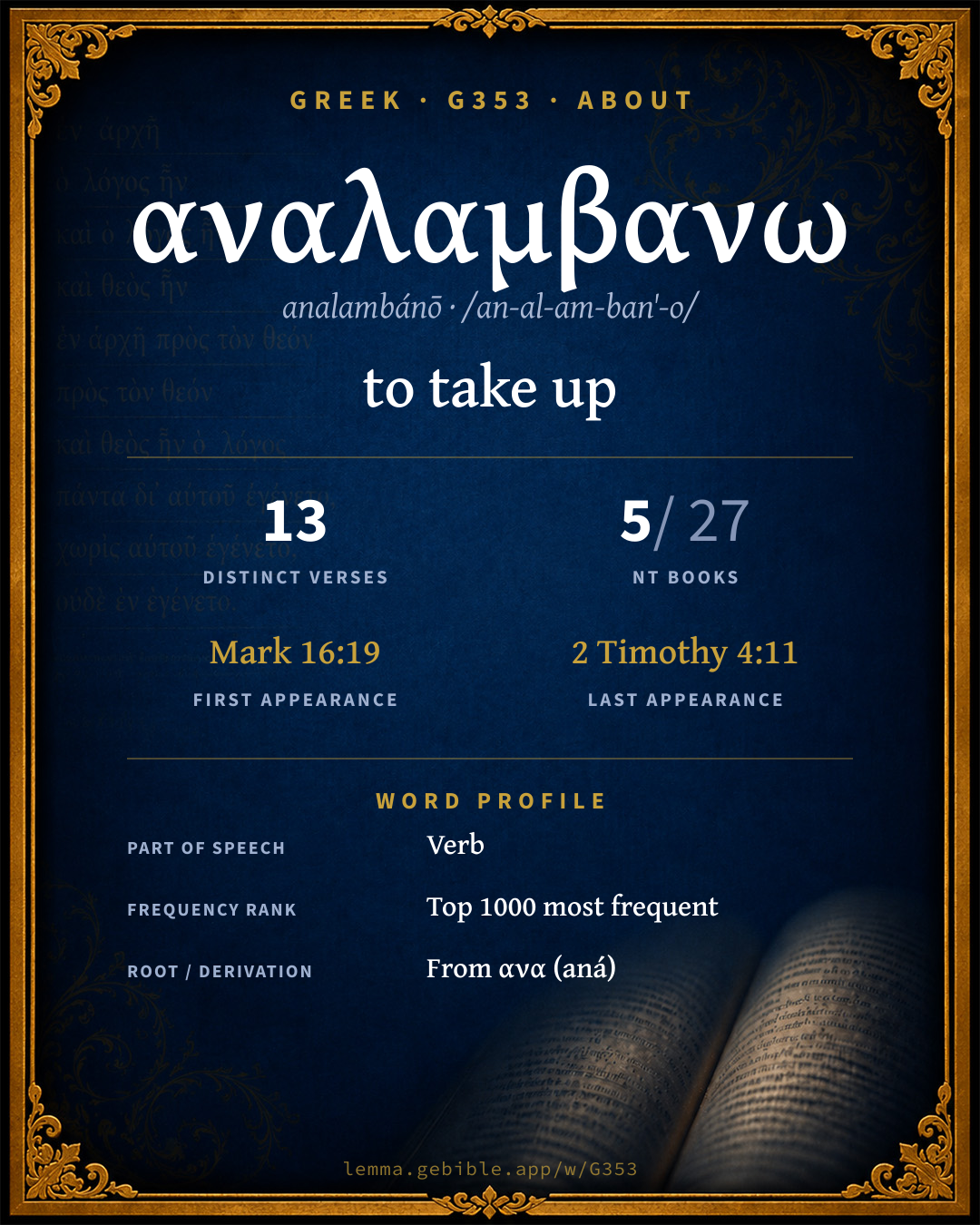
ἀναλαμβάνω
to take up
‘to take up’ is one of 2 main senses fuller range ↓
Full lexicon entry — Thayer's Greek Lexicon
From Thayer's Greek Lexicon
Where this word appears
Grammar key — what these labels mean
Part of speech
- Verb
- An action or state-of-being word.
Tense
- Aorist
- Action viewed as a simple whole, without regard to duration — often past (perfective aspect).
- Present
- Ongoing or general action in present time (imperfective aspect).
Voice
- Passive
- The subject receives the action.
- Active
- The subject performs the action.
Mood
- Indicative
- States a fact or asks a factual question (the mood of reality).
- Participle
- A verbal adjective (“writing,” “having written”).
- Imperative
- Expresses a command or request.
- Infinitive
- A verbal noun (“to write”), unmarked for person or number.
Case
- Nominative
- The case of the subject (and the predicate nominative).
Person
- 3rd person
- The one spoken about (“he / she / it / they”).
- 2nd person
- The one addressed (“you”).
Gender
- Masculine
- Grammatically masculine.
Number
- Singular
- One.
- Plural
- More than one.
Every verse where G353 appears in the Book of Ephesians — 2 distinct verses. Click any verse to open its interlinear word-by-word view. Verse text shown in the World English Bible for context — . Each verse’s Greek form is shown with its reference; the English is not keyword-highlighted, since the data carries no word-level English alignment. Use “Compare translations” on any verse to read it across multiple English versions. This concordance covers the Greek New Testament; Septuagint (Greek Old Testament) occurrences of this word are not indexed here.
Ephesians
- Ephesians 6:13 ἀναλάβετε aor act impv 2pl Therefore, put on the whole armor of God, that you may be able to withstand in the evil day, and, having done all, to stand.
- Ephesians 6:16 ἀναλαβόντες aor act ptcp nom pl masc above all, taking up the shield of faith, with which you will be able to quench all the fiery darts of the evil one.
About this entry
At a glance — auto-summarized from this page’s data, not written by a person. Every figure links to its source below. This summary describes the numbers; it doesn’t interpret them.
The Greek verb αναλαμβανω centers on the idea of “to take up.” Acts dominates its distribution — 8 of 13 verses. The Greek New Testament uses it across 13 verses — uncommon. First canonically at Mark 16:19, it enters the text early. Lexicons map it across 2 senses. For the data behind this summary, explore the sense tree and the renderings breakdown below.
Gloss history
Strong's 1890 vs modern scholarship

About this word
Strong's G353 catalogs a Greek word from the Greek New Testament.
These counts are not copied from any lexicon or concordance. They are computed here, from the morphology-tagged Greek New Testament. What Lemma adds →
- 13
- distinct verses
- The word appears in 13 distinct verses.
- 5 / 27
- NT books
- The word appears in 5 of 27 New Testament books.
- #863
- by frequency
- Top 1000 most frequent Greek words (rank 863 of 5,347 Greek words by occurrence).
View all 13 occurrences in the concordance →
By section of the New Testament
By traditional corpus
Conventional, traditional groupings — biblical authorship is debated, so this is a traditional corpus grouping, not an authorship claim. Some books belong to more than one corpus (Luke is in both the Gospels and the Lukan corpus, and so on), so these shares overlap and need not total 100%. Each figure is a share of the word’s 13 distinct verses.
- Lukan (Luke–Acts) 8 verses · 62%
- Pauline corpus 4 verses · 31%
- Gospels 1 verse · 8%
How translations render this word
Counts come from each version’s own published word-to-Strong’s tagging or interlinear alignment — an approximate guide to how each version renders this word, not a word-level alignment the data otherwise carries. Because each total is that version’s own tagged count, the per-version totals vary from one another and need not match the appearance or distinct-verse counts above. These counts may also differ from a printed concordance because Lemma counts each distinctly tagged rendering and does not collapse phrase taggings into a single head-word total. This is a fixed set of word-tagged versions (KJV, ASV, BSB, ULT) and does not change with the reading translation you choose elsewhere. Each version’s license is shown beside its name below (and on Sources).
- King James Version: He was taken up 2×
- American Standard Version: He was received up 2×, Take 2×, Was received up 2×
- Berean Standard Bible: He was taken up 2×, Take up 2×, Was taken up 2×
- unfoldingWord Literal Text: Taking 3×, Board 2×, He was taken up 2×
King James Version Public Domain
Renders G353 across 14 tagged occurrences — most commonly:
Plus 12 renderings that appear only once — usually multi-word phrases or single function words the recovered tagging swept in, not distinct renderings.
American Standard Version Public Domain
Renders G353 across 14 tagged occurrences — most commonly:
Plus 8 renderings that appear only once — usually multi-word phrases or single function words the recovered tagging swept in, not distinct renderings.
Berean Standard Bible Public Domain
Renders G353 across 13 tagged occurrences — most commonly:
Plus 7 renderings that appear only once — usually multi-word phrases or single function words the recovered tagging swept in, not distinct renderings.
unfoldingWord Literal Text CC BY-SA 4.0
Renders G353 across 16 tagged occurrences — most commonly:
Plus 7 renderings that appear only once — usually multi-word phrases or single function words the recovered tagging swept in, not distinct renderings.
Senses in Thayer's
The 2 senses Thayer's distinguishes for this word, in lexicon order (not ranked by frequency or importance). The full entry — with sub-senses — is in the Lexicon Entry tab.
- to take up, raise
- to take up (a thing in order to carry or use it)
Word origin
Derived from ανα (aná) (G303) — among.
Forms in the corpus
The 7 distinct written forms G353 takes in the Greek New Testament, most frequent first — each parse links to that tense’s occurrences in the concordance.
| Form | Parsing | Example | Uses |
|---|---|---|---|
| ἀνελήμφθη anelḗmphthē | Verb, Aorist, Passive, Indicative, 3rd person, Singular | Mark 16:19 | 5 |
| ἀναλαβόντες analabóntes | Verb, Aorist, Active, Participle, Nominative, Plural, Masculine | Acts 20:14 | 3 |
| ἀναλάβετε analábete | Verb, Aorist, Active, Imperative, 2nd person, Plural | Ephesians 6:13 | 1 |
| ἀναλαβὼν analabṑn | Verb, Aorist, Active, Participle, Nominative, Singular, Masculine | 2 Timothy 4:11 | 1 |
| ἀναλαμβάνειν analambánein | Verb, Present, Active, Infinitive | Acts 20:13 | 1 |
| ἀναλημφθεὶς analēmphtheìs | Verb, Aorist, Passive, Participle, Nominative, Singular, Masculine | Acts 1:11 | 1 |
| ἀνελάβετε anelábete | Verb, Aorist, Active, Indicative, 2nd person, Plural | Acts 7:43 | 1 |
Same root — word family
Other Thayer's entries built from the same root as G353, grouped by Strong’s listed origin. These share a root / origin per the lexicon — not necessarily a shared meaning. Each links to that word’s own entry.
Derives from
Shares the same root
- αναβαινω anabaínō G305 to ascend
- αναβαλλομαι anabállomai G306 to delay
- αναβιβαζω anabibázō G307 to draw up
- αναβλεπω anablépō G308 to look up
- αναβοαω anaboáō G310 to cry out
- αναγγελλω anangéllō G312 to announce
- αναγενναω anagennáō G313 to be born again
- αναγινωσκω anaginṓskō G314 to recognize
- αναγκη anánkē G318 necessity
- αναγνωριζομαι anagnōrízomai G319 to recognize
- αναγω anágō G321 to lead up
- αναδεικνυμι anadeíknymi G322 to proclaim
- αναδεχομαι anadéchomai G324 to take up
- αναδιδωμι anadídōmi G325 to give forth
- αναζαω anazáō G326 to live again
- αναζητεω anazētéō G327 to search out
- αναζωννυμι anazṓnnymi G328 to gird up
- αναζωπυρεω anazōpyréō G329 to inflame
- αναθαλλω anathállō G330 to sprout up
- αναθεωρεω anatheōréō G333 to observe
- αναιρεω anairéō G337 to take away
- ανακαθιζω anakathízō G339 to sit up
- ανακαινιζω anakainízō G340 to renew
- ανακαινοω anakainóō G341 to make new
+51 more words share this root (not shown).
Derived from this word
Compare all same-root words → Showing 4 of 78 — not the complete family. They share a root, not necessarily a meaning.
Septuagint usage
The same Greek word αναλαμβανω appears 68 times in the Greek Old Testament (Septuagint), across 67 verses in 16 books.
- 68
- LXX occurrences
- Tagged occurrences of this Greek word in the Septuagint.
- 67
- verses
- Distinct Septuagint verses containing this word.
- 16 / 39
- OT books
- The word appears in 16 of the 39 Old Testament books.
Sample Septuagint occurrences
- Genesis 24:61 ἀναλαμβάνω
- Exodus 4:20 ἀναλαμβάνω
- Numbers 14:1 ἀναλαμβάνω
- Deuteronomy 1:41 ἀναλαμβάνω
- 2 Kings 2:9 ἀναλαμβάνω
- 2 Chronicles 25:28 ἀναλαμβάνω
- Job 13:14 ἀναλαμβάνω
- Psalms 49:16 ἀναλαμβάνω
- Isaiah 40:24 ἀναλαμβάνω
- Jeremiah 4:6 ἀναλαμβάνω
- Lamentations 3:41 ἀναλαμβάνω
- Ezekiel 2:2 ἀναλαμβάνω
Septuagint occurrences (same lexeme)
Every verse where the same Strong’s number (G353) appears in the Greek Septuagint — showing the first 50 of 67. Verse text shown in the World English Bible for context; the Greek form is the matched word — the English is not keyword-highlighted.
- Genesis 24:61 ἀναλαμβάνω Rebekah arose with her ladies. They rode on the camels, and followed the man. The servant took Rebekah, and went his way.
- Genesis 45:19 ἀναλαμβάνω Now you are commanded: do this. Take wagons out of the land of Egypt for your little ones, and for your wives, and bring your father, and come.
- Genesis 45:27 ἀναλαμβάνω They told him all the words of Joseph, which he had said to them. When he saw the wagons which Joseph had sent to carry him, the spirit of Jacob, their father, revived.
- Genesis 46:5 ἀναλαμβάνω Jacob rose up from Beersheba, and the sons of Israel carried Jacob, their father, their little ones, and their wives, in the wagons which Pharaoh had sent to carry him.
- Genesis 46:6 ἀναλαμβάνω They took their cattle, and their goods, which they had gotten in the land of Canaan, and came into Egypt-- Jacob, and all his seed with him,
- Genesis 48:1 ἀναλαμβάνω It happened after these things, that someone said to Joseph, "Behold, your father is sick." He took with him his two sons, Manasseh and Ephraim.
- Genesis 50:13 ἀναλαμβάνω for his sons carried him into the land of Canaan, and buried him in the cave of the field of Machpelah, which Abraham bought with the field, for a possession of a burying-place, from Ephron the Hittite, before Mamre.
- Exodus 4:20 ἀναλαμβάνω Moses took his wife and his sons, and set them on a donkey, and he returned to the land of Egypt. Moses took God's rod in his hand.
- Exodus 10:13 ἀναλαμβάνω Moses stretched forth his rod over the land of Egypt, and Yahweh brought an east wind on the land all that day, and all the night; and when it was morning, the east wind brought the locusts.
- Exodus 10:19 ἀναλαμβάνω Yahweh turned an exceeding strong west wind, which took up the locusts, and drove them into the Red Sea. There remained not one locust in all the borders of Egypt.
- Exodus 12:32 ἀναλαμβάνω Take both your flocks and your herds, as you have said, and be gone; and bless me also!"
- Exodus 12:34 ἀναλαμβάνω The people took their dough before it was leavened, their kneading-troughs being bound up in their clothes on their shoulders.
- Exodus 19:4 ἀναλαμβάνω 'You have seen what I did to the Egyptians, and how I bore you on eagles' wings, and brought you to myself.
- Exodus 28:12 ἀναλαμβάνω You shall put the two stones on the shoulder-pieces of the ephod, to be stones of memorial for the children of Israel: and Aaron shall bear their names before Yahweh on his two shoulders for a memorial.
- Numbers 14:1 ἀναλαμβάνω All the congregation lifted up their voice, and cried; and the people wept that night.
- Numbers 23:7 ἀναλαμβάνω He took up his parable, and said, From Aram has Balak brought me, The king of Moab from the mountains of the East: Come, curse me Jacob, Come, defy Israel.
- Numbers 23:18 ἀναλαμβάνω He took up his parable, and said, Rise up, Balak, and hear; Listen to me, you son of Zippor:
- Numbers 24:3 ἀναλαμβάνω He took up his parable, and said, Balaam the son of Beor says, The man whose eye was closed says;
- Numbers 24:15 ἀναλαμβάνω He took up his parable, and said, Balaam the son of Beor says, The man whose eye was closed says;
- Numbers 24:20 ἀναλαμβάνω He looked at Amalek, and took up his parable, and said, Amalek was the first of the nations; But his latter end shall come to destruction.
- Numbers 24:21 ἀναλαμβάνω He looked at the Kenite, and took up his parable, and said, Strong is your dwelling-place, Your nest is set in the rock.
- Numbers 24:23 ἀναλαμβάνω He took up his parable, and said, Alas, who shall live when God does this?
- Deuteronomy 1:41 ἀναλαμβάνω Then you answered and said to me, We have sinned against Yahweh, we will go up and fight, according to all that Yahweh our God commanded us. You girded on every man his weapons of war, and were forward to go up into the hill-country.
- Deuteronomy 32:11 ἀναλαμβάνω As an eagle that stirs up her nest, That flutters over her young, He spread abroad his wings, he took them, He bore them on his feathers.
- 2 Kings 2:9 ἀναλαμβάνω It happened, when they had gone over, that Elijah said to Elisha, Ask what I shall do for you, before I am taken from you. Elisha said, please let a double portion of your spirit be on me.
- 2 Kings 2:10 ἀναλαμβάνω He said, You have asked a hard thing: [nevertheless], if you see me when I am taken from you, it shall be so to you; but if not, it shall not be so.
- 2 Kings 2:11 ἀναλαμβάνω It happened, as they still went on, and talked, that behold, [there appeared] a chariot of fire, and horses of fire, which parted them both apart; and Elijah went up by a whirlwind into heaven.
- 2 Chronicles 25:28 ἀναλαμβάνω They brought him on horses, and buried him with his fathers in the city of Judah.
- Job 13:14 ἀναλαμβάνω Why should I take my flesh in my teeth, And put my life in my hand?
- Job 17:9 ἀναλαμβάνω Yet shall the righteous hold on his way. He who has clean hands shall grow stronger and stronger.
- Job 21:12 ἀναλαμβάνω They sing to the tambourine and harp, And rejoice at the sound of the pipe.
- Job 22:22 ἀναλαμβάνω Please receive instruction from his mouth, And lay up his words in your heart.
- Job 27:21 ἀναλαμβάνω The east wind carries him away, and he departs; It sweeps him out of his place.
- Job 36:3 ἀναλαμβάνω I will get my knowledge from afar, And will ascribe righteousness to my Maker.
- Job 40:10 ἀναλαμβάνω "Now deck yourself with excellency and dignity. Array yourself with honor and majesty.
- Psalms 49:16 ἀναλαμβάνω Don't be afraid when a man is made rich, When the glory of his house is increased.
- Psalms 71:3 ἀναλαμβάνω Be to me a rock of refuge to which I may always go. Give the command to save me, For you are my rock and my fortress.
- Psalms 77:70 ἀναλαμβάνω
- Psalms 138:9 ἀναλαμβάνω
- Psalms 145:9 ἀναλαμβάνω Yahweh is good to all. His tender mercies are over all his works.
- Psalms 146:6 ἀναλαμβάνω Who made heaven and earth, The sea, and all that is in them; Who keeps truth forever;
- Isaiah 40:24 ἀναλαμβάνω Yes, they have not been planted; yes, they have not been sown; yes, their stock has not taken root in the earth: moreover he blows on them, and they wither, and the whirlwind takes them away as stubble.
- Isaiah 46:4 ἀναλαμβάνω and even to old age I am he, and even to gray hairs will I carry you. I have made, and I will bear; yes, I will carry, and will deliver.
- Isaiah 63:9 ἀναλαμβάνω In all their affliction he was afflicted, and the angel of his presence saved them: in his love and in his pity he redeemed them; and he bore them, and carried them all the days of old.
- Jeremiah 4:6 ἀναλαμβάνω Set up a standard toward Zion: flee for safety, don't stay; for I will bring evil from the north, and a great destruction.
- Jeremiah 7:29 ἀναλαμβάνω Cut off your hair, [Jerusalem], and cast it away, and take up a lamentation on the bare heights; for Yahweh has rejected and forsaken the generation of his wrath.
- Jeremiah 13:20 ἀναλαμβάνω Lift up your eyes, and see those who come from the north: where is the flock that was given you, your beautiful flock?
- Jeremiah 26:3 ἀναλαμβάνω It may be they will listen, and turn every man from his evil way; that I may repent me of the evil which I purpose to do to them because of the evil of their doings.
- Lamentations 3:41 ἀναλαμβάνω Let us lift up our heart with our hands to God in the heavens.
- Lamentations 5:13 ἀναλαμβάνω The young men bare the mill; The children stumbled under the wood.
These are occurrences of the same Greek lexeme (G353) in the Septuagint — not a translation of any one Hebrew word. The store carries no word-level Hebrew↔Greek alignment, so no Hebrew original is asserted here. Counts come from the recovered LXX Strong's tagging — high-frequency vocabulary is well covered, while rare or late forms may be untagged — so they reflect tagged occurrences and may slightly undercount.