
Psalms 146:6

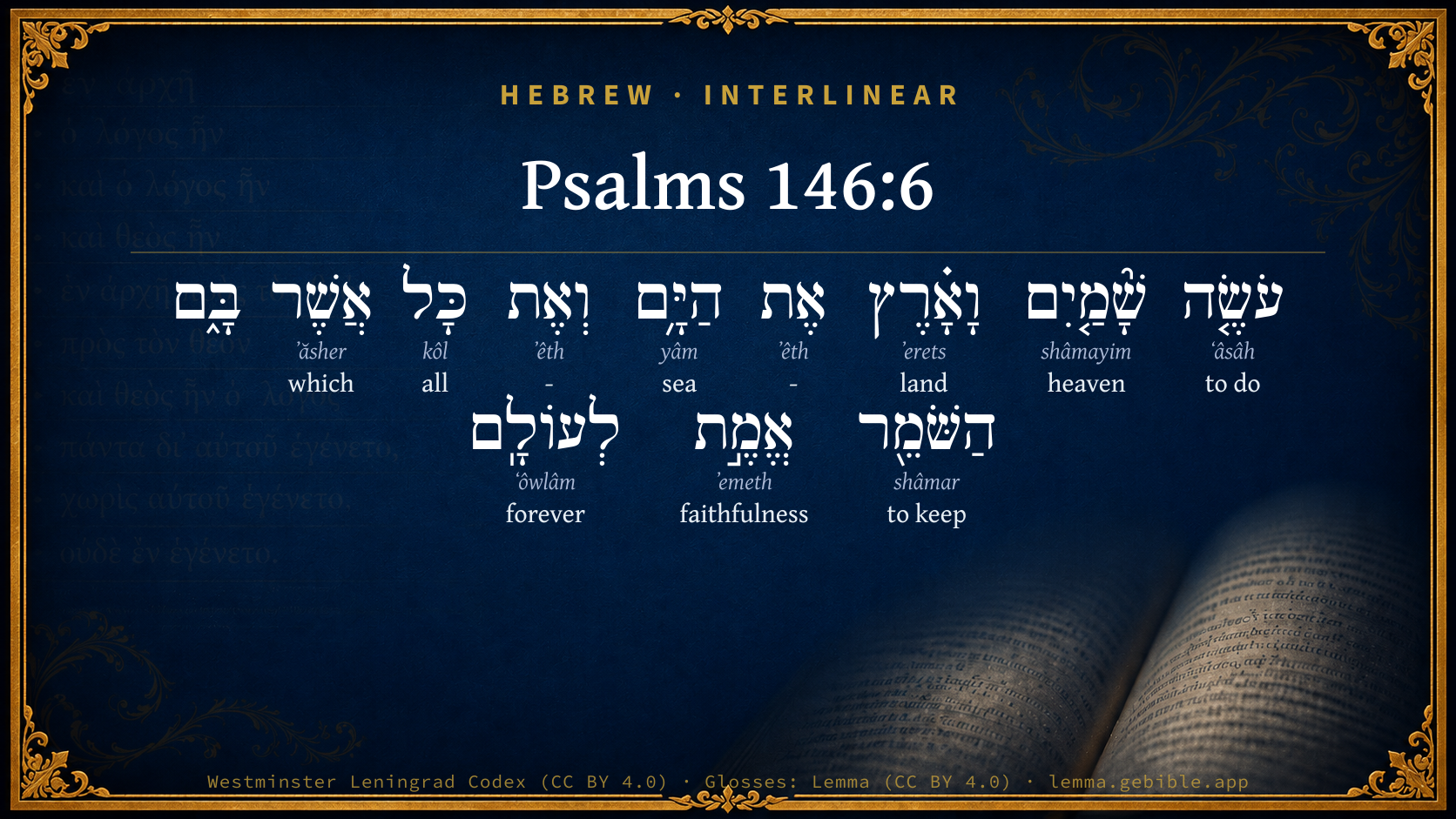
Hebrew (Westminster Leningrad Codex) Psalms 146:6 appears in the Hebrew Old Testament. The text above is from the Westminster Leningrad Codex. Each word links to its Strong’s number, a concise gloss, and parsing drawn from the Open Scriptures Hebrew Bible morphology. Click any word for its full Brown-Driver-Briggs (BDB) entry.
Download image
Cite this verse

Psalms 146:6 (World English Bible). Public Domain. Lemma interlinear Bible study tool, https://lemma.gebible.app/v/psalms/146/6.

Show BibTeX & RIS
BibTeX
RIS
English Translation
Who made heaven and earth, The sea, and all that is in them; Who keeps truth forever;
World English Bible · Public Domain
Download a study sheet

One document with this verse’s original text, its word-by-word gloss line, the meaning frame, cross-references with their text, attributed commentary, and full source and license credits — printable, and it pastes into notes with its structure intact.

This verse Autodidact and up

Study sheet (.html) Plain text (.txt)

A passage Seminary Student

Up to 50 verses in one chapter. A passage sheet keeps up to 6 commentary sources and 12 cross-references per verse, in the order this page ranks them, and says so on the sheet whenever that leaves anything out. Ask for a single verse and you get the Autodidact verse sheet above.

Everything on this page stays free to read, with no account — the sheet is a download of what is already on screen, not access to it.

Want to remove ads? Support Godless Engineer
Compare translations 3

The same verse in 3 English versions, stacked beneath the original-language interlinear above. Click any original word for its lexicon entry.

Each is an independent rendering of the whole verse — the interlinear is not word-aligned to these translations.

Highlighted words mark where these versions differ — a whole-verse word diff, not a word-by-word alignment.

  • World English Bible Public Domain
    Who made heaven and earth, The sea, and all that is in them; Who keeps truth forever;
  • King James Version Public Domain
    Which made heaven, and earth, the sea, and all that therein is: which keepeth truth for ever:
  • unfoldingWord Literal Text CC BY-SA 4.0
    the one having made the heavens and the earth, the sea and all that in them, the one keeping faithfulness forever,

unfoldingWord Literal Text — © unfoldingWord, licensed CC BY-SA 4.0. Word-aligned USFM3 via Door43 (git.door43.org/unfoldingWord/en_ult).

Versions to compare (up to 4)

3 of 4 selected

Show all 18 translations

Every available English version of this verse, each an independent rendering of the whole verse.

  • World English Bible Public Domain
    Who made heaven and earth, The sea, and all that is in them; Who keeps truth forever;
  • Berean Standard Bible Public Domain
    the Maker of heaven and earth, the sea, and everything in them. He remains faithful forever.
  • Majority Standard Bible Public Domain
    the Maker of heaven and earth, the sea, and everything in them. He remains faithful forever.
  • King James Version Public Domain
    Which made heaven, and earth, the sea, and all that therein is: which keepeth truth for ever:
  • American Standard Version (1901) Public Domain
    Who made heaven and earth, The sea, and all that in them is; Who keepeth truth for ever;
  • Revised Version (1885) Public Domain
    Which made heaven and earth, the sea, and all that in them is; which keepeth truth for ever:
  • Geneva Bible (1599) Public Domain
    Which made heauen and earth, the sea, and all that therein is: which keepeth his fidelitie for euer:
  • Douay-Rheims (1899) Public Domain
    And they shall speak of the might of thy terrible acts: and shall declare thy greatness.
  • Young's Literal Translation Public Domain
    Making the heavens and earth, The sea and all that `is' in them, Who is keeping truth to the age,
  • Literal Standard Version CC BY-SA 4.0
    Making the heavens and earth, || The sea and all that [is] in them, || Who is keeping truth for all time,
  • Unlocked Literal Bible CC BY-SA 4.0
    Yahweh made heaven and earth, the sea, and all that is in them; he observes trustworthiness forever.
  • unfoldingWord Literal Text CC BY-SA 4.0
    the one having made the heavens and the earth, the sea and all that in them, the one keeping faithfulness forever,
  • Darby Bible Public Domain
    Who made the heavens and the earth, the sea and all that is therein; who keepeth truth for ever;
  • World Messianic Bible Public Domain
    who made heaven and earth, the sea, and all that is in them; who keeps truth forever;
  • Webster's Bible Public Domain
    Who made heaven, and earth, the sea, and all that is in them: who keepeth truth for ever:
  • Free Bible Version CC BY-SA 4.0
    the one who made heaven and earth, and the sea along with everything it contains. He is trustworthy forever.
  • Bible in Basic English Public Domain
    Who made heaven and earth, the sea, and all things in them; who keeps faith for ever:
  • JPS Tanakh (1917) Public Domain
    Who made heaven and earth, the sea, and all that in them is; who keepeth truth for ever;

Literal Standard Version (2020), Covenant Press — licensed CC BY-SA 4.0. Text via the HelloAO Bible API (eBible.org). Unlocked Literal Bible (unfoldingWord) — licensed CC BY-SA 4.0. Text via the HelloAO Bible API (eBible.org). unfoldingWord Literal Text — © unfoldingWord, licensed CC BY-SA 4.0. Word-aligned USFM3 via Door43 (git.door43.org/unfoldingWord/en_ult). Free Bible Version, Dr. Jonathan Gallagher — licensed CC BY-SA 4.0. Text via the HelloAO Bible API (eBible.org).

Word by word

More ways to search: Search by grammar → Find every occurrence → Compare this word →

Practice this passage: Drill this verse → Learn its vocabulary →

אֱמֶ֣ת
ʼemeth
H571
“faithfulness”
Noun, Common, Feminine, Singular, Absolute
Part of Speech
Noun
Type
Common
Gender
Feminine
Number
Singular
State
Absolute
Full BDB Definition

Origin: contracted from H539

TWOT: 116k

firmness, faithfulness, truth (noun feminine) - sureness, reliability - stability, continuance - faithfulness, reliableness - truth - as spoken - of testimony and judgment - of divine instruction - truth as a body of ethical or religious knowledge - true doctrine - in truth, truly (adverb)
  1. עֹשֶׂ֤ה ʻâsâh H6213 “doing” Verb, Qal, Participle Active, Masculine, Singular, Absolute
  2. שָׁ֘מַ֤יִם shâmayim H8064 “heaven(s)” Noun, Common, Masculine, Plural, Absolute
  3. וָאָ֗רֶץ ʼerets H776 “and · land” Conjunction + Noun, Common, Both, Singular, Absolute
  4. אֶת ʼêth H853 “-” Particle, Direct Object
  5. הַיָּ֥ם yâm H3220 “the · sea” Particle, Definite Article + Noun, Common, Masculine, Singular, Absolute
  6. וְאֶת ʼêth H853 “and · -” Conjunction + Particle, Direct Object
  7. כָּל kôl H3605 “all of” Noun, Common, Masculine, Singular, Construct
  8. אֲשֶׁר ʼăsher H834 “which” Particle, Relative
  9. הַשֹּׁמֵ֖ר shâmar H8104 “the · keeping” Particle, Definite Article + Verb, Qal, Participle Active, Masculine, Singular, Absolute
  10. לְעוֹלָֽם ʻôwlâm H5769 “to/for · forever” Preposition + Noun, Common, Masculine, Singular, Absolute

About this verse

These counts appear in no published source. They are computed here, from the morphology-tagged text and Lemma’s own curated glosses. What Lemma adds →

12
words
10
distinct lemmas
Wisdom
section

Grammatical profile

  • 2 verbs
  • 6 nouns
  • 1 preposition
  • 3 particles

Verb forms

  • עֹשֶׂ֤ה Qal · Participle Active
  • הַשֹּׁמֵ֖ר Qal · Participle Active

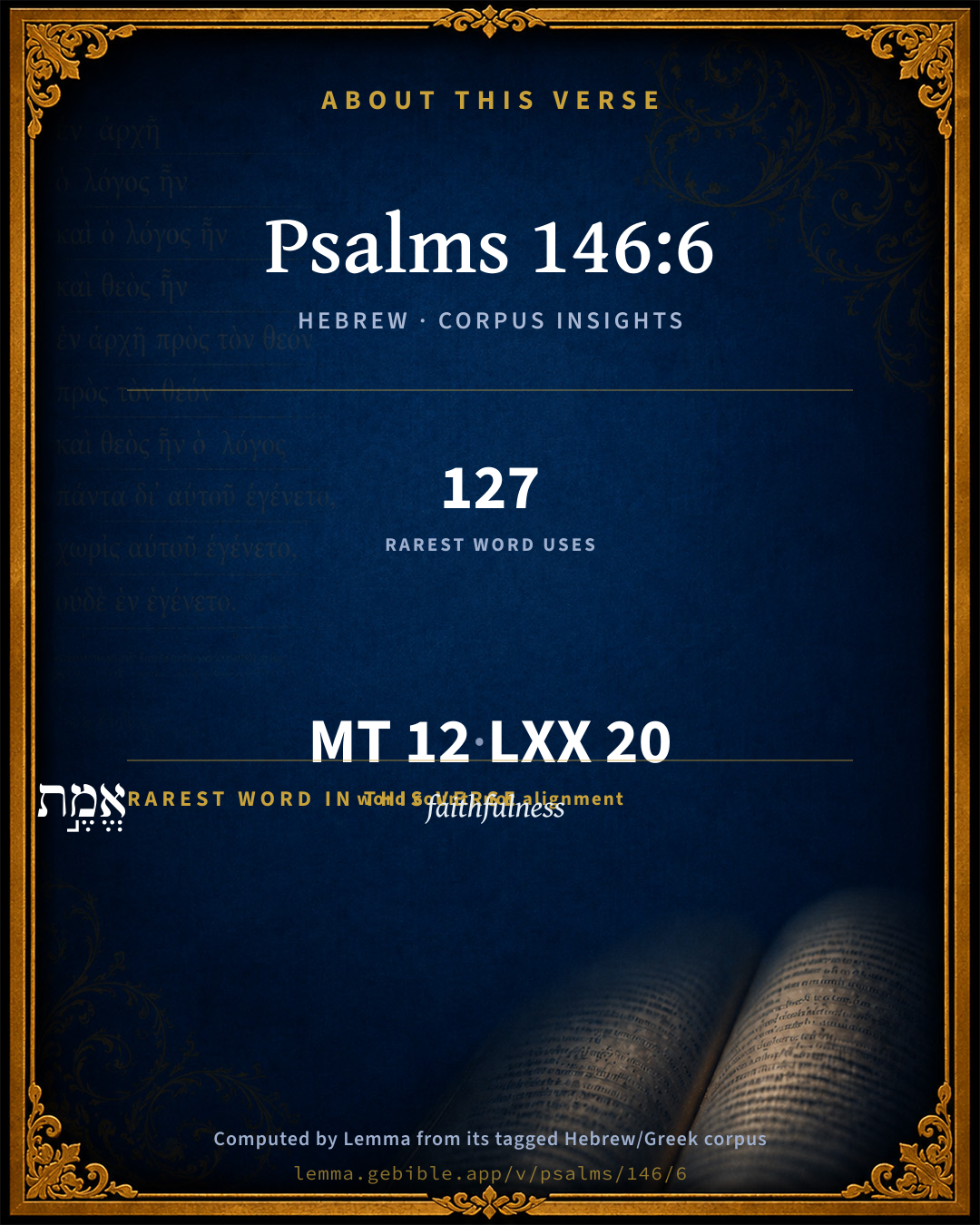
Hebrew & Septuagint length

In English translation the verse runs 17 words from the Hebrew and 17 from the Septuagint (LXX English) — the same length.

A rough comparison of the two English renderings, which tokenize alike — not a word-level alignment.

Word counts can differ between the Hebrew and the Greek without any difference in meaning — e.g. the Hebrew direct-object marker אֵת has no separate Greek word, and Greek often adds the article ὁ.

In the original languages it is 12 Hebrew tokens and 20 Greek tokens — but the two are counted differently (Hebrew bundles its prefixes and suffixes into one token; the Greek is in lemma form), so that isn’t a like-for-like length.

Cross-references

26

Topical passages linked to Psalms 146:6 in the Treasury of Scripture Knowledge — connected by theme and wording, ordered by reader-vote popularity; previews shown in the World English Bible.

  • Exodus 20:11 for in six days Yahweh made heaven and earth, the sea, and all that is in them, and rested the seventh day; therefore Yahweh blessed the Sabbath day, and made it holy.
  • Revelation 14:7 He said with a loud voice, "Fear the Lord, and give him glory; for the hour of his judgment has come. Worship him who made the heaven, the earth, the sea, and the springs of waters!"
  • Psalms 100:5 For Yahweh is good. His loving kindness endures forever, His faithfulness to all generations.
  • Psalms 136:5–6 To him who by understanding made the heavens; For his loving kindness endures forever:
  • Genesis 1:1 In the beginning God created the heavens and the earth.
  • Jeremiah 32:17 Ah Lord Yahweh! behold, you have made the heavens and the earth by your great power and by your outstretched arm; there is nothing too hard for you,
  • Colossians 1:16 For by him were all things created, in the heavens and on the earth, things visible and things invisible, whether thrones or dominions or principalities or powers; all things have been created through him, and for him.
  • Psalms 89:2 I indeed declare, "Love stands firm forever. You established the heavens. Your faithfulness is in them."
  • Psalms 95:5 The sea is his, and he made it. His hands formed the dry land.
  • Proverbs 8:28–29 When he established the clouds above, When the springs of the deep became strong,
  • Psalms 33:6 By Yahweh's word the heavens were made; All their host by the breath of his mouth.
  • Psalms 117:2 For his loving kindness is great toward us. Yahweh's faithfulness endures forever. Praise Yah!
  • Titus 1:2 in hope of eternal life, which God, who can't lie, promised before eternal times;
  • Hebrews 6:18 that by two immutable things, in which it is impossible for God to lie, we may have a strong encouragement, who have fled for refuge to take hold of the hope set before us.
  • Job 38:8–11 "Or who shut up the sea with doors, When it broke forth from the womb,
  • Psalms 115:15 Blessed are you by Yahweh, Who made heaven and earth.
  • Jeremiah 10:11–12 Thus shall you say to them, The gods that have not made the heavens and the earth, these shall perish from the earth, and from under the heavens.
  • John 1:3 All things were made through him. Without him was not anything made that has been made.
  • Acts 14:15 "Men, why are you doing these things? We also are men of like passions with you, and bring you good news, that you should turn from these vain things to the living God, who made the sky and the earth and the sea, and all that is in them;
  • Deuteronomy 7:9 Know therefore that Yahweh your God, he is God, the faithful God, who keeps covenant and loving kindness with them who love him and keep his commandments to a thousand generations,
  • Psalms 89:33 But I will not completely take my loving kindness from him, Nor allow my faithfulness to fail.
  • Psalms 98:3 He has remembered his loving kindness and his faithfulness toward the house of Israel. All the ends of the earth have seen the salvation of our God.
  • Psalms 148:5–6 Let them praise the name of Yahweh, For he commanded, and they were created.
  • Daniel 9:4 I prayed to Yahweh my God, and made confession, and said, Oh, Lord, the great and dreadful God, who keeps covenant and loving kindness with those who love him and keep his commandments,
  • John 10:34 Jesus answered them, "Isn't it written in your law, 'I said, you are gods?'
  • Micah 7:20 You will give truth to Jacob, and mercy to Abraham, As you have sworn to our fathers from the days of old.

Cross-references courtesy of OpenBible.info (CC BY 4.0).

Hebrew and Greek witnesses Masoretic Hebrew ↔ Greek Septuagint

The same verse in the two great witnesses to the Old Testament, shown verse-for-verse.

You’re reading Greek Psalm 145 (Hebrew Psalm 146). The Septuagint counts the superscription, so verse numbers can differ from the Hebrew — chapter-level alignment, not verse-by-verse. Numbering follows Rahlfs.

These are two independent witnesses, not word-aligned to each other, and the Septuagint is shown in lemma (dictionary) form.

Hebrew Psalms 146:6 Masoretic · Westminster Leningrad Codex

עֹשֶׂ֤ה שָׁ֘מַ֤יִם וָאָ֗רֶץ אֶת הַיָּ֥ם וְאֶת כָּל אֲשֶׁר בָּ֑ם הַשֹּׁמֵ֖ר אֱמֶ֣ת לְעוֹלָֽם

Who made heaven and earth, The sea, and all that is in them; Who keeps truth forever;

World English Bible · Public Domain

Greek LXX Greek Psalm 145:6 Septuagint · lemma form

ὁ ποιέω ὁ οὐρανός καί ὁ γῆ ὁ θάλασσα καί πᾶς ὁ ἐν αὐτός ὁ φυλάσσω ἀλήθεια εἰς ὁ αἰών

who made heaven, and earth, the sea, and all things in them: who keeps truth for ever:

LXX2012 (modern English Septuagint) · Public Domain

Hebrew: Westminster Leningrad Codex (CC BY 4.0). Greek: Septuagint (public domain); English from LXX2012 (modern English Septuagint) (Public Domain). How the Septuagint differs from the Hebrew →

Commentary

Notes on Psalms 146:6 from classic Christian and Jewish commentators (each source and its license shown beneath its notes). The classic Christian expositions comment on the surrounding passage and are grouped to its opening verse, so a note may address several verses; the Jewish commentaries on the Tanakh (Rashi and others) are per-verse, so they appear only where the commentator wrote on this verse.

Lemma curates 59 commentaries, every one of them public domain or Creative Commons licensed, each selected and text-cleaned for this edition rather than reprinted as found. About our sources →

Trapp's Complete Commentary

John Trapp

Psa 146:6 Which made heaven, and earth, the sea, and all that therein [is]: which keepeth truth for ever:

Ver. 6. Which made heaven, and earth, &c.] And, therefore, can help, doubtless.

Which keepeth truth for ever] And, therefore, will; since he will not suffer his faithfulness to fail, nor alter the thing that is gone out of his mouth, Psa 89:33-37 And this "for ever" is opposed to that mortality and mutability of earthly princes, Psa 146:4.

John Trapp, A Commentary or Exposition upon All the Books of the Old and New Testament (1647–1656) — public domain. Text from a community e-Sword module.

The Biblical Illustrator

Joseph S. Exell

Psa_146:6

Which keepeth truth for ever.

Truth as an attribute of God

He keepeth truth for ever--

I. In nature (Psa_19:1-14.; Job_37:1-24.).

II. In the region of moral being and life. He keepeth the truth of them for ever. In all ages, in all worlds, these impalpable things, truth, honour, purity, righteousness, charity, are one and are the same. He who has learnt to love them here has eternal kindred; he who has knit his soul to them here has eternal communion; he who has dared to die for them here has eternal renown. The Greek sage was right. The sisters of the unseen realities, which have the rule of us here, await us behind the veil. In vain shall we betray them here, if they affront us there with their retributions, and exact their penalties through eternity. If truth, honour, duty, be transitory and mundane things, the temptation is terrible to shirk them. They cost much, and to him who holds them in slight honour they bring slight rewards. But if He keepeth their truth for ever; if He who is eternal lives by them, works by them, and will so live and work for ever, it lends an awful force to the man who is ready on earth to live for them and die for them; and it blasts with an awful eternal desolation the life which dishonours them and treads them in the dust.

III. In the covenant of redemption.

I. The truth of reconciliation. He declares that He is absolutely reconciled to us in Christ Jesus. That truth He keepeth for ever. Meet Him in Christ. Your sin has for ever vanished from before His face. Your soul is for ever under the heaven of His smiles (Col_1:19; Rom_5:1-11; Eph_1:3-12; Gal_3:21; Gal_4:7). That truth He keepeth for ever.

2. The truth of regeneration (Gal_4:4-5). If your life is built on this rock, Gods calling of you as a son in Christ, if your hope is rested in this sovereign purpose of the Lord God Almighty, to present you complete in Christ in the day of the manifestation of the Son of God, then there is nothing in the universe which is stronger; nothing on earth, heaven or hell, nothing out of yourself can tear you away. And this is the end which God is pursuing through the whole of your discipline (Heb_12:1-12). He keeps the truth of this purpose for ever. To bring out the filial character, to enable you to comprehend His paternal character, is the great end of all you are called to endure.

3. The truth of His covenant engagement concerning man and the universe with His Son. We have His purpose and His love to trust to; but both grounds of assurance assume their strongest form and convey the surest hope when we contemplate the covenant which was established with the God-man when He finished the work which the Father had given Him to do. We are ever haunted in our endeavours to realize Gods faithfulness by the thought of our own unfaithfulness, our utter unworthiness of such fidelity, such love. That we may have strong assurance God established His covenant with us as a covenant with the God-man, the well-beloved Son. Not what we are before the Father but what He is, our advocate, representative, and living head, is then the question. The building up of the spiritual universe under Him as its head, the redemption of the creature, all created things from the bondage of corruption, the realization of the ideal beauty, purity, and splendour, which has haunted like a dim dream in all ages the imagination of mankind, the completion of the New Jerusalem, the filling up of the muster-roll of its citizens, the gathering of the crowned victors of the spiritual battle around the throne of the Captain, to shine and reign with Him in the palaces of eternity,--these are assured to Christ by the terms of the everlasting covenant. And these the God who keepeth truth for ever will evermore secure. (J. B. Brown, B. A.)

The Biblical Illustrator, edited by Joseph S. Exell (c. 1880s–1900s) — public domain. Text from a community e-Sword module.

J. A. Alexander on Psalms

Joseph Addison Alexander

6. (Psa 146:6) Who made heaven and earth, the sea, and all that (is) in them—the (one) keeping truth for ever. Two reasons are here given for thus relying upon God; his almighty power, as exercised and proved in the creation of the world, and his unchangeable fidelity. See above, Psa 25:5. Who made, literally making, with the usual reference to God's creative power as still exerted in the sustentation of the universe. See above, on Psa 65:6; Psa 121:2; Psa 144:2.

Joseph Addison Alexander, The Psalms Translated and Explained (1850) — public domain. Text from a community e-Sword module.

Geneva Bible (1599)

Geneva Bible translators

He encourageth the godly to trust only in the Lord, both for that his power is able to deliver them from all danger, and from his promise sake, his will is most ready to do it.

Geneva Bible (1599) marginal notes — public domain. Text via Bolls.life.

John Calvin's Commentaries

6. Who made heaven, etc. By all these epithets he confirms the truth previously stated. For though at first sight it may seem inappropriate to speak of the Creation, the power of God bears most pertinently upon his helping us whenever danger is near. We know how easily Satan tempts to distrust, and we are thrown into a state of trembling agitation by the slightest causes. Now, if we reflect that God is the Maker of heaven and earth, we will reasonably give him the honor of having the government of the world which he created in his hands and power. There is in this first ascription, then, a commendation of his power, which should swallow up all our fears. As it is not enough that God is merely able to help us, but as a promise is farther necessary, to the effect that he is willing and shall do it, David next declares that he is faithful and true, that, on discovering his willingness, no room may be left for hesitation.

John Calvin's Commentaries (1540-1563) — public domain. Text from the Calvin Translation Society English edition (1840s-50s) via the Christian Classics Ethereal Library (ccel.org). Calvin's coverage is partial (roughly two-thirds of the Bible); uncommented books and verses are honest gaps, never fabricated. The 19th-century editor's footnotes and remarks are omitted so the notes are faithfully Calvin's own voice.

Ellicott's Commentary for English Readers

(6) Truth.—Or, faithfulness. The connection of this feature of the Divine character with the creative act is worthy of notice. That act alone was for the universe a promise and pledge, just as the covenant was a peculiar promise to Israel. Tennyson has put the same thought into verse:

“Thou madest man, he knows not why;

He thinks he was not made to die;

And Thou hast made him: Thou art just.”

In Memoriam.

A Bible Commentary for English Readers, edited by Charles John Ellicott (1878–1897) — public domain. Text from a community e-Sword module.

The Cambridge Bible for Schools and Colleges

gen. ed. J. J. S. Perowne

6. The omnipotence and faithfulness of Jehovah are contrasted with the frailty and transitoriness of man (Psa_146:3-4). For similar references to the power of Jehovah manifested in creation as a ground for trusting Him see Psa_121:2; Psa_124:8; cp. Neh_9:6; Act_4:24.

all that in them is] In heaven and earth and sea; all being wherever found. Cp. Exo_20:11.

The Cambridge Bible for Schools and Colleges (gen. ed. J. J. S. Perowne; Cambridge University Press, 1878–1918) — public domain. Text from a community e-Sword module.

John Gill's Exposition

Which made heaven and earth, the sea, and all that therein is,.... This and the following verses are a description of that divine Person, even Christ, who is the help and hope of his people; and every character of him is a reason for faith and hope in him; all things are made by him, which are in the whole compass of creation, the heaven, earth, and sea, and all in them; the fowls of the airy heaven; the sun, moon, and stars, the hosts of the starry heavens; and the angels, the inhabitants of the third heaven; the beasts of the field, and cattle of a thousand hills; and man, the chief of God's works on earth; and the innumerable fishes of the sea, great and small; and he that made all these, what is it he cannot do? he must be the mighty God, and a mighty Saviour, and the proper object of trust and hope; see Joh 1:1;

which keepeth truth for ever; the truth of doctrine, who as Mediator is full of it, and by whom it came; and, as the Prophet of the church, concealed it not, from the great congregation, the law of truth being in his lips, as the antitype of Levi; the truth of the promises, which are all yea and amen in him; every promise being made to him, and being in him, as the promise of eternal life, with all others, which are safely kept by him, and he will see them performed; the truth of all his engagements with his Father, as the surety of his people; to take their nature, obey, suffer, and die for them, which he has truly and punctually made good, being faithful to him that appointed him; and the truth of all his sayings, concerning his presence with his church and ministers unto the end of the world, and of whatsoever should befall them, from his resurrection and ascension to his second coming.

John Gill's Exposition of the Whole Bible (1746–1763) — public domain (CC PDM 1.0). Text via the HelloAO Bible API.

Albert Barnes' Notes on the Bible

Which made heaven and earth ... - Who is the true God, the Creator of all things. Happy is he who can address the God who called all this wondrous universe into being, and who sustains all by his power, as his God.

Which keepeth truth for ever - Who is always true to his promises. In this verse there are two reasons given why the lot of the people of God would be a happy one:

(1) That Yahweh is the true God, the Creator of all things, and, therefore, able to protect and provide for them.

(2) That he is faithful, and may always be relied on.

Idol-gods have no power, and every reliance placed on them is a vain reliance; people are often false and cannot be trusted, but Yahweh has infinite power, and every promise that he makes will be fulfilled; all that he says is eternally and unchangeably true. The reasons for trusting in him, or the reasons why they who trust in him are “happy,” are further stated in the following verses.

Albert Barnes' Notes on the Bible (1834–1885) — public domain. Text from a community e-Sword/MySword module.

Matthew Poole's English Annotations

Both because he liveth for ever to fulfil his promises, and because he is eternally and unchangeably faithful.

Matthew Poole's English Annotations on the Holy Bible (1683–1685) — public domain. Text from a community e-Sword/MySword module.

The Treasury of David

Charles H. Spurgeon

Ver. 6. Which made heaven, and earth, the sea, and all that therein is. Wisely may we trust our Creator: justly may we expect to be happy in so doing. He who made heaven can make a heaven for us, and make us fit for heaven. He who made the earth can preserve us while we are on earth, and help us to make good use of it while we sojourn upon it. He who made the sea and all its mysteries can steer us across the pathless deeps of a troubled life, and make it a way for his redeemed to pass over. This God who still makes the world by keeping it in existence is assuredly able to keep us to his eternal kingdom and glory. The making of the worlds is the standing proof of the power and wisdom of that great God in whom we trust. It is our joy that he not only made heaven, but the sea; not only things which are bright and blessed, but things which are deep and dark. Concerning all our circumstances, we may say the Lord is there. In storms and hurricanes the Lord reigneth as truly as in that great calm which rules the firmament above.

Which keepeth truth for ever. This is a second and most forcible justification of our trust: the Lord will never permit his promise to fail. He is true to his own nature, true to the relationships which he has assumed, true to his covenant, true to his Word, true to his Son. He keeps true, and is the keeper of all that is true. Immutable fidelity is the character of Jehovah's procedure. None can charge him with falsehood or vacillation.

Ver. 6. Which keepeth truth for ever. Stored in his inexhaustible treasury as the most costly jewel ever there. And that because the truth which he so keeps, and which is the sustaining power which preserves the fabric of creation, is the Eternal Word, his only begotten Son, Jesus Christ. Dionysius the Carthusian, and Ayguan, in Neale and Littledale.

Ver. 6. Which keepeth truth for ever. God does indeed keep the truth from age to agehow else would the Book of God have lived? John Lorinus.

Ver. 6-9. The LORD, is an Almighty God, as the Creator of the universe; next, he is a faithful God "who keepeth truth forever"; further, he is a righteous God (Ps 146:7) a bountiful God (ib.) a gracious God (Ps 146:7-9). J.J. Stewart Perowne.

Ver. 6-7. The God of our hope is,

1. Creator.

2. Truth keeper.

3. Vindicator.

4. Provider.

5. Deliverer.

Psalms 146:7*

Charles H. Spurgeon's The Treasury of David (1869–1885) — public domain. Psalms only. Text from a community e-Sword/MySword module.

The Pulpit Commentary

Which made heaven, and earth, the sea, and all that therein is. Who is, therefore, an omnipotent Help, the very opposite of "the son of man, in whom is no help" at all (ver. 3) Which keepeth truth for ever; i.e. who keeps all his promises, and has promised his help to all such as call upon him faithfully. (Psa_145:18)

Vers. 6-8. Satisfaction in the activity of God.

Herein is a marked contrast between Jehovah, the God of revelation, and all the gods which men have of themselves created. Man always imagines his supreme God as quiescent, impassive, eternally still. Revelation presents to us God as ceaselessly active, never still, everywhere working. All creation, involving sustenance, involves the constant energy and enterprise of God. Brahma is the infinitely silent one. The figures of a Buddha embody the perfection of listlessness and indifference. The Lord Jesus Christ gave us our primal and essential thought of God when he said, "My Father worketh hitherto, and I work.

I MAN IS SURROUNDED WITH THE ACTIVITIES OF EVIL. More than surrounded, for there is the more serious activity of evil within him.

What has to be taken into full account is that evil is a ceaselessly and energetically active force. That truth is embodied for us in the description of evil as "a roaring lion, walking about, seeking whom he may devour." It is on account of that activity that we are bidden to "watch" When men sleep, the enemy is active, and goes sowing tares in their fields. One thing often surprises men. Temptation takes them at unawares; sometimes in their times of conscious strength, sometimes when they are unconscious of their weakness. Morning, noon, and night we have to take account of ever-active evil.

II MAN NEEDS THE ASSURANCE OF THE SUPERIOR ACTIVITY OF GOD, illustrated by the way in which this need was felt by Persians, and met by Zoroaster, who taught the superior activity of Ormuzd over Ahriman a superior activity which assured a continuous as well as a final triumph. This psalm brings on us an answering impression of the activity of our good God. And it is an activity

(1) in the sphere of the things that affect man, and

(2) in man himself. For it is the chief charm of the activity of God that we may think of it as the sanctifying activity of the Holy Spirit, who "dwelleth with us and in us, R.T.

The Pulpit Commentary (1880–1919), ed. H.D.M. Spence-Jones & Joseph S. Exell — public domain. Text from a community e-Sword module.

John Wesley's Explanatory Notes

For ever - Both because he liveth forever to fulfil his promises, and because he is eternally faithful.

John Wesley, Explanatory Notes Upon the Whole Bible (1754–1765) — public domain. Text via the GEBible commentary corpus.

Rashi

Rabbi Shlomo Yitzchaki (Rashi)

Who keeps truth forever To the end of many generations, He fulfills and keeps the truth of His promise.

Rashi on the Tanakh — English translations: “The Judaica Press complete Tanach with Rashi, translated by A. J. Rosenberg” (CC BY 4.0); “Pentateuch with Rashi's commentary by M. Rosenbaum and A.M. Silbermann, 1929-1934” (public domain); “The Metsudah Tanach series, Lakewood, N.J” (CC BY 4.0); and “The Book of Joshua, Metsudah Publications, 1997” (CC BY 4.0). Text via Sefaria.

Ibn Ezra

Rabbi Abraham ibn Ezra

"He who makes" - the meaning is that God can do all He desires, for He is the Maker of Heaven and Earth, the Seas and All that is in Them. "Heavens" - these are the angels, and the great host are the attendants [of God], and on the earth [there are] the birds, animals, and humans, and in the sea [there are] great creatures.

"He who keeps truth for all time" - These are the categories of all species that are on the earth and in the sea, only [that] in the heavens all those in them in their specificity are kept for all eternity [without God keeping them], therefore you(flying creatures) do not fear man that he might oppress you, and he slaughters for you your apportioned sustenance (i.e. man kills and buzzards feed on the carcasses), and he will release your bonds.

Ibn Ezra on the Tanakh — English translations: “Sefaria Community Translation” (CC0 1.0 (public-domain dedication)); “Yalkut, Sifsei Chachomim Chumash, Metsudah Publications, 2009” (CC BY 4.0); and “Commentary of Ibn Ezra on Isaiah - trans. by M. Friedlander, 1873” (public domain). Text via Sefaria.

Lesson kit

Teaching starters — assembled from the data on this page, not authored interpretation. Every prompt links to the verse data it draws on. Edit before teaching.

Psalms, in the Wisdom, opens this verse with 12 words (10 distinct Hebrew lemmas). Its most distinctive word is ʼemeth (“faithfulness”). A historical commentator’s framing appears above. Read the whole chapter for the surrounding context.

Discussion questions

  1. How does “faithfulness” (ʼemeth) shape what this verse is saying?
  2. How does Exodus 20:11, which shares this passage’s theme, read alongside this verse?
  3. These translations render this verse differently; the difference is in the English rendering, not the original. What questions does that raise?
  4. «עֹשֶׂ֤ה» is a Qal Participle Active verb. How does that grammatical form shape the action described?
  5. Compare how Trapp's Complete Commentary and The Biblical Illustrator read this verse. Where do they agree or differ?

Things to notice

Reading settings

Reading text

Shown beneath each verse's original-language words.

Old Testament
Old Testament edition

Read the OT as the Masoretic Hebrew (MT) or the Greek Septuagint (LXX).

English shown for the Greek Septuagint (in the Hebrew ↔ Greek comparison).

Comparing translations? Open the Compare panel on any verse page to stack up to four side by side.