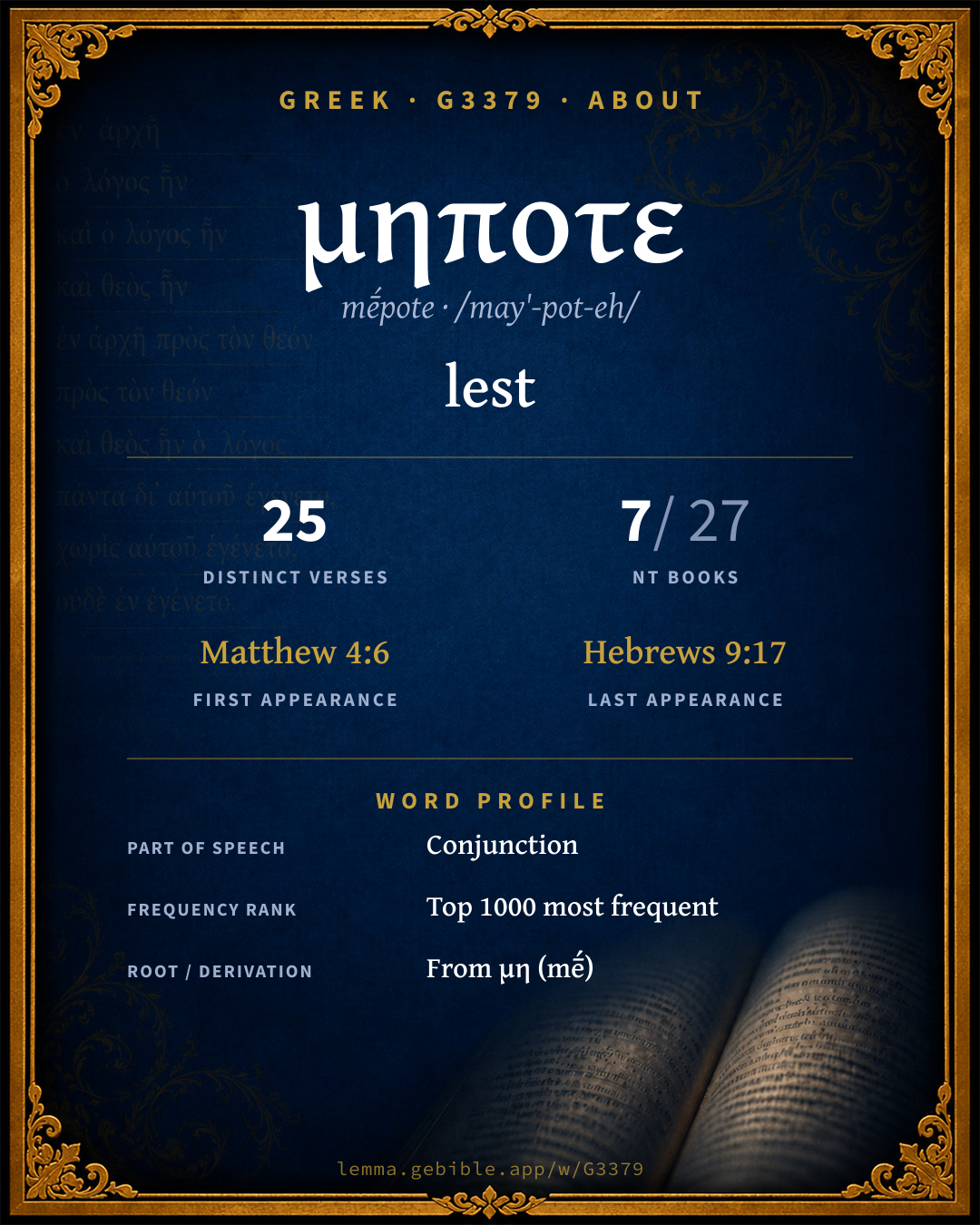
μηποτε
lest
Full lexicon entry — Thayer's Greek Lexicon
From Thayer's Greek Lexicon
Where this word appears
Grammar key — what these labels mean
Part of speech
- Adverb
- A word that modifies a verb, adjective, or other adverb.
Degree
- Negative
- Marks a negative form.
Every verse where G3379 appears in the Book of 2 Timothy — 1 distinct verse. Click any verse to open its interlinear word-by-word view. Verse text shown in the World English Bible for context — . Each verse’s Greek form is shown with its reference; the English is not keyword-highlighted, since the data carries no word-level English alignment. Use “Compare translations” on any verse to read it across multiple English versions. This concordance covers the Greek New Testament; Septuagint (Greek Old Testament) occurrences of this word are not indexed here.
2 Timothy
About this entry
At a glance — auto-summarized from this page’s data, not written by a person. Every figure links to its source below. This summary describes the numbers; it doesn’t interpret them.
The Greek conjunction μηποτε centers on the idea of “lest.” Its earliest occurrence is Matthew 4:6. Spanning 25 verses in 7 books, it ranks among the uncommon words of the Greek New Testament. Matthew dominates its distribution — 8 of 25 verses. Related forms include μη, μηδαμως and μηδε. Dig into 25-verse concordance and the renderings breakdown below.
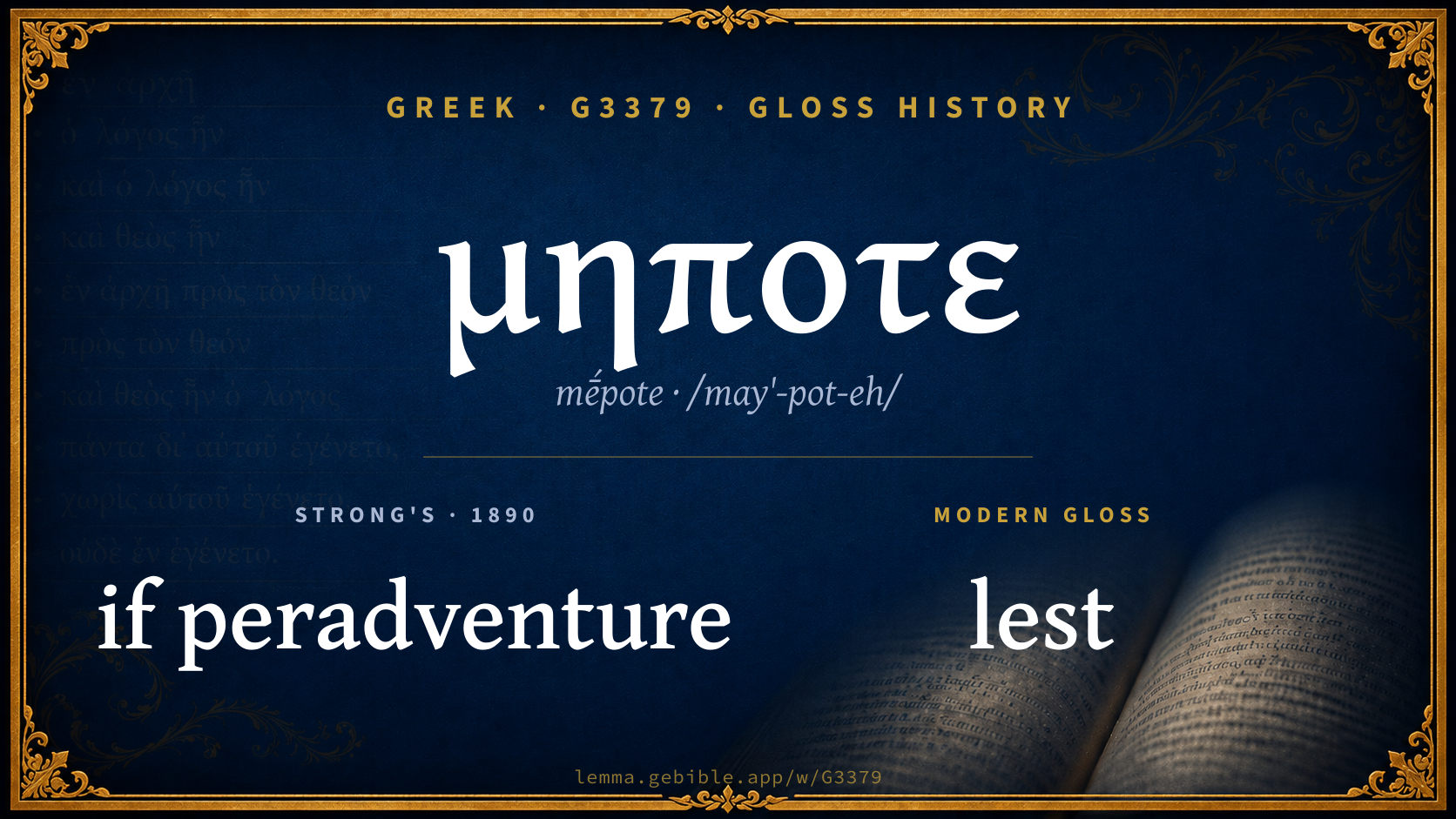
Gloss history
Strong's 1890 vs modern scholarship
About this word
Strong's G3379 catalogs a Greek word from the Greek New Testament.
These counts are not copied from any lexicon or concordance. They are computed here, from the morphology-tagged Greek New Testament. What Lemma adds →
- 25
- distinct verses
- The word appears in 25 distinct verses.
- 7 / 27
- NT books
- The word appears in 7 of 27 New Testament books.
- #530
- by frequency
- Top 1000 most frequent Greek words (rank 530 of 5,347 Greek words by occurrence).
View all 25 occurrences in the concordance →
By section of the New Testament
By traditional corpus
Conventional, traditional groupings — biblical authorship is debated, so this is a traditional corpus grouping, not an authorship claim. Some books belong to more than one corpus (Luke is in both the Gospels and the Lukan corpus, and so on), so these shares overlap and need not total 100%. Each figure is a share of the word’s 25 distinct verses.
- Gospels 18 verses · 72%
- Lukan (Luke–Acts) 9 verses · 36%
- Hebrews 4 verses · 16%
- Johannine 1 verse · 4%
- Pauline corpus 1 verse · 4%
How translations render this word
Counts come from each version’s own published word-to-Strong’s tagging or interlinear alignment — an approximate guide to how each version renders this word, not a word-level alignment the data otherwise carries. Because each total is that version’s own tagged count, the per-version totals vary from one another and need not match the appearance or distinct-verse counts above. These counts may also differ from a printed concordance because Lemma counts each distinctly tagged rendering and does not collapse phrase taggings into a single head-word total. This is a fixed set of word-tagged versions (KJV, ASV, BSB, ULT) and does not change with the reading translation you choose elsewhere. Each version’s license is shown beside its name below (and on Sources).
- King James Version: Lest 11×, Lest at any time 7×
- American Standard Version: Lest 12×, Lest haply 7×, Peradventure 2×
- Berean Standard Bible: Or 1×
- unfoldingWord Literal Text: Lest 14×, Not 6×, That 5×
King James Version Public Domain
Renders G3379 across 28 tagged occurrences — most commonly:
Plus 10 renderings that appear only once — usually multi-word phrases or single function words the recovered tagging swept in, not distinct renderings.
American Standard Version Public Domain
Renders G3379 across 25 tagged occurrences — most commonly:
Plus 4 renderings that appear only once — usually multi-word phrases or single function words the recovered tagging swept in, not distinct renderings.
Berean Standard Bible Public Domain
Renders G3379 across 1 tagged occurrence — most commonly:
unfoldingWord Literal Text CC BY-SA 4.0
Renders G3379 across 31 tagged occurrences — most commonly:
Plus 4 renderings that appear only once — usually multi-word phrases or single function words the recovered tagging swept in, not distinct renderings.
Senses in Thayer's
The 1 sense Thayer's distinguishes for this word, in lexicon order (not ranked by frequency or importance). The full entry — with sub-senses — is in the Lexicon Entry tab.
- that ... not, lest, whether perhaps, whether or not, in no way, perhaps
Word origin
Derived from μη (mḗ) (G3361) — not.
Forms in the corpus
The 2 distinct written forms G3379 takes in the Greek New Testament, most frequent first — each parse links to that case’s occurrences in the concordance.
| Form | Parsing | Example | Uses |
|---|---|---|---|
| μήποτε mḗpote | Adverb, Negative | Matthew 4:6 | 24 |
| μήποτέ mḗpoté | Adverb, Negative | Matthew 5:25 | 1 |
Same root — word family
Other Thayer's entries built from the same root as G3379, grouped by Strong’s listed origin. These share a root / origin per the lexicon — not necessarily a shared meaning. Each links to that word’s own entry.
Derives from
Shares the same root
- μηδαμως mēdamōs G3365 by no means
- μηδε mēdé G3366 and not
- μηδεις mēdeís G3367 no one
- μηκετι mēkéti G3371 no longer
- μη ουκ mḕ ouk G3378 not ever
- μηπω mḗpō G3380 not yet
- μηπως mḗpōs G3381 lest
- μητε mḗte G3383 nor
- μητι mḗti G3385 whether
- μητις mḗtis G3387 let no one
- ου ou G3756 not
Compare all same-root words → Showing 4 of 13 — not the complete family. They share a root, not necessarily a meaning.
Septuagint usage
The same Greek word μηποτε appears 73 times in the Greek Old Testament (Septuagint), across 71 verses in 17 books.
- 73
- LXX occurrences
- Tagged occurrences of this Greek word in the Septuagint.
- 71
- verses
- Distinct Septuagint verses containing this word.
- 17 / 39
- OT books
- The word appears in 17 of the 39 Old Testament books.
Sample Septuagint occurrences
- Genesis 3:22 μήποτε
- Exodus 1:10 μήποτε
- Numbers 16:34 μήποτε
- Joshua 6:18 μήποτε
- Judges 3:24 μήποτε
- Ruth 4:6 μήποτε
- 1 Samuel 4:9 μήποτε
- 2 Samuel 1:20 μήποτε
- 1 Kings 18:27 μήποτε
- 2 Kings 2:16 μήποτε
- Ezra 4:22 μήποτε
- Job 1:5 μήποτε
Septuagint occurrences (same lexeme)
Every verse where the same Strong’s number (G3379) appears in the Greek Septuagint — showing the first 50 of 71. Verse text shown in the World English Bible for context; the Greek form is the matched word — the English is not keyword-highlighted.
- Genesis 3:22 μήποτε Yahweh God said, "Behold, the man has become like one of us, knowing good and evil. Now, lest he put forth his hand, and also take of the tree of life, and eat, and live forever..."
- Genesis 19:17 μήποτε It came to pass, when they had taken them out, that he said, "Escape for your life! Don't look behind you, neither stay anywhere in the plain. Escape to the mountain, lest you be consumed!"
- Genesis 20:2 μήποτε Abraham said about Sarah his wife, "She is my sister." Abimelech king of Gerar sent, and took Sarah.
- Genesis 24:5 μήποτε The servant said to him, "What if the woman isn't willing to follow me to this land? Must I bring your son again to the land you came from?"
- Genesis 24:39 μήποτε I said to my master, 'What if the woman will not follow me?'
- Genesis 26:7 μήποτε The men of the place asked him about his wife. He said, "She is my sister," for he was afraid to say, "My wife," lest, he thought, the men of the place might kill me for Rebekah, because she was beautiful to look on.
- Genesis 26:9 μήποτε Abimelech called Isaac, and said, "Behold, surely she is your wife. Why did you say, 'She is my sister?'" Isaac said to him, "Because I said, 'Lest I die because of her.'"
- Genesis 27:12 μήποτε What if my father touches me? I will seem to him as a deceiver, and I would bring a curse on myself, and not a blessing."
- Genesis 27:45 μήποτε until your brother's anger turn away from you, and he forgets what you have done to him. Then I will send, and get you from there. Why should I be bereaved of you both in one day?"
- Genesis 31:24 μήποτε God came to Laban, the Syrian, in a dream of the night, and said to him, "Take heed to yourself that you don't speak to Jacob either good or bad."
- Genesis 31:29 μήποτε It is in the power of my hand to hurt you, but the God of your father spoke to me last night, saying, 'Take heed to yourself that you don't speak to Jacob either good or bad.'
- Genesis 31:31 μήποτε Jacob answered Laban, "Because I was afraid, for I said, 'Lest you should take your daughters from me by force.'
- Genesis 32:12 μήποτε You said, 'I will surely do you good, and make your seed as the sand of the sea, which can't be numbered because there are so many.'"
- Genesis 38:11 μήποτε Then Judah said to Tamar, his daughter-in-law, "Remain a widow in your father's house, until Shelah, my son, is grown up;" for he said, "Lest he also die, like his brothers." Tamar went and lived in her father's house.
- Genesis 38:23 μήποτε Judah said, "Let her keep it, lest we be shamed. Behold, I sent this kid, and you haven't found her."
- Genesis 42:4 μήποτε But Jacob didn't send Benjamin, Joseph's brother, with his brothers; for he said, "Lest perhaps harm happen to him."
- Genesis 43:12 μήποτε and take double money in your hand, with the money that was returned in the mouth of your sacks carry again in your hand. Perhaps it was an oversight.
- Genesis 47:18 μήποτε When that year was ended, they came to him the second year, and said to him, "We will not hide from my lord how our money is all spent, and the herds of cattle are my lord's. There is nothing left in the sight of my lord, but our bodies, and our lands.
- Genesis 50:15 μήποτε When Joseph's brothers saw that their father was dead, they said, "It may be that Joseph will hate us, and will fully pay us back for all of the evil which we did to him.
- Exodus 1:10 μήποτε Come, let us deal wisely with them, lest they multiply, and it happen that when any war breaks out, they also join themselves to our enemies, and fight against us, and escape out of the land."
- Exodus 5:3 μήποτε They said, "The God of the Hebrews has met with us. Please let us go three days' journey into the wilderness, and sacrifice to Yahweh, our God, lest he fall on us with pestilence, or with the sword."
- Exodus 13:17 μήποτε It happened, when Pharaoh had let the people go, that God didn't lead them by the way of the land of the Philistines, although that was near; for God said, "Lest perhaps the people change their minds when they see war, and they return to Egypt;"
- Exodus 19:21 μήποτε Yahweh said to Moses, "Go down, charge the people, lest they break through to Yahweh to gaze, and many of them perish.
- Exodus 19:22 μήποτε Let the priests also, who come near to Yahweh, sanctify themselves, lest Yahweh break forth on them."
- Exodus 19:24 μήποτε Yahweh said to him, "Go down and you shall bring Aaron up with you, but don't let the priests and the people break through to come up to Yahweh, lest he break forth on them."
- Exodus 20:19 μήποτε They said to Moses, "Speak with us yourself, and we will listen; but don't let God speak with us, lest we die."
- Exodus 32:12 μήποτε Why should the Egyptians speak, saying, 'He brought them forth for evil, to kill them in the mountains, and to consume them from the surface of the earth?' Turn from your fierce wrath, and repent of this evil against your people.
- Exodus 34:12 μήποτε Be careful, lest you make a covenant with the inhabitants of the land where you are going, lest it be for a snare in the midst of you:
- Exodus 34:15 μήποτε Don't make a covenant with the inhabitants of the land, lest they play the prostitute after their gods, and sacrifice to their gods, and one call you and you eat of his sacrifice;
- Numbers 16:34 μήποτε All Israel that were round about them fled at the cry of them; for they said, Lest the earth swallow us up.
- Joshua 6:18 μήποτε But as for you, only keep yourselves from the devoted thing, lest when you have devoted it, you take of the devoted thing; so would you make the camp of Israel accursed, and trouble it.
- Judges 3:24 μήποτε Now when he was gone out, his servants came; and they saw, and, behold, the doors of the upper room were locked; and they said, Surely he is covering his feet in the upper chamber.
- Judges 7:2 μήποτε Yahweh said to Gideon, The people who are with you are too many for me to give the Midianites into their hand, lest Israel vaunt themselves against me, saying, My own hand has saved me.
- Judges 9:54 μήποτε Then he called hastily to the young man his armor bearer, and said to him, Draw your sword, and kill me, that men not say of me, A woman killed him. His young man thrust him through, and he died.
- Judges 14:15 μήποτε It happened on the seventh day, that they said to Samson's wife, Entice your husband, that he may declare to us the riddle, lest we burn you and your father's house with fire: have you called us to impoverish us? is it not [so]?
- Judges 15:12 μήποτε They said to him, We have come down to bind you, that we may deliver you into the hand of the Philistines. Samson said to them, Swear to me that you will not fall on me yourselves.
- Judges 18:25 μήποτε The children of Dan said to him, "Don't let your voice be heard among us, lest angry fellows fall on you, and you lose your life, with the lives of your household."
- Ruth 4:6 μήποτε The near kinsman said, I can't redeem it for myself, lest I mar my own inheritance: take my right of redemption on you; for I can't redeem it.
- 1 Samuel 4:9 μήποτε Be strong, and behave yourselves like men, O you Philistines, that you not be servants to the Hebrews, as they have been to you: quit yourselves like men, and fight.
- 1 Samuel 23:22 μήποτε Please go make yet more sure, and know and see his place where his haunt is, [and] who has seen him there; for it is told me that he deals very subtly.
- 2 Samuel 1:20 μήποτε Don't tell it in Gath, Don't publish it in the streets of Ashkelon; Lest the daughters of the Philistines rejoice, Lest the daughters of the uncircumcised triumph.
- 2 Samuel 17:16 μήποτε Now therefore send quickly, and tell David, saying, Don't lodge this night at the fords of the wilderness, but by all means pass over; lest the king be swallowed up, and all the people who are with him.
- 2 Samuel 20:6 μήποτε David said to Abishai, Now will Sheba the son of Bichri do us more harm than did Absalom: take your lord's servants, and pursue after him, lest he get him fortified cities, and escape out of our sight.
- 1 Kings 18:27 μήποτε It happened at noon, that Elijah mocked them, and said, Cry aloud; for he is a god: either he is musing, or he is gone aside, or he is on a journey, or peradventure he sleeps and must be awakened.
- 2 Kings 2:16 μήποτε They said to him, See now, there are with your servants fifty strong men; let them go, we pray you, and seek your master, lest the Spirit of Yahweh has taken him up, and cast him on some mountain, or into some valley. He said, You shall not send.
- Ezra 4:22 μήποτε Take heed that you not be slack herein: why should damage grow to the hurt of the kings?
- Ezra 6:8 μήποτε Moreover I make a decree what you shall do to these elders of the Jews for the building of this house of God: that of the king's goods, even of the tribute beyond the River, expenses be given with all diligence to these men, that they be not hindered.
- Ezra 7:23 μήποτε Whatever is commanded by the God of heaven, let it be done exactly for the house of the God of heaven; for why should there be wrath against the realm of the king and his sons?
- Ezra 16:3 μήποτε
- Job 1:5 μήποτε It was so, when the days of their feasting had run their course, that Job sent and sanctified them, and rose up early in the morning, and offered burnt offerings according to the number of them all. For Job said, "It may be that my sons have sinned, and renounced God in their hearts." Thus did Job continually.
These are occurrences of the same Greek lexeme (G3379) in the Septuagint — not a translation of any one Hebrew word. The store carries no word-level Hebrew↔Greek alignment, so no Hebrew original is asserted here. Counts come from the recovered LXX Strong's tagging — high-frequency vocabulary is well covered, while rare or late forms may be untagged — so they reflect tagged occurrences and may slightly undercount.