2 Timothy 2:25

Greek (Tischendorf 8th ed.) 2 Timothy 2:25 appears in the Greek New Testament. The text above is from the Tischendorf 8th edition. Each word links to its Strong’s number and a concise gloss. Click any word for its full Thayer’s Greek Lexicon entry.
Download image
Cite this verse

2 Timothy 2:25 (World English Bible). Public Domain. Lemma interlinear Bible study tool, https://lemma.gebible.app/v/2-timothy/2/25.

Show BibTeX & RIS
BibTeX
RIS
English Translation
in gentleness correcting those who oppose him: perhaps God may give them repentance leading to a full knowledge of the truth,
World English Bible · Public Domain
Highlights
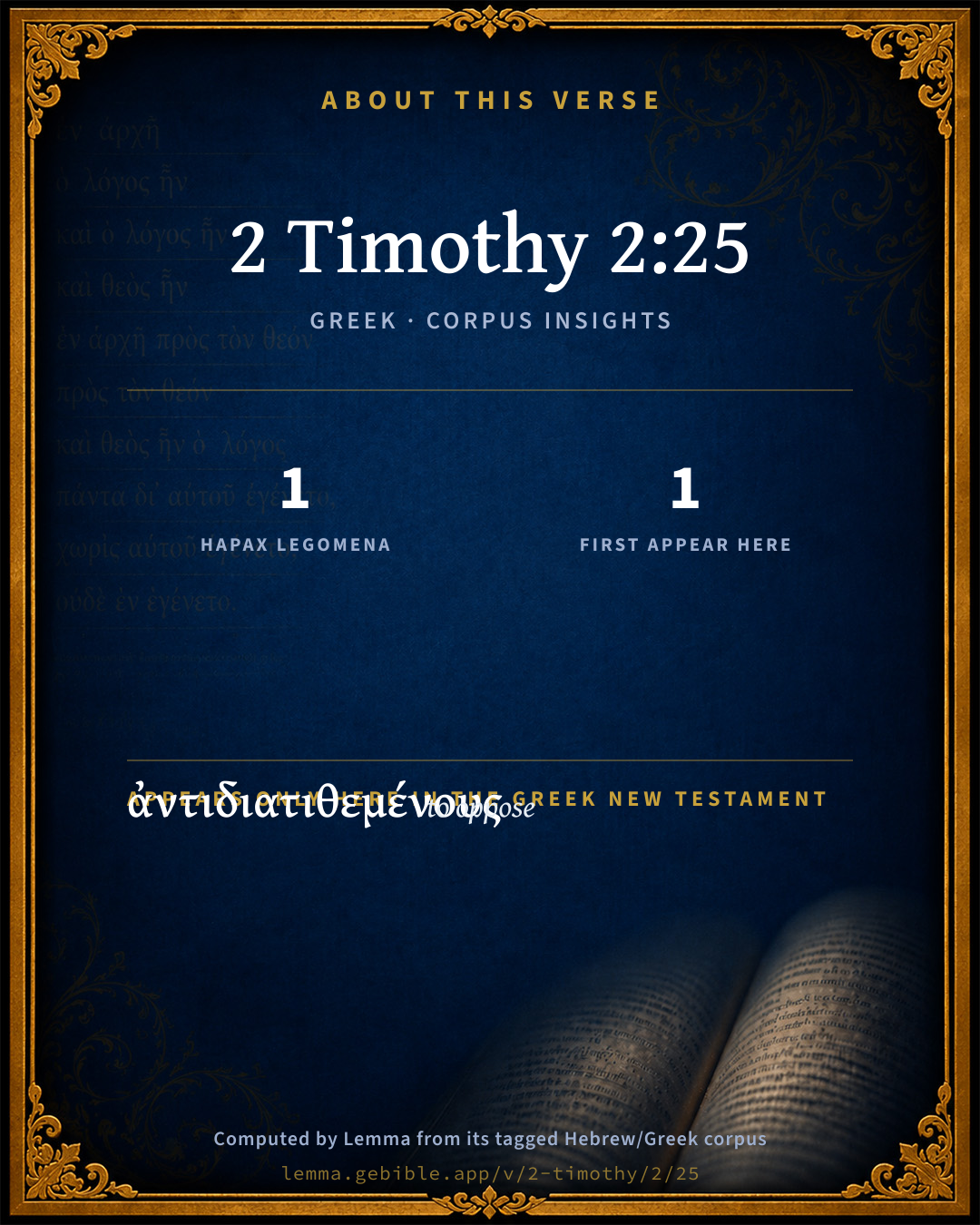
  • 1 hapax legomenon — only here in the Greek New Testament
  • 1 first appearance in the Greek New Testament
Full analysis ↓
Download a study sheet

One document with this verse’s original text, its word-by-word gloss line, the meaning frame, cross-references with their text, attributed commentary, and full source and license credits — printable, and it pastes into notes with its structure intact.

This verse Autodidact and up

Study sheet (.html) Plain text (.txt)

A passage Seminary Student

Up to 50 verses in one chapter. A passage sheet keeps up to 6 commentary sources and 12 cross-references per verse, in the order this page ranks them, and says so on the sheet whenever that leaves anything out. Ask for a single verse and you get the Autodidact verse sheet above.

Everything on this page stays free to read, with no account — the sheet is a download of what is already on screen, not access to it.

Want to remove ads? Support Godless Engineer
Compare translations 3

The same verse in 3 English versions, stacked beneath the original-language interlinear above. Click any original word for its lexicon entry.

Each is an independent rendering of the whole verse — the interlinear is not word-aligned to these translations.

Highlighted words mark where these versions differ — a whole-verse word diff, not a word-by-word alignment.

  • World English Bible Public Domain
    in gentleness correcting those who oppose him: perhaps God may give them repentance leading to a full knowledge of the truth,
  • King James Version Public Domain
    In meekness instructing those that oppose themselves; if God peradventure will give them repentance to the acknowledging of the truth;
  • unfoldingWord Literal Text CC BY-SA 4.0
    in meekness educating the ones opposing. God may perhaps give them repentance for knowledge of the truth,

unfoldingWord Literal Text — © unfoldingWord, licensed CC BY-SA 4.0. Word-aligned USFM3 via Door43 (git.door43.org/unfoldingWord/en_ult).

Versions to compare (up to 4)

3 of 4 selected

Show all 19 translations

Every available English version of this verse, each an independent rendering of the whole verse.

  • World English Bible Public Domain
    in gentleness correcting those who oppose him: perhaps God may give them repentance leading to a full knowledge of the truth,
  • Berean Standard Bible Public Domain
    He must gently reprove those who oppose him, in the hope that God may grant them repentance leading to a knowledge of the truth.
  • Majority Standard Bible Public Domain
    He must gently reprove those who oppose him, in the hope that God may grant them repentance leading to a knowledge of the truth.
  • King James Version Public Domain
    In meekness instructing those that oppose themselves; if God peradventure will give them repentance to the acknowledging of the truth;
  • American Standard Version (1901) Public Domain
    in meekness correcting them that oppose themselves; if peradventure God may give them repentance unto the knowledge of the truth,
  • Revised Version (1885) Public Domain
    in meekness correcting them that oppose themselves; if peradventure God may give them repentance unto the knowledge of the truth,
  • Geneva Bible (1599) Public Domain
    Instructing them with meekenesse that are contrary minded, prouing if God at any time will giue them repentance, that they may acknowledge the trueth,
  • Douay-Rheims (1899) Public Domain
    With modesty admonishing them that resist the truth: if peradventure God may give them repentance to know the truth,
  • Young's Literal Translation Public Domain
    in meekness instructing those opposing -- if perhaps God may give to them repentance to an acknowledging of the truth,
  • Literal Standard Version CC BY-SA 4.0
    instructing those opposing in meekness—if perhaps God may give to them conversion to an acknowledging of the truth,
  • Unlocked Literal Bible CC BY-SA 4.0
    He must in meekness educate those who oppose him. God may perhaps give them repentance for the knowledge of the truth.
  • unfoldingWord Literal Text CC BY-SA 4.0
    in meekness educating the ones opposing. God may perhaps give them repentance for knowledge of the truth,
  • Darby Bible Public Domain
    in meekness setting right those who oppose, if God perhaps may sometime give them repentance to acknowledgment of [the] truth,
  • World Messianic Bible Public Domain
    in gentleness correcting those who oppose him. Perhaps God may give them repentance leading to a full knowledge of the truth,
  • Webster's Bible Public Domain
    In meekness instructing those that oppose themselves; if God perhaps will give them repentance to the acknowledging of the truth:
  • Free Bible Version CC BY-SA 4.0
    gently correcting opponents. Perhaps God may help them to come to repent and to understand the truth.
  • Bible in Basic English Public Domain
    Gently guiding those who go against the teaching; if by chance God may give them a change of heart and true knowledge,
  • Text-Critical English NT CC BY 4.0
    instructing his opponents with gentleness. Perhaps God will grant them repentance leading to the knowledge of the truth.
  • Tyndale New Testament (1534) Public Domain
    and can informe them that resist yf that god at eny tyme will geve them repentaunce for to knowe the trueth:

Literal Standard Version (2020), Covenant Press — licensed CC BY-SA 4.0. Text via the HelloAO Bible API (eBible.org). Unlocked Literal Bible (unfoldingWord) — licensed CC BY-SA 4.0. Text via the HelloAO Bible API (eBible.org). unfoldingWord Literal Text — © unfoldingWord, licensed CC BY-SA 4.0. Word-aligned USFM3 via Door43 (git.door43.org/unfoldingWord/en_ult). Free Bible Version, Dr. Jonathan Gallagher — licensed CC BY-SA 4.0. Text via the HelloAO Bible API (eBible.org).

Word by word

More ways to search: Search by grammar → Find every occurrence → Compare this word →

Practice this passage: Drill this verse → Learn its vocabulary →

ἀντιδιατιθεμένους
antidiatíthemai
G475
“to oppose”
Verb, Present, Middle, Participle, Accusative, Plural, Masculine
Part of Speech
Verb
Tense
Present
Voice
Middle
Mood
Participle
Case
Accusative
Number
Plural
Gender
Masculine
Full Thayer's Definition

Origin: from G473 and G1303

TDNT: None

1. to place one's self in opposition, to oppose, to dispose in turn, to take in hand in turn, to retaliate
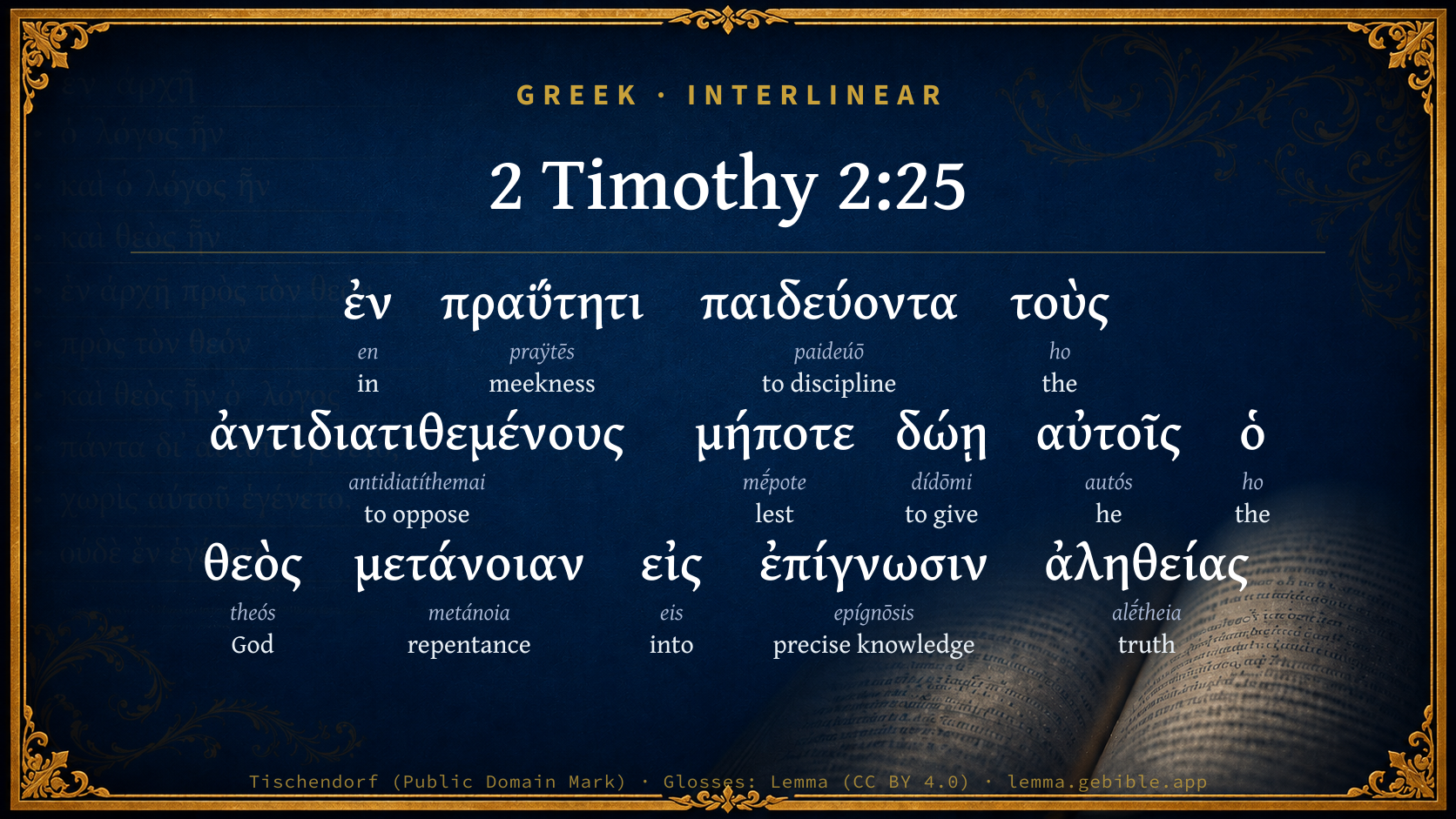
  1. ἐν en G1722 “in” Preposition
  2. πραΰτητι praÿtēs G4240 “meekness” Noun, Dative, Singular, Feminine
  3. παιδεύοντα paideúō G3811 “to discipline” Verb, Present, Active, Participle, Accusative, Singular, Masculine
  4. τοὺς ho G3588 “the” Article, Accusative, Plural, Masculine
  5. μήποτε mḗpote G3379 “lest” Adverb, Negative
  6. δώῃ dídōmi G1325 “to give” Verb, Aorist, Active, Optative, 3rd person, Singular
  7. αὐτοῖς autós G846 “he” Personal pronoun, Dative, Plural, Masculine
  8. ὁ ho G3588 “the” Article, Nominative, Singular, Masculine
  9. θεὸς theós G2316 “God” Noun, Nominative, Singular, Masculine
  10. μετάνοιαν metánoia G3341 “repentance” Noun, Accusative, Singular, Feminine
  11. εἰς eis G1519 “into” Preposition
  12. ἐπίγνωσιν epígnōsis G1922 “precise knowledge” Noun, Accusative, Singular, Feminine
  13. ἀληθείας alḗtheia G225 “truth” Noun, Genitive, Singular, Feminine

About this verse

These counts appear in no published source. They are computed here, from the morphology-tagged text and Lemma’s own curated glosses. What Lemma adds →

14
words
13
distinct lemmas
Pauline Epistles
section

Notable vocabulary

1 hapax legomenon — a word that appears only here in the entire Greek New Testament:

  • ἀντιδιατιθεμένους to oppose G475

First appearance in Scripture

This word makes its first canonical appearance in the Greek New Testament here:

  • ἀντιδιατιθεμένους to oppose G475

Shared distinctive vocabulary

πραΰτητι meekness G4240 occurs in 12 verses of the Greek New Testament. Also found in:

Repetition

A word recurs within this verse:

  • τοὺς the G3588 ×2

Cross-references

29

Topical passages linked to 2 Timothy 2:25 in the Treasury of Scripture Knowledge — connected by theme and wording, ordered by reader-vote popularity; previews shown in the World English Bible.

  • Acts 11:18 When they heard these things, they held their peace, and glorified God, saying, "Then God has also granted to the Gentiles repentance to life!"
  • Galatians 6:1 Brothers, even if a man is caught in some fault, you who are spiritual must restore such a one in a spirit of gentleness; looking to yourself so that you also aren't tempted.
  • 1 Timothy 2:4 who desires all people to be saved and come to full knowledge of the truth.
  • 1 John 5:16 If anyone sees his brother sinning a sin not leading to death, he shall ask, and God will give him life for those who sin not leading to death. There is a sin leading to death. I don't say that he should make a request concerning this.
  • Acts 8:22 Repent therefore of this, your wickedness, and ask God if perhaps the thought of your heart may be forgiven you.
  • Matthew 11:29 Take my yoke upon you, and learn from me, for I am gentle and lowly in heart; and you will find rest for your souls.
  • 1 Peter 3:15 But sanctify the Lord God in your hearts; and always be ready to give an answer to everyone who asks you a reason concerning the hope that is in you, with humility and fear:
  • John 5:34 But the testimony which I receive is not from man. However, I say these things that you may be saved.
  • Acts 2:38 Peter said to them, "Repent, and be baptized, everyone of you, in the name of Jesus Christ for the forgiveness of sins, and you will receive the gift of the Holy Spirit.
  • Acts 5:31 God exalted him with his right hand to be a Prince and a Savior, to give repentance to Israel, and remission of sins.
  • Acts 20:21 testifying both to Jews and to Greeks repentance toward God, and faith toward our Lord Jesus.
  • Jeremiah 13:15–17 Hear you, and give ear; don't be proud; for Yahweh has spoken.
  • Jeremiah 31:33 But this is the covenant that I will make with the house of Israel after those days, says Yahweh: I will put my law in their inward parts, and in their heart will I write it; and I will be their God, and they shall be my people:
  • Ezekiel 11:19 I will give them one heart, and I will put a new spirit within you; and I will take the stony heart out of their flesh, and will give them a heart of flesh;
  • Mark 1:3–4 The voice of one crying in the wilderness, 'Make ready the way of the Lord! Make his paths straight!'"
  • Mark 1:15 and saying, "The time is fulfilled, and the Kingdom of God is at hand! Repent, and believe in the Gospel."
  • 2 Timothy 3:7 always learning, and never able to come to the knowledge of the truth.
  • Titus 1:1 Paul, a servant of God, and an apostle of Jesus Christ, according to the faith of God's chosen ones, and the knowledge of the truth which is according to godliness,
  • Jeremiah 31:18–19 I have surely heard Ephraim bemoaning himself [thus], You have chastised me, and I was chastised, as a calf unaccustomed [to the yoke]: turn you me, and I shall be turned; for you are Yahweh my God.
  • Ezekiel 36:26 A new heart also will I give you, and a new spirit will I put within you; and I will take away the stony heart out of your flesh, and I will give you a heart of flesh.
  • Ezekiel 36:31 Then shall you remember your evil ways, and your doings that were not good; and you shall loathe yourselves in your own sight for your iniquities and for your abominations.
  • Acts 22:1–23 "Brothers and fathers, listen to the defense which I now make to you."
  • James 1:17 Every good gift and every perfect gift is from above, coming down from the Father of lights, with whom can be no variation, nor turning shadow.
  • Jeremiah 26:12–15 Then spoke Jeremiah to all the princes and to all the people, saying, Yahweh sent me to prophesy against this house and against this city all the words that you have heard.
  • Acts 5:21 When they heard this, they entered into the temple about daybreak, and taught. But the high priest came, and those who were with him, and called the council together, and all the senate of the children of Israel, and sent to the prison to have them brought.
  • 1 Timothy 6:11 But you, man of God, flee these things, and follow after righteousness, godliness, faith, love, patience, and gentleness.
  • Titus 3:2 to speak evil of no one, not to be contentious, to be gentle, showing all humility toward all men.
  • Zechariah 12:10 I will pour on the house of David, and on the inhabitants of Jerusalem, the spirit of grace and of supplication; and they will look to me whom they have pierced; and they shall mourn for him, as one mourns for his only son, and will grieve bitterly for him, as one grieves for his firstborn.
  • Matthew 21:32 For John came to you in the way of righteousness, and you didn't believe him, but the tax collectors and the prostitutes believed him. When you saw it, you didn't even repent afterward, that you might believe him.

Cross-references courtesy of OpenBible.info (CC BY 4.0).

Commentary

Notes on 2 Timothy 2:25 from classic Christian and Jewish commentators (each source and its license shown beneath its notes). The classic Christian expositions comment on the surrounding passage and are grouped to its opening verse, so a note may address several verses; the Jewish commentaries on the Tanakh (Rashi and others) are per-verse, so they appear only where the commentator wrote on this verse.

Lemma curates 59 commentaries, every one of them public domain or Creative Commons licensed, each selected and text-cleaned for this edition rather than reprinted as found. About our sources →

The Biblical Illustrator

Joseph S. Exell

2Ti_2:25

In meekness instructing those that oppose themselves; if God per adventure will give them repentance to the acknowledging of the truth.

The phrase is difficult as it stands. Strictly translated it would be, lest at any time; but this would be out of harmony with the whole strain of the passage. Grave doubt is expressed, but hope is not extinguished. God is the giver of repentance. Scharlitz, quoted by Fairbairn, suggests whether God may not still give repentance. Here is expression of the thought that there is room and necessity for the operation of the Spirit of God, over and above the normal action of the truth upon the understanding. (H. R. Reynolds, D. D.)

Timothys ministry

(2Ti_2:25-26):--Consider--

I. The characters among whom it was to re exercised--opposers not only of God, but of themselves. They oppose--

1. Their duty.

2. Their conscience.

3. Their peace.

4. Their safety.

II. Its nature. It was a ministry of--

1. Instruction.

2. Meekness.

III. Its design.

1. That sinners may be led to repentance.

2. Led to an acknowledgment of the truth.

3. Recovered from the snares of the devil. (Anon.)

Meekness in the minister

He who cannot bear calmly and reply with dignity to contradiction, is just as little fitted for the ministry of the gospel as the physician would be for his profession who would allow himself to become moved by the abusive speech of a patient in fever delirium either to forsake the sick-bed, or to hurl back the abuse. (Van Oosterzee.)

Thunder rare

But you may reply that ministers must be Boanerges, Sons of Thunder, rattle in a congregation. True; notwithstanding, meekness is to be retained, practised. But to return an answer suitable to the objection.

1. Every thin vapour, light exhalation, will not afford matter to cause a thunder-crack; so each text, subject, doth not give warrant to denounce terrors.

2. Before it thunder we apprehend a light, and then the voice striketh the organ of hearing, and the eye of the mind is to be enlightened in order ere that judgment be threatened.

3. Thunder is rare, not at every season; should the minister continually shoot the shafts of Gods indignation, would not the vulgar begin to smile, laugh him to scorn?

4. After a great crack of thunder the heavens grow black and refresh the earth with sweet showers of water, and when the bolts of justice are cast among the people a preacher is to assume a doleful look, a sad countenance. These rules observed, cry aloud, Thunder and spare not l What shall I more say? In the cause of thy Master be bold, resolute; in thine own, let meekness have her perfect work. (J. Barlow, D. D.)

The spirit of opposition

It was written of Thoreau, the author, that He was by nature of the opposition; there was a constitutional No in him that could not be tortured into Yes. (H. O. Mackey.)

The nature of religious truths

I. Here is a supposition laid down--that truth is something real in itself and of importance to men; something that may be found, and which we ought to seek after. Wherever the Scripture speaks of truth it always means such truth as has relation to religion. All truth, of what kind soever it be, is real. But truth in matters of religion is always of the greatest importance; as being the foundation and the support of right practice. These truths of God are like an immovable rock, the basis and foundation of that true religion which approves itself to every mans understanding by clear reason, and glorifies God by making men like unto Him through virtue and righteousness in their practice. All false religions consist in changing these truths of God into a lie (Rom_1:25).

II. Such is the corrupt state and disposition of mankind, that some there will always be who will set themselves to oppose the truth, Notwithstanding the native excellency and beauty of truth considered in itself; notwithstanding the strength and clearness of reason with which it is generally accompanied; notwithstanding the apparent benefit and advantage to which the knowledge of truth always brings, to mankind; yet so little sensible are men of the intrinsic excellency of things, so unattentive to the strength of the clearest reason, so apt to be imposed upon in judging concerning their own true interests; that nothing is more common than to see the plainest and most useful truths in matters of religion violently and passionately opposed. The principal causes of this opposition are--

1. Ignorance. Meaning here by ignorance not a bare want of knowledge. There is a presumptuous ignorance which despises knowledge, and this makes men oppose the truth before they understand anything of it.

2. Carelessness. They blindly, and without any consideration, follow the customs of the place where they happen to live, and the knowledge of truth seems to them to be of no great importance. They take up their religion at adventures, not from the consideration of the laws of nature or of revelation, but merely from the company they chance to be educated amongst, and thus all religions are put upon an equal foot, varying according to the accidental temper, of the persons among whom they prevail.

3. Prejudice. They have accustomed themselves to found their belief entirely in an implicit reliance upon other men, instead of building it upon the evidence of things themselves which is the foundation of truth.

4. Rut the last and greatest reason of mens setting themselves in opposition to the truth is the wickedness and corruption of their manners, the love of unrighteousness and debauchery, the desire and power of dominion, the concern they are under for the defence and support of a sect or party without having any knowledge how far they are, or are not, in the right.

III. The direction given us concerning our own duty, that we ought in meekness to instruct those who oppose themselves against the truth. We cannot always discern who they are that err through ignorance and through a vicious disposition. But if we would, yet meekness is at all times necessarily a fruit of the spirit, and we are commanded to be patient towards all men, towards them that oppose as well as towards them that are only ignorant of the truth.

IV. A particular reason with regard to the persons to be instructed, why our instruction to them ought always to be accompanied with meekness. If God peradventure will give them repentance to the acknowledgment of the truth. In the original it is, Lest God peradventure should give them repentance to the acknowledgment of the truth. The meaning is, we are to instruct them with meekness, lest peradventure, by our heat and passion, we raise in them a just prejudice against us, when, by meek instruction, they might possibly have been brought to repentance, and to the acknowledgment of the truth, and so we, by our ill-behaviour become answerable for their miscarriage. For this reason we so frequently find repeated in Scripture the following admonitions, which may serve for a proper application of this whole discourse: 1Pe_2:12; 1Pe_3:15; 1Co_10:32; Col_4:5; 1Ti_3:7; Php_2:15; Php_4:5; Mat_5:16. (S. Clarke, D. D.)

Repentance the design of preaching

1. One principal end of the ministry is to bring men to repentance.

2. By meek preaching God may work repentance.

3. Repentance is hopeful and yet doubtful.

4. Ministers are to preach and leave the success to the Lord. (J. Barlow, D. D.)

Meekness in controversy

When Dr. Swift was arguing one day with great coolness with a gentleman who had become exceedingly warm in the dispute, one of the company asked him how he could keep his temper so well. The reason is, replied the dean, I have truth on my side. A cobbler at Leyden, who used to attend the public dispulations held at the academy, was once asked if he understood Latin. No, replied the mechanic, but I know who is wrong in the argument. How? replied his friend. Why, by seeing who is angry first. (Sunday School Teacher.)

Many qualities requisite in a minister

The medical attendant of my brother has just been expressing his surprise to see how much I am worn within this last half year; I am very sensible of it myself, and expect that I shall be much more worn if my people continue in such a grievous state. I would that my eyes were a fountain of tears to run down day and night. Would you believe it? I have been used to read the Scriptures to get from them rich discoveries of the power and grace of Christ: to learn how to minister to a loving and obedient people; I am now reading them really and literally to know how to minister to a conceited, contentious, and rebellious people. Two qualities, I am sure, are requisite, meekness and patience, yet, in some cases, I shall be constrained to rebuke with authority. I have been used to sail in the Pacific. I am now learning to navigate the Red Sea, that is full of shoals and rocks, with a very intricate passage. I trust the Lord will carry me safely through; but my former trials have been nothing to this. (C. Simeon.)

Plain instruction

Who expects to find Bradshaw full of Latin questions? You get it as a guide, and you want it to be as plain as possible. You have lost your way among some mountains one night, and are overtaken by some classic--who says, I will tell you the way to get home in sixteen different languages, none of which you comprehend. I think you would reply, I would rather be told it, sir, in one that I could understand. Or, if some profound professor should inform you that he could explain the geological strata and formation of the soil on which you were standing, I think you would say, If you could point me to my own abode, I should be more grateful. And I think if some poor ragged girl or shepherd boy could tell you of a way by which you could escape that wood or yonder precipice and reach a hospitable shelter, such information would undoubtedly be more profitable to you. The sign-post that points the way by the side of the roads never have a quotation of poetry upon them, or sentences from Isocrates or Sophocles. There is just the word, and that is enough. (C. H. Spurgeon.)

The Biblical Illustrator, edited by Joseph S. Exell (c. 1880s–1900s) — public domain. Text from a community e-Sword module.

Tyndale Open Study Notes

Tyndale Open Resources

2:25 Gently instruct: Cp. 1 Cor 4:21; 2 Cor 10:1; 1 Thes 5:14; 2 Thes 3:14-15; Titus 3:10-11; Jude 1:22-23.

Tyndale Open Study Notes — © Tyndale Open Resources, licensed CC BY-SA 4.0. Text via the HelloAO Bible API.

Bengel's Gnomon

Johann Albrecht Bengel

2Ti 2:25. Μήποτε) μὴ interrogative: with this expectation, if at any time, etc.—δῷ αὐτοῖς ό Θεὸς, God may give to them) For it does not belong to human power. A motive for patience. [He who attempts to use violence, so much the less accomplishes aught: nor, yet, should he give way to sluggishness.—V. g.]—μετάνοιαν, repentance) This is antecedent to knowledge or acknowledgment.—εἰς, to or for) So εἰς in the following verse.

Bengel's Gnomon of the New Testament — English translation (T&T Clark, Edinburgh, 1860) — public domain. Text from a community e-Sword module.

Expositor's Greek Testament

ed. W. Robertson Nicoll

2Ti 2:25 . τοὺς ἀντιδιατιθεμένους : They who err from right thinking are to be dealt with as tenderly and considerately as they who err from right living. Cf. Gal 6:1 , καταρτίζετε τὸν τοιοῦτον ἐν πνεύματι πραΰτητος . See also chap. 2Ti 4:2 , and reff. Field takes ἀντιδιατίθεσθαι as equivalent to ἐναντίως διατίθεσθαι , “to be contrariwise or adversely affected”. Similarly Ambrosiaster, eos qui diversa sentiunt . Field notes that “the only other example of the compound verb is to be found in Longinus περὶ ὕψους , xvii. 1”. The A.V. and R.V. take the word here as middle, them that oppose themselves, eos qui resistunt [veritati] (Vulg.). von Soden finds in this word the key to the meaning of ἀντιθέσεις , 1Ti 6:20 .

μήποτε (not elsewhere in Paul) = εἴποτε .

δώῃ : The subjunctive seems a syntactical necessity. See J. H. Moulton, Grammar , vol. i. pp. 55, 193, 194, Blass, Grammar , p. 213. On the other hand, W. H. text, and Winer-Moulton, Grammar , p. 374, read δῴη , optative.

μετάνοιαν : It is certainly implied that false theories in religion are not unconnected with moral obliquity and faulty practice. See Tit 1:15-16 ; Tit 3:11 .

The Expositor's Greek Testament, edited by W. Robertson Nicoll (1897–1910) — public domain. Text from a community e-Sword module.

Geneva Bible (1599)

Geneva Bible translators

He meaneth such as do not yet see the truth.

Geneva Bible (1599) marginal notes — public domain. Text via Bolls.life.

Jamieson, Fausset & Brown

Robert Jamieson, A. R. Fausset & David Brown

instructing--Greek, "disciplining," instructing with correction, which those who deal in "uninstructive" or "undisciplined questions" need (see on Ti2 2:23; Ti1 1:20).

those that oppose themselves--Greek, "oppositely affected"; those of a different opinion.

if . . . peradventure--Greek, "if at any time."

repentance--which they need as antecedent to the full knowledge (so the Greek for 'acknowledgment') of the truth" (Ti1 2:4), their minds being corrupted (Ti2 3:8), and their lives immoral. The cause of the spiritual ignorance which prompts such "questions" is moral, having its seat in the will, not in the intellect (Joh 7:17). Therefore repentance is their first need. That, not man, but God alone can "give" (Act 5:31).

Jamieson, Fausset & Brown — Commentary Critical and Explanatory on the Whole Bible (1871) — public domain (CC PDM 1.0). Text via the HelloAO Bible API.

Adam Clarke's Commentary

Verse 25. Those that oppose] αντιδιατιθεμενους. This seems to refer to those who opposed the apostle's authority; and hence the propriety of the allusion to the rebellion of Korah and his company. See observations at the end of the chapter.

If God peradventure] He was to use every means which he had reason to believe God might bless; and the apostle intimates that, bad as they were, they were not out of the reach of God's mercy.

Adam Clarke's Commentary on the Bible (1810–1826) — public domain. Text from a community e-Sword/MySword module.

John Calvin's Commentaries

25 If sometime God grant to them repentance This expression, “If sometime,” or “If perhaps,” points out the difficulty of the case, as being nearly desperate or beyond hope. Paul therefore means that even towards the most unworthy we must exercise meekness; and although at first there be no appearance of having gained advantage, still we must make the attempt. For the same reason he mentions that “God will grant it.” Since the conversion of a man is in the hand of God, who knows whether they who today appear to be unteachable shall be suddenly changed by the power of God, into other men? Thus, whoever shall consider that repentance is the gift and work of God, will cherish more earnest hope, and, encouraged by this confidence, will bestow more toil and exertion for the instruction of rebels. We should view it thus, that our duty is, to be employed in sowing and watering, and, while we do this, we must look for the increase from God. (1 Corinthians 3:6.) Our labors and exertions are thus of no advantage in themselves; and yet, through the grace of God, they are not fruitless.

To the knowledge of the truth We may learn from this what is the actual repentance of those who for a time were disobedient to God; for Paul declares that it begins with “the knowledge of the truth.” By this he means that the understanding of man is blinded, so long as it stands out fiercely against God and his doctrine.

John Calvin's Commentaries (1540-1563) — public domain. Text from the Calvin Translation Society English edition (1840s-50s) via the Christian Classics Ethereal Library (ccel.org). Calvin's coverage is partial (roughly two-thirds of the Bible); uncommented books and verses are honest gaps, never fabricated. The 19th-century editor's footnotes and remarks are omitted so the notes are faithfully Calvin's own voice.

Ellicott's Commentary for English Readers

(25) In meekness instructing those that oppose themselves.—By “those that oppose themselves,” St. Paul alludes scarcely so much to those leading teachers of false doctrine as to those led away by them. In Tit_3:10 we read how these pronounced heretics—no doubt the teachers and leaders of the school—were, after a first and second admonition, to be shunned, were to be left to themselves. These, however, were evidently to be dealt with in a different manner. Their treatment was to be a gentle one. Nothing is here said respecting a first and second admonition only; no hint is given that these are to be shunned. They are clearly not the same as those referred to in Tit_3:10, or above in 2Ti_2:21 of this chapter, where, again, separation is definitely urged.

If God peradventure will give them repentance.—The Greek original here also carries out what was said in the Note on the last clause, and may be rendered literally, if perchance at any time God might grant to them . . . This suggests a hope at least that at some time or other God’s grace would work in these “opposing” members of the congregation a change. The “repentance” here signifies an abandonment on the part of those erring Christians of that wrong course on which they had entered, and a return to the true Church of God and to the full knowledge of the gospel truth.

A Bible Commentary for English Readers, edited by Charles John Ellicott (1878–1897) — public domain. Text from a community e-Sword module.

The Cambridge Bible for Schools and Colleges

gen. ed. J. J. S. Perowne

25. in meekness instructing] Meekness, gentleness of heart, the feeling as separate from the demeanour: still more clearly brought out by the use of the compound word 1Ti_6:11. The corresponding adjective is used by ‘the Lord’ Himself of Himself, ‘I am meek and lowly in heart,’ Mat_11:29. See note on Tit_3:2. A very interesting passage where it occurs is Gal_5:22, where Bp Lightfoot divides the nine fruits of the Spirit into three sets of three, and shews how each of the first two triads is arranged in an ascending scale, (1) love, joy, peace, (2) patient endurance, kindly feeling, active beneficence. May not the third triad be similarly arranged thus, (3) a childlike trust, a woman’s meekness, a man’s self-mastery?

instructing] The word is explained 1Ti_1:20 and Tit_2:12; in all but two of the thirteen places where it occurs in N.T. the sense of ‘correction,’ ‘discipline’ is clear; and in those two, Act_7:22; Act_22:3, the instruction is that of school or college, and ‘schooled’ will best express it. So here ‘correcting,’ bringing under discipline.

those that oppose themselves] Lit. ‘that are becoming contentiously disposed’; the usage of the middle is disponere aliquid, not disponere se; hence ‘oppose themselves’ must not be taken as at any rate a literal version; the word corresponding to the perfect of this verb is the well known ‘adversaries’ 1Co_16:9, used also 1Ti_5:14.

if God peradventure] Lit. ‘if God might perchance at some time,’ Lat. ‘si forte aliquando.’

will give] The optative not subjunctive mood has the best authority. The exact force then is ‘You must discipline them, in case God may give them repentance, as we wish and pray.’

repentance] The word occurs only four times in St Paul’s Epistles, though frequent in St Luke’s Gospel and Acts. Cf. Trench, N. T. Syn. p. 247, who defines it as ‘a change of mind, taking a wiser view of the past, a regret for the ill done in that past, and out of all this a change for the better.’

to the acknowledging of the truth] Better, unto the full knowledge; ‘unto’ expresses the state into which repentance is designed to bring them, as Act_11:18, ‘hath God granted repentance unto life’; ‘full knowledge’ as in 1Ti_2:4, where see note.

The Cambridge Bible for Schools and Colleges (gen. ed. J. J. S. Perowne; Cambridge University Press, 1878–1918) — public domain. Text from a community e-Sword module.

John Gill's Exposition

In meekness instructing those that oppose themselves,.... To the truth; resist it and deny it; or contradict some other tenets and principles of theirs, or the Scriptures, which they themselves allowed to be the word of God, and the rule of faith and practice, and so are self-convinced and self-condemned. These are to be instructed, being ignorant, and in a tender and gentle manner, though very perverse and obstinate.

If God peradventure will give them repentance to the acknowledging of the truth: repentance here designs a repentance of errors in principle, a change of mind upon conviction, and such as issues in a free and ingenuous confession, and acknowledgment of the truth before opposed; and such a repentance is the gift of God: it is he that opens the eyes of the understanding, and works conviction in the mind, and leads into all truth, as it is in Jesus; and induces men to repent of their errors, confess their mistakes, and own the truth; even as repentance of evil practices is not owing to the power of men, nor to the bare influence of means, but to the efficacious grace of God, it being a grant from him. And though this is not certain, that God will give repentance to such contradictors and blasphemers of his Gospel; yet as it is his will, that all his chosen ones should come to repentance, and that some of all sorts should be saved, and come to the knowledge of the truth; and seeing these things have been brought about under and by the ministry of the word, it is an encouragement to the ministers of the Gospel to continue their instructions in the manner here directed.

John Gill's Exposition of the Whole Bible (1746–1763) — public domain (CC PDM 1.0). Text via the HelloAO Bible API.

Trapp's Complete Commentary

John Trapp

25 In meekness instructing those that oppose themselves; if God peradventure will give them repentance to the acknowledging of the truth;

Ver. 25. Those that oppose themselves] Though they should deal as absurdly with us as those that deny the snow to be white, &c. Aristotle forbids to dispute with such. {a} But Christ commands not only by force of argument to convince them, Jdg 1:22, but also to handle them gently, and in meekness to instruct them.

If God will give them, &c.] Repentance is God’s gift: neither is it in the power of any to repent at pleasure. Some vainly conceit that these five words, Lord, have mercy upon me, are as efficacious to send them to heaven, as the Papists that their five words of consecration are to transubstantiate the bread. But as many are undone (saith a divine) by buying a counterfeit jewel; so many are in hell by mistake of their repentance.

{a} ελεγχετε διακρινομενοι. Arguite disputatos; sic Lorinus vertit.

John Trapp, A Commentary or Exposition upon All the Books of the Old and New Testament (1647–1656) — public domain. Text from a community e-Sword module.

Albert Barnes' Notes on the Bible

In meekness instructing those that oppose themselves - That is, those who embrace error, and array themselves against the truth. We are not to become angry with such persons, and denounce them at once as heretics. We are not to hold them up to public reproach and scorn; but we are to set about the business of patiently “instructing them.” Their grand difficulty, it is supposed in this direction, is, that they are ignorant of the truth. Our business with them is, “calmly to show them what the truth is.” If they are angry, we are not to be. If they oppose the truth, we are still calmly to state it to them. If they are slow to see it, we are not to become weary or impatient. Nor, if they do not embrace it at all, are we to become angry with them, and denounce them. We may pity them, but we need not use hard words. This is the apostolic precept about the way of treating those who are in error; and can any one fail to see its beauty and propriety? Let it be remembered, also, that this is not only beautiful and proper in itself; it is the wiseST course, if we would bring others over to our opinions. You are not likely to convince a man that you are right, and that he is wrong, if you first make him angry; nor are you very likely to do it, if you enter into harsh contention. You then put him on his guard; you make him a party, and, from self-respect, or pride, or anger, he will endeavor to defend his own opinions, and will not yield to yours. “Meekness” and “gentleness” are the very best things, if you wish to convince another that he is wrong. With his heart first, and then modestly and kindly show him “what the truth is,” in as few words, and with as unassuming a spirit, as possible, “and you have him.”

If God peradventure will give them repentance, ... - Give them such a view of the error which they have embraced, and such regret for having embraced it, that they shall be willing to admit the truth. After all our care in teaching others the truth, our only dependence is on God for its success. We cannot be absolutely certain that they will see their error; we cannot rely certainly on any power which argument will have; we can only hope that God may show them their error, and enable them to see and embrace the truth; compare Act 11:18. The word rendered “peradventure,” here - μήποτε mēpote - means, usually, “not even, never;” and then, “that never, lest ever” - the same as “lest perhaps.” It is translated “lest at any time,” Mat 4:6; Mat 5:25; Mat 13:15; Mar 4:12; Luk 21:34; “lest,” Matt, Luk 7:6; Luk 13:29; Luk 15:32; “et al.: lest haply,” Luk 14:12; Act 5:39. It does not imply that there was any CHance about what is said, but rather that there was uncertainty in the mind of the speaker, and that there was need of caution LesT something should occur; or, that anything was done, or should be done, to prevent something from happening.

It is not used elsewhere in the New Testament in the sense which our translators, and all the critics, so far as I have examined, give to it here - as implying A hope that God would give them repentance, etc. But I may be permitted to suggest another interpretation, which will accord with the uniform meaning of the word in the New Testament, and which will refer the matter to those who had embraced the error, and not to God. It is this: “In meekness instructing ‘those that oppose themselves’ (ἀντιδιατιθεμένους antidiatithemenous) ‘lest’ - μήποτε mēpote - God should give them repentance, and they should recover themselves out of the snare of the devil,” etc. That is, they put themselves in this posture of opposition so that they shall not be brought to repentance, and recover themselves. They do it with a precautionary view that they may not be thus brought to repentance, and be recovered to God. They take this position of opposition to the truth, intending not to be converted; and this is the reason why they are not converted.

Albert Barnes' Notes on the Bible (1834–1885) — public domain. Text from a community e-Sword/MySword module.

Haydock's Catholic Bible Commentary

If at any time [10] God may touch the hearts of those who believe not, or who lead a wicked life. (Witham) --- In the Greek it is Greek: mepote, lest; that is, correct those who resist the truth, in hopes that God will some time bring them by repentance to the knowledge of the truth. The Greek does not express a fear that they will repent, but a certain doubt, mixed with strong hope and earnest desire of their conversion. Conversion from sin and heresy is the gift of God, yet we see good exhortations and prayers are available thereto; which would not be the case if we had not free-will. But these exhortations, to be profitable, must be made as the apostle says, Greek: en praoteti; i.e. with modesty and meekness. Si forte det Deus illis meliorem mentem; i.e. ut perveniant ad agnitionem ejus veritatis, quam nunc oppugnant.

===============================

[BIBLIOGRAPHY]

Ne quando, Greek: mepote, quasi, si quando.

George Leo Haydock (1774–1849), Haydock's Catholic Family Bible and Commentary, 1859 edition — public domain. Excludes Psalms (Douay-Rheims chapter numbering differs from Protestant) and Deuterocanonical books (Catholic canon only).

Matthew Poole's English Annotations

In meekness instructing those that oppose themselves; without passion better informing such as have sucked in an error, not reviling them, but gently instructing them, and labouring to convince them of their mistake; for all those who for a time may oppose the truth, are not such as never repent, nor do it out of malice or hatred, they may do it out of ignorance and weakness.

If God peradventure will give them repentance to the acknowledging of the truth; and God may give them a power, and a heart to repent, and to acknowledge that truth, which they at present oppose; and although this must be God’s work, yet he doth it by ministers as his means and instruments, who are to use probable means in order to it; such are not railing and reviling, but meek instructions, and a kind and gentle behaviour to them. A foul-mouthed minister is seldom an instrument to cleanse another’s heart.

Matthew Poole's English Annotations on the Holy Bible (1683–1685) — public domain. Text from a community e-Sword/MySword module.

Whedon's Commentary on the Bible

Daniel D. Whedon

25. Meekness—Disarming hostile feeling in order to give fair play for conviction.

Give them repentance—In consequence of their readiness of conviction produced by your mildness of dealing.

Repentance—That is, the power, not the act, of repentance; namely, from their guilty error, which becomes a conversion to the acknowledging of the truth.

Daniel D. Whedon (gen. ed.), Commentary on the Old and New Testaments (1874–1909) — public domain. Text from a community e-Sword module.

The Pulpit Commentary

Correcting them for instructing those, A.V; peradventure God for God peradventure, A.V; may for will, A.V; unto the knowledge for to the acknowledging, A.V Correcting (paideuonta), paideuein means properly to "educate," "bring up," or "train" a child. Hence sometimes the idea of teaching predominates, sometimes that of correcting or chastising. Here the context shows that the idea of teaching is predominant partly because the word suggests something contrary to the ajpaideutoi zhthseiv of ver. 23, and partly because the end of this paideia is to bring them to the knowledge of God"s truth. The A.V "instructing" is therefore the right word here. Them that oppose themselves (toumenouv); only here in the New Testament or the LXX, or in classical Greek. Literally, those who arrange or set themselves in opposition; or, in one word, "opponents," referring, no doubt, chiefly to such ajntilegontev as are mentioned in the very similar passage, Tit_1:9. (see too Tit_2:8) If peradventure (mhpote). "Mhpote, in later Greek, loses its aversative meaning ("lest at any time"), and is almost equivalent to eipote" (Alford, in loc. )equivalent to "in case God should," etc. Repentance (metanoia); such a change of mind as shall lead them to embrace the truth. Knowledge (ejpignwsiv); almost invariably used of the knowledge of God or of God"s truth (ch. 3:7; (Rom_1:28; Eph_1:17 Eph_4:13; Col_1:9, 10 3:10; Tit_1:1; Heb_10:26, etc.) The truth; that truth which before they set themselves to oppose, disputing against it and resisting it. The servant of the Lord must never despair of any one, never throw an additional obstacle in any one"s way by roughness or harsh speech, and never allow unkind feelings to be roused in his own breast by the perverseness or unreasonableness of them that oppose themselves to him.

The Pulpit Commentary (1880–1919), ed. H.D.M. Spence-Jones & Joseph S. Exell — public domain. Text from a community e-Sword module.

John Wesley's Explanatory Notes

In meekness - He has often need of zeal, always of meekness. If haply God - For it is wholly his work. May give them repentance - The acknowledging of the truth would then quickly follow.

John Wesley, Explanatory Notes Upon the Whole Bible (1754–1765) — public domain. Text via the GEBible commentary corpus.

The People's New Testament

B. W. Johnson

25. In meekness correcting. Opposers must be corrected, but not rudely; rather gently, kindly, humbly. If God … will give them repentance. God gives repentance often by providences which lead to repentance.

B. W. Johnson's The People's New Testament with Notes (1889–1891) — public domain. Electronic text from the Christian Classics Ethereal Library (CCEL) ThML edition.

Cambridge Greek Testament for Schools and Colleges

25. πραΰτητι. This is the orthography of the best MSS.; D2bcEKL and some other authorities spell it πραότητι, which is the reading of the rec. text. See crit. note on Tit 3:2.

δῴη. This is the reading of א*ACD2*G which must be preferred to δῷ the reading of אcD2cEKLP followed by the rec. text.

25. ἐν πραὑτητι παιδεύοντα τοὺς ἀντιδιατιθεμένους, in meekness correcting those who are adversely affected.

πραΰτης is commended again in the list of Christian graces in Tit 3:2 (see also on Tit 1:7), and several times elsewhere in St Paul’s Epistles (Gal 5:23; Gal 6:1; Eph 4:2; Col 3:12 &c.). It expresses the Christian’s attitude, not to God (for this does not enter into the idea) but to man, and as a Christian virtue, it is based on the example of Christ, who was Himself, as He said, πραΰς (Mat 11:29).

It is a question whether ἀντιδιατιθεμένους has a passive or a middle sense. The English versions take it in the latter way as equivalent to ‘those who oppose themselves,’ which yields a quite satisfactory sense; but, as Field has pointed out, in the only other instance of the occurrence of ἀντιδιατίθεσθαι (in Longinus) it is unquestionably passive, which therefore may rule the present passage. Ambrosiaster renders eos qui diversa sentiunt, which agrees with the translation here adopted. The general force of the injunction is not much affected, whichever rendering we adopt; it is comparable to Tit 1:9, τοὺς ἀντιλέγοντας ἐλέγχειν, although the thought here is rather of a gentle and persuasive exhibition of the error of the false teachers, than of their formal refutation.

μήποτε δῴη αὐτοῖς ὁ θεός, if haply God may give to them. We have adopted the reading δῴη, as better attested by manuscripts than δῷ of the rec. text (see crit. note); but the optative here is strange (see Blass, Gram. of N.T. Greek, § 65. 3). If it is correct, it perhaps suggests the idea of the contingency as more remote than δῷ would indicate. μήποτε does not occur again in St Paul.

μετάνοιαν, repentance. It is remarkable how seldom St Paul uses this word (only again in Rom 2:4; 2Co 7:9-10), although the idea of repentance and reconciliation is continually in his thoughts.

εἰς ἐπίγνωσιν ἀληθείας unto knowledge of the truth. Cp. 2Ti 3:7 and see note on 1Ti 2:4.

Cambridge Greek Testament for Schools and Colleges (Cambridge University Press, 1896; 21 vols, various authors incl. Carr, Maclear, Plummer, Farrar, Lumby, Moule, M. R. James, Simcox) — public domain. Text from a community e-Sword module.

International Critical Commentary

25. παιδεύοντα] contrast ἀπαιδεύτους 23 and cf. Tit 2:12. The servant will be carrying out the work of grace.

τοὺς ἀντιδιατιθεμένους] those who are adversely disposed; cf. Longinus, de Subl. 17, πρὸς τὴν πειθὼ τῶν λόγων πάντως ἀντιδιατίθεται (Field, Ot. Norvic. ad loc.).

μήποτε δῴη] “ne quando,” Vulg.; “si quando,” Ambros. It is an indirect question; cf. Tob 8:10 μὴ καὶ οὗτος ἀποθάνῃ: Luk 3:15 μήποτε αὐτὸς εἴη ὁ Χριστός: Gen 24:5,Gen 24:39.

δῴη] οὐκ εἶπε, μήποτε δυνηθῇς . . . τοῦ Κυρίου τὸ πᾶν γίνεται, Chrys The form is optative, cf. 1:16-18; but both here and in Eph 1:17 the subjunctive δώῃ would be more natural; cf. Moulton, N. T. Gr., p. 55; W.-H ii. p. 168.

International Critical Commentary — older volumes (1896–1929), various authors — public domain. Text from a community e-Sword module.

Vincent's Word Studies in the New Testament

Marvin R. Vincent

In meekness [εν πραυτητι] . A Pauline word, only here in Pastorals, But comp. praupaqia, 1Ti 6:11 (note). Const. With instruction. Instructing [παιδευοντα] . See on 1Ti 1:20. Better, correcting!.

Those that oppose themselves [τους αντιδιατιθεμενους] . N. T. o LXX Class. only late Gleek. Themselves is wrong. The meaning is, those who oppose the servant of the Lord; Who carry on the ajntiqeseiv oppositions (1Ti 6:20); =gainsayers (ajntilegontev Tit 1:9). Paul 's word is ajntikeisqai to oppose : see 1Co 16:9; Gal 5:17; Phi 1:28; 2Th 2:4.

Repentance [μετανοιαν] . Only here in Pastorals. See on repent) Mt 3:2.

To the acknowledging of the truth [εις επιγνωσιν αληθειας] . More correctly, the knowledge. The formula Past o. See 1Ti 2:4 (note); 2Ti 3:7. For eijv unto after metanoia repentance, see Mr 1:4; Luk 3:3; Luk 24:47; Act 11:18; Act 20:21; 2Co 7:10.

Marvin R. Vincent, Word Studies in the New Testament (1887–1900) — public domain. Text from a community e-Sword/MySword module.

Lesson kit

Teaching starters — assembled from the data on this page, not authored interpretation. Every prompt links to the verse data it draws on. Edit before teaching.

2 Timothy, in the Pauline Epistles, opens this verse with 14 words (13 distinct Greek lemmas). Its most distinctive word is antidiatíthemai (“to oppose”). A historical commentator’s framing appears above. Read the whole chapter for the surrounding context.

Discussion questions

  1. What does “to oppose” (antidiatíthemai) contribute to the verse as a whole?
  2. 1 word here appears nowhere else in the Greek New Testament. Why might the author reach for such rare wording?
  3. This is the first place “to oppose” appears in Scripture (first appears here). What does its debut here establish?
  4. How does 1 Corinthians 4:21, which shares the word «meekness», read alongside this verse?
  5. What does the repetition of “the” (2× in this one verse) do in this verse?
  6. These translations render this verse differently. What is at stake in choosing one wording over another?
  7. Compare how The Biblical Illustrator and Tyndale Open Study Notes read this verse. Where do they agree or differ?

Things to notice

  • 1 word in this verse appears nowhere else in the Greek New Testament.
  • 1 word makes its first canonical appearance in Scripture here.
  • These translations choose different wording for 19 words in this verse.
  • “the” occurs 2× in this single verse.
  • 13 distinct Greek lemmas span 14 words in this verse.

Reading settings

Reading text

Shown beneath each verse's original-language words.

Old Testament
Old Testament edition

Read the OT as the Masoretic Hebrew (MT) or the Greek Septuagint (LXX).

English shown for the Greek Septuagint (in the Hebrew ↔ Greek comparison).

Comparing translations? Open the Compare panel on any verse page to stack up to four side by side.