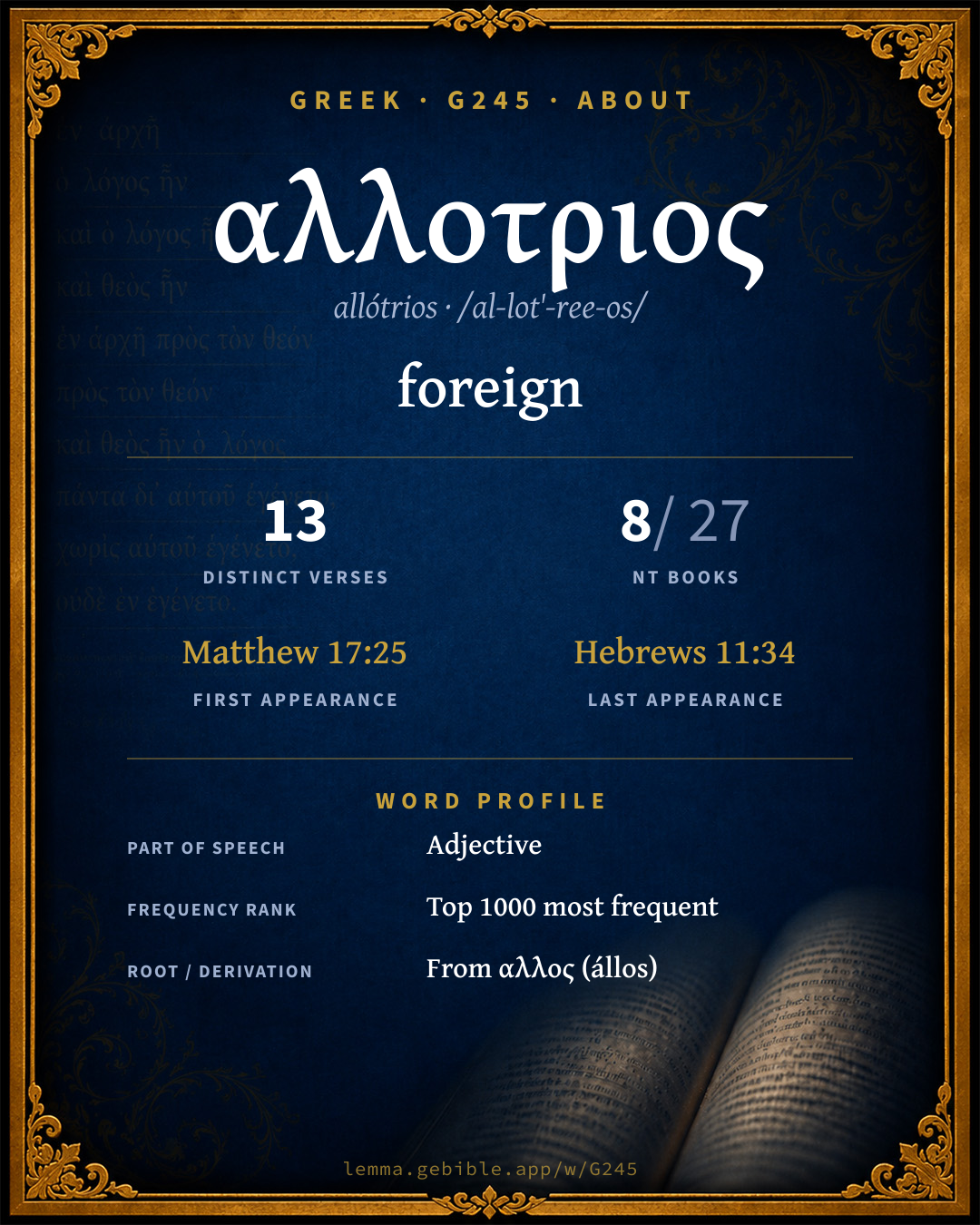
ἀλλότριος
foreign
‘foreign’ is one of 2 main senses fuller range ↓
Full lexicon entry — Thayer's Greek Lexicon
From Thayer's Greek Lexicon
Where this word appears
See every Dative-case word in the Greek New Testament →
Grammar key — what these labels mean
Part of speech
- Adjective
- A word that describes or qualifies a noun.
Case
- Genitive
- The case of source, possession, or “of” — answers “whose / from what.”
- Dative
- The case of the indirect object, means, or location — “to / for / with / in.”
- Accusative
- The case of the direct object and of extent.
Gender
- Masculine
- Grammatically masculine.
- Feminine
- Grammatically feminine.
- Neuter
- Grammatically neuter.
Number
- Plural
- More than one.
- Singular
- One.
Every verse where G245 appears in the Book of John — 1 distinct verse. Click any verse to open its interlinear word-by-word view. Verse text shown in the World English Bible for context — . Each verse’s Greek form is shown with its reference; the English is not keyword-highlighted, since the data carries no word-level English alignment. Use “Compare translations” on any verse to read it across multiple English versions. This concordance covers the Greek New Testament; Septuagint (Greek Old Testament) occurrences of this word are not indexed here.
John
About this entry
At a glance — auto-summarized from this page’s data, not written by a person. Every figure links to its source below. This summary describes the numbers; it doesn’t interpret them.
“foreign” is the headline sense of the Greek adjective αλλοτριος (allótrios). Scripture first uses it in Matthew 17:25. It appears 13 verses across 8 books of the Greek New Testament, among its uncommon vocabulary. Catalogued under 2 senses, its meaning is not single-sense. It shares a root with αλλος, αλλα and αλλασσω. See the sense tree, 13-verse concordance, and the renderings breakdown below.
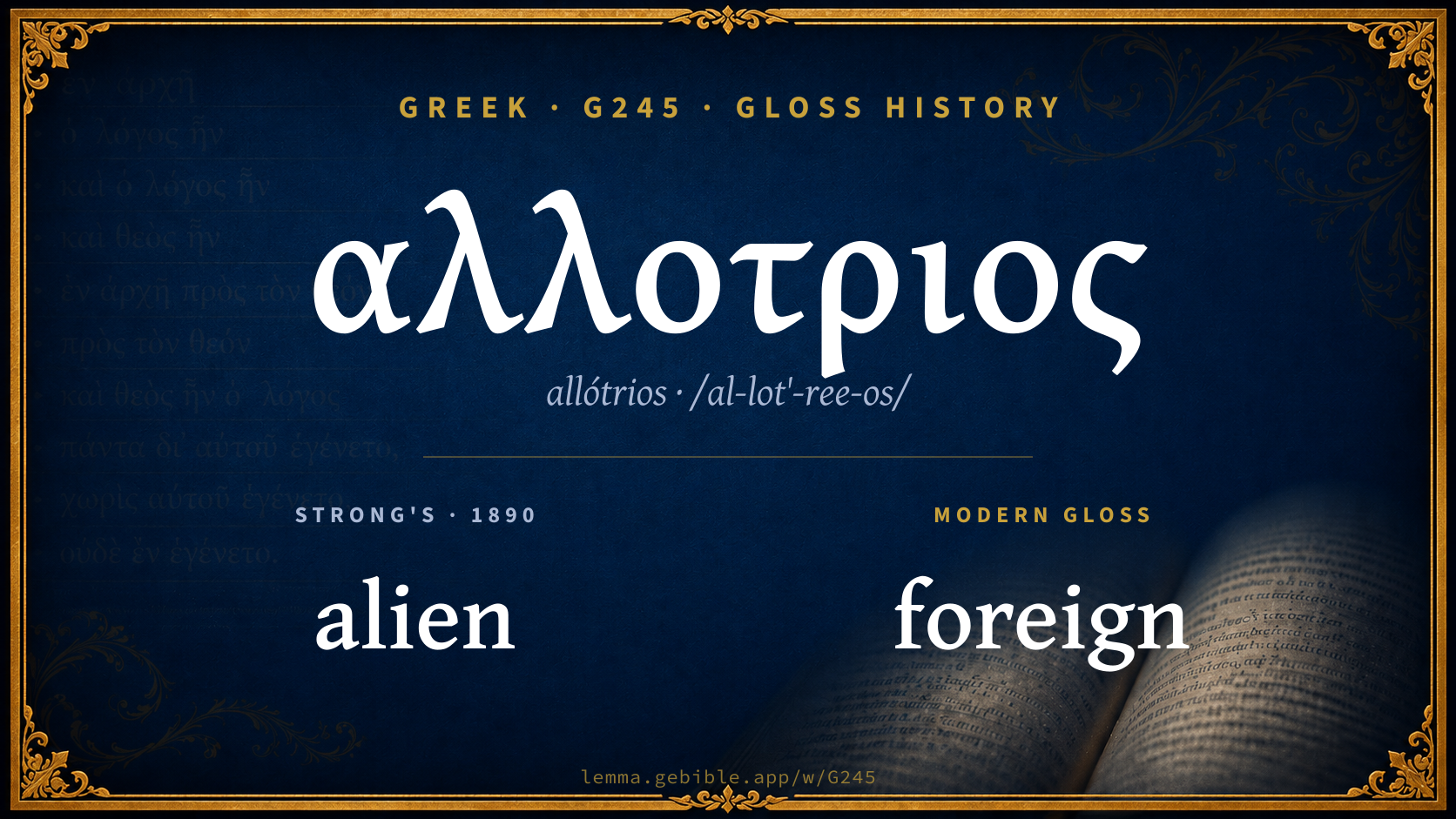
Gloss history
Strong's 1890 vs modern scholarship
About this word
Strong's G245 catalogs a Greek word from the Greek New Testament.
These counts are not copied from any lexicon or concordance. They are computed here, from the morphology-tagged Greek New Testament. What Lemma adds →
- 13
- distinct verses
- The word appears in 13 distinct verses.
- 8 / 27
- NT books
- The word appears in 8 of 27 New Testament books.
- #814
- by frequency
- Top 1000 most frequent Greek words (rank 814 of 5,347 Greek words by occurrence).
View all 13 occurrences in the concordance →
By section of the New Testament
By traditional corpus
Conventional, traditional groupings — biblical authorship is debated, so this is a traditional corpus grouping, not an authorship claim. Some books belong to more than one corpus (Luke is in both the Gospels and the Lukan corpus, and so on), so these shares overlap and need not total 100%. Each figure is a share of the word’s 13 distinct verses.
- Pauline corpus 5 verses · 38%
- Gospels 4 verses · 31%
- Hebrews 3 verses · 23%
- Lukan (Luke–Acts) 2 verses · 15%
- Johannine 1 verse · 8%
How translations render this word
Counts come from each version’s own published word-to-Strong’s tagging or interlinear alignment — an approximate guide to how each version renders this word, not a word-level alignment the data otherwise carries. Because each total is that version’s own tagged count, the per-version totals vary from one another and need not match the appearance or distinct-verse counts above. These counts may also differ from a printed concordance because Lemma counts each distinctly tagged rendering and does not collapse phrase taggings into a single head-word total. This is a fixed set of word-tagged versions (KJV, ASV, BSB, ULT) and does not change with the reading translation you choose elsewhere. Each version’s license is shown beside its name below (and on Sources).
- King James Version: Another man's 3×, Strangers 3×
- American Standard Version: Another 2×, Other men 2×, Strangers 2×
- Berean Standard Bible: Others 4×, Foreign 2×
- unfoldingWord Literal Text: Strangers 3×, Foreign 2×, Others 2×
King James Version Public Domain
Renders G245 across 14 tagged occurrences — most commonly:
Plus 8 renderings that appear only once — usually multi-word phrases or single function words the recovered tagging swept in, not distinct renderings.
American Standard Version Public Domain
Renders G245 across 13 tagged occurrences — most commonly:
Plus 7 renderings that appear only once — usually multi-word phrases or single function words the recovered tagging swept in, not distinct renderings.
Berean Standard Bible Public Domain
Renders G245 across 13 tagged occurrences — most commonly:
Plus 7 renderings that appear only once — usually multi-word phrases or single function words the recovered tagging swept in, not distinct renderings. Not rendered by a distinct English word in 1 further occurrence.
unfoldingWord Literal Text CC BY-SA 4.0
Renders G245 across 14 tagged occurrences — most commonly:
Plus 7 renderings that appear only once — usually multi-word phrases or single function words the recovered tagging swept in, not distinct renderings.
Senses in Thayer's
The 2 senses Thayer's distinguishes for this word, in lexicon order (not ranked by frequency or importance). The full entry — with sub-senses — is in the Lexicon Entry tab.
- belonging to another
- foreign, strange, not of one's own family, alien, an enemy
Word origin
Derived from αλλος (állos) (G243) — another.
From G243 ; another's that is not one´ s own; by extension foreign not akin hostile : - alien (an-) other (man´ s men´ s) strange (-r).
— Strong’s Exhaustive Concordance (1890), public domain.
Forms in the corpus
The 7 distinct written forms G245 takes in the Greek New Testament, most frequent first — each parse links to that case’s occurrences in the concordance.
| Form | Parsing | Example | Uses |
|---|---|---|---|
| ἀλλοτρίῳ allotríō | Adjective, Dative, Singular, Masculine | Luke 16:12 | 4 |
| ἀλλοτρίων allotríōn | Adjective, Genitive, Plural, Masculine | Matthew 17:25 | 4 |
| ἀλλότριον allótrion | Adjective, Accusative, Singular, Masculine | Romans 14:4 | 2 |
| ἀλλοτρίαις allotríais | Adjective, Dative, Plural, Feminine | 1 Timothy 5:22 | 1 |
| ἀλλοτρίαν allotrían | Adjective, Accusative, Singular, Feminine | Hebrews 11:9 | 1 |
| ἀλλοτρίοις allotríois | Adjective, Dative, Plural, Masculine | 2 Corinthians 10:15 | 1 |
| ἀλλοτρίᾳ allotría | Adjective, Dative, Singular, Feminine | Acts 7:6 | 1 |
Same root — word family
Other Thayer's entries built from the same root as G245, grouped by Strong’s listed origin. These share a root / origin per the lexicon — not necessarily a shared meaning. Each links to that word’s own entry.
Derives from
Shares the same root
- αλλα allá G235 but
- αλλασσω allássō G236 to change
- αλλαχοθεν allachóthen G237 from another place
- αλληγορεω allēgoréō G238 to speak allegorically
- αλληλων allḗlōn G240 one another
- αλλογενης allogenḗs G241 foreigner
- αλλοφυλος allóphylos G246 foreign
- αλλως állōs G247 otherwise
Derived from this word
Compare all same-root words → Showing 4 of 11 — not the complete family. They share a root, not necessarily a meaning.
Septuagint usage
The same Greek word αλλοτριος appears 123 times in the Greek Old Testament (Septuagint), across 116 verses in 25 books.
- 123
- LXX occurrences
- Tagged occurrences of this Greek word in the Septuagint.
- 116
- verses
- Distinct Septuagint verses containing this word.
- 25 / 39
- OT books
- The word appears in 25 of the 39 Old Testament books.
Sample Septuagint occurrences
- Genesis 17:12 ἀλλότριος
- Exodus 2:22 ἀλλότριος
- Leviticus 10:1 ἀλλότριος
- Numbers 3:4 ἀλλότριος
- Deuteronomy 14:21 ἀλλότριος
- Joshua 24:14 ἀλλότριος
- Judges 10:16 ἀλλότριος
- 1 Samuel 7:3 ἀλλότριος
- 2 Samuel 22:45 ἀλλότριος
- 1 Kings 8:41 ἀλλότριος
- 2 Kings 19:24 ἀλλότριος
- 2 Chronicles 6:32 ἀλλότριος
Septuagint occurrences (same lexeme)
Every verse where the same Strong’s number (G245) appears in the Greek Septuagint — showing the first 50 of 116. Verse text shown in the World English Bible for context; the Greek form is the matched word — the English is not keyword-highlighted.
- Genesis 17:12 ἀλλότριος He who is eight days old will be circumcised among you, every male throughout your generations, he who is born in the house, or bought with money of any foreigner who is not of your seed.
- Genesis 31:15 ἀλλότριος Aren't we accounted by him as foreigners? For he has sold us, and has also quite devoured our money.
- Genesis 35:2 ἀλλότριος Then Jacob said to his household, and to all who were with him, "Put away the foreign gods that are among you, purify yourselves, change your garments.
- Genesis 35:4 ἀλλότριος They gave to Jacob all the foreign gods which were in their hands, and the rings which were in their ears; and Jacob hid them under the oak which was by Shechem.
- Exodus 2:22 ἀλλότριος She bore a son, and he named him Gershom, for he said, "I have lived as a foreigner in a foreign land."
- Exodus 18:3 ἀλλότριος and her two sons. The name of one son was Gershom, for Moses said, "I have lived as a foreigner in a foreign land".
- Exodus 21:8 ἀλλότριος If she doesn't please her master, who has married her to himself, then he shall let her be redeemed. He shall have no right to sell her to a foreign people, seeing he has dealt deceitfully with her.
- Leviticus 10:1 ἀλλότριος Nadab and Abihu, the sons of Aaron, each took his censer, and put fire in it, and laid incense on it, and offered strange fire before Yahweh, which he had not commanded them.
- Leviticus 16:1 ἀλλότριος Yahweh spoke to Moses, after the death of the two sons of Aaron, when they drew near before Yahweh, and died;
- Numbers 3:4 ἀλλότριος Nadab and Abihu died before Yahweh, when they offered strange fire before Yahweh, in the wilderness of Sinai, and they had no children. Eleazar and Ithamar ministered in the priest's office in the presence of Aaron their father.
- Numbers 17:2 ἀλλότριος Speak to the children of Israel, and take of them rods, one for each fathers' house, of all their princes according to their fathers' houses, twelve rods: write you every man's name on his rod.
- Numbers 26:61 ἀλλότριος Nadab and Abihu died, when they offered strange fire before Yahweh.
- Deuteronomy 14:21 ἀλλότριος You shall not eat of anything that dies of itself: you may give it to the foreigner living among you who is within your gates, that he may eat it; or you may sell it to a foreigner: for you are a holy people to Yahweh your God. You shall not boil a kid in its mother's milk.
- Deuteronomy 15:3 ἀλλότριος Of a foreigner you may exact it: but whatever of your is with your brother your hand shall release.
- Deuteronomy 17:15 ἀλλότριος you shall surely set him king over you, whom Yahweh your God shall choose: one from among your brothers shall you set king over you; you may not put a foreigner over you, who is not your brother.
- Deuteronomy 23:21 ἀλλότριος When you shall vow a vow to Yahweh your God, you shall not be slack to pay it: for Yahweh your God will surely require it of you; and it would be sin in you.
- Deuteronomy 29:21 ἀλλότριος Yahweh will set him apart to evil out of all the tribes of Israel, according to all the curses of the covenant that is written in this book of the law.
- Deuteronomy 31:16 ἀλλότριος Yahweh said to Moses, Behold, you shall sleep with your fathers; and this people will rise up, and play the prostitute after the strange gods of the land, where they go to be among them, and will forsake me, and break my covenant which I have made with them.
- Deuteronomy 31:18 ἀλλότριος I will surely hide my face in that day for all the evil which they shall have worked, in that they are turned to other gods.
- Deuteronomy 31:20 ἀλλότριος For when I shall have brought them into the land which I swore to their fathers, flowing with milk and honey, and they shall have eaten and filled themselves, and grown fat; then will they turn to other gods, and serve them, and despise me, and break my covenant.
- Deuteronomy 32:12 ἀλλότριος Yahweh alone did lead him, There was no foreign god with him.
- Deuteronomy 32:16 ἀλλότριος They moved him to jealousy with strange [gods]; With abominations provoked they him to anger.
- Joshua 24:14 ἀλλότριος Now therefore fear Yahweh, and serve him in sincerity and in truth; and put away the gods which your fathers served beyond the River, and in Egypt; and serve you Yahweh.
- Joshua 24:23 ἀλλότριος Now therefore put away, [said he], the foreign gods which are among you, and incline your heart to Yahweh, the God of Israel.
- Judges 10:16 ἀλλότριος They put away the foreign gods from among them, and served Yahweh; and his soul was grieved for the misery of Israel.
- Judges 19:12 ἀλλότριος His master said to him, We won't turn aside into the city of a foreigner, that is not of the children of Israel; but we will pass over to Gibeah.
- 1 Samuel 7:3 ἀλλότριος Samuel spoke to all the house of Israel, saying, If you do return to Yahweh with all your heart, then put away the foreign gods and the Ashtaroth from among you, and direct your hearts to Yahweh, and serve him only; and he will deliver you out of the hand of the Philistines.
- 2 Samuel 22:45 ἀλλότριος The foreigners shall submit themselves to me: As soon as they hear of me, they shall obey me.
- 2 Samuel 22:46 ἀλλότριος The foreigners shall fade away, Shall come trembling out of their close places.
- 1 Kings 8:41 ἀλλότριος Moreover concerning the foreigner, who is not of your people Israel, when he shall come out of a far country for your name's sake
- 1 Kings 8:43 ἀλλότριος hear in heaven, your dwelling-place, and do according to all that the foreigner calls to you for; that all the peoples of the earth may know your name, to fear you, as does your people Israel, and that they may know that this house which I have built is called by my name.
- 1 Kings 9:9 ἀλλότριος and they shall answer, Because they forsook Yahweh their God, who brought forth their fathers out of the land of Egypt, and laid hold on other gods, and worshiped them, and served them: therefore has Yahweh brought all this evil on them.
- 1 Kings 11:1 ἀλλότριος Now king Solomon loved many foreign women, together with the daughter of Pharaoh, women of the Moabites, Ammonites, Edomites, Sidonians, and Hittites;
- 1 Kings 11:4 ἀλλότριος For it happened, when Solomon was old, that his wives turned away his heart after other gods; and his heart was not perfect with Yahweh his God, as was the heart of David his father.
- 1 Kings 11:7 ἀλλότριος Then did Solomon build a high place for Chemosh the abomination of Moab, on the mountain that is before Jerusalem, and for Molech the abomination of the children of Ammon.
- 2 Kings 19:24 ἀλλότριος I have dug and drunk strange waters, and with the sole of my feet will I dry up all the rivers of Egypt.
- 2 Chronicles 6:32 ἀλλότριος Moreover concerning the foreigner, who is not of your people Israel, when he shall come from a far country for your great name's sake, and your mighty hand, and your outstretched arm; when they shall come and pray toward this house:
- 2 Chronicles 6:33 ἀλλότριος then hear from heaven, even from your dwelling-place, and do according to all that the foreigner calls to you for; that all the peoples of the earth may know your name, and fear you, as does your people Israel, and that they may know that this house which I have built is called by your name.
- 2 Chronicles 14:2 ἀλλότριος Asa did that which was good and right in the eyes of Yahweh his God:
- 2 Chronicles 28:25 ἀλλότριος In every city of Judah he made high places to burn incense to other gods, and provoked to anger Yahweh, the God of his fathers.
- 2 Chronicles 33:15 ἀλλότριος He took away the foreign gods, and the idol out of the house of Yahweh, and all the altars that he had built in the mountain of the house of Yahweh, and in Jerusalem, and cast them out of the city.
- 2 Chronicles 34:25 ἀλλότριος Because they have forsaken me, and have burned incense to other gods, that they might provoke me to anger with all the works of their hands; therefore is my wrath poured out on this place, and it shall not be quenched.
- Ezra 10:2 ἀλλότριος Shecaniah the son of Jehiel, one of the sons of Elam, answered Ezra, We have trespassed against our God, and have married foreign women of the peoples of the land: yet now there is hope for Israel concerning this thing.
- Ezra 10:10 ἀλλότριος Ezra the priest stood up, and said to them, You have trespassed, and have married foreign women, to increase the guilt of Israel.
- Ezra 10:11 ἀλλότριος Now therefore make confession to Yahweh, the God of your fathers, and do his pleasure; and separate yourselves from the peoples of the land, and from the foreign women.
- Ezra 10:14 ἀλλότριος Let now our princes be appointed for all the assembly, and let all those who are in our cities who have married foreign women come at appointed times, and with them the elders of every city, and the judges of it, until the fierce wrath of our God be turned from us, until this matter be dispatched.
- Ezra 10:17 ἀλλότριος They made an end with all the men who had married foreign women by the first day of the first month.
- Ezra 10:18 ἀλλότριος Among the sons of the priests there were found who had married foreign women: [namely], of the sons of Jeshua, the son of Jozadak, and his brothers, Maaseiah, and Eliezer, and Jarib, and Gedaliah.
- Ezra 10:44 ἀλλότριος All these had taken foreign wives; and some of them had wives by whom they had children.
- Ezra 19:2 ἀλλότριος
These are occurrences of the same Greek lexeme (G245) in the Septuagint — not a translation of any one Hebrew word. The store carries no word-level Hebrew↔Greek alignment, so no Hebrew original is asserted here. Counts come from the recovered LXX Strong's tagging — high-frequency vocabulary is well covered, while rare or late forms may be untagged — so they reflect tagged occurrences and may slightly undercount.