

Deuteronomy 15:3

Hebrew (Westminster Leningrad Codex) Deuteronomy 15:3 appears in the Hebrew Old Testament. The text above is from the Westminster Leningrad Codex. Each word links to its Strong’s number, a concise gloss, and parsing drawn from the Open Scriptures Hebrew Bible morphology. Click any word for its full Brown-Driver-Briggs (BDB) entry.
Download image
Cite this verse

Deuteronomy 15:3 (World English Bible). Public Domain. Lemma interlinear Bible study tool, https://lemma.gebible.app/v/deuteronomy/15/3.

Show BibTeX & RIS
BibTeX
RIS
English Translation
Of a foreigner you may exact it: but whatever of your is with your brother your hand shall release.
World English Bible · Public Domain
Download a study sheet

One document with this verse’s original text, its word-by-word gloss line, the meaning frame, cross-references with their text, attributed commentary, and full source and license credits — printable, and it pastes into notes with its structure intact.

This verse Autodidact and up

Study sheet (.html) Plain text (.txt)

A passage Seminary Student

Up to 50 verses in one chapter. A passage sheet keeps up to 6 commentary sources and 12 cross-references per verse, in the order this page ranks them, and says so on the sheet whenever that leaves anything out. Ask for a single verse and you get the Autodidact verse sheet above.

Everything on this page stays free to read, with no account — the sheet is a download of what is already on screen, not access to it.

Want to remove ads? Support Godless Engineer
Compare translations 3

The same verse in 3 English versions, stacked beneath the original-language interlinear above. Click any original word for its lexicon entry.

Each is an independent rendering of the whole verse — the interlinear is not word-aligned to these translations.

Highlighted words mark where these versions differ — a whole-verse word diff, not a word-by-word alignment.

  • World English Bible Public Domain
    Of a foreigner you may exact it: but whatever of your is with your brother your hand shall release.
  • King James Version Public Domain
    Of a foreigner thou mayest exact it again: but that which is thine with thy brother thine hand shall release;
  • unfoldingWord Literal Text CC BY-SA 4.0
    You may collect a foreigner, and what is yours your brother your hand shall release.

unfoldingWord Literal Text — © unfoldingWord, licensed CC BY-SA 4.0. Word-aligned USFM3 via Door43 (git.door43.org/unfoldingWord/en_ult).

Versions to compare (up to 4)

3 of 4 selected

Show all 18 translations

Every available English version of this verse, each an independent rendering of the whole verse.

  • World English Bible Public Domain
    Of a foreigner you may exact it: but whatever of your is with your brother your hand shall release.
  • Berean Standard Bible Public Domain
    You may collect something from a foreigner, but you must forgive whatever your brother owes you.
  • Majority Standard Bible Public Domain
    You may collect something from a foreigner, but you must forgive whatever your brother owes you.
  • King James Version Public Domain
    Of a foreigner thou mayest exact it again: but that which is thine with thy brother thine hand shall release;
  • American Standard Version (1901) Public Domain
    Of a foreigner thou mayest exact it: but whatsoever of thine is with thy brother thy hand shall release.
  • Revised Version (1885) Public Domain
    Of a foreigner thou mayest exact it: but whatsoever of thine is with thy brother thine hand shall release.
  • Geneva Bible (1599) Public Domain
    Of a stranger thou mayest require it: but that which thou hast with thy brother, thine hand shall remit:
  • Douay-Rheims (1899) Public Domain
    Of the foreigner or stranger thou mayst exact it: of thy countryman and neighbour thou shalt not have power to demand it again.
  • Young's Literal Translation Public Domain
    of the stranger thou mayest exact, and that which is thine with thy brother doth thy hand release;
  • Literal Standard Version CC BY-SA 4.0
    of the stranger you may exact, but that which is yours with your brother your hand releases,
  • Unlocked Literal Bible CC BY-SA 4.0
    From a foreigner you may demand it; but whatever of yours is with your brother your hand must release.
  • unfoldingWord Literal Text CC BY-SA 4.0
    You may collect a foreigner, and what is yours your brother your hand shall release.
  • Darby Bible Public Domain
    Of the foreigner thou mayest demand it; but what is thine with thy brother thy hand shall release;
  • World Messianic Bible Public Domain
    Of a foreigner you may require it; but whatever of yours is with your brother, your hand shall release.
  • Webster's Bible Public Domain
    Of a foreigner thou mayest exact it again: but that which is thine with thy brother thy hand shall release:
  • Free Bible Version CC BY-SA 4.0
    You are allowed to collect payments from a foreigner, but you must cancel whatever your fellow Israelite owes you.
  • Bible in Basic English Public Domain
    A man of another nation may be forced to make payment of his debt, but if your brother has anything of yours, let it go;
  • JPS Tanakh (1917) Public Domain
    Of a foreigner thou mayest exact it; but whatsoever of thine is with thy brother thy hand shall release.

Literal Standard Version (2020), Covenant Press — licensed CC BY-SA 4.0. Text via the HelloAO Bible API (eBible.org). Unlocked Literal Bible (unfoldingWord) — licensed CC BY-SA 4.0. Text via the HelloAO Bible API (eBible.org). unfoldingWord Literal Text — © unfoldingWord, licensed CC BY-SA 4.0. Word-aligned USFM3 via Door43 (git.door43.org/unfoldingWord/en_ult). Free Bible Version, Dr. Jonathan Gallagher — licensed CC BY-SA 4.0. Text via the HelloAO Bible API (eBible.org).

Word by word

More ways to search: Search by grammar → Find every occurrence → Compare this word →

Practice this passage: Drill this verse → Learn its vocabulary →

תַּשְׁמֵ֥ט
shâmaṭ
H8058
“to release”
Verb, Hiphil, Jussive, 3rd Person, Feminine, Singular
Part of Speech
Verb
Stem
Hiphil
Form
Jussive
Person
3rd Person
Gender
Feminine
Number
Singular
Full BDB Definition

Origin: a primitive root

TWOT: 2408

to release, let drop or loose or rest or fall - (Qal) to let drop or fall - (Niphal) to be made to fall down, be thrown down - (Hiphil) - to cause to let drop - to release, let drop
  1. אֶת ʼêth H853 “-” Particle, Direct Object
  2. הַנָּכְרִ֖י nokrîy H5237 “the · foreign” Particle, Definite Article + Adjective, Adjective, Masculine, Singular, Absolute
  3. תִּגֹּ֑שׂ nâgas H5065 “to oppress” Verb, Qal, Imperfect, 2nd Person, Masculine, Singular
  4. וַאֲשֶׁ֨ר ʼăsher H834 “and · which” Conjunction + Particle, Relative
  5. יִהְיֶ֥ה hâyâh H1961 “to be” Verb, Qal, Imperfect, 3rd Person, Masculine, Singular
  6. אֶת ʼêth H854 “with” Preposition
  7. אָחִ֖יךָ ʼâch H251 “brother · your” Noun, Common, Masculine, Singular, Construct + Suffix, Personal, 2nd Person, Masculine, Singular
  8. יָדֶֽךָ yâd H3027 “hand · your” Noun, Common, Both, Singular, Construct + Suffix, Personal, 2nd Person, Masculine, Singular

About this verse

These counts appear in no published source. They are computed here, from the morphology-tagged text and Lemma’s own curated glosses. What Lemma adds →

10
words
9
distinct lemmas
Pentateuch
section

Notable vocabulary

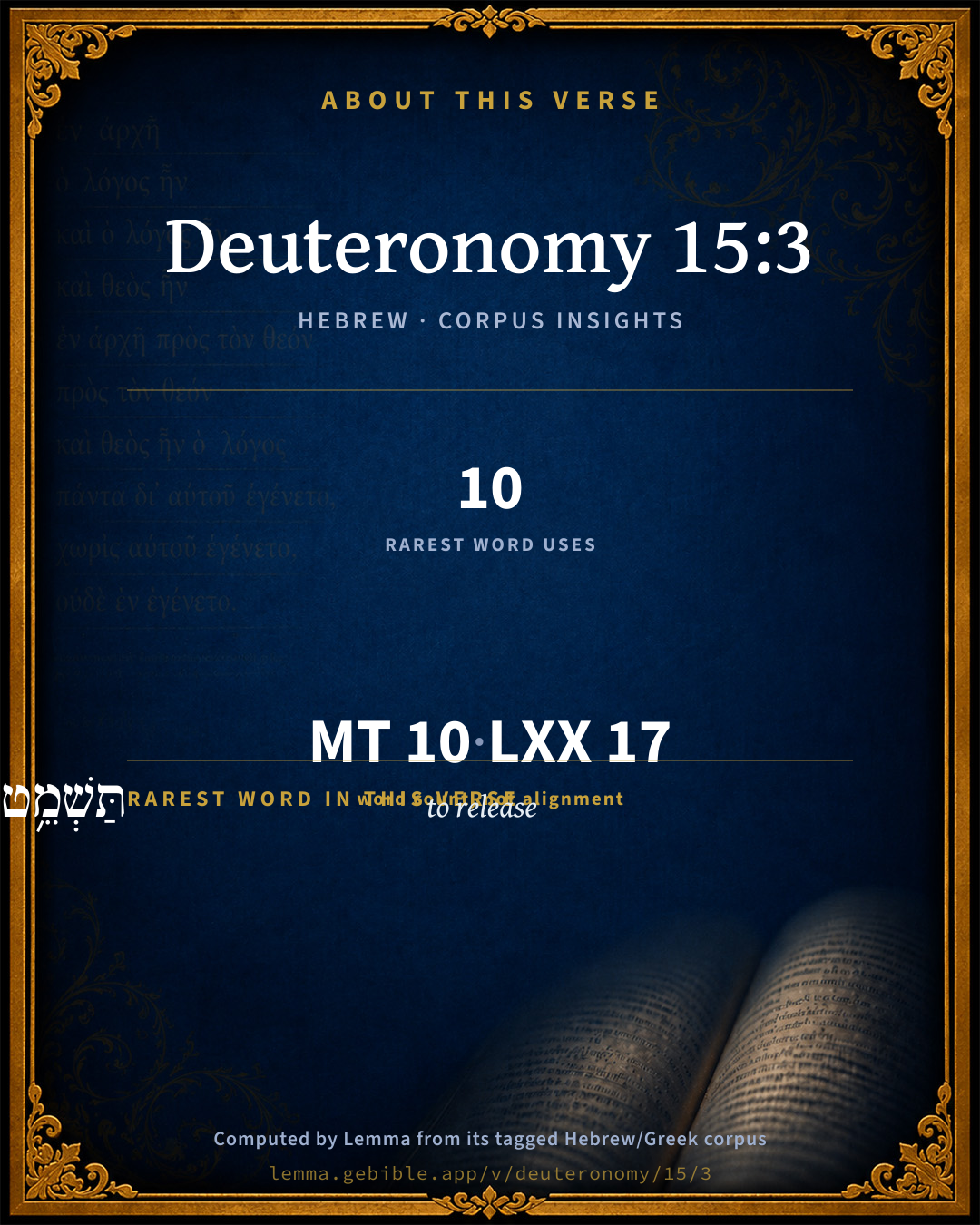
The rarest word here is תַּשְׁמֵ֥ט to release H8058 — appearing just 10 times in the whole Hebrew Bible.

Shared distinctive vocabulary

תַּשְׁמֵ֥ט to release H8058 occurs in 8 verses of the Hebrew Bible. Also found in:

Grammatical profile

  • 3 verbs
  • 2 nouns
  • 1 adjective
  • 2 prepositions
  • 2 particles

Verb forms

  • תִּגֹּ֑שׂ Qal · Imperfect
  • יִהְיֶ֥ה Qal · Imperfect
  • תַּשְׁמֵ֥ט Hiphil · Jussive

Hebrew & Septuagint length

In English translation the verse runs 19 words from the Hebrew and 23 from the Septuagint (LXX English) — closely comparable.

A rough comparison of the two English renderings, which tokenize alike — not a word-level alignment.

Word counts can differ between the Hebrew and the Greek without any difference in meaning — e.g. the Hebrew direct-object marker אֵת has no separate Greek word, and Greek often adds the article ὁ.

In the original languages it is 10 Hebrew tokens and 17 Greek tokens — but the two are counted differently (Hebrew bundles its prefixes and suffixes into one token; the Greek is in lemma form), so that isn’t a like-for-like length.

Cross-references

6

Topical passages linked to Deuteronomy 15:3 in the Treasury of Scripture Knowledge — connected by theme and wording, ordered by reader-vote popularity; previews shown in the World English Bible.

  • Deuteronomy 23:20 to a foreigner you may lend on interest; but to your brother you shall not lend on interest, that Yahweh your God may bless you in all that you put your hand to, in the land where you go in to possess it.
  • Exodus 22:25 "If you lend money to any of my people with you who is poor, you shall not be to him as a creditor; neither shall you charge him interest.
  • Matthew 17:25–26 He said, "Yes." When he came into the house, Jesus anticipated him, saying, "What do you think, Simon? From whom do the kings of the earth receive toll or tribute? From their children, or from strangers?"
  • John 8:35 A bondservant doesn't live in the house forever. A son remains forever.
  • 1 Corinthians 6:6–7 But brother goes to law with brother, and that before unbelievers!
  • Galatians 6:10 So then, as we have opportunity, let's do what is good toward all men, and especially toward those who are of the household of the faith.

Cross-references courtesy of OpenBible.info (CC BY 4.0).

Hebrew and Greek witnesses Masoretic Hebrew ↔ Greek Septuagint

The same verse in the two great witnesses to the Old Testament, shown verse-for-verse.

These are two independent witnesses, not word-aligned to each other, and the Septuagint is shown in lemma (dictionary) form.

Hebrew Deuteronomy 15:3 Masoretic · Westminster Leningrad Codex

אֶת הַנָּכְרִ֖י תִּגֹּ֑שׂ וַאֲשֶׁ֨ר יִהְיֶ֥ה לְךָ֛ אֶת אָחִ֖יךָ תַּשְׁמֵ֥ט יָדֶֽךָ

Of a foreigner you may exact it: but whatever of your is with your brother your hand shall release.

World English Bible · Public Domain

Greek LXX Deuteronomy 15:3 Septuagint · lemma form

ὁ ἀλλότριος ἀποαἰτέω ὅσος ἐάν εἰμί σύ παρά αὐτός ὁ ἀδελφός σύ ἄφεσις ποιέω ὁ χρέος σύ

Of a stranger you shall ask again whatever he has of yours, but to your brother you shall remit his debt to you.

LXX2012 (modern English Septuagint) · Public Domain

Hebrew: Westminster Leningrad Codex (CC BY 4.0). Greek: Septuagint (public domain); English from LXX2012 (modern English Septuagint) (Public Domain). How the Septuagint differs from the Hebrew →

Targum (Aramaic paraphrase)

2

The Targum is the ancient Jewish Aramaic paraphrase of the Hebrew Scriptures — an interpretive translation, not the Hebrew text itself. Onkelos (literal) and Pseudo-Jonathan (expansive) render the Torah, and Jonathan the Prophets. Coverage is partial: where no permissively-licensed English translation exists for a verse, only the Aramaic is shown. This is verse-level text, not a word-by-word alignment to the Hebrew.

  1. Targum Onkelos Torah (Genesis–Deuteronomy)
    מִן בַּר עַמְמִין תִּתְבַּע וְדִי יְהֵי לָךְ עִם אָחוּךְ תַּשְׁמֵט יְדָךְ

    (no public-domain English translation for this verse)

    Targum Onkelos — Aramaic: “Onkelos Genesis” (public domain); “Onkelos Exodus” (public domain); “Onkelos Leviticus” (public domain); “Onkelos Numbers” (public domain); “Onkelos Deuteronomy” (public domain). English: “Sefaria Community Translation” (CC0 1.0 (public-domain dedication)); “J.W. Etheridge. The Targums of Onkelos and Jonathan Ben Uzziel on the Pentateuch. London: Longmans, Green, 1862” (public domain). Text via Sefaria.

  2. Targum Pseudo-Jonathan Torah (Genesis–Deuteronomy)
    יַת בַּר עַמְמִין תִּדְחוֹק וְדִינָא דִי יֶהֱוֵי לָךְ עִם אָחוּךְ תַּשְׁמֵיט יְדָךְ

    From a son of the Gentiles thou mayest exact, but the lawful right (dina) which is thine with thy brother thou shalt release with thine hand.

    Targum Pseudo-Jonathan — Aramaic: “Targum Jonathan on Genesis” (public domain); “Targum Jonathan on Exodus” (public domain); “Targum Jonathan on Leviticus” (public domain); “Targum Jonathan on Numbers” (public domain); “Targum Jonathan on Deuteronomy” (public domain). English: “The Targum of Jonathan ben Uzziel, trans. J. W. Etheridge, London, 1862” (public domain). Text via Sefaria.

Commentary

Notes on Deuteronomy 15:3 from classic Christian and Jewish commentators (each source and its license shown beneath its notes). The classic Christian expositions comment on the surrounding passage and are grouped to its opening verse, so a note may address several verses; the Jewish commentaries on the Tanakh (Rashi and others) are per-verse, so they appear only where the commentator wrote on this verse.

Lemma curates 59 commentaries, every one of them public domain or Creative Commons licensed, each selected and text-cleaned for this edition rather than reprinted as found. About our sources →

Trapp's Complete Commentary

John Trapp

Deu 15:3 Of a foreigner thou mayest exact [it again]: but [that] which is thine with thy brother thine hand shall release;

Ver. 3. Of a foreigner.] To show that none that are alienated from the life of God, or a godly life, have remission of sin by Christ: "he sanctifies all whom he justifies." Compare Rom 11:26 Isa 59:20.

John Trapp, A Commentary or Exposition upon All the Books of the Old and New Testament (1647–1656) — public domain. Text from a community e-Sword module.

Jamieson, Fausset & Brown

Robert Jamieson, A. R. Fausset & David Brown

Of a foreigner thou mayest exact it again--Admission to all the religious privileges of the Israelites was freely granted to heathen proselytes, though this spiritual incorporation did not always imply an equal participation of civil rights and privileges (Lev 25:44; Jer 34:14; compare Ch1 22:2; Ch2 2:17).

Jamieson, Fausset & Brown — Commentary Critical and Explanatory on the Whole Bible (1871) — public domain (CC PDM 1.0). Text via the HelloAO Bible API.

The Cambridge Bible for Schools and Colleges

gen. ed. J. J. S. Perowne

3. foreigner] nokrî distinct not only from neighbour- or brother-Israelite, but also from gçr the foreign client or settler in Israel (Deu_14:21).

The Cambridge Bible for Schools and Colleges (gen. ed. J. J. S. Perowne; Cambridge University Press, 1878–1918) — public domain. Text from a community e-Sword module.

John Gill's Exposition

Of a foreigner thou mayest exact it again,.... Either on the seventh year, or after it:

but that which is thine with thy brother, thine hand shall release; a debt that lies between them, where the one is the creditor, and the other debtor, the creditor shall freely and fully forgive the debtor. So those only are released or forgiven by the Lord who are his own, whom he has reserved for himself, or chosen to everlasting life; who are interested in the covenant of his grace, one article in which is the forgiveness of sins; and who are redeemed by the blood of Christ, a branch of which redemption is remission of sin; and who are called by grace, and believe in Christ, to whom pardon of sins is promised; but those who are foreigners and strangers, and are not the Lord's chosen, redeemed, and called people, have no share in this blessing of grace; nor such who are rich in their own esteem, and need nothing; but those who are poor and unable to pay their debts, and are sensible of their spiritual poverty, and apply to the Lord for the forgiveness of their sins.

John Gill's Exposition of the Whole Bible (1746–1763) — public domain (CC PDM 1.0). Text via the HelloAO Bible API.

Haydock's Catholic Bible Commentary

Stranger, who has not received circumcision. Such were entitled only to the common privileges of people in distress. They could not claim a share in the feasts, made out of the tithes of the Jews, &c. (Grotius)

George Leo Haydock (1774–1849), Haydock's Catholic Family Bible and Commentary, 1859 edition — public domain. Excludes Psalms (Douay-Rheims chapter numbering differs from Protestant) and Deuterocanonical books (Catholic canon only).

Matthew Poole's English Annotations

A foreigner, or stranger, yea, though a proselyte. For,

1. They are oft called by this name, as Gen 17:12; Rth 2:10.

2. Though proselytes were admitted to the church privileges of the Israelites, yet they were not admitted to all their civil immunities or privileges. See 1Ch 22:2; 2Ch 2:17.

3. Such were not then freed from their personal debt, to wit, of their service, Lev 25:44; Deu 15:12; Jer 34:14, therefore not from their real debt.

That which is thine, to wit, by right, though lent to him.

Matthew Poole's English Annotations on the Holy Bible (1683–1685) — public domain. Text from a community e-Sword/MySword module.

Whedon's Commentary on the Bible

Daniel D. Whedon

3. Of a foreigner thou mayest exact it — There would be a reason for dealing in a different way with the foreigner. He did not observe the sabbatical year. He would have his ordinary income from his land, while the Hebrew would not.

Daniel D. Whedon (gen. ed.), Commentary on the Old and New Testaments (1874–1909) — public domain. Text from a community e-Sword module.

The Pulpit Commentary

A foreigner; a stranger of another nation, having no internal social relation to Israel (yrikn;), as distinguished from the stranger who lived among them and had claims on their benevolence (rGe). Of such they might exact a debt, without regard to the year of release. "This rule breathes no hatred of foreigners, but simply allows the Israelites the right of every creditor to demand his debts and enforce the demand upon foreigners, even in the sabbatical year. There was no severity in this, because foreigners could get their ordinary income in the seventh year as well as in any other" (Keil).

The Pulpit Commentary (1880–1919), ed. H.D.M. Spence-Jones & Joseph S. Exell — public domain. Text from a community e-Sword module.

Keil & Delitzsch

C. F. Keil & F. Delitzsch

The foreigner thou mayest press, but what thou hast with thy brother shall thy hand let go. נכרי is a stranger of another nation, standing in no inward relation to Israel at all, and is to be distinguished from גּר, the foreigner who lived among the Israelites, who had a claim upon their protection and pity. This rule breathes no hatred of foreigners, but simply allows the Israelites the right of every creditor to demand his debts, and enforce the demand upon foreigners, even in the sabbatical year. There was no severity in this, because foreigners could get their ordinary income in the seventh year as well as in any other.

Keil & Delitzsch — Biblical Commentary on the Old Testament (1861–1891) — public domain (CC PDM 1.0). Text via the HelloAO Bible API. (Old Testament only.)

Rashi

Rabbi Shlomo Yitzchaki (Rashi)

את הנכרי תגוש OF ANY ALIEN THOU MAYEST EXACT IT AGAIN — This implies a positive command (Sifrei Devarim 113:1).

Rashi on the Tanakh — English translations: “The Judaica Press complete Tanach with Rashi, translated by A. J. Rosenberg” (CC BY 4.0); “Pentateuch with Rashi's commentary by M. Rosenbaum and A.M. Silbermann, 1929-1934” (public domain); “The Metsudah Tanach series, Lakewood, N.J” (CC BY 4.0); and “The Book of Joshua, Metsudah Publications, 1997” (CC BY 4.0). Text via Sefaria.

Ramban (Nachmanides)

Rabbi Moshe ben Nachman (Ramban / Nachmanides)

OF AN ALIEN ‘TIGOS’ (THOU MAYEST EXACT IT). “This constitutes a positive commandment.” Thus is Rashi’s language quoting the Sifre. 113. The meaning thereof is that there is a positive commandment with respect to your brother [that you are not to exact the debt from him after it was cancelled by the Sabbatical year, the reasoning being as follows]: of an ‘alien’ thou mayest exact it, but not from your brother, and a negative commandment derived from a positive commandment carries the force of a positive commandment. ]. Now, by Scripture stating of an alien thou shalt exact it, we infer that one may not exact it from an Israelite, and since a negative commandment that is derived by implication from a positive commandment has the force of the positive injunction from which it is derived — it follows that he, who exacts it from an Israelite, violates both an explicit negative commandment and an implied positive commandment. This is the intent of the Sifre, but not as stated by Rashi that there is a positive commandment to exact it from the heathen. See “The Commandments,” Vol. I, pp. 150-151, where Rashi’s position coincides with that of Rambam, and Ramban differs with him. And because we have been taught there [in the Sifre]: “He shall not exact it [of his neighbor and his brother] — it is a negative commandment upon him,” therefore the Rabbis again taught: “Of an alien thou shalt exact it — this is a positive commandment,” [not to exact the debt from a brother] meaning to say that he who exacts the debt from his brother violates both a positive commandment and a negative commandment.In the same way the Rabbis have said there: 263. “Unto an alien ‘thashich’ (mayest thou lend upon interest) — it is a positive commandment. But unto thy brother thou shalt not lend upon interest — this is a negative commandment.” This, too, is as we have explained [that the meaning of the Sifre is] that there is a positive commandment with respect to your brother not to lend him on interest, and so did Rashi explain there, but not that there is any commandment to lend an alien on interest. It is so indicated from the Gemara of the Chapter “What is usury?” Now Harav Rabbi Moshe ben Maimon made both of them actual commandments — to exact debts from an alien and to lend him upon interest., Positive Commandment 198. He erred regarding these texts taught in the Sifre. Such expressions are common there [in the Sifre] in many places, as for example; 103. “Of all clean fowls ye may eat — it is a positive commandment. And all winged swarming things are unclean; they shall not be eaten, Verse 19. — this is a negative commandment.”, implies that you may not eat unclean fowl. Similarly the Rabbis mentioned in the Sifra 3:2. and in the Sifre: 101. “These are the beasts which ye may eat — it is a positive commandment.” But the matter is clear [as I have explained it].

Ramban (Nachmanides) on the Tanakh — English translation: “Commentary on the Torah by Ramban (Nachmanides). Translated and annotated by Charles B. Chavel. New York, Shilo Pub. House, 1971-1976” (CC BY 4.0). Text via Sefaria.

Lesson kit

Teaching starters — assembled from the data on this page, not authored interpretation. Every prompt links to the verse data it draws on. Edit before teaching.

Deuteronomy, in the Pentateuch, opens this verse with 10 words (9 distinct Hebrew lemmas). Its most distinctive word is shâmaṭ (“to release”). A historical commentator’s framing appears above. Read the whole chapter for the surrounding context.

Discussion questions

  1. The word shâmaṭ carries the sense “to release.” How does it shape the verse?
  2. Exodus 23:11 shares the word «to release» with this verse. How do the two illuminate each other?
  3. These translations render this verse differently; the difference is in the English rendering, not the original. What questions does that raise?
  4. The verb «תִּגֹּ֑שׂ» is Qal Imperfect. How does its form color the action?
  5. Reading how Trapp's Complete Commentary and Jamieson, Fausset & Brown read this verse, where do the two commentators agree and where do they part?

Things to notice

Reading settings

Reading text

Shown beneath each verse's original-language words.

Old Testament
Old Testament edition

Read the OT as the Masoretic Hebrew (MT) or the Greek Septuagint (LXX).

English shown for the Greek Septuagint (in the Hebrew ↔ Greek comparison).

Comparing translations? Open the Compare panel on any verse page to stack up to four side by side.