
Deuteronomy 23:21

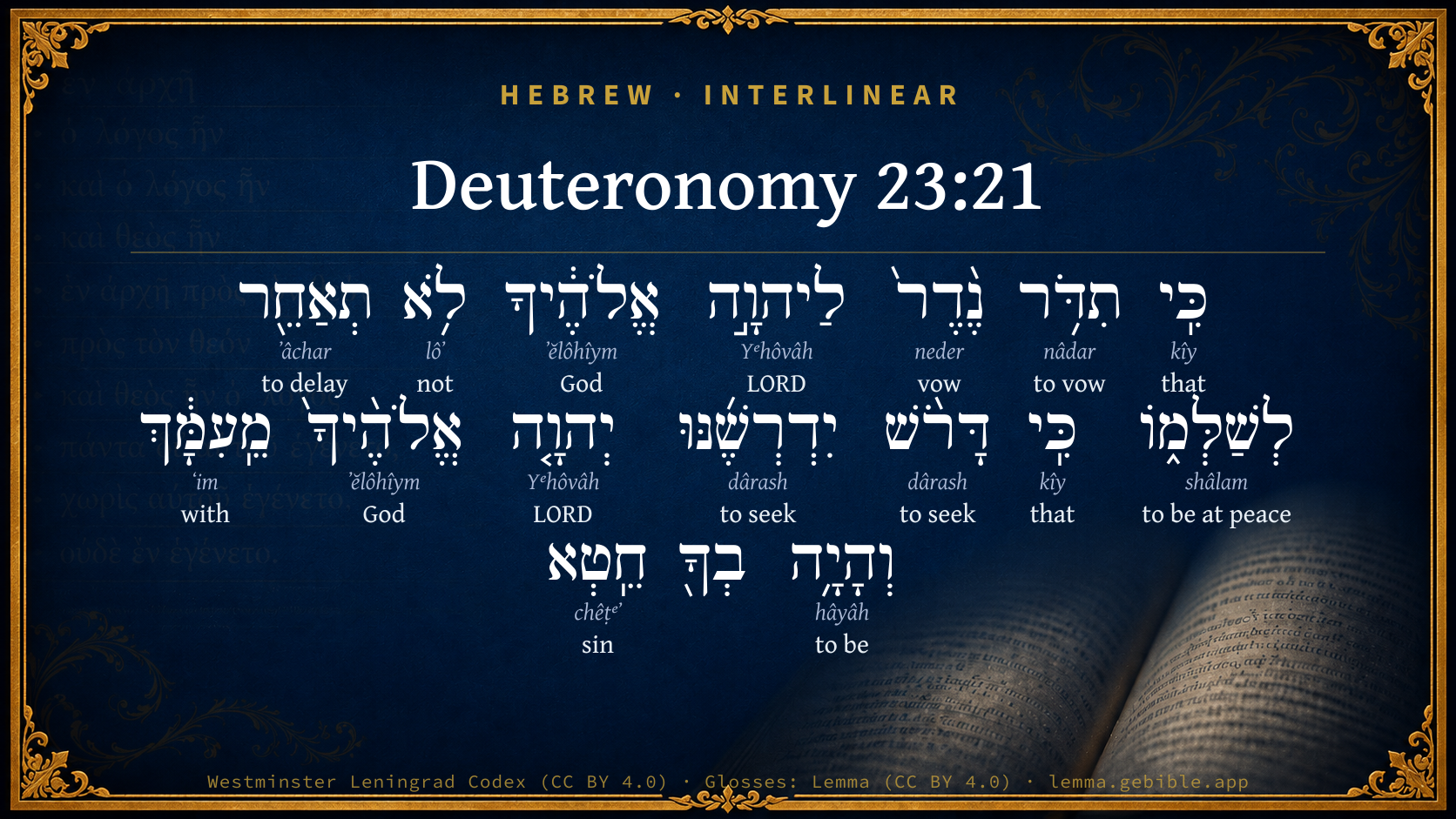
Hebrew (Westminster Leningrad Codex) Deuteronomy 23:21 appears in the Hebrew Old Testament. The text above is from the Westminster Leningrad Codex. Each word links to its Strong’s number, a concise gloss, and parsing drawn from the Open Scriptures Hebrew Bible morphology. Click any word for its full Brown-Driver-Briggs (BDB) entry.
Download image
Cite this verse

Deuteronomy 23:21 (World English Bible). Public Domain. Lemma interlinear Bible study tool, https://lemma.gebible.app/v/deuteronomy/23/21.

Show BibTeX & RIS
BibTeX
RIS
English Translation
When you shall vow a vow to Yahweh your God, you shall not be slack to pay it: for Yahweh your God will surely require it of you; and it would be sin in you.
World English Bible · Public Domain
Download a study sheet

One document with this verse’s original text, its word-by-word gloss line, the meaning frame, cross-references with their text, attributed commentary, and full source and license credits — printable, and it pastes into notes with its structure intact.

This verse Autodidact and up

Study sheet (.html) Plain text (.txt)

A passage Seminary Student

Up to 50 verses in one chapter. A passage sheet keeps up to 6 commentary sources and 12 cross-references per verse, in the order this page ranks them, and says so on the sheet whenever that leaves anything out. Ask for a single verse and you get the Autodidact verse sheet above.

Everything on this page stays free to read, with no account — the sheet is a download of what is already on screen, not access to it.

Want to remove ads? Support Godless Engineer
Compare translations 3

The same verse in 3 English versions, stacked beneath the original-language interlinear above. Click any original word for its lexicon entry.

Each is an independent rendering of the whole verse — the interlinear is not word-aligned to these translations.

Highlighted words mark where these versions differ — a whole-verse word diff, not a word-by-word alignment.

  • World English Bible Public Domain
    When you shall vow a vow to Yahweh your God, you shall not be slack to pay it: for Yahweh your God will surely require it of you; and it would be sin in you.
  • King James Version Public Domain
    When thou shalt vow a vow unto the LORD thy God, thou shalt not slack to pay it: for the LORD thy God will surely require it of thee; and it would be sin in thee.
  • unfoldingWord Literal Text CC BY-SA 4.0
    When you vow a vow to Yahweh your God, you shall not delay to fulfill it, for, requiring, Yahweh your God shall require it from you; and it would be sin for you.

unfoldingWord Literal Text — © unfoldingWord, licensed CC BY-SA 4.0. Word-aligned USFM3 via Door43 (git.door43.org/unfoldingWord/en_ult).

Versions to compare (up to 4)

3 of 4 selected

Show all 18 translations

Every available English version of this verse, each an independent rendering of the whole verse.

  • World English Bible Public Domain
    When you shall vow a vow to Yahweh your God, you shall not be slack to pay it: for Yahweh your God will surely require it of you; and it would be sin in you.
  • Berean Standard Bible Public Domain
    If you make a vow to the LORD your God, do not be slow to keep it, because He will surely require it of you, and you will be guilty of sin.
  • Majority Standard Bible Public Domain
    If you make a vow to the LORD your God, do not be slow to keep it, because He will surely require it of you, and you will be guilty of sin.
  • King James Version Public Domain
    When thou shalt vow a vow unto the LORD thy God, thou shalt not slack to pay it: for the LORD thy God will surely require it of thee; and it would be sin in thee.
  • American Standard Version (1901) Public Domain
    When thou shalt vow a vow unto Jehovah thy God, thou shalt not be slack to pay it: for Jehovah thy God will surely require it of thee; and it would be sin in thee.
  • Revised Version (1885) Public Domain
    When thou shalt vow a vow unto the LORD thy God, thou shalt not be slack to pay it: for the LORD thy God will surely require it of thee; and it would be sin in thee.
  • Geneva Bible (1599) Public Domain
    When thou shalt vowe a vowe vnto the Lord thy God, thou shalt not be slacke to paye it: for the Lord thy God will surely require it of thee, and so it should be sinne vnto thee.
  • Douay-Rheims (1899) Public Domain
    When thou hast made a vow to the Lord thy God, thou shalt not delay to pay it: because the Lord thy God will require it. And if thou delay, it shall be imputed to thee for a sin.
  • Young's Literal Translation Public Domain
    `When thou vowest a vow to Jehovah thy God, thou dost not delay to complete it; for Jehovah thy God doth certainly require it from thee, and it hath been in thee -- sin.
  • Literal Standard Version CC BY-SA 4.0
    When you vow a vow to your God YHWH, you do not delay to complete it; for your God YHWH certainly requires it from you, lest it has been sin in you.
  • Unlocked Literal Bible CC BY-SA 4.0
    When you make a vow to Yahweh your God, you must not be slow in fulfilling it, for Yahweh your God will surely require it of you; it would be sin for you not to fulfill it.
  • unfoldingWord Literal Text CC BY-SA 4.0
    When you vow a vow to Yahweh your God, you shall not delay to fulfill it, for, requiring, Yahweh your God shall require it from you; and it would be sin for you.
  • Darby Bible Public Domain
    When thou vowest a vow to Jehovah thy God, thou shalt not delay to perform it; for Jehovah thy God will certainly require it of thee, and it shall be sin in thee.
  • World Messianic Bible Public Domain
    When you vow a vow to the LORD your God, you shall not be slack to pay it, for the LORD your God will surely require it of you; and it would be sin in you.
  • Webster's Bible Public Domain
    When thou shalt vow a vow to the LORD thy God, thou shalt not defer to pay it: for the LORD thy God will surely require it of thee; and it would be sin in thee.
  • Free Bible Version CC BY-SA 4.0
    If you make a promise to the Lord your God, don't be slow in keeping it, because he will definitely demand that you fulfill it and you will be guilty of sin if you don't.
  • Bible in Basic English Public Domain
    When you take an oath to the Lord, do not be slow to give effect to it: for without doubt the Lord your God will make you responsible, and will put it to your account as sin.
  • JPS Tanakh (1917) Public Domain
    (23-22) When thou shalt vow a vow unto the LORD thy God, thou shalt not be slack to pay it; for the LORD thy God will surely require it of thee; and it will be sin in thee.

Literal Standard Version (2020), Covenant Press — licensed CC BY-SA 4.0. Text via the HelloAO Bible API (eBible.org). Unlocked Literal Bible (unfoldingWord) — licensed CC BY-SA 4.0. Text via the HelloAO Bible API (eBible.org). unfoldingWord Literal Text — © unfoldingWord, licensed CC BY-SA 4.0. Word-aligned USFM3 via Door43 (git.door43.org/unfoldingWord/en_ult). Free Bible Version, Dr. Jonathan Gallagher — licensed CC BY-SA 4.0. Text via the HelloAO Bible API (eBible.org).

Word by word

More ways to search: Search by grammar → Find every occurrence → Compare this word →

Practice this passage: Drill this verse → Learn its vocabulary →

תְאַחֵ֖ר
ʼâchar
H309
“to delay”
Verb, Piel, Imperfect, 2nd Person, Masculine, Singular
Part of Speech
Verb
Stem
Piel
Form
Imperfect
Person
2nd Person
Gender
Masculine
Number
Singular
Full BDB Definition

Origin: a primitive root

TWOT: 68

to delay, hesitate, tarry, defer, remain behind - (Qal) - to delay, tarry (intensive) - to cause one to delay, hinder, keep back - (Piel) to delay, wait, stay behind (but not in hope)
  1. כִּֽי kîy H3588 “that” Conjunction
  2. תִדֹּ֥ר nâdar H5087 “to vow” Verb, Qal, Imperfect, 2nd Person, Masculine, Singular
  3. נֶ֨דֶר֙ neder H5088 “vow” Noun, Common, Masculine, Singular, Absolute
  4. לַיהוָ֣ה Yᵉhôvâh H3068 “to/for · LORD” Preposition + Noun, Proper
  5. אֱלֹהֶ֔יךָ ʼĕlôhîym H430 “God(s) · your” Noun, Common, Masculine, Plural, Construct + Suffix, Personal, 2nd Person, Masculine, Singular
  6. לֹ֥א lôʼ H3808 “not” Particle, Negative
  7. לְשַׁלְּמ֑וֹ shâlam H7999 “to be at peace · him” Preposition + Verb, Piel, Infinitive Construct + Suffix, Personal, 3rd Person, Masculine, Singular
  8. כִּֽי kîy H3588 “that” Conjunction
  9. דָּרֹ֨שׁ dârash H1875 “to seek” Verb, Qal, Infinitive Absolute
  10. יִדְרְשֶׁ֜נּוּ dârash H1875 “to seek · him” Verb, Qal, Imperfect, 3rd Person, Masculine, Singular + Suffix, Personal, 3rd Person, Masculine, Singular
  11. יְהוָ֤ה Yᵉhôvâh H3068 “LORD” Noun, Proper
  12. אֱלֹהֶ֨יךָ֙ ʼĕlôhîym H430 “God(s) · your” Noun, Common, Masculine, Plural, Construct + Suffix, Personal, 2nd Person, Masculine, Singular
  13. מֵֽעִמָּ֔ךְ ʻim H5973 “from · with · you” Preposition + Preposition + Suffix, Personal, 2nd Person, Feminine, Singular
  14. וְהָיָ֥ה hâyâh H1961 “and · to be” Conjunction + Verb, Qal, Sequential Perfect, 3rd Person, Masculine, Singular
  15. חֵֽטְא chêṭᵉʼ H2399 “sin” Noun, Common, Masculine, Singular, Absolute

About this verse

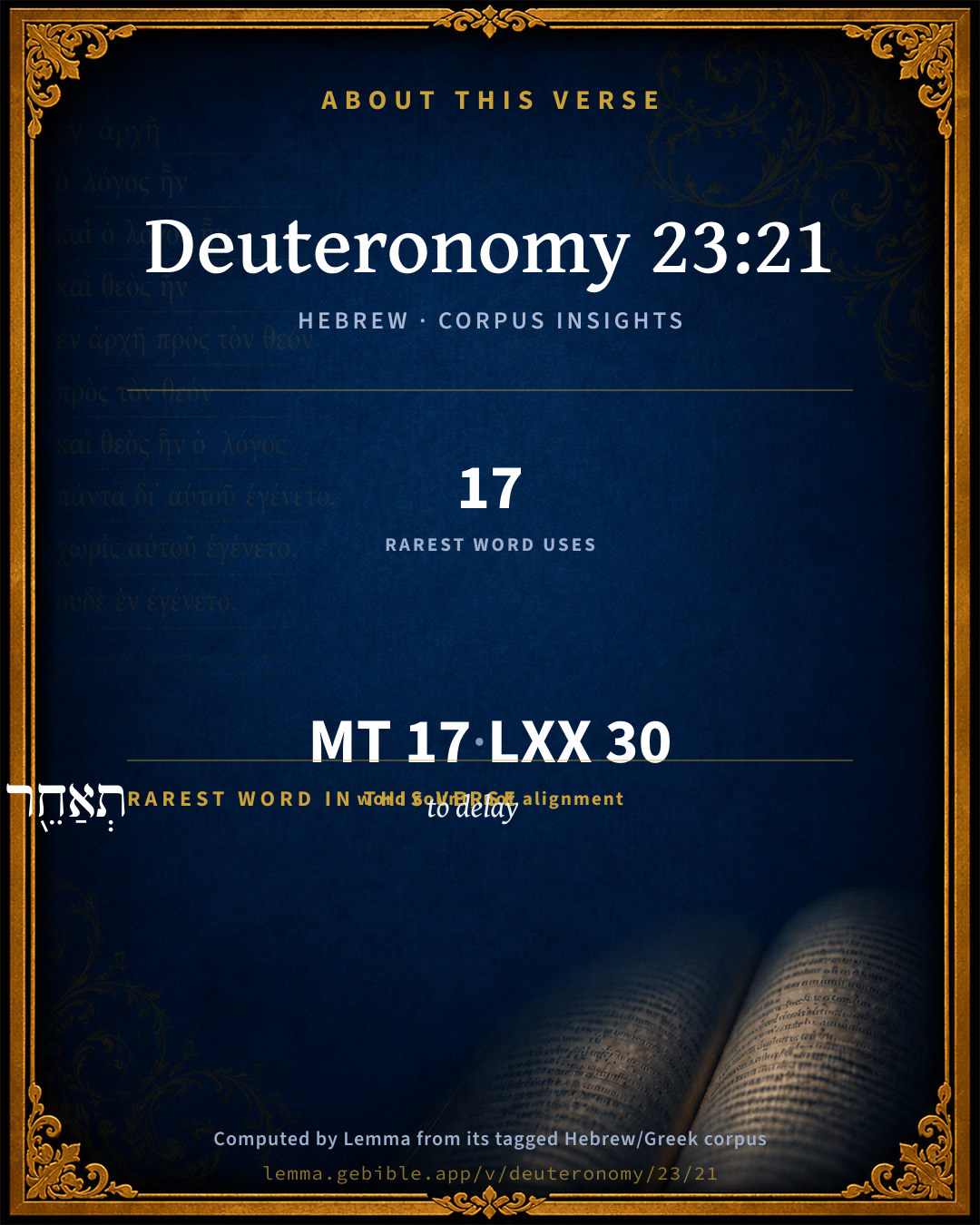
These counts appear in no published source. They are computed here, from the morphology-tagged text and Lemma’s own curated glosses. What Lemma adds →

17
words
12
distinct lemmas
Pentateuch
section

Notable vocabulary

The rarest word here is תְאַחֵ֖ר to delay H309 — appearing just 17 times in the whole Hebrew Bible.

Shared distinctive vocabulary

תְאַחֵ֖ר to delay H309 occurs in 17 verses of the Hebrew Bible. Also found in:

Grammatical profile

  • 6 verbs
  • 6 nouns
  • 2 prepositions
  • 2 conjunctions
  • 1 particle

Verb forms

  • תִדֹּ֥ר Qal · Imperfect
  • תְאַחֵ֖ר Piel · Imperfect
  • לְשַׁלְּמ֑וֹ Piel · Infinitive Construct
  • דָּרֹ֨שׁ Qal · Infinitive Absolute
  • יִדְרְשֶׁ֜נּוּ Qal · Imperfect
  • וְהָיָ֥ה Qal · Sequential Perfect

Repetition

Words recur within this verse — often emphatic in Hebrew:

  • לַיהוָ֣ה LORD H3068 ×2
  • אֱלֹהֶ֔יךָ God H430 ×2
  • דָּרֹ֨שׁ to seek H1875 ×2
  • כִּֽי that H3588 ×2

Hebrew & Septuagint length

In English translation the verse runs 35 words from the Hebrew and 38 from the Septuagint (LXX English) — closely comparable.

A rough comparison of the two English renderings, which tokenize alike — not a word-level alignment.

Word counts can differ between the Hebrew and the Greek without any difference in meaning — e.g. the Hebrew direct-object marker אֵת has no separate Greek word, and Greek often adds the article ὁ.

In the original languages it is 17 Hebrew tokens and 30 Greek tokens — but the two are counted differently (Hebrew bundles its prefixes and suffixes into one token; the Greek is in lemma form), so that isn’t a like-for-like length.

Cross-references

14

Topical passages linked to Deuteronomy 23:21 in the Treasury of Scripture Knowledge — connected by theme and wording, ordered by reader-vote popularity; previews shown in the World English Bible.

  • Ecclesiastes 5:4–5 When you vow a vow to God, don't defer to pay it; for he has no pleasure in fools. Pay that which you vow.
  • Psalms 66:13–14 I will come into your temple with burnt offerings. I will pay my vows to you,
  • Psalms 116:18 I will pay my vows to Yahweh, Yes, in the presence of all his people,
  • Numbers 30:1–16 Moses spoke to the heads of the tribes of the children of Israel, saying, This is the thing which Yahweh has commanded.
  • Psalms 56:12 Your vows are on me, God. I will give thank offerings to you.
  • Psalms 76:11 Make vows to Yahweh your God, and fulfill them! Let all of his neighbors bring presents to him who is to be feared.
  • Genesis 28:20 Jacob vowed a vow, saying, "If God will be with me, and will keep me in this way that I go, and will give me bread to eat, and clothing to put on,
  • Genesis 35:1–3 God said to Jacob, "Arise, go up to Bethel, and live there. Make there an altar to God, who appeared to you when you fled from the face of Esau your brother."
  • Leviticus 27:2–34 "Speak to the children of Israel, and say to them, 'When a man makes a vow, the persons shall be for Yahweh by your valuation.
  • Deuteronomy 23:18 You shall not bring the hire of a prostitute, or the wages of a dog, into the house of Yahweh your God for any vow: for even both these are an abomination to Yahweh your God.
  • Jonah 1:16 Then the men feared Yahweh exceedingly; and they offered a sacrifice to Yahweh, and made vows.
  • Matthew 5:33 "Again you have heard that it was said to them of old time, 'You shall not make false vows, but shall perform to the Lord your vows,'
  • Jonah 2:9 But I will sacrifice to you with the voice of thanksgiving. I will pay that which I have vowed. Salvation belongs to Yahweh."
  • Nahum 1:15 Behold, on the mountains the feet of him who brings good news, who publishes peace! Keep your feasts, Judah! Perform your vows, for the wicked one will no more pass through you. He is utterly cut off.

Cross-references courtesy of OpenBible.info (CC BY 4.0).

Hebrew and Greek witnesses Masoretic Hebrew ↔ Greek Septuagint

The same verse in the two great witnesses to the Old Testament, shown verse-for-verse.

These are two independent witnesses, not word-aligned to each other, and the Septuagint is shown in lemma (dictionary) form.

Hebrew Deuteronomy 23:21 Masoretic · Westminster Leningrad Codex

כִּֽי תִדֹּ֥ר נֶ֨דֶר֙ לַיהוָ֣ה אֱלֹהֶ֔יךָ לֹ֥א תְאַחֵ֖ר לְשַׁלְּמ֑וֹ כִּֽי דָּרֹ֨שׁ יִדְרְשֶׁ֜נּוּ יְהוָ֤ה אֱלֹהֶ֨יךָ֙ מֵֽעִמָּ֔ךְ וְהָיָ֥ה בְךָ֖ חֵֽטְא

When you shall vow a vow to Yahweh your God, you shall not be slack to pay it: for Yahweh your God will surely require it of you; and it would be sin in you.

World English Bible · Public Domain

Greek LXX Deuteronomy 23:21 Septuagint · lemma form

ὁ ἀλλότριος ἐκτοκίζω ὁ δέ ἀδελφός σύ οὐ ἐκτοκίζω ἵνα εὐλογέω σύ κύριος ὁ θεός σύ ἐν πᾶς ὁ ἔργον σύ ἐπί ὁ γῆ εἰς ὅς εἰςπορεύομαι ἐκεῖ κληρονομέω αὐτός

And if you will vow a vow to the Lord your God, you shall not delay to pay it; for the Lord your God will surely require it of you, and otherwise it shall be sin in you.

LXX2012 (modern English Septuagint) · Public Domain

Hebrew: Westminster Leningrad Codex (CC BY 4.0). Greek: Septuagint (public domain); English from LXX2012 (modern English Septuagint) (Public Domain). How the Septuagint differs from the Hebrew →

Targum (Aramaic paraphrase)

2

The Targum is the ancient Jewish Aramaic paraphrase of the Hebrew Scriptures — an interpretive translation, not the Hebrew text itself. Onkelos (literal) and Pseudo-Jonathan (expansive) render the Torah, and Jonathan the Prophets. Coverage is partial: where no permissively-licensed English translation exists for a verse, only the Aramaic is shown. This is verse-level text, not a word-by-word alignment to the Hebrew.

  1. Targum Onkelos Torah (Genesis–Deuteronomy)
    לְבַר עַמְמִין תְּרַבֵּי וְלַאֲחוּךְ לָא תְרַבֵּי בְּדִיל דִיבָרֵכִנָךְ יְיָ אֱלָהָךְ בְּכֹל אוֹשָׁטוּת יְדָךְ עַל אַרְעָא דִי אַתְּ עָלֵל:לתַמָן לְמֵירְתַהּ

    (no public-domain English translation for this verse)

    Targum Onkelos — Aramaic: “Onkelos Genesis” (public domain); “Onkelos Exodus” (public domain); “Onkelos Leviticus” (public domain); “Onkelos Numbers” (public domain); “Onkelos Deuteronomy” (public domain). English: “Sefaria Community Translation” (CC0 1.0 (public-domain dedication)); “J.W. Etheridge. The Targums of Onkelos and Jonathan Ben Uzziel on the Pentateuch. London: Longmans, Green, 1862” (public domain). Text via Sefaria.

  2. Targum Pseudo-Jonathan Torah (Genesis–Deuteronomy)
    לְבַר עַמְמִין תֵּיזוּף מִנֵּיהּ בְּרִיבִּיתָא וּלְאָחוּךְ לָא תֵיזוּף בְּרִיבִּיתָא מִן בִּגְלַל דִּיבָרְכִינָךְ יְיָ אֱלָהָךְ בְּכָל אוֹשָׁטוּת יְדָךְ עַל אַרְעָא דְאַנְתְּ עָלֵיל לְתַמָּן לְמֵירְתָהּ

    To a son of the Gentiles thou mayest lend for usury, but to thy brother thou shalt not lend for usury; that the Lord thy God may bless thee in all that thou puttest thine hand un to, in the land into which thou art entering to possess it.

    Targum Pseudo-Jonathan — Aramaic: “Targum Jonathan on Genesis” (public domain); “Targum Jonathan on Exodus” (public domain); “Targum Jonathan on Leviticus” (public domain); “Targum Jonathan on Numbers” (public domain); “Targum Jonathan on Deuteronomy” (public domain). English: “The Targum of Jonathan ben Uzziel, trans. J. W. Etheridge, London, 1862” (public domain). Text via Sefaria.

Commentary

Notes on Deuteronomy 23:21 from classic Christian and Jewish commentators (each source and its license shown beneath its notes). The classic Christian expositions comment on the surrounding passage and are grouped to its opening verse, so a note may address several verses; the Jewish commentaries on the Tanakh (Rashi and others) are per-verse, so they appear only where the commentator wrote on this verse.

Lemma curates 59 commentaries, every one of them public domain or Creative Commons licensed, each selected and text-cleaned for this edition rather than reprinted as found. About our sources →

Trapp's Complete Commentary

John Trapp

Deu 23:21 When thou shalt vow a vow unto the LORD thy God, thou shalt not slack to pay it: for the LORD thy God will surely require it of thee; and it would be sin in thee.

Ver. 21. Thou shalt not slack to pray.] Come off with it round and readily, as those {Zec 5:9} that had "wings," and "wind in their wings," Habent aulae suum cito, cito God loves a cheerful giver.

John Trapp, A Commentary or Exposition upon All the Books of the Old and New Testament (1647–1656) — public domain. Text from a community e-Sword module.

Joseph Benson's Commentary

Deu 23:21; Deu 23:23. Not slack — Not delay; because delays might make them both unable to pay it, and unwilling too. A free-will-offering — Which, though thou didst freely make, yet, being made, thou art no longer free, but obliged to perform it.

Joseph Benson's Commentary on the Old and New Testaments (1811–1818) — public domain. Text from a community e-Sword module.

Jamieson, Fausset & Brown

Robert Jamieson, A. R. Fausset & David Brown

When thou shalt vow a vow--(See on Num 30:2).

Jamieson, Fausset & Brown — Commentary Critical and Explanatory on the Whole Bible (1871) — public domain (CC PDM 1.0). Text via the HelloAO Bible API.

Adam Clarke's Commentary

Verse 21. When thou shalt vow, &c.] See Clarke on Nu 30:2, &c.

Adam Clarke's Commentary on the Bible (1810–1826) — public domain. Text from a community e-Sword/MySword module.

Ellicott's Commentary for English Readers

(21) When thou shalt vow . . . thou shalt not be slack . . .—The three yearly feasts are mentioned by Rashi and the Rabbis as occasions for the payment of vows. (See 1Sa_1:21.) This precept is cited in Ecc_5:4, but with sufficient verbal variation to prevent its being called a quotation.

A Bible Commentary for English Readers, edited by Charles John Ellicott (1878–1897) — public domain. Text from a community e-Sword module.

John Gill's Exposition

When thou shalt vow a vow unto the Lord thy God,.... Which must be of things in a man's power to perform, and of what are lawful to be done, and according to the mind and will of God revealed in his word, and agreeably to the manner of worship prescribed by him; as that he will offer such a sacrifice, a freewill offering to him, and the like, besides what he was bound to do, or give such and such things for the repair of the sanctuary, or for the relief of the poor; See Gill on Num 30:2. This law is thought by Aben Ezra to be repeated on the mention of the hire of a whore, &c. being forbidden to be brought for a vow, Deu 23:18,

thou shall not slack to pay it; or delay the payment of it, but do it immediately; since zeal and affection might abate, and there might not be hereafter an ability to perform, or death might come and prevent it; the Targum of Jonathan adds, at the three feasts, that is, of the passover, pentecost, and tabernacles; and the Jewish writers (h) say, that no man transgresses this precept respecting the delay of paying a vow, until the three feasts have passed:

for the Lord thy God will surely require it of thee; exact the payment of it, and expect it, insist upon the performance of it, and punish for neglect:

and it would be sin in thee; guilt of sin would be contracted, and punishment inflicted; Aben Ezra interprets it of the latter.

(h) Maimon. & Bartenora in Misn. Roshhashanah, c. 1. sect. 1. & in Ediot, c. 7. sect. 4.

John Gill's Exposition of the Whole Bible (1746–1763) — public domain (CC PDM 1.0). Text via the HelloAO Bible API.

Haydock's Catholic Bible Commentary

Delay, beyond the time appointed. (Menochius) --- If no time was specified, the vow must be fulfilled without any unnecessary procrastination. See Numbers xxx. 2. (Haydock) --- Vows induce an obligation which before did not exist. (Worthington)

George Leo Haydock (1774–1849), Haydock's Catholic Family Bible and Commentary, 1859 edition — public domain. Excludes Psalms (Douay-Rheims chapter numbering differs from Protestant) and Deuterocanonical books (Catholic canon only).

Matthew Poole's English Annotations

Thou shalt not slack to pay it, to wit, if the matter of it be lawful, and in thy own power. See Num 30:2. Not slack or delay, because delays may make thee both unable to pay it, and unwilling too, the sense of one’s obligation growing every day weaker than other, &c.

It would be sin in thee, i.e. it would be laid to thy charge as a sin, and bring judgment upon thee.

Matthew Poole's English Annotations on the Holy Bible (1683–1685) — public domain. Text from a community e-Sword/MySword module.

Whedon's Commentary on the Bible

Daniel D. Whedon

21. When thou shalt vow — Vows which were made to Jehovah must be kept, but there was no requirement to make the vows. Comp. Exo_22:29; Num_30:2, and Leviticus 27.

Daniel D. Whedon (gen. ed.), Commentary on the Old and New Testaments (1874–1909) — public domain. Text from a community e-Sword module.

The Pulpit Commentary

Vers. 21-23. A vow to the Lord, once made, was to be religiously kept; the Lord would require it, and to refuse or neglect to pay it would be held a sin. No one, however, was under any obligation to vow that was to be a purely voluntary act. That which is gone out of thy lips thou shalt keep and perform. .. according as thou hast vowed unto the Lord thy God of free-will (hbdn, spontaneously). (For the law concerning vows in general, see Le 27, and Nu 30)

Vers. 21-23. Vows to God to be performed.

The vow here made is supposed to be entirely voluntary. It was "a free-will offering." in Num_30:3-8, abuse is guarded against. Yews made without the knowledge or consent of the father or husband were to be of no force. No priest had any warrant from the Mosaic institutes to come between a young woman and her father, or between husband and wife. Vows to God were to he completely spontaneous, as between the soul and God. They were not to he extorted by others, nor yet to involve the entanglement of others.

Vers. 21-23. The place of vows.

It is not obligatory to make vows; it is obligatory to fulfill them. We are often free to contract an obligation; we are not free to violate it. A man is not bound to marry; having married, he is bound to cherish his wife.

I VOWS IMPLY SPECIAL ACTS OF KINDNESS ON THE PART OF GOD. The ordinary course of God"s bounty baffles verbal description. The forethought, the active energy, the well-laid plans, the unslumbering attention, the changeless affection, which are required for the preservation of human life, no language can express. But this is not all that God does for us. In times of unusual perplexity, special guidance is often vouchsafed to us. When surrounding events seemed most adverse to our interests, in answer to prayer, sudden deliverance has come. A precious life was in jeopardy: human help was unavailing; but God graciously interposed, and midnight suddenly became a summer noon.

II VOWS IMPLY, ON OUR PART, DEFECTIVE PIETY. Vows are made under the influence of excessive fear or from an influx of sudden joy. In a time of sharp distress, a man will put himself under special obligation, if God will grant his request. Or, when some expected good has fallen to one"s lot, in the impulse of sudden gladness we vow to devote some special offering unto God. Now, this is not wrong. Still there is something better. It is better to be always in a frame of trustful feeling, so that we may welcome whatever God ordains, and realize that what God does is best. It is better to rely upon his promise that help shall come in times of need! It is better to cultivate the habit of frequent offerings to God"s cause, so that no vow is needed to prick us up to the full discharge of duty. The vow implies that we cannot trust ourselves at all times to give to God his due. Therefore our endeavor should be to cultivate a childlike and a steadfast faith. It is good that the "heart be established with grace.

III VOWS CREATE FOR US A NEW OBLIGATION. Having made a debt, we are bound to pay it; but it is better not to accumulate a debt. Men lay a trap to catch themselves. Conscious of deficient trust and love towards God, they take advantage of some favorable state of feeling to make new obligations from which it shall be difficult to escape. In their better moods of mind they create new motives and new sanctions for religious conduct, which they cannot remove when the better feeling has vanished. They use the rising tide to bear their barque away. They utilize summer piety to provide for winter coldness. But having framed a religious vow, truth requires that it should be scrupulously kept. To violate a vow would injure our own soul"s life would deaden and stupefy conscience, would justly provoke our God. No common sin is this. D.

The Pulpit Commentary (1880–1919), ed. H.D.M. Spence-Jones & Joseph S. Exell — public domain. Text from a community e-Sword module.

John Wesley's Explanatory Notes

Not slack - Not delay: because delays may make them both unable to pay it, and unwilling too.

John Wesley, Explanatory Notes Upon the Whole Bible (1754–1765) — public domain. Text via the GEBible commentary corpus.

Keil & Delitzsch

C. F. Keil & F. Delitzsch

Vows vowed to the Lord were to be fulfilled without delay; but omitting to vow was not a sin. (On vows themselves, see at Lev and Num 30:2.) נדבה is an accusative defining the meaning more fully: in free will, spontaneously.

Keil & Delitzsch — Biblical Commentary on the Old Testament (1861–1891) — public domain (CC PDM 1.0). Text via the HelloAO Bible API. (Old Testament only.)

unfoldingWord translationNotes

Door43 World Missions Community

General Information:

Moses speaks to the Israelites as if they were one man, so the words "you" and "your" here are singular. (See: Forms of You)

you must not be slow in fulfilling it

"you must not take a long time to fulfill the vow"

for Yahweh your God will surely require it of you

"because Yahweh your God will blame you and punish you if you do not fulfill your vow"

But if you will refrain from making a vow, it will be no sin for you

The full meaning of this statement can be made explicit. AT: "But, if you do not make a vow, you will not sin because you will not have a vow to fulfill" (See: Assumed Knowledge and Implicit Information)

That which has gone out from your lips

This is an idiom. AT: "The words you have spoken" (See: Idiom)

according as you have vowed to Yahweh your God

"whatever you have vowed to Yahweh your God that you will do"

anything that you have freely promised with your mouth

"anything that people have heard you promise to do because you wanted to do it"

with your mouth

"so that people heard you say it"

translationWords

vow

fulfill

sin

promise

unfoldingWord translationNotes — © Distant Shores Media and the Door43 World Missions Community, licensed CC BY-SA 4.0. Source: git.door43.org/Door43/en_tn.

Rashi

Rabbi Shlomo Yitzchaki (Rashi)

לנכרי תשיך UNTO AN ALIEN THOU MAYEST LEND UPON INTEREST (according to Rashi: TO AN ALIEN THOU MAYEST PAY INTEREST) — but not to thy brother. Such a prohibition which is not plainly stated but can only be drawn by inference from a positive command is itself regarded only as a positive command — so that one who pays interest to his brother transgresses two negative commands: לא תשיך in v. 20, ולאחיך לא תשיך in v. 21 and a positive command לנכרי תשיך — ולאחיך לא (cf. Sifrei Devarim 263:1; Bava Metzia 70b; also cf. Rashi on Deuteronomy 14:20).

Rashi on the Tanakh — English translations: “The Judaica Press complete Tanach with Rashi, translated by A. J. Rosenberg” (CC BY 4.0); “Pentateuch with Rashi's commentary by M. Rosenbaum and A.M. Silbermann, 1929-1934” (public domain); “The Metsudah Tanach series, Lakewood, N.J” (CC BY 4.0); and “The Book of Joshua, Metsudah Publications, 1997” (CC BY 4.0). Text via Sefaria.

Lesson kit

Teaching starters — assembled from the data on this page, not authored interpretation. Every prompt links to the verse data it draws on. Edit before teaching.

Deuteronomy, in the Pentateuch, opens this verse with 17 words (12 distinct Hebrew lemmas). Its most distinctive word is ʼâchar (“to delay”). A historical commentator’s framing appears above. Read the whole chapter for the surrounding context.

Discussion questions

  1. The word ʼâchar carries the sense “to delay.” How does it shape the verse?
  2. How does Genesis 24:56, which shares the word «to delay», read alongside this verse?
  3. What does the repetition of “LORD” (2× in this one verse) do in this verse?
  4. These translations render this verse differently; the difference is in the English rendering, not the original. What questions does that raise?
  5. «תִדֹּ֥ר» is a Qal Imperfect verb. How does that grammatical form shape the action described?
  6. Compare how Trapp's Complete Commentary and Joseph Benson's Commentary read this verse. Where do they agree or differ?

Things to notice

Reading settings

Reading text

Shown beneath each verse's original-language words.

Old Testament
Old Testament edition

Read the OT as the Masoretic Hebrew (MT) or the Greek Septuagint (LXX).

English shown for the Greek Septuagint (in the Hebrew ↔ Greek comparison).

Comparing translations? Open the Compare panel on any verse page to stack up to four side by side.