
Ezra 10:11

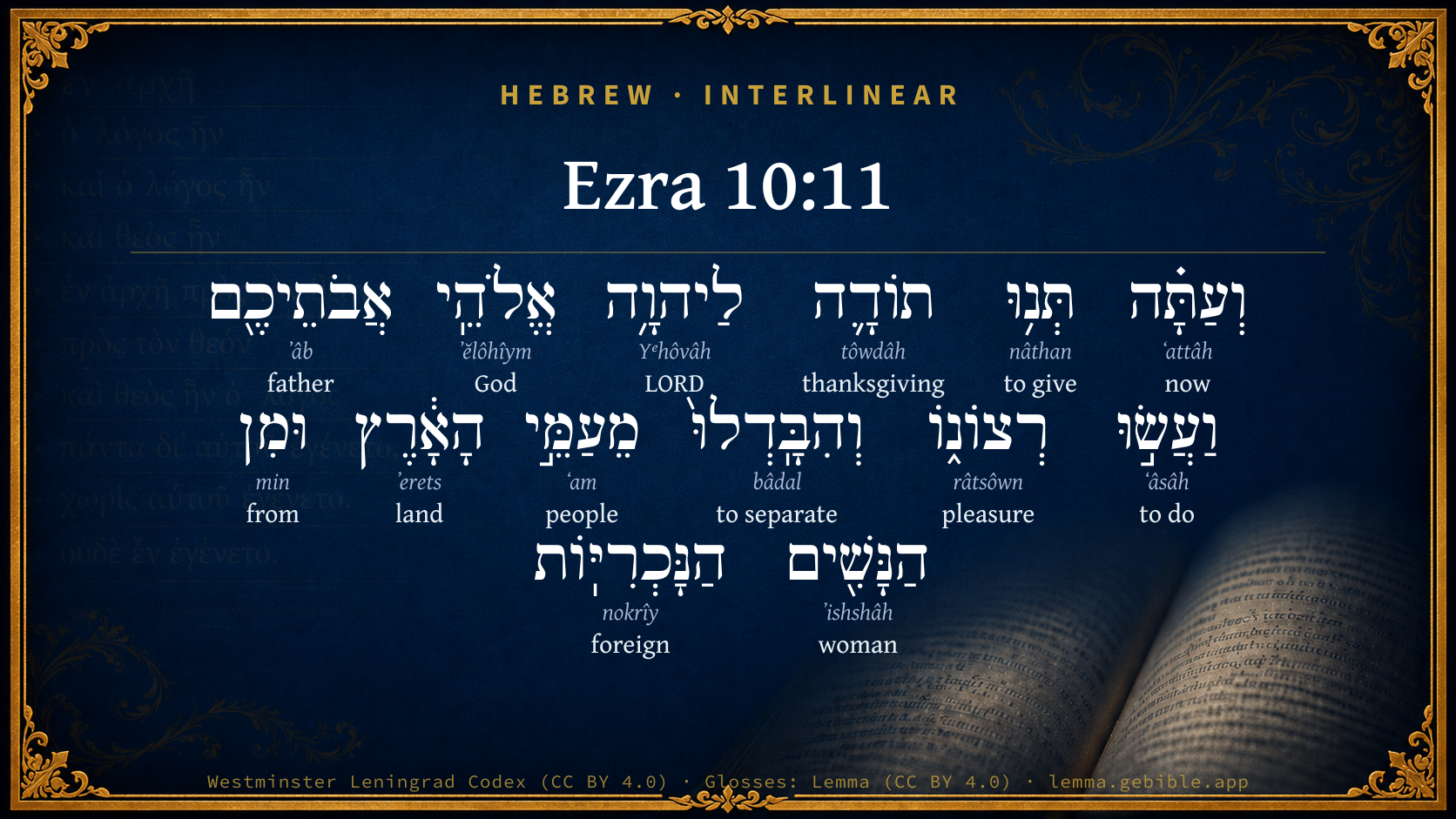
Hebrew (Westminster Leningrad Codex) Ezra 10:11 appears in the Hebrew Old Testament. The text above is from the Westminster Leningrad Codex. Each word links to its Strong’s number, a concise gloss, and parsing drawn from the Open Scriptures Hebrew Bible morphology. Click any word for its full Brown-Driver-Briggs (BDB) entry.
Download image
Cite this verse

Ezra 10:11 (World English Bible). Public Domain. Lemma interlinear Bible study tool, https://lemma.gebible.app/v/ezra/10/11.

Show BibTeX & RIS
BibTeX
RIS
English Translation
Now therefore make confession to Yahweh, the God of your fathers, and do his pleasure; and separate yourselves from the peoples of the land, and from the foreign women.
World English Bible · Public Domain
Download a study sheet

One document with this verse’s original text, its word-by-word gloss line, the meaning frame, cross-references with their text, attributed commentary, and full source and license credits — printable, and it pastes into notes with its structure intact.

This verse Autodidact and up

Study sheet (.html) Plain text (.txt)

A passage Seminary Student

Up to 50 verses in one chapter. A passage sheet keeps up to 6 commentary sources and 12 cross-references per verse, in the order this page ranks them, and says so on the sheet whenever that leaves anything out. Ask for a single verse and you get the Autodidact verse sheet above.

Everything on this page stays free to read, with no account — the sheet is a download of what is already on screen, not access to it.

Want to remove ads? Support Godless Engineer
Compare translations 3

The same verse in 3 English versions, stacked beneath the original-language interlinear above. Click any original word for its lexicon entry.

Each is an independent rendering of the whole verse — the interlinear is not word-aligned to these translations.

Highlighted words mark where these versions differ — a whole-verse word diff, not a word-by-word alignment.

  • World English Bible Public Domain
    Now therefore make confession to Yahweh, the God of your fathers, and do his pleasure; and separate yourselves from the peoples of the land, and from the foreign women.
  • King James Version Public Domain
    Now therefore make confession unto the LORD God of your fathers, and do his pleasure: and separate yourselves from the people of the land, and from the strange wives.
  • unfoldingWord Literal Text CC BY-SA 4.0
    But now, give praise to Yahweh, the God of your fathers, and do his will, and separate yourselves from the peoples of the land, and from the foreign women.”

unfoldingWord Literal Text — © unfoldingWord, licensed CC BY-SA 4.0. Word-aligned USFM3 via Door43 (git.door43.org/unfoldingWord/en_ult).

Versions to compare (up to 4)

3 of 4 selected

Show all 18 translations

Every available English version of this verse, each an independent rendering of the whole verse.

  • World English Bible Public Domain
    Now therefore make confession to Yahweh, the God of your fathers, and do his pleasure; and separate yourselves from the peoples of the land, and from the foreign women.
  • Berean Standard Bible Public Domain
    Now, therefore, make a confession to the LORD, the God of your fathers, and do His will. Separate yourselves from the people of the land and from your foreign wives.”
  • Majority Standard Bible Public Domain
    Now, therefore, make a confession to the LORD, the God of your fathers, and do His will. Separate yourselves from the people of the land and from your foreign wives.”
  • King James Version Public Domain
    Now therefore make confession unto the LORD God of your fathers, and do his pleasure: and separate yourselves from the people of the land, and from the strange wives.
  • American Standard Version (1901) Public Domain
    Now therefore make confession unto Jehovah, the God of your fathers, and do his pleasure; and separate yourselves from the peoples of the land, and from the foreign women.
  • Revised Version (1885) Public Domain
    Now therefore make confession unto the LORD, the God of your fathers, and do his pleasure: and separate yourselves from the peoples of the land, and from the strange women.
  • Geneva Bible (1599) Public Domain
    Now therefore giue praise vnto the Lord God of your fathers, and do his will, and separate your selues from the people of the land, and from the strange wiues.
  • Douay-Rheims (1899) Public Domain
    And now make confession to the Lord the God of your fathers, and do his pleasure, and separate yourselves from the people of the land, and from your strange wives.
  • Young's Literal Translation Public Domain
    and, now, make confession to Jehovah, God of your fathers, and do His good pleasure, and be separated from the peoples of the land, and from the strange women.'
  • Literal Standard Version CC BY-SA 4.0
    and now, make confession to YHWH, God of your fathers, and do His good pleasure, and be separated from the peoples of the land, and from the strange women.”
  • Unlocked Literal Bible CC BY-SA 4.0
    But now give praise to Yahweh, your ancestors' God, and do his will. Separate from the people of the land and from the foreign women.”
  • unfoldingWord Literal Text CC BY-SA 4.0
    But now, give praise to Yahweh, the God of your fathers, and do his will, and separate yourselves from the peoples of the land, and from the foreign women.”
  • Darby Bible Public Domain
    And now make confession to Jehovah the God of your fathers, and do his pleasure, and separate yourselves from the peoples of the land, and from the foreign wives.
  • World Messianic Bible Public Domain
    Now therefore make confession to the LORD, the God of your fathers and do his pleasure. Separate yourselves from the peoples of the land and from the foreign women.”
  • Webster's Bible Public Domain
    Now therefore make confession to the LORD God of your fathers, and do his pleasure: and separate yourselves from the people of the land, and from the foreign wives.
  • Free Bible Version CC BY-SA 4.0
    Now you must confess your sin to the Lord, the God of your forefathers, and do what he requires. Sever your connections with the people of the land and your foreign wives.”
  • Bible in Basic English Public Domain
    So now, give praise to the Lord, the God of your fathers, and do his pleasure; and make yourselves separate from the peoples of the land and from the strange women.
  • JPS Tanakh (1917) Public Domain
    Now therefore make confession unto the LORD, the God of your fathers, and do His pleasure; and separate yourselves from the peoples of the land, and from the foreign women.'

Literal Standard Version (2020), Covenant Press — licensed CC BY-SA 4.0. Text via the HelloAO Bible API (eBible.org). Unlocked Literal Bible (unfoldingWord) — licensed CC BY-SA 4.0. Text via the HelloAO Bible API (eBible.org). unfoldingWord Literal Text — © unfoldingWord, licensed CC BY-SA 4.0. Word-aligned USFM3 via Door43 (git.door43.org/unfoldingWord/en_ult). Free Bible Version, Dr. Jonathan Gallagher — licensed CC BY-SA 4.0. Text via the HelloAO Bible API (eBible.org).

Word by word

More ways to search: Search by grammar → Find every occurrence → Compare this word →

Practice this passage: Drill this verse → Learn its vocabulary →

תוֹדָ֛ה
tôwdâh
H8426
“thanksgiving”
Noun, Common, Feminine, Singular, Absolute
Part of Speech
Noun
Type
Common
Gender
Feminine
Number
Singular
State
Absolute
Full BDB Definition

Origin: from H3034

TWOT: 847b

confession, praise, thanksgiving - give praise to God - thanksgiving in songs of liturgical worship, hymn of praise - thanksgiving choir or procession or line or company - thank-offering, sacrifice of thanksgiving - confession
  1. וְעַתָּ֗ה ʻattâh H6258 “and · now” Conjunction + Adverb
  2. תְּנ֥וּ nâthan H5414 “give” Verb, Qal, Imperative, 2nd Person, Masculine, Plural
  3. לַיהוָ֥ה Yᵉhôvâh H3068 “to/for · LORD” Preposition + Noun, Proper
  4. אֱלֹהֵֽי ʼĕlôhîym H430 “God(s) of” Noun, Common, Masculine, Plural, Construct
  5. אֲבֹתֵיכֶ֖ם ʼâb H1 “fathers · your” Noun, Common, Masculine, Plural, Construct + Suffix, Personal, 2nd Person, Masculine, Plural
  6. וַעֲשׂ֣וּ ʻâsâh H6213 “and · do” Conjunction + Verb, Qal, Imperative, 2nd Person, Masculine, Plural
  7. רְצוֹנ֑וֹ râtsôwn H7522 “pleasure · his” Noun, Common, Masculine, Singular, Construct + Suffix, Personal, 3rd Person, Masculine, Singular
  8. וְהִבָּֽדְלוּ֙ bâdal H914 “and · separate” Conjunction + Verb, Niphal, Imperative, 2nd Person, Masculine, Plural
  9. מֵעַמֵּ֣י ʻam H5971 “from · peoples of” Preposition + Noun, Common, Masculine, Plural, Construct
  10. הָאָ֔רֶץ ʼerets H776 “the · land” Particle, Definite Article + Noun, Common, Both, Singular, Absolute
  11. וּמִן min H4480 “and · from” Conjunction + Preposition
  12. הַנָּשִׁ֖ים ʼishshâh H802 “the · women” Particle, Definite Article + Noun, Common, Feminine, Plural, Absolute
  13. הַנָּכְרִיּֽוֹת nokrîy H5237 “the · foreign” Particle, Definite Article + Adjective, Adjective, Feminine, Plural, Absolute

About this verse

These counts appear in no published source. They are computed here, from the morphology-tagged text and Lemma’s own curated glosses. What Lemma adds →

14
words
14
distinct lemmas
Historical
section

Shared distinctive vocabulary

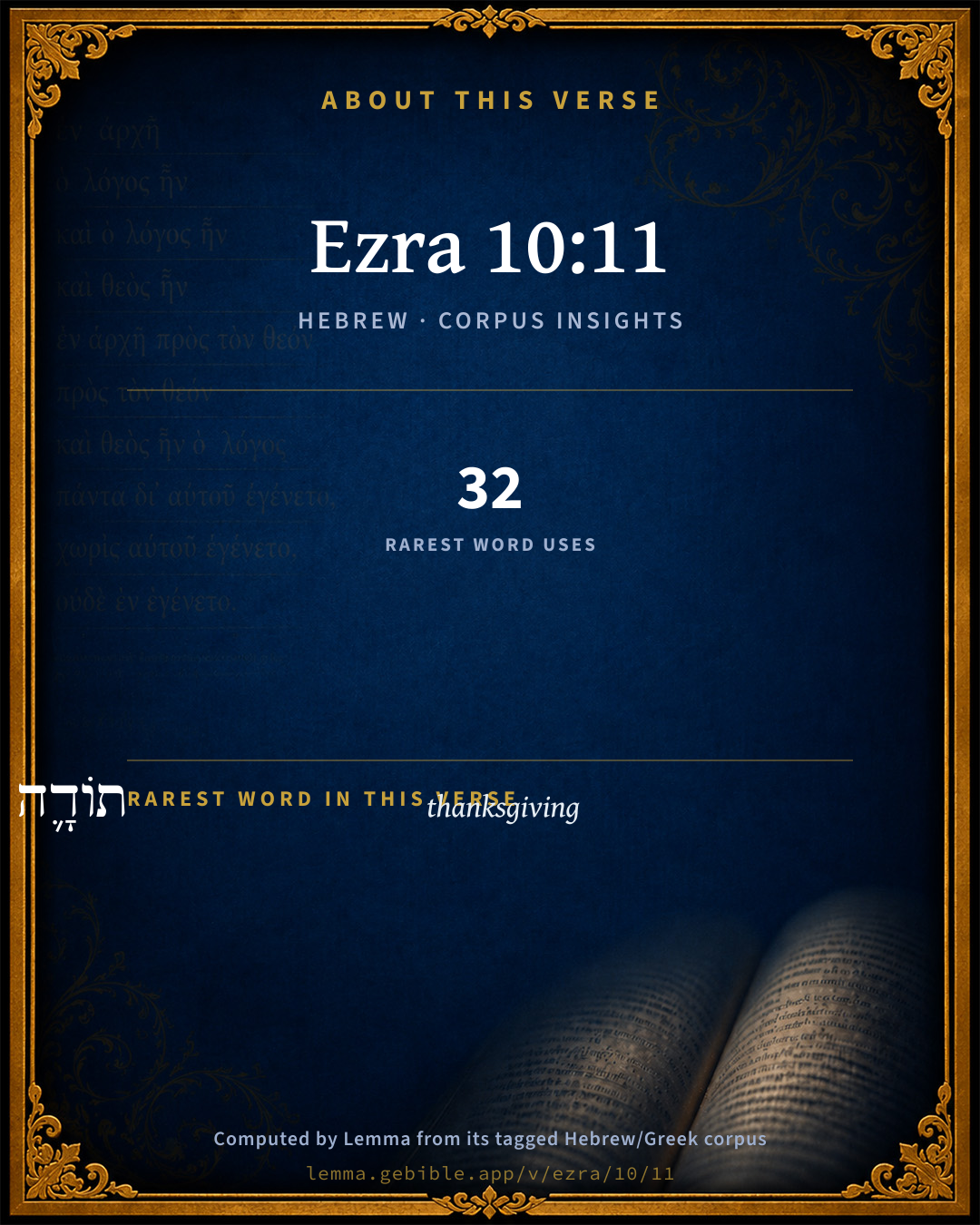
תוֹדָ֛ה thanksgiving H8426 occurs in 30 verses of the Hebrew Bible. Also found in:

Grammatical profile

  • 3 verbs
  • 8 nouns
  • 1 adjective
  • 1 preposition
  • 1 adverb

Verb forms

  • תְּנ֥וּ Qal · Imperative
  • וַעֲשׂ֣וּ Qal · Imperative
  • וְהִבָּֽדְלוּ֙ Niphal · Imperative

Hebrew & Septuagint length

In English translation the verse runs 29 words from the Hebrew and 34 from the Septuagint (LXX English) — closely comparable.

A rough comparison of the two English renderings, which tokenize alike — not a word-level alignment.

Word counts can differ between the Hebrew and the Greek without any difference in meaning — e.g. the Hebrew direct-object marker אֵת has no separate Greek word, and Greek often adds the article ὁ.

Cross-references

17

Topical passages linked to Ezra 10:11 in the Treasury of Scripture Knowledge — connected by theme and wording, ordered by reader-vote popularity; previews shown in the World English Bible.

  • Romans 12:2 Don't be conformed to this world, but be transformed by the renewing of your mind, so that you may prove what is the good, well-pleasing, and perfect will of God.
  • Leviticus 26:40–42 "'If they confess their iniquity, and the iniquity of their fathers, in their trespass which they trespassed against me, and also that, because they walked contrary to me,
  • Deuteronomy 7:3–4 neither shall you make marriages with them; your daughter you shall not give to his son, nor his daughter shall you take to your son.
  • Joshua 7:19 Joshua said to Achan, My son, please give glory to Yahweh, the God of Israel, and make confession to him; and tell me now what you have done; don't hide it from me.
  • Ezra 10:3 Now therefore let us make a covenant with our God to put away all the wives, and such as are born of them, according to the counsel of my lord, and of those who tremble at the commandment of our God; and let it be done according to the law.
  • Proverbs 28:13 He who conceals his sins doesn't prosper, But whoever confesses and renounces them finds mercy.
  • Isaiah 1:16–18 Wash yourselves, make yourself clean. Put away the evil of your doings from before my eyes; Cease to do evil.
  • Jeremiah 3:13 Only acknowledge your iniquity, that you have transgressed against Yahweh your God, and have scattered your ways to the strangers under every green tree, and you have not obeyed my voice, says Yahweh.
  • 1 John 1:7–9 But if we walk in the light, as he is in the light, we have fellowship with one another, and the blood of Jesus Christ, his Son, cleanses us from all sin.
  • Ezra 9:1 Now when these things were done, the princes drew near to me, saying, The people of Israel, and the priests and the Levites, have not separated themselves from the peoples of the lands, [doing] according to their abominations, even of the Canaanites, the Hittites, the Perizzites, the Jebusites, the Ammonites, the Moabites, the Egyptians, and the Amorites.
  • Nehemiah 13:3 It came to pass, when they had heard the law, that they separated from Israel all the mixed multitude.
  • Psalms 32:5 I acknowledged my sin to you. I didn't hide my iniquity. I said, I will confess my transgressions to Yahweh, And you forgave the iniquity of my sin. Selah.
  • Isaiah 56:4 For thus says Yahweh of the eunuchs who keep my Sabbaths, and choose the things that please me, and hold fast my covenant:
  • 1 Corinthians 2:12–14 But we received, not the spirit of the world, but the Spirit which is from God, that we might know the things that were freely given to us by God.
  • 2 Corinthians 6:17 Therefore, "'Come out from among them, And be separate,' says the Lord, 'Touch no unclean thing. I will receive you.
  • Colossians 1:10 that you may walk worthily of the Lord, to please him in all respects, bearing fruit in every good work, and increasing in the knowledge of God;
  • Hebrews 13:21 make you complete in every good work to do his will, working in you that which is well pleasing in his sight, through Jesus Christ, to whom be the glory forever and ever. Amen.

Cross-references courtesy of OpenBible.info (CC BY 4.0).

Hebrew and Greek witnesses Masoretic Hebrew ↔ Greek Septuagint

The same verse in the two great witnesses to the Old Testament, shown verse-for-verse.

These are two independent witnesses, not word-aligned to each other, and the Septuagint is shown in lemma (dictionary) form.

Hebrew Ezra 10:11 Masoretic · Westminster Leningrad Codex

וְעַתָּ֗ה תְּנ֥וּ תוֹדָ֛ה לַיהוָ֥ה אֱלֹהֵֽי אֲבֹתֵיכֶ֖ם וַעֲשׂ֣וּ רְצוֹנ֑וֹ וְהִבָּֽדְלוּ֙ מֵעַמֵּ֣י הָאָ֔רֶץ וּמִן הַנָּשִׁ֖ים הַנָּכְרִיּֽוֹת

Now therefore make confession to Yahweh, the God of your fathers, and do his pleasure; and separate yourselves from the peoples of the land, and from the foreign women.

World English Bible · Public Domain

Greek LXX Ezra 10:11 Septuagint · lemma form

καί νῦν δίδωμι αἴνεσις κύριος ὁ θεός ὁ πατήρ σύ καί ποιέω ὁ ἀρεστός ἐνώπιος αὐτός καί διαστέλλω ἀπό λαός ὁ γῆ καί ἀπό ὁ γυνή ὁ ἀλλότριος

Now therefore give praise to the Lord God of our fathers, and do that which is pleasing in his sight: and separate yourselves from the peoples of the land, and from the strange wives.

LXX2012 (modern English Septuagint) · Public Domain

In the Septuagint this is one book — Esdras B (2 Esdras): Ezra is chapters 1–10, Nehemiah 11–23.

On this verse, Haydock's Catholic Bible Commentary discusses the Septuagint’s reading. Read the note in Commentary ↓

Hebrew: Westminster Leningrad Codex (CC BY 4.0). Greek: Septuagint (public domain); English from LXX2012 (modern English Septuagint) (Public Domain). How the Septuagint differs from the Hebrew →

Commentary

Notes on Ezra 10:11 from classic Christian and Jewish commentators (each source and its license shown beneath its notes). The classic Christian expositions comment on the surrounding passage and are grouped to its opening verse, so a note may address several verses; the Jewish commentaries on the Tanakh (Rashi and others) are per-verse, so they appear only where the commentator wrote on this verse.

Lemma curates 59 commentaries, every one of them public domain or Creative Commons licensed, each selected and text-cleaned for this edition rather than reprinted as found. About our sources →

Trapp's Complete Commentary

John Trapp

Ezr 10:11 Now therefore make confession unto the LORD God of your fathers, and do his pleasure: and separate yourselves from the people of the land, and from the strange wives.

Ver. 11. Now therefore make confession] This is the soul’s vomit, Vomitus sordium animae (Naz.) which is the hardest kind of medicine, but most healthy. This the devil knows, viz. that there is no way to purge the sick soul but upwards, by casting out the vicious humour wherewith it is clogged; and, therefore, he holds the lips close, that the heart may not disburden itself by so wholesome evacuation. Confession must follow upon conviction, as here; and be followed by reformation.

And do his pleasure: and separate, &c.] For they that confess and forsake not their sins are only dog sick. When they have disgorged their stomachs, and got a little ease, they will be as bad as before. Wicked people make account of confession as drunkards do of vomiting; that they may add drunkenness to thirst. But the man that shall have mercy must both confess and forsake, Pro 28:13. Open a vein, and let out his bad blood.

John Trapp, A Commentary or Exposition upon All the Books of the Old and New Testament (1647–1656) — public domain. Text from a community e-Sword module.

Joseph Benson's Commentary

Ezr 10:11-12. Make confession unto the Lord; and do his pleasure — You have sinfully pleased yourselves, now please God, by your obedience to his command. And separate yourselves from your strange wives — There being no mention made here of putting away their children, but only their wives, it has been thought by some that they kept their children, and, by circumcision, dedicated them to God. For, though Shechaniah proposed the putting them away, yet it may seem not improbable that Ezra, to whom the matter was referred, when he came to order what should be actually done, mitigated the severity of the proposal. As thou hast said, so must we do — They saw no other remedy, and so submitted to what he required.

Joseph Benson's Commentary on the Old and New Testaments (1811–1818) — public domain. Text from a community e-Sword module.

Geneva Bible (1599)

Geneva Bible translators

Read Josh. 7:19.

Geneva Bible (1599) marginal notes — public domain. Text via Bolls.life.

Adam Clarke's Commentary

Verse 11. Make confession] Acknowledge your sins before God, with deep compunction of heart, and the fullest resolution to forsake them.

Adam Clarke's Commentary on the Bible (1810–1826) — public domain. Text from a community e-Sword/MySword module.

The Cambridge Bible for Schools and Colleges

gen. ed. J. J. S. Perowne

11. make confession unto the Lord God of your fathers] R.V. make confession (marg. Or, give thanks) unto the Lord, the God of your fathers. ‘Make confession’. Literally ‘give thanksgiving or praise’. The substantive is connected with the verb which in its reflexive form means, as in Ezr_10:1, ‘made confession’. It is found elsewhere in these books (Neh_12:27; Neh_12:31; Neh_12:38-40; 2Ch_29:31; 2Ch_33:16) with the meaning of ‘thanksgiving’, which is the general sense of the word in other books (Lev_7:12-13; Lev_7:15; Psa_26:7; Psa_42:4; Psa_50:14; Psa_50:23; Psa_56:12; Psa_100:4; Psa_107:22; Psa_116:17; Psa_147:7; Isa_51:3; Jer_17:26; Jer_30:19; Jer_33:11; Amo_4:5; Jon_2:9). The only possible exception is Jos_7:19 ‘My son, give, I pray thee, glory to the Lord, the God of Israel, and make confession (marg. Or, give praise) unto him’. There, as in this passage, ‘make confession’ is a good paraphrase rather than a strict translation. ‘Praise’ was given to God by the utterance of confession. The penitent who renounced his sin and threw himself upon the mercies of God rendered that true praise of trust and love, from which ‘confession’ springs. Cf. Psa_50:23 ‘Whoso offereth the sacrifice of thanksgiving glorifieth me’. On ‘the Lord, the God of your fathers’, see note on Ezr_8:28.

and do his pleasure] The words of praise to be verified in action. The same phrase as in Psa_40:8 ‘I delight to do thy will, O God’, Psa_143:10 ‘Teach me to do thy will’.

and … from the people of the land, and from the strange wives] R.V. from the peoples of the land and from the strange women. See note on Ezr_10:2. The separation entailed not merely the divorce of the wives but a complete breaking of intercourse with all residents in the land who had not adopted the religion of the Jews.

The Cambridge Bible for Schools and Colleges (gen. ed. J. J. S. Perowne; Cambridge University Press, 1878–1918) — public domain. Text from a community e-Sword module.

John Gill's Exposition

Now therefore make confession to the Lord God of your fathers,.... Of their sin, and express their detestation of it, and repentance for it:

and do his pleasure; obey his will, and particularly in this case:

and separate yourselves from the people of the land; the Canaanites, &c. have no fellowship with them, make no covenants, contracts, and alliances with them for the future:

and from the strange wives; they had taken; put them away.

John Gill's Exposition of the Whole Bible (1746–1763) — public domain (CC PDM 1.0). Text via the HelloAO Bible API.

Haydock's Catholic Bible Commentary

Confession. Septuagint, "give praise;" which is done by repentance and virtue. (Menochius) --- Confess your faults, and submit to the justice of God, Josue vii. 19. (Calmet)

George Leo Haydock (1774–1849), Haydock's Catholic Family Bible and Commentary, 1859 edition — public domain. Excludes Psalms (Douay-Rheims chapter numbering differs from Protestant) and Deuterocanonical books (Catholic canon only).

Matthew Poole's English Annotations

Do his pleasure; you have sinfully pleased yourselves, now please God by your obedience to his command.

Matthew Poole's English Annotations on the Holy Bible (1683–1685) — public domain. Text from a community e-Sword/MySword module.

The Pulpit Commentary

Make confession. This is undoubtedly the true meaning of tnu thodah in this place, and not give praise" (dote ainesin), as the LXX render. Separate yourselves from the people of the land. The marriages naturally led on to familiar intercourse with the relatives and friends of the women, and so tended to break down the barrier between Jew and Gentile which it had been the special object of the Mosaic legislation to erect.

The Pulpit Commentary (1880–1919), ed. H.D.M. Spence-Jones & Joseph S. Exell — public domain. Text from a community e-Sword module.

unfoldingWord translationNotes

Door43 World Missions Community

Separate from

move away from, be different from

translationWords

praise

Yahweh

God

will of God

unfoldingWord translationNotes — © Distant Shores Media and the Door43 World Missions Community, licensed CC BY-SA 4.0. Source: git.door43.org/Door43/en_tn.

Rashi

Rabbi Shlomo Yitzchaki (Rashi)

confess Heb. תּוֹדָה, [which, in this case, means] וִדּוּי, confession.

Rashi on the Tanakh — English translations: “The Judaica Press complete Tanach with Rashi, translated by A. J. Rosenberg” (CC BY 4.0); “Pentateuch with Rashi's commentary by M. Rosenbaum and A.M. Silbermann, 1929-1934” (public domain); “The Metsudah Tanach series, Lakewood, N.J” (CC BY 4.0); and “The Book of Joshua, Metsudah Publications, 1997” (CC BY 4.0). Text via Sefaria.

Lesson kit

Teaching starters — assembled from the data on this page, not authored interpretation. Every prompt links to the verse data it draws on. Edit before teaching.

Ezra, in the Historical, opens this verse with 14 words (14 distinct Hebrew lemmas). Its most distinctive word is tôwdâh (“thanksgiving”). A historical commentator’s framing appears above. Read the whole chapter for the surrounding context.

Discussion questions

  1. What does “thanksgiving” (tôwdâh) contribute to the verse as a whole?
  2. How does Leviticus 7:12, which shares the word «thanksgiving», read alongside this verse?
  3. These translations render this verse differently; the difference is in the English rendering, not the original. What questions does that raise?
  4. «תְּנ֥וּ» is a Qal Imperative verb. How does that grammatical form shape the action described?
  5. Compare how Trapp's Complete Commentary and Joseph Benson's Commentary read this verse. Where do they agree or differ?

Things to notice

Reading settings

Reading text

Shown beneath each verse's original-language words.

Old Testament
Old Testament edition

Read the OT as the Masoretic Hebrew (MT) or the Greek Septuagint (LXX).

English shown for the Greek Septuagint (in the Hebrew ↔ Greek comparison).

Comparing translations? Open the Compare panel on any verse page to stack up to four side by side.