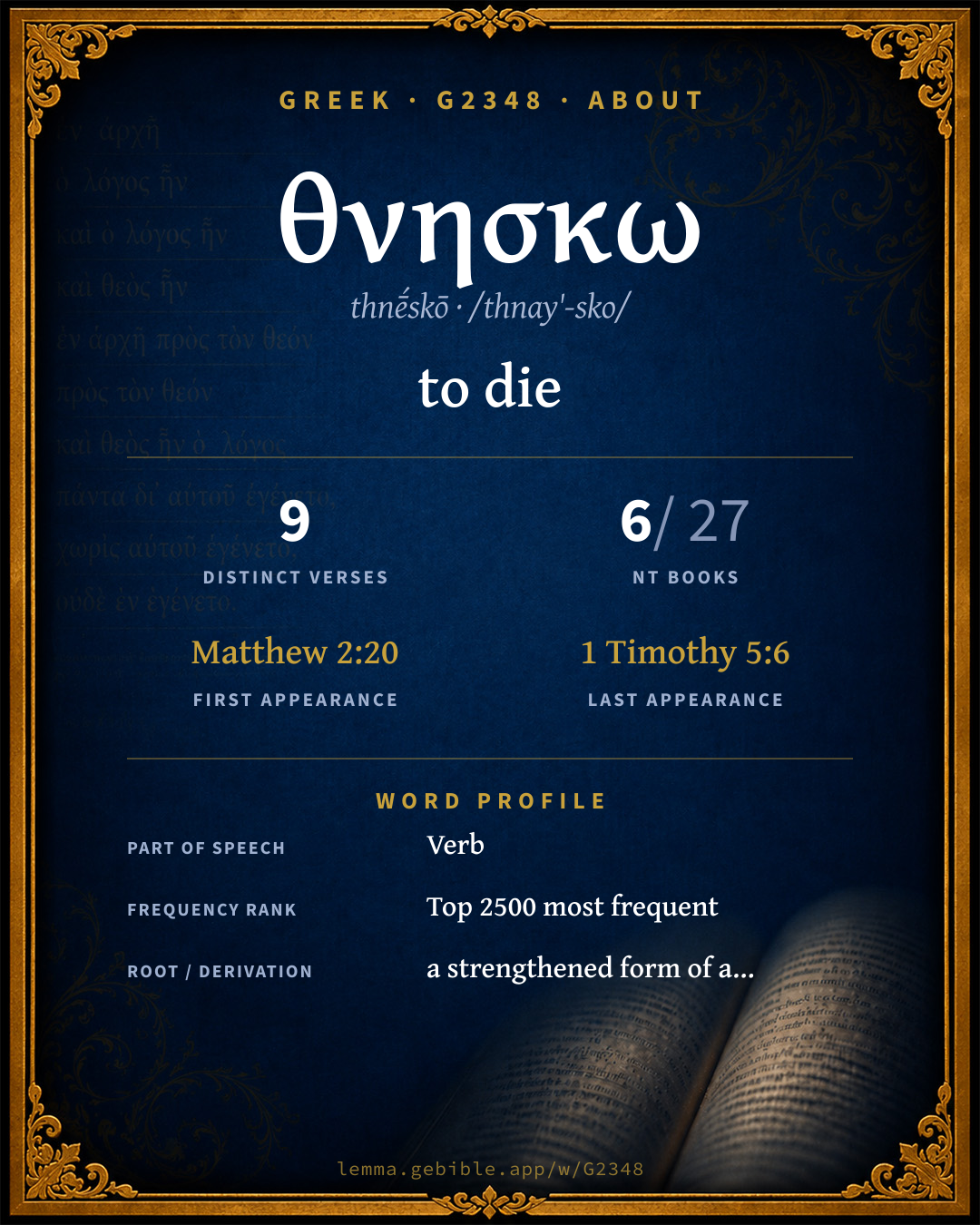
θνήσκω
to die
‘to die’ is one of 2 main senses fuller range ↓
Full lexicon entry — Thayer's Greek Lexicon
From Thayer's Greek Lexicon
Where this word appears
Grammar key — what these labels mean
Part of speech
- Verb
- An action or state-of-being word.
Tense
- Perfect
- A completed past action with continuing present results.
Voice
- Active
- The subject performs the action.
Mood
- Indicative
- States a fact or asks a factual question (the mood of reality).
- Participle
- A verbal adjective (“writing,” “having written”).
- Infinitive
- A verbal noun (“to write”), unmarked for person or number.
Case
- Nominative
- The case of the subject (and the predicate nominative).
- Accusative
- The case of the direct object and of extent.
- Genitive
- The case of source, possession, or “of” — answers “whose / from what.”
Person
- 3rd person
- The one spoken about (“he / she / it / they”).
Gender
- Masculine
- Grammatically masculine.
Number
- Singular
- One.
- Plural
- More than one.
Every verse where G2348 appears in the Book of John — 2 distinct verses. Click any verse to open its interlinear word-by-word view. Verse text shown in the World English Bible for context — . Each verse’s Greek form is shown with its reference; the English is not keyword-highlighted, since the data carries no word-level English alignment. Use “Compare translations” on any verse to read it across multiple English versions. This concordance covers the Greek New Testament; Septuagint (Greek Old Testament) occurrences of this word are not indexed here.
John
- John 11:44 τεθνηκὼς perf act ptcp nom sg masc He who was dead came out, bound hand and foot with wrappings, and his face was wrapped around with a cloth. Jesus said to them, "Free him, and let him go."
- John 19:33 τεθνηκότα perf act ptcp acc sg masc but when they came to Jesus, and saw that he was already dead, they didn't break his legs.
About this entry
At a glance — auto-summarized from this page’s data, not written by a person. Every figure links to its source below. This summary describes the numbers; it doesn’t interpret them.
θνησκω — transliterated thnḗskō — is a Greek verb carrying the sense “to die.” Scripture first uses it in Matthew 2:20. It appears 9 verses across 6 books of the Greek New Testament, among its uncommon vocabulary. Its lexical range runs to 2 senses. From the same root come θανατος and θνητος. See the sense tree, 9-verse concordance, and the renderings breakdown below.
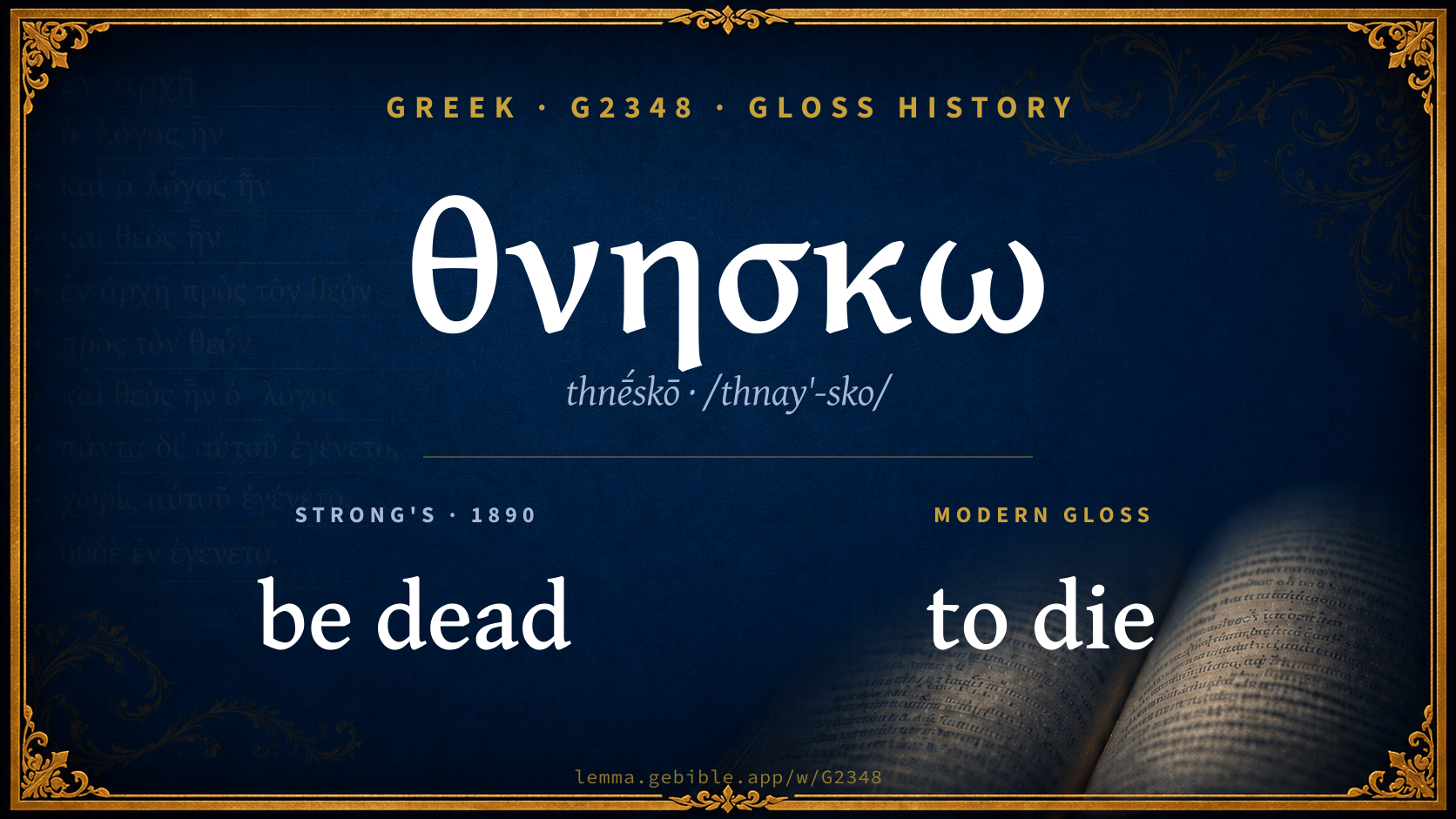
Gloss history
Strong's 1890 vs modern scholarship
About this word
Strong's G2348 catalogs a Greek word from the Greek New Testament.
These counts are not copied from any lexicon or concordance. They are computed here, from the morphology-tagged Greek New Testament. What Lemma adds →
- 9
- distinct verses
- The word appears in 9 distinct verses.
- 6 / 27
- NT books
- The word appears in 6 of 27 New Testament books.
- #1,140
- by frequency
- Top 2500 most frequent Greek words (rank 1,140 of 5,347 Greek words by occurrence).
View all 9 occurrences in the concordance →
By section of the New Testament
By traditional corpus
Conventional, traditional groupings — biblical authorship is debated, so this is a traditional corpus grouping, not an authorship claim. Some books belong to more than one corpus (Luke is in both the Gospels and the Lukan corpus, and so on), so these shares overlap and need not total 100%. Each figure is a share of the word’s 9 distinct verses.
- Gospels 6 verses · 67%
- Lukan (Luke–Acts) 4 verses · 44%
- Johannine 2 verses · 22%
- Pauline corpus 1 verse · 11%
How translations render this word
Counts come from each version’s own published word-to-Strong’s tagging or interlinear alignment — an approximate guide to how each version renders this word, not a word-level alignment the data otherwise carries. Because each total is that version’s own tagged count, the per-version totals vary from one another and need not match the appearance or distinct-verse counts above. These counts may also differ from a printed concordance because Lemma counts each distinctly tagged rendering and does not collapse phrase taggings into a single head-word total. This is a fixed set of word-tagged versions (KJV, ASV, BSB, ULT) and does not change with the reading translation you choose elsewhere. Each version’s license is shown beside its name below (and on Sources).
- King James Version: Was dead 3×, Dead 2×, Had been dead 2×
- American Standard Version: Was dead 5×, Dead 2×, Is dead 2×
- Berean Standard Bible: Is dead 2×
- unfoldingWord Literal Text: Died 2×, Has died 2×, Have died 2×
King James Version Public Domain
Renders G2348 across 15 tagged occurrences — most commonly:
Plus 6 renderings that appear only once — usually multi-word phrases or single function words the recovered tagging swept in, not distinct renderings.
American Standard Version Public Domain
Renders G2348 across 13 tagged occurrences — most commonly:
Plus 4 renderings that appear only once — usually multi-word phrases or single function words the recovered tagging swept in, not distinct renderings.
Berean Standard Bible Public Domain
Renders G2348 across 9 tagged occurrences — most commonly:
Plus 7 renderings that appear only once — usually multi-word phrases or single function words the recovered tagging swept in, not distinct renderings.
unfoldingWord Literal Text CC BY-SA 4.0
Renders G2348 across 11 tagged occurrences — most commonly:
Plus 5 renderings that appear only once — usually multi-word phrases or single function words the recovered tagging swept in, not distinct renderings.
Senses in Thayer's
The 2 senses Thayer's distinguishes for this word, in lexicon order (not ranked by frequency or importance). The full entry — with sub-senses — is in the Lexicon Entry tab.
- to die, to be dead
- metaph. to be spiritually dead
Word origin
Origin: a strengthened form of a simpler primary thano than'-o (which is used for it only in certain tenses)
A strengthened form of a simpler primary word θάνω thanō (which is used for it only in certain tenses); to die (literally or figuratively): - be dead die.
— Strong’s Exhaustive Concordance (1890), public domain.
Forms in the corpus
The 6 distinct written forms G2348 takes in the Greek New Testament, most frequent first — each parse links to that tense’s occurrences in the concordance.
| Form | Parsing | Example | Uses |
|---|---|---|---|
| τέθνηκεν téthnēken | Verb, Perfect, Active, Indicative, 3rd person, Singular | Mark 15:44 | 3 |
| τεθνηκὼς tethnēkṑs | Verb, Perfect, Active, Participle, Nominative, Singular, Masculine | Luke 7:12 | 2 |
| τεθνήκασιν tethnḗkasin | Verb, Perfect, Active, Indicative, 3rd person, Plural | Matthew 2:20 | 1 |
| τεθνηκέναι tethnēkénai | Verb, Perfect, Active, Infinitive | Acts 14:19 | 1 |
| τεθνηκότα tethnēkóta | Verb, Perfect, Active, Participle, Accusative, Singular, Masculine | John 19:33 | 1 |
| τεθνηκότος tethnēkótos | Verb, Perfect, Active, Participle, Genitive, Singular, Masculine | Acts 25:19 | 1 |
Same root — word family
Other Thayer's entries built from the same root as G2348, grouped by Strong’s listed origin. These share a root / origin per the lexicon — not necessarily a shared meaning. Each links to that word’s own entry.
Derived from this word
Compare all same-root words → They share a root, not necessarily a meaning.
Septuagint usage
The same Greek word θνησκω appears 73 times in the Greek Old Testament (Septuagint), across 61 verses in 17 books.
- 73
- LXX occurrences
- Tagged occurrences of this Greek word in the Septuagint.
- 61
- verses
- Distinct Septuagint verses containing this word.
- 17 / 39
- OT books
- The word appears in 17 of the 39 Old Testament books.
Sample Septuagint occurrences
- Genesis 50:15 θνήσκω
- Exodus 4:19 θνήσκω
- Leviticus 11:31 θνήσκω
- Numbers 17:13 θνήσκω
- Deuteronomy 25:5 θνήσκω
- Judges 3:25 θνήσκω
- Ruth 1:8 θνήσκω
- 1 Samuel 4:17 θνήσκω
- 2 Samuel 1:5 θνήσκω
- 1 Kings 3:20 θνήσκω
- 2 Kings 4:32 θνήσκω
- 2 Chronicles 22:10 θνήσκω
Septuagint occurrences (same lexeme)
Every verse where the same Strong’s number (G2348) appears in the Greek Septuagint — showing the first 50 of 61. Verse text shown in the World English Bible for context; the Greek form is the matched word — the English is not keyword-highlighted.
- Genesis 50:15 θνήσκω When Joseph's brothers saw that their father was dead, they said, "It may be that Joseph will hate us, and will fully pay us back for all of the evil which we did to him.
- Exodus 4:19 θνήσκω Yahweh said to Moses in Midian, "Go, return into Egypt; for all the men who sought your life are dead."
- Exodus 12:30 θνήσκω Pharaoh rose up in the night, he, and all his servants, and all the Egyptians; and there was a great cry in Egypt, for there was not a house where there was not one dead.
- Exodus 14:30 θνήσκω Thus Yahweh saved Israel that day out of the hand of the Egyptians; and Israel saw the Egyptians dead on the seashore.
- Exodus 21:35 θνήσκω "If one man's bull injures another's, so that it dies, then they shall sell the live bull, and divide its price; and they shall also divide the dead animal.
- Leviticus 11:31 θνήσκω These are they which are unclean to you among all that creep. Whoever touches them when they are dead, shall be unclean until the evening.
- Leviticus 11:32 θνήσκω On whatever any of them falls when they are dead, it shall be unclean; whether it is any vessel of wood, or clothing, or skin, or sack, whatever vessel it is, with which any work is done, it must be put into water, and it shall be unclean until the evening; then it will be clean.
- Numbers 17:13 θνήσκω Everyone who comes near, who comes near to the tent of Yahweh, dies: shall we perish all of us?
- Numbers 17:14 θνήσκω
- Numbers 19:11 θνήσκω He who touches the dead body of any man shall be unclean seven days:
- Numbers 19:13 θνήσκω Whoever touches a dead person, the body of a man who has died, and doesn't purifies himself, defiles the tent of Yahweh; and that soul shall be cut off from Israel: because the water for impurity was not sprinkled on him, he shall be unclean; his uncleanness is yet on him.
- Numbers 19:18 θνήσκω and a clean person shall take hyssop, and dip it in the water, and sprinkle it on the tent, and on all the vessels, and on the persons who were there, and on him who touched the bone, or the slain, or the dead, or the grave:
- Numbers 25:9 θνήσκω Those who died by the plague were twenty-four thousand.
- Numbers 33:4 θνήσκω while the Egyptians were burying all their firstborn, whom Yahweh had struck among them: on their gods also Yahweh executed judgments.
- Deuteronomy 25:5 θνήσκω If brothers dwell together, and one of them die, and have no son, the wife of the dead shall not be married outside to a stranger: her husband's brother shall go in to her, and take her to him as wife, and perform the duty of a husband's brother to her.
- Deuteronomy 26:14 θνήσκω I have not eaten of it in my mourning, neither have I put away of it, being unclean, nor given of it for the dead: I have listened to the voice of Yahweh my God; I have done according to all that you have commanded me.
- Judges 3:25 θνήσκω They waited until they were ashamed; and, behold, he didn't open the doors of the upper room: therefore they took the key, and opened [them], and, behold, their lord was fallen down dead on the earth.
- Judges 16:30 θνήσκω Samson said, Let me die with the Philistines. He bowed himself with all his might; and the house fell on the lords, and on all the people who were therein. So the dead that he killed at his death were more than those who he killed in his life.
- Ruth 1:8 θνήσκω Naomi said to her two daughters-in-law, Go, return each of you to her mother's house: Yahweh deal kindly with you, as you have dealt with the dead, and with me.
- Ruth 2:20 θνήσκω Naomi said to her daughter-in-law, Blessed be he of Yahweh, who has not left off his kindness to the living and to the dead. Naomi said to her, The man is a close relative to us, one of our near kinsmen.
- Ruth 4:5 θνήσκω Then said Boaz, What day you buy the field of the hand of Naomi, you must buy it also of Ruth the Moabitess, the wife of the dead, to raise up the name of the dead on his inheritance.
- Ruth 4:10 θνήσκω Moreover Ruth the Moabitess, the wife of Mahlon, have I purchased to be my wife, to raise up the name of the dead on his inheritance, that the name of the dead not be cut off from among his brothers, and from the gate of his place: you are witnesses this day.
- 1 Samuel 4:17 θνήσκω He who brought the news answered, Israel is fled before the Philistines, and there has been also a great slaughter among the people, and your two sons also, Hophni and Phinehas, are dead, and the ark of God is taken.
- 1 Samuel 4:19 θνήσκω His daughter-in-law, Phinehas' wife, was with child, near to be delivered: and when she heard the news that the ark of God was taken, and that her father-in-law and her husband were dead, she bowed herself and brought forth; for her pains came on her.
- 1 Samuel 17:31 θνήσκω When the words were heard which David spoke, they rehearsed them before Saul; and he sent for him.
- 1 Samuel 24:15 θνήσκω Yahweh therefore be judge, and give sentence between me and you, and see, and plead my cause, and deliver me out of your hand.
- 1 Samuel 31:5 θνήσκω When his armor bearer saw that Saul was dead, he likewise fell on his sword, and died with him.
- 1 Samuel 31:7 θνήσκω When the men of Israel who were on the other side of the valley, and those who were beyond the Jordan, saw that the men of Israel fled, and that Saul and his sons were dead, they forsook the cities, and fled; and the Philistines came and lived in them.
- 2 Samuel 1:5 θνήσκω David said to the young man who told him, How know you that Saul and Jonathan his son are dead?
- 2 Samuel 1:19 θνήσκω Your glory, Israel, is slain on your high places! How are the mighty fallen!
- 2 Samuel 2:7 θνήσκω Now therefore let your hands be strong, and be you valiant; for Saul your lord is dead, and also the house of Judah have anointed me king over them.
- 2 Samuel 4:1 θνήσκω When [Ish-bosheth], Saul's son, heard that Abner was dead in Hebron, his hands became feeble, and all the Israelites were troubled.
- 2 Samuel 4:10 θνήσκω when one told me, saying, Behold, Saul is dead, thinking to have brought good news, I took hold of him, and killed him in Ziklag, which was the reward I gave him for his news.
- 2 Samuel 9:8 θνήσκω He did obeisance, and said, "What is your servant, that you should look on such a dead dog as I am?"
- 2 Samuel 12:18 θνήσκω It happened on the seventh day, that the child died. The servants of David feared to tell him that the child was dead; for they said, Behold, while the child was yet alive, we spoke to him, and he didn't listen to our voice: how will he then vex himself, if we tell him that the child is dead!
- 2 Samuel 12:19 θνήσκω But when David saw that his servants were whispering together, David perceived that the child was dead; and David said to his servants, Is the child dead? They said, He is dead.
- 2 Samuel 12:23 θνήσκω But now he is dead, why should I fast? can I bring him back again? I shall go to him, but he will not return to me.
- 2 Samuel 14:2 θνήσκω Joab sent to Tekoa, and fetched there a wise woman, and said to her, please act like a mourner, and put on mourning clothing, Please, and don't anoint yourself with oil, but be as a woman who has a long time mourned for the dead:
- 2 Samuel 16:9 θνήσκω Then said Abishai the son of Zeruiah to the king, "Why should this dead dog curse my lord the king? Please let me go over and take off his head."
- 1 Kings 3:20 θνήσκω She arose at midnight, and took my son from beside me, while your handmaid slept, and laid it in her bosom, and laid her dead child in my bosom.
- 1 Kings 3:21 θνήσκω When I rose in the morning to give my child suck, behold, it was dead; but when I had looked at it in the morning, behold, it was not my son, whom I bore.
- 1 Kings 3:22 θνήσκω The other woman said, No; but the living is my son, and the dead is your son. This said, No; but the dead is your son, and the living is my son. Thus they spoke before the king.
- 1 Kings 3:23 θνήσκω Then said the king, The one says, This is my son who lives, and your son is the dead: and the other says, No; but your son is the dead, and my son is the living.
- 1 Kings 11:21 θνήσκω When Hadad heard in Egypt that David slept with his fathers, and that Joab the captain of the host was dead, Hadad said to Pharaoh, Let me depart, that I may go to my own country.
- 1 Kings 12:24 θνήσκω Thus says Yahweh, You shall not go up, nor fight against your brothers the children of Israel: return every man to his house; for this thing is of me. So they listened to the word of Yahweh, and returned and went their way, according to the word of Yahweh.
- 1 Kings 16:4 θνήσκω Him who dies of Baasha in the city shall the dogs eat; and him who dies of his in the field shall the birds of the sky eat.
- 1 Kings 20:14 θνήσκω Ahab said, By whom? He said, Thus says Yahweh, By the young men of the princes of the provinces. Then he said, Who shall begin the battle? He answered, You.
- 1 Kings 20:15 θνήσκω Then he mustered the young men of the princes of the provinces, and they were two hundred and thirty-two: and after them he mustered all the people, even all the children of Israel, being seven thousand.
- 1 Kings 20:16 θνήσκω They went out at noon. But Ben Hadad was drinking himself drunk in the pavilions, he and the kings, the thirty-two kings who helped him.
- 1 Kings 20:24 θνήσκω Do this thing: take the kings away, every man out of his place, and put captains in their room;
These are occurrences of the same Greek lexeme (G2348) in the Septuagint — not a translation of any one Hebrew word. The store carries no word-level Hebrew↔Greek alignment, so no Hebrew original is asserted here. Counts come from the recovered LXX Strong's tagging — high-frequency vocabulary is well covered, while rare or late forms may be untagged — so they reflect tagged occurrences and may slightly undercount.