
1 Kings 3:23

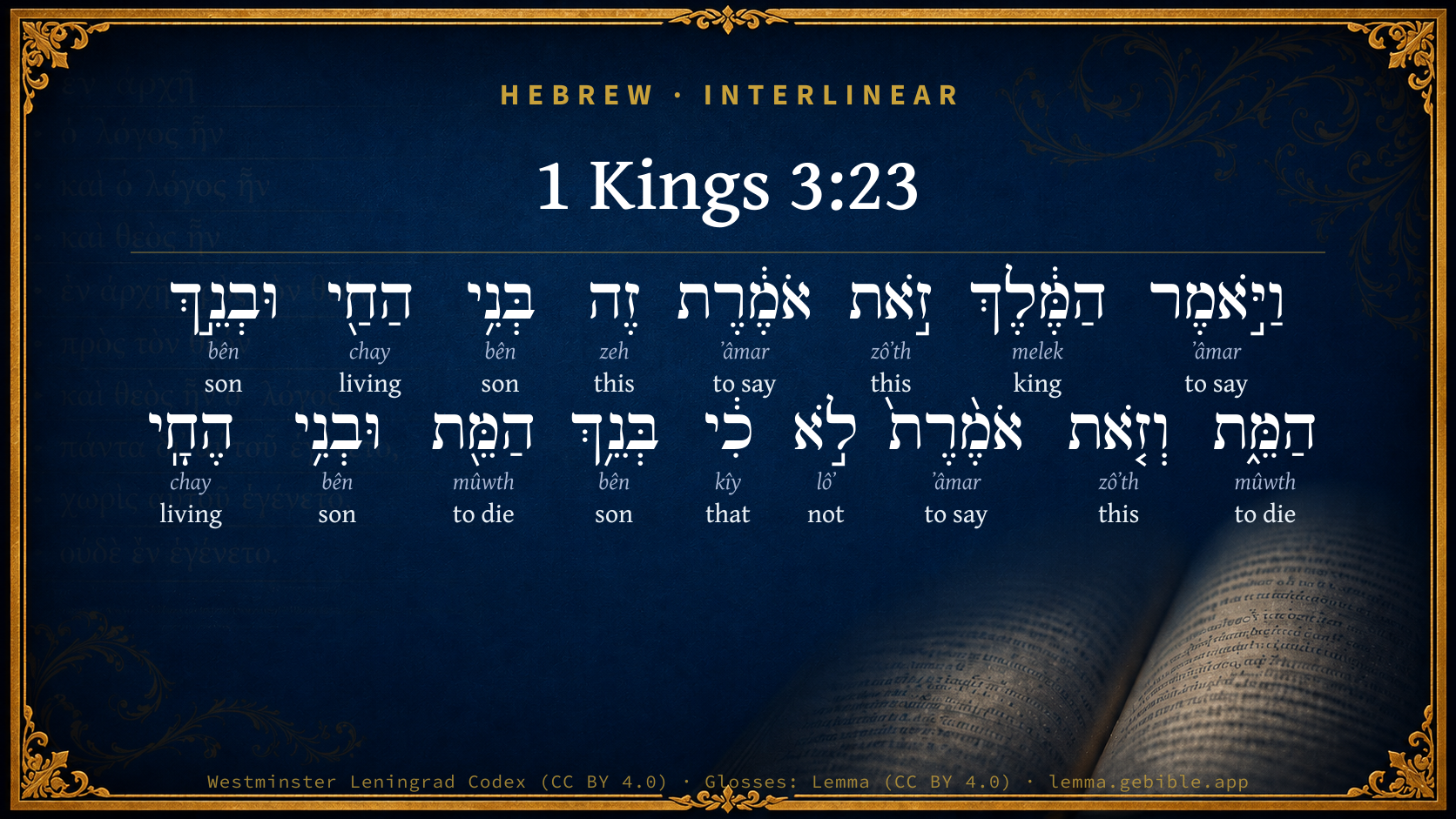
Hebrew (Westminster Leningrad Codex) 1 Kings 3:23 appears in the Hebrew Old Testament. The text above is from the Westminster Leningrad Codex. Each word links to its Strong’s number, a concise gloss, and parsing drawn from the Open Scriptures Hebrew Bible morphology. Click any word for its full Brown-Driver-Briggs (BDB) entry.
Download image
Cite this verse

1 Kings 3:23 (World English Bible). Public Domain. Lemma interlinear Bible study tool, https://lemma.gebible.app/v/1-kings/3/23.

Show BibTeX & RIS
BibTeX
RIS
English Translation
Then said the king, The one says, This is my son who lives, and your son is the dead: and the other says, No; but your son is the dead, and my son is the living.
World English Bible · Public Domain
Download a study sheet

One document with this verse’s original text, its word-by-word gloss line, the meaning frame, cross-references with their text, attributed commentary, and full source and license credits — printable, and it pastes into notes with its structure intact.

This verse Autodidact and up

Study sheet (.html) Plain text (.txt)

A passage Seminary Student

Up to 50 verses in one chapter. A passage sheet keeps up to 6 commentary sources and 12 cross-references per verse, in the order this page ranks them, and says so on the sheet whenever that leaves anything out. Ask for a single verse and you get the Autodidact verse sheet above.

Everything on this page stays free to read, with no account — the sheet is a download of what is already on screen, not access to it.

Want to remove ads? Support Godless Engineer
Compare translations 3

The same verse in 3 English versions, stacked beneath the original-language interlinear above. Click any original word for its lexicon entry.

Each is an independent rendering of the whole verse — the interlinear is not word-aligned to these translations.

Highlighted words mark where these versions differ — a whole-verse word diff, not a word-by-word alignment.

  • World English Bible Public Domain
    Then said the king, The one says, This is my son who lives, and your son is the dead: and the other says, No; but your son is the dead, and my son is the living.
  • King James Version Public Domain
    Then said the king, The one saith, This is my son that liveth, and thy son is the dead: and the other saith, Nay; but thy son is the dead, and my son is the living.
  • unfoldingWord Literal Text CC BY-SA 4.0
    And the king said, “This one says, ‘This my son, the living one, and your son the one having died,’ but that one says, ‘No, but your son the one having died, and my son the living one.’”

unfoldingWord Literal Text — © unfoldingWord, licensed CC BY-SA 4.0. Word-aligned USFM3 via Door43 (git.door43.org/unfoldingWord/en_ult).

Versions to compare (up to 4)

3 of 4 selected

Show all 18 translations

Every available English version of this verse, each an independent rendering of the whole verse.

  • World English Bible Public Domain
    Then said the king, The one says, This is my son who lives, and your son is the dead: and the other says, No; but your son is the dead, and my son is the living.
  • Berean Standard Bible Public Domain
    Then the king replied, “This woman says, ‘My son is alive and yours is dead,’ but that woman says, ‘No, your son is dead and mine is alive.’”
  • Majority Standard Bible Public Domain
    Then the king replied, “This woman says, ‘My son is alive and yours is dead,’ but that woman says, ‘No, your son is dead and mine is alive.’”
  • King James Version Public Domain
    Then said the king, The one saith, This is my son that liveth, and thy son is the dead: and the other saith, Nay; but thy son is the dead, and my son is the living.
  • American Standard Version (1901) Public Domain
    Then said the king, The one saith, This is my son that liveth, and thy son is the dead: and the other saith, Nay; but thy son is the dead, and my son is the living.
  • Revised Version (1885) Public Domain
    Then said the king, The one saith, This is my son that liveth, and thy son is the dead: and the other saith, Nay; but thy son is the dead, and my son is the living.
  • Geneva Bible (1599) Public Domain
    Then sayde the King, She sayth, This that liueth is my sonne, and the dead is thy sonne: and the other sayth, Nay, but the dead is thy sonne, and the liuing is my sonne.
  • Douay-Rheims (1899) Public Domain
    Then said the king: The one saith, My child is alive, and thy child is dead. And the other answereth: Nay, but thy child is dead, and mine liveth.
  • Young's Literal Translation Public Domain
    And the king saith, `This `one' saith, This `is' my son, the living, and thy son `is' the dead; and that `one' saith, Nay, but thy son `is' the dead, and my son the living.'
  • Literal Standard Version CC BY-SA 4.0
    And the king says, “This [one] says, This [is] my son, the living, and your son [is] the dead; and that [one] says, No, but your son [is] the dead, and my son the living.”
  • Unlocked Literal Bible CC BY-SA 4.0
    Then the king said, “One of you says, 'This is my son who is alive, and your son is dead,' and the other says, 'No, your son is the dead one, and my son is the living one.'”
  • unfoldingWord Literal Text CC BY-SA 4.0
    And the king said, “This one says, ‘This my son, the living one, and your son the one having died,’ but that one says, ‘No, but your son the one having died, and my son the living one.’”
  • Darby Bible Public Domain
    Then said the king, The one says, This that is living is my son, and thy son is the dead; and the other says, No, for thy son is the dead, and my son is the living.
  • World Messianic Bible Public Domain
    Then the king said, “One says, ‘This is my son who lives, and your son is the dead one;’ and the other says, ‘No! But your son is the dead one, and my son is the living one.’”
  • Webster's Bible Public Domain
    Then said the king, The one saith, This is my son that liveth, and thy son is the dead; and the other saith, No; but thy son is the dead, and my son is the living.
  • Free Bible Version CC BY-SA 4.0
    The king intervened, saying, “So this woman says, ‘My son is the one that's alive. Your son is the one that's dead,’ while the other woman says, ‘No! Your son is the one that's dead. My son is the one that's alive.’”
  • Bible in Basic English Public Domain
    Then the king said, One says, The living child is my son, and yours is the dead: and the other says, Not so; but your son is the dead one and mine is the living.
  • JPS Tanakh (1917) Public Domain
    Then said the king: 'The one saith: This is my son that liveth, and thy son is the dead; and the other saith: Nay; but thy son is the dead, and my son is the living.'

Literal Standard Version (2020), Covenant Press — licensed CC BY-SA 4.0. Text via the HelloAO Bible API (eBible.org). Unlocked Literal Bible (unfoldingWord) — licensed CC BY-SA 4.0. Text via the HelloAO Bible API (eBible.org). unfoldingWord Literal Text — © unfoldingWord, licensed CC BY-SA 4.0. Word-aligned USFM3 via Door43 (git.door43.org/unfoldingWord/en_ult). Free Bible Version, Dr. Jonathan Gallagher — licensed CC BY-SA 4.0. Text via the HelloAO Bible API (eBible.org).

Word by word

More ways to search: Search by grammar → Find every occurrence → Compare this word →

Practice this passage: Drill this verse → Learn its vocabulary →

הַחַ֖י
chay
H2416
“the · living”
Particle, Definite Article + Adjective, Adjective, Masculine, Singular, Absolute
Part of Speech
Particle + Adjective
Type
Adjective
Gender
Masculine
Number
Singular
State
Absolute
Full BDB Definition

Origin: from H2421

TWOT: 644a

living, alive (adjective) - green (of vegetation) - flowing, fresh (of water) - lively, active (of man) - reviving (of the springtime) - relatives (noun masculine) - life (abstract emphatic) (noun masculine) - life - sustenance, maintenance - living thing, animal (noun feminine) - animal - life - appetite - revival, renewal - community (noun feminine)
  1. וַיֹּ֣אמֶר ʼâmar H559 “and · to say” Conjunction + Verb, Qal, Sequential Imperfect, 3rd Person, Masculine, Singular
  2. הַמֶּ֔לֶךְ melek H4428 “the · king” Particle, Definite Article + Noun, Common, Masculine, Singular, Absolute
  3. זֹ֣את zôʼth H2063 “this” Pronoun, Demonstrative, Feminine, Singular
  4. אֹמֶ֔רֶת ʼâmar H559 “saying” Verb, Qal, Participle Active, Feminine, Singular, Absolute
  5. זֶה zeh H2088 “this” Pronoun, Demonstrative, Masculine, Singular
  6. בְּנִ֥י bên H1121 “son · my” Noun, Common, Masculine, Singular, Construct + Suffix, Personal, 1st Person, Common, Singular
  7. וּבְנֵ֣ךְ bên H1121 “and · son · your” Conjunction + Noun, Common, Masculine, Singular, Construct + Suffix, Personal, 2nd Person, Feminine, Singular
  8. הַמֵּ֑ת mûwth H4191 “the · dying” Particle, Definite Article + Verb, Qal, Participle Active, Masculine, Singular, Absolute
  9. וְזֹ֤את zôʼth H2063 “and · this” Conjunction + Pronoun, Demonstrative, Feminine, Singular
  10. אֹמֶ֨רֶת֙ ʼâmar H559 “saying” Verb, Qal, Participle Active, Feminine, Singular, Absolute
  11. לֹ֣א lôʼ H3808 “not” Particle, Negative
  12. כִ֔י kîy H3588 “that” Conjunction
  13. בְּנֵ֥ךְ bên H1121 “son · your” Noun, Common, Masculine, Singular, Construct + Suffix, Personal, 2nd Person, Feminine, Singular
  14. הַמֵּ֖ת mûwth H4191 “the · dying” Particle, Definite Article + Verb, Qal, Participle Active, Masculine, Singular, Absolute
  15. וּבְנִ֥י bên H1121 “and · son · my” Conjunction + Noun, Common, Masculine, Singular, Construct + Suffix, Personal, 1st Person, Common, Singular
  16. הֶחָֽי chay H2416 “the · living” Particle, Definite Article + Adjective, Adjective, Masculine, Singular, Absolute

About this verse

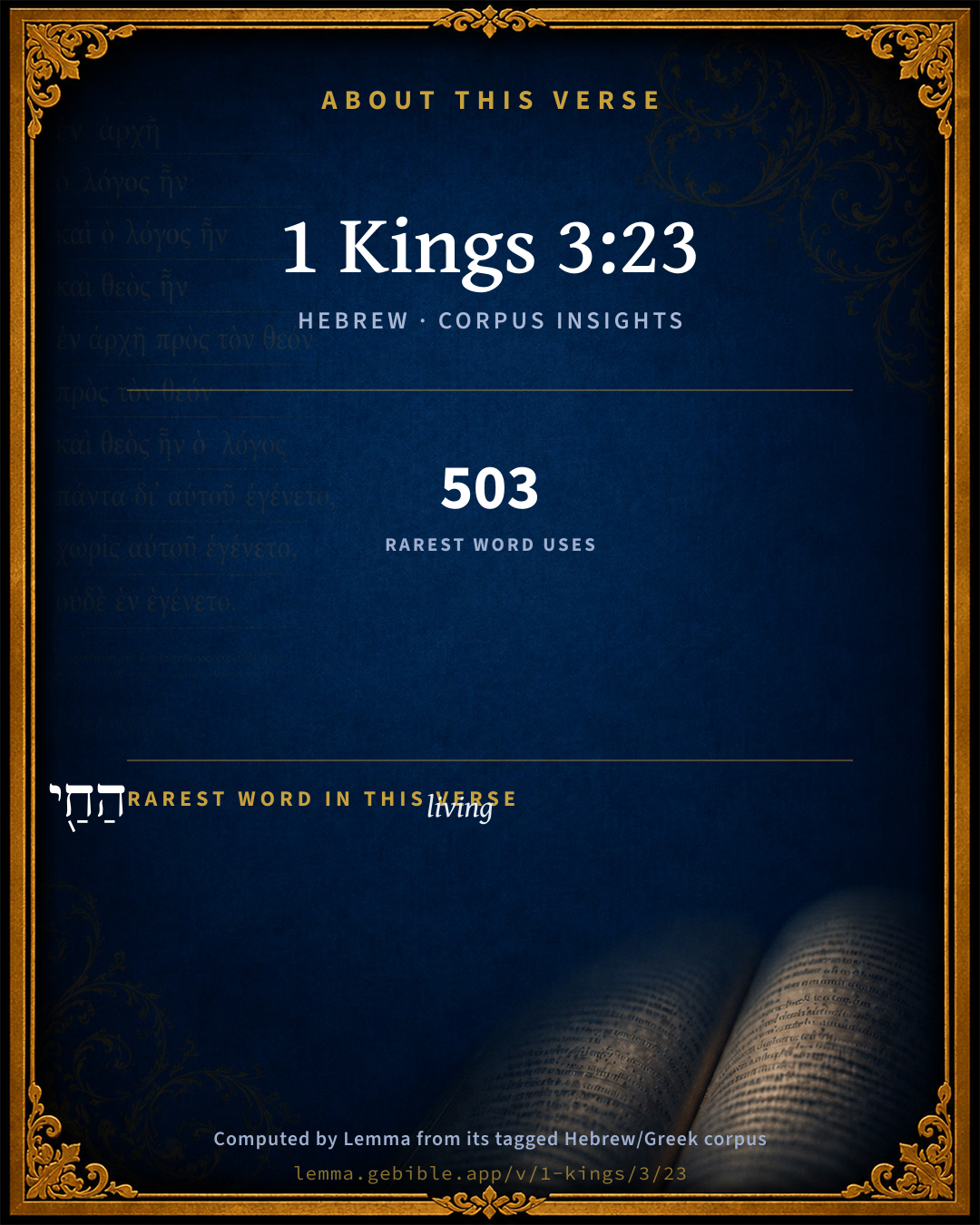
These counts appear in no published source. They are computed here, from the morphology-tagged text and Lemma’s own curated glosses. What Lemma adds →

17
words
9
distinct lemmas
Historical
section

Grammatical profile

  • 5 verbs
  • 5 nouns
  • 2 adjectives
  • 3 pronouns
  • 1 conjunction
  • 1 particle

Verb forms

  • וַיֹּ֣אמֶר Qal · Sequential Imperfect
  • אֹמֶ֔רֶת Qal · Participle Active
  • הַמֵּ֑ת Qal · Participle Active
  • אֹמֶ֨רֶת֙ Qal · Participle Active
  • הַמֵּ֖ת Qal · Participle Active

Repetition

Words recur within this verse — often emphatic in Hebrew:

  • בְּנִ֥י son H1121 ×4
  • וַיֹּ֣אמֶר to say H559 ×3
  • הַחַ֖י living H2416 ×2
  • הַמֵּ֑ת to die H4191 ×2
  • זֹ֣את this H2063 ×2

Hebrew & Septuagint length

In English translation the verse runs 36 words from the Hebrew and 40 from the Septuagint (LXX English) — closely comparable.

A rough comparison of the two English renderings, which tokenize alike — not a word-level alignment.

Word counts can differ between the Hebrew and the Greek without any difference in meaning — e.g. the Hebrew direct-object marker אֵת has no separate Greek word, and Greek often adds the article ὁ.

Hebrew and Greek witnesses Masoretic Hebrew ↔ Greek Septuagint

The same verse in the two great witnesses to the Old Testament, shown verse-for-verse.

These are two independent witnesses, not word-aligned to each other, and the Septuagint is shown in lemma (dictionary) form.

Hebrew 1 Kings 3:23 Masoretic · Westminster Leningrad Codex

וַיֹּ֣אמֶר הַמֶּ֔לֶךְ זֹ֣את אֹמֶ֔רֶת זֶה בְּנִ֥י הַחַ֖י וּבְנֵ֣ךְ הַמֵּ֑ת וְזֹ֤את אֹמֶ֨רֶת֙ לֹ֣א כִ֔י בְּנֵ֥ךְ הַמֵּ֖ת וּבְנִ֥י הֶחָֽי

Then said the king, The one says, This is my son who lives, and your son is the dead: and the other says, No; but your son is the dead, and my son is the living.

World English Bible · Public Domain

Greek LXX 1 Kings 3:23 Septuagint · lemma form

καί εἶπον ὁ βασιλεύς αὐτός σύ λέγω οὗτος ὁ υἱός ἐγώ ὁ ζάω καί ὁ υἱός οὗτος ὁ θνήσκω καί σύ λέγω οὐ ἀλλά ὁ υἱός ἐγώ ὁ ζάω καί ὁ υἱός σύ ὁ θνήσκω

and the king said to them, You say, This is my son, even the living one, and this woman's son is the dead one: and you say, No, but the living is my son, and the dead is your son.

LXX2012 (modern English Septuagint) · Public Domain

Hebrew: Westminster Leningrad Codex (CC BY 4.0). Greek: Septuagint (public domain); English from LXX2012 (modern English Septuagint) (Public Domain). How the Septuagint differs from the Hebrew →

Targum (Aramaic paraphrase)

1

The Targum is the ancient Jewish Aramaic paraphrase of the Hebrew Scriptures — an interpretive translation, not the Hebrew text itself. Onkelos (literal) and Pseudo-Jonathan (expansive) render the Torah, and Jonathan the Prophets. Coverage is partial: where no permissively-licensed English translation exists for a verse, only the Aramaic is shown. This is verse-level text, not a word-by-word alignment to the Hebrew.

  1. Targum Jonathan Prophets (Joshua–Malachi)
    וַאֲמַר מַלְכָּא דָא אֲמָרָא דֵין בְּרִי חַיָא וּבְרִיךְ מֵיתָא וְדָא אֲמַרָא לָא כֵּן בְּרִיךְ מֵיתָא וּבְרִי חַיָא:

    (no public-domain English translation for this verse)

    Targum Jonathan — Aramaic: “Mikraot Gedolot” (public domain). English: “Sefaria Community Translation” (CC0 1.0 (public-domain dedication)); “London "Chaldee Paraphrase," 1871” (public domain). Text via Sefaria.

Commentary

Notes on 1 Kings 3:23 from classic Christian and Jewish commentators (each source and its license shown beneath its notes). The classic Christian expositions comment on the surrounding passage and are grouped to its opening verse, so a note may address several verses; the Jewish commentaries on the Tanakh (Rashi and others) are per-verse, so they appear only where the commentator wrote on this verse.

Lemma curates 59 commentaries, every one of them public domain or Creative Commons licensed, each selected and text-cleaned for this edition rather than reprinted as found. About our sources →

Trapp's Complete Commentary

John Trapp

1Ki 3:23 Then said the king, The one saith, This [is] my son that liveth, and thy son [is] the dead: and the other saith, Nay; but thy son [is] the dead, and my son [is] the living.

Ver. 23. The one saith, This is my son,] q.d., This is a blind business: here is no better proof than the one is Aio, I affirm, and the other is Nego; I deny, neither is the one of better repute or credit than the other, as being both harlots.

John Trapp, A Commentary or Exposition upon All the Books of the Old and New Testament (1647–1656) — public domain. Text from a community e-Sword module.

John Gill's Exposition

And the king said, bring me a sword,.... The design of which might not at first appear to the court, and it might be thought strange, and greatly wondered at: what should be the meaning of it:

and they brought a sword before the king; his commands were obeyed.

John Gill's Exposition of the Whole Bible (1746–1763) — public domain (CC PDM 1.0). Text via the HelloAO Bible API.

The Pulpit Commentary

Then (promptly, without hesitation) said the king, The one saith (Heb. this is saying," i.e., keeps saying) This is my son that liveth, and thy son is the dead; and the other saith, Nay, but thy son is the dead and my son is the living.

The Pulpit Commentary (1880–1919), ed. H.D.M. Spence-Jones & Joseph S. Exell — public domain. Text from a community e-Sword module.

unfoldingWord translationNotes

Door43 World Missions Community

General Information:

Solomon makes a decision for the two women.

translationWords

sword

children

unfoldingWord translationNotes — © Distant Shores Media and the Door43 World Missions Community, licensed CC BY-SA 4.0. Source: git.door43.org/Door43/en_tn.

Lesson kit

Teaching starters — assembled from the data on this page, not authored interpretation. Every prompt links to the verse data it draws on. Edit before teaching.

1 Kings, in the Historical, opens this verse with 17 words (9 distinct Hebrew lemmas). Its most distinctive word is chay (“living”). A historical commentator’s framing appears above. Read the whole chapter for the surrounding context.

Discussion questions

  1. What does “living” (chay) contribute to the verse as a whole?
  2. What does the repetition of “son” (4× in this one verse) do in this verse?
  3. These translations render this verse differently; the difference is in the English rendering, not the original. What questions does that raise?
  4. «וַיֹּ֣אמֶר» is a Qal Sequential Imperfect verb. How does that grammatical form shape the action described?
  5. Compare how Trapp's Complete Commentary and John Gill's Exposition read this verse. Where do they agree or differ?

Things to notice

Reading settings

Reading text

Shown beneath each verse's original-language words.

Old Testament
Old Testament edition

Read the OT as the Masoretic Hebrew (MT) or the Greek Septuagint (LXX).

English shown for the Greek Septuagint (in the Hebrew ↔ Greek comparison).

Comparing translations? Open the Compare panel on any verse page to stack up to four side by side.