Daniel 7:2

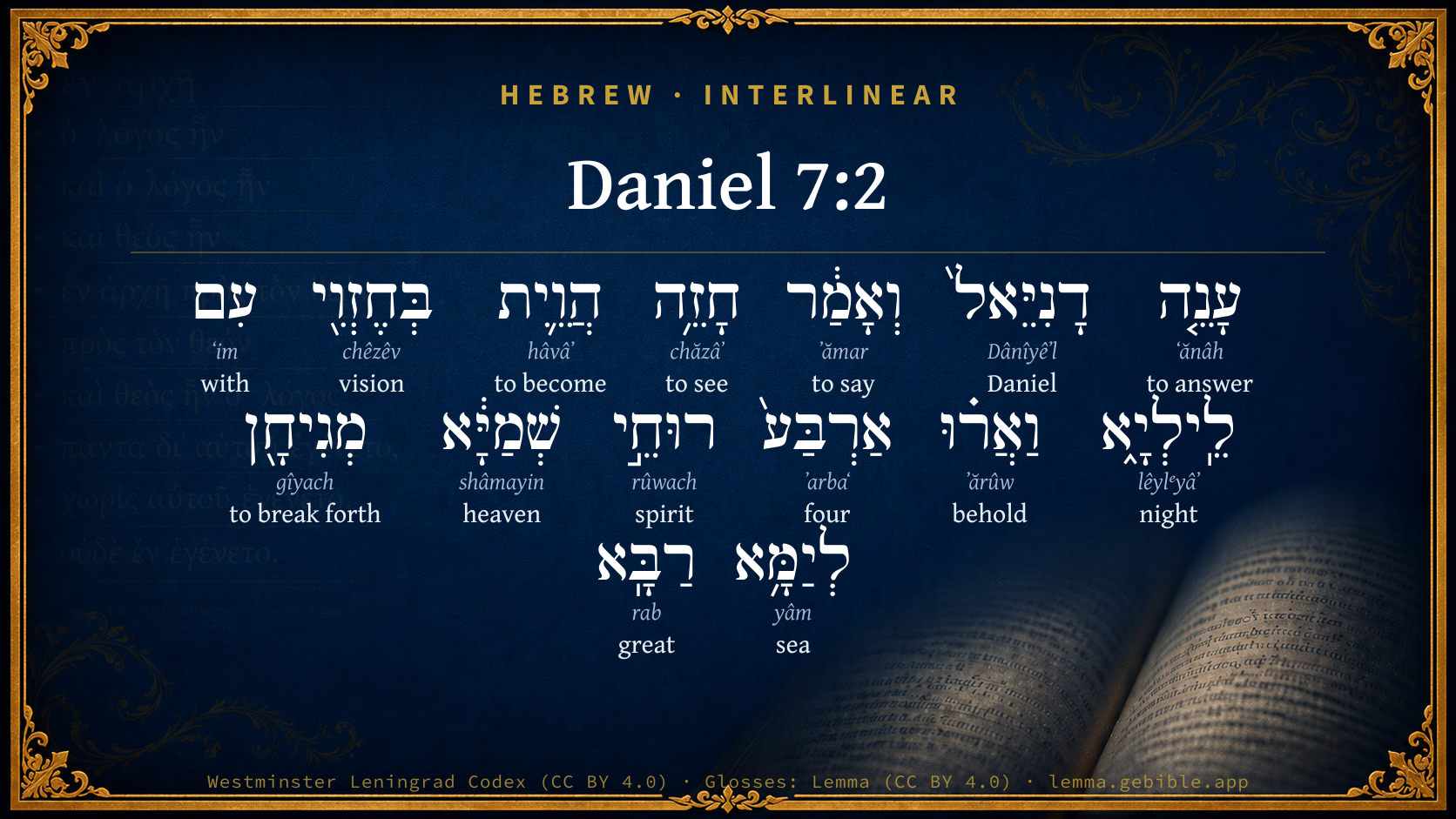
Hebrew (Westminster Leningrad Codex) Daniel 7:2 appears in the Hebrew Old Testament. The text above is from the Westminster Leningrad Codex. Each word links to its Strong’s number, a concise gloss, and parsing drawn from the Open Scriptures Hebrew Bible morphology. Click any word for its full Brown-Driver-Briggs (BDB) entry.
Download image
Cite this verse

Daniel 7:2 (World English Bible). Public Domain. Lemma interlinear Bible study tool, https://lemma.gebible.app/v/daniel/7/2.

Show BibTeX & RIS
BibTeX
RIS
English Translation
Daniel spoke and said, I saw in my vision by night, and, behold, the four winds of the sky broke forth on the great sea.
World English Bible · Public Domain
Highlights Full analysis ↓
Download a study sheet

One document with this verse’s original text, its word-by-word gloss line, the meaning frame, cross-references with their text, attributed commentary, and full source and license credits — printable, and it pastes into notes with its structure intact.

This verse Autodidact and up

Study sheet (.html) Plain text (.txt)

A passage Seminary Student

Up to 50 verses in one chapter. A passage sheet keeps up to 6 commentary sources and 12 cross-references per verse, in the order this page ranks them, and says so on the sheet whenever that leaves anything out. Ask for a single verse and you get the Autodidact verse sheet above.

Everything on this page stays free to read, with no account — the sheet is a download of what is already on screen, not access to it.

Want to remove ads? Support Godless Engineer
Compare translations 3

The same verse in 3 English versions, stacked beneath the original-language interlinear above. Click any original word for its lexicon entry.

Each is an independent rendering of the whole verse — the interlinear is not word-aligned to these translations.

Highlighted words mark where these versions differ — a whole-verse word diff, not a word-by-word alignment.

  • World English Bible Public Domain
    Daniel spoke and said, I saw in my vision by night, and, behold, the four winds of the sky broke forth on the great sea.
  • King James Version Public Domain
    Daniel spake and said, I saw in my vision by night, and, behold, the four winds of the heaven strove upon the great sea.
  • unfoldingWord Literal Text CC BY-SA 4.0
    Daniel related and said, “In my vision at night I was looking, and behold, the four winds of heaven were stirring up the great sea.

unfoldingWord Literal Text — © unfoldingWord, licensed CC BY-SA 4.0. Word-aligned USFM3 via Door43 (git.door43.org/unfoldingWord/en_ult).

Versions to compare (up to 4)

3 of 4 selected

Show all 18 translations

Every available English version of this verse, each an independent rendering of the whole verse.

  • World English Bible Public Domain
    Daniel spoke and said, I saw in my vision by night, and, behold, the four winds of the sky broke forth on the great sea.
  • Berean Standard Bible Public Domain
    Daniel declared: “In my vision in the night I looked, and suddenly the four winds of heaven were churning up the great sea.
  • Majority Standard Bible Public Domain
    Daniel declared: “In my vision in the night I looked, and suddenly the four winds of heaven were churning up the great sea.
  • King James Version Public Domain
    Daniel spake and said, I saw in my vision by night, and, behold, the four winds of the heaven strove upon the great sea.
  • American Standard Version (1901) Public Domain
    Daniel spake and said, I saw in my vision by night, and, behold, the four winds of heaven brake forth upon the great sea.
  • Revised Version (1885) Public Domain
    Daniel spake and said, I saw in my vision by night, and, behold, the four winds of the heaven brake forth upon the great sea.
  • Geneva Bible (1599) Public Domain
    Daniel spake and saide, I sawe in my vision by night, and behold, the foure windes of the heauen stroue vpon the great sea:
  • Douay-Rheims (1899) Public Domain
    I saw in my vision by night, and behold the four winds of the heaven strove upon the great sea.
  • Young's Literal Translation Public Domain
    Answered hath Daniel and said, `I was seeing in my vision by night, and lo, the four winds of the heavens are coming forth to the great sea;
  • Literal Standard Version CC BY-SA 4.0
    Daniel has answered and said, “I was seeing in my vision by night, and behold, the four winds of the heavens are coming forth to the Great Sea;
  • Unlocked Literal Bible CC BY-SA 4.0
    Daniel explained, “In my vision at night I saw that the four winds of heaven were stirring up the great sea.
  • unfoldingWord Literal Text CC BY-SA 4.0
    Daniel related and said, “In my vision at night I was looking, and behold, the four winds of heaven were stirring up the great sea.
  • Darby Bible Public Domain
    Daniel spoke and said, I saw in my vision by night, and behold, the four winds of the heavens broke forth upon the great sea.
  • World Messianic Bible Public Domain
    Daniel spoke and said, “I saw in my vision by night, and, behold, the four winds of the sky broke out on the great sea.
  • Webster's Bible Public Domain
    Daniel spoke and said, I saw in my vision by night, and behold, the four winds of heaven strove upon the great sea.
  • Free Bible Version CC BY-SA 4.0
    In my vision that I had that night I saw a tremendous storm, blowing from every direction, stirring up a great sea.
  • Bible in Basic English Public Domain
    I had a vision by night, and saw the four winds of heaven violently moving the great sea.
  • JPS Tanakh (1917) Public Domain
    Daniel spoke and said: I saw in my vision by night, and, behold, the four winds of the heaven broke forth upon the great sea.

Literal Standard Version (2020), Covenant Press — licensed CC BY-SA 4.0. Text via the HelloAO Bible API (eBible.org). Unlocked Literal Bible (unfoldingWord) — licensed CC BY-SA 4.0. Text via the HelloAO Bible API (eBible.org). unfoldingWord Literal Text — © unfoldingWord, licensed CC BY-SA 4.0. Word-aligned USFM3 via Door43 (git.door43.org/unfoldingWord/en_ult). Free Bible Version, Dr. Jonathan Gallagher — licensed CC BY-SA 4.0. Text via the HelloAO Bible API (eBible.org).

Word by word

More ways to search: Search by grammar → Find every occurrence → Compare this word →

Practice this passage: Drill this verse → Learn its vocabulary →

מְגִיחָ֖ן
gîyach
H1519
“breaking forth”
Adjective, V
Part of Speech
Adjective
Full BDB Definition

Origin: corresponding to H1518

TWOT: 345 v

(Aphel) to break forth
  1. עָנֵ֤ה ʻănâh H6032 “answering” Adjective, V
  2. דָנִיֵּאל֙ Dânîyêʼl H1841 “Daniel” Adjective, N
  3. וְאָמַ֔ר ʼămar H560 “and · saying” Adjective, C + Verb, Qal, Participle Active, Masculine, Singular, Absolute
  4. חָזֵ֥ה chăzâʼ H2370 “seeing” Adjective, V
  5. הֲוֵ֛ית hâvâʼ H1934 “to become” Adjective, V, Plural
  6. בְּחֶזְוִ֖י chêzêv H2376 “in/at · vision · my” Adjective, R + Noun, Common, Masculine, Singular, Construct + Suffix, Personal, 1st Person, Common, Singular
  7. עִם ʻim H5974 “with” Adjective, R
  8. לֵֽילְיָ֑א lêylᵉyâʼ H3916 “night · the” Adjective, N, Common + Particle, Definite Article
  9. וַאֲר֗וּ ʼărûw H718 “and · behold” Adjective, C + Particle, Demonstrative
  10. אַרְבַּע֙ ʼarbaʻ H703 “four” Adjective, A, Common
  11. רוּחֵ֣י rûwach H7308 “spirits of” Adjective, N, Common
  12. שְׁמַיָּ֔א shâmayin H8065 “heaven(s) · the” Adjective, N, Common + Particle, Definite Article
  13. לְיַמָּ֥א yâm H3221 “to/for · sea · the” Adjective, T + Noun, Common, Masculine, Singular, Determined + Particle, Definite Article
  14. רַבָּֽא rab H7229 “great · the” Adjective, A + Particle, Definite Article

About this verse

These counts appear in no published source. They are computed here, from the morphology-tagged text and Lemma’s own curated glosses. What Lemma adds →

15
words
15
distinct lemmas
Prophets
section

Notable vocabulary

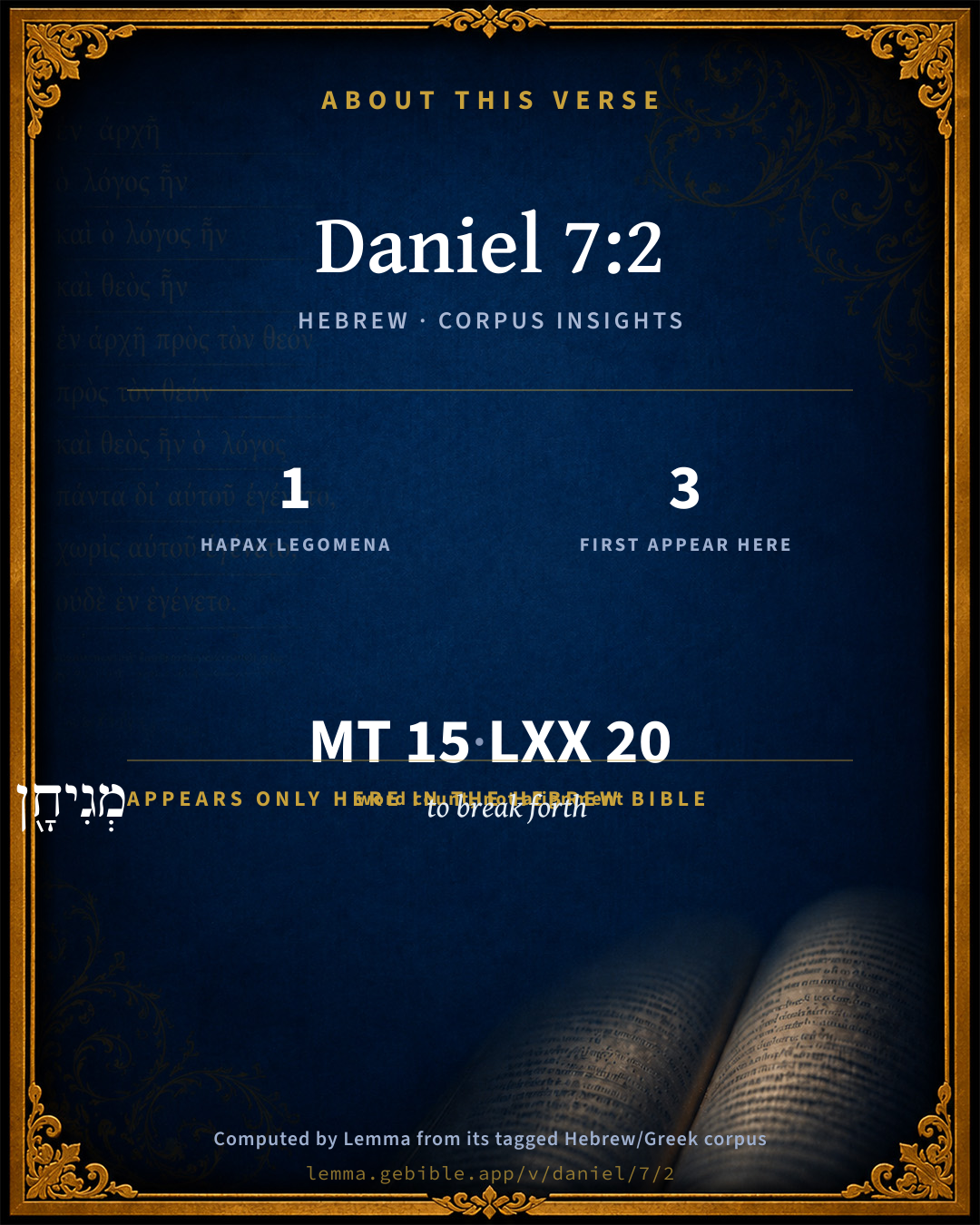
1 hapax legomenon — a word that appears only here in the entire Hebrew Bible:

  • מְגִיחָ֖ן to break forth H1519

First appearance in Scripture

These words make their first canonical appearance in the Hebrew Bible here:

  • וַאֲר֗וּ behold H718
  • מְגִיחָ֖ן to break forth H1519
  • לְיַמָּ֥א sea H3221

Shared distinctive vocabulary

לְיַמָּ֥א sea H3221 occurs in 2 verses of the Hebrew Bible. Also found in:

Grammatical profile

  • 1 verb
  • 1 noun
  • 8 adjectives
  • 5 particles

Verb forms

  • וְאָמַ֔ר Qal · Participle Active

Hebrew & Septuagint length

In English translation the verse runs 25 words from the Hebrew and 16 from the Septuagint (LXX English) — the Septuagint runs noticeably shorter here. See the side-by-side →

A rough comparison of the two English renderings, which tokenize alike — not a word-level alignment.

Word counts can differ between the Hebrew and the Greek without any difference in meaning — e.g. the Hebrew direct-object marker אֵת has no separate Greek word, and Greek often adds the article ὁ.

In the original languages it is 15 Hebrew tokens and 20 Greek tokens — but the two are counted differently (Hebrew bundles its prefixes and suffixes into one token; the Greek is in lemma form), so that isn’t a like-for-like length.

Cross-references

2

Topical passages linked to Daniel 7:2 in the Treasury of Scripture Knowledge — connected by theme and wording, ordered by reader-vote popularity; previews shown in the World English Bible.

  • Revelation 7:1 After this, I saw four angels standing at the four corners of the earth, holding the four winds of the earth, so that no wind would blow on the earth, or on the sea, or on any tree.
  • Revelation 17:15 He said to me, "The waters which you saw, where the prostitute sits, are peoples, multitudes, nations, and languages.

Cross-references courtesy of OpenBible.info (CC BY 4.0).

Hebrew and Greek witnesses Masoretic Hebrew ↔ Greek Septuagint

The same verse in the two great witnesses to the Old Testament, shown verse-for-verse.

Here the Septuagint runs noticeably shorter than the Hebrew — LXX2012 (modern English Septuagint) 16 words vs World English Bible 25. A rough length comparison of the two English translations, not a word-level alignment — read both below.

These are two independent witnesses, not word-aligned to each other, and the Septuagint is shown in lemma (dictionary) form.

Hebrew Daniel 7:2 Masoretic · Westminster Leningrad Codex

עָנֵ֤ה דָנִיֵּאל֙ וְאָמַ֔ר חָזֵ֥ה הֲוֵ֛ית בְּחֶזְוִ֖י עִם לֵֽילְיָ֑א וַאֲר֗וּ אַרְבַּע֙ רוּחֵ֣י שְׁמַיָּ֔א מְגִיחָ֖ן לְיַמָּ֥א רַבָּֽא

Daniel spoke and said, I saw in my vision by night, and, behold, the four winds of the sky broke forth on the great sea.

World English Bible · Public Domain

Greek LXX Daniel 7:2 Septuagint · lemma form

ἐπί ὁ κοίτη ἐγώ θεωρέω κατά ὕπνος νύξ καί ἰδού τέσσαρες ἄνεμος ὁ οὐρανός ἐνπίπτω εἰς ὁ θάλασσα ὁ μέγας

I Daniel looked, and, behold, the four winds of heaven blew violently upon the great sea.

LXX2012 (modern English Septuagint) · Public Domain

On this verse, The Cambridge Bible for Schools and Colleges discusses the Septuagint’s reading. Read the note in Commentary ↓

Hebrew: Westminster Leningrad Codex (CC BY 4.0). Greek: Septuagint (public domain); English from LXX2012 (modern English Septuagint) (Public Domain). How the Septuagint differs from the Hebrew →

Commentary

Notes on Daniel 7:2 from classic Christian and Jewish commentators (each source and its license shown beneath its notes). The classic Christian expositions comment on the surrounding passage and are grouped to its opening verse, so a note may address several verses; the Jewish commentaries on the Tanakh (Rashi and others) are per-verse, so they appear only where the commentator wrote on this verse.

Lemma curates 59 commentaries, every one of them public domain or Creative Commons licensed, each selected and text-cleaned for this edition rather than reprinted as found. About our sources →

Trapp's Complete Commentary

John Trapp

Dan 7:2 Daniel spake and said, I saw in my vision by night, and, behold, the four winds of the heaven strove upon the great sea.

Ver. 2. Daniel spake and said.] His writing is called his speaking, to teach us to receive the writings of the prophets and apostles with no less reverence than if we had heard them speak with their own mouths. {a}

I saw in my vision by night.] The night doth in Scripture frequently signify trouble. This "vision by night" was of troublesome businesses - viz., hurlyburlies in the world, and persecutions in the Church.

And behold the four winds of the heavens strove upon the great sea,] i.e., There was a huge bustle upon the earth, by means of the four successive monarchies. See Rev 13:1; Rev 13:11. The world is fitly called the "great sea," ever unquiet and full of commotions; which are also called "winds" for their boisterousness, contrariety of nature, and inconstance.

{a} Willet.

John Trapp, A Commentary or Exposition upon All the Books of the Old and New Testament (1647–1656) — public domain. Text from a community e-Sword module.

The Biblical Illustrator

Joseph S. Exell

Dan_7:2-3

I saw in my vision by night.

Modes of Communication with God

Since the days of the apostles, the intercourse between Heaven and earth has been maintained through the ordinary channels. God speaks to man through the medium of his conscience--in the Bible, and by the operation of His providence. These are now the appointed means whereby we are to ascertain a knowledge of our duty. Not that our Heavenly Father is less desirous of guiding us into the path of truth, or that we, His children are more abandoned to the perils of the world than were the people of His inheritance in a former age; but the ransom of our souls having been effected through the meritorious sacrifice of the Son of God, the Saviour, having ascended into glory and received gifts for men; and instruction, accompanied with the most cheering promises, adapted to the case of every individual, having been imported in the canon of Scripture, the Deity has withdrawn Himself from holding a more immediate communion with His creatures, leaving us, not to ourselves, but to the influence of those aids which He has provided. Though visible conferences have ceased between the inhabitants of this world and their omnipresent Creator, we are still under Divine control, and derive our guidance, our strength, and our comfort from on high. The ancient seers were instructed in different ways. Some were endowed with the gift of prophecy by the action of the Holy Spirit upon the mind, illumining the understanding, and conveying to the person so inspired the requisite acquaintance with events not yet accomplished. Angels were also employed to unfold to men the designs of the Almighty. Daring the ages of prophecy, dreams appear to have been frequently of a supernatural order, and highly significant of some important circumstance. (Charles Popham Miles, B.A.)

The Biblical Illustrator, edited by Joseph S. Exell (c. 1880s–1900s) — public domain. Text from a community e-Sword module.

Joseph Benson's Commentary

Dan 7:2-3. Behold, the four winds strove upon the great sea — This denotes those commotions in the world, and that troublesome state of affairs, out of which empires and kingdoms commonly take their rise. And four great beasts came up from the sea — Signifying the four great monarchies, or kingdoms, that should successively arise in the world, and have their origin from wars and commotions, which generally end in setting up the conqueror to be a great monarch over those whom he hath subdued: compare Rev 13:1. The reason why these monarchies, which were represented to Nebuchadnezzar in the form of a great image, formed of gold and silver, brass and iron, are here exhibited by fierce and savage beasts, has been observed in the note on Dan 2:31.

Joseph Benson's Commentary on the Old and New Testaments (1811–1818) — public domain. Text from a community e-Sword module.

Keil & Delitzsch

C. F. Keil & F. Delitzsch

With Dan 7:2 Daniel begins his written report: "Daniel began and said," introduces the matter. חזוי עם־ליליא, visions in (during) the night, cf. Dan 2:19. Dan 7:2 and Dan 7:3 describe the scene in general. The four winds of heaven break loose upon the great sea, and rage fiercely, so that four great beasts, each diverse from the others, arise out of its bosom. The great sea is not the Mediterranean (Berth., Ges., Hitz., Ewald), for such a geographical reference is foreign to the context. It is the ocean; and the storm on it represents the "tumults of the people," commotions among the nations of the world (Hv., Leng., Hofm., etc.), corresponding to the prophetic comparison found in Jer 17:12; Jer 46:7. "Since the beasts represent the forms of the world-power, the sea must represent that out of which they arise, the whole heathen world" (Hofmann). In the interpretation of the image (Dan 7:17) יגּמא מן is explained by ארעא מן. גּיח means to break forth (Eze 32:2), to burst out in storm, not causative, "to make the great sea break forth" (Kran.). The causative meaning is not certainly found either in the Hebrew or the Chaldee. The four winds stand in relation to the four quarters of the heavens; cf. Jer 49:39. Calvin remarks: Mundus similis turbulento mari, quod non agitatur una procella vel uno vento, sed diversis ventis inter se confligentibus, ac si totum coelum conspiraret ad motus excitandos. With this, however, the meaning of the words is not exhausted. The four winds of heaven are not merely diversi venti, and their bursting forth is not only an image of a general commotion represented by a storm in the ocean. The winds of the heavens represent the heavenly powers and forces by which God sets the nations of the world in motion; and the number four has a symbolical meaning: that the people of all regions of the earth are moved hither and thither in violent commotion. "(Ecumenical commotions give rise to oecumenical kingdoms" (Kliefoth). As a consequence of the storm on the sea, there arise out of it four fierce beasts, not all at once, but, as Dan 7:6 and Dan 7:7 teach, one after another, and each having a different appearance. The diversity of the form of the beasts, inasmuch as they represent kingdoms, is determined beforehand, not only to make it noticeable that the selection of this symbol is not arbitrary but is significant (Hvernick), but emphatically to intimate that the vision of different kingdoms is not to be dealt with, as many interpreters seem inclined to do, as one only of different kings of one kingdom.

Keil & Delitzsch — Biblical Commentary on the Old Testament (1861–1891) — public domain (CC PDM 1.0). Text via the HelloAO Bible API. (Old Testament only.)

Tyndale Open Study Notes

Tyndale Open Resources

7:2 The sea is an image of evil or chaos in the Old Testament (see Ps 89:10; Isa 5:30; 57:20), as it was throughout the ancient Near East.

Tyndale Open Study Notes — © Tyndale Open Resources, licensed CC BY-SA 4.0. Text via the HelloAO Bible API.

Geneva Bible (1599)

Geneva Bible translators

Which signified that there should be horrible troubles and afflictions in the world in all corners of the world, and at sundry times.

Geneva Bible (1599) marginal notes — public domain. Text via Bolls.life.

Jamieson, Fausset & Brown

Robert Jamieson, A. R. Fausset & David Brown

the four winds--answering to the "four beasts"; their several conflicts in the four quarters or directions of the world.

strove--burst forth (from the abyss) [MAURER].

sea--The world powers rise out of the agitations of the political sea (Jer 46:7-8; Luk 21:25; compare Rev 13:1; Rev 17:15; Rev 21:1); the kingdom of God and the Son of man from the clouds of heaven (Dan 7:13; compare Joh 8:23). TREGELLES takes "the great sea" to mean, as always elsewhere in Scripture (Jos 1:4; Jos 9:1), the Mediterranean, the center territorially of the four kingdoms of the vision, which all border on it and have Jerusalem subject to them. Babylon did not border on the Mediterranean, nor rule Jerusalem, till Nebuchadnezzar's time, when both things took place simultaneously. Persia encircled more of this sea, namely, from the Hellespont to Cyrene. Greece did not become a monarchy before Alexander's time, but then, succeeding to Persia, it became mistress of Jerusalem. It surrounded still more of the Mediterranean, adding the coasts of Greece to the part held by Persia. Rome, under Augustus, realized three things at once--it became a monarchy; it became mistress of the last of the four parts of Alexander's empire (symbolized by the four heads of the third beast), and of Jerusalem; it surrounded all the Mediterranean.

Jamieson, Fausset & Brown — Commentary Critical and Explanatory on the Whole Bible (1871) — public domain (CC PDM 1.0). Text via the HelloAO Bible API.

Adam Clarke's Commentary

Verse 2. The four winds of the heaven strove upon the great sea] The idea of strife is taken here from the effects that must be produced, were the east, the west, the north, and the south winds to rise tempestuously, and meet on the surface of the sea. By the great sea, the Mediterranean is meant; and is so called to distinguish it from those lakes called seas by the Hebrews; such as the Sea of Galilee, Dead Sea, Sea of Tiberias, c. but even that may refer to Asia, the scene of all these contentions. This dream is the same in meaning, under different emblems, as that of Nebuchadnezzar's metallic image; but in Daniel's dream several circumstances are added. It is supposed that Daniel had this dream about forty-eight years after Nebuchadnezzar had the vision of the great image.

Adam Clarke's Commentary on the Bible (1810–1826) — public domain. Text from a community e-Sword/MySword module.

John Calvin's Commentaries

He repeats again, He saw in his vision during the night. Again, I say, Daniel affirms that he brought forward nothing but what God had authoritatively delivered to him. For we know that in the Church all human traditions ought to be treated as worthless, since all men’s wisdom is vanity and lies. As God alone deserves to be listened to by the faithful, so Daniel here asserts that he offers nothing of his own by dreaming: in the ordinary way, but, that the vision is sure, and such as cannot deceive the pious.

He afterwards adds, Behold! the four winds of heaven fought in a great sea. I much prefer this rendering. Interpreters differ respecting the winds, but the genuine sense appears to be this; Daniel assumes a simile universally known, for on solid ground any such turbulent concussion is seldom heard of as at sea, when any mighty tempest arises. Without doubt, he here proposes the image of a raging sea to warn the faithful against dreadful commotion at hand, just as, if the sea were agitated with storms and raging with tempests on all sides. This is the meaning of the phrase. Hence he names four winds, to show the faithful how the motion which should shatter the globe should not be single and simple, but that various storms should arise together on all sides — exactly as it happens. We may’ sometimes see the earth moved just as if a tempest were, tossing about the sea in all directions, but the motion will yet be single. But God wished to show his Prophet not only a simple concussion, but many and different ones, just as if all the winds were to, meet in one general conflict. Philosophers, indeed, enumerate more winds than four when they desire to treat of the number with precision, but it is the common phrase to speak of four winds blowing from the four quarters or regions of the globe. The sense, however, is clear and by no means forced — the world being like a troubled sea, not agitated by a single storm or wind, but by different conflicting blast., as if the whole heavens conspired to stir up commotion’s. This vision at the first glance was very bitter to the faithful, because they counted the years prescribed to them by Jeremiah; the seventieth year was now at hand, and God had then promised them an end of their troubles. Now God announces that they must not indulge in the hope of rest and joy, but rather prepare themselves for sustaining the rush of the fiercest winds, as the world would be everywhere agitated by different storms. They might perhaps suspect God of not performing his promises, but this ought, to be sufficient for appeasing their minds and propping them up with the hope of redemption, when they saw nothing happen either rashly or by chance. Again God came to meet their temptations lest their courage should fail, by teaching them that the method of their redemption was not quite so easy as they had previously conceived from former predictions. God indeed had not changed his plans, for although a long period had elapsed since he spoke by Isaiah and the other prophets, yet he wished to prepare the Jews against delay, lest it should break down the courage which would be required to meet such great afflictions. But when redemption really approached, then God explained its method more fully and familiarly, and showed how great and severe were the remaining struggles. Hence the faithful, instructed by such prophecies, would contend strenuously and yet proceed constantly in their course of faith and patience. It now follows, —

John Calvin's Commentaries (1540-1563) — public domain. Text from the Calvin Translation Society English edition (1840s-50s) via the Christian Classics Ethereal Library (ccel.org). Calvin's coverage is partial (roughly two-thirds of the Bible); uncommented books and verses are honest gaps, never fabricated. The 19th-century editor's footnotes and remarks are omitted so the notes are faithfully Calvin's own voice.

Ellicott's Commentary for English Readers

(2) The great sea.—In general (e.g., Jos_15:47), these words imply the Mediterranean. Such cannot be the meaning here, so that according to Dan_7:17 we are justified in explaining the “sea” to mean the nations of the world, which are compared to the sea (Isa_27:1; Psa_46:3). The raging of the winds from the four quarters of the sky points to the various political and social agitations which disturb the world’s history, and lead to the changes and revolutions which mark its progress as it tends towards the end.

A Bible Commentary for English Readers, edited by Charles John Ellicott (1878–1897) — public domain. Text from a community e-Sword module.

The Cambridge Bible for Schools and Colleges

gen. ed. J. J. S. Perowne

2. Daniel answered and said, I saw] properly, I was seeing (or beholding), as Dan_4:10; Dan_4:13 : so Dan_7:4; Dan_7:6-7; Dan_7:9; Dan_7:11 (twice), 13, 21. LXX. and Theod. rightly render by ἐθεώρουν.

the four winds of the heaven] The same expression, Dan_8:8, Dan_11:4; Zec_2:6; Zec_6:5; 2Es_13:5.

strove upon] were breaking forth (see Jdg_20:33 Heb.) on to, creating a great disturbance of the waters. A.V. strove is to be explained from the sense which the word has in the Targums. The root means to break or burst forth, of water (as Job_38:8); but in the Targums it is common, in the conjug. here used, in the sense of to wage war, lit. to cause war to break forth, as Deu_20:4, and even with ‘war’ omitted, Jos_23:3 al.; hence strove. However, the prep. which here follows does not mean upon, but to.

the great sea] a name of the Mediterranean Sea, Jos_1:4; Jos_9:1 al. However, that sense is not to be pressed here; the ‘great sea,’ tossed up by the four winds of heaven, symbolizes the agitated world of nations (cf. Dan_7:3 with Dan_7:17; and comp. Rev_17:15 : also Isa_17:12).

The Cambridge Bible for Schools and Colleges (gen. ed. J. J. S. Perowne; Cambridge University Press, 1878–1918) — public domain. Text from a community e-Sword module.

John Gill's Exposition

Daniel spake and said, I saw in my vision by night,.... He declared he had had a vision by night, and this was the substance of it:

and, behold, the four winds of the heaven strove upon the great sea: the east, west, north, and south winds, broke out from each of their quarters, and rushed in upon the great sea; either the Mediterranean, so called in comparison of the sea of Sodom, and the sea of Tiberias in Judea; or upon the waters of the main ocean, and raised up its waves, and seemed as it were to be striving and fighting with them, and put them into a strange agitation; by which may be meant the whole world, and the kingdoms and nations of it, because of its largeness, inconstancy, instability, and disquietude; see Rev 17:15, and by the "four winds" some understand the angels, either good or bad, concerned in the affairs of Providence on earth, either by divine order or permission; or rather the kings of the earth raising commotions in it, striving and fighting with one another, either to defend or enlarge their dominions; and which have been the means in Providence of the rising up of some great state or monarchy, as after appears.

John Gill's Exposition of the Whole Bible (1746–1763) — public domain (CC PDM 1.0). Text via the HelloAO Bible API.

Albert Barnes' Notes on the Bible

Daniel spake and said - That is, he spake and said in the manner intimated in the previous verse. It was by a record made at the time, and thus he might be said to speak to his own generation and to all future times.

I saw in my vision by night - I beheld in the vision; that is, he saw represented to him the scene which he proceeds to describe. He seemed to see the sea in a tempest, and these monsters come up from it, and the strange succession of events which followed.

And behold, the four winds of the heaven - The winds that blow under the heaven, or that seem to come from the heaven - or the air. Compare Jer 49:36. The number of the winds is here referred to as four as they are now, as blowing mainly from the four quarters of the earth. Nothing is more common now than to designate them in this manner - as the east, the south, the west, the north wind. So the Latins - Eurus, Auster, Zephyrus, Boreas.

Strove - מגיחן megı̂ychân. Burst, or rushed forth; seemed to conflict together. The winds burst, rushed from all quarters, and seemed to meet on the sea, throwing it into wild commotion. The Hebrew word (גיח gı̂yach) means to break or burst forth, as a fountain or stream of waters, Job 40:23; an infant breaking forth from the womb, Job 38:8; a warrior rushing forth to battle, Eze 32:2. Hence, the Chaldean to break forth; to rush forth as the winds. The symbol here would naturally denote some wild commotion among the nations, as if the winds of heaven should rush together in confusion.

Upon the great sea - This expression would properly apply to any great sea or ocean, but it is probable that the one that would occur to Daniel would be the Mediterranean Sea, as that was best known to him and his contemporaries. A heaving ocean - or an ocean tossed with storms - would be a natural emblem to denote a nation, or nations, agitated with internal conflicts, or nations in the midst of revolutions. Among the sacred poets and the prophets, hosts of armies invading a land are compared to overflowing waters, and mighty changes among the nations to the heaving billows of the ocean in a storm. Compare Jer 46:7-8; Jer 47:2; Isa 8:7-8; Isa 17:12; Isa 59:19; Dan 11:40; Rev 13:1. The classic reader will be reminded in the description here of the words of Virgil, AEn. I. 82, following:

“Ac venti, velut agmine facto

Qua data porta ruunt, et terras turbine perflant.

Incubuere mari, totumque a sedibus imis

Una Eurusque, Notusque ruunt, creberquc procellis.

Africus, et vastos volvunt ad littora fluctus.”

Compare also Ovid, Trist. I. 2, 25, following. It was from this agitated sea that the beasts that Daniel saw, representing successive kingdoms, seemed to rise; and the fair interpretation of this part of the symbol is, that there was, or would be, as it appeared in vision to Daniel, commotions among the nations resembling the sea driven by storms, and that from these commotions there would arise successive kingdoms having the characteristics specified by the appearance of the four beasts. We naturally look, in the fulfillment of this, to some state of things in which the nations were agitated and convulsed; in which they struggled against each other, as the winds strove upon the sea; a state of things which preceded the rise of these four successive kingdoms. Without now pretending to determine whether that was the time denoted by this, it is certain that all that is here said would find a counterpart in the period which immediately preceded the reign of Nebuchadnezzar, or the kingdom which he founded and adorned. His rapid and extensive conquests; the agitation of the nations in self-defense, and their wars against one another, would be well denoted by the agitation of the ocean as seen in vision by Daniel. It is true that there have been many other periods of the world to which the image would be applicable, but no one can doubt that it was applicable to this period, and that would be all that would be necessary if the design was to represent a series of kingdoms commencing with that of Nebuchadnezzar.

Albert Barnes' Notes on the Bible (1834–1885) — public domain. Text from a community e-Sword/MySword module.

Haydock's Catholic Bible Commentary

Winds, to imply the tumults occasioned by fresh kingdoms (Worthington) in the world. (Theod.)

George Leo Haydock (1774–1849), Haydock's Catholic Family Bible and Commentary, 1859 edition — public domain. Excludes Psalms (Douay-Rheims chapter numbering differs from Protestant) and Deuterocanonical books (Catholic canon only).

Matthew Poole's English Annotations

Because Daniel doth not expound what is meant by

winds, expositors think there is room left for every one’s conjecture; wherein this seems most likely, that by the four winds of the great sea is signified commotions of contrary nations and factions, striving together by wars, and producing these four beasts successively. That this is often signified by winds, see Jer 49:36; 51:1; in the destruction of Babylon, the first monarchy; and of Elam, i.e. the Persian monarchy.

The great sea in Scripture is the Mediterranean Sea, called now the Levant, Archipelago, Straits, &c.

1. Comparatively; for the people called lakes seas, as the sea of Galilee, Gennesareth, Cinneroth, the Dead Sea, or lake of Sodom; but the Mediterranean was

Jamma rabba, the great sea, for its length and breadth, above all the lakes put together, though it be itself but a lake in comparison of the Atlantic and Indian Oceans.

2. Great sea, because the great stage of action hath been on it, and adjoined to it; and all the four great monarchies have been masters of it.

3. Allegorically, for it is usual in Scripture to compare people to waters, and nations to seas, Rev 13:1; 17:15; called so from the confused noise of it, Rev 19:6, and from the unstableness of them, always running and rolling with every wind as it blows, endangering those that ride upon the backs of its swelling waves.

Matthew Poole's English Annotations on the Holy Bible (1683–1685) — public domain. Text from a community e-Sword/MySword module.

Whedon's Commentary on the Bible

Daniel D. Whedon

2, 3. The four winds of the heaven [for the numerical symbolism see Introduction to Ezekiel, VIII] strove (literally, burst forth) upon the waters of the Mediterranean (Eze_47:10) — the great international ocean of the ancients, and therefore symbolic of all the imperial powers “of the earth” (Dan_7:17, and compare Isaiah 17; Psa_65:7) — and out of this boiling tempest the prophet sees in vision each savage empire thrown up upon the shore (Dan_7:4) in the form of a hideous wild beast (compare Isa_17:1; Isa_29:3; Isa_51:19; Eze_17:3; Eze_29:3; Rev_13:1); each beast as diverse from the others as the kingdom which it represented was different. What a sublime stage and scenery for this sublimest “epic of history”!

Daniel D. Whedon (gen. ed.), Commentary on the Old and New Testaments (1874–1909) — public domain. Text from a community e-Sword module.

The Pulpit Commentary

Daniel spake and said, I saw in my vision by night, and, behold, the four winds of the heaven strove upon the great sea. The Septuagint omits the introductory clause, and renders, "On my couch I saw in my night-sleep, and, behold, the four winds of heaven fell upon the great sea." Theodotion, like the LXX, omits the introductory clause, and renders, "I Daniel beheld, and, lo, the four winds of the heaven rushed upon (prosebalon) the great sea." The Peshitta seems as if transferred from the Massoretic text, the resemblance is so close. The variations in the Greek Version may be due to condensation of a fuller narrative. The verb translated "strove" in our Authorized Version is better rendered, as in the Revised, "brake forth upon." Luther"s version is, "sturmeten wider einander." This, like the Authorized Version, seems to be the result of the Vulgate pugnabant. The only objection to this is that it ought to be followed by a preposition (Bevan). The translation suggested by Levy, "stirred up," appears still better. The sea referred to is naturally to be taken as the Mediterranean; it is "the great sea" of the prophets. (Eze_47:10) Jerusalem is not so far from the sea but that Daniel might have seen it in his boyhood. The symbolic meaning of the sea is the mass of heathen nations. (Psa_65:7) The "four winds of heaven" usually stand for the points of the compass. (Jer_49:34) Here, however, the winds are pictured as actual forces dashing down upon the sea, and stirring it up to its depths. It may be objected that this is an impossible picture. It might be replied that Virgil, in the first book of the "AEneid," 84-86, and Milton, in "Paradise Regained," has the same thing. Daniel has more freedom, for he narrates a vision, and, further, to him the winds (rucheen) were under the guidance of angels. Hitzig denies that the winds can be angelicae potestates, as Jerome maintains; and, when Jerome supports his position by a quotation from the Septuagint Version of Deu_32:8, gives as answer a mark of exclamation. The passage, "He set the nations according to the number of the angels of God," represents a phase of thought in regard to angelology, which Daniel elsewhere obviously has. The double meaning of the word ruach made the transition easy. We see the same double meaning in Zec_6:5. The sea, then, is to be regarded as the great mass of Gentile nations, and the winds are, therefore, the spiritual agencies by which God carries on the history of the world. As there are four winds, there are also four empires. There are angelic princes of at least two of these empires referred to later. May we not argue that these empires had, according to the thought of Daniel, each an angelic head? It may be doubted whether the most advanced critics know more of angelology than Daniel, or can be certain that his view was a mistaken one. Moreover, the Mediterranean Sea was the centre round which the epic of history, as revealed to Daniel, unfolded itself. Nebuchadnezzar marched along the eastern shores of that midland sea; the Persian monarchs essayed to command it by their fleets; across a branch of that sea came Alexander; and from yet further across its blue waters came the Romans. The Mediterranean saw most of the history transacted that took place between the time of Daniel and that of our Lord.

The Pulpit Commentary (1880–1919), ed. H.D.M. Spence-Jones & Joseph S. Exell — public domain. Text from a community e-Sword module.

John Wesley's Explanatory Notes

The four winds - Probably by the four winds of the great sea is signified commotions of contrary nations, striving together by wars, and producing these four beasts successively.

John Wesley, Explanatory Notes Upon the Whole Bible (1754–1765) — public domain. Text via the GEBible commentary corpus.

Scofield Reference Notes

C. I. Scofield

great sea

The "sea" in Scripture imagery stands for the populace, the mere unorganized mass of mankind Mat 13:47; Rev 13:1.

The Scofield Reference Bible (1917 edition), notes by C. I. Scofield — public domain. Text from a community e-Sword module.

Rashi

Rabbi Shlomo Yitzchaki (Rashi)

and behold [as translated,] and behold.

the four winds of the heavens were stirring up, etc. four blowing winds coming from the four directions of the world and waging war with the Great Sea and stirring it up.

Rashi on the Tanakh — English translations: “The Judaica Press complete Tanach with Rashi, translated by A. J. Rosenberg” (CC BY 4.0); “Pentateuch with Rashi's commentary by M. Rosenbaum and A.M. Silbermann, 1929-1934” (public domain); “The Metsudah Tanach series, Lakewood, N.J” (CC BY 4.0); and “The Book of Joshua, Metsudah Publications, 1997” (CC BY 4.0). Text via Sefaria.

Lesson kit

Teaching starters — assembled from the data on this page, not authored interpretation. Every prompt links to the verse data it draws on. Edit before teaching.

Daniel, in the Prophets, opens this verse with 15 words (15 distinct Hebrew lemmas). Its most distinctive word is gîyach (“to break forth”). The Greek Septuagint runs shorter here. A historical commentator’s framing appears above. Read the whole chapter for the surrounding context.

Discussion questions

  1. What does “to break forth” (gîyach) contribute to the verse as a whole?
  2. This verse holds 1 word here found nowhere else in the Hebrew Bible. What might the rare word draw attention to?
  3. 3 words here appear for the first time in Scripture. What is being introduced at this debut?
  4. Daniel 7:3 shares the word «sea» with this verse. How do the two illuminate each other?
  5. Compared with the Hebrew, the Septuagint runs shorter here. What questions does that raise?
  6. These translations render this verse differently; the difference is in the English rendering, not the original. What questions does that raise?
  7. The verb «וְאָמַ֔ר» is Qal Participle Active. How does its form color the action?
  8. Reading how Trapp's Complete Commentary and The Biblical Illustrator read this verse, where do the two commentators agree and where do they part?

Things to notice

Reading settings

Reading text

Shown beneath each verse's original-language words.

Old Testament
Old Testament edition

Read the OT as the Masoretic Hebrew (MT) or the Greek Septuagint (LXX).

English shown for the Greek Septuagint (in the Hebrew ↔ Greek comparison).

Comparing translations? Open the Compare panel on any verse page to stack up to four side by side.