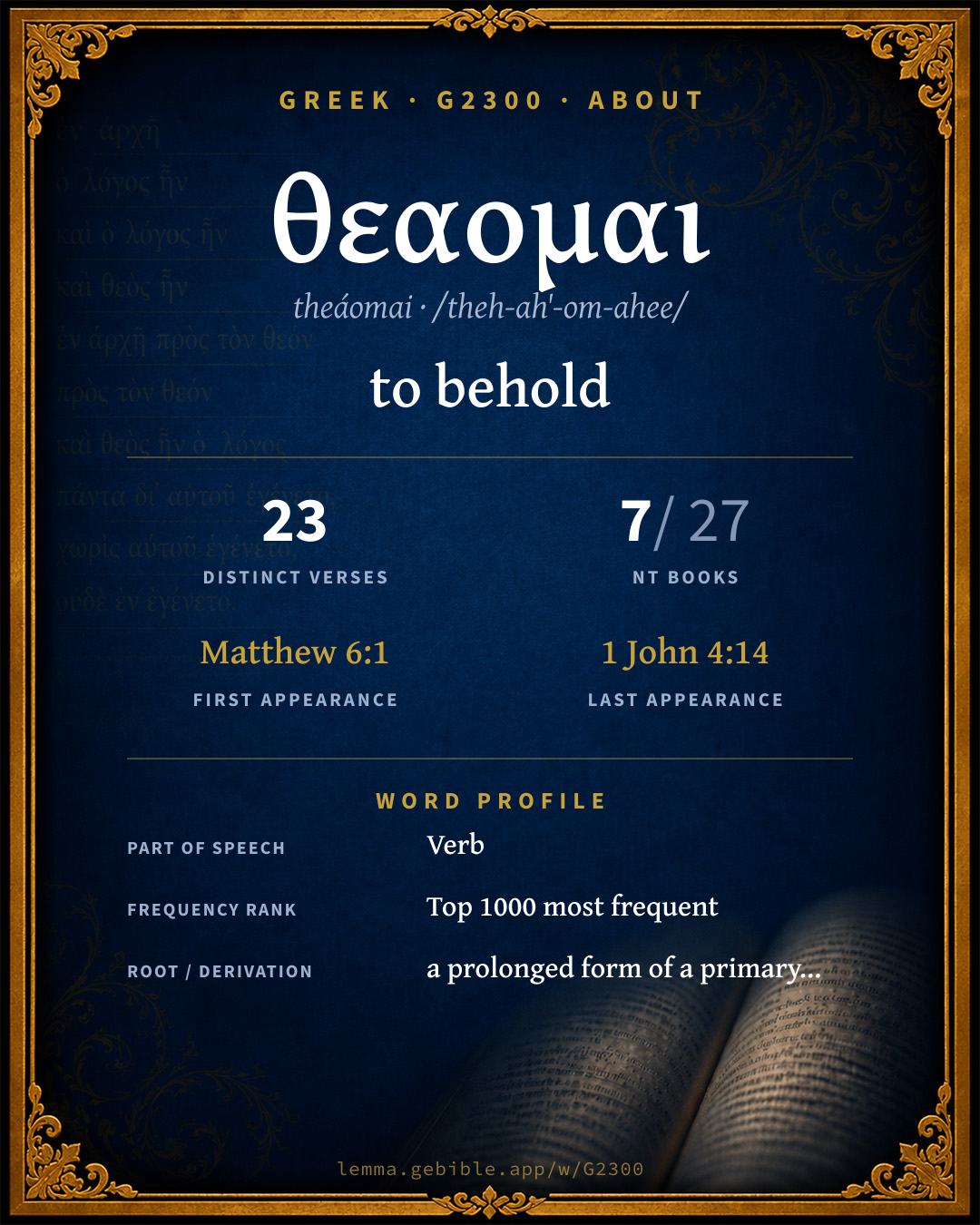
θεάομαι
to behold
also: look upon, view attentively, contemplate fuller range ↓
Full lexicon entry — Thayer's Greek Lexicon
From Thayer's Greek Lexicon
Where this word appears
See every Aorist-tense verb in the Greek New Testament →
Grammar key — what these labels mean
Part of speech
- Verb
- An action or state-of-being word.
Tense
- Aorist
- Action viewed as a simple whole, without regard to duration — often past (perfective aspect).
- Perfect
- A completed past action with continuing present results.
Voice
- Middle deponent
- Middle in form but active in meaning.
- Passive
- The subject receives the action.
- Middle or Passive deponent
- Middle/passive in form but active in meaning.
Mood
- Infinitive
- A verbal noun (“to write”), unmarked for person or number.
- Participle
- A verbal adjective (“writing,” “having written”).
- Indicative
- States a fact or asks a factual question (the mood of reality).
- Imperative
- Expresses a command or request.
Case
- Nominative
- The case of the subject (and the predicate nominative).
- Dative
- The case of the indirect object, means, or location — “to / for / with / in.”
Person
- 1st person
- The speaker (“I / we”).
- 3rd person
- The one spoken about (“he / she / it / they”).
- 2nd person
- The one addressed (“you”).
Gender
- Masculine
- Grammatically masculine.
Number
- Singular
- One.
- Plural
- More than one.
Grammatical forms 14 distinct
- Verb, Aorist, Middle deponent, Infinitive 4 times (17%)
- Verb, Aorist, Middle deponent, Participle, Nominative, Singular, Masculine 3 times (13%)
- Verb, Aorist, Middle deponent, Indicative, 1st person, Plural 2 times (9%)
- Verb, Aorist, Middle deponent, Indicative, 3rd person, Plural 2 times (9%)
- Verb, Aorist, Middle deponent, Participle, Nominative, Plural, Masculine 2 times (9%)
- Verb, Aorist, Passive, Infinitive 2 times (9%)
- Verb, Aorist, Middle deponent, Indicative, 2nd person, Plural 1 time (4%)
- Verb, Aorist, Middle deponent, Indicative, 3rd person, Singular 1 time (4%)
+6 more forms (6 occurrences)
Parsed forms decoded from the imported morphology (Robinson–Tischendorf, public domain), counted across 23 parsed occurrences — not distinct verses.
Every verse where G2300 appears — 23 distinct verses across 7 books. Click any verse to open its interlinear word-by-word view. Verse text shown in the World English Bible for context — . Each verse’s Greek form is shown with its reference; the English is not keyword-highlighted, since the data carries no word-level English alignment. Use “Compare translations” on any verse to read it across multiple English versions. This concordance covers the Greek New Testament; Septuagint (Greek Old Testament) occurrences of this word are not indexed here.
Matthew 4 verses
- Matthew 6:1 θεαθῆναι aor pass inf "Be careful that you don't do your charitable giving before men, to be seen by them, or else you have no reward from your Father who is in heaven.
- Matthew 11:7 θεάσασθαι aor mid.dep inf As these went their way, Jesus began to say to the multitudes concerning John, "What did you go out into the wilderness to see? A reed shaken by the wind?
- Matthew 22:11 θεάσασθαι aor mid.dep inf But when the king came in to see the guests, he saw there a man who didn't have on wedding clothing,
- Matthew 23:5 θεαθῆναι aor pass inf But all their works they do to be seen by men. They make their phylacteries broad, enlarge the fringes of their garments,
Mark 2 verses
- Mark 16:11 ἐθεάθη aor pass ind 3sg When they heard that he was alive, and had been seen by her, they disbelieved.
- Mark 16:14 θεασαμένοις aor mid.dep ptcp dat pl masc Afterward he was revealed to the eleven themselves as they sat at the table, and he rebuked them for their unbelief and hardness of heart, because they didn't believe those who had seen him after he had risen.
Luke 3 verses
- Luke 5:27 ἐθεάσατο aor mid.dep ind 3sg After these things he went out, and saw a tax collector named Levi sitting at the tax office, and said to him, "Follow me!"
- Luke 7:24 θεάσασθαι aor mid.dep inf When John's messengers had departed, he began to tell the multitudes about John, "What did you go out into the wilderness to see? A reed shaken by the wind?
- Luke 23:55 ἐθεάσαντο aor mid.dep ind 3pl The women, who had come with him out of Galilee, followed after, and saw the tomb, and how his body was laid.
John 7 verses
- John 1:14 ἐθεασάμεθα aor mid.dep ind 1pl The Word became flesh, and lived among us. We saw his glory, such glory as of the one and only Son of the Father, full of grace and truth.
- John 1:32 τεθέαμαι perf mid/pass.dep ind 1sg John testified, saying, "I have seen the Spirit descending like a dove out of heaven, and it remained on him.
- John 1:38 θεασάμενος aor mid.dep ptcp nom sg masc Jesus turned, and saw them following, and said to them, "What are you looking for?" They said to him, "Rabbi" (which is to say, being interpreted, Teacher), "where are you staying?"
- John 4:35 θεάσασθε aor mid.dep impv 2pl Don't you say, 'There are yet four months until the harvest?' Behold, I tell you, lift up your eyes, and look at the fields, that they are white for harvest already.
- John 6:5 θεασάμενος aor mid.dep ptcp nom sg masc Jesus therefore lifting up his eyes, and seeing that a great multitude was coming to him, said to Philip, "Where are we to buy bread, that these may eat?"
- John 8:10 θεασάμενος aor mid.dep ptcp nom sg masc Jesus, standing up, saw her and said, "Woman, where are your accusers? Did no one condemn you?"
- John 11:45 θεασάμενοι aor mid.dep ptcp nom pl masc Therefore many of the Jews, who came to Mary and saw what Jesus did, believed in him.
Acts 3 verses
- Acts 1:11 ἐθεάσασθε aor mid.dep ind 2pl who also said, "You men of Galilee, why do you stand looking into the sky? This Jesus, who was received up from you into the sky will come back in the same way as you saw him going into the sky."
- Acts 21:27 θεασάμενοι aor mid.dep ptcp nom pl masc When the seven days were almost completed, the Jews from Asia, when they saw him in the temple, stirred up all the multitude and laid hands on him,
- Acts 22:9 ἐθεάσαντο aor mid.dep ind 3pl "Those who were with me indeed saw the light and were afraid, but they didn't understand the voice of him who spoke to me.
Romans 1 verse
1 John 3 verses
- 1 John 1:1 ἐθεασάμεθα aor mid.dep ind 1pl That which was from the beginning, that which we have heard, that which we have seen with our eyes, that which we saw, and our hands touched, concerning the Word of life
- 1 John 4:12 τεθέαται perf mid/pass.dep ind 3sg No one has seen God at any time. If we love one another, God remains in us, and his love has been perfected in us.
- 1 John 4:14 τεθεάμεθα perf mid/pass.dep ind 1pl We have seen and testify that the Father has sent the Son as the Savior of the world.
About this entry
At a glance — auto-summarized from this page’s data, not written by a person. Every figure links to its source below. This summary describes the numbers; it doesn’t interpret them.
At its core, θεαομαι (theáomai) means “to behold.” It first appears in Matthew 6:1. Spanning 23 verses in 7 books, it ranks among the uncommon words of the Greek New Testament. Its uses concentrate in John (30% of all occurrences). Ranging over 3 senses, its meaning includes “look upon”, “view attentively”, and “contemplate”. Each statement above links to its evidence; the full detail follows below.
Gloss history
Strong's 1890 vs modern scholarship
About this word
Strong's G2300 catalogs a Greek word from the Greek New Testament.
These counts are not copied from any lexicon or concordance. They are computed here, from the morphology-tagged Greek New Testament. What Lemma adds →
- 23
- distinct verses
- The word appears in 23 distinct verses.
- 7 / 27
- NT books
- The word appears in 7 of 27 New Testament books.
- #563
- by frequency
- Top 1000 most frequent Greek words (rank 563 of 5,347 Greek words by occurrence).
View all 23 occurrences in the concordance →
By section of the New Testament
By traditional corpus
Conventional, traditional groupings — biblical authorship is debated, so this is a traditional corpus grouping, not an authorship claim. Some books belong to more than one corpus (Luke is in both the Gospels and the Lukan corpus, and so on), so these shares overlap and need not total 100%. Each figure is a share of the word’s 23 distinct verses.
- Gospels 16 verses · 70%
- Johannine 10 verses · 43%
- Lukan (Luke–Acts) 6 verses · 26%
- General (Catholic) Epistles 3 verses · 13%
- Pauline corpus 1 verse · 4%
How translations render this word
Counts come from each version’s own published word-to-Strong’s tagging or interlinear alignment — an approximate guide to how each version renders this word, not a word-level alignment the data otherwise carries. Because each total is that version’s own tagged count, the per-version totals vary from one another and need not match the appearance or distinct-verse counts above. These counts may also differ from a printed concordance because Lemma counts each distinctly tagged rendering and does not collapse phrase taggings into a single head-word total. This is a fixed set of word-tagged versions (KJV, ASV, BSB, ULT) and does not change with the reading translation you choose elsewhere. Each version’s license is shown beside its name below (and on Sources).
- King James Version: Saw 6×, See 4×, Had seen 2×
- American Standard Version: Beheld 5×, Behold 3×, Be seen 2×
- Berean Standard Bible: Saw 5×, See 5×, Had seen 2×
- unfoldingWord Literal Text: Having seen 4×, See 4×, Saw 3×
King James Version Public Domain
Renders G2300 across 23 tagged occurrences — most commonly:
Plus 11 renderings that appear only once — usually multi-word phrases or single function words the recovered tagging swept in, not distinct renderings. Not rendered by a distinct English word in 1 further occurrence.
American Standard Version Public Domain
Renders G2300 across 22 tagged occurrences — most commonly:
Plus 10 renderings that appear only once — usually multi-word phrases or single function words the recovered tagging swept in, not distinct renderings.
Berean Standard Bible Public Domain
Renders G2300 across 22 tagged occurrences — most commonly:
Plus 10 renderings that appear only once — usually multi-word phrases or single function words the recovered tagging swept in, not distinct renderings.
unfoldingWord Literal Text CC BY-SA 4.0
Renders G2300 across 23 tagged occurrences — most commonly:
Plus 10 renderings that appear only once — usually multi-word phrases or single function words the recovered tagging swept in, not distinct renderings.
Senses in Thayer's
The 3 senses Thayer's distinguishes for this word, in lexicon order (not ranked by frequency or importance). The full entry — with sub-senses — is in the Lexicon Entry tab.
- to behold, look upon, view attentively, contemplate (often used of public shows)
- in the sense of visiting, meeting with a person
- to learn by looking, to see with the eyes, to perceive
Word origin
Origin: a prolonged form of a primary verb
A prolonged form of a primary verb; to look closely at that is (by implication) to perceive (literally or figuratively); by extension to visit : - behold look (upon) see. Compare G3700 .
— Strong’s Exhaustive Concordance (1890), public domain.
Forms in the corpus
The 14 distinct written forms G2300 takes in the Greek New Testament, most frequent first — each parse links to that tense’s occurrences in the concordance.
Same root — word family
Other Thayer's entries built from the same root as G2300, grouped by Strong’s listed origin. These share a root / origin per the lexicon — not necessarily a shared meaning. Each links to that word’s own entry.
Derived from this word
Compare all same-root words → They share a root, not necessarily a meaning.
Septuagint usage
The same Greek word θεαομαι appears 1 time in the Greek Old Testament (Septuagint), across 1 verse in 1 book.
- 1
- LXX occurrences
- Tagged occurrences of this Greek word in the Septuagint.
- 1
- verse
- Distinct Septuagint verses containing this word.
- 1 / 39
- OT books
- The word appears in 1 of the 39 Old Testament books.
Sample Septuagint occurrences
- 2 Chronicles 22:6 θεάομαι
Septuagint occurrences (same lexeme)
Every verse where the same Strong’s number (G2300) appears in the Greek Septuagint. Verse text shown in the World English Bible for context; the Greek form is the matched word — the English is not keyword-highlighted.
These are occurrences of the same Greek lexeme (G2300) in the Septuagint — not a translation of any one Hebrew word. The store carries no word-level Hebrew↔Greek alignment, so no Hebrew original is asserted here. Counts come from the recovered LXX Strong's tagging — high-frequency vocabulary is well covered, while rare or late forms may be untagged — so they reflect tagged occurrences and may slightly undercount.