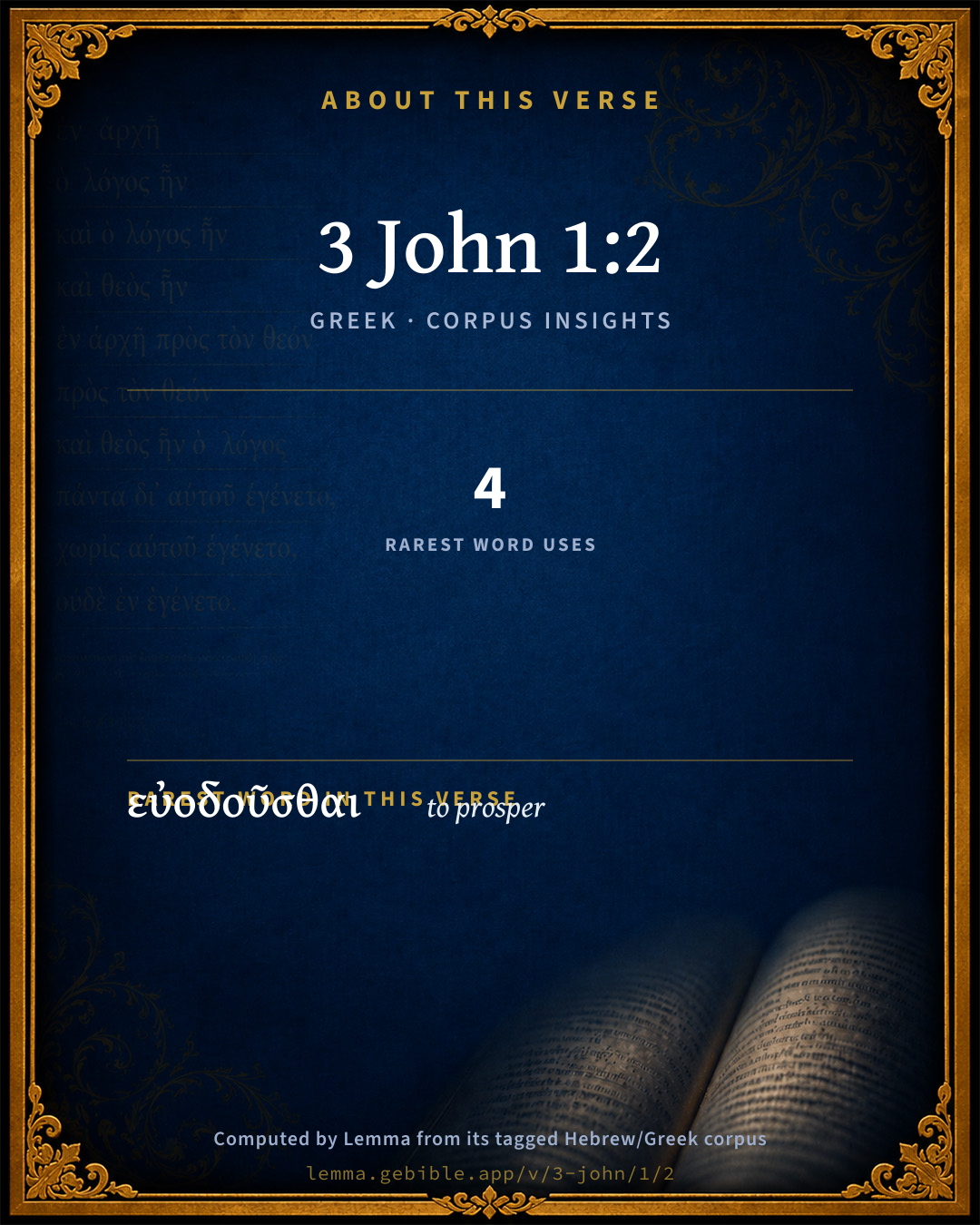
3 John 1:2

Greek (Tischendorf 8th ed.) 3 John 1:2 appears in the Greek New Testament. The text above is from the Tischendorf 8th edition. Each word links to its Strong’s number and a concise gloss. Click any word for its full Thayer’s Greek Lexicon entry.

Download image
Cite this verse

3 John 1:2 (World English Bible). Public Domain. Lemma interlinear Bible study tool, https://lemma.gebible.app/v/3-john/1/2.

Show BibTeX & RIS
BibTeX
RIS
English Translation
Beloved, I pray that you may prosper in all things and be healthy, even as your soul prospers.
World English Bible · Public Domain
Download a study sheet

One document with this verse’s original text, its word-by-word gloss line, the meaning frame, cross-references with their text, attributed commentary, and full source and license credits — printable, and it pastes into notes with its structure intact.

This verse Autodidact and up

Study sheet (.html) Plain text (.txt)

A passage Seminary Student

Up to 50 verses in one chapter. A passage sheet keeps up to 6 commentary sources and 12 cross-references per verse, in the order this page ranks them, and says so on the sheet whenever that leaves anything out. Ask for a single verse and you get the Autodidact verse sheet above.

Everything on this page stays free to read, with no account — the sheet is a download of what is already on screen, not access to it.

Want to remove ads? Support Godless Engineer
Compare translations 3

The same verse in 3 English versions, stacked beneath the original-language interlinear above. Click any original word for its lexicon entry.

Each is an independent rendering of the whole verse — the interlinear is not word-aligned to these translations.

Highlighted words mark where these versions differ — a whole-verse word diff, not a word-by-word alignment.

  • World English Bible Public Domain
    Beloved, I pray that you may prosper in all things and be healthy, even as your soul prospers.
  • King James Version Public Domain
    Beloved, I wish above all things that thou mayest prosper and be in health, even as thy soul prospereth.
  • unfoldingWord Literal Text CC BY-SA 4.0
    Beloved, I pray concerning everything you to prosper and to be healthy, just as your soul prospers.

unfoldingWord Literal Text — © unfoldingWord, licensed CC BY-SA 4.0. Word-aligned USFM3 via Door43 (git.door43.org/unfoldingWord/en_ult).

Versions to compare (up to 4)

3 of 4 selected

Show all 19 translations

Every available English version of this verse, each an independent rendering of the whole verse.

  • World English Bible Public Domain
    Beloved, I pray that you may prosper in all things and be healthy, even as your soul prospers.
  • Berean Standard Bible Public Domain
    Beloved, I pray that in every way you may prosper and enjoy good health, as your soul also prospers.
  • Majority Standard Bible Public Domain
    Beloved, I pray that in every way you may prosper and enjoy good health, as your soul also prospers.
  • King James Version Public Domain
    Beloved, I wish above all things that thou mayest prosper and be in health, even as thy soul prospereth.
  • American Standard Version (1901) Public Domain
    Beloved, I pray that in all things thou mayest prosper and be in health, even as thy soul prospereth.
  • Revised Version (1885) Public Domain
    Beloved, I pray that in all things thou mayest prosper and be in health, even as thy soul prospereth.
  • Geneva Bible (1599) Public Domain
    Beloued, I wish chiefly that thou prosperedst and faredst well as thy soule prospereth.
  • Douay-Rheims (1899) Public Domain
    Dearly beloved, concerning all things I make it my prayer that thou mayest proceed prosperously, and fare well as thy soul doth prosperously.
  • Young's Literal Translation Public Domain
    beloved, concerning all things I desire thee to prosper, and to be in health, even as thy soul doth prosper,
  • Literal Standard Version CC BY-SA 4.0
    Beloved, I desire you to prosper concerning all things, and to be in health, even as your soul prospers,
  • Unlocked Literal Bible CC BY-SA 4.0
    Beloved, I pray that all may go well with you and that you may be healthy, just as it is well with your soul.
  • unfoldingWord Literal Text CC BY-SA 4.0
    Beloved, I pray concerning everything you to prosper and to be healthy, just as your soul prospers.
  • Darby Bible Public Domain
    Beloved, I desire that in all things thou shouldest prosper and be in health, even as thy soul prospers.
  • World Messianic Bible Public Domain
    Beloved, I pray that you may prosper in all things and be healthy, even as your soul prospers.
  • Webster's Bible Public Domain
    Beloved, I wish above all things that thou mayest prosper and be in health, even as thy soul prospereth.
  • Free Bible Version CC BY-SA 4.0
    My friend, I pray most of all that you're doing well and are in good physical health, for I know you're doing well spiritually.
  • Bible in Basic English Public Domain
    My loved one, it is my prayer that you may do well in all things, and be healthy in body, even as your soul does well.
  • Text-Critical English NT CC BY 4.0
    Beloved, I pray that in all respects yoʋ may prosper and be in good health, even as yoʋr soul prospers.
  • Tyndale New Testament (1534) Public Domain
    Beloved I wisshe in all thinges that thou prosperedest and faredest well even as thy soule prospereth.

Literal Standard Version (2020), Covenant Press — licensed CC BY-SA 4.0. Text via the HelloAO Bible API (eBible.org). Unlocked Literal Bible (unfoldingWord) — licensed CC BY-SA 4.0. Text via the HelloAO Bible API (eBible.org). unfoldingWord Literal Text — © unfoldingWord, licensed CC BY-SA 4.0. Word-aligned USFM3 via Door43 (git.door43.org/unfoldingWord/en_ult). Free Bible Version, Dr. Jonathan Gallagher — licensed CC BY-SA 4.0. Text via the HelloAO Bible API (eBible.org).

Word by word

More ways to search: Search by grammar → Find every occurrence → Compare this word →

Practice this passage: Drill this verse → Learn its vocabulary →

εὐοδοῦσθαι
euodóō
G2137
“to prosper”
Verb, Present, Passive, Infinitive
Part of Speech
Verb
Tense
Present
Voice
Passive
Mood
Infinitive
Full Thayer's Definition

Origin: from a compound of G2095 and G3598

TDNT: 06:49,7

1. to grant a prosperous and expeditious journey, to lead by a direct and easy way 2. to grant a successful issue, to cause to prosper 3. to prosper, be successful
  1. Ἀγαπητέ agapētós G27 “beloved” Adjective, Vocative, Singular, Masculine
  2. περὶ perí G4012 “about” Preposition
  3. πάντων pâs G3956 “all” Adjective, Genitive, Plural, Neuter
  4. εὔχομαί eúchomai G2172 “to pray” Verb, Present, Middle or Passive deponent, Indicative, 1st person, Singular
  5. σε sý G4771 “you” Personal pronoun, 2nd person, Accusative, Singular
  6. καὶ kaí G2532 “and” Conjunction
  7. ὑγιαίνειν hygiaínō G5198 “to be healthy” Verb, Present, Active, Infinitive
  8. καθὼς kathṓs G2531 “according as” Adverb
  9. εὐοδοῦταί euodóō G2137 “to prosper” Verb, Present, Passive, Indicative, 3rd person, Singular
  10. σου sý G4771 “you” Personal pronoun, 2nd person, Genitive, Singular
  11. ἡ ho G3588 “the” Article, Nominative, Singular, Feminine
  12. ψυχή psychḗ G5590 “soul” Noun, Nominative, Singular, Feminine

About this verse

These counts appear in no published source. They are computed here, from the morphology-tagged text and Lemma’s own curated glosses. What Lemma adds →

13
words
11
distinct lemmas
General Epistles
section

Notable vocabulary

The rarest word here is εὐοδοῦσθαι to prosper G2137 — appearing just 4 times in the whole Greek New Testament.

Shared distinctive vocabulary

εὐοδοῦσθαι to prosper G2137 occurs in 3 verses of the Greek New Testament. Also found in:

Repetition

Words recur within this verse:

  • εὐοδοῦσθαι to prosper G2137 ×2
  • σε you G4771 ×2

Cross-references

17

Topical passages linked to 3 John 1:2 in the Treasury of Scripture Knowledge — connected by theme and wording, ordered by reader-vote popularity; previews shown in the World English Bible.

  • 2 Peter 1:3–9 seeing that his divine power has granted to us all things that pertain to life and godliness, through the knowledge of him who called us by his own glory and virtue;
  • 2 Peter 3:18 But grow in the grace and knowledge of our Lord and Savior Jesus Christ. To him be the glory both now and forever. Amen.
  • Colossians 1:4–6 having heard of your faith in Christ Jesus, and of the love which you have toward all the saints,
  • 1 Peter 4:8 And above all things be earnest in your love among yourselves, for love covers a multitude of sins.
  • Psalms 20:1–5 May Yahweh answer you in the day of trouble. May the name of the God of Jacob set you up on high,
  • 1 Thessalonians 2:13–14 For this cause we also thank God without ceasing, that, when you received from us the word of the message of God, you accepted it not as the word of men, but, as it is in truth, the word of God, which also works in you who believe.
  • 2 Thessalonians 1:3 We are bound to always give thanks to God for you, brothers, even as it is appropriate, because your faith grows exceedingly, and the love of each and every one of you towards one another abounds;
  • 1 Thessalonians 1:3–10 remembering without ceasing your work of faith and labor of love and patience of hope in our Lord Jesus Christ, before our God and Father.
  • Philemon 1:5–7 hearing of your love, and of the faith which you have toward the Lord Jesus, and toward all the saints;
  • Philippians 2:4 each of you not just looking to his own things, but each of you also to the things of others.
  • James 5:12 But above all things, my brothers, don't swear, neither by heaven, nor by the earth, nor by any other oath; but let your "yes" be "yes," and your "no," "no;" so that you don't fall into hypocrisy.
  • Revelation 2:9 "I know your works, oppression, and your poverty (but you are rich), and the blasphemy of those who say they are Jews, and they are not, but are a synagogue of Satan.
  • Philippians 2:27 For indeed he was sick, nearly to death, but God had mercy on him; and not on him only, but on me also, that I might not have sorrow on sorrow.
  • 1 Thessalonians 2:19–20 For what is our hope, or joy, or crown of rejoicing? Isn't it even you, before our Lord Jesus at his coming?
  • 1 Thessalonians 3:6–9 But when Timothy came just now to us from you, and brought us glad news of your faith and love, and that you have good memories of us always, longing to see us, even as we also long to see you;
  • 3 John 1:3–6 For I rejoiced greatly, when brothers came and testified about your truth, even as you walk in truth.
  • 2 Thessalonians 2:13 But we are bound to always give thanks to God for you, brothers loved by the Lord, because God chose you from the beginning for salvation through sanctification of the Spirit and belief in the truth;

Cross-references courtesy of OpenBible.info (CC BY 4.0).

Commentary

Notes on 3 John 1:2 from classic Christian and Jewish commentators (each source and its license shown beneath its notes). The classic Christian expositions comment on the surrounding passage and are grouped to its opening verse, so a note may address several verses; the Jewish commentaries on the Tanakh (Rashi and others) are per-verse, so they appear only where the commentator wrote on this verse.

Lemma curates 59 commentaries, every one of them public domain or Creative Commons licensed, each selected and text-cleaned for this edition rather than reprinted as found. About our sources →

Jamieson, Fausset & Brown

Robert Jamieson, A. R. Fausset & David Brown

above all things--Greek, "concerning all things": so ALFORD: in all respects. But WAHL justifies English Version (compare Pe1 4:8). Of course, since his soul's prosperity is presupposed, "above all things" does not imply that John wishes Gaius' bodily health above that of his soul, but as the first object to be desired next after spiritual health. I know you are prospering in the concerns of your soul. I wish you similar prosperity in your body. Perhaps John had heard from the brethren (Jo3 1:3) that Gaius was in bad health, and was tried in other ways (Jo3 1:10), to which the wish, Jo3 1:2, refers.

prosper--in general.

be in health--in particular.

Jamieson, Fausset & Brown — Commentary Critical and Explanatory on the Whole Bible (1871) — public domain (CC PDM 1.0). Text via the HelloAO Bible API.

Ellicott's Commentary for English Readers

(2 a.) (2) Beloved.—St. John’s affection is founded on the high merits of Caius as a Christian.

Above all things.—This may mean “in all things.”

Be in health.—An ascetic would be surprised that one of the greatest of the Apostles should be so earnest on such a point. But the better a man’s health, the more thoroughly he can do the work of God. Sickness may be allowed to chasten the erring or rebellious heart, but a Christian whose faith is firm and character established, can ill afford to despise the inestimable blessing of a sound body. Functional and organic disorder or enervation proportionately lessen the capacity for thought, resolution, and activity.

Even as thy soul prospereth.—The word “prospereth” is literally makes good way, and so links on to the idea of walking, in 3Jn_1:3-4. The health of the soul came first in the Apostle’s mind: when there is that, he can wish for bodily health to support it.

(2 b.) (3) I rejoiced greatly.—Compare 2Jn_1:4. “For” introduces the reason of the high praise in 3Jn_1:2.

The truth that is in thee.—The inward presence of Christ, manifested by the Christian life and consistency of Caius.

Even as thou walkest in the truth.—This is an additional evidence from the brethren to show that the presence of the truth in Caius had been practically tested.

Thou is emphatic in the Greek, showing that there were others, like Diotrephes, of whom this could not be said.

(4) I have no greater joy.—This is a general statement arising out of the particular instance. The comparative is double—a comparative formed on a comparative; it may be only irregular, an evidence that the writer was not a classical Greek scholar, or it may be for intensity. There is a similar comparative in Eph_3:8, where the force is evidently intensive.

My children means the members of the churches specially under the care of St. John.

(5) Thou doest faithfully—i.e., worthily of a faithful man, consistently with the Christian character. It may be translated, “Thou doest a faithful work in whatsoever. . . .”

Whatsoever thou doest.—Done from right motives, as unto Christ. Whatever form (it is hinted that the form would be various) the activity of Caius might take, so high was the Apostle’s opinion of his character, that he was sure it would be done wisely and well.

And to strangers.—According to another reading it is, “And that, strangers,” as in 1Co_6:6, Eph_2:8, Php_1:28. Either way, the strangers would be Christians; but, according to the reading in the text, the brethren would be more or less acquaintances of their host. The duty of entertaining Christians on their travels was of peculiar importance in early times, (1) from the length of time which travelling required, (2) from the poverty of the Christians, (3) from the kind of society they would meet at public inns. The duty is enforced in Rom_12:13; 1Ti_3:2; Tit_1:8; Heb_13:2; 1Pe_4:9.

(6) Charity might be translated “love.”

Before the church.—That where the Apostle then was, and from which they had probably been sent forth as missionaries, or, at any rate, with some definite religious object.

Whom if thou bring forward.—Perhaps while they were still staying with Caius, the emissaries sent back a report to the church whence they came. St. John seems to imply that there was still something which Caius could do for them. “If thou bring forward” is in the Greek in the past; “when thou hast sent them on, it will be a good work.”

After a godly sort.—Rather, worthily of God. (Comp. Tit_3:13, 1Co_16:11.) It would imply journey money, provisions, love, care, encouragement, prayer, a humble and reasonable imitation of God’s providence to Caius, proportional to his means, the occasion, and the recipients.

(7) Because that for his name’s sake they went forth.—Their object was the highest possible—the glory of God’s name. Hence there must have been some kind of missionary character in their journey. (Comp. Act_5:41; Act_15:40; Rom_1:6; Jas_2:7.)

Of the Gentiles.—Probably the heathens among whom they were preaching. From settled churches, or wealthy Christians of long standing, there would be nothing inimical to the interests of the message in receiving material support. Among those who were hearing for the first time, it would be highly prejudicial if there were any appearance of selling the truth. (Comp. 1Co_9:18; 2Co_11:7; 2Co_12:16; 1Th_2:9.)

(2 c.) (8) We therefore.—In contrast to the heathens.

To receive.—In the original there is a play with the word “receiving” in 3Jn_1:8. (Comp. Mat_10:40.)

That we might be fellowhelpers to the truth.—Fellow-helpers with them. The principle of co-operation was one of the earliest and leading ideas of the kingdom of Christ. Those who try to work alone lose the mighty force of sympathy, are sure to make mistakes, cannot help arousing opposition, and run the risk of nursing in their own souls an unsuspected spirit of self-will, self-confidence, and spiritual pride. Those who do not care to help the good works of others are at best cold Christians, feeble believers; they fail in the great critical testing virtue of Christian love; they limit the operation of God, who has chosen to work by human means; they hinder the spread of the gospel, and delay the second coming of Christ. (Comp. 2Co_8:23; Php_1:27; Col_4:11; 1Th_3:2.) (2 d.)

(9) I wrote unto the church.—“I wrote somewhat unto the Church.” This may either have been a copy of his Gospel or his First Epistle, or a lost letter of no special importance. The Church was that of the place where Caius and Diotrephes lived. Nothing whatever can be said of Diotrephes, except that his personal ambition led him into the grievous sin of rejecting the authority of the bosom friend of the Saviour; that he talked malignantly against St. John and his friends; that he refused to entertain the emissaries of the Church in which St. John was residing; and that he actually went so far as to eject from the local congregation those who were willing to entertain them. We may conjecture that, on account of the loyalty of Caius to St. John, there was so little intercourse between him and Diotrephes, that he would not even hear that St. John had written; that the greater part of the people of the place adhered for the present to Diotrephes, so that in addressing Caius St. John calls them “the church,” and “them;” and, from 3Jn_1:11, that even now St. John did not think it superfluous to urge Caius not to follow the example of Diotrephes or submit to his influence.

Loveth to have the preeminence.—Makes it his evil aim to have the whole influence of the community in his own hands.

(10) If I come.—Comp. 1Jn_2:28. St. John was evidently expecting in both Letters to set out on the same journey.

Prating.—Idle slander; the moths that are always attracted to “the fierce light that beats about a throne.” The intense spiritual affectionateness of the Apostle of love might be easily misunderstood by an unconverted pretender; but it is needless to imagine the groundless babble of a tyrannical upstart.

Casteth them out.—Not necessarily formal excommunication; but Diotrephes had so far succeeded in his object that he was able to exclude these better disposed persons from the Christian society of the place.

(2 e.) (11) Follow not that which is evil.—One of those simple exhortations so characteristic of St. John, which derive an intense meaning from the circumstances and the context. There was probably every reason why Caius should follow Diotrephes: peace, good-fellowship, the dislike of singularity, popular example, and the indolent indifference which ordinary men feel for truth and right. But the difference between right and wrong is eternal and irreconcilable. The conduct of Diotrephes was of the devil; and mighty moral consequences might follow if Caius gave way from good-natured pliability. (Comp. Joh_5:29; Joh_18:23; Eph_5:1; 2Th_3:7; 2Th_3:9; Heb_13:7; 1Pe_3:10-11; 1Jn_3:12.)

(2 f.) He that doeth good is of God.—Comp. 1Jn_3:10. “Doeth good” includes all practical virtue. (Comp. 1Pe_2:14-15; 1Pe_2:20; 1Pe_3:6; 1Pe_3:17.)

He that doeth evil hath not seen God.—Comp. 1Jn_2:3; 1Jn_3:6; 1Jn_3:10; 1Jn_4:2-4; 1Jn_4:6; 1Jn_4:8; 1Jn_5:19.

(2 g.) (12) Demetrius may very likely be the bearer of the Epistle.

Good report.—Rather, the witness.

Of all men.—All Christians who knew him.

Of the truth itself.—Christ dwelling in him manifested His presence as the Way, the Truth, and the Life in new virtues for every circumstance that arose in the career of Demetrius. His walk, agreeing with the revealed truth of God, showed that God was with him. (Comp. Act_4:13.)

And we also.—St. John adds his own independent testimony as a third, in the most emphatic manner possible.

And ye know that our record is true.—There is no arrogance or egotism in this: it is solely the appeal to the loyal fidelity of Caius—to the simplicity of Christ’s gospel as set forth by John in accordance with the other Apostles. The personal experience of believers would convince them of the truth of the last of the Apostles. (Comp. Joh_19:25; Joh_21:24.)

A Bible Commentary for English Readers, edited by Charles John Ellicott (1878–1897) — public domain. Text from a community e-Sword module.

The Biblical Illustrator

Joseph S. Exell

3Jn_1:2

Beloved, I wish above all things that thou mayest prosper and be in health, even as thy soul prospereth.

Gaius the beloved

I. Deprivation. Gaius was deprived of physical health. Johns prayer for him implies that his affliction was severe, that it was not a mere passing ailment. For the present affliction is not joyous, but grievous ; and pain is felt as keenly by the sensitive nerves of the pious as by the most abandoned of mankind. And there is an element in affliction that pains the good man that the godless know nothing about. The fact that the state of his bodily health prevents him from carrying out certain purposes for the benefit of his fellow-men is a severe and painful trial to him. The afflicted are not able to meet with their brethren in their public gatherings. This is a serious loss to them. However anxious Gaius might have been to assist in the worlds work, the probability is that the state of his health precluded the possibility of his doing so. And yet there was one very important thing he could do--he could endure affliction patiently. That is no little matter. To suffer affliction, showing an example of submission, of meekness and sweetness of temper, is one of the highest and noblest services God has given His truest children to do.

II. Compensation. Though his body was afflicted, his soul was in health and prospered. His soul grew strong and flourished on truth. Such men are invaluable blessings to their age; they are the pillars upon whom the moral fabric of their time rests. Their integrity, their transparent honesty, their pure motives, and their faithfulness in all they attempt to do, is what makes the world what it is--a place worth living in. A soul that has some truth has the germs of spiritual health; a soul that is filled with truth is vigorous and will grow apace. Ye shall know the truth, and the truth shall make you free, free from all that hinders the development of the spirits life. So thoroughly was Gaius possessed of the truth, that he walked in it; it was the potent principle that guided his whole conduct in his relation to men and God. He would not swerve the slightest degree to the right or to the left from its dictates. The vessel that is to arrive at the desired haven must not be allowed to run out of the lines of the compass. Gaius walked in the truth, as the only path that leads to the home on high. The truth as it is in Jesus saves the soul. Further, Gaius possessed charity. Brethren and strangers.., bear witness to thy charity before the Church. In his case, love was not a weak sentiment, an effervescence merely, but a strong and rational passion of the soul. He was not content to love in word or in tongue only, he showed his love in kind deeds. He was not a little fragment of human nature, like a diminutive island in mid -ocean cut off from the rest of the earth; but a noble part of the great whole of mankind, and a model member of the universal Church of the living God.

III. Compassion. John felt keenly for Gaius in his affliction. Genuine brotherly sympathy, which is the utterance of a warm and true heart, is like rich and copious showers of rain that fall upon the scorched and chapped earth, and seem to hasten to run into the many crevices to soften the divided parts and to bring them together again that the many-pieced earth might be healed. Observe, Johns sympathy in this instance took the form of a prayer; he prayed that Gaius might prosper and be in health, even as his soul prospered. The measure of physical health he desired for him was the measure of spiritual health which he then enjoyed. If this were the rule for prayer, how poor, and frail, and sickly would the health of the great majority of mankind be! What is the value of this estate? said a gentleman to another with whom he was riding, as they passed a fine mansion and through rich fields. I dont know what it is valued at; I know what it cost its late possessor. How much? His soul. A solemn pause followed this brief answer. The late possessor referred to was the son of a pious man who supported his family by the labour of his hands. The son early obtained a subordinate position in a mercantile establishment in this city. He was then a professor of religion. He continued to maintain a reputable profession until he became a partner in the concern. He then gave increasing attention to business, and less to religion. Just before he died, he said, My prosperity has been my ruin. Many may wonder why they are kept so poor here; they dont seem to know that spiritual wealth is essential to the wise and safe handling of material riches. (D. Rhys Jenkins.)

St. Johns prayer for Gaius

I. Prosperity of soul is the chief and most valuable prosperity. Sin is the disease of the soul; and when the power of it is subdued, and the principles and habits of holiness implanted and cherished, by the Divine and almighty Physician, then the health of the soul is restored and it becomes prosperous. It is in some measure healthful and prosperous when it is filled with useful knowledge; when it is able to discern those things that differ; and hath a clear understanding of the Divine will, and the various motives by which obedience to it is enforced. But knowledge is only the foundation of religion. Health of soul chiefly consists in piety and righteousness; in an ardent love to God, a high delight in the exercises of devotion; in a sincere faith in Jesus Christ, and a regular and circumspect conversation, founded upon the principles, and conducted by the rules, of His gospel.

II. A person may have a prosperous soul, and yet want external prosperity. Their souls are ill lodged; and the tabernacles in which they dwell do not appear to suit the dignity and worth of the inhabitants. This is sometimes owing to disorders conveyed to them from their parents. It is frequently owing to the ill-judged indulgence of their parents. Many (as Mr. Baxter observes, who was himself an instance of it) struggle all their days with pain and sickness, through the folly of their mothers; who breed them up delicately, and deny them nothing which they like and crave, how injurious soever to their health. Sometimes they are made to possess the iniquities of their youth; particularly impurity, intemperance, idleness, or ungoverned passions. In many cases the immediate hand of God is to be acknowledged in the weaknesses and languors of our frame. He exerciseth His servants with this painful discipline, to make their hearts better, to quicken their diligence and excite their sympathy and concern for the good of others.

III. We may very properly wish and pray that our friends may enjoy temporal prosperity, especially health. Much of the comfort of life depends upon health. Where that is enjoyed, we can discharge those active services which our several relations and connections demand, and can enjoy the bounties of providence with relish and pleasure. If an instrument be out of tune, the most skilful hand can produce no harmony. If the body be disordered by pain and sickness, the soul cannot act by it with ease, freedom, and cheerfulness. It needs great strength and prosperity of soul to behave well, amidst wearisome days and nights, and months of vanity. Therefore it is reasonable and proper that we should pray to that God who raised this curious frame and hath all nature under His control, that we may prosper and be in health. And if we hope for His interposition, it should be our care to avoid everything that would injure the health, and to take proper methods to restore and confirm it, when it is impaired.

IV. It is happy for our friends when we can wish them to be as prosperous and healthful as they are good. Application:

1. To those who have no prosperity, neither temporal nor spiritual.

2. To those who have temporal, but no spiritual prosperity.

3. To those whose souls prosper, but they want temporal prosperity; who, like Gaius, have sickly constitutions, but healthy souls. The instance in the text shows how unreasonable it is to conclude that your souls do not prosper, because the outward man doth not. (J. Orton, D. D.)

Soul prosperity

I. The character of gaius.

1. The indwelling of the truth of God. He walked in the truth--he was a fellow-helper of the truth--he was beloved for the truths sake. By the indwelling of Gods truth, living principles are implanted in the soul. They are a fountain spring, whence well forth love, benevolence, active well-doing, and the end is eternal life and glory.

2. The external manifestation of his piety. The truth moulded and shaped his outer life. His daily actions bore its holy impress. His creed was not one thing, and his walk another. As a citizen of the world, and as a member of Christs Church, his entire conduct was influenced by what he believed and professed.

3. The fidelity that characterised him. He acted as a good steward of Gods bounty.

4. The brotherly love he displayed. To this his brethren in the Church, and the strangers that visited the place bore testimony.

II. His spiritual prosperity.

1. Pre-eminent soul-prosperity. This is by no means a common condition among the people of God--to be more prosperous in spiritual interests than in other interests.

2. The living embodiment of truth. The indwelling truth came forth in embodied action. If we are rooted and grounded in doctrinal truth by the Holy Spirit, we shall give a living manifestation of that in our practical godliness.

3. Devotional solitude combined with energetic action. The prosperous Christian lives much alone with God. But he has also much to do with society. His field of labour is the world.

4. Largeness of heart. With many self is first and last, all and in all. Spiritual prosperity to such is a thing unknown.

5. Deep humility of soul. It has been well said that a haughty, self-sufficient professor is a doubtful character; and that high minds are like high hills, blasted and barren. We may say, then, that lowly minds are like well-watered, fruitful valleys.

III. The bearing of this subject on our circumstances.

1. The great want of the Church of Christ is soul-prosperity.

2. Individual solicitude is requisite in order to meet that want.

3. The vital spring of spiritual prosperity is found in the presence and mighty operations of the Holy Spirit (Isa_44:3-4; Eze_36:25-27; Eze_37:14). (P. Morrison.)

Prosperity and piety

We have recorded here one of the most remarkable prayers of which we have any information; for the word translated I wish, not only expresses the fact that the thing is desired, and that the person thus desiring would have pleasure in securing it, but it carries the additional idea of so desiring it as to make it a matter of earnest and formal petition. In considering the prayer--

I. The person who offers this prayer--it is the Apostle John. We know from all his writings that he was eminently affectionate. Whilst his heart abounded in affection, he was still most discriminating in his views. Probably there is no portion of the New Testament which contains severer tests of Christian character than are to be found in the three short Epistles of John. They are very spiritual, and they enter very largely into the inward workings of the grace of God upon the heart. He manifested throughout his long and eventful life the greatest solicitude for those who were converted under his ministry.

II. The person for whom the prayer was offered--it is for the well-beloved Gaius.

1. First, his character. It is very excellent, and caused him to be much loved by all lovers of good men. Two ingredients, however, are particularly named as forming his character. These are his piety and his benevolence: With this union of piety towards God and good-will towards men his soul prospered. A plant is said to thrive and prosper when it brings forth fruit, a field when it abounds with precious grain, a human body when it is healthy and vigorous and active. So a soul prospers when it abounds in the love of the truth, in the love of those who hold the truth, and yields the peaceable fruit of righteousness richly, in large measure, and in a corresponding practice.

2. But notice his condition. From the language of the text it is gathered that he was a man of feeble health. The particular Greek word used encourages this idea. Whether it was a permanent weakness of constitution or an occasional fit of illness, we cannot tell, though it is obvious from the prayer of the apostle, that he might be in health, but that he was at that time an invalid. From the prayer that he might prosper, there is reason to suppose that Gaius had suffered in his worldly property, was somewhat reduced in circumstances. Some are of opinion that he suffered from persecution, and that by the violence of wicked men his property was wrenched away from him. There is much plausibility in this supposition. Others, however, think, that by reason of his great liberality to the saints he had actually impoverished himself. This opinion is strengthened by the account we have in the Acts of the Apostles of the liberality of the early Christians. At any rate the situation of this Gaius was such as to call for the prayer of the Apostle John that he might again be prospered.

III. The prayer offered in behalf of Gaius. It is very short, but it is very comprehensive. It is that in all things he may be prospered, and be in health. Thus we see that it is proper to pray for temporal blessings. Beside this, a special promise is made to the diligent. Yet of all mere temporal blessings, health stands as that most valuable; for without it, we can neither labour for God, nor enjoy the good with which he favours us. But this prayer, whilst it is concerned about temporal prosperity, contains one peculiarity; it is--that this prosperity and this health may be in proportion to the prosperity of the soul. Oh! what an exaltation this gives to spiritual things above all temporal affairs! Here is the revelation of wisdom--that the spiritual state of the soul is the proper rule of prayer, and that it is the just standard of desire for health and prosperity. This is a rule most sifting in its operation, a rule that tries to the very uttermost the spirit of prayer as well as the confidence of our hearts in God.

1. Now, in reviewing this subject, we learn in the first place, how careful men would be if this rule of praying was their constant, honest practice--if every one in the retirement of the closet should put up this prayer--O Lord God, grant me this day health of body equal to the health of my soul. O Lord God, grant that I may prosper in my business, exactly as my soul prospers.

2. Secondly, how fearful a thing it is by the loss of piety to convert property from being a means of grace to become a source of danger and ruin! If all Christians would live in the spirit of this prayer, how every interest of religion would prosper! Again, true piety will seek the prosperity of the soul above all things.

3. And now, finally, we learn that the injury of riches is in the motive for which we desire them. If for their own sake we desire them, for the purpose of accumulation, then this is mammon worship. Again, if we desire them for the power, or for the gratification which they afford us, then this is mere selfishness. If, on the other hand, it is to do good, this induces benevolence. (W. Patten, D. D.)

Spiritual health

I. It is a law of life that health is essential to perfect enjoyment.

II. Perfect soul health is the best safeguard against the force of temptation. It is becoming more and more acknowledged that bodily disease is due not so much to outward causes as to predisposing causes. It arises not so much from the presence of disease germs without, but susceptibility of tissue that provides soil for their ready growth. When the seeds of disease are already in the body, outward causes may soon provoke their development. Is it not so with the souls life? When the pulse of the soul is feeble and the moral tone low, a man soon succumbs to moral taint.

III. Perfect soul health is essential to true spiritual growth. Dwarfs are much more common in the spiritual than in the physical sphere. Many Christians remain at the earliest stage of the Christian life. They are ever in religious childhood.

IV. The means to be employed for the maintenance of spiritual health. It is a sine qua non that a healthy Christian breathes pure air. When a diver goes down into the sea he takes full care to be supplied with a sufficient amount of pure air from above. Our daily duties may bring us into surroundings very uncongenial to the religious life. We have no right, however, to involve ourselves in any situation or engage in any pursuit where the atmosphere of prayer cannot reach us. No one expects to nourish and build up a robust physical frame on mere condiments and confectionery. The result would soon become apparent in impoverished blood and feeble pulse. Aye, and men cannot nourish their souls on daily newspapers and exciting novels. An old writer says: Thou canst not read the Scriptures too much, and what thou readest thou canst not read too well, and what thou readest well thou canst not too well understand, and what thou understandest well thou canst not too well teach, and what thou teachest well thou canst not too well live. Food may be received into the system, but the body is not nourished and strengthened unless its various faculties are brought into suitable exercise. Half the worries and vexations which afflict many Christians would disappear if they were more active for their master, working with both hands earnestly for His cause. (J. G. Greaves.)

Spiritual and temporal prosperity

I. A supposition made, that the soul of him in regard to whom the wish is expressed is prospering.

1. He knew the truth, and knew it well. Every one who desires to be blessed with soul prosperity must be intimately acquainted with it likewise. The truth is the great revelation of the gospel concerning the way of salvation by Christ crucified for sinners. This is the great ocean, to which all other truths are but tributary streams, and from whose bosom all the showers of blessings that fall on the moral wilderness of human life and refresh it, derive their origin. Were this truth unknown, what mysteries would encompass us! What unanswerable questions would start up before us! In what uncertainty would we live, in what fear would we die!

2. Gaius believed the truth, and every one who desires soul prosperity must believe it too. Those who content themselves with a mere speculative acquaintance with Divine truth, resemble those who would sit down to a feast, but leave the food untasted before them. And what a vain thing it is to speak about the truth, to profess it, to argue for it, to recommend it, if all the while we never recollect that it is our duty to believe it!

3. Gaius walked in the truth,--that is, he lived in a manner that was consistent with the principles of the gospel; and every one who would attain soul prosperity must do so likewise. Now, if we believe this truth, we cannot but walk in it, and love God as our best friend, and we will feel that He is entitled to all the service that we are able to render; for we are not our own, but are bought with the mighty price of the blood of His Son. Again, the truth of the gospel tells us that sin is a most abominable and dangerous thing, and that holiness is a most excellent and becoming thing; and we must walk in this truth by showing that we really believe it, in our avoidance of sin, and our practice of whatsoever things are just, and honest, and true, and lovely, and of good report. In the same way we must walk in the truth by showing our faith in every department of revelation, by bringing it into our practice.

4. Gaius loved the truth; and without love to the truth it is impossible to obtain prosperity of soul. If we believe the truth we cannot but love it, because it is so glorious in itself and so suitable to us; and if we walk in the truth, we must love it more and more, as we discover by increasing experience new beauties and excellences.

II. Notice the wish itself: I wish above all things that thou mayest prosper, and be in health.

1. The apostle here expresses a wish for the worldly prosperity of Gaius. Affliction, then, is not a blessing in itself; nor is worldly prosperity in itself an evil. What the apostle would have called prosperity, in a worldly point of view, would likely have consisted of the two following particulars: first, such an amount of the good things of this world as will preserve us from the oppressive cares of poverty on the one hand, and those almost equally great, and more dangerous, though less unpleasant ones, which must always accompany inordinate wealth. The second element of prosperity which the good man would desire would probably be a tranquil, easy flow of his affairs, without great difficulties, great successes, or great reverses. And such a prosperity as this is what we may wish for ourselves and for our friends.

2. The apostle expresses a wish for the bodily health of his friend. This is necessary to complete the idea of worldly comfort; for without this, all that rank is able to command or wealth to procure will be little enjoyed. To care for the health of the body is a duty; for God has not made so fine a piece of workmanship to be carelessly destroyed. Man is a compound being, consisting of two parts--soul and body; and if it be a duty to care for the one, it is as certainly a duty to care for the other, though certainly it is a duty of far inferior importance, and one of whose neglect there is much less risk of complaining.

III. The limit appended: I wish above all things that thou mayest prosper and be in health, even as thy soul prospereth.

1. When we wish for our friends prosperity and health, the limit as thy soul prospereth is necessary for their own good. If we wish for worldly prosperity to a bad man, we wish in general for what will harden his heart, and turn his mind more effectually away from God. But for one whose soul is really prospering, health and prosperity are good things. We may be certain that whatever the wealth or influence of a truly good man, whose religion is prosperous, will enable him to do, he will lend it all to what, in doing good to others, will do good to himself.

2. But if soul prosperity is necessary to render them safe to the individual himself, it is equally necessary to render his health and prosperity a blessing to others. (W. Dickson.)

Spiritual prosperity

There are two worlds in which every man lives, two distinct yet equally real scenes of existence in which we spend the days and hours of life. To the outward world, with its material objects and interests, no man altogether or exclusively belongs. You have but to close the eye or abstract the thoughts from outer things, and instantly you pass into another region:. you become, as it were, the dweller in an inner world--that strange mysterious region of thoughts and feeling and desires, of memory and conscience and will--that microcosm, that little but most real world within every human breast. Corresponding to these two worlds, the external and the internal, there are two lives we all may be said to lead,--the outer life of sense, the inner hidden life and history of the soul. The visible material life is but the scaffolding under which the unseen and eternal life is rearing. With respect to each of us, there has been, from the dawn of our existence, a mental as well as a material history--a life of the soul, a course of inward progress or retrogression, series of changes for good or evil in the character of that mysterious dweller beneath every breast, more worthy to be chronicled, fraught, would we but believe it, with interest deeper, more momentous far, than the fortunes and vicissitudes of our outward career. In the passage before us, the apostle, as you will perceive at a glance, makes reference to the two courses of human experience of which we have just spoken--the outward and the inward. The text is simply an expression of affectionate desire for the welfare of one who seems to have been very dear to the writer. It is the friendly greeting of a believer to a brother in Christ. And you perceive that the particular form it takes is, not that merely of a simple wish for the friends happiness, but of a wish more specifically for his happiness, his prosperity, at once in the inward and the outer life.

I. Of what in the language of the world is commonly designated prosperity, perhaps the two main elements are wealth and power. Now there are in the spiritual condition of man elements analogous to these, of which his inward prosperity may be said to consist.

1. There is, it will need very little reflection to perceive, a wealth which may be predicated of the inward as well as of the outward life. Money, property, worldly goods, are not more real possessions than thought, knowledge, wisdom. Nor are the outward comforts and luxuries, the gratifications of sense and appetite that may be procured by the former, more literally a mans own, what belongs to him, what makes him richer, than are warm affections, a fertile imagination, a memory stored with information, and, above all, a heart full of Gods grace. The common phraseology of life recognises this fact, when we speak, for instance, of a richly-furnished mind, a mind rich in intellectual resources, a rich vein of thought, an ample fund of information, and the like. Nor let it be said that this is merely the language of metaphor. Take two men, one in comparatively straitened circumstances, yet possessed of great mental abilities and attainments--the other, overflowing with money, yet narrow-souled and ignorant; you would not hesitate to say which is really the richer of the two. And if this be true of mere intellect, if even secular knowledge constitute a wealth more valuable than any outward possession, surely not less true must the same thought be when applied to that wisdom which maketh wise unto salvation. Surely that man is indeed the richest, who bears within his bosom the treasure of a soul at peace with God, and safe for all eternity! For money, property, every worldly possession, is out of the man. It does not come into the soul. It can be separated from him. It is but an accident, not an essential property of his being. But knowledge, faith, spiritual-mindedness, love to Christ, these are a sort of wealth that go into and become transfused through the very essence of the man. Yours, too, is the only unvarying wealth. A soul, on which the image of Christ is impressed, is a thing precious everywhere, and for ever; it has not, like mans wealth, a different value in different countries and at different times; it will pass current everywhere--it is free of the universe. Yours, finally, is the only lasting wealth. The time will come when the richest must abandon his wealth for ever. The only thing you shall be able to keep, is that which you have stored up in the soul itself. That alone will go out with the soul into eternity.

2. The other element, commonly included in the idea of prosperity, is power. He is universally esteemed a prosperous man in his outward circumstances who is advancing or has risen from comparative lowliness and obscurity to a position of eminence and influence in society. Now, to this also there is a parallel in the inward life. We may be inwardly as well as outwardly powerful. In the little world within the breast there are stations of rank, dominion, authority, to which we may aspire, or from which we may fall. There is a real subjection, degradation, slavery of spirit, to which we may be reduced; there is a real power, freedom, emancipation, to which we may attain. It is not a mere metaphor, for instance, when, in common language, we say that the profligate man is the slave of his appetites.

II. The reasons for which this soul-prosperity should be regarded in our desires as the standard or measure of outward prosperity.

1. Can it be doubtful to any one that wealth, power, prosperity, are no blessings where Gods grace has not come before them?--that it is not good to be happy if first we are not holy? The rich, gay, happy, outward life, and the dark moral antithesis within! It is good to be gay, where the gaiety is real. But it is not good, it is not seemly, it is, sooth to say, the sorrowfullest thing under heaven, to be gay where there is every reason to be sad. Right pleasant, too, it is to behold the ruddy hue on the cheek, and the bright sparkle in the eye of health. But have you never felt that no sight is so truly melancholy as the unnatural brightness in the eye, or the glow that often gathers on consumptions cheek, the more beautiful as the end draweth near? And yet, sad though these contrasts are, there is something more truly pitiful, there is a more awful, because a moral sadness, in the sight which the minions of outward prosperity, of worldly comfort and happiness, not seldom present to a thoughtful observers eye. Looking on an irreligious mans life, mindful how rapidly the stream of time is bearing him onward to the unseen, does there not force itself on the mind a sense of something horribly incongruous in all this gaiety, as were the mirth of men in a sinking ship, or wild shouts of laughter from some crew hurrying onward to the torrents brink!

2. Outward prosperity is not desirable for a mans own sake, if unaccompanied by inward, because of the bad moral influence which it has on his own character. For an irreligious man, nothing is more to be deprecated than an uninterrupted flow of worldly good. Only in proportion as the dew of Gods hidden grace is descending on the heart, can it be safe for a man to be exposed to the hot sun of worldly prosperity; and if that secret element of strength and fertility be not continually supplied, the scorching heat must speedily wither up, in the spiritual soil, every green and beautiful thing.

3. It is not only for a mans own good, but also for the good of others, that he should prosper outwardly only in the measure in which his soul prospereth. For, obviously, wealth, power, influence, all outward advantages, are just so many means of doing good or evil put into a mans hands; and whether such advantages shall be for the benefit or injury of mankind, depends on the inward character of him to whom they are intrusted. Mankind are losers when a selfish man prospers; they are gainers by the prosperity of the generous and liberal-minded. The latter receive the blessings of Gods providence as the sun receives light, to brighten and gladden the world, or as the healthy plant the influences of nature, to scatter them abroad in fertility and fragrance again. The former, on the contrary, like an excrescence on the fruit-tree absorbing the moisture that might have gone to produce leaves and fruit, receive any blessing at Gods hand only to retain or abuse it; or, like a rank weed, draw in the genial influences of the soil and atmosphere of life only to poison all the air around them. (J. Caird, D. D.)

The Christians New Years compliment

This is the New Testament expression of a formula to which we have been accustomed from our youth, and is alike benevolent, seasonable, and beautiful. Such an expression is music to the heart of him who hears it; and it is the expression of a noble and a Christian interest in him who gives it utterance.

1. Let us look, then, at the benevolence of this wish. Christianity is a system of benevolence, nay, not of benevolence only, or of good wishes, but of good deeds. Every line that is written in the gospel is charged with love.

2. In the second place, notice in this wish of the aged John the fact that his benevolent wish goes beyond the year that passeth by; and he wishes him not only prosperity of body, but health and prosperity of soul. He wishes him not simply a happy new year, but a happy eternity. I wish above all things that thou mayest prosper and be in health, even as thy soul prospereth. And that wish that looks on man and regards him as the subject simply of this world, is a very imperfect one. It is the least worthy of a Christian.

3. Now notice in the next place the comprehensiveness of this wish.

4. But note again the discriminating character of this wish. Beloved, I wish that thou mayest prosper and be in health, even as thy soul prospereth. In other words, if I translate it into common phraseology, it is--Gaius, I am anxious for your health; I am desirous that you should be a rich man, and a great man, a healthy man and a happy man, but I am desirous still more that your soul may be right in its relationship to God. Such is the wish of John as expressed to Gaius; and nothing can be more reasonable than this.

5. Thus we see in this prayer of John, not only benevolence, but comprehensiveness and discrimination; we see in it also intensity. It is no bare expression--a wish with the lip, that has no counterpart in the heart. In Scripture there is courtesy, but it is the courtesy of Christianity. But what is this prosperity of soul that is spoken of? I am sure you will concur with me when I say that it must be preceded by a state of acceptance with God through Jesus Christ our Lord. Not only a change of state, which is justification, but a change of nature, which is regeneration.

Having noticed, then, these two as preliminary to the souls health, let us notice what are some of the signs and features of real health of soul.

1. I would say, first of all, that a growing, deepening sense of unworthiness in the sight of God is one of the best and most unequivocal signs of a state of grace and healthiness of soul.

2. Another sign is a clearer apprehension of the suitableness and sufficiency of Christ as our Saviour.

3. Another sign of this soul health is greater teachableness.

4. Another sign of this spiritual health will be greater delight in hearing the gospel.

5. Another evidence of this soul-prosperity is less bondage to the world. Just as a Christian grows in true spiritual prosperity will he have less care about what men say of him, and more anxiety that God should think well of him.

6. Another sign of this true spiritual prosperity and progress is more entire acquiescence in Gods will. The number and the frequency of your waverings is evidence that you are far from spiritual truth. (J. Cumming, D. D.)

New Years wishes

Life may become a parable, if we will make it so. Our New Years wishes or our longings and cravings after some earthly good may remind us of those higher blessings without which every living man is poor--those great gifts which are more precious than all the treasures of this world, and yet not beyond the reach of the poor outcast, who wanders over it without a home and without a friend.

I. Let me say, first, that when we talk of prosperity, every man, as its first condition, asks that he may be safe and free. If I cannot sit at ease in my own home, if I dare not sleep without a guard at my chamber-door, if I crouch and watch in my lair, no man in his senses would think of calling me happy and prosperous. A kingdom would be a poor bribe for which to accept a life like that. Now we do but say the simple truth when we declare that the servant of God is the only safe man in the world. Others may have a bold step and a proud look; they may feel secure because they walk with the crowd, and may take the fools course of living in the present, without care for the future; but there is no escape from the sweeping declarations of Scripture as to our death in sin and our life in Christ, no reversal of the sentence which leaves every impenitent, unsanctified man without hope.

II. Let me speak of another thing which enters largely into the common notion of prosperity--bodily health and ease. Our common greetings take this direction. Ailments are a serious kind of drawback to mens happiness. Yet what a plague lieth on mens souls, and few apprehend the half of its malignity and danger!

III. Another element of prosperity is success; advancement, I mean, as distinct from mere possession.

IV. One more particular I must mention, which most men deem a prime requisite for a prosperous or happy life--friends. (J. H. Gurney, M. A.)

The health and prosperity of the soul

Every minister is, or ought to be, a physician of souls. He should know how to feel the souls pulse and to read its spiritual symptoms. He has the experience of his own inner life. He should understand the art of anatomy. He should know the intimate connection of the spiritual with the physical. Is the level of your religious good health at the level of your bodily health? How comfortable, how robust, how active, how capable your body is! but your soul--your real life inside your body--how is it with that? What would be the result of a careful examination this morning of your souls health?

I. Let us examine, first, what may be at this moment the sickness of the soul to which you are subject, and from which you may now be suffering. It may be that your soul looks better, healthier, than ever it did in your life. But inwardly you are getting weaker and weaker; you do not know it--you scarcely feel it. You think that all is right; that you will be better to-morrow: thats consumption! Or, you have no religious feelings at all; you are neither happy nor unhappy. Your vital power is passing away, but you do not know that it is decreasing--you do not care about it: that is paralysis, creeping paralysis! Or, on the contrary, you are very excited; you talk very much about religion, often very foolishly, very wildly. Your words are extravagant; you cannot restrain yourself; it is all high-flown: thats fever! Or you have run down to the opposite extreme; every feather is a burden, every shadow distresses you. You are miserable. Thats inanition or melancholia! It is a heart disease. Or your soul generally seems right. But there is one very sore, bad place, and you cannot get rid of it--it grows: thats ulcer--perhaps cancer! Or, worse still, some immorality is vitiating your soul. An allowed sin is sapping everything that is good: thats poison--poison of the blood! Or every thing that is good and true in you is dying--dying slowly, surely. There is no pain now; there is no pain: thats mortification: thats death!

II. But now the question is, what is the remedy? What are the secrets of the recovery of the spiritual life to a diseased soul?

1. The first and all-important and sure remedy is to go at once to the Good and Great Physician Himself; He can and He will cure all.

2. Then go and do exactly according to His orders.

3. Next bathe yourself in blood. He will show you the fountain, and Himself will do the washing.

4. Take the medicines which He prescribes. They will, perhaps, be bitter, very bitter: penitence, tears, losses, afflictions, severe self-discipline--it may be amputation! But there will be something very sweet to take away the bitterness and lull all the pain!

III. But now let me suppose, that you are in health, that your soul prospers, or, as the word is in the original, more literally, that your soul is in a good way--what shall you do to keep well?

1. First, keep very near to the Good Physician to whom you owe your recovery, and consult Him very often, and wait for His answer.

2. Then, use His prescription, for He is the Counsellor to the soul, always ready to listen patiently; He knows the exact treatment your constitution requires, and His remedies are infallible.

3. Then, you must never forget two things: one, the fact that you have a soul, and the other, that your soul is a very delicate thing, easily and immediately affected by all outward things, and has a great tendency to relapses.

4. Fourthly, you must be very careful of the atmosphere in which you live; see that it be a pure atmosphere, free from all impurities!

5. Your soul must never omit its daily exercises: some good work which you have in hand for God, some labour of love. (J. Vaughan, M. A.)

Soul-health

I. We will examine the words of the text.

1. I wish; more correctly, I pray. Prayer is a wish sanctified. Turn your wishes into prayers.

2. That thou mayest prosper. We may ask for prosperity for our friends; especially if, like Gaius, they serve God and His cause with their substance.

3. And be in health. This is necessary to the enjoyment of prosperity. What would all else be without it?

4. Even as thy soul prospereth. We are startled at this wish: the spiritual health of Gaius is made the standard of his outward prosperity! Dare we pray thus for many of our friends? Dare we pray thus for ourselves? What would be the result if such a prayer were answered?

II. We will mention the symptoms of ill-health.

1. A low temperature. Lukewarmness is an ill sign. In business, such a man will make but little way; in religion, none at all.

2. A contracted heart. If we do not love the brethren, there is something wrong with us.

3. A failing appetite as to spiritual food.

4. A difficulty in breathing. When prayer is an irksome duty, everything is wrong with us.

5. A general lethargy: unwillingness for holy service, want of heart, etc.

6. An ungovernable craving for unhealthy things.

III. We will suggest means of recovery.

1. Seek good food. Study the Word.

2. Breathe freely. Do not restrain prayer.

3. Exercise yourself unto godliness. Labour for God.

4. Return to your native air: breathe the atmosphere of Calvary.

5. Live by the sea. Dwell near to Gods all-sufficiency.

6. If these things fail, here is an old prescription: Carnis et Sanguinis Christi. This taken several times a day, in a draught of the tears of repentance, is a sure cure.

IV. We will conclude with an exhortation.

1. Brother Christian, is it a small matter to be weak and feeble? Thou needest all thy vigour. Go to Calvary, and recruit thyself.

2. Sinner, thou art dead, but life and health are in Christ! (C. H. Spurgeon.)

Soul prosperity

Whom do you regard as a prosperous man for this world? There are several elements that enter into that condition. The first, we may say, is health. Another is riches. A good name is another. A cultivated taste, well-stored and regulated mind, leisure, and fondness for reading and study, are also indications of prosperity. Now in what respects does soul prosperity answer to these elements of temporal prosperity? It must have them all in order to reach the highest prosperity. First, the soul must be in health. A healthful soul is one all of whose faculties are sound and in harmonious exercise: the eye of the understanding translucent, the muscles of will strong, the nerves of conscience sensitive; all the faculties receptive and digestive of Divine sanative truth. There are riches, too, which the soul may gather and enjoy. There are treasures attainable which are essential to spiritual prosperity. The same term which describes gathering of gold, describes the treasures of the Spirit. The blessing of the Lord it maketh rich. It is possible for us to accumulate the exceeding riches of His grace, the unsearchable riches of Christ, and then the riches of His glory. Even the reproach of Christ is greater riches than the treasures of Egypt. If, then, you would have a prosperous soul you must have a rich soul. A good repute is also necessary to spiritual prosperity, not always in the sight of men, indeed, for the world will speak evil of you were you as holy as Jesus, but in the sight of God. And yet the world, even while it sneers and abuses, is won by a pure life. He has a prosperous soul who deserves the confidence and esteem of his fellow-men for his truthfulness, purity and benevolence, whether the world awards it to him or not. Need I say that a refined taste, cultivated by the study of Divine truth and by communion with the purest hearts and fellowship with the most lovely lives in the Church of God, is an admirable aid to the promotion and preservation of soul health? And, in fine, progress, advancement, success in holy and useful religious industries, is a mark and method of soul prosperity. If you would not call the drone and laggard, who is ever falling backward and eating up his capital and trading only upon his old stock, a prosperous man in any worldly business, how can you call one a prosperous Christian who has no religious enterprise, who satisfies himself with his old experience, and so without progress has nothing but an old stock and a diminished capital to draw upon? Thrift utilises the past, and draws it forward into the present, and pushes it onward into the future. If we look abroad into the world, we shall find that many have temporal prosperity without spiritual. Their bodies are pampered; their souls are starved. Some have spiritual prosperity without temporal. Many of Gods saints are among the poor of this world, with few of the comforts and none of the luxuries which money can buy. Yet they may be such as the Lord loves and guides. Many have neither temporal nor spiritual prosperity. Not all the poor are pure within. A few have both temporal and spiritual prosperity. There are some rich men that are godly. There are more whose circumstances are comfortable, who, above want, and without dread of poverty, enjoy as much of the pleasures of living as their wealthier neighbours. And with this good measure of worldly prosperity they unite the higher enjoyments of peace with God, faith in Jesus Christ, the consolations of the Holy Ghost, and pleasant fellowship with the purest and most refined society of earth. These are they who give power and beauty to the Church, and whose whole existence is benefit and blessing to the world. This is what St. John prayed for Gaius--earthly vigour and resources corresponding to the sincerity of his piety. If your soul health were brought into correlation with your bodily health, how would it be with your soul? The body, in many cases, becoming like the soul, would be transformed from strength and soundness into weakness and sickliness. The subject teaches us that there is often a want of harmony between an inward character and our outward circumstances. The rich in this worlds goods are often very poor in godly wealth. Gods favour they improve in all secular business, and lay up for themselves treasures on earth. Gods grace they neglect and ignore, and lay not up within themselves treasures for heaven. There are thus discords in human nature which the gospel is given to harmonise. Oh! do not consent to remain more rich or prosperous in worldly than in spiritual treasures. (J. L. Burrows, D. D.)

Gaius, and his souls prosperity

Can that be said of us, my brethren, which John here says of his well-beloved friend Gaius? Let Us ask ourselves, in Gods sight, whether or no our souls have had any true spiritual prosperity this past year. Gaiuss soul was prospering. Gaius was in both moral and spiritual prosperity. And John, and all good men, saw that Gaiuss soul was in prosperity, and they rejoiced to see it. Gaius prospered in the knowledge of the truth, and in the love of the truth, and in the obedience of the truth. He prospered also in his fidelity to whatever he undertook, both to John, and to the brethren, and to strangers.

1. Has your soul prospered under the preaching of the truth? Has this, or any other pulpit, been of any real assistance and service to your spiritual life this past year? And, if so, in what has your souls prosperity manifested itself? And if you have experienced no such prosperity, why not?

2. But in these days, you are not independent of the pulpit, indeed, but you are not so wholly dependent on it, and instructed by it, as many men are. You have money to buy books and you have time to read books. A man is known by his books. A man cannot always choose his minister. But he can always choose his books. Now, honestly, do the books about God, and about the soul and God, make you uncomfortable? As a matter of fact, do you ever open, and of your own accord and liking, such a book from one years end to the other?

3. But I may be a great authority on the best books; I may be a great collector and devourer of devotional books; and yet, all the time, I may be an utterly unspiritual and undevotional man myself. Philo for this twenty years has been collecting and reading all the spiritual books he can hear of. Philo will ride you forty miles in winter to have a conversation about spiritual books, or to see a collection larger than his own. But Philo never thinks how wonderful it is that a man who knows regeneration to be the whole world should yet content himself with books upon the new birth, instead of being born again himself. For all that is changed in Philo is his taste for books. He is no more dead to the world: no more delivered from himself: as unwilling to enter into war with himself, and to deny his appetites, as he was twenty years ago. Yet all is well with Philo: he has no suspicion of himself. Have you been any better of what you have heard about prayer this last year? I tell you you are cutting your own throat if you come and sit and consent to sermon after sermon on secret and spiritual prayer, and still remain the same prayerless and unspiritual man you have all your life been.

4. Socrates, the wisest of the Greeks, was wont to insist that a life without constant cross-examination was no true life at all. Know thyself, was the holiest and most urgent of the holy texts of his god to Socrates. But a greater than Socrates has preached to us, and on still holier and still more heart-searching texts. How does His dialectic prosper in your souls? To put it in the most elementary and superficial way: Do you know as much as your one besetting sin, and what it really is? Do you know about yourself what all your friends see in you with such pain and shame? and what all your enemies rejoice over and laugh at? Has Christs cross-examination taken you down at all among the motives that move you in all you think, and say, and do? Is the holy and spiritual law of God at all within your heart?

5. Once more: Take from among a thousand things that might be set forth as sure tests of soul-prosperity--take the forgiveness of injuries. This is perhaps the very last grace to which even gracious men, and men prospering in grace, ever attain to. Caesar forgot nothing but injuries. How do you stand in this all-important obedience?

6. Just one more test of your prosperity. The taming of the tongue, as our Lords brother calls it. If you are prospering with that great task, then you are well on to being a perfect man as James has it. All the roads in the old world led to Rome. And all the prosperities of the soul point to prayer. What a year! and the beginning of what prosperity! it would be to you, if you discovered for yourself, this year, something of the power, and the joy, and the sweetness of secret prayer. (A. Whyte, D. D.)

Health

is the foundation of all human activity. A sickly man cannot even think healthily. Men would be surprised if they were able to take a survey, to find how many of the things which have filled the world with feuds and laden with errors, may be traced back to a disordered stomach. Who would go to sea in a leaky vessel? (K. Braune, D. D.)

Health the chief thing

On one occasion an eminent literary man and a member of the House of Lords were talking with the Duke of Albany when the conversation turned on what gave the best chance of happy life. The literary man said that persons in a middle position who were without ambitions they could not satisfy were in the happiest state. The conversation went on, and one of the speakers said to the Duke that his own position must be a happy one. You forget, he said, I am worst off of all. I want the chief thing. It is health--health--health.

The helpfulness of health

A mower with a good scythe will do more in one day than another that hath a bad one can do in two; every workman knoweth the benefit of having his tools in order; and every traveller knows the difference between a cheerful and a tired horse. And they that have tried health and sickness know what a help it is in every work of God, to have a healthful body and cheerful spirits, and an alacrity and promptitude to obey the mind. (R. Baxter.)

The Biblical Illustrator, edited by Joseph S. Exell (c. 1880s–1900s) — public domain. Text from a community e-Sword module.

Joseph Benson's Commentary

3Jn 1:2-4. Beloved, I wish — Or, I pray, as ευχομαι is translated by Beza, Estius, Erasmus, Schmidius, Doddridge, and others. Above all things — Or, with respect to all things, as περι παντων rather signifies; that thou mayest prosper and be in health — Namely, of body; even as, I doubt not, thy soul prospereth — In faith, love, and every virtue. For I rejoiced greatly when the brethren — Who went to the church, of which thou art a member; came back and testified of the truth that is in thee — Thy faith, love, and other Christian graces; even as thou walkest in the truth — Adornest the gospel by an exemplary conduct, and all good works. The apostle emphatically terms Gaius’s joining works of charity with faith in the doctrines of the gospel, the truth that was in him. For there is no true faith without good works: it always produces good works: neither are any works good but such as proceed from faith. These two joined constitute the truth of religion. For I have, &c. — That is, nothing gives me greater joy, than to hear that my children walk in the truth — Such is the spirit of every true Christian pastor. It seems probable by this, as has been intimated above, that Gaius was converted by St. John. Hence, in speaking to him, he uses the tender style of paternal love, and his calling him one of his children, when writing under the character of the elder, has peculiar beauty and propriety.

Joseph Benson's Commentary on the Old and New Testaments (1811–1818) — public domain. Text from a community e-Sword module.

Lange's Commentary on the Holy Scriptures

The Apostle’s joys and sorrows

3Jn_1:2-11

2Beloved, I wish above all things2 that thou mayest prosper and be in health, even 3as thy soul prospereth. For3 I rejoiced greatly when the4 brethren came and testified of the truth that is in thee,5 even as thou6 walkest in the truth.7 4I have no greater joy than8 to hear that my children walk in truth.9 5Beloved, thou doest faithfully10 whatsoever thou doest11 to the brethren, and12 to strangers; 6Which have borne witness of thy charity before the church13: whom if thou bring forward on their journey after a godly sort, thou shalt do well:14 7Because that for his name’s sake15 they went forth, taking nothing of the Gentiles.16 8We therefore ought to receive17 such, that we might be fellow helpers to the truth18. 9I wrote unto the church19: but Diotrephes,who loveth to have the preeminence among them,20 receiveth us not. 10Wherefore, if I come, I will remember21 his deeds which he doeth, prating against us with malicious words22: and not content therewith, neither doth he himself receive the brethren, and23 forbiddeth them that would, and casteth them out of the church. 11Beloved, follow24 not that which is evil, but that which is good. He that doeth good is of God: but25 he that doeth evil hath not seen God. 12Demetrius hath good report of all men, and of the truth itself26: yea, and we also bear record; and ye know27 that our record28 is true.

EXEGETICAL AND CRITICAL

Wish for the prosperity of Gains. 3Jn_1:2-4.

3Jn_1:2. Beloved:—Joy in and care for Gaius account for the accumulation of terms of endearment.

In all things I wish that thou mayest prosper.—Περὶ πάντων is simply idiomatic: with respect to all things: περὶ, with the idea of including, encircling, shutting in, both in connection with substantives and absolutely, is found at the head of whole sentences in the sense of adtinet ad; 1Co_16:1. Cf. Winer, p. 390, sq. Connected with εὔχομαι, which signifies “to wish,” but carries here also the force of intercession (cf. Jam_5:15), the most natural sense is “praying for, concerning all things,” without any necessity for recurring to the Homeric usage of the preposition, viz. prae=above all things, as alleged by Schott, Düsterdieck and others. Rather than giving it that construction, we may connect περὶ πάντων with εὐοδοῦσθαι (Bengel, Huther, al.), which connection is affected neither by the rhetorical emphasis of the position of περί πάντων (Lücke), nor by the circumstance that it cannot belong to ὑγιαίνειν.—The prosperity referred to (εὐοδοῦσθαι) is general, in re familiari (Bengel), in all outward relations of life. Εὐοδοῦν, to make, lead a good way (εὐοδία) is transitive, while εὐοδεῖν to have a good way, is intransitive; hence the Passive, which carries the same force as the intransitive verb. Cf. Rom_1:10; 1Co_16:2; Lücke, Düsterdieck and al.—Καὶ ὑγιαίνειν singles out a particular point. Possibly Gaius had been sick (Düsterdieck), or was in delicate health; but this cannot be inferred with certainty as a fact, for health per se is important enough, if outward prosperity is the matter referred to.

Even as thy soul prospereth.—Oecumenius: ἐν τῇ κατὰ τὸ εὐαγγέλιον πολιτείᾳ, consequently in that it has the truth, and that he walks in it (3Jn_1:3); the words καθὼς εὐοδοῦταί σου ἡ ψυχή contain a high encomium on Gaius and the object of the Apostle’s particular rejoicing.

3Jn_1:3. For I rejoiced greatly.—On ἐχάρην γὰρ λίαν see 2Jn_1:4. These words give the reason of the encomium, as of a well authenticated fact.

When brethren came and testified to thy truth.—The connection with the Aorist ἐχάρην requires us to continue the Participles ἐρχομένων καὶ μαρτυρούντων as Imperfects, as in Luk_17:12 (Lücke, Huther, Düsterdieck al.); the Dative σου τῇ ἀληθείᾳ governed by μαρτυρεῖν (as in 3Jn_1:6; 3Jn_1:12; Joh_5:33; Joh_18:37; Joh_3:26) denotes the truth become subjective in Gaius; hence not=sinceritas (a Lapide, Beza and al.), but inward, Christian life, born of the truth, and itself truth (Lücke, Huther, Düsterdieck and al.); the restriction to liberalitas (Lorinus), is inadmissible.

As thou walkest in truth.—This clause contains the testimony of the brethren, hence it is an indirect clause recording the Christianity of Gaius as evidenced by his walk; on that account we have also ἀκούω in 3Jn_1:4, so that it is not the testimony of the Apostle added to that of the brethren (Besser). So Brückner, Huther, Düsterdieck, and al. The express and emphatic σὺ denotes that the testimony of the brethren had been different with reference to others, for instance in the case of Diotrephes 3Jn_1:9-10.

3Jn_1:4. I have no greater joy than this.—Here the Apostle expresses his mind in general. On μειζοτέραν, a double comparative, like Eph_3:8, see Winer, p. 81. Grotius: “Est ad intendendam significationem comparativus e comparativo factus.” The Genitive τούτων is not=ταύτης, the neuter Plural, carrying a general reference, is restricted by the following ἵνα to one idea. Winer, p. 175 compares ἐφ’ οἰς and ἀνθ’ ὦν, also μετὰ ταῦτα and καὶ ταῦτα, Heb_11:12, and cites Joh_1:51.

That I hear my children are walking in the truth.—On ἵνα see Joh_15:13. It signifies the Apostle’s desire to hear this; this is his whole aim. Τὰ ἐμὰ τέκνα are the Christians committed to John; the members of the Churches confided to his care and placed under his paternal direction (Huther).

Praise and necessity of hospitality, 3Jn_1:5-8.

3Jn_1:5. Beloved, as in 3Jn_1:2.

Thou actest faithfully.—πιστὸν ποιεῖς; Oecumenius: ἄξιον πιστοῦ ἀνδρός. Bengel: “Facis quiddam quod facile a te pollicebar mihi et fidelibus;” this explanation is too narrow, the reference to the πίστις which lays hold of the ἀλήθεια and carries out in love being too definite. But it is not on that account=πίστιν ποιεῖσθαι (Ebrard).

Whatsoever thou doest for the brethren.—Ὃ ἐὰν (ἃν)=quodcunque denotes that this activity had various modes of expression and made itself felt in different directions. On ἐργάζεσθαι εἰς, cf. Mat_26:10.

And that strangers.—Καὶ τοῦτο, as in 1Co_6:6; Eph_2:8; Php_1:28, is not different in point of sense from καὶ εἰς τοὺς ξένους: and that=this too for (towards) strangers. This additional particular shows that the brethren were unknown and strangers, and acknowledges and praises the hospitality of Gaius as more liberal and not confined merely to brethren personally known to him. On the importance of φιλοξενία, cf. Heb_13:2; Rom_12:13; 1Ti_3:2; Tit_1:8; 1Pe_4:9.

3Jn_1:6. Who have testified to thy love before the Church.—Οἳ ἐμαρτύρησαν are the strange brethren; not only some of their number singled out (de Wette). Ἐνώπιον τῆς ἐκκλησίας denotes the Church where the Apostle was at the time of writing (Grotius, Huther, Düsterdieck al.), before which they gave an account of their experience [on their missionary journey—M.], like in Act_14:27, and made mention of the love of Gaius. Bengel’s “publice commemorabantur exempla ad hortandum” goes too far.

Whom thou shalt do well to conduct (forward) worthily of God.—The reading: οὓς καλῶς ποιήσεις προπέμψας is established; the Future with the part. aor. is difficult. The Future is simple and clear; Gaius will do well; we must not construe it, with Huther, as Futur. exactum. For at Mar_13:13, the being saved (σωθήσεται) does not take place until after the enduring is accomplished (ὃ ὑπομείνας εἰς τέλος). Cf. Winer, p. 306, where only the part. aor. carries the force of the futur. exact. But the action of Gaius is not finished until he has accomplished the providing and speeding forward of the brethren; this is the sense of the part. aor. In such a connection the Future indicates a certain expectation, not without the direction softened by the Future, even as the ὀφείλομεν, 3Jn_1:8, is morata formula hortandi (Bengel). It is more allowable to see here with Luther, a vagueness of expression than to venture with Ebrard on the correction ἐποίησας. As καλῶς qualifies ποιεῖν (Act_10:33; Php_4:14), so ἀξίως τοῦ θεοῦ qualifies προπέμπειν, to fit out for a journey (Tit_3:13; 1Co_16:11); in a manner worthy of God [whose messengers they are—M.], with all care and love (Lücke); the viaticum (Grotius), commeatus (Bengel), will not be wanting; but this is not all. Cf. 1Th_2:12; Col_1:10.

3Jn_1:7. For they went forth on behalf of the name.—Ἐξῆλθαν; the reason why they went forth is intimated by ὑπὲρ τοῦ ὀνόματος, as in Act_5:41, on behalf of the name of Christ, cf. Jam_2:7, even for the purpose of preaching it, as in Rom_1:6, so that they went forth as missionaries, as in Act_15:40 (Lücke, Huther, Düsterdieck and others). Hence the reference is neither to the name of God, which would require αὐτοῦ, and then to be referred back to τοῦ θεοῦ, 3Jn_1:6, nor only to the Christian religion, and least of all to the name of the brethren who were called missionaries (Paulus). The connection of ἐξῆλθαν with ἀπὸ τῶν ἐθνικῶν is untenable (Beza, Bengel, al.), which belongs to λαμβάνοντες.

Receiving nothing from the heathens.—The Part. Præs. with μηδὲν denotes the maxim of the missionaries not to receive any support from the heathens (Huther, Düsterdieck), agreeably to Mat_10:8. The Mathematical astrologers and thaumaturgs did, on the contrary, make a business of religious affairs. But compare also the practice of St. Paul (1Co_9:18; 2Co_11:7, sqq.; 2Co_12:16, sqq., 1Th_2:9, sqq.), although he might not take any thing from the younger Churches. On the construction of λαμβάνειν ἀπὸ, cf. Mat_17:25, and Winer, p. 388, note 1.

3Jn_1:8. We therefore ought to receive such persons.—In contrast to τῶν ἐθνικῶν the Apostle begins with: ἡμεῖς οὖν [οὖν because they receive nothing from the heathens, therefore we, etc.—M.]. The communicative Plural denotes the general Christian duty to take part in missions; hence ὀφείλομεν. There is a fine play on the word ὑπολαμβάνειν after μηδὲν λαμβάνοντες; elegans antanaclasis (Carpzov). According to Strabo’s definition: οἱ εὔποροι τοὺς ἐνδεεῖς ὑπολαμβάνουσι, this word implies both the προπέμπειν (3Jn_1:6), and the λαμβάνειν εἰς οἰκίαν (2Jn_1:10).

That we may become fellow-workers (for) the truth.—The purpose (ἵνα) is a noble one, viz. to serve the truth and work for it. The Dative τῇ ἀληθείᾳ denotes the object to which the work of the missionaries is devoted; we should become the assistants and fellow-workers of the missionaries; συν also refers back to τοιούτους, not to τῇ ἀληθείᾳ as Luther, Bengel and Besser allege. Our view is also held by Brückner, Huther, Düsterdieck. Cf. Col_4:11 : συνεργοὶ εἰς τὴν βασιλείαν τοῦ θεοῦ; 1Th_3:2; συνεργὸν ἐν τῷ εὐαγγελίῳ; 2Co_8:23 : εἰς ὑμᾶς.

Complaint of a hostile person. 3Jn_1:9-10.

3Jn_1:9. I wrote somewhat to the Church.—Ἔγραψα designates a lost Epistle; τι does not imply that the writing was specially important, but brief, he wrote somewhat (Lücke, Huther, Düsterdieck), the writing was not particularly valuable [nothing is said one way or another, τι leaves the matter quite indefinite and merely imports that he had written somewhat—M.]. The reference here cannot be to the first Epistle (Wolf, Stier al.), or to the second, for they contain not the remotest allusion to the relations here specified. Diotrephes might have withheld it from the Church (Huther).—The Church to which he had written (τῇ ἐκκλησίᾳ), is that of which Gaius was a member, who was to correct and repair the injuries done by Diotrephes (3Jn_1:5-8; 3Jn_1:11). Hence it is wrong to hold with Bengel (“illius loci, ex quo exierunt. Occupatio: ne Cajus dicat, cur itur ad nos?”), with whom Besser agrees, that the reference here is to the Church from which the missionaries went forth.

But he who loveth to be foremost among them, Diotrephes, doth not receive us.—We have no particulars concerning Diotrephes; it neither may be affirmed nor denied that he was a presbyter or deacon of the Church. But φιλοπρωτεύων renders it more improbable than probable. It is a pure conjecture to describe him as an opponent of the Jewish Christians (Grotius), or as a gnostic or judaistic false teacher; he was ambitiosus; this is known. Schol. I. defines φιλοπρωτεύων thus: ὁ ὑφαρπάζων τὰ πρωτεῖα.—Αὐτῶν is taken from ἐκκλησία, [the collective noun—M.], and designates the members of the Church who, as Huther supposes, were wont to meet at his house. Ἐπιδέχεσθαι ἡμᾶς signifies to receive us; hence not: to acknowledge our Epistles and exhortations (de Lyra, Grotius, Lücke, de Wette and al.).—Huther 1st ed. [corrected in the 2d—M.]. In not complying with the directions given in the Apostle’s Epistle, Diotrephes virtually delined to receive the Apostle himself (3Jn_1:10).

3Jn_1:10. Therefore, if I come, I will bring to remembrance the works which he doeth.—With διὰ τοῦτο the Apostle bases his coming and censure on the refractory conduct of Diotrephes. On ἐὰν ἔλθω see 1Jn_2:28. That it would take place soon is indicated by εὐθέως, 3Jn_1:14. It is not necessary to supply αὐτὸν (Huther), or ἐκκλησίαν (Paulus) after ὑπομνήσω; the Accusative of the person which is added in Joh_14:26; Tit_3:1 is also wanting in 2Ti_2:14.—It was the Apostle’s intention to censure not only Diotrephes, who was not singular in his reprehensible conduct, but had a friendly party backing him. Bede: “In omnium notitiam manifesting arguendo producam.” Although the connection requires us to understand the feature of censure (de Lyra: puniam, Bengel: notabo, ut sentiat, animadvertam), the idea of an instructive calling to mind is by all means to be retained; the censure lies in the matter being mentioned and that publicly. Αὐτοῦ τὰ ἔργα, ἃ ποιεῖ are the object of ὑπομιμνήσκειν, and these consist in the sequel, viz.:

Prating against us with wicked words.—On λόγοις πονηροῖς see 2Jn_1:11; 1Jn_3:12. They were slanderous words calculated to lower and detract from the Apostle’s influence, but idle, worthless tattle, untenable falsehoods; hence φλυαρῶν, “apposite calumnias Diotrephis vocat garritum” (á Lapide); the intransitive verb has a transitive reference to ἡμᾶς taken from the λόγοις πονηροῖς; a similar construction may be seen in μαθητεύω, Mat_28:19; θριαμβεύω, Col_2:15 (properly nugari, cf. 1Ti_5:13.)

And not contented with this.—Ἀρκεῖσθαι with the Dative only, occurs at Luk_3:14; Heb_13:5 instead of ἐπὶ τούτοις; μὴ ἀρκούμενος with φλυαρεῖν against the Apostles, he wrongs the missionary brethren in two ways, viz.:

Neither doth he himself receive the brethren.—Οὔτε followed by καὶ is of frequent occurence, see Winer p. 516, 7. Αὐτὸς answers to βουλομένους. Ἐπιδέχεσθαι signifies literally to receive, to entertain hospitably, 2Jn_1:10. The reference is to the ἀδελφοί mentioned 3Jn_1:7.

But also, those who would do it, he hindereth.—There was consequently no lack of well-disposed Church-members; but he κωλύει by force, imperiousness, cunning tricks and speeches.

And casteth out of the Church.—Ἐκβάλλειν ἐκ τῆς ἐκκλησίας may signify: to excommunicate, but according to the context also to turn out of the local congregation. In the latter case κωλύει and ἐκβάλλει would have the same object; but in the former ἀδελφοί would be the object with αὐτούς understood. The former, adopted by Düsterdieck on account of the meaning of the word and the construction, seems to be improbable, because excommunication in a case which had no reference to false doctrine or immorality of life, would be immoderate and unheard of, and hardly conceivable at that time. But it might be possible that Diotrephes was wont to hold, or caused to be held, the meetings of the Church in his own house, and refused admittance to those who were opposed to him; but that would not be an excommunication. Huther, who maintains the other view, seems to enter more fully into the circumstances hinted at, and to avoid untenable conjectures.

Exhortation and Commendation. 3Jn_1:11-12.

3Jn_1:11. Beloved; peculiarly emphatic as following what goes before. 1Jn_4:1; 1Jn_4:7; 1Jn_4:11.

Imitate not evil but good.—On μὴ μιμοῦ see Heb_13:7; 2Th_3:7; 2Th_3:9; Eph_5:1. Τὸ κακόν in Diotrephe, τὸ ἀγαθόν in Demetrio (Bengel). De Wette erroneously asserts that the diction here is “unjohannean,” for we have τὰ ἔργα πονηρὰ and δίκαια in 1Jn_3:12; τὸ κακόν in Joh_18:23; τὰ ἀγαθά and τὰ φαῦλα in Joh_5:29 : the diction is generally biblical, 1Pe_3:10-11.

He that doeth good, is (out) of God.—Cf. 1Jn_3:10. Ὁ ἀγαθοποιῶν is general, as before (1 Pet. 2:14; 15:20; 1Pe_3:6; 1Pe_3:17); a Lapide, Grotius, Paulus and al erroneously apply and restrict this expression to benevolence and hospitality.

He that doeth evil, hath not seen God.—It is inconceivable how Lücke and de Wette can call this expression, unjohannean,” considering that ἐκ θεοῦ ἐστίν with the constantly recurring ἐκ θεοῦ εἶναι (1Jn_4:2-4; 1Jn_4:6; 1Jn_3:10; 1Jn_5:19) is manifestly “johannean,” and that we read at 1Jn_3:6 : οὐχ ἑώρακεν αὐτὸν notwithstanding the addition there of οὐδὲ ἔγνωκεν αὐτὸν, and at 1Jn_4:8 : οὐκ ἔγνω τὸν θεόν, 1Jn_2:3 : ἐγνώκαμεν αὐτὸν.

3Jn_1:12. Unto Demetrius testimony hath been borne by all, and by the truth itself.—Demetrius was probably the bearer of this Epistle (Lücke, Düsterdieck, Huther), and John commends him to Gaius. Hence he cannot be one of the βουλόμενοι, whom Diotrephes is said to have hindered and excommunicated (Ebrard); in that, case he would have been a member of the congregation to which Gaius belonged, and known to him. The Perfect μεμαρτύρηται denotes a testimony which has been given and continues to be valid; used absolutely, without any further qualification, it always denotes a good testimony (Act_6:3; Act_10:22; Act_16:2, etc.). In ὑπὸ πάντων the reference is to Christians; for the matter in question bears on the Christian excellence of Demetrius (Lücke); the restriction to those who knew him, is self-evident, and hence otherwise than in 2Jn_1:1. Limiting it to the brethren 3Jn_1:5; 3Jn_1:7; 3Jn_1:10 (Ebrard), or extending it to Jews and Gentiles (Oecumenius), cannot be done; there is nothing to warrant either construction; the former would require a further qualification, the latter is limited to his congregation by the context.—Καὶ ὑπ’ αὐτῆς τῆς ἀληθείας imports a personified and independent testimony running parallel with that of the πάντες, equal to it, real, and the truth itself giving that testimony. Hence we cannot agree with the explanation of Huther who thinks that the Apostle wanted to give prominence to the circumstance that the good testimony of all was not founded on their human judgment, in the testimony of the ἀλήθεια dwelling in them, and refers to Joh_15:26-27. There the truth does not bear testimony concurrent with, and outside of the πάντες, but in them and out of themselves. We ought rather to think with Düsterdieck of the walk and conversation of Demetrius, in which the ἀλήθεια dwelling in him, shows itself as vital and bearing testimony to him; he is an image of the truth, which is personified in him, in his walk and nature. It is not sufficient to think here only of the res ipsa, or res ipsæ, the reality (a Lapide, Grotius, Beausobre); the Divine Truth is the witness here. [Alford reproducing, and, as so often, improving on Düsterdieck: “The objective Truth of God, which is the Divine rule of the walk of all believers, gives a good testimony to him, who really walks in the truth. This witness lies in the accordance of his walk with the requirement of God’s Truth. It was the mirror in which the walk of Demetrius was reflected; and his form, thus seen in the mirror of God’s Truth, in which the perfect form of Christ is held up to us (1Jn_2:6; 1Jn_3:3; 1Jn_3:16), appeared in the likeness of Christ: so that the mirror itself seemed to place in a clear light his Christian virtue and uprightness, and thus to bear witness to him.”—M.].

But we also bear testimony.—John adds now his own testimony, as a third [and independent testimony—M.]; καὶ ἡμεῖς δὲ makes this testimony of the Apostle very emphatic. Cf. notes on. 1Jn_1:3.

And thou knowest that our testimony is true.—The reference is only to the personal testimony of the Apostle; Grotius explains erroneously: “alii, qui Ephesi sunt.” Cf. Joh_19:35; Joh_21:24. Gaius knows and values it as a true and reliable testimony; not however because of the episcopal, apostolical and canonical dignity of John (a Lapide), but because of his personal truthfulness.

ETHICAL

1. Outward prosperity, and more especially physical health, are of sufficient value to become the objects of a Christian wish in the form of intercession, but must always be subordinated to the health, or rather by Divine grace to the recovery of the soul walking in the truth of God. A parallel passage is 2Co_12:7 (σκόλοψ τῇ σαρκί) cf. 3Jn_1:9—(ἀρκεῖ σοι ἡ χάρις μου, ἡ γὰρ δύναμις ἐν ἀσθενείᾳ τελεῖται).

2. The greatest joy of the servants of Christ is, not to labour in vain in their congregations, though they labour for nothing (3Jn_1:4).

3. Participation in the work of missions is the sacred duty of individuals (3Jn_1:5-8) as well as of Churches (3Jn_1:10), and a life-token of the truth in them (3Jn_1:8; 3Jn_1:11). Missionaries are objects of Christian love.

4. Ambition destroys the efficiency and position of men, so that they not only work evil themselves, but also hinder good.

5. Church-visitation is an official work, derived from the Apostolical Church.

6. We should look to and imitate in our walk and conversation those who have a good testimony in truth, not those who err and commit sin.

HOMILETICAL AND PRACTICAL

Compare Ethical.—Health is the foundation of all human activity. A sickly man cannot even think healthily. Men would be surprised, if they were able to take such a survey, to find how many of the things which have filled the world with feuds and laden with errors, may be traced back to a disordered stomach. Who would go to sea in a leaky vessel?

Starke:—Christians should bless and greet one another, wish one another good, pray for one another, so that all of us may be benefited.—There is none so weak but that he may be of use to others; though it be done only by wishing and praying, yet it is a great service.—A faithful teacher may be known by this token, that he rejoices over the spiritual growth of his hearers and others, and thanks God for it.—The evangelical truth is not still, it walks and causes those to walk who have it.—The natural life is not concluded with one step; sure, the spiritual life is a constant progression unto death.—Preachers have anxiety and toil in their ministry, they meet with hatred and envy, opposition and persecution, mockery and derision, but their joy in the fruits of their labour overcomes all the rest.—Would that all evangelical ministers might become zealous and imitators of the holy men of God, who have faithfully performed the work of the Lord. Let every one be of good cheer and courage in the discharge of his duty and he will be exalted to their society in heaven.—He who seeks only temporal and transitory things in the ministry is an antichrist and brings shame on the name of Christ.—It is very injurious to the course of the Gospel, if its servants seek only their own advantage; this makes more atheists than Christians.—Those who while exhorting others to the practice of godliness, include themselves, not only set a higher value on their exhortation, but also render it more telling and efficacious.—Those who receive the servants of Christ, receive Himself. Should we then not eagerly long to receive Him in His members? He will richly pay for His entertainment.—He that is of the truth and loves the truth must seek to further it in every possible way; this is the mark of a true one.—Be not surprised if thou findest no room with the clear truth among false teachers and prophets; for Christ Himself and His Apostles did not find it.—When loose talkers have exhausted words and proofs, they forthwith have recourse to detraction, slander and abuse.—Devilish malice—not to do good yourself and actually to hinder others who would do good.—False teachers are opposed to the children of God and avoid their company; but this very course shows plainly that they are not the children of God.—Heretics and false teachers foster not only errors of the understanding, but these are also allied to perversity and a malicious will.—The knowledge of the letter [of the Scriptures], is vastly remote from illumination.—He who does not see God by faith here, will not see Him in glory hereafter.—Benefits which have been shown to us, should be publicly acknowledged.

Heubner:—Here we are reminded of the double health. How rarely do we ask after the health of the soul: it is thought unbecoming, and yet it is the most important matter.—Let the sick in body be specially anxious for the health of the soul (2Co_4:16).—Spiritual paternal joys may compensate us for the want of bodily ones (2Co_1:14; 1Th_2:19).—Where do we now find a congregation interested in the spiritual condition of another congregation?—The exhibition of love to the messengers of the Gospel, is a duty we owe to the Gospel itself. Such love exalts the praise of Christianity and of the Church.—Diotrephes probably turned them away as vagabonds. There were of course those who went begging in the name of the Gospel, idle begging brothers [Grussbrüder], like the μητραγύρται among the heathen went begging in the name of Mother Cybele.—The hatred of strange, calling and visiting Christians which is also found among clergymen, proceeds from a secret, wicked malice; they do not want strangers to become acquainted with the condition of their congregation, or to bring the Gospel which they themselves do lack; they are afraid of being eclipsed and of having their credit impaired (1Th_2:16).—Demetrius is so faithful and simple that the truth itself commends him in speaking forth from him. This is the best commendation, which we can have through ourselves and through faith (2Co_1:12).—You cannot give a testimonial to others, unless you have out of themselves [i.e., from their life and conversation.—M.] a testimony of the truth.

Besser:—Hospitality was a conspicuous virtue of the first Christians, and St. Paul enumerates it among the qualities of an unblamable bishop (1Ti_3:8; Tit_1:8). Every parsonage, yea, every Christian house was a home to travellers, where expelled brethren, or brethren travelling as evangelists met with hospitable welcome.—Instead of causing his name (Diotrephes, one nursed by Jupiter, the great mythological god of the heathen) to be mistaken and of becoming a Theotrephes, one nursed by God, he continued in the captivity of the love of the world.—The elder would not have admonished a confirmed obdurate man.—When a Diotrephes desired to be highly esteemed, a John had to be little esteemed. Where it is impossible to obey the law of God, there we ought not to be possible.

Footnotes:

[2]3Jn_1:2. [German: “In all things.” So Lillie. “Concerning all things.” Alford.—M.]

[3]3Jn_1:3. Cod. Sin. and several minusc. omit γὰρ after ἐΧάρην.

[4]3Jn_1:3. [German: “When brethren came.” Lillie.—M.]

[5]3Jn_1:3. [German: “And testified to thy truth;” so Alford, Lillie.—M.]

[6]3Jn_1:3. σὺ is emphatic, omitted in A., but inserted in B. C. G. K. Cod. Sin.

[7]3Jn_1:3. [German: “In truth,” without the Article; so Alford, Lillie.—M.]

[8]3Jn_1:4. The best authorities read τούτων; ταύτης found only in minusc. and versions, is doubtless a correction.—Some read χάριν instead of χαρὰν. [German: “Greater than this I have [no joy, that;” Lillie: “Greater joy than this I have none, to hear;” Alford: “I have no greater joy than this, that.”—M.]

[9]3Jn_1:4. A. B. ἐντῇἀλησείᾳ; C. Cod. Sin. al. omit the Article.

[10]3Jn_1:5. [German: “Beloved, thou actest faithfully.” So Lillie.—M.]

[11]3Jn_1:5. B C. G. K. Cod. Sin. al. read ἐργάσῃ, so that the ἐργάζῃ of A cannot stand.

[12]3Jn_1:5. A. B. C. Cod. Sin. al. have καὶτοῦτο, instead of καὶεἰςτοὐς, of G. K. [German: “And that strangers.” So Alford.—M.]

[13]3Jn_1:6. [German: “Who have testified to thy love before the Church;” so Lillie and Alford, who renders however; “in the presence of the Church.”—M.]

[14]3Jn_1:6. [German: “Whom thou shalt do well to conduct (forward) worthily of God.” Alford: “Whom thou wilt do well if thou forward on their way, worthily of God;” Lillie: “Whom thou shalt do well to forward their way, in a manner worthy of God.”—M.]

[15]3Jn_1:7. [German: “For they went out on behalf of the name;” Lillie: “For in behalf of the name they went forth.” Alford: “On behalf of.”—M.]

[16]3Jn_1:7. A. B. C. Cod. Sin. al. read ἐθνικῶν, instead of ἐθνῶν, the reading of G. K. [German: “Receiving nothing from the heathens.”—M.]

[17]3Jn_1:8. A. B. C. Cod. Sin. al.: ὐπολαμβάνειν; G.K.: ἀπολαμβάνειν.

[18]3Jn_1:8. Τῇἀληθείᾳ; Cod. Sin.: τῇἐκκλησίᾳ, with the emendation τῇἀληθείᾳ, [The latter reading, without the emendation, occurs also in A.—M.]

[19]3Jn_1:9. A. B. C. Cod. Sin. read τι; a hand has added ἄν in Cod. Sin. [German: “I wrote somewhat to the Church;” so Alford.—M.]

[20]3Jn_1:9. [German: “ But he who loveth to be the first of them, Diotrephes, does not receive us;” Lillie: “But he who loveth to be foremost among them, Diotrephes, doth not admit us;” Alford: “Howbeit, Diotrephes, who loveth preëminence over them, receiveth us not.”—M.]

[21]3Jn_1:10. [German: “Therefore, if I come, I will bring to remembrance;” so Lillie; Alford: “Bring to mind.”—M.]

[22]3Jn_1:10. [German: “Wicked words.”—M.]

[23]3Jn_1:10. [German: “And not contented with this, neither does he himself receive the brethren, but also, those who would do it, he hindereth, and casteth out of the Church.”—M.]

[24]3Jn_1:11. [German: “Imitate not evil, but good;” so Alford.—M.]

[25]3Jn_1:11. ὁκακοποιῶν is best authenticated [A. B. C. K.—M.]; ὁδὲ κακοπ., text. rec., is only feebly supported. [German: “He that doeth evil,” omits the “but” of E. V., so Alford.—M.]

[26]3Jn_1:12. [C. inserts τῆς ἐκκλησίας καὶ before τῆςἀληθείας. Instead of ἀληθείας A. probably reads ἐκκλησίας. [A. corrected, B. G. K. read ἀληθείας. German: “Unto Demetrius testimony hath been borne by all, and by the truth itself.”—M.]

[27]3Jn_1:12. [German: “And thou knowest; A. B. C. al. Vulg.: οἶδας; οἴδατε 1.r. according to the G. K. al. several versions, etc.—M.]

[28]3Jn_1:12. [German: “That our testimony is true.”—M.]

Lange's Commentary on the Holy Scriptures (Critical, Doctrinal, and Homiletical), ed. John Peter Lange, English translation edited by Philip Schaff (1864–1880) — public domain. Text from a community e-Sword module.

MacLaren's Expositions of Holy Scripture

Alexander MacLaren

3 John

A PROSPEROUS SOUL

3Jn 1:2.

This little letter contains no important doctrinal teaching nor special revelation of any kind. It is the outpouring of the Christian love of the old Apostle to a brother about whom we know nothing else except that John, the beloved, loved him in the truth. And this prayer-for it is a prayer rather than a mere wish, since a good man like John turned all his wishes into prayers-this prayer in the original is even more emphatic and beautiful than in our version. ‘Beloved, I pray that in all things thou mayest prosper and be in health, even as thy soul prospereth,’ says the Revised Version, and that slight change in the position of one clause is at once felt to be an improvement. We can scarcely suppose an Apostle praying for anybody ‘above all things’ that he might get on in the world. But the wish that Gaius may prosper outwardly in all things, as his soul prospers, is eminently worthy of John. He sets these two types of prosperity over against one another, and says, ‘My wish for you is that you may be as prosperous and robust in spiritual matters as you are in bodily, and material things’.

I. Now note-in the; first place, What makes a prosperous soul?

That question might be answered in a great variety of ways, but I purpose for the present to answer it by confining myself to this letter, and seeing what we can find out about the man to whom it was addressed. ‘I rejoiced greatly when the brethren came and testified of the truth that is in thee.’ There is the starting-point of true health of soul. That soul, and only that soul, is prosperous, in which what the Apostle calls here ‘ the truth’ is lodged and rooted; and by ‘ the truth’ he means, of course, the whole great revelation of God in Jesus Christ; and eminently Jesus Christ Himself who is the embodied Truth. Whether we take the phrase as meaning the abiding of Jesus Christ in the heart, or whether we take it as meaning more simply the incorporation into the very substance of the being, of the motives and principles that lie in the Gospel, comes to pretty much the same thing. The one thing which makes a man’s soul healthy is to get Jesus Christ into it. That acts like an amulet that banishes all diseases and corruptions. That is like the preserving salt which, rubbed into a perishable substance, arrests corruption and makes food sweet and savory. It is the engrafted word that is able to save the soul, and howsoever many other things may contribute to the inner well-being and prosperity of a man, such as intellectual acquirements, refined tastes, the gratification of pure affections, the fulfilment of innocent and legitimate hopes, and the like, the one thing that makes the soul prosperous is to have Christ in His word deeply planted and inseparably enshrined in its personality and being.

And how is that enshrining to be brought about? Alas, we all know the way a great deal better than we practice it. The prosperous soul is the soul that has opened itself in docile obedience for the entrance of the quickening and cleansing word. And just as a flower will open its calyx in the sunshine, and being opened by the sunshine playing upon its elastic filaments, will, because it is opened, receive into itself the sun that opened it and so grow; in like manner, that heart that disparts itself at the touch of Christ’s hand, and welcomes Him into the inner chambers and shrine of its being, will find that where He comes He brings warmth and fragrance and growth and all blessing. The prosperous soul is the Christ-inhabited soul. By willing reception, by patient waiting, by the study of God’s word, by the endeavour to bring ourselves more and more under the influence of the truth as it is in Jesus, does that truth that makes prosperity take up its abode within us.

But the letter gives another of the characteristics of the truly prosperous and healthy soul. ‘Thy brethren came and testified of the truth that is in thee, even as thou walkest in the truth.’ The Apostle is not afraid of a confusion of metaphors which shocks sticklers for rhetorical propriety. The truth is, first of all, regarded as being in the man; and then it is regarded as being a road on which, and within the limits of which he walks, or an atmosphere in which he moves. The incongruity is no real incongruity, but it strikingly brings out the great and blessed fact of the Gospel that the man who has the grace of God, the truth as it is in Jesus, within him, thereby finds that there is prepared for him a path within the limits of that truth in which he can safely walk. There will be progress if there be prosperity. The prosperous spirit is the active and advancing spirit, not content merely with sitting and saying, ‘I have the truth in my soul. Thy word have I hid in my heart that I sin not against Thee’; but recognizing that that truth is the law of his life, and prescribes for him a course of conduct. The prosperous soul is the soul that confines its activity within the fence which ‘the truth as it is in Jesus,’ who is the pattern, and the motive, and the law, and the power, has laid down for us; and within those limits makes daily and hourly advance to a more entire conformity with the example of the Lord. The prosperous soul is the soul that walks-not that sits idle-for action is the end of thought, and the purpose of the truth is to make men good, and not merely wise-a soul that acts and advances, yet never passing out of the atmosphere of the Gospel, nor going beyond the principles and motives that are laid down there.

There is a third characteristic in this letter, which we may also take for an illustration of the Apostle’s idea. For he says: ‘Thou doest faithfully whatsoever thou doest.’

Now ‘faithfully’ is not here used in the sense of righteously discharging all obligations and fulfilling one’s stewardship, but it means something deeper than that. The root idea is ‘whatever thou doest thou doest as a work of Christian faith’; or, to put it into other words, the prosperous soul is the soul all whose activity is based upon that one great truth made its own by faith, that Jesus Christ loves it, and so is all the result of trust in Him. Faith in Christ is the mother-tincture, out of which every virtue can be compounded, according to the liquid to which you add it. The basis of all, the ‘stock’ from which all the rest is really made, is the act of faith in Jesus Christ. And so the prosperous soul is the soul that has the truth in it, and walks in the truth which it has, and does everything because it trusts in the living God and in Jesus Christ His Son.

Is that your notion of the ideal of human nature, of the true and noble prosperity of an immortal spirit? Unless it be you have yet to learn the loftiest elevation and the fairest beauty that are possible for men. The prosperous soul filled with Christ within, and walking with Christ by its side, and drawing laws and motives, pattern and power from Him, is the soul that truly has fulfilled its ideal, and is journeying on the right road. For that is the literal meaning of the word that is rendered here ‘prosper’; journeying on the right road to the true goal of human nature.

II. Look at the wished-for correspondence between this soul-prosperity and outward prosperity. ‘Beloved,’ says John, ‘I wish above all things,’ or rather, ‘I wish that in regard to all things, thou mayest prosper and be in health as thy soul prospereth.’

How would you like that standard applied to your worldly prosperity? Would you like not to get on any better in business than you do in religion? Would you be content that your limbs should be no more healthy than your soul, or that you should be making no more advances in worldly happiness and material prosperity than you are in the Divine life? Would you be content to have your worldly prosperity doled out to you out of the same spoon, of the same dimensions, with which you are content to receive your spiritual prosperity? ‘As thy soul prospereth’-that would mean a very Lenten diet for a good many of us, and a very near approach to insolvency for some commercial men. Brethren, there is a sharp test in these words. I suppose this good Gaius to whom the letter was written was very likely in humble circumstances, and not improbably in enfeebled health. And John was probably wishing for him more than he had, when he wished him to get on as well in the world as he did in his spiritual life, and desired that his soul might prosper as much as his body. It would be a bad thing for some of us if the same standard of proportion were applied to us.

Another consideration is suggested by this correspondence, and that is that it is always a disastrous thing for Christian people when outward prosperity gets ahead of inward. It is the ruin of a good many so-called Christian people. When a man gets on in the world he begins, too often, to decline in the truth. It is difficult for us to carry a full cup without spilling it. And the worst thing that could happen to many Christian people would be what they fret, and fume, and work themselves into a fever, and live careful days and sleepless nights in order to secure-and that is, outward prosperity. The best thing is that the soul should be more prosperous than the body, and the worst adversity is the outward prosperity that ruins or harms the inward life.

III. So, lastly, note the superiority of the inward prosperity.

There is no overstrained spiritualism here. John has set us an example that we need not be afraid to follow. If he that leaned upon Christ’s bosom, and had drunk in more of the spirit of his Master than any of the Twelve, was not afraid to pray for this good brother that he might have worldly good and health, we need not doubt that for ourselves, and for those that are dear to us, it is perfectly legitimate and right that we should desire and pray for both things. There is no unnatural, artificial, hypocritical pretence of despising the present and the outward in the words here. Although the Apostle does put the two things side by side, he does not fall into the error of casting contempt upon either. He is a true disciple of the Master who said, ‘ Your Father knoweth that ye have need of these things.’ And if your Father knows that you have need, then you may be quite sure that you will get them, and it is a lie to pretend that you do not want them when you do.

But then, that being admitted, look how the higher towers above the legitimate lower. It will always be the case that if a man seeks first the Kingdom of God and His righteousness, there will be-in his simple devotion to the truth, and walking within the limits that it prescribes, and making all his life an act of faith-a direct tendency in a great many directions to secure the best possible use, and the largest possible enjoyment, from the things that are seen and temporal. ‘Godliness hath promise of the life which now is’; and the first Psalm, which perhaps may have been in the Apostle’s mind here, contains a truth that was not exhausted in the Old Testament days, because the man whose heart is set on the law of God, and who meditates upon that law day and night, all that he doeth shall prosper. There is in godliness a distinct and constant tendency to make the best of both worlds; but the best is not made of the present world unless we subordinate it and feel distinctly its insignificance in comparison with the future, which is also the present, unseen world.

And even when, as is often the case, the devout and inwardly prosperous soul is compassed about with sorrows that never can be stanched, with griefs through which anything but an immortal life would bleed itself away; or with poverty and want and anxiety arising from causes which no personal devotion can ever touch or affect-even then if the soul prospers it has the power, the magic power, of converting poison into food, and sorrow into a means of growth; and they whose spirits are joined to Jesus Christ, and whose souls ever move in harmony with Him-and therefore are prosperous souls-will find that there is nothing in this world that is really adverse to them. For ‘all things work together for good to them that love God,’ since he who loves God thinks nothing bad that helps him to love Him better; and since he who loves God finds occasion for loving and trusting Him more in every variety and vicissitude of earthly fortune.

Therefore, brethren, if we will follow the directions that this Apostle gives us as to how to secure the prosperity of our souls, God is faithful and He will measure to us prosperity in regard of outward things by the proportion which our faith in Him bears to His faithfulness. The more we love Him, the more certainly will all things be our servants. If we can say ‘We are Christ’s,’ then all things are ours.

Alexander MacLaren, Expositions of Holy Scripture (1904–1910) — public domain. Text from a community e-Sword module.

Meyer's Critical & Exegetical Commentary

Heinrich August Wilhelm Meyer

3Jn_1:2. Instead of with the usual formula of greeting, the Epistle begins with a wish for the welfare of Caius.

περὶ πάντων] πάντων is not masculine (Paulus: on account of all, i.e. for the good of all), but neuter. Several commentators, Beza, Castellio, Wahl, Lücke (1st ed.), Ewald, Düsterdieck, etc., interpret περὶ πάντων = πρὸ πάντων here, and connect it with εὔχομαι; but usus loquendi and thought are opposed to this. Although περί in some passages in Homer indicates precedence, yet this signification is utterly foreign to the LXX. and the N. T.; besides, it is not to be supposed that the apostle would have so specially emphasized the wish referring to the external circumstances of life; περὶ πάντων, with most of the commentators (even Lücke, 2d ed.), is rather to be connected with σε εὐοδοῦσθαι (though not with ὑγιαίνειν) in its usual signification: in regard to all things. In reply to the objection which has been made out of the position of the words, Lücke with justice remarks: it is put first with rhetorical emphasis, corresponding to ἡ ψυχή, which is compared with it, at the end.

εὔχομαι] it is true, means also to pray (Jam_5:15), but usually: to wish, so here also; that with John it was an εὔχεσθαι πρὸς τὸν Θεόν, is self-evident.

σε εὐοδοῦσθαι καὶ ὑγιαίνειν] εὐοδοῦσθαι, besides here, is only found in Rom_1:10 and 1Co_16:2; in both passages it means: to be fortunate (see Meyer on Rom_1:10); similarly it signifies here also prosperity; comp. the detailed account of the usage of the word in the classics and in the LXX. by Lücke and Düsterdieck on this passage.

The apostle wishes that it may go well and happily with Caius in all external circumstances; that it is just these he has in view in πάντων, is clear from the contrasted ψυχή. By means of ὑγιαίνειν (= to be in health, comp. Luk_5:31; Luk_7:10, and other passages) one element of the general εὐοδοῦσθαι is brought specially out. It is not to be inferred from the wish which is expressed that Caius had been ill (Düsterdieck).

καθὼς εὐοδοῦταί σου ἡ ψυχή] By the prosperity of the soul of Caius, to which the external welfare was to correspond, it is not the natural condition, as the sequel shows, but the Christian state of salvation that is to be understood.

Meyer — Critical and Exegetical Commentary on the New Testament — English translation by Peter Christie, edited by Frederick Crombie (T&T Clark, 1880) — public domain. Text from a community e-Sword module.

Expositor's Greek Testament

ed. W. Robertson Nicoll

3Jn 1:2 . Cf. Law, Ser. Call , chap. vii. “Flavia would be a miracle of piety, if she was but half as careful of her soul as she is of her body. The rising of a pimple on her face, the sting of a gnat, will make her keep her room for two or three days, and she thinks they are very rash people that do not take care of things in time.” Penn, Fruits of Solitude : “He is curious to wash, dress and perfume his Body, but careless of his Soul. The one shall have many Hours, the other not so many Minutes.” περὶ πάντων , de omnibus , with εὐοδοῦσθαι καὶ ὑγιαίνειν , not præ omnibus , “above all things”. The latter use is epic ( e.g. , Horn. Il. i. 287: περὶ πάντων ἕμμεναι ἄλλων ), and prosperity and health were not the summa bona in the Apostle’s estimation. εὐοδοῦσθαι , “prosper” in worldly matters. Trouble tests character. “A good knight is best known in battle, and a Christian in the time of trouble and adversity”; and Gaius had stood the test. The hostility of Diotrephes, probably a well-to-do member of the Church, had lessened his maintenance ( εὐοδοῦσθαι ) and affected his health ( ὑγιαίνειν ), yet St. John has only admiration for the spirit he has manifested and commendation for the part he has played.

The Expositor's Greek Testament, edited by W. Robertson Nicoll (1897–1910) — public domain. Text from a community e-Sword module.

Adam Clarke's Commentary

Verse 2. I wish above all things] περι παντων ευχομαι. Above all things I pray that thou mayest prosper, and be in health, και υγιαινειν. to which one MS. adds εν αληθεια, which gives it a different meaning, viz., that thou mayest be sound in the truth. The prayer of St. John for Caius includes three particulars: 1. Health of body; 2. Health of soul; and 3. Prosperity in secular affairs. That thou mayest PROSPER and be in HEALTH, as thy SOUL PROSPERETH. These three things, so necessary to the comfort of life, every Christian may in a certain measure expect, and for them every Christian is authorized to pray; and we should have more of all three if we devoutly prayed for them.

It appears from the last clause that the soul of Caius was in a very prosperous state.

Adam Clarke's Commentary on the Bible (1810–1826) — public domain. Text from a community e-Sword/MySword module.

The Cambridge Bible for Schools and Colleges

gen. ed. J. J. S. Perowne

2–4. Personal Good Wishes and Sentiments

2. I wish above all things that] Rather, I pray that in all respects; literally, concerning all things. It might well surprise us to find S. John placing health and prosperity above all things; and though the Greek phrase (περὶ πάντων) has that meaning sometimes in Homer, yet no parallel use of it has been found in either N.T. or LXX.

prosper] The word (εὐοδούσθαι) occurs elsewhere in N.T. only Rom_1:10 and 1Co_16:2, but is frequent in LXX. Etymologically it has the meaning of being prospered in a journey, but that element has been lost in usage, and should not be restored even in Rom_1:10.

and be in health] Bodily health, the chief element in all prosperity: Luk_7:10; Luk_15:27; comp. Luk_5:31. We cannot conclude from these good wishes that Gaius had been ailing in health and fortune: but it is quite clear from what follows that ‘prosper and be in health’ do not refer to his spiritual condition, and this verse is, therefore, good authority for praying for temporal blessings for our friends. In the Pastoral Epistles ‘to be in health’ (ὑγιαίνειν) is always used figuratively of faith and doctrine.

The order of the Greek is striking, ‘all things’ at the beginning being placed in contrast to ‘soul’ at the end of the sentence: in all things I pray that thou mayest prosper and be in health, even as prospereth thy soul. The verse is a model for all friendly wishes of good fortune to others.

The Cambridge Bible for Schools and Colleges (gen. ed. J. J. S. Perowne; Cambridge University Press, 1878–1918) — public domain. Text from a community e-Sword module.

John Gill's Exposition

Beloved, I wish above all things that thou mayest prosper,.... Or succeed in all temporal affairs, in the business of life, in which he was; and as success of this sort depends upon the blessing of God, which maketh rich, it is to be wished and prayed for from him:

and be in health; that is, of body, which above all things above all outward mercies, is the most desirable; for without this, what are the richest dainties, the largest possessions, or the best of friends? without this there can be no comfortable enjoyment of either of them; and therefore of this sort of mercies, it is in the first place, and above all others, to be wished for, and desired by one friend for another. The rule and measure of this wish is according to the prosperity of his soul,

even as thy soul prospereth: the soul is diseased with sin, and may be said to be in good health, when all its iniquities are forgiven; and may be said to prosper, when having a spiritual appetite for the Gospel, the sincere milk of the word, it feeds upon it, is nourished by it, and grows thereby; when it is in the lively exercise of faith, hope, and love; when spiritual knowledge is increased, or it grows in grace, and in the knowledge of Christ Jesus; when the inward man is renewed day by day with fresh strength; and when it enjoys communion with God, has the light of his countenance, and the joys of his salvation; and when it is fruitful in every good work.

John Gill's Exposition of the Whole Bible (1746–1763) — public domain (CC PDM 1.0). Text via the HelloAO Bible API.

Trapp's Complete Commentary

John Trapp

2 Beloved, I wish above all things that thou mayest prosper and be in health, even as thy soul prospereth.

Ver. 2. That thou mayest prosper] Gr. ευοδουσθαι, that thou mayest make a good voyage of it, and come safe and sound to thy journey’s end.

Even as thy soul prospereth] By the blessing of him that dwelt in the bush, Deu 33:16. Now the soul prospereth when it hath close communion with God, and enjoys the light of his loving countenance, preferring his favour before the world’s warm sun.

John Trapp, A Commentary or Exposition upon All the Books of the Old and New Testament (1647–1656) — public domain. Text from a community e-Sword module.

Albert Barnes' Notes on the Bible

Beloved, I wish above all things - Margin, “pray.” The word used here commonly means in the New Testament to pray; but it is also employed to express a strong and earnest desire for anything, Act 27:29; Rom 9:3; 2Co 13:9. This is probably all that is implied here. The phrase rendered “above all things” - περὶ πάντων peri pantōn - would be more correctly rendered here “concerning, or in respect to all things;” and the idea is, that John wished earnestly that “in all respects” he might have the same kind of prosperity which his soul had. The common translation “above all things” would seem to mean that John valued health and outward prosperity more than he did anything else; that he wished that more than his usefulness or salvation. This cannot be the meaning, and is not demanded by the proper interpretation of the original. See this shown by Lucke, in loc. The sense is, “In every respect, I wish that it may go as well with you as it does with your soul; that in your worldly prosperity, your comfort, and your bodily health, you may be as prosperous as you are in your religion.” This is the reverse of the wish which we are commonly constrained to express for our friends; for such is usually the comparative want of prosperity and advancement in their spiritual interests, that it is an expression of benevolence to desire that they might prosper in that respect as much as they do in others.

That thou mayest prosper - εὐοδοῦσθαι euodousthai. This word occurs in the New Testament only in the following places: Rom 1:10, rendered “have a prosperous journey;” 1Co 16:2, rendered “hath prospered;” and in the passage before us. It means, properly, “to lead in a good way; to prosper one’s journey;” and then to make prosperous; to give success to; to be prospered. It would apply here to any plan or purpose entertained. It would include success in business, happiness in domestic relations, or prosperity in any of the engagements and transactions in which a Christian might lawfully engage. It shows that it is right to wish that our friends may have success in the works of their hands and their plans of life.

And be in health - To enjoy bodily health. It is not necessary to to suppose, in order to a correct interpretation of this, that Gaius was at that time suffering from bodily indisposition, though perhaps it is most natural to suppose that, as John makes the wish for his health so prominent. But it is common, in all circumstances, to wish for the health and prosperity of our friends; and it is as proper as it is common, if we do not give that a degree of prominence above the welfare of the soul.

Even as thy soul prospereth - John had learned, it would seem, from the “brethren” who had come to him, 3Jo 1:3, that Gaius was living as became a Christian; that he was advancing in the knowledge of the truth, and was exemplary in the duties of the Christian life; and he prays that in all other respects he might be prospered as much as he was in that. It is not very common that a man is more prospered in his spiritual interests than he is in his other interests, or that we can, in our wishes for the welfare of our friends, make the prosperity of the soul, and the practice and enjoyment of religion, the standard of our wishes in regard to other things. It argues a high state of piety when we can, as the expression of our highest desire for the welfare of our friends, express the hope that they may be in all respects as much prospered as they are in their spiritual concerns.

Albert Barnes' Notes on the Bible (1834–1885) — public domain. Text from a community e-Sword/MySword module.

Whedon's Commentary on the Bible

Daniel D. Whedon

2. Beloved—Commencing the real matter of the epistle with a direct address.

Above all things—Rather, in all respects.

Prosper—Literal Greek, be in a good way.

Health—So that estate, body, and soul, should all prosper alike. It is a happy fact when the soul is the standard of the prosperity, and the other prosperities are measured up to it.

Daniel D. Whedon (gen. ed.), Commentary on the Old and New Testaments (1874–1909) — public domain. Text from a community e-Sword module.

The Pulpit Commentary

Beloved, I pray that in all respects (not "above all things St. John would surely never have said that) thou mayest prosper and be in health, even as thy soul prospereth. The apostle wishes that his earthly career may be as bright as his spiritual career is; may he have a sound body for his sound mind, and may his fortunes be sound also. The Greek for "prosper" eujodousqai means exactly to "have a good career.

HOMILIES BY W. JONES. Ver. 2.

Ideal prosperity.

I wish above all things that thou mayest prosper," etc. The Authorized Version of this verse seems to carry the meaning that St. John valued physical health and secular prosperity above everything else. The original does not convey such a meaning. Revised Version, "Beloved, I pray that in all things thou mayest prosper and be in health, even as thy soul prospereth.

I THE APOSTLE PRAYS THAT HIS FRIEND GAIUS MAY HAVE TEMPORAL PROSPERITY AND PHYSICAL HEALTH. From the expression of this desire in so brief a letter, we may infer that St. John regarded these things as of great importance.

1. Secular prosperity is desirable. Non-success in business is to be deprecated. For our own sake, for the sake of our families, and for the sake of our usefulness, prosperity in temporal things is desirable. Wealth is a

2. wonderful power; and in the hands of a wise man it is a great boon both to himself and to others.

3. Physical health is desirable. Health of body, for many obvious reasons, is one of God"s best gifts to man. It is important also for other reasons which are not obvious to all. The state of the body exercises a great influence upon the mind and soul. It is the organ and agent of both; and, if it be unhealthy, our impressions of the outward will be untrue, and our influence upon the outward will be limited and feeble. Our spiritual feelings and expressions are considerably toned and coloured by our physical condition.

II THE APOSTLE INDICATES THE REMARKABLE SPIRITUAL PROSPERITY OF HIS FRIEND CAIUS. This is clear from his making his spiritual prosperity the measure of the desired bodily health and temporal prosperity. The next verse also contributes evidence of this prosperity of soul. It was seen in his growing acquaintance with the truth and his growing conformity to the truth. "Brethren bare witness unto thy truth, even as thou walkest in truth." Perhaps Gaius himself needed this assurance of his spiritual prosperity. "The words of the apostle seem to imply," says Dr. Binney," that the health of Gains was somewhat enfeebled. This might affect his feelings, and render the actual prosperity of his soul, while visible to others, unperceived by himself; his excellence was obvious to all who knew him, though bodily infirmity or mental depression concealed the truth from his own consciousness. On this account he was addressed by John in the words of encouragement words delicately but strongly conveying the apostle"s confidence in his spiritual state, and assuring him, at the same time, of his constantly sharing in his supplications and prayers." This spiritual prosperity is more important than material progress and success.

III THE APOSTLE MAKES THE PROSPERITY OF HIS SOUL THE MEASURE OF THE PHYSICAL HEALTH AND SECULAR PROSPERITY DESIRED FOR GAIUS. This is profoundly significant. Unless our spiritual prosperity be at least commensurate with our temporal prosperity, the latter ceases to be a blessing. All the worldly wealth which a man possesses which is more than proportionate to the wealth of his soul, he will do well to get rid of at once, or by Divine grace bring the wealth of his soul into proportion with it. Without this correspondence we cannot use wealth aright, riches will injure us, the material will crush the spiritual in us. When outward riches are more than proportionate to his godliness and grace, they are a curse to their possessor. But when there is a proportion between the two, wealth is a blessing worthy an apostle"s prayer. What astounding revolutions would take place if this prayer were universally realized! What transformations in health! Many now hale and strong would become weak and sickly. Many now diseased and feeble would become sound and vigorous. What transformations in circumstances! Many pampered sons and daughters of riches and luxury would come to poverty and want. Many of the indigent would pass from the abode of penury to the palace of ease and plenty. "A terrible wish this," says Binney, "if it were offered for and were to take effect upon many a professor: it would blast them in body and ruin them in circumstances; it would render them, like the Church that thought itself rich and increased in goods, " poor, and miserable, and blind, and naked. Shah I offer this prayer for you? If this prayer were realized, the physical would bear the true proportion to the spiritual, and the temporal to the eternal. Learn how far secular wealth is desirable. W.J.

The Pulpit Commentary (1880–1919), ed. H.D.M. Spence-Jones & Joseph S. Exell — public domain. Text from a community e-Sword module.

Burkitt's Expository Notes on the New Testament

William Burkitt

Observe here, 1. This holy man, Gaius who was so hospitable an host to the ministers and members of Christ, had but a weak and sickly body, and wanted health; strength of grace and dearness of respect, even from God himself, cannot prevail against diseases; such as are most holy are sometimes most weak and sickly.

Observe, 2. That though Gaius had but a weak and consumptive body, yet had he a very thriving and vigorous soul; it is a very common, yet a very sad and true, observation, that men of strong, healthy, and active bodies, have weak, lame, sickly, and sinful souls. Ah, wretched sinner! when under obligations to serve thy God best, thou forgettest him most, and prostitutest thy health to the service of thy lusts: how does the health and ease of one day deserve the service and thankfulness of thy whole life! But, alas! instead of that, thou makest him to serve with thy sins, and layest the first fruits of thy time and strength upon the devil’s altar.

Observe, 3. Our apostle’s wish on the behalf of Gaius, namely, that his body were as healthful as his soul was holy, that he had as much health in the one, as he had grace in the other; I wish above all things that thou mayest prosper and be in health, even as thy soul prospereth.

Behold here, such an improved and well-grown Christian was this holy man Gaius, that our apostle makes the properous state of his soul the measure of all that prosperity which the one could wish, or the other desire; as thy soul prospereth, so may thy bodily health, for the service of God and of thy soul.

William Burkitt's Expository Notes on the New Testament (1700–1703) — public domain. Text from a community e-Sword module.

The People's New Testament

B. W. Johnson

2. Even as thy soul prospereth. He wishes Gaius all good things, but most of all prosperity of soul.

B. W. Johnson's The People's New Testament with Notes (1889–1891) — public domain. Electronic text from the Christian Classics Ethereal Library (CCEL) ThML edition.

Cambridge Greek Testament for Schools and Colleges

2–4. PERSONAL GOOD WISHES AND SENTIMENTS

2. περὶ πάντων εὔχομαι. I pray that in all respects; literally, concerning all things. It might well surprise us to find S. John placing health and prosperity above all things, as A.V. has it; and though περὶ πάντων has that meaning sometimes in Homer (Il. I. 287), yet no parallel use of it has been found in either N.T. or LXX. It belongs to εὐοδοῦσθαι rather than to εὔχομαι, a word which occurs here only in S. John.

εὐοδοῦσθαι. The word occurs elsewhere in N.T. only Rom 1:10 and 1Co 16:2, but is frequent in LXX. Etymologically it has the meaning of being prospered in a journey, but that element has been lost in usage, and should not be restored even in Rom 1:10.

ὑγιαίνειν. Bodily health, the chief element in all prosperity: Luk 7:10; Luk 15:27; comp. Luk 15:31. We cannot conclude from these good wishes that Gaius had been ailing in health and fortune: but it is quite clear from what follows that ‘prosper and be in health’ do not refer to his spiritual condition; and this verse is, therefore, good authority for praying for temporal blessings for our friends. In the Pastoral Epistles ὑγιαίνειν is always used figuratively of faith and doctrine.

The order of the Greek is striking, περὶ πάντων at the beginning being placed in contrast to ἡ ψυχή at the end of the sentence: in all things I pray that thou mayest prosper and be in health, even as prospereth thy soul. The verse is a model for all friendly wishes of good fortune to others. Ἡ ψυχή here means the immaterial part of man’s nature; and the well-being of the ψυχή is the measure of all well-being, in a far higher sense than the Aristotelian (Nic. Eth. I. vii. 15). Ubi anima valet, omnia valere possunt (Bengel). For a similar use of ἠ ψυχή as including the πνεῦμα comp. Mat 10:28; 1Pe 1:9; 1Pe 1:22.

Cambridge Greek Testament for Schools and Colleges (Cambridge University Press, 1896; 21 vols, various authors incl. Carr, Maclear, Plummer, Farrar, Lumby, Moule, M. R. James, Simcox) — public domain. Text from a community e-Sword module.

Alford’s Greek Testament

Henry Alford

2-4.] Wish that Caius may prosper, as his soul prospers: and ground of this latter assertion. Beloved (the repetition of ἀγαπητέ is due perhaps more to the fact that the direct address begins here, than to any specific motive, such as the supposed ill-health of Caius, as Düsterd. from Lücke (but not in his 3rd edn.)), I pray that concerning all things thou mayest prosper (περὶ πάντων is taken by many, e. g. Beza (E. V.), Wahl, Lücke (1st edn.), al., and recently by Düsterd., as signifying “above all things:” for which they allege Hom. Il. α. 287, ἀλλʼ ὅδʼ ἀνὴρ ἐθέλει περὶ πάντων ἔμμεναι ἄλλων. But it has been urged on the other side 1) that Homeric usage is no real index to N. T. usage: 2) that the meaning in Homer is not that sought here: 3) that it would be unnatural for the Apostle to pray for Caius’s bodily health and prosperity “above all things.” And hence the other modern Commentators, Lücke (edn. 2), De Wette, Huther, Sander, have taken the above meaning: which cannot be impugned, as Düsterd., by saying that περί is never found joined with εὐοδοῦσθαι, or that ἐν πᾶσιν would be more natural than περὶ πάντων. περί with a gen. is too usual signifying reference, to be set aside or judged of by the consideration of the verb which precedes: St. John himself uses it with verbs of very various classes. εὐοδοῦσθαι is pass. of εὐοδόω, of which the neut. form is εὐοδέω, from εὐοδία, to have a καλὴ ὁδός: -όω, to make, or give a καλή ὁδός. So Hesych., εὐοδώσει, κατευθυνεῖ· εὐωδώθη, ἡτοιμάσθη. So that the pass. εὐοδοῦσθαι comes to much the same as the intrans. εὐοδεῖν. Its use is common, and regular, in the LXX. See notes on reff., and Lücke’s and Düsterd.’s account of the usages, here) and be in health (i. e. bodily health. περὶ πάντων, in all probability, does not belong to ὑγιαίνειν, but only to εὐοδοῦσθαι: the latter verb is a particular, taken out of the former, which is general), even as thy soul prospereth (viz. ἐν τῇ κατὰ τὸ εὐαγγέλιον πολιτείᾳ, Œc.: as is shewn by what follows. There is a passage in Philo, Quis rer. div. hæres, § 58, vol. i. p. 514, in which the well-being of body and soul are similarly compared: ὅταν εὐοδῇ μοι τὰ ἐκτὸς πρὸς εὐπορίαν καὶ εὐδοξίαν· εὐοδῇ τὰ σώματος πρὸς ὑγείαν τε καὶ ἰσχύν, εὐοδῇ δὲ καὶ τὰ ψυχῆς πρὸς ἀπόλαυσιν ἀρετῶν). For I rejoiced greatly when the brethren came and testified to thy truth (the participles ἐρχ. and μαρτ. are in reality timeless, and convey merely the reason of the ἐχάρην: but such a connexion is given in English by the temporal adverb, which has in this case rather a ratiocinative than a purely temporal force. In σου τῇ ἀληθείᾳ, the subst. is necessarily subjective—thy share of that Truth in which thou walkest, see below), even as (almost = how that, see below) thou walkest in truth (this clause is not an independent one, adding the testimony of the Apostle to that of the brethren,—“as (I know that) thou walkest &c.:” but is epexegetical of the former clause, and states the substance of the testimony of the brethren, as is shewn by what follows, ἀκούω τὰ ἐμὰ τ. κ.τ.λ.).

Henry Alford, The Greek Testament (1849–1861) — public domain. Text from a community e-Sword module.

International Critical Commentary

2. περὶ πάντων] must be taken with εὐοδοῦσθαι. The writer prays for the prosperity of Gaius in all respects, and especially in the matter of health. There is no need to alter περὶ πάντων into the conventional πρὸ πάντων of epistolary introductions. The converse change would be far more likely to have taken place.

εὐοδοῦσθαι] Bartlet’s ingenious conjecture that the other name of Gaius may have been Euodias, is again outside the sphere of commentary. The word is part of the common and conventional language of Epistles. For its use in the N. T., compare Rom 1:10; 1Co 16:2. Cf. also Hermas, Sim. vi. 3, 5.

δγιαίνειν] The word may possibly suggest that Gaius’ health had caused his friends anxiety; but it certainly does not necessarily do so. Its use in letters is conventional. Cf. Oxyrh. Pap. ii. 293 (p. 293), Διονύσιος Διδύμῃ τῇ ἀδελφῇ πλειστὰ χαίρειν καὶ διὰ παντὸ[ς] ὑγιαίνειν, and ii. 292 (p. 292), πρὸ δὲ πάντων ὑγιαίνειν σε εὔχομαι ἀβασκάντως τὰ ἄριστα πράσσων.

καθὼς… ψυχή] Cf. Philo, Quis rer. div. heres, p. 514 (Wendland, iii. p. 65). Philo is commenting on “μετʼ εἰρήνης τραφείς” (Gen 15:15). Πότε οὖν τοῦτο συμβήσεταῖ; ὅταν εὐοδῇ μὲν τὰ ἐκτὸς πρὸς εὐπορίαν καὶ εὐδοξίαν, εὐοδῇ δὲ τὰ σώματος πρὸς ὑγίειάν τε καὶ ἰσχύν, εὐοδῇ δὲ τὰ ψυχῆς πρὸς ἀπόλαυσιν ἀρετῶν.The reference is to be found in Wettstein.

και ῦγιαινειν] om. boh-codd. | καθως] + καιIc 364 (137).3. ἐχάρην] Cf. 2Jn 1:4; Php 4:10.

ἐρχομένων… καὶ μαρτυρούντων] The tense almost precludes the reference of the words to a single occasion, and their evidence should not be so interpreted in attempts to discover the historical setting of the Epistles. They suggest rather the means by which the Elder kept himself in touch with the Churches for whose welfare he regarded himself as responsible, and over which he exercised his supervision.

σου τῇ ἀληθείᾳ] As always in the Johannine writings, “truth” covers every sphere of life, moral, intellectual, spiritual. Those who visited Ephesus had from time to time borne witness that Gaius’ whole life corresponded to the highest standard of life and conduct.

περιπατεῖς] Cf. note on 1Jn 1:6.

εχαρην γαρA B C K L P al. pler. boh-codd. syrbodl et p Thphyl. Oec.] om. γαρ א 4. 5. 6. 13. 25. 65. 100 dscr vg. boh-ed. sah. arm. aeth. | σου] σοιIa 64 (328) sah. (uid.) | τη αληθεια] την αληθειανIa 158, 1100 (395): caritati boh-cod. | συ] pr. και22. 56. 80. 98 arm-codd. (uid.): om. A 37.

International Critical Commentary — older volumes (1896–1929), various authors — public domain. Text from a community e-Sword module.

Vincent's Word Studies in the New Testament

Marvin R. Vincent

Beloved. Compare the plural, 1Jo 3:2, 21; 1Jo 4:1, 7, 11.

I wish above all things [περι παντων ευχομαι] . Wrong. This sense of peri is contrary to New Testament usage. The preposition means concerning. So Rev. "I pray that in all things thou mayst prosper." Eucomai I pray or wish, occurs only here in John's writings, and not often elsewhere. See Act 26:29; Rom 9:3; Jas 5:16.

Mayst prosper [ευοδουσθαι] . Lit., have a prosperous journey. From ejn well, and oJdov a way. In this original sense, Rom 1:10. The word occurs only three times in the New Testament. See 1Co 16:2. Be in health [υγιαινειν] . Used in the New Testament both in a physical and moral sense. The former is found only here and in Luke's Gospel. See Luk 5:31; Luk 7:10; Luk 14:27. Paul uses it of soundness in faith or doctrine. See 1Ti 1:10; 1Ti 6:3; 2Ti 1:13; Tit 2:2. Here of Gaius' bodily health, as is shown by soul in the next clause.

Soul [ψυχη] . See on Mr 12:30; Luk 1:46. The soul [ψυχη] is the principle of individuality, the seat of personal impressions. It has a side in contact with both the material and the spiritual element of humanity, and is thus the mediating organ between body and spirit. Its meaning, therefore, constantly rises above life or the living individual, and takes color from its relation to either the emotional or the spiritual side of life, from the fact of its being the seat of the feelings, desires, affections, aversions, and the bearer and manifester of the divine life - principle [πνευμα] . Consequently yuch is often used in our sense of heart (Luk 1:46; Luk 2:35; Joh 10:24; Act 14:2); and the meanings of yuch soul and pneuma spirit, occasionally approach each other very closely. Compare Joh 12:27, and Joh 11:33; Mt 11:29, and 1Co 16:18. Also both words in Luk 1:47. In this passage yuch soul, expresses the soul regarded as moral being designed for everlasting life. See Heb 6:19; Heb 10:39; Heb 8:17; 1Pe 2:11; 1Pe 4:19. John commonly uses the word to denote the principle of the natural life. See Joh 10:11, 15; Joh 13:37; Joh 14:13; 1Jo 3:16; Rev 8:9; Rev 12:11; Rev 16:3.

Marvin R. Vincent, Word Studies in the New Testament (1887–1900) — public domain. Text from a community e-Sword/MySword module.

Westcott on Hebrews & the Epistles of John

Brooke Foss Westcott

2, ᾿Αγαπητέ] carissime V. (ov. 5, 11). For the use of the plural see 1 John ii. 7 note. |

περὶ π. εὔχ. σε evod....|] de omnibus orationem facio prospere te ἱηργοαὲ V. awe οἷ! things I pray that thou mayest be prosperous... The phrase περὶ πάντων is remarkable. It may go with εὐοδοῦσθαι or with the sentence generally (comp. 1 Cor. xvi. 1) The sense ‘above all things’ is not justified by any parallel in the N, T. or Lxx.; and the context points to a contrast between ‘the soul’ and other things. The thought appears to be of the public and social work of Gaius as distinguished from his personal progress, though ὑγιαίνειν may point to some illness.

2 Cor. xiii, 7,9; Acts xxvi. 29; xxvii. 29. evod, καὶ ὑγιαίνειν] The elements of progress and vigour are combined. Rom. i. 10. In St Paul ὑγιαίνειν is always used metaphorically of sound doctrine; but it occurs in the literal sense of sound health in St Luke: v. 31, Vii. 10, XV. 27.

καθὼς.. ψυχή) sicut prospere agit anima tua VY. Ψυχή expresses here the principle of the higher life (‘sou!’)

*uerCoTépav

(Hebr. vi. 19, x. 39, xiii. 17; 1 Pet. ii. II, iv..19). The nearest approach to this sense elsewhere in St John’s writings is John xii. 27 (x. 24). In other places he uses it only of the principle of the ‘natural’ life.

Brooke Foss Westcott (1825–1901), The Epistle to the Hebrews (1889) and The Epistles of St John (1883) — public domain (pre-1929). Text recovered from Internet Archive / Google Books OCR scans. Westcott’s Gospel of John commentary is not included (its OCR lost the chapter running-heads required for reliable verse-keying). Some Greek quoted in the Hebrews volume is imperfectly rendered by the OCR.

Lesson kit

Teaching starters — assembled from the data on this page, not authored interpretation. Every prompt links to the verse data it draws on. Edit before teaching.

3 John, in the General Epistles, opens this verse with 13 words (11 distinct Greek lemmas). Its most distinctive word is euodóō (“to prosper”). A historical commentator’s framing appears above. Read the whole chapter for the surrounding context.

Discussion questions

  1. What does “to prosper” (euodóō) contribute to the verse as a whole?
  2. How does Romans 1:10, which shares the word «to prosper», read alongside this verse?
  3. What does the repetition of “to prosper” (2× in this one verse) do in this verse?
  4. These translations render this verse differently. What is at stake in choosing one wording over another?
  5. Compare how Jamieson, Fausset & Brown and Ellicott's Commentary for English Readers read this verse. Where do they agree or differ?

Things to notice

  • These translations choose different wording for 16 words in this verse.
  • “to prosper” occurs 2× in this single verse.
  • 11 distinct Greek lemmas span 13 words in this verse.

Reading settings

Reading text

Shown beneath each verse's original-language words.

Old Testament
Old Testament edition

Read the OT as the Masoretic Hebrew (MT) or the Greek Septuagint (LXX).

English shown for the Greek Septuagint (in the Hebrew ↔ Greek comparison).

Comparing translations? Open the Compare panel on any verse page to stack up to four side by side.