
Job 22:27

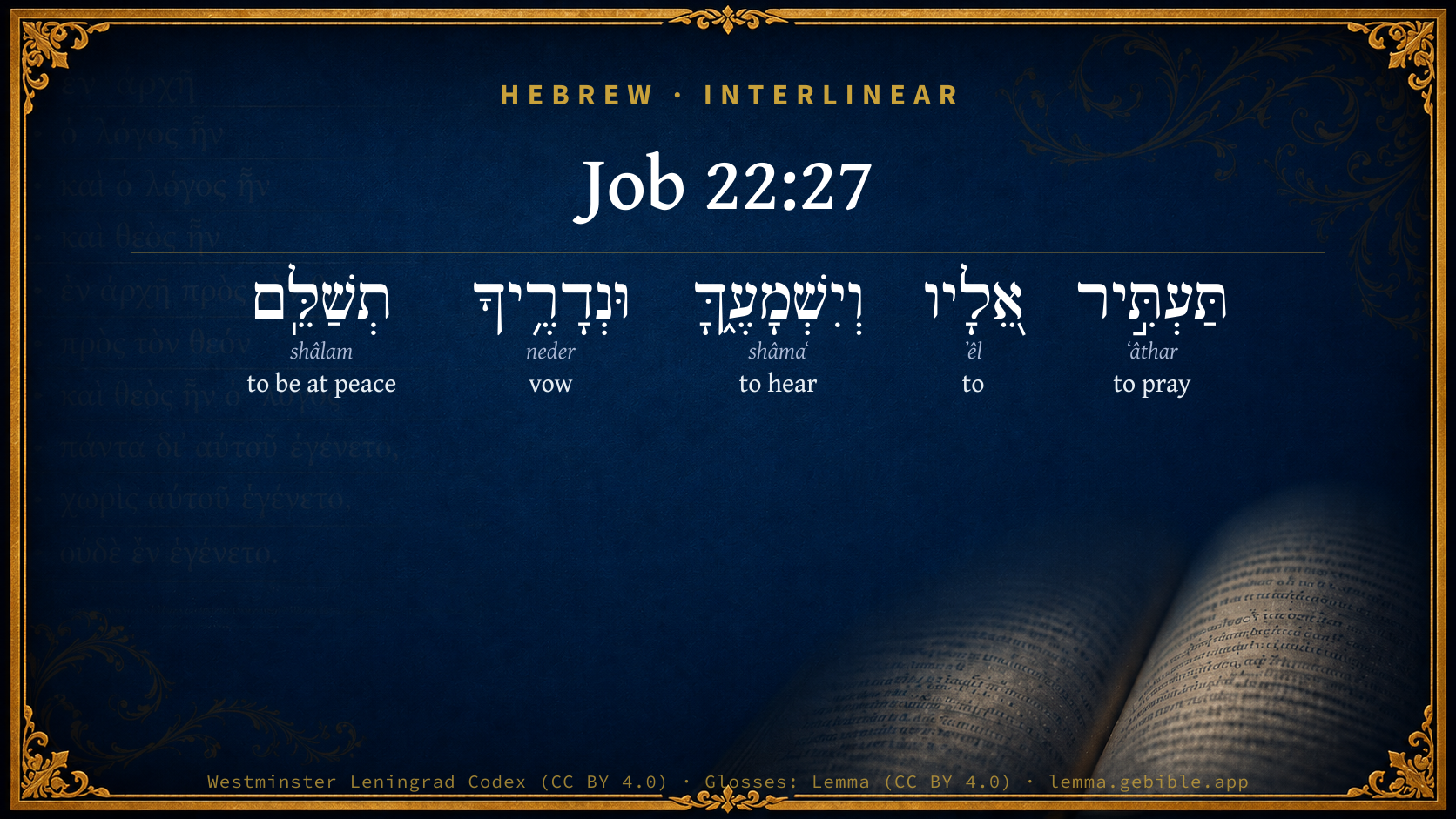
Hebrew (Westminster Leningrad Codex) Job 22:27 appears in the Hebrew Old Testament. The text above is from the Westminster Leningrad Codex. Each word links to its Strong’s number, a concise gloss, and parsing drawn from the Open Scriptures Hebrew Bible morphology. Click any word for its full Brown-Driver-Briggs (BDB) entry.
Download image
Cite this verse

Job 22:27 (World English Bible). Public Domain. Lemma interlinear Bible study tool, https://lemma.gebible.app/v/job/22/27.

Show BibTeX & RIS
BibTeX
RIS
English Translation
You shall make your prayer to him, and he will hear you. You shall pay your vows.
World English Bible · Public Domain
Download a study sheet

One document with this verse’s original text, its word-by-word gloss line, the meaning frame, cross-references with their text, attributed commentary, and full source and license credits — printable, and it pastes into notes with its structure intact.

This verse Autodidact and up

Study sheet (.html) Plain text (.txt)

A passage Seminary Student

Up to 50 verses in one chapter. A passage sheet keeps up to 6 commentary sources and 12 cross-references per verse, in the order this page ranks them, and says so on the sheet whenever that leaves anything out. Ask for a single verse and you get the Autodidact verse sheet above.

Everything on this page stays free to read, with no account — the sheet is a download of what is already on screen, not access to it.

Want to remove ads? Support Godless Engineer
Compare translations 3

The same verse in 3 English versions, stacked beneath the original-language interlinear above. Click any original word for its lexicon entry.

Each is an independent rendering of the whole verse — the interlinear is not word-aligned to these translations.

Highlighted words mark where these versions differ — a whole-verse word diff, not a word-by-word alignment.

  • World English Bible Public Domain
    You shall make your prayer to him, and he will hear you. You shall pay your vows.
  • King James Version Public Domain
    Thou shalt make thy prayer unto him, and he shall hear thee, and thou shalt pay thy vows.
  • unfoldingWord Literal Text CC BY-SA 4.0
    You will pray to him, and he will hear you, and your vows you will pay.

unfoldingWord Literal Text — © unfoldingWord, licensed CC BY-SA 4.0. Word-aligned USFM3 via Door43 (git.door43.org/unfoldingWord/en_ult).

Versions to compare (up to 4)

3 of 4 selected

Show all 18 translations

Every available English version of this verse, each an independent rendering of the whole verse.

  • World English Bible Public Domain
    You shall make your prayer to him, and he will hear you. You shall pay your vows.
  • Berean Standard Bible Public Domain
    You will pray to Him, and He will hear you, and you will fulfill your vows.
  • Majority Standard Bible Public Domain
    You will pray to Him, and He will hear you, and you will fulfill your vows.
  • King James Version Public Domain
    Thou shalt make thy prayer unto him, and he shall hear thee, and thou shalt pay thy vows.
  • American Standard Version (1901) Public Domain
    Thou shalt make thy prayer unto him, and he will hear thee; And thou shalt pay thy vows.
  • Revised Version (1885) Public Domain
    Thou shalt make thy prayer unto him, and he shall hear thee; and thou shalt pay thy vows.
  • Geneva Bible (1599) Public Domain
    Thou shalt make thy praier vnto him, and he shall heare thee, and thou shalt render thy vowes.
  • Douay-Rheims (1899) Public Domain
    Thou shalt pray to him, and he will hear thee, and thou shalt pay vows.
  • Young's Literal Translation Public Domain
    Thou dost make supplication unto Him, And He doth hear thee, And thy vows thou completest.
  • Literal Standard Version CC BY-SA 4.0
    You make supplication to Him, || And He hears you, || And you complete your vows.
  • Unlocked Literal Bible CC BY-SA 4.0
    You will make your prayer to him, and he will hear you; you will pay your vows to him.
  • unfoldingWord Literal Text CC BY-SA 4.0
    You will pray to him, and he will hear you, and your vows you will pay.
  • Darby Bible Public Domain
    Thou shalt make thy prayer unto him, and he will hear thee, and thou shalt pay thy vows;
  • World Messianic Bible Public Domain
    You will make your prayer to him, and he will hear you. You will pay your vows.
  • Webster's Bible Public Domain
    Thou shalt make thy prayer to him, and he shall hear thee, and thou shalt pay thy vows.
  • Free Bible Version CC BY-SA 4.0
    You will pray to him, and he will hear you, and you will keep your promises to him.
  • Bible in Basic English Public Domain
    You will make your prayer to him, and be answered; and you will give effect to your oaths.
  • JPS Tanakh (1917) Public Domain
    Thou shalt make thy prayer unto Him, and He will hear thee, and thou shalt pay thy vows;

Literal Standard Version (2020), Covenant Press — licensed CC BY-SA 4.0. Text via the HelloAO Bible API (eBible.org). Unlocked Literal Bible (unfoldingWord) — licensed CC BY-SA 4.0. Text via the HelloAO Bible API (eBible.org). unfoldingWord Literal Text — © unfoldingWord, licensed CC BY-SA 4.0. Word-aligned USFM3 via Door43 (git.door43.org/unfoldingWord/en_ult). Free Bible Version, Dr. Jonathan Gallagher — licensed CC BY-SA 4.0. Text via the HelloAO Bible API (eBible.org).

Word by word

More ways to search: Search by grammar → Find every occurrence → Compare this word →

Practice this passage: Drill this verse → Learn its vocabulary →

About this verse

These counts appear in no published source. They are computed here, from the morphology-tagged text and Lemma’s own curated glosses. What Lemma adds →

5
words
5
distinct lemmas
Wisdom
section

Notable vocabulary

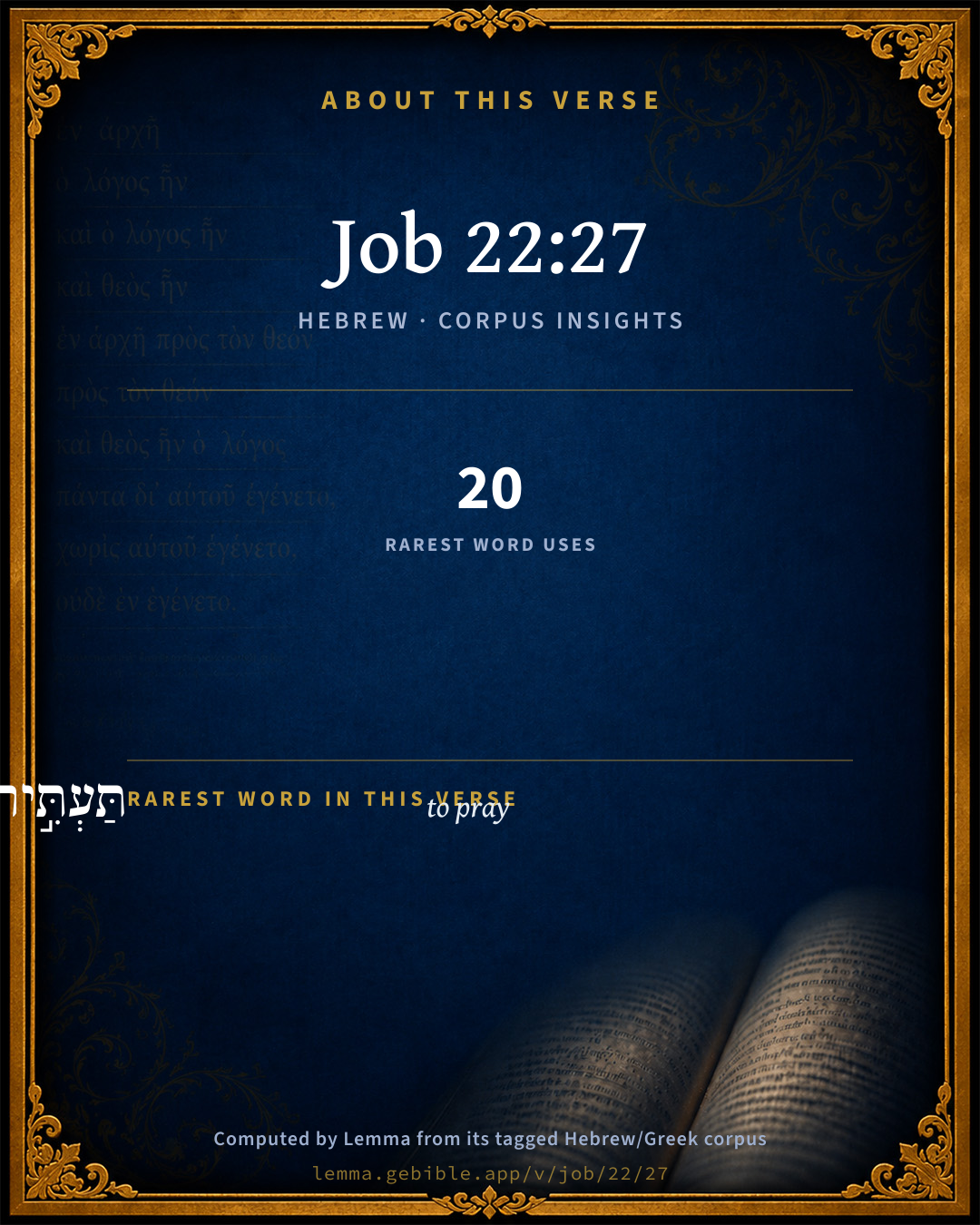
The rarest word here is תַּעְתִּ֣יר to pray H6279 — appearing just 20 times in the whole Hebrew Bible.

Shared distinctive vocabulary

תַּעְתִּ֣יר to pray H6279 occurs in 19 verses of the Hebrew Bible. Also found in:

Grammatical profile

  • 3 verbs
  • 1 noun
  • 1 preposition

Verb forms

  • תַּעְתִּ֣יר Hiphil · Imperfect
  • וְיִשְׁמָעֶ֑ךָּ Qal · Imperfect
  • תְשַׁלֵּֽם Piel · Imperfect

Hebrew & Septuagint length

In English translation the verse runs 17 words from the Hebrew and 20 from the Septuagint (LXX English) — closely comparable.

A rough comparison of the two English renderings, which tokenize alike — not a word-level alignment.

Word counts can differ between the Hebrew and the Greek without any difference in meaning — e.g. the Hebrew direct-object marker אֵת has no separate Greek word, and Greek often adds the article ὁ.

Cross-references

13

Topical passages linked to Job 22:27 in the Treasury of Scripture Knowledge — connected by theme and wording, ordered by reader-vote popularity; previews shown in the World English Bible.

  • Isaiah 58:9 Then shall you call, and Yahweh will answer; you shall cry, and he will say, Here I am. If you take away from the midst of you the yoke, the putting forth of the finger, and speaking wickedly;
  • Psalms 116:1 I love Yahweh, because he listens to my voice, And my cries for mercy.
  • 1 John 5:14–15 This is the boldness which we have toward him, that, if we ask anything according to his will, he listens to us.
  • Psalms 50:14–15 Offer to God the sacrifice of thanksgiving. Pay your vows to the Most High.
  • Psalms 91:15 He will call on me, and I will answer him. I will be with him in trouble. I will deliver him, and honor him.
  • Job 33:26 He prays to God, and he is favorable to him, So that he sees his face with joy: He restores to man his righteousness.
  • Psalms 66:17–20 I cried to him with my mouth. He was extolled with my tongue.
  • Job 34:28 So that they caused the cry of the poor to come to him, He heard the cry of the afflicted.
  • Psalms 66:13–14 I will come into your temple with burnt offerings. I will pay my vows to you,
  • Ecclesiastes 5:4 When you vow a vow to God, don't defer to pay it; for he has no pleasure in fools. Pay that which you vow.
  • Psalms 56:12 Your vows are on me, God. I will give thank offerings to you.
  • Psalms 116:14 I will pay my vows to Yahweh, Yes, in the presence of all his people.
  • Jonah 2:9 But I will sacrifice to you with the voice of thanksgiving. I will pay that which I have vowed. Salvation belongs to Yahweh."

Cross-references courtesy of OpenBible.info (CC BY 4.0).

Hebrew and Greek witnesses Masoretic Hebrew ↔ Greek Septuagint

The same verse in the two great witnesses to the Old Testament, shown verse-for-verse.

These are two independent witnesses, not word-aligned to each other, and the Septuagint is shown in lemma (dictionary) form.

Hebrew Job 22:27 Masoretic · Westminster Leningrad Codex

תַּעְתִּ֣יר אֵ֭לָיו וְיִשְׁמָעֶ֑ךָּ וּנְדָרֶ֥יךָ תְשַׁלֵּֽם

You shall make your prayer to him, and he will hear you. You shall pay your vows.

World English Bible · Public Domain

Greek LXX Job 22:27 Septuagint · lemma form

εὔχομαι δέ σύ πρός αὐτός εἰςἀκούω σύ δίδωμι δέ σύ ἀποδίδωμι ὁ εὐχή

And he shall hear you when you pray to him, and he shall grant you power to pay your vows.

LXX2012 (modern English Septuagint) · Public Domain

Hebrew: Westminster Leningrad Codex (CC BY 4.0). Greek: Septuagint (public domain); English from LXX2012 (modern English Septuagint) (Public Domain). How the Septuagint differs from the Hebrew →

Commentary

Notes on Job 22:27 from classic Christian and Jewish commentators (each source and its license shown beneath its notes). The classic Christian expositions comment on the surrounding passage and are grouped to its opening verse, so a note may address several verses; the Jewish commentaries on the Tanakh (Rashi and others) are per-verse, so they appear only where the commentator wrote on this verse.

Lemma curates 59 commentaries, every one of them public domain or Creative Commons licensed, each selected and text-cleaned for this edition rather than reprinted as found. About our sources →

Trapp's Complete Commentary

John Trapp

Job 22:27 Thou shalt make thy prayer unto him, and he shall hear thee, and thou shalt pay thy vows.

Ver. 27. Thou shalt make thy prayer unto him, and he shall hear thee] Yea, though thou multiply prayers, Multiplicabis verba tua (Mer.), and intercessions for thyself and others (as the word signifieth, and as afterwards Job did for Eliphaz and his fellows, or else it had gone worse with them), yet he shall hear thee in all. Thou shalt, as his favourite, have the royalty of his ear, and he shall say unto thee seriously, as Zedekiah did once to his courtiers soothingly, The king can deny you nothing. Iste vir potuit apud Deum quod voluit, said one concerning Luther, That man could have of God whatsoever he wanted. This David took (as well he might) for a singular mercy, Psa 13:6; Psa 66:20.

And thou shalt pay thy vows] i.e. Thou shalt return thy thanks, and so shalt drive a holy trade, as it were, between heaven and earth. Nulla tibi a Duo nisi gratias agendi occasio dabifur. Thou shalt have unmiscarrying returns of thy suits; so that thou must be ready with thy praises after their prayers; for that is all thou shalt have to do. "Praise waiteth for thee, O God, in Sion; and unto thee shall the vow be performed. O thou that hearest prayers, unto thee shall all flesh come," with their thanks in their hands as it were, Psa 65:1-2.

John Trapp, A Commentary or Exposition upon All the Books of the Old and New Testament (1647–1656) — public domain. Text from a community e-Sword module.

Joseph Benson's Commentary

Job 22:27. Thou shalt make thy prayer unto him — Hebrew, תעתיר אליו, tagnter eelaiv, thou shalt pray earnestly and importunately, or, thou shalt multiply thy prayer. Under all thy burdens, in all thy wants, cares, and fears, thou shalt apply to heaven for wisdom, strength, and comfort. Thou shalt pay thy vows — Thou shalt obtain those blessings for which thou didst make vows to God, and therefore, according to thy obligation, shalt pay thy vows to him.

Joseph Benson's Commentary on the Old and New Testaments (1811–1818) — public domain. Text from a community e-Sword module.

Tyndale Open Study Notes

Tyndale Open Resources

22:27 Ironically, Job will pray, God will hear, and Eliphaz will reap the benefits (42:8). • you will fulfill your vows: Vows were often stimulated by repentance and forgiveness (Hos 14:2; Jon 1:16; 2:9) and when seeking divine intervention (Judg 11:29-40; 1 Sam 1:1-28). Vows are binding (Num 30:2; Deut 23:23; Pss 22:25; 61:5, 8; 116:14, 18; Eccl 5:4-5).

Tyndale Open Study Notes — © Tyndale Open Resources, licensed CC BY-SA 4.0. Text via the HelloAO Bible API.

Jamieson, Fausset & Brown

Robert Jamieson, A. R. Fausset & David Brown

(Isa 58:9, Isa 58:14).

pay thy vows--which thou hast promised to God in the event of thy prayers being heard: God will give thee occasion to pay the former, by hearing the latter.

Jamieson, Fausset & Brown — Commentary Critical and Explanatory on the Whole Bible (1871) — public domain (CC PDM 1.0). Text via the HelloAO Bible API.

Adam Clarke's Commentary

Verse 27. Thou shalt make thy prayer unto him] תעתיר tatir, thou shalt open or unbosom thyself. And when the heart prays, God hears; and the person, being blessed, vows fidelity, prays on, is supported, and enabled to pay his vows.

Adam Clarke's Commentary on the Bible (1810–1826) — public domain. Text from a community e-Sword/MySword module.

The Cambridge Bible for Schools and Colleges

gen. ed. J. J. S. Perowne

27. pay thy vows] In making requests in prayer it was customary to make a vow to sacrifice or offer unto the Lord if the prayer was granted. Job shall have cause to fulfil his vows, his prayers being heard.

The Cambridge Bible for Schools and Colleges (gen. ed. J. J. S. Perowne; Cambridge University Press, 1878–1918) — public domain. Text from a community e-Sword module.

John Gill's Exposition

Thou shalt also decree a thing, and it shall be established unto thee,.... Strictly speaking, this is only true of God, whose decrees are unfrustrable, whose counsel shall stand, and the thoughts of his heart be established to all generations; and frequently so it is, according to an usual saying, man appoints, but God disappoints; this may be understood of Job, either as a civil magistrate, that he should decree a thing in a court of judicature with so much wisdom and equity, that it should stand firm and sure, and, though made on earth, should be ratified in heaven, as the decrees and doctrines of the apostles of Christ are said to be, Mat 16:19; see Pro 8:15; or, as a private man in civil affairs, signifying that he should be so guided by the Lord, and prospered and succeeded in all his ways and works, that what he determined to do, and formed a scheme for the execution of, it should be brought about and confirmed; he committing his ways to the Lord, his thoughts should be established, or his purposes and designs effected, see Psa 1:3; or rather as a praying man; and so it agrees with what goes before, that he should lift up his voice to God, and pray unto him with success, and have just occasion to praise him, or pay his vows to him, since he should have the desires of his heart; whatever was upon his mind, and he prayed in faith for, he should have it; as Elijah prayed, both that it might not rain, and that it might rain, and both were according to his word, or the decree of his lips in prayer: see Kg1 17:1;

and the light shall shine upon thy ways; which is the reason of all things prospering and succeeding, and being established according to his wish and will; the light of grace shining in him, to put him upon and instruct him in denying and avoiding that which is sinful, and doing that which was just and good; and the light of the word without him, being a light unto his feet, and a lamp to his paths, to guide and direct him, and especially the light of God's favour and blessing on him, succeeding him in all his ways and works, and making them prosperous.

John Gill's Exposition of the Whole Bible (1746–1763) — public domain (CC PDM 1.0). Text via the HelloAO Bible API.

Albert Barnes' Notes on the Bible

Thou shalt make thy prayer unto him - God would then hear him, for he would be righteous. This was one of the blessings which would follow reconciliation. It is, in fact, one of the blessings of a return to God. He hears the cry of his people, and answers their supplications. To be permitted to go to God and to tell him all our needs, to plead for all we need and to implore blessings on our families and friends, is a privilege of far higher value than anything which wealth can bestow; is worth more than all the honors of this world.

And thou shalt pay thy vows - That is, thy vows shall be accepted; thou shalt obtain those blessings for which thou didst make thy vows.

Albert Barnes' Notes on the Bible (1834–1885) — public domain. Text from a community e-Sword/MySword module.

Haydock's Catholic Bible Commentary

Vows, after obtaining thy requests. (Menochius) --- Et positis aris jam vota in littore solves. (Virgil, Æneid iii.)

George Leo Haydock (1774–1849), Haydock's Catholic Family Bible and Commentary, 1859 edition — public domain. Excludes Psalms (Douay-Rheims chapter numbering differs from Protestant) and Deuterocanonical books (Catholic canon only).

Matthew Poole's English Annotations

Hear thee, i.e. answer thy prayers, and not disregard them, and hide himself from thee, as now he doth.

Thou shalt pay thy vows, i.e. thou shalt obtain those blessings for which thou didst make vows to God, and therefore, according to thy obligation, shalt pay thy vows to him. The antecedent is here supposed and understood out of the consequent.

Matthew Poole's English Annotations on the Holy Bible (1683–1685) — public domain. Text from a community e-Sword/MySword module.

The Pulpit Commentary

Thou shalt make thy prayer unto him, and he shall hear thee. Now Job prays, but is not heard; he asks for death, but it does not come; he begs for a respite from suffering, but it is refused him; he beseeches God to enter into argument with him, (Job_9:32-34 Job_10:2) but God vouchsafes no answer. Let him follow Eliphaz"s advice, "return to the Almighty" (ver. 23), humble himself in the dust, repent and "put away his iniquity" (ver. 23), and then, Eliphaz promises him, all shall be changed God will become gracious to him, will listen to him, and grant his requests, will remove his heavy hand, and crown him with mercy and loving-kindness. Then, he adds, thou shalt pay thy vows. Thou shalt have wealth enough, and strength enough, to pay any vows that thou hast made, which now in thy afflicted state thou canst not do. Vows are part of natural religion, and were widely prevalent over all the East in ancient times. The performance of vows, which was strictly enjoined in the Mosaic Law, (Deu_23:21) must at all times have been felt as obligatory by the natural conscience.

The prayer that shall be hears.

This verse is one of a series that describe the happy results of the penitent return to God referred to in ver. 23. Thus Eliphaz means that after we have returned in penitence to God our prayer will be heard. His principle is quite in accordance with the teaching of Scripture, though, as usual, his application of it to Job is unjust.

I PRAYER IS AN ELEMENT OF PROSPERITY. It is not only a condition on which prosperity is given; it is a part of the prosperity itself. Trouble drives us go prayer; but happiness cannot let us dispense with it. It is possible for one go be too miserable, too depressed, too hopeless, go pray. The best praying seems to need an element of joyous confidence. When it springs from this happy condition it enhances the joy of it. It is a very low and selfish notion that leads people to economize their prayers, and reserve them for times of dire necessity. Surely it should be a happy thing for the child go talk with his Father!

II PRAYER EXPECTS AN ANSWER. We may pray without looking for any reply pray because we cannot contain ourselves in silence, because the strong feelings of the soul will burst out into utterance. Then there may be a certain relief in the mere opening of the floodgates of emotion. But this is not the chief end of prayer. Further, we may just confide our case to God, consoled by the thought that he hears, even though we do not believe that any help is possible. Thus comfort is sought in the silent sympathy of a friend to whom the burdened soul can pour out its griefs. Still, the chief end of prayer is not reached in this way. It is difficult to carry on a one-sided conversation with an auditor who makes no reply, who does not even give us a sign that he hears or is at all interested in what one says. Prayer would languish and perish if God did not answer it. This he will not now do in an audible voice, nor always by such evident tokens that we can have no doubt that what he has done is in response to the cry of his children. Yet all who are in the habit of praying can bear witness to the fact that God hears prayer, and replies often in the most surprising and unmistakable way.

III THE PRAYER THAT IS TO BE ANSWERED MUST BE SINCERE. Cain"s sacrifice was rejected. The Pharisee"s prayer could not reach heaven. We cannot pray to God effectively until we renounce sin and return to him. Then the prayer must be a real, inward, spiritual act. Such prayer is not valued by the correctness of its phraseology; much less is it estimated quantitatively by the time it occupies and the number of its words. The one essential quality is reality. The simple reason why many so-called prayers are not answered is that they are not really prayers at all. They do not come out of a worshipper"s heart. Therefore they cannot reach the ears of God, and incline him to respond to them. If all such pretended prayers were left out of account there would be leas scepticism and more glad confidence that God does hear prayer. W.F.A.

The Pulpit Commentary (1880–1919), ed. H.D.M. Spence-Jones & Joseph S. Exell — public domain. Text from a community e-Sword module.

John Wesley's Explanatory Notes

Make - The word is, thou shalt multiply thy prayer. Under all thy burdens, in all thy wants, cares and fears, thou shalt send to heaven for wisdom, strength and comfort. Pay - Thou shalt obtain those blessings for which thou didst make vows to God, and therefore, according to thy obligation, shalt pay thy vows to him.

John Wesley, Explanatory Notes Upon the Whole Bible (1754–1765) — public domain. Text via the GEBible commentary corpus.

Rashi

Rabbi Shlomo Yitzchaki (Rashi)

and you will pay your wows You will be confident that your sacrifices, the payments of your vows, will be accepted.

Rashi on the Tanakh — English translations: “The Judaica Press complete Tanach with Rashi, translated by A. J. Rosenberg” (CC BY 4.0); “Pentateuch with Rashi's commentary by M. Rosenbaum and A.M. Silbermann, 1929-1934” (public domain); “The Metsudah Tanach series, Lakewood, N.J” (CC BY 4.0); and “The Book of Joshua, Metsudah Publications, 1997” (CC BY 4.0). Text via Sefaria.

Lesson kit

Teaching starters — assembled from the data on this page, not authored interpretation. Every prompt links to the verse data it draws on. Edit before teaching.

Job, in the Wisdom, opens this verse with 5 words (5 distinct Hebrew lemmas). Its most distinctive word is ʻâthar (“to pray”). A historical commentator’s framing appears above. Read the whole chapter for the surrounding context.

Discussion questions

  1. How does “to pray” (ʻâthar) shape what this verse is saying?
  2. Genesis 25:21 shares the word «to pray» with this verse. How do the two illuminate each other?
  3. The translations on this page render this verse differently — a whole-verse word diff, not a word-by-word alignment. What might account for the different wordings?
  4. The verb «תַּעְתִּ֣יר» is Hiphil Imperfect. How does its form color the action?
  5. Reading how Trapp's Complete Commentary and Joseph Benson's Commentary read this verse, where do the two commentators agree and where do they part?

Things to notice

Reading settings

Reading text

Shown beneath each verse's original-language words.

Old Testament
Old Testament edition

Read the OT as the Masoretic Hebrew (MT) or the Greek Septuagint (LXX).

English shown for the Greek Septuagint (in the Hebrew ↔ Greek comparison).

Comparing translations? Open the Compare panel on any verse page to stack up to four side by side.