Psalms 131:2

Hebrew (Westminster Leningrad Codex) Psalms 131:2 appears in the Hebrew Old Testament. The text above is from the Westminster Leningrad Codex. Each word links to its Strong’s number, a concise gloss, and parsing drawn from the Open Scriptures Hebrew Bible morphology. Click any word for its full Brown-Driver-Briggs (BDB) entry.
Download image
Cite this verse

Psalms 131:2 (World English Bible). Public Domain. Lemma interlinear Bible study tool, https://lemma.gebible.app/v/psalms/131/2.

Show BibTeX & RIS
BibTeX
RIS
English Translation
Surely I have stilled and quieted my soul, Like a weaned child with his mother, Like a weaned child is my soul within me.
World English Bible · Public Domain
Download a study sheet

One document with this verse’s original text, its word-by-word gloss line, the meaning frame, cross-references with their text, attributed commentary, and full source and license credits — printable, and it pastes into notes with its structure intact.

This verse Autodidact and up

Study sheet (.html) Plain text (.txt)

A passage Seminary Student

Up to 50 verses in one chapter. A passage sheet keeps up to 6 commentary sources and 12 cross-references per verse, in the order this page ranks them, and says so on the sheet whenever that leaves anything out. Ask for a single verse and you get the Autodidact verse sheet above.

Everything on this page stays free to read, with no account — the sheet is a download of what is already on screen, not access to it.

Want to remove ads? Support Godless Engineer
Compare translations 3

The same verse in 3 English versions, stacked beneath the original-language interlinear above. Click any original word for its lexicon entry.

Each is an independent rendering of the whole verse — the interlinear is not word-aligned to these translations.

Highlighted words mark where these versions differ — a whole-verse word diff, not a word-by-word alignment.

  • World English Bible Public Domain
    Surely I have stilled and quieted my soul, Like a weaned child with his mother, Like a weaned child is my soul within me.
  • King James Version Public Domain
    Surely I have behaved and quieted myself, as a child that is weaned of his mother: my soul is even as a weaned child.
  • unfoldingWord Literal Text CC BY-SA 4.0
    Rather, I have stilled and quieted my soul like a weaned child upon his mother; like a weaned child upon me my soul.

unfoldingWord Literal Text — © unfoldingWord, licensed CC BY-SA 4.0. Word-aligned USFM3 via Door43 (git.door43.org/unfoldingWord/en_ult).

Versions to compare (up to 4)

3 of 4 selected

Show all 18 translations

Every available English version of this verse, each an independent rendering of the whole verse.

  • World English Bible Public Domain
    Surely I have stilled and quieted my soul, Like a weaned child with his mother, Like a weaned child is my soul within me.
  • Berean Standard Bible Public Domain
    Surely I have stilled and quieted my soul; like a weaned child with his mother, like a weaned child is my soul within me.
  • Majority Standard Bible Public Domain
    Surely I have stilled and quieted my soul; like a weaned child with his mother, like a weaned child is my soul within me.
  • King James Version Public Domain
    Surely I have behaved and quieted myself, as a child that is weaned of his mother: my soul is even as a weaned child.
  • American Standard Version (1901) Public Domain
    Surely I have stilled and quieted my soul; Like a weaned child with his mother, Like a weaned child is my soul within me.
  • Revised Version (1885) Public Domain
    Surely I have stilled and quieted my soul; like a weaned child with his mother, my soul is with me like a weaned child.
  • Geneva Bible (1599) Public Domain
    Surely I haue behaued my selfe, like one wained from his mother, and kept silence: I am in my selfe as one that is wained.
  • Douay-Rheims (1899) Public Domain
    Lord, hear my voice. Let thy ears be attentive to the voice of my supplication.
  • Young's Literal Translation Public Domain
    Have I not compared, and kept silent my soul, As a weaned one by its mother? As a weaned one by me `is' my soul.
  • Literal Standard Version CC BY-SA 4.0
    Have I not compared, and kept my soul silent, || As a weaned one by its mother? As a weaned one by me [is] my soul.
  • Unlocked Literal Bible CC BY-SA 4.0
    Indeed I have stilled and quieted my soul; like a weaned child with his mother, my soul within me is like a weaned child.
  • unfoldingWord Literal Text CC BY-SA 4.0
    Rather, I have stilled and quieted my soul like a weaned child upon his mother; like a weaned child upon me my soul.
  • Darby Bible Public Domain
    Surely I have restrained and composed my soul, like a weaned child with its mother: my soul within me is as a weaned child.
  • World Messianic Bible Public Domain
    Surely I have stilled and quieted my soul, like a weaned child with his mother, like a weaned child is my soul within me.
  • Webster's Bible Public Domain
    Surely I have behaved and quieted myself as a child that is weaned by his mother: my soul is even as a weaned child.
  • Free Bible Version CC BY-SA 4.0
    On the contrary, I have chosen to be calm and quiet, like a weaned child with its mother. I am like a weaned child with its mother.
  • Bible in Basic English Public Domain
    See, I have made my soul calm and quiet, like a child on its mother's breast; my soul is like a child on its mother's breast.
  • JPS Tanakh (1917) Public Domain
    Surely I have stilled and quieted my soul; like a weaned child with his mother; my soul is with me like a weaned child.

Literal Standard Version (2020), Covenant Press — licensed CC BY-SA 4.0. Text via the HelloAO Bible API (eBible.org). Unlocked Literal Bible (unfoldingWord) — licensed CC BY-SA 4.0. Text via the HelloAO Bible API (eBible.org). unfoldingWord Literal Text — © unfoldingWord, licensed CC BY-SA 4.0. Word-aligned USFM3 via Door43 (git.door43.org/unfoldingWord/en_ult). Free Bible Version, Dr. Jonathan Gallagher — licensed CC BY-SA 4.0. Text via the HelloAO Bible API (eBible.org).

Word by word

More ways to search: Search by grammar → Find every occurrence → Compare this word →

Practice this passage: Drill this verse → Learn its vocabulary →

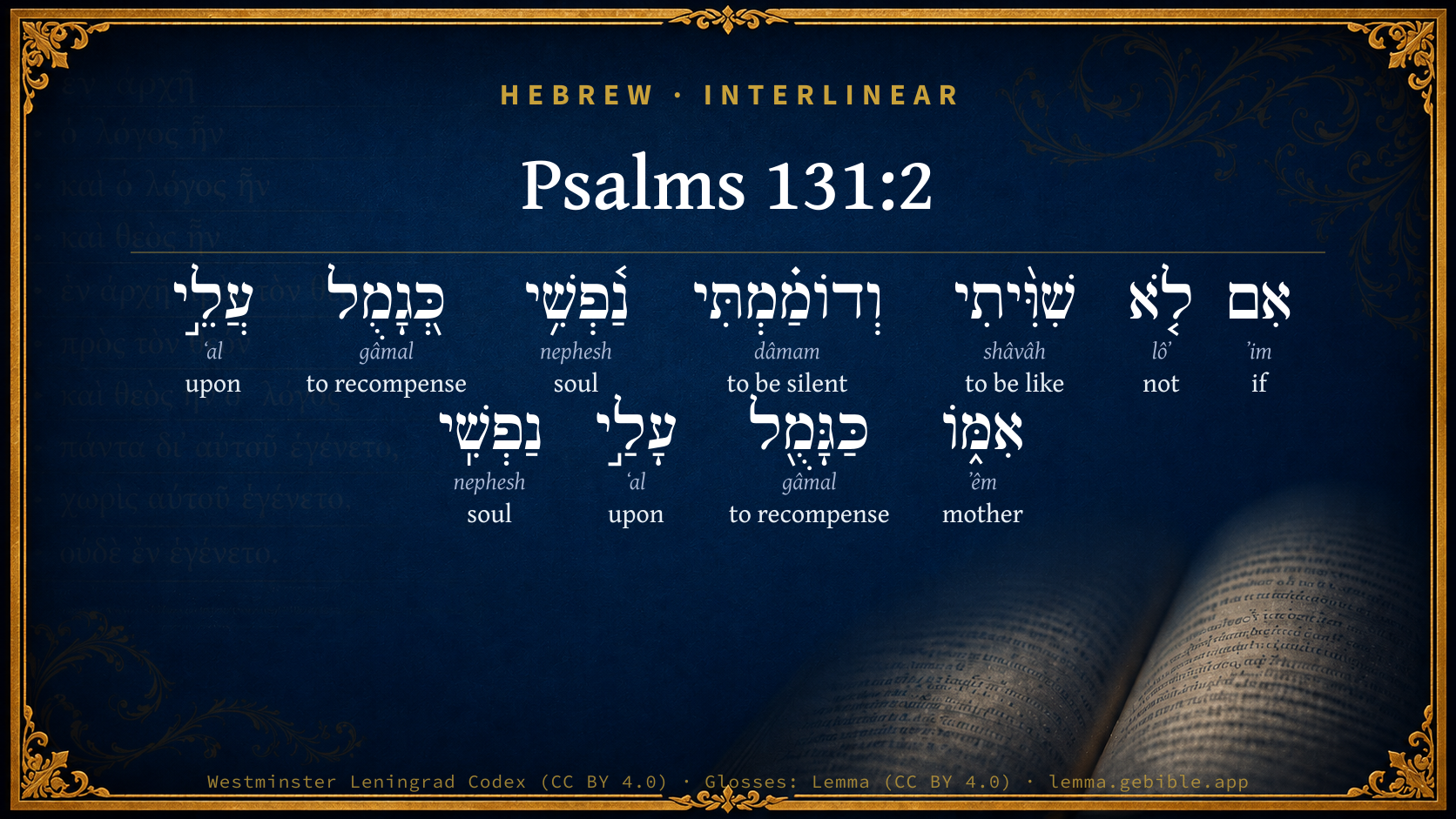
שִׁוִּ֨יתִי
shâvâh
H7737
“to be like”
Verb, Piel, Perfect, 1st Person, Common, Singular
Part of Speech
Verb
Stem
Piel
Form
Perfect
Person
1st Person
Gender
Common
Number
Singular
Full BDB Definition

Origin: a primitive root

TWOT: 2342 , 2343

to agree with, be or become like, level, resemble - (Qal) - to be like - equivalent (participle) - to set, place - setting (participle) - (Piel) to level, smooth, still - (Hiphil) to make like - (Nithpael) to be alike - (Piel) to set, place
  1. אִם ʼim H518 “if” Conjunction
  2. לֹ֤א lôʼ H3808 “not” Particle, Negative
  3. וְדוֹמַ֗מְתִּי dâmam H1826 “and · to be silent” Conjunction + Verb, Polel, Perfect, 1st Person, Common, Singular
  4. נַ֫פְשִׁ֥י nephesh H5315 “soul · my” Noun, Common, Both, Singular, Construct + Suffix, Personal, 1st Person, Common, Singular
  5. כְּ֭גָמֻל gâmal H1580 “like/as · recompensed” Preposition + Verb, Qal, Participle Passive, Masculine, Singular, Absolute
  6. עֲלֵ֣י ʻal H5921 “upon” Preposition
  7. אִמּ֑וֹ ʼêm H517 “mother · his” Noun, Common, Feminine, Singular, Construct + Suffix, Personal, 3rd Person, Masculine, Singular
  8. כַּגָּמֻ֖ל gâmal H1580 “like/as the · recompensed” Preposition, Determined + Verb, Qal, Participle Passive, Masculine, Singular, Absolute
  9. עָלַ֣י ʻal H5921 “upon · me” Preposition + Suffix, Personal, 1st Person, Common, Singular
  10. נַפְשִֽׁי nephesh H5315 “soul · my” Noun, Common, Both, Singular, Construct + Suffix, Personal, 1st Person, Common, Singular

About this verse

These counts appear in no published source. They are computed here, from the morphology-tagged text and Lemma’s own curated glosses. What Lemma adds →

11
words
8
distinct lemmas
Wisdom
section

Notable vocabulary

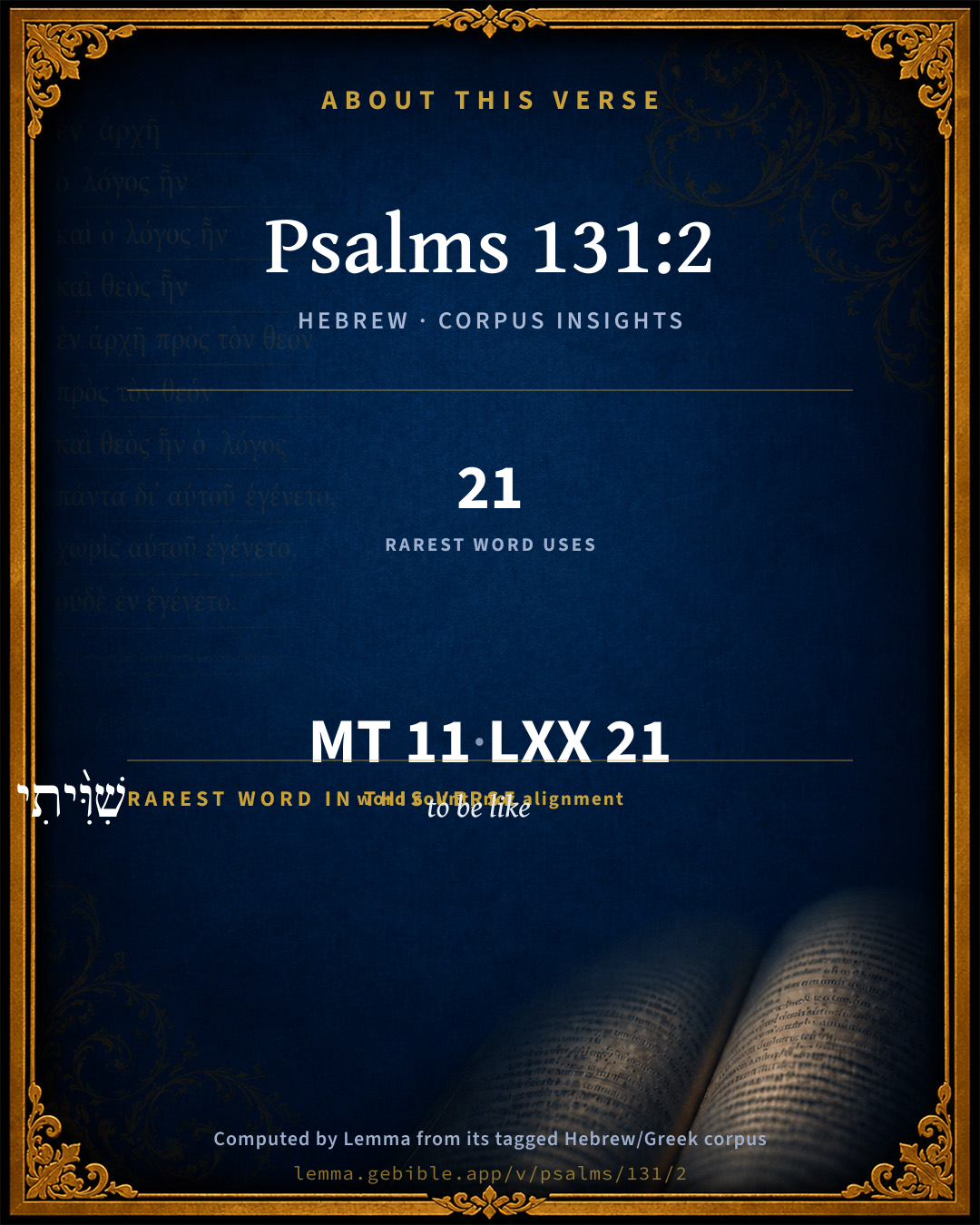
The rarest word here is שִׁוִּ֨יתִי to be like H7737 — appearing just 21 times in the whole Hebrew Bible.

Shared distinctive vocabulary

שִׁוִּ֨יתִי to be like H7737 occurs in 21 verses of the Hebrew Bible. Also found in:

Grammatical profile

  • 4 verbs
  • 3 nouns
  • 2 prepositions
  • 1 conjunction
  • 1 particle

Verb forms

  • שִׁוִּ֨יתִי Piel · Perfect
  • וְדוֹמַ֗מְתִּי Polel · Perfect
  • כְּ֭גָמֻל Qal · Participle Passive
  • כַּגָּמֻ֖ל Qal · Participle Passive

Repetition

Words recur within this verse — often emphatic in Hebrew:

  • נַ֫פְשִׁ֥י soul H5315 ×2
  • כְּ֭גָמֻל to recompense H1580 ×2
  • עֲלֵ֣י upon H5921 ×2

Hebrew & Septuagint length

In English translation the verse runs 24 words from the Hebrew and 32 from the Septuagint (LXX English) — closely comparable.

A rough comparison of the two English renderings, which tokenize alike — not a word-level alignment.

Word counts can differ between the Hebrew and the Greek without any difference in meaning — e.g. the Hebrew direct-object marker אֵת has no separate Greek word, and Greek often adds the article ὁ.

In the original languages it is 11 Hebrew tokens and 21 Greek tokens — but the two are counted differently (Hebrew bundles its prefixes and suffixes into one token; the Greek is in lemma form), so that isn’t a like-for-like length.

Cross-references

16

Topical passages linked to Psalms 131:2 in the Treasury of Scripture Knowledge — connected by theme and wording, ordered by reader-vote popularity; previews shown in the World English Bible.

  • Mark 10:15 Most assuredly I tell you, whoever will not receive the Kingdom of God like a little child, he will in no way enter into it."
  • 1 Corinthians 14:20 Brothers, don't be children in thoughts, yet in malice be babies, but in thoughts be mature.
  • Psalms 42:11 Why are you in despair, my soul? Why are you disturbed within me? Hope in God! For I shall still praise him, The saving help of my countenance, and my God.
  • Psalms 43:5 Why are you in despair, my soul? Why are you disturbed within me? Hope in God! For I shall still praise him: My Savior, my helper, and my God.
  • Lamentations 3:26 It is good that a man should hope and quietly wait for the salvation of Yahweh.
  • Matthew 18:3–4 and said, "Most assuredly I tell you, unless you turn, and become as little children, you will in no way enter into the Kingdom of Heaven.
  • John 14:1–2 "Don't let your heart be troubled. Believe in God. Believe also in me.
  • Psalms 62:1 My soul rests in God alone. My salvation is from him.
  • Isaiah 30:15 For thus said the Lord Yahweh, the Holy One of Israel, In returning and rest shall you be saved; in quietness and in confidence shall be your strength. You would not:
  • Psalms 42:5 Why are you in despair, my soul? Why are you disturbed within me? Hope in God! For I shall still praise him for the saving help of his presence.
  • Luke 21:19 By your endurance you will win your lives.
  • 1 Samuel 30:6 David was greatly distressed; for the people spoke of stoning him, because the soul of all the people was grieved, every man for his sons and for his daughters: but David strengthened himself in Yahweh his God.
  • 1 Samuel 24:10 Behold, this day your eyes have seen how that Yahweh had delivered you today into my hand in the cave: and some bade me kill you; but [my eye] spared you; and I said, I will not put forth my hand against my lord; for he is Yahweh's anointed.
  • 2 Samuel 15:25–26 The king said to Zadok, Carry back the ark of God into the city: if I shall find favor in the eyes of Yahweh, he will bring me again, and show me both it, and his habitation:
  • 2 Samuel 16:11–12 David said to Abishai, and to all his servants, Behold, my son, who came forth from my bowels, seeks my life: how much more [may] this Benjamite now [do it]? let him alone, and let him curse; for Yahweh has invited him.
  • 1 Samuel 25:32–33 David said to Abigail, Blessed be Yahweh, the God of Israel, who sent you this day to meet me:

Cross-references courtesy of OpenBible.info (CC BY 4.0).

Hebrew and Greek witnesses Masoretic Hebrew ↔ Greek Septuagint

The same verse in the two great witnesses to the Old Testament, shown verse-for-verse.

You’re reading Greek Psalm 130 (Hebrew Psalm 131). The Septuagint counts the superscription, so verse numbers can differ from the Hebrew — chapter-level alignment, not verse-by-verse. Numbering follows Rahlfs.

These are two independent witnesses, not word-aligned to each other, and the Septuagint is shown in lemma (dictionary) form.

Hebrew Psalms 131:2 Masoretic · Westminster Leningrad Codex

אִם לֹ֤א שִׁוִּ֨יתִי וְדוֹמַ֗מְתִּי נַ֫פְשִׁ֥י כְּ֭גָמֻל עֲלֵ֣י אִמּ֑וֹ כַּגָּמֻ֖ל עָלַ֣י נַפְשִֽׁי

Surely I have stilled and quieted my soul, Like a weaned child with his mother, Like a weaned child is my soul within me.

World English Bible · Public Domain

Greek LXX Greek Psalm 130:2 Septuagint · lemma form

εἰ μή ταπεινφρονέω ἀλλά ὑψόω ὁ ψυχή ἐγώ ὡς ὁ ἀπογαλακτίζω ἐπί ὁ μήτηρ αὐτός ὡς ἀνταπόδοσις ἐπί ὁ ψυχή ἐγώ

I shall have sinned if I have not been humble, but have exulted my soul: according to the relation of a weaned child to his mother, so will you recompense my soul.

LXX2012 (modern English Septuagint) · Public Domain

On this verse, Albert Barnes' Notes on the Bible discusses the Septuagint’s reading. Read the note in Commentary ↓

Hebrew: Westminster Leningrad Codex (CC BY 4.0). Greek: Septuagint (public domain); English from LXX2012 (modern English Septuagint) (Public Domain). How the Septuagint differs from the Hebrew →

Commentary

Notes on Psalms 131:2 from classic Christian and Jewish commentators (each source and its license shown beneath its notes). The classic Christian expositions comment on the surrounding passage and are grouped to its opening verse, so a note may address several verses; the Jewish commentaries on the Tanakh (Rashi and others) are per-verse, so they appear only where the commentator wrote on this verse.

Lemma curates 59 commentaries, every one of them public domain or Creative Commons licensed, each selected and text-cleaned for this edition rather than reprinted as found. About our sources →

Trapp's Complete Commentary

John Trapp

Psa 131:2 Surely I have behaved and quieted myself, as a child that is weaned of his mother: my soul [is] even as a weaned child.

Ver. 2. Surely I have behaved] Heb. if I have not, &c., a deep asseveration, such as hath the force of an oath, Si non composui et sedavi.

And quieted myself] Heb. stilled or made silent my soul; chiding it when distempered or noiseful, as the mother doth her weanling.

As a child that is weaned of his mother] Who neither thinketh great things of himself nor seeketh great things for himself; but is lowly and fellowly, Mat 18:1, innocent and unaware, taking what his mother giveth him, and resting in her love.

My soul is even as a weaned child] Who will not be drawn to suck again, though never so fair and full strutting a breast. So not David, the world’s dugs.

John Trapp, A Commentary or Exposition upon All the Books of the Old and New Testament (1647–1656) — public domain. Text from a community e-Sword module.

The Biblical Illustrator

Joseph S. Exell

Psa_131:2-3

As a child that is weaned of its mother.

The weaned soul hoping in the Lord

In the same hour in which the soul of man is by grace weaned from itself and-its own high thoughts, it begins to hope and rejoice in the Lord Jesus Christ. Yet, for a man to have the Lord alone for his confidence seems, to the unrenewed mind, the highest presumption; to put a present, an immediate trust in the Lord for all the future, in time and in eternity, is thought to be unhallowed boldness, and not humility or weanedness of heart. The whole dealings of God with man bring us back to the ever memorable words of the Lord Jesus (Mat_11:25-26).

I. The first weaning of the soul the grand event of a mans history. When God begins to deal with you in saving grace. He weans you from self, in its various forms, according to our Lords teaching (Mat_16:24). This self-denial includes weaning from the world, from your own will, from your own strength.

II. The joy in the Lord that springs up in every weaned soul. The Lord your is now ransom, your righteousness, and the well of living joy within you.

III. The daily weaning of the soul through life. The soul has to be weaned from all that must be forsaken, from that which may be either granted or denied, and from its own wisdom and way in the kingdom of heaven on earth.

IV. The earnest desires and the fruitful work of every weaned soul.

1. The weaning of the soul from self and from its own earthly affections neither stupefies the mind nor quenches the fire of all nobler desires.

2. The gracious weaning of the soul prepares and fits us for fruitful work. In grace, the helplessness of the child is combined with the strength and energy of the man. Except we receive the kingdom of heaven as a little child, we cannot enter therein; yet it is the same kingdom of heaven that suffereth violence, and which the violent take by force. (A. Moody Stuart, D. D.)

The weaned child

An aged minister once made the confession to another concerning this passage--I wish it were true of me; but I think I should have to make an alteration of one syllable, and then it would exactly describe me at times: My soul is even as a weaning rather than a weaned child, for, said he, with the infirmities of old age, I fear I get fretful and peevish and anxious, and, when the day is over, I do not feel that I have been in the calm, trustful frame I could desire. And we have often to make the same confession. We wish we were as a weaned child, but then we are not. To the child weaning is one of its first troubles, and no doubt it is a terrible trouble to the poor little heart. But it gets over it somehow. It is a very happy condition of heart which is here indicated, and I desire to promote it in you. So--

I. Let us think what the psalmist meant by it. Look at the context and you will see that he meant--

1. That pride had been subdued in him. Lord, he says, my heart is not haughty, nor mine eyes lofty. We are all proud by nature. The Lord Mayor is not a bit prouder in his gold chain than the beggar in his rags. Great I grows without any watering, for the soil of nature is muddy, and the rush of pride takes to it mightily. You need never be troubled about a mans keeping up his opinion of himself; he will be pretty sure to do that. David could say, My heart is not haughty. His brother Eliab said that he was proud when he went down to carry his fathers present to his soldier brothers, but it was not so. Whatever faults he had, he certainly had not that of vanity. Now, it is a great blessing when the Spirit of God keeps us from being proud. After all, we are nobodies, and we have come of a line of nobodies. The proudest peer of the realm may trace his pedigree as far as ever he likes, but he ought to remember that, if his blood is blue, it must be very unhealthy to have such blood in ones veins. The common ruddy blood of the peasant is, after all, far healthier.

2. And next he tells us that he was not ambitious. Neither do I exercise myself in great matters. He was a shepherd; he did not want to go and fight Goliath, and when he did he could say, Is there not a cause? Else he had kept in the background still. We shall never be as a weaned child if we have got high notions of what we ought to be, and large desires for self. Baruch thought he was somebody, tie had been writing the Word of the Lord, had he not? But the prophet said to him, Seekest thou great things for thyself? Seek them not. We often seek after great approbation. And sometimes we are ambitious to do great things in the Church. The great destroyer of good works is the ambition to do great works. He is the best draughtsman, not who draws the largest but the most perfect circle.

3. He was not intrusive. Neither do I exercise myself in great matters, or in things too high for me. Many men vex themselves because they will do what David did not. They want to understand everything. Some want to shape the Scriptures to their creed, and they get a very nice square creed too, and trim the Bible most dexterously; it is wonderful how they do it; but I would rather have a crooked creed and a straight Bible, than I would try to twist the Bible round to what I believe. The same evil comes up when we want to know all the reasons of the Divine providence. Why this happened and why that. When we begin asking, Why? Why? Why?--what an endless task we have before us! Now, from the simile itself we gather that the condition of heart David spoke of was like one who was able to give up his natural food. What nature loves the soul gives up. And that he had conquered his desires. Paul had, for he had learnt in whatever state he was therewith to be content. And doubtless, also, therewithout. And that as the child depends upon its mother entirely, so he depended upon the Lord.

II. The excellence of this condition. Desires will no longer worry you. You give your thoughts to something better than the things of earth. Note the psalm which follows this, for there David declares he will build for the Lord of Hosts. When you are free from fretting, worrying, and self-seeking, you are free to work for the Lord.

III. Is this state attainable? Certainly. David said, My soul is even as, etc. Not that he hoped it would be. What is the way to get it? The psalm tells us. Let Israel hope in the Lord. Easier said than done, says somebody. Yes, except by faith; but to faith it is easy enough. You unconverted, may the Lord make you first a child, and then as a weaned child. (C. H. Spurgeon.)

The nature and effects of a weaned disposition of soul

I. From what does grace wean the soul?

1. From the dry breasts of the world (Jam_1:27; 1Jn_2:16).

(1) From the profits of the world (Heb_11:26).

(2) From the pleasures of the world.

(3) From all worldly comforts whatsoever, making it take up its rest in God (Luk_14:6).

2. From the foulsome breasts of sin, so that it loathes that which it loved before.

II. How is the soul weaned from these things?

1. Grace lays gall and wormwood upon these breasts, and so embitters them to the soul that it is made willing to give over sucking them (Hos_2:6-7). Now, there are two things that serve to embitter these breasts.

(1) Continual disappointments from them. Though the man is always seeking satisfaction from them, he can never get it. Like the prodigal (Luk_15:16).

(2) Severe wounds arise from them. The man leans with great delight on the broken reed; and, ere he is aware, it pierceth through his hand. He sucks eagerly at the breast, and, instead of milk, wrings out blood.

2. The Lord fills the soul with better things (Joh_4:14).

III. What are the effects of a weaned disposition of soul?

1. The weaned soul is a resigned soul.

(1) To the will of Gods commandments.

(2) To the will of His providence.

2. The weaned soul is cheerful, and not fretful in its resignation. What God does is not only well done, but best done; so says the weaned soul.

3. The weaned soul stands on other grounds, when created comforts are with him, and even when created streams are running full: he draws his support in both cases from God as the fountain.

4. The weaned soul will stand without them when these are gone, for they were not the props on which his house rested. Such a soul can adopt the prayer of Hab_3:17-18.

5. The weaned soul uses creative comforts passingly. They follow the directions of Paul (1Co_7:29-31).

6. The weaned soul casts itself upon the Lord, without carnal anxiety, as the weaned child depends on the mothers care (Php_4:6). (T. Boston, D. D.)

Weanedness of soul

I. Its nature. It presupposes a power left in the soul of loving and desiring. It is not the destruction of its appetite, but the controlling and changing of it. A weaned child still hungers, but it hungers no more afar the food that once delighted it; it is quiet without it; it can feed on other things; so a soul weaned from the world still pants much as ever for food and happiness, but it no longer seeks them in worldly objects. There is nothing in the world that it feels necessary for its happiness. This thing in it it loves, and that thing it values, but it knows that it can do without them, and it is ready to do without them whenever God pleases. Could you give up all you have at Gods call? and when you had done so, instead of saying, There goes all my happiness, could you say with a calm, though perhaps with a bleeding, heart, I can be happy still; my best treasure is yet left? Then yours is a weaned soul.

II. Its sources. Our souls are as fast bound to the world as they were at first, or faster. We shall never leave it of our own accord. It is Gods own right hand that must draw us from it. And how? The figure in the text will partly tell us.

1. By embittering the world to us.

2. By removing from us the thing we love.

3. By giving us better food. Worldly pleasures debase the soul; they dispose it to sink deeper and deeper in its search for happiness, and to take up with viler things; the soul is always the worse for them: spiritual pleasures exalt the soul; they give it a distaste for all that is low and vile, and teach it to aspire to the very highest objects.

III. Its advantages.

1. It will save us from much sin.

2. It will keep us quiet under our many troubles. (C. Bradley, M. A.)

Submission

I. What is implied in this representation of submission to God.

1. That we labour to be satisfied with what God appoints.

2. That we can do without what God does not appoint.

3. That we have higher comforts than those which God sees fit to deny.

II. The considerations which are adapted to cherish such a submission.

1. All the events of Providence are a discipline for promoting the welfare of good men.

2. Jesus Christ submitted to the will of God.

3. The demand of submission in its present form is only temporary. Submission is the character and blessedness of heaven; but there are no evils to be submitted to there.

III. The advantages which result from this submission.

1. It creates a just and a religious independence of men.

2. The submission which has been represented inspires with hope in God.

3. This submission quickens our desires for heaven. (Essex Remembrancer.)

The suppression of self-will

This is one of the shortest of the Psalms, and one of the most beautiful. It is unique. The grace of Christian humility is here before its time. The bird sings before the sun has risen. The spirit of Jesus is here. We almost expect the psalm to conclude with the words, Blessed are the meek. Gods benediction of peace rests upon a lowly soul. The hand of God has gently rocked a weary spirit to rest. The Authorized Version does not give the full meaning of the text. We should read, As a weaned child upon his mother, so lies my soul upon me. The subject, then, is the suppression of self-will. Let us think of the good which is possible through failure, of the beatitude of disappointment, the peace of defeat. We see men putting forth all their powers in some noble cause, but the good results are strangely withheld. They conceive holy designs, which, like that of David to build a temple, are frustrated. Jesus Christ will not have even His work preferred before Him. The final sacrifice which some men are called upon to make is not the sacrifice of a pleasure, or the relinquishment of some precious treasure; it is the sacrifice of a dear purpose by which they hoped to bring glory to their Lord. They are required to turn from the path of hallowed service, to renounce the holy enterprise. John Ruskin has told us how, when he came into clearer light, his hope of some better service was cut off by failure of health. Just when I was coming out of school, very sorry for having been such a foolish boy, yet having taken a prize or two, and expect now to enter upon some more serious business than cricket, I am dismissed, by the Master I hoped to serve, with a Thats all I want of you, sir. To give up what is dear to them is for some men comparatively easy, but to give up what they deemed dear to Christ,--to bind on the altar of sacrifice the one offspring of our heart, which gave such fair promise that in it men should be blessed,--that is hard. But it has to be done to the bitter end. No angelic voice stays the descending knife. Now, it is not difficult to see that, in many cases, these disappointments and failures are inevitable. Men are prone to exaggerate their powers, and to minify the hindrances which are before them. They have an attractive programme of bills which they propose to carry, but they underrate the forces of obstruction, and it is not in their power to enforce a closure. Now, there is no more searching test of character than disappointment. How charming the way in which John the Baptist accepted the narrowing sphere, and acquiesced in the circumstances which consigned him to comparative obscurity and silence. He must increase, but I must decrease. That exquisite humility gives the transfiguring touch to a noble soul. It sheds a softened splendour upon the granite peaks of his character. It is possible for a man to be victorious even in defeat. Success may be good, but failure may be better. Disappointment brings a richer dower than achievement. No man need be ashamed of failure, or afraid of it, after the Cross of Christ. Now, this weaning of the soul, this spirit of chastened submission, this complete suppression of self-will, this hearty acquiescence in the will of God, do not come easily to a man. The soul does not gain these heights without struggle. This psalm, tranquil as it is, bears traces of sore conflict. There is in it the echo of a storm. Surely I have behaved and quieted myself. The word behaved here bears a meaning which we do not now attach to it. It means to hold in, to restrain. The psalmist has known tears, protests, demands, complaints. Passion and pride have raged like swelling waves. But all this is over now. Lord, my heart is not haughty, etc. He does not seek a position above him involving duties and responsibilities too heavy. He accepts the limitations of his life, and adapts himself to them. He is at last willing, having tried all other ways, to try just Gods. Observe, this is not a state of torpor, which leads one to retire from service, and sit, with folded hands, in dull inaction. Nor is it a state of weakness, in which a man ceases from effort because it seems to fail. It is a submission that is full of hopefulness. It implies a persuasion that, though we seem to fail, Gods cause never fails; a calm conviction that, though the good result is deferred, it will surely come. There are men who, when thwarted, hindered, disappointed, foiled, in the midst of their broken purposes and crushed hopes, cry, Even so, Father, for so it seemed good in Thy sight. When that hour comes the soul enters into rest. Abraham made a great feast on the same day that Isaac was weaned. There are rich feasts for weaned souls. The joy of conquest is poor beside the ecstasy of renunciation. The complacency of attainment, the pride of achievement, the flush of success, grows pale before the peace of disappointment. If there is one way in which, more than in any other, God is glorified upon this earth, it is when a man takes the bitter cup of disappointment, and says, Nevertheless, not as I will, but as Thou wilt. Such men are victorious over defeat by accepting it. Surrender is the supreme grace of the Christian soul. When a man bows meekly down before the will of God, he has reached the highest good. (J. Lewis.)

The quiet mind

This psalm is called a Psalm of David, and there seems no sufficient reason for doubting that it comes from his pen. Probably it belongs to one or other of the few peaceful seasons of his troubled reign, in which he was at leisure to practise that self-discipline which makes men strong, and those habits of meditation which make men wise. We have here a rare and a beautiful state of mind; and there are two expressions in this second verse which will help us to understand it. I have behaved and quieted myself; literally, I have stilled and hushed my soul. The idea seems to be that of checking and restraining himself. The man has reproved his wayward impulses; he has arrested unreasonable ambitions and unseemly desires; he has taken himself in hand, and has dealt firmly and faithfully with that turbulent compound. His mind, for a time long or short, and from causes which he does not explain, has been like a troubled sea; and he has ruled the raging of its waters, and hushed the violence of the storm. The second expression is more striking still. For some reason or other the psalmist has not only been in a stormy mood, but in an uneasy, fretful, unsatisfied mood as well. He has been like a child passing through its first troubles. There is no vehemence in what he is here alluding to. His soul is not in arms. It is irritation, disappointment, unsatisfied desire, with perhaps a general sense of not being able to make the thing out. But it is all over now. From many a source of earthly joy and satisfaction he has had to wean himself away. And he has done it. The painful business is over; and in the sweet content of a tranquil, satisfied, and assured mind, his soul is even as a weaned child. Humility--a just estimate of oneself, a just conception of what one is, what one has a right to demand from life, what one really has a right to be angry and disappointed over; a clear perception of our relations to a Divine Being, to this great and wondrous universe in which we find ourselves, and to man, our brother and fellow-traveller: this is the sweet secret of peace, now and always. Have you ever known pride happy? You could as soon find a cone standing unsupported on its apex. Pride, in every form of it, is a monster with many mouths; and some of them are always crying, in all the bitterness of unsatisfied desire, Give, give! Notice here how thoroughly in this matter David is at one with a Greater than David (Mat_11:27-28). Not until we have brought down those high and haughty minds of ours; not until we have learned, I do not say the sad, but the sober look; not until lofty imaginations are in the dust at our feet, imaginations which in every direction are their own scourge,--can we know anything of the weaned condition of Davids mind, or enter into the rest which remaineth for the people of God. I hardly know which to admire the more in David--his profound wisdom, or his profound piety. Certainly it is as sure a mark of wisdom to know the limits of inquiry in any direction, and reverently to bow to them, as it is within such limits to reverently prosecute such inquiry. And the piety of it all is quite as great as the practical wisdom. It is so eminently characteristic of a true and trustful child to be able and willing to say, I cannot understand these things; but my Father knows all about them. Is that childish talk? Then let me be a child. I have read somewhere, Of such is the kingdom of heaven. Do you tell me that it is not knowledge? I say, it is better than knowledge; for it comes of the love that shall endure, when knowledge shall have vanished away. (J. Thew.)

The Biblical Illustrator, edited by Joseph S. Exell (c. 1880s–1900s) — public domain. Text from a community e-Sword module.

Joseph Benson's Commentary

Psa 131:2-3. Surely I have behaved and quieted myself — Hebrew, שׁויתי ודוממתי נפשׁי, I have composed and hushed, or, rendered silent, my soul. When my mind was provoked to any irregular passion or temper, I restrained and subdued all such sinful motions or dispositions. As a child that is weaned of his mother — As void of all that ambition and malice, wherewith I am charged, as a child newly weaned; or, rather, as wholly depending upon God’s providence, as the poor helpless infant, when it is deprived of its accustomed food, the milk of the breast, takes no care to provide for itself, but wholly relies upon its mother for support. I have levelled my mind to an equality with my condition; and resolved to acquiesce in the present state of things, committing myself wholly to thy care, being content to be disposed of as thou pleasest.” Let Israel hope in the Lord, &c. — “Let all good men, in like manner, modestly place their confidence and hope in the Lord, as long as they live; and choose rather to be depressed, than by any undue means to raise themselves to greatness and honour.” — Bishop Patrick.

Joseph Benson's Commentary on the Old and New Testaments (1811–1818) — public domain. Text from a community e-Sword module.

J. A. Alexander on Psalms

Joseph Addison Alexander

2. (Psa 131:2) (God knows) if I have not soothed and quieted my soul, as a weaned (child leans) upon his mother; as a weaned (child leans) on me my soul. The first clause contains a strong asseveration, in the idiomatic form of an ancient oath, very feebly represented by our adverb surely. See above, on Psa 89:35. The word translated soothed means rather smoothed, levelled, as in Isa 28:25. Quieted, stilled, hushed, reduced to silence. The repeated use of the preposition on in this connection is so marked and striking, that it seems to make it necessary to supply a verb with which it may be construed. This is certainly better than to give it a different meaning in the two clauses, or in both one which does not belong to it. In the version above given, the comparison suggested is between a weaned child, quietly reposing on its mother's breast, without desiring to be suckled as of old, and the soul of the Psalmist, by a bold conception represented as his child, and acting in like manner. Hengstenberg denies that there is any reference to the mother's milk, or that weaned has any other meaning here than that of infant or young child, as in Isa 11:8; Isa 28:9. The comparison is then coincident with that in Mat 18:3-4. But the use of the word weaned, which was here required by no parallelism as in Isaiah, and the singular aptness of the figure suggested by the word when strictly under-stood, have led most interpreters, and will probably lead most readers, to prefer the obvious and strict interpretation.

Joseph Addison Alexander, The Psalms Translated and Explained (1850) — public domain. Text from a community e-Sword module.

Tyndale Open Study Notes

Tyndale Open Resources

131:2 The psalmist calmed and quieted himself, surrendering his ambitions and taming his ego (Gal 2:20). • like a weaned child: The psalmist sees himself as a contented child.

Tyndale Open Study Notes — © Tyndale Open Resources, licensed CC BY-SA 4.0. Text via the HelloAO Bible API.

Geneva Bible (1599)

Geneva Bible translators

He was void of ambition and wicked desires.

Geneva Bible (1599) marginal notes — public domain. Text via Bolls.life.

Adam Clarke's Commentary

Verse 2. I have behaved and quieted myself, as a child] On the contrary, I have been under the rod of others, and when chastised have not complained; and my silence under my affliction was the fullest proof that I neither murmured nor repined, but received all as coming from the hands of a just God.

My soul is even as a weaned child.] I felt I must forego many conveniences and comforts which I once enjoyed; and these I gave up without repining or demurring.

Adam Clarke's Commentary on the Bible (1810–1826) — public domain. Text from a community e-Sword/MySword module.

John Calvin's Commentaries

2. If I have not set, etc. He here employs a figure which appropriately explains what he meant, and likens himself to a weaned child; by which is intended, that he dismissed all the anxieties which disquiet the man of ambition, and was willing to be satisfied with small things. This assertion, which some might be inclined to disbelieve, he makes with an oath, expressed in that particular form of which I have elsewhere taken notice, in which the imprecation is not directly brought forward, but left to be understood, to teach us caution in the use of God’s name. “אם-לא, A formula of swearing which may be translated surely or indeed. I have surely so disposed and disciplined my soul as to remove it from any longing after great things, from any ambitious tendencies.” — Phillips.

“Whom shall I teach knowledge? them that are weaned from the milk? and drawn from the breasts?”

where the Prophet censures the people for their slowness of apprehension, and being as incapable of profiting by instruction as infants. In the passage now before us, what is recommended is that simplicity of which Christ spake,

“Unless ye become like this little child, ye shall in no wise enter into the kingdom of God.” Of all explanations the best is that of considering the comparison to consist between the humbleness and simplicity of the Psalmist’s mind, and that of a little child, in whom there does not exist a sufficient consciousness to create an ambition for any worldly object. The comparison is not with יונק, a suckling; for it has a longing after the mother’s breast, and, therefore, such a comparison would not be appropriate. The same, indeed, may be said of a child who has only just been weaned; for, in that stage, how often does it cry and mourn after that of which it has been deprived, and the possession of which was just before its chief pleasure? We therefore conclude, that the comparison is intended to be with a child who has been weaned a sufficient time to have forgotten its infantile nutriment, and who is not conscious of any particular desires or cravings, and quietly resigns itself to its mother’s care and training. — Phillips.

The vain desires with which men are carried away originate in their seeking to be wise and careful above what is necessary. David adds accordingly, my soul over me is quieted, not as expressing the language of self-confidence, but speaking as if his soul lay sweetly and peacefully on his bosom, undisturbed by inordinate desires. He contrasts the wayward and tumultuous agitation which prevails in those of a discontented spirit, with the peace which reigns in the man who abides in the calling of the Lord. From the verse with which the Psalm closes, we see the reason why David asserted his having undertaken nothing in the spirit of a carnal ambition. He calls upon Israel to hope in the Lord, words which must have been abrupt had it not deeply concerned the common safety of the Church, to know that he sat upon the throne of the kingdom by Divine appointment, in which case the faithful would be certain of the bestowment of the promised blessing. Our hope is of the right kind when we cherish humble and sober views of ourselves, and neither wish nor attempt anything without the leading and approbation of God.

John Calvin's Commentaries (1540-1563) — public domain. Text from the Calvin Translation Society English edition (1840s-50s) via the Christian Classics Ethereal Library (ccel.org). Calvin's coverage is partial (roughly two-thirds of the Bible); uncommented books and verses are honest gaps, never fabricated. The 19th-century editor's footnotes and remarks are omitted so the notes are faithfully Calvin's own voice.

Ellicott's Commentary for English Readers

(2) Surely.—This seems the best way of rendering the phrase, which literally is if not, and is plainly elliptical, being commonly used to express strong asseveration after an oath.

I have behaved . . .—The figure here is plain. It is taken from a baby’s first real sorrow when he not merely feels pain, but is allowed no access to that which was his solace hitherto. He moans, and frets, and sobs, but at last is quieted by the love which is powerful to soothe, even when it must deny. So, as George Herbert says of man, “If goodness lead him not, then weariness may toss him to God’s breast.” But the exact rendering is matter of difference and difficulty. The verb rendered “behave” means to make equal or like. This is its meaning, even in Isa_38:13, which is the only place referred to by Gesenius in support of his translation here “calmed.” We cannot, therefore, render, as many critics, “I calmed and quieted my soul.” But, as in Hebrew, it is common to express one idea by the combination of two verbs, so “I made like, and I quieted my soul,” is really an idiomatic way of saying “I made as quiet as.” The redundancy of the sign of comparison as after verbs of likening may be illustrated by Psa_49:12, as well as by the passage in Isaiah referred to above. We thus get: “Surely I made my soul as quiet as a weaned child upon his mother, as a weaned child upon me, my soul.” Instead of fretting after what is too great for him, he quiets his ambition, and his spirit lies calm and gentle, like a child in its mother’s arms, that after the first trouble of weaning is over is soothed and lulled by the maternal caress. Perhaps the opposite idea, expressed by the common phrase, “to nurse ambitious thoughts,” may serve to illustrate this somewhat unwonted image. For Israel as a “weaned child,” comp. Isa_28:9.

A Bible Commentary for English Readers, edited by Charles John Ellicott (1878–1897) — public domain. Text from a community e-Sword module.

The Cambridge Bible for Schools and Colleges

gen. ed. J. J. S. Perowne

2. Surely I have calmed and quieted my soul:

Like a weaned child on its mother’s breast,

Like a weaned child is my soul upon me.

He has calmed (lit. levelled, Isa_28:25, of levelling ground for sowing) his soul, and silenced it (Psa_62:1; Psa_62:5; Lam_3:26). It is no longer disturbed by the storms of passion and the clamours of ambition. As the child that has gone through the troublesome process of weaning can lie happily and contentedly in its mother’s arms without fretting or craving for the breast, so the Psalmist’s soul, weaned from worldly ambition, can lie still without murmuring or repining. It is not the helplessness of the child—children in the East were sometimes not weaned till the age of three, 2Ma_7:27, cp. note on 1Sa_1:23-24—but its contentment in spite of the loss of what once seemed indispensable, that is the point of the comparison.

The same preposition which is used of the child in its mother’s arms, lit. upon its mother, is used of the soul’s relation to the Psalmist, upon me. The soul in Hebrew psychology was sometimes distinguished from a man’s whole ‘self,’ and regarded as acting upon it or related to it from without. Cp. Psa_42:4-6; Psa_42:11; Psa_142:3; &c. See Delitzsch, Biblical Psychology (E.T.) pp. 179 ff.

The Cambridge Bible for Schools and Colleges (gen. ed. J. J. S. Perowne; Cambridge University Press, 1878–1918) — public domain. Text from a community e-Sword module.

John Gill's Exposition

Surely I have behaved and quieted myself,.... Or "my soul" (o); behaved quietly and peaceably towards all men, even his inferiors in Saul's court and elsewhere, and had given no tokens of a restless, turbulent, and ambitious spirit; as well as behaved patiently under all his troubles and afflictions, reproaches and calumnies: or "if I have not" (p), being in the form of an oath or imprecation, as Kimchi and Aben Ezra observe; if I have not thus behaved, let it come to me so and so, or let me be as a weaned child. Noldius renders it by way of interrogation, "have I not composed and quieted myself?" &c. The Targum is,

"if I have not put the hand to the mouth, and caused my soul to be silent, until it heard the words of the law;''

as a child that is weaned of his mother: and, for the further confirmation of it, it is added,

my soul is even as a weaned child; innocent and harmless, had no more ill designs against Saul than a weaned child; humble, meek, and lowly, and had no more aspiring and ambitious views than such an one; like that, weaned from the world, the riches, honours, pleasures, and profits of it; as well as from nature, from self, from his own righteousness, and from all dependence on it; and as a child that is weaned from the breast wholly depends on its nurse for sustenance, so did he wholly depend upon God, his providence, grace, and strength; and as to the kingdom, he had no more covetous desires after it than a weaned child has to the breast, and was very willing to wait the due time for the enjoyment of it. The Targum,

"as one weaned on the breasts of its mother, I am strengthened in the law.''

This is to be understood not of a child while weaning, when it is usually peevish, fretful, and froward; but when weaned, and is quiet and easy in its mother's arms without the breast.

(o) "animam meam", V. L. Pagninus, Montanus, &c. (p) "si non", Montanus; "male sit mihi si non", Tigurine version.

John Gill's Exposition of the Whole Bible (1746–1763) — public domain (CC PDM 1.0). Text via the HelloAO Bible API.

Albert Barnes' Notes on the Bible

Surely I have behaved and quieted myself - Margin, as in Hebrew, my soul. The Hebrew is, “If I have not soothed and quieted my soul.” This is a strong mode of affirming that he had done it. The negative form is often thus used to denote a strong affirmation. The full form would be, “God knows if I have not done this;” or, “If I have not done this, then let me bear the consequences; let me be punished.” The idea is that he was conscious he had done this. Instead of being arrogant, proud, and ambitious - instead of meddling with matters above him, and which did not belong to him, he had known his proper place. He had been gentle, calm, retiring. The word rendered behaved means properly to be even or level; then, in the form used here, to make even, smooth, or level; and it is used here in the sense of calming the mind; smoothing down its roughnesses; keeping it tranquil. Compare the notes at Isa 38:13, in our version, “I reckoned” (the same word as here) “till morning,” but where the correct translation would be, “I composed or calmed myself until morning.” So the meaning here is, that he had kept his mind calm, and even, and gentle.

As a child that is weaned of his mother - See Isa 28:9. There have been very various interpretations of this passage. See Rosenmuller in loc. Perhaps the true idea is that of a child, when weaned, as leaning upon its mother, or as reclining upon her breast. As a weaned child leans upon its mother. That is, as a child, accustomed to the breast, and now deprived of it, lays its head gently where it had been accustomed to derive its nutriment, feeling its dependence, hoping to obtain nourishment again: not angry, but gently grieved and sad. A little child thus clinging to its mother - laying its head gently down on the bosom - languishing - looking for nourishment - would be a most tender image of meekness and gentleness.

My soul is even as a weaned child - literally, “As a weaned child upon me my soul;” that is probably, My soul leans upon me as a weaned child. My powers, my nature, my desires, my passions, thus lean upon me, are gentle, unambitious, confiding. The Septuagint renders this in a different manner, and giving a different idea, “Had I not been humble, but exalted myself as a weaned child doth against its mother, how wouldst thou have retributed against my soul!” The Hebrew, however, requires that it should be otherwise interpreted. The idea is, that he had been gentle; that he had calmed down his feelings; that whatever aspirations he might have had, he had kept them under; that though he might have made inquiries, or offered suggestions that seemed to savor of pride or ambition, he had been conscious that this was not so, but that he had known his proper place, and had kept it. The sentiment here is, that religion produces a child-like spirit; that it disposes all to know and keep their right place; that to whatever inquiries or suggestions it may lead among the young, it will tend to keep them modest and humble; and that whatever suggestions one in early life may be disposed to make, they will be connected with a spirit that is humble, gentle, and retiring. Religion produces self-control, and is inconsistent with a proud, an arrogant, and an ambitious spirit.

Albert Barnes' Notes on the Bible (1834–1885) — public domain. Text from a community e-Sword/MySword module.

Matthew Poole's English Annotations

When my mind was provoked to irregular practices, either by my own corrupt heart, or by Saul’s implacable rage and tyranny, or by the solicitation of any of my followers, as 1Sa 24; 1Sa 26, I restrained and subdued all such evil motions.

As a child that is weaned of his mother, either,

1. As void of all that ambition and malice wherewith I am charged as a child newly weaned; or rather,

2. As wholly depending upon God’s providence for the way and. time of bringing me to the kingdom, as the poor helpless infant, when it is deprived of its natural and accustomed food, the mother’s milk, takes no care to provide for itself, but wholly relies upon its mother’s care and providence for its support.

Matthew Poole's English Annotations on the Holy Bible (1683–1685) — public domain. Text from a community e-Sword/MySword module.

The Treasury of David

Charles H. Spurgeon

Ver. 2. Surely I have behaved and quieted myself. The original bears somewhat of the form of an oath, and therefore our translators exhibited great judgment in introducing the word "surely"; it is not a literal version, but it correctly gives the meaning. The Psalmist had been upon his best behaviour, and had smoothed down the roughnesses of his self will; by holy effort he had mastered his own spirit, so that towards God he was not rebellious, even as towards man he was not haughty. It is no easy thing to quiet yourself: sooner may a man calm the sea, or rule the wind, or tame a tiger, than quiet himself. We are clamorous, uneasy, petulant; and nothing but grace can make us quiet under afflictions, irritations, and disappointments. As a child that is weaned of afflictions mother. He had become as subdued and content as a child whose weaning is fully accomplished. The Easterners put off the time of weaning far later than we do, and we may conclude that the process grows none the easier by being postponed. At last there must be an end to the suckling period, and then a battle begins: the child is denied his comfort, and therefore frets and worries, flies into pets, or sinks into sulks. It is facing its first great sorrow and it is in sore distress. Yet time brings not only alleviations, but the ending of the conflict; the boy ere long is quite content to find his nourishment at the table with his brothers, and he feels no lingering, wish to return to those dear fountains from which he once sustained his life. He is no longer angry with his mother, but buries his head in that very bosom after which he pined so grievously: he is weaned on his mother rather than from her.

"My soul doth like a weanling rest,

I cease to weep;

So mother's lap, though dried her breast,

Can lull to sleep."

To the weaned child his mother is his comfort though she has denied him comfort. It is a blessed mark of growth out of spiritual infancy when we can forego the joys which once appeared to be essential, and can find our solace in him who denies them to us: then we behave manfully, and every childish complaint is hushed. If the Lord removes our dearest delight we bow to his will without a murmuring thought; in fact, we find a delight in giving up our delight. This is no spontaneous fruit of nature, but a well tended product of divine grace: it grows out of humility and lowliness, and it is the stem upon which peace blooms as a fair flower. My soul is even as a weaned child; or it may be read, "as a weaned child on me my soul", as if his soul leaned upon him in mute submission, neither boasting nor complaining. It is not every child of God who arrives at this weanedness speedily. Some are sucklings when they ought to be fathers; others are hard to wean, and cry, and fight, and rage against their heavenly parent's discipline. When we think ourselves safely through the weaning, we sadly discover that the old appetites are rather wounded than slain, and we begin crying again for the breasts which we had given up. It is easy to begin shouting before we are out of the wood, and no doubt hundreds have sung this Psalm long before they have understood it. Blessed are those afflictions which subdue our affections, which wean us from self sufficiency, which educate us into Christian manliness, which teach us to love God not merely when he comforts us, but even when he tries us. Well might the sacred poet repeat his figure of the weaned child; it is worthy of admiration and imitation; it is doubly desirable and difficult of attainment. Such weanedness from self springs from the gentle humility declared in the former verse, and partly accounts for its existence. If pride is gone, submission will be sure to follow; and, on the other hand, if pride is to be driven out, self must also be vanquished.

Ver. 2. Surely I have behaved and quieted myself, etc. Oh, how sapless and insipid doth the world grow to the soul that is making meet for heaven! "I am crucified to the world, and this world to me." Ga 6:14. In valet doth this harlot think to allure me by her attractions of profit and pleasure. "Surely I have behaved and quieted myself, as a child that is weaned of his mother: my soul is even as a weaned child." There is no more relish in these gaudy things to my palate, than in the white of an egg; everything grows a burden to me, were it not my duty to follow my calling, and be thankful for my enjoyments. I think I have my wife, husband, and dearest relations, as if I had none; I weep for outward losses, as if I wept not; rejoice in comforts below as if I rejoiced net (1Co 7:29-30); my thoughts are taken up with other objects. The men of the world slight me, many seem to be weary of me, and I am as weary of them. It is none of these earthly things that my heart is set upon; my soul is set on things above, my treasure is in heaven, and I would have my heart there also: I have sent before me all my goods into another country, and am shortly for removing; and when I look about me, I see a bare, empty house, and am ready to say with Monica, What do I here? my father, husband, mother (Jerusalem above), my brethren, sisters, best friends are above. I think, I grudge the world any portion of my heart, and think not these temporal visible things worth a cast of my eye compared with things invisible and eternal: 2Co 4:18. Oliver Heywood, 1629-1702.

Ver. 2. (first clause). If I have not restrained, or quieted, and compelled to silence, my soul. It is a Hebrew phrase of asseveration and of swearing: as if he would say, I have thoroughly imposed silence on my soul, that it should be tranquil, and should bear patiently the divinely imposed cross. Just as in the following Psalm we hear a like form of asseveration: "If I will come into the tabernacle of my house", meaning "I will not come", etc. Solomon Gesner.

Ver. 2. I have behaved and quieted myself, as a child that is weaned. Weaned from what? Self sufficiency, self will, self seeking. From creatures and the things of the worldnot; indeed, as to their use, but as to any dependence upon them for his happiness and portion...Yet this experience is no easy attainment. The very form of expression"I have behaved and quieted myself", reminds us of some risings which were with difficulty subdued. There is a difference here between Christ and Christians. In him the exercise of grace encountered no adverse principles; but in them it meets with constant opposition. The flesh lusteth against the spirit, and when we would do good evil is present with us; hence the warfare within. So it is with "the child that is weaned." The task to the mother is trying and troublesome. The infant cries, and seems to sob out his heart. He thinks it very hard in her, and knows not what she means by her seeming cruelty, and the mother's fondness renders all her firmness necessary to keep her at the process; and sometimes she also weeps at the importunity of his dear looks, and big tears, and stretched out hands. But it must be done, and therefore, though she pities, she perseveres; and after a while he is soothed and satisfied, forgets the breast, and no longer feels even a hankering after his former pleasure. But how is the weaning of the child accomplished? By embittering the member to his lips; by the removal of the object in the absence and concealment of the mother; by the substitution of other food; by the influence of time. So it is with us. We love the world, and it deceives us. We depend on creatures, and they fail us, and pierce us through with many sorrows. We enter forbidden paths, and follow after our lovers; and our way is hedged up with thorns; and we then say, "Return unto thy rest, O my soul; and now, Lord, what wait I for? My hope is in thee." The enjoyment of a greater good subdues the relish of a less. What are the indulgences of sin, or the dissipations of the world to one who is abundantly satisfied with tile goodness of God's house, and is made to drink of the river of his pleasures? William Jay (1769-1853), in "Evening Exercises for the Closet."

Ver. 2. As a child that is weaned of his mother. Though the weaned child has not what it would have, or what it naturally most desireth, the milk of the breastyet it is contented with what the mother givethit rests upon her love and provision. So are we to be content with what providence alloweth us: Heb 13:5, "Let your conversation be without covetousness, and be content with such things as ye have"; and Php 4:11, "I have learned, in whatsoever state I am, therewith to be content." Whatever pleaseth our heavenly Father should please us. The child that is put from the breast to a harder diet is yet contented at last. The child doth not prescribe what it will eat, drink, or put on. Children are in no care for enlarging possessions, heaping up riches, aspiring after dignities and honours; but meekly take what is provided for them. The child, when it has lost the food which nature provideth for it, is not solicitous, but wholly refers itself to the mother, hangeth upon the mother. So for everything whatsoever should we depend upon God, refer ourselves to God, and expect all things from him: Ps 62:5, "My soul, wait thou only upon God; for my expectation is from him." With such a simplicity of submission should we rest and depend upon God. Let us take heed of being over wise and provident for ourselves, but let us trust our Father which is in heaven, and refer ourselves to his wise and holy government. Thomas Manton.

Ver. 2. As a child that is weaned of his mother. Weaned from the world, the riches, honours, pleasures, and profits of it; as well as from nature, from self, from his own righteousness, and all dependence upon it; and as a child that is weaned from the breast wholly depends on its nurse for sustenance, so did he wholly depend upon God, his providence, grace, and strength; and as to the kingdom, he had no more covetous desires after it than a weaned child has to the breast, and was very willing to wait the due time for the enjoyment of it. The Targum has it, "as one weaned on the breasts of its mother, I am strengthened in the law." This is to be understood not of a child whilst weaning, when it is usually peevish, fretful, and froward, but when it is weaned, and is quiet and easy in its mother's arms without the breast. John Gill.

Ver. 2. My soul is even as a weaned child. In its nature, weanedness of soul differs essentially from that disgust with the world, to which its ill usage and meanness sometimes give rise. It is one thing to be angry with the world, or ashamed of it, and another to be weaned from it. Alter the world, ennoble it, and many a proud mind that now despises, would court it. It is different also from that weariness of spirit which generally follows a free indulgence in earthly enjoyments. There is such a thing as wearing out the affections. Solomon appears to have done this at one period of his life. "I have not a wish left", said a well known sensualist of our own country, who had drunk as deeply as he could drink of tile world's cup. "Were all the earth contains spread out before me, I do not know a thing I would take the trouble of putting out my hand to reach."

This weanedness of soul presupposes a power left in the soul of loving and desiring. It is not the destruction of its appetite, but the controlling and changing of it. A weaned child still hungers, but it hungers no more after the food that once delighted it; it is quiet without it; it can feed on other things: so a soul weaned from the world, still pants as much as ever for food and happiness, but it no longer seeks them in worldly things, or desires to do so. There is nothing in the world that it feels necessary for its happiness. This thing in it it loves, and that thing it values; but it knows that it can do without them, and it is ready to do without them whenever God pleases.

Let us inquire now into the sources of this frame of mindhow we get it. One thing is certainit is not our work. We do not bring ourselves to it. No infant weans itself. The truth is, it is God that must wean us from the world. We shall never leave it of our own accord. It is God's own right hand that must draw us from it. And how? The figure in the text will partly tell us. 1. By embittering the world to us. 2. At other times the Lord removes from us the thing we love. 3. But he weans us most from the earth by giving us better food. Condensed from a Sermon by Charles Bradley, entitled "Weanedness of Soul", 1836.

Ver. 2. As a weaned child. That is, meek, modest, humble, submissive, simple, etc. See Mt 18:1-4. Henry Ainsworth. 1622.

Ver. 2. Here is David's picture of himself...Observe, the "child" which is drawn for us to copyis "weaned": the process is complete; it has been truly disciplined; the lesson is learned; and now it rests in its "weaning." The whole image expresses a repose which follows a struggle. Surely I have behaved and quieted myself, as a child that is weaned of his mother; or, more literally, "on his mother"; now content to lie still on the very place of its privation, "as a child that is weaned on his mother."

That obedience would be a tame and valueless thing, which was not the consequence of quiet control. A mere apathetic state is the very opposite of obedience that may be truly so called. But this is the point of the similitude, there has been a distress, and a battle, and a self victory; and now the stilled will is hushed into submission and contentment; ready to forego what is most liked, and to take just whatever is given it"a weaned child."

I do not believe that it was ever the intention of God that any man should so merge and lose his will in the Divine, that he should have no distinct will of his own. There have been many who have tried to attain this annihilation of will; and they have made it the great aim and end of life. But the character of the dispensation does not allow it. I do not believe it to be a possible thing; and if it were possible, I do not believe that it would be after the mind of God. It is not man's present relation to his Maker. None of the saints in the Bible did more than submit a strong existing will. The Lord Jesus Christ himself did no more. "What shall I say? Father, save me from this hour; but for this cause came I unto this hour. Father, glorify thy name. Not my will, but thine be done." Evidently two things"My will", "Thy will." It was an instantly and perfectly subjugated will, nevertheless, a will.

And this is what is required of us; and what the nature of our manhood, and the provisions of our religion have to assume. A will, decidedly a will: the more decided the will, the stronger the character, and the greater the man. But a will that is always being given up, separated, conformed, constantly, increasingly conformed. The unity of the two wills is heaven. Condensed from a Sermon by James Vaughan.

Ver. 2. The soul is as a weaned child:

1. In conversion.

2. In sanctification, which is a continual weaning from the world and sin.

3. In bereavement.

4. In affliction of every kind.

5. In death. G. R.

Ver. 2.

1. The soul has to be weaned as well as the body.

a) It is first nourished by others.

b) It is afterward thrown upon its own resources.

2. The soul is weaned from one thing by giving its attention to another.

a) From worldly things by heavenly.

b) From self righteousness by the righteousness of another.

c) From sin to holiness.

d) From the world to Christ.

e) From self to God. G.R.

Ver. 2.

1. A desirable condition: "As a weaned child."

2. A difficult taskto subdue and quiet self.

3. A delightful result: "Surely... my soul is as a weaned child." W. H. J. P.

Ver. 2.

1. Soul fretfulness: weak, dishonourable, rebellious.

2. Soul government; throne often abdicated; God gives each the sceptre of self rule; necessary to successful life.

3. Soul quiet: its sweetness; its power. Come, Holy Spirit, breathe it upon us! W. B. H.

Ver. 2. See "Spurgeon's Sermons", No. 1210: "The Weaned Child."

Ver. 2-3. The weaned child hoping in the Lord:

1. The first weaning of the soul, the grand event of a man's history.

2. The joy in the Lord that springs up in every weaned soul: "My soul is even as a weaned child; let Israel hope in the Lord from henceforth and for ever."

3. The daily weaning of the soul through life.

4. The earnest desires and the fruitful work of every weaned soul. A. Moody Stuart.

Psalms 131:3*

Charles H. Spurgeon's The Treasury of David (1869–1885) — public domain. Psalms only. Text from a community e-Sword/MySword module.

Whedon's Commentary on the Bible

Daniel D. Whedon

2. The conditional Hebrew particle אם, (eem,) here joined with the negative, לא, (loh,) takes the sense of solemn asseveration, as in the formula of swearing: “Certainly, verily, I have behaved myself,” etc. See on Psa_132:3. From negative disavowals he rises to affirmations.

Behaved and quieted—Literally, Smoothed, or levelled and stilled; that is, he had composed and hushed his soul as a weaned child. On this comparison to childhood see Mat_18:3. The comparison is not to an infant, but to a child of three years, the Hebrew period of weaning, (2Ma_7:27,) the earliest age of choice and rudimental development. The discipline of weaning is very notable. It effected a total alienation from its earliest nature and habits. As a weaned child David had learned not only to deny himself of prohibited indulgence in the common pride of monarchs, but was cured of the desire. He had no craving for that which God had denied, and from which he was now completely separated. There can be no more natural and beautiful description of a humble, subdued, and submissive spirit than in these artless professions.

Daniel D. Whedon (gen. ed.), Commentary on the Old and New Testaments (1874–1909) — public domain. Text from a community e-Sword module.

The Pulpit Commentary

Surely I have behaved and quieted myself; rather, I have stilled and quieted my soul. I have brought my soul into a state of peacefulness and content. As a child that is weaned of his mother. The weaned child is quiet and content; the suckling always impatient and restless. My soul is even as a weaned child. Another repetition for the sake of emphasis. (see Psa_130:5, Psa_130:6)

Restraint of natural ambitions.

"Instead of fretting after what is too great for him, he quiets his ambition, and his spirit lies calm and gentle, like a child in its mother"s arms, that, after the first trouble of weaning is over, is soothed and lulled by the maternal caress." The image is strikingly simple and true, of natural desire stayed and of a subdued quietness of rest rather than delight. Perowne quotes the following as a mother"s experience: "The weaned child has for the first time become conscious of grief. The piteous longing for the sweet nourishment of his life, the broken sob of disappointment, mark the trouble of his innocent heart: it is not so much the bodily suffering; he has felt that pain before, and cried while it lasted; but now his joy and comfort are taken away, and he knows not why. When his head is once more laid on his mother"s bosom, then he trusts and loves and rests; but he has learned the first lesson of humility, he is cast down, and clings with fond helplessness to his one friend.

I NATURAL AMBITIONS ARE NOT WRONG IN THEMSELVES. They do but express a man"s individuality and energy. They are but the sign of the intelligence that can fix an aim and a purpose for a life. It describes a helpless, hopeless man to say, "He has no ambition." Such a man wants nothing, tries for nothing, and gets nothing. Religious people often condemn ambition as an essential evil. All we need say is that it may be, but it need not be.

II NATURAL AMBITIONS BECOME WRONG WHEN THEY ARE SELF-CENTERED. A man is a being in relations. There is a measure of health in every scheme he has for the benefit of another. A man is a dependent being, and his first consideration has to be the approval of him on whom he depends. Ambition to secure purely selfish ends is sin against our relationship, and against our dependence. Ambition that is self-centered is only too likely to inspire unscrupulous means.

III NATURAL AMBITIONS NEED RESTRAINT WHEN GOD"S WILL IS KNOWN. It is not that God"s will is either antagonistic to, or out of harmony with, our natural ambitions; it is that they are either exaggerated, or have become masterful. If we could read life aright, we should always find that God"s will for our life is in strictest harmony with our own real and well-qualified ambitions. And precisely what the revelation of God"s will does for us is help us in getting our ambitions into proper limitation and control. God does not want the service of men out of whom all heart and energy have been taken. It is not any crushing out of our individuality that honors God: restraint within wise limits means the retention of all good and right ambitions. R.T.

The Pulpit Commentary (1880–1919), ed. H.D.M. Spence-Jones & Joseph S. Exell — public domain. Text from a community e-Sword module.

John Wesley's Explanatory Notes

Surely - When my mind was provoked. Weaned - Wholly depending upon God's providence, as the poor helpless infant, relies upon its mother for support.

John Wesley, Explanatory Notes Upon the Whole Bible (1754–1765) — public domain. Text via the GEBible commentary corpus.

unfoldingWord translationNotes

Door43 World Missions Community

I have stilled and quieted my soul

The soul represents the person or his emotions. Being calm and peaceful is spoken of has having making one's soul still and quiet. AT: "I am calm and peaceful" (See: Synecdoche and Metaphor)

my soul within me

The soul represents the person or his emotions. AT: "I" (See: Metonymy)

a weaned child with his mother

The psalmist speaks of himself being content and resting as if he were a young child that no longer demands breast milk from his mother. AT: "content like a young child that no longer cries for breast milk but rests in his mother's arms" or "content and resting" (See: Metaphor)

translationWords

soul

Israel

hope

eternity

unfoldingWord translationNotes — © Distant Shores Media and the Door43 World Missions Community, licensed CC BY-SA 4.0. Source: git.door43.org/Door43/en_tn.

Rashi

Rabbi Shlomo Yitzchaki (Rashi)

I calmed and quieted my soul upon You, like a suckling who is placed upon his mother. גָמוּל is one who sucks the breasts.

like a suckling was my soul with me My soul within me was before You as an infant sucking its mother’s breasts.

Rashi on the Tanakh — English translations: “The Judaica Press complete Tanach with Rashi, translated by A. J. Rosenberg” (CC BY 4.0); “Pentateuch with Rashi's commentary by M. Rosenbaum and A.M. Silbermann, 1929-1934” (public domain); “The Metsudah Tanach series, Lakewood, N.J” (CC BY 4.0); and “The Book of Joshua, Metsudah Publications, 1997” (CC BY 4.0). Text via Sefaria.

Lesson kit

Teaching starters — assembled from the data on this page, not authored interpretation. Every prompt links to the verse data it draws on. Edit before teaching.

Psalms, in the Wisdom, opens this verse with 11 words (8 distinct Hebrew lemmas). Its most distinctive word is shâvâh (“to be like”). A historical commentator’s framing appears above. Read the whole chapter for the surrounding context.

Discussion questions

  1. The word shâvâh carries the sense “to be like.” How does it shape the verse?
  2. How does 2 Samuel 22:34, which shares the word «to be like», read alongside this verse?
  3. What does the repetition of “soul” (2× in this one verse) do in this verse?
  4. The translations on this page render this verse differently — a whole-verse word diff, not a word-by-word alignment. What might account for the different wordings?
  5. «שִׁוִּ֨יתִי» is a Piel Perfect verb. How does that grammatical form shape the action described?
  6. Compare how Trapp's Complete Commentary and The Biblical Illustrator read this verse. Where do they agree or differ?

Things to notice

Reading settings

Reading text

Shown beneath each verse's original-language words.

Old Testament
Old Testament edition

Read the OT as the Masoretic Hebrew (MT) or the Greek Septuagint (LXX).

English shown for the Greek Septuagint (in the Hebrew ↔ Greek comparison).

Comparing translations? Open the Compare panel on any verse page to stack up to four side by side.