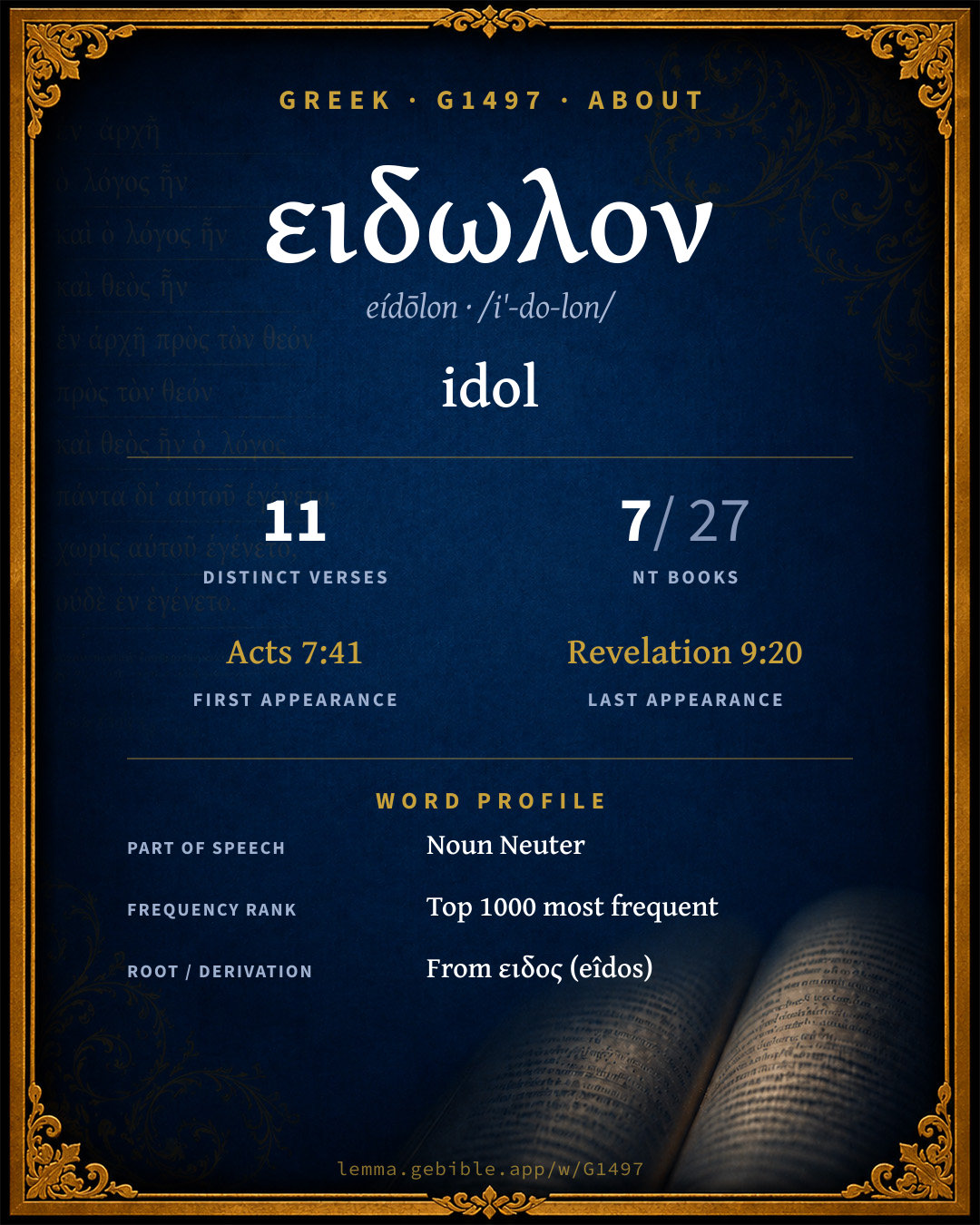
εἴδωλον
idol
‘idol’ is one of 4 main senses fuller range ↓
Full lexicon entry — Thayer's Greek Lexicon
From Thayer's Greek Lexicon
Where this word appears
See every Genitive-case word in the Greek New Testament →
Grammar key — what these labels mean
Part of speech
- Noun
- A naming word — a person, place, thing, or idea.
Case
- Genitive
- The case of source, possession, or “of” — answers “whose / from what.”
- Accusative
- The case of the direct object and of extent.
- Nominative
- The case of the subject (and the predicate nominative).
- Dative
- The case of the indirect object, means, or location — “to / for / with / in.”
Gender
- Neuter
- Grammatically neuter.
Number
- Plural
- More than one.
- Singular
- One.
Grammatical forms
- Noun, Genitive, Plural, Neuter 4 times (36%)
- Noun, Accusative, Plural, Neuter 3 times (27%)
- Noun, Nominative, Singular, Neuter 2 times (18%)
- Noun, Dative, Singular, Neuter 1 time (9%)
- Noun, Genitive, Singular, Neuter 1 time (9%)
Parsed forms decoded from the imported morphology (Robinson–Tischendorf, public domain), counted across 11 parsed occurrences — not distinct verses.
Every verse where G1497 appears — 11 distinct verses across 7 books. Click any verse to open its interlinear word-by-word view. Verse text shown in the World English Bible for context — . Each verse’s Greek form is shown with its reference; the English is not keyword-highlighted, since the data carries no word-level English alignment. Use “Compare translations” on any verse to read it across multiple English versions. This concordance covers the Greek New Testament; Septuagint (Greek Old Testament) occurrences of this word are not indexed here.
Acts 2 verses
- Acts 7:41 εἰδώλῳ n dat sg neut They made a calf in those days, and brought a sacrifice to the idol, and rejoiced in the works of their hands.
- Acts 15:20 εἰδώλων n gen pl neut but that we write to them that they abstain from the pollution of idols, from sexual immorality, from what is strangled, and from blood.
Romans 1 verse
1 Corinthians 4 verses
- 1 Corinthians 8:4 εἴδωλον n nom sg neut Therefore concerning the eating of things sacrificed to idols, we know that no idol is anything in the world, and that there is no other God but one.
- 1 Corinthians 8:7 εἰδώλου n gen sg neut However, that knowledge isn't in all men. But some, with consciousness of the idol until now, eat as of a thing sacrificed to an idol, and their conscience, being weak, is defiled.
- 1 Corinthians 10:19 εἴδωλόν n nom sg neut What am I saying then? That a thing sacrificed to idols is anything, or that an idol is anything?
- 1 Corinthians 12:2 εἴδωλα n acc pl neut You know that when you were heathen, you were led away to those mute idols, however you might be led.
2 Corinthians 1 verse
1 Thessalonians 1 verse
1 John 1 verse
Revelation 1 verse
About this entry
At a glance — auto-summarized from this page’s data, not written by a person. Every figure links to its source below. This summary describes the numbers; it doesn’t interpret them.
At its core, ειδωλον (eídōlon) means “idol.” Catalogued under 4 senses, its meaning is not single-sense. It turns up in 11 verses across 7 books, an uncommon footprint. The word gravitates to 1 Corinthians (36%), then Acts and Romans. Scripture first uses it in Acts 7:41. Dig into 11-verse concordance and the renderings breakdown below.
Gloss history
Strong's 1890 vs modern scholarship
About this word
Strong's G1497 catalogs a Greek word from the Greek New Testament.
These counts are not copied from any lexicon or concordance. They are computed here, from the morphology-tagged Greek New Testament. What Lemma adds →
- 11
- distinct verses
- The word appears in 11 distinct verses.
- 7 / 27
- NT books
- The word appears in 7 of 27 New Testament books.
- #978
- by frequency
- Top 1000 most frequent Greek words (rank 978 of 5,347 Greek words by occurrence).
View all 11 occurrences in the concordance →
Most concentrated in
- 1 Corinthians 4 verses 36%
- Acts 2 verses 18%
- Romans 1 verse 9%
By section of the New Testament
By traditional corpus
Conventional, traditional groupings — biblical authorship is debated, so this is a traditional corpus grouping, not an authorship claim. Some books belong to more than one corpus (Luke is in both the Gospels and the Lukan corpus, and so on), so these shares overlap and need not total 100%. Each figure is a share of the word’s 11 distinct verses.
- Pauline corpus 7 verses · 64%
- Lukan (Luke–Acts) 2 verses · 18%
- Johannine 2 verses · 18%
- General (Catholic) Epistles 1 verse · 9%
- Revelation 1 verse · 9%
How translations render this word
Counts come from each version’s own published word-to-Strong’s tagging or interlinear alignment — an approximate guide to how each version renders this word, not a word-level alignment the data otherwise carries. Because each total is that version’s own tagged count, the per-version totals vary from one another and need not match the appearance or distinct-verse counts above. These counts may also differ from a printed concordance because Lemma counts each distinctly tagged rendering and does not collapse phrase taggings into a single head-word total. This is a fixed set of word-tagged versions (KJV, ASV, BSB, ULT) and does not change with the reading translation you choose elsewhere. Each version’s license is shown beside its name below (and on Sources).
- King James Version: Idols 7×, Idol 4×
- American Standard Version: Idols 7×, Idol 3×
- Berean Standard Bible: Idols 7×, Idol 3×
- unfoldingWord Literal Text: Idols 8×, Idol 3×
King James Version Public Domain
Renders G1497 across 11 tagged occurrences — most commonly:
American Standard Version Public Domain
Renders G1497 across 11 tagged occurrences — most commonly:
Plus 1 rendering that appears only once — usually multi-word phrases or single function words the recovered tagging swept in, not distinct renderings.
Berean Standard Bible Public Domain
Renders G1497 across 11 tagged occurrences — most commonly:
Plus 1 rendering that appears only once — usually multi-word phrases or single function words the recovered tagging swept in, not distinct renderings.
unfoldingWord Literal Text CC BY-SA 4.0
Renders G1497 across 11 tagged occurrences — most commonly:
Senses in Thayer's
The 4 senses Thayer's distinguishes for this word, in lexicon order (not ranked by frequency or importance). The full entry — with sub-senses — is in the Lexicon Entry tab.
- i.e. whatever represents the form of an object, either real or imaginary
- used of the shades of the departed, apparitions, spectres, phantoms of the mind, etc.
- the image of an heathen god
- a false god
Word origin
Derived from ειδος (eîdos) (G1491) — appearance.
From G1491 ; an image (that is for worship); by implication a heathen god or (plural) the worship of such : - idol.
— Strong’s Exhaustive Concordance (1890), public domain.
Forms in the corpus
The 6 distinct written forms G1497 takes in the Greek New Testament, most frequent first — each parse links to that case’s occurrences in the concordance.
| Form | Parsing | Example | Uses |
|---|---|---|---|
| εἰδώλων eidṓlōn | Noun, Genitive, Plural, Neuter | Acts 15:20 | 4 |
| εἴδωλα eídōla | Noun, Accusative, Plural, Neuter | Romans 2:22 | 3 |
| εἰδώλου eidṓlou | Noun, Genitive, Singular, Neuter | 1 Corinthians 8:7 | 1 |
| εἰδώλῳ eidṓlō | Noun, Dative, Singular, Neuter | Acts 7:41 | 1 |
| εἴδωλον eídōlon | Noun, Nominative, Singular, Neuter | 1 Corinthians 8:4 | 1 |
| εἴδωλόν eídōlón | Noun, Nominative, Singular, Neuter | 1 Corinthians 10:19 | 1 |
Same root — word family
Other Thayer's entries built from the same root as G1497, grouped by Strong’s listed origin. These share a root / origin per the lexicon — not necessarily a shared meaning. Each links to that word’s own entry.
Derives from
Shares the same root
Derived from this word
- ειδωλειον eidōleîon G1493 idol temple
- ειδωλοθυτον eidōlóthyton G1494 idol meat
- ειδωλολατρεια eidōlolatreía G1495 idolatry
- ειδωλολατρης eidōlolátrēs G1496 idolater
Proper names from this root
People and places named from this root — a name, not an additional meaning of the word.
Compare all same-root words → Showing 4 of 8 — not the complete family. 1 of the same-root words is a proper name (a person or place). They share a root, not necessarily a meaning.
Septuagint usage
The same Greek word ειδωλον appears 72 times in the Greek Old Testament (Septuagint), across 69 verses in 19 books.
- 72
- LXX occurrences
- Tagged occurrences of this Greek word in the Septuagint.
- 69
- verses
- Distinct Septuagint verses containing this word.
- 19 / 39
- OT books
- The word appears in 19 of the 39 Old Testament books.
Sample Septuagint occurrences
- Genesis 31:19 εἴδωλον
- Exodus 20:4 εἴδωλον
- Leviticus 19:4 εἴδωλον
- Numbers 25:2 εἴδωλον
- Deuteronomy 5:8 εἴδωλον
- 1 Samuel 31:9 εἴδωλον
- 1 Kings 11:5 εἴδωλον
- 2 Kings 17:12 εἴδωλον
- 1 Chronicles 10:9 εἴδωλον
- 2 Chronicles 11:15 εἴδωλον
- Psalms 96:7 εἴδωλον
- Isaiah 1:29 εἴδωλον
Septuagint occurrences (same lexeme)
Every verse where the same Strong’s number (G1497) appears in the Greek Septuagint — showing the first 50 of 69. Verse text shown in the World English Bible for context; the Greek form is the matched word — the English is not keyword-highlighted.
- Genesis 31:19 εἴδωλον Now Laban had gone to shear his sheep: and Rachel stole the teraphim that were her father's.
- Genesis 31:34 εἴδωλον Now Rachel had taken the teraphim, put them in the camel's saddle, and sat on them. Laban felt about all the tent, but didn't find them.
- Genesis 31:35 εἴδωλον She said to her father, "Don't let my lord be angry that I can't rise up before you; for the manner of women is on me." He searched, but didn't find the teraphim.
- Exodus 20:4 εἴδωλον "You shall not make for yourselves an idol, nor any image of anything that is in the heavens above, or that is in the earth beneath, or that is in the water under the earth:
- Leviticus 19:4 εἴδωλον "'Don't turn to idols, nor make molten gods for yourselves. I am Yahweh your God.
- Leviticus 26:30 εἴδωλον I will destroy your high places, and cut down your incense altars, and cast your dead bodies upon the bodies of your idols; and my soul will abhor you.
- Numbers 25:2 εἴδωλον for they called the people to the sacrifices of their gods; and the people ate, and bowed down to their gods.
- Numbers 33:52 εἴδωλον then you shall drive out all the inhabitants of the land from before you, and destroy all their figured [stones], and destroy all their molten images, and demolish all their high places:
- Deuteronomy 5:8 εἴδωλον "You shall not make an engraved image for yourself, [nor] any likeness [of anything] that is in heaven above, or that is in the earth beneath, or that is in the water under the earth:
- Deuteronomy 29:16 εἴδωλον (for you know how we lived in the land of Egypt, and how we came through the midst of the nations through which you passed;
- Deuteronomy 32:21 εἴδωλον They have moved me to jealousy with that which is not God; They have provoked me to anger with their vanities: I will move them to jealousy with those who are not a people; I will provoke them to anger with a foolish nation.
- 1 Samuel 31:9 εἴδωλον They cut off his head, and stripped off his armor, and sent into the land of the Philistines round about, to carry the news to the house of their idols, and to the people.
- 1 Kings 11:5 εἴδωλον For Solomon went after Ashtoreth the goddess of the Sidonians, and after Milcom the abomination of the Ammonites.
- 1 Kings 11:7 εἴδωλον Then did Solomon build a high place for Chemosh the abomination of Moab, on the mountain that is before Jerusalem, and for Molech the abomination of the children of Ammon.
- 1 Kings 11:33 εἴδωλον because that they have forsaken me, and have worshiped Ashtoreth the goddess of the Sidonians, Chemosh the god of Moab, and Milcom the god of the children of Ammon; and they have not walked in my ways, to do that which is right in my eyes, and [to keep] my statutes and my ordinances, as did David his father.
- 2 Kings 17:12 εἴδωλον and they served idols, of which Yahweh had said to them, You shall not do this thing.
- 2 Kings 21:11 εἴδωλον Because Manasseh king of Judah has done these abominations, and has done wickedly above all that the Amorites did, who were before him, and has made Judah also to sin with his idols;
- 2 Kings 21:21 εἴδωλον He walked in all the way that his father walked in, and served the idols that his father served, and worshiped them:
- 2 Kings 23:24 εἴδωλον Moreover those who had familiar spirits, and the wizards, and the teraphim, and the idols, and all the abominations that were seen in the land of Judah and in Jerusalem, did Josiah put away, that he might confirm the words of the law which were written in the book that Hilkiah the priest found in the house of Yahweh.
- 1 Chronicles 10:9 εἴδωλον They stripped him, and took his head, and his armor, and sent into the land of the Philistines round about, to carry the news to their idols, and to the people.
- 1 Chronicles 16:26 εἴδωλον For all the gods of the peoples are idols: But Yahweh made the heavens.
- 2 Chronicles 11:15 εἴδωλον and he appointed him priests for the high places, and for the male goats, and for the calves which he had made.
- 2 Chronicles 14:4 εἴδωλον and commanded Judah to seek Yahweh, the God of their fathers, and to do the law and the commandment.
- 2 Chronicles 15:16 εἴδωλον Also Maacah, the mother of Asa the king, he removed from being queen, because she had made an abominable image for an Asherah; and Asa cut down her image, and made dust of it, and burnt it at the brook Kidron.
- 2 Chronicles 17:3 εἴδωλον Yahweh was with Jehoshaphat, because he walked in the first ways of his father David, and didn't seek the Baals,
- 2 Chronicles 23:17 εἴδωλον All the people went to the house of Baal, and broke it down, and broke his altars and his images in pieces, and killed Mattan the priest of Baal before the altars.
- 2 Chronicles 24:18 εἴδωλον They forsook the house of Yahweh, the God of their fathers, and served the Asherim and the idols: and wrath came on Judah and Jerusalem for this their guiltiness.
- 2 Chronicles 28:2 εἴδωλον but he walked in the ways of the kings of Israel, and made also molten images for the Baals.
- 2 Chronicles 33:22 εἴδωλον He did that which was evil in the sight of Yahweh, as did Manasseh his father; and Amon sacrificed to all the engraved images which Manasseh his father had made, and served them.
- 2 Chronicles 34:7 εἴδωλον He broke down the altars, and beat the Asherim and the engraved images into powder, and hewed down all the sun-images throughout all the land of Israel, and returned to Jerusalem.
- 2 Chronicles 35:19 εἴδωλον In the eighteenth year of the reign of Josiah was this Passover kept.
- Psalms 96:7 εἴδωλον Ascribe to Yahweh, you families of nations, Ascribe to Yahweh glory and strength.
- Psalms 113:12 εἴδωλον
- Psalms 134:15 εἴδωλον
- Psalms 151:6 εἴδωλον
- Isaiah 1:29 εἴδωλον For they shall be ashamed of the oaks which you have desired, And you shall be confounded for the gardens that you have chosen.
- Isaiah 10:11 εἴδωλον shall I not, as I have done to Samaria and her idols, so do to Jerusalem and her idols?
- Isaiah 27:9 εἴδωλον Therefore by this shall the iniquity of Jacob be forgiven, and this is all the fruit of taking away his sin: that he makes all the stones of the altar as chalk stones that are beaten in sunder, [so that] the Asherim and the sun-images shall rise no more.
- Isaiah 30:22 εἴδωλον You shall defile the overlaying of your engraved images of silver, and the plating of your molten images of gold: you shall cast them away as an unclean thing; you shall tell it, Get you hence.
- Isaiah 37:19 εἴδωλον and have cast their gods into the fire: for they were no gods, but the work of men's hands, wood and stone; therefore they have destroyed them.
- Isaiah 41:28 εἴδωλον When I look, there is no man: even among them there is no counselor who, when I ask of them, can answer a word.
- Isaiah 48:5 εἴδωλον therefore I have declared it to you from of old; before it came to pass I shown it you; lest you should say, My idol has done them, and my engraved image, and my molten image, has commanded them.
- Isaiah 57:5 εἴδωλον you who inflame yourselves among the oaks, under every green tree; who kill the children in the valleys, under the clefts of the rocks?
- Jeremiah 9:13 εἴδωλον Yahweh says, Because they have forsaken my law which I set before them, and have not obeyed my voice, neither walked therein,
- Jeremiah 14:22 εἴδωλον Are there any among the vanities of the nations that can cause rain? or can the sky give showers? Aren't you he, Yahweh our God? therefore we will wait for you; for you have made all these things.
- Jeremiah 16:19 εἴδωλον Yahweh, my strength, and my stronghold, and my refuge in the day of affliction, to you shall the nations come from the ends of the earth, and shall say, Our fathers have inherited nothing but lies, [even] vanity and things in which there is no profit.
- Ezekiel 6:4 εἴδωλον Your altars shall become desolate, and your sun-images shall be broken; and I will cast down your slain men before your idols.
- Ezekiel 6:6 εἴδωλον In all your dwelling-places the cities shall be laid waste, and the high places shall be desolate; that your altars may be laid waste and made desolate, and your idols may be broken and cease, and your sun-images may be hewn down, and your works may be abolished.
- Ezekiel 6:13 εἴδωλον You shall know that I am Yahweh, when their slain men shall be among their idols round about their altars, on every high hill, on all the tops of the mountains, and under every green tree, and under every thick oak, the places where they offered sweet savor to all their idols.
- Ezekiel 8:10 εἴδωλον So I went in and saw; and see, every form of creeping things, and abominable animals, and all the idols of the house of Israel, portrayed on the wall round about.
These are occurrences of the same Greek lexeme (G1497) in the Septuagint — not a translation of any one Hebrew word. The store carries no word-level Hebrew↔Greek alignment, so no Hebrew original is asserted here. Counts come from the recovered LXX Strong's tagging — high-frequency vocabulary is well covered, while rare or late forms may be untagged — so they reflect tagged occurrences and may slightly undercount.