Isaiah 37:19

Hebrew (Westminster Leningrad Codex) Isaiah 37:19 appears in the Hebrew Old Testament. The text above is from the Westminster Leningrad Codex. Each word links to its Strong’s number, a concise gloss, and parsing drawn from the Open Scriptures Hebrew Bible morphology. Click any word for its full Brown-Driver-Briggs (BDB) entry.
Download image
Cite this verse

Isaiah 37:19 (World English Bible). Public Domain. Lemma interlinear Bible study tool, https://lemma.gebible.app/v/isaiah/37/19.

Show BibTeX & RIS
BibTeX
RIS
English Translation
and have cast their gods into the fire: for they were no gods, but the work of men's hands, wood and stone; therefore they have destroyed them.
World English Bible · Public Domain
Download a study sheet

One document with this verse’s original text, its word-by-word gloss line, the meaning frame, cross-references with their text, attributed commentary, and full source and license credits — printable, and it pastes into notes with its structure intact.

This verse Autodidact and up

Study sheet (.html) Plain text (.txt)

A passage Seminary Student

Up to 50 verses in one chapter. A passage sheet keeps up to 6 commentary sources and 12 cross-references per verse, in the order this page ranks them, and says so on the sheet whenever that leaves anything out. Ask for a single verse and you get the Autodidact verse sheet above.

Everything on this page stays free to read, with no account — the sheet is a download of what is already on screen, not access to it.

Want to remove ads? Support Godless Engineer
Compare translations 3

The same verse in 3 English versions, stacked beneath the original-language interlinear above. Click any original word for its lexicon entry.

Each is an independent rendering of the whole verse — the interlinear is not word-aligned to these translations.

Highlighted words mark where these versions differ — a whole-verse word diff, not a word-by-word alignment.

  • World English Bible Public Domain
    and have cast their gods into the fire: for they were no gods, but the work of men's hands, wood and stone; therefore they have destroyed them.
  • King James Version Public Domain
    And have cast their gods into the fire: for they were no gods, but the work of men's hands, wood and stone: therefore they have destroyed them.
  • unfoldingWord Literal Text CC BY-SA 4.0
    And they have put their gods in the fire, for they not gods, but rather the work of the hands of man, wood and stone, and they have destroyed them.

unfoldingWord Literal Text — © unfoldingWord, licensed CC BY-SA 4.0. Word-aligned USFM3 via Door43 (git.door43.org/unfoldingWord/en_ult).

Versions to compare (up to 4)

3 of 4 selected

Show all 18 translations

Every available English version of this verse, each an independent rendering of the whole verse.

  • World English Bible Public Domain
    and have cast their gods into the fire: for they were no gods, but the work of men's hands, wood and stone; therefore they have destroyed them.
  • Berean Standard Bible Public Domain
    They have cast their gods into the fire and destroyed them, for they were not gods, but only wood and stone—the work of human hands.
  • Majority Standard Bible Public Domain
    They have cast their gods into the fire and destroyed them, for they were not gods, but only wood and stone—the work of human hands.
  • King James Version Public Domain
    And have cast their gods into the fire: for they were no gods, but the work of men's hands, wood and stone: therefore they have destroyed them.
  • American Standard Version (1901) Public Domain
    and have cast their gods into the fire: for they were no gods, but the work of men's hands, wood and stone; therefore they have destroyed them.
  • Revised Version (1885) Public Domain
    and have cast their gods into the fire: for they were no gods, but the work of men’s hands, wood and stone; therefore they have destroyed them.
  • Geneva Bible (1599) Public Domain
    And haue cast their gods in ye fire: for they were no gods, but the worke of mans hands, euen wood or stone: therefore they destroyed them.
  • Douay-Rheims (1899) Public Domain
    And they have cast their gods into the fire, for they were not gods, but the works of men's hands, of wood and stone: and they broke them in pieces.
  • Young's Literal Translation Public Domain
    so as to put their gods into fire -- for they `are' no gods, but work of the hands of man, wood and stone -- and they destroy them.
  • Literal Standard Version CC BY-SA 4.0
    so as to put their gods into fire—for they [are] no gods, but work of the hands of man, wood and stone—and they destroy them.
  • Unlocked Literal Bible CC BY-SA 4.0
    They have put their gods into the fire, for they were not gods but the work of men's hands, just wood and stone. So the Assyrians have destroyed them.
  • unfoldingWord Literal Text CC BY-SA 4.0
    And they have put their gods in the fire, for they not gods, but rather the work of the hands of man, wood and stone, and they have destroyed them.
  • Darby Bible Public Domain
    and have cast their gods into the fire; for they were no gods, but the work of men's hands, wood and stone; and they have destroyed them.
  • World Messianic Bible Public Domain
    and have cast their gods into the fire; for they were no gods, but the work of men’s hands, wood and stone; therefore they have destroyed them.
  • Webster's Bible Public Domain
    And have cast their gods into the fire: for they were no gods, but the work of men's hands, wood and stone: therefore they have destroyed them.
  • Free Bible Version CC BY-SA 4.0
    They have thrown their gods into the fire because they are not really gods—they are just the work of human hands, made of wood and stone so they could destroy them.
  • Bible in Basic English Public Domain
    And have given their gods to the fire: for they were no gods, but wood and stone, the work of men's hands; so they have given them to destruction.
  • JPS Tanakh (1917) Public Domain
    and have cast their gods into the fire; for they were no gods, but the work of men's hands, wood and stone; therefore they have destroyed them.

Literal Standard Version (2020), Covenant Press — licensed CC BY-SA 4.0. Text via the HelloAO Bible API (eBible.org). Unlocked Literal Bible (unfoldingWord) — licensed CC BY-SA 4.0. Text via the HelloAO Bible API (eBible.org). unfoldingWord Literal Text — © unfoldingWord, licensed CC BY-SA 4.0. Word-aligned USFM3 via Door43 (git.door43.org/unfoldingWord/en_ult). Free Bible Version, Dr. Jonathan Gallagher — licensed CC BY-SA 4.0. Text via the HelloAO Bible API (eBible.org).

Word by word

More ways to search: Search by grammar → Find every occurrence → Compare this word →

Practice this passage: Drill this verse → Learn its vocabulary →

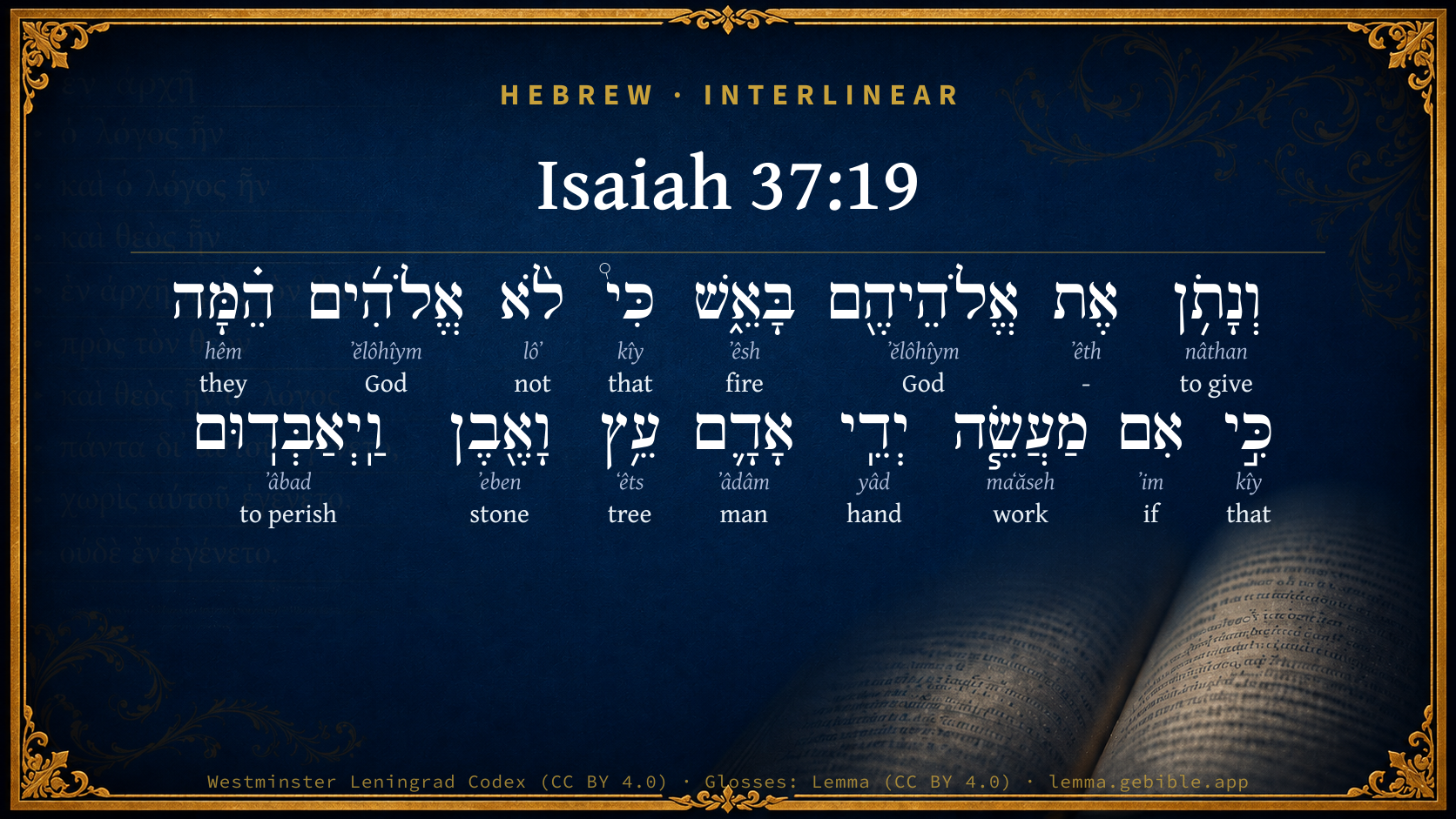
וַֽיְאַבְּדֽוּם
ʼâbad
H6
“and · to perish · them”
Conjunction + Verb, Piel, Sequential Imperfect, 3rd Person, Masculine, Plural + Suffix, Personal, 3rd Person, Masculine, Plural
Part of Speech
Conjunction + Verb
Stem
Piel
Form
Sequential Imperfect
Person
3rd Person
Gender
Masculine
Number
Plural
Full BDB Definition

Origin: a primitive root

TWOT: 2

perish, vanish, go astray, be destroyed - (Qal) - perish, die, be exterminated - perish, vanish (figuratively) - be lost, strayed - (Piel) - to destroy, kill, cause to perish, to give up - to blot out, do away with, cause to vanish, (figuratively) - cause to stray, lose - (Hiphil) - to destroy, put to death - of divine judgment - object name of kings (figuratively)
  1. וְנָתֹ֥ן nâthan H5414 “and · to give” Conjunction + Verb, Qal, Infinitive Absolute
  2. אֶת ʼêth H853 “-” Particle, Direct Object
  3. אֱלֹהֵיהֶ֖ם ʼĕlôhîym H430 “God(s) · their” Noun, Common, Masculine, Plural, Construct + Suffix, Personal, 3rd Person, Masculine, Plural
  4. בָּאֵ֑שׁ ʼêsh H784 “in/at the · fire” Preposition, Determined + Noun, Common, Both, Singular, Absolute
  5. כִּי֩ kîy H3588 “that” Conjunction
  6. לֹ֨א lôʼ H3808 “not” Particle, Negative
  7. אֱלֹהִ֜ים ʼĕlôhîym H430 “God(s)” Noun, Common, Masculine, Plural, Absolute
  8. הֵ֗מָּה hêm H1992 “they” Pronoun, Personal, 3rd Person, Masculine, Plural
  9. כִּ֣י kîy H3588 “that” Conjunction
  10. אִם ʼim H518 “if” Conjunction
  11. מַעֲשֵׂ֧ה maʻăseh H4639 “work of” Noun, Common, Masculine, Singular, Construct
  12. יְדֵֽי yâd H3027 “hands of” Noun, Common, Both, Dual, Construct
  13. אָדָ֛ם ʼâdâm H120 “man” Noun, Common, Masculine, Singular, Absolute
  14. עֵ֥ץ ʻêts H6086 “tree” Noun, Common, Masculine, Singular, Absolute
  15. וָאֶ֖בֶן ʼeben H68 “and · stone” Conjunction + Noun, Common, Feminine, Singular, Absolute

About this verse

These counts appear in no published source. They are computed here, from the morphology-tagged text and Lemma’s own curated glosses. What Lemma adds →

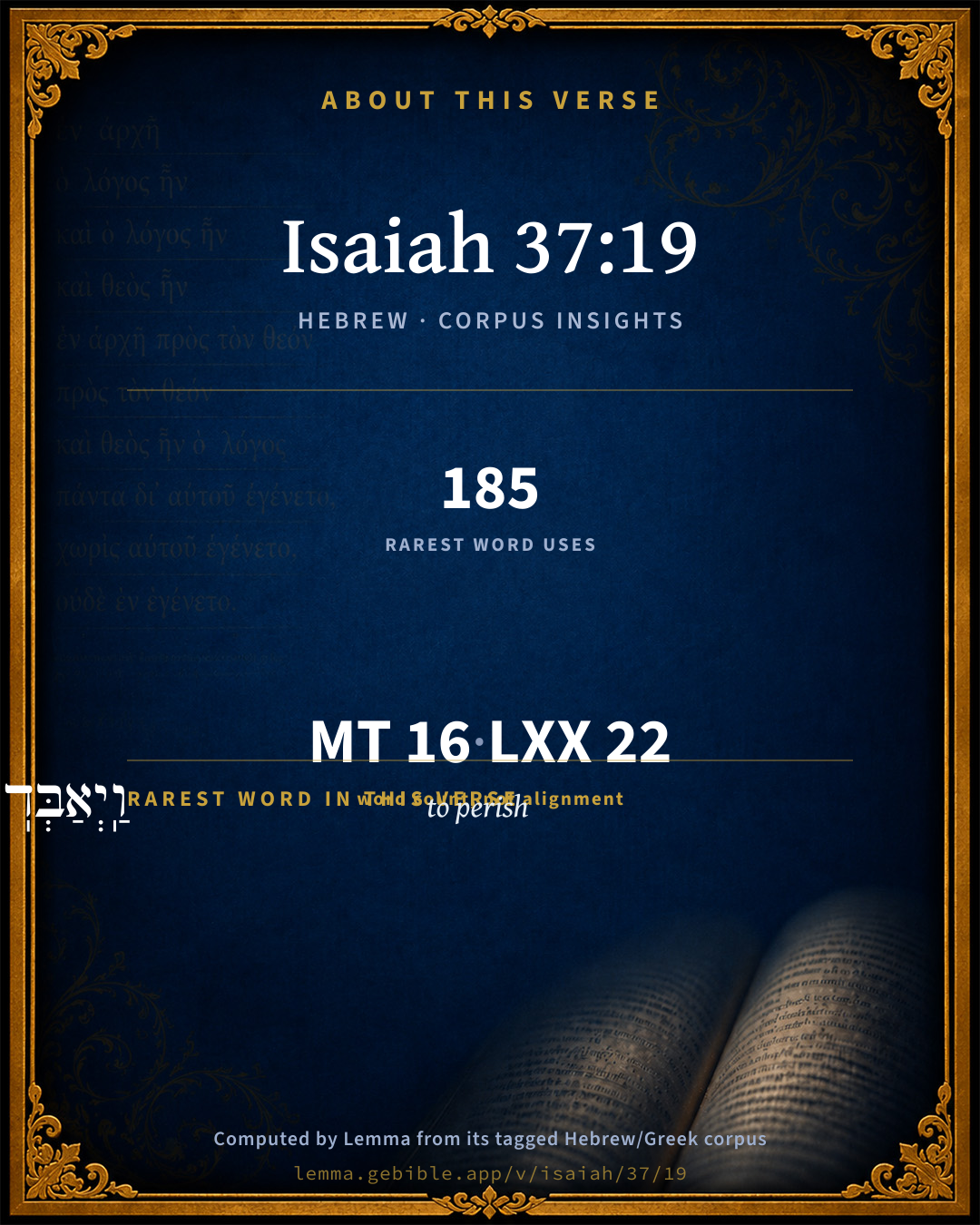
16
words
14
distinct lemmas
Prophets
section

Grammatical profile

  • 2 verbs
  • 8 nouns
  • 1 pronoun
  • 3 conjunctions
  • 2 particles

Verb forms

  • וְנָתֹ֥ן Qal · Infinitive Absolute
  • וַֽיְאַבְּדֽוּם Piel · Sequential Imperfect

Repetition

Words recur within this verse — often emphatic in Hebrew:

  • אֱלֹהֵיהֶ֖ם God H430 ×2
  • כִּי֩ that H3588 ×2

Hebrew & Septuagint length

In English translation the verse runs 27 words from the Hebrew and 28 from the Septuagint (LXX English) — closely comparable.

A rough comparison of the two English renderings, which tokenize alike — not a word-level alignment.

Word counts can differ between the Hebrew and the Greek without any difference in meaning — e.g. the Hebrew direct-object marker אֵת has no separate Greek word, and Greek often adds the article ὁ.

In the original languages it is 16 Hebrew tokens and 22 Greek tokens — but the two are counted differently (Hebrew bundles its prefixes and suffixes into one token; the Greek is in lemma form), so that isn’t a like-for-like length.

Cross-references

16

Topical passages linked to Isaiah 37:19 in the Treasury of Scripture Knowledge — connected by theme and wording, ordered by reader-vote popularity; previews shown in the World English Bible.

  • Exodus 32:20 He took the calf which they had made, and burnt it with fire, ground it to powder, and scattered it on the water, and made the children of Israel drink of it.
  • 2 Samuel 5:21 They left their images there; and David and his men took them away.
  • Psalms 115:4–8 Their idols are silver and gold, The work of men's hands.
  • Isaiah 10:9–11 Isn't Calno as Carchemish? Isn't Hamath as Arpad? Isn't Samaria as Damascus?
  • Isaiah 26:14 [They are] dead, they shall not live; [they are] deceased, they shall not rise: therefore have you visited and destroyed them, and made all memory of them to perish.
  • Isaiah 36:18–20 Beware lest Hezekiah persuade you, saying, Yahweh will deliver us. Has any of the gods of the nations delivered his land out of the hand of the king of Assyria?
  • Isaiah 40:19–21 The image, a workman has cast [it], and the goldsmith overlays it with gold, and casts [for it] silver chains.
  • Isaiah 41:7 So the carpenter encourages the goldsmith, [and] he who smoothes with the hammer him who strikes the anvil, saying of the soldering, It is good; and he fastens it with nails, that is should not be moved.
  • Isaiah 41:24 Behold, you are of nothing, and your work is of nothing; an abomination is he who chooses you.
  • Isaiah 41:29 Behold, all of them, their works are vanity [and] nothing; their molten images are wind and confusion.
  • Isaiah 44:9–10 Those who fashion an engraved image are all of them vanity; and the things that they delight in shall not profit; and their own witnesses don't see, nor know: that they may be disappointed.
  • Isaiah 44:17 The residue of it he makes a god, even his engraved image; he falls down to it and worships, and prays to it, and says, Deliver me; for you are my god.
  • Isaiah 46:1–2 Bel bows down, Nebo stoops; their idols are on the animals, and on the cattle: the things that you carried about are made a load, a burden to the weary [animal].
  • Jeremiah 10:3–6 For the customs of the peoples are vanity; for one cuts a tree out of the forest, the work of the hands of the workman with the axe.
  • Jeremiah 10:11 Thus shall you say to them, The gods that have not made the heavens and the earth, these shall perish from the earth, and from under the heavens.
  • Hosea 8:6 For this is even from Israel! The workman made it, and it is no God; Indeed, the calf of Samaria shall be broken in pieces.

Cross-references courtesy of OpenBible.info (CC BY 4.0).

Hebrew and Greek witnesses Masoretic Hebrew ↔ Greek Septuagint

The same verse in the two great witnesses to the Old Testament, shown verse-for-verse.

These are two independent witnesses, not word-aligned to each other, and the Septuagint is shown in lemma (dictionary) form.

Hebrew Isaiah 37:19 Masoretic · Westminster Leningrad Codex

וְנָתֹ֥ן אֶת אֱלֹהֵיהֶ֖ם בָּאֵ֑שׁ כִּי֩ לֹ֨א אֱלֹהִ֜ים הֵ֗מָּה כִּ֣י אִם מַעֲשֵׂ֧ה יְדֵֽי אָדָ֛ם עֵ֥ץ וָאֶ֖בֶן וַֽיְאַבְּדֽוּם

and have cast their gods into the fire: for they were no gods, but the work of men's hands, wood and stone; therefore they have destroyed them.

World English Bible · Public Domain

Greek LXX Isaiah 37:19 Septuagint · lemma form

καί ἐνβάλλω ὁ εἴδωλον αὐτός εἰς ὁ πῦρ οὐ γάρ θεός εἰμί ἀλλά ἔργον χείρ ἄνθρωπος ξύλον καί λίθος καί ἀποὀλλύω αὐτός

and have cast their idols into the fire: for, they were no gods, but the work of men's hands, wood and stone; and they have cast them away.

LXX2012 (modern English Septuagint) · Public Domain

On this verse, John Gill's Exposition discusses the Septuagint’s reading. Read the note in Commentary ↓

Hebrew: Westminster Leningrad Codex (CC BY 4.0). Greek: Septuagint (public domain); English from LXX2012 (modern English Septuagint) (Public Domain). How the Septuagint differs from the Hebrew →

Targum (Aramaic paraphrase)

1

The Targum is the ancient Jewish Aramaic paraphrase of the Hebrew Scriptures — an interpretive translation, not the Hebrew text itself. Onkelos (literal) and Pseudo-Jonathan (expansive) render the Torah, and Jonathan the Prophets. Coverage is partial: where no permissively-licensed English translation exists for a verse, only the Aramaic is shown. This is verse-level text, not a word-by-word alignment to the Hebrew.

  1. Targum Jonathan Prophets (Joshua–Malachi)
    וּמוֹקְדִין יַת טַעֲוַתְהוֹן בְּנוּרָא אֲרֵי לָא טַעֲוָן דְאִית בְּהוֹן צְרוֹךְ אִינוּן אֱלָהֵין עוֹבַד יְדֵי אֱנָשָׁא אָעָא וְאַבְנָא וְאַבְּדוּנוּן:

    And have burnt their gods in the fire: for they were no gods, they are of no use, but they are the work of men's hands, wood and stone, therefore they have destroyed them.

    Targum Jonathan — Aramaic: “Mikraot Gedolot” (public domain). English: “Sefaria Community Translation” (CC0 1.0 (public-domain dedication)); “London "Chaldee Paraphrase," 1871” (public domain). Text via Sefaria.

Commentary

Notes on Isaiah 37:19 from classic Christian and Jewish commentators (each source and its license shown beneath its notes). The classic Christian expositions comment on the surrounding passage and are grouped to its opening verse, so a note may address several verses; the Jewish commentaries on the Tanakh (Rashi and others) are per-verse, so they appear only where the commentator wrote on this verse.

Lemma curates 59 commentaries, every one of them public domain or Creative Commons licensed, each selected and text-cleaned for this edition rather than reprinted as found. About our sources →

Jamieson, Fausset & Brown

Robert Jamieson, A. R. Fausset & David Brown

cast . . . gods into . . . fire--The policy of the Assyrians in order to alienate the conquered peoples from their own countries was, both to deport them elsewhere, and to destroy the tutelary idols of their nation, the strongest tie which bound them to their native land. The Roman policy was just the reverse.

Jamieson, Fausset & Brown — Commentary Critical and Explanatory on the Whole Bible (1871) — public domain (CC PDM 1.0). Text via the HelloAO Bible API.

The Cambridge Bible for Schools and Colleges

gen. ed. J. J. S. Perowne

19. the work of men’s hands] Cf. ch. Isa_2:20, Isa_17:8, Isa_31:7.

wood and stone] Deu_4:28; Deu_28:36; Deu_28:64; Deu_29:17; Eze_20:32.

The Cambridge Bible for Schools and Colleges (gen. ed. J. J. S. Perowne; Cambridge University Press, 1878–1918) — public domain. Text from a community e-Sword module.

John Gill's Exposition

Then Isaiah the son of Amoz sent unto Hezekiah, saying,.... Isaiah, by a spirit of prophecy, was made acquainted by the Lord both with the prayer of Hezekiah, and the Lord's answer to it; and therefore immediately sent to the king, who was either at the temple praying, or was returned to the palace, to let him know, the mind of the Lord in this matter. The Septuagint and Syriac versions render it, "and Isaiah the son of Amoz was sent to Hezekiah"; but this does not agree with the Hebrew text; Isaiah sent messengers to the king, and by them informed him what the Lord had said in answer to his prayer. Why he went not himself cannot be said:

thus saith the Lord God of Israel; Hezekiah had been praying to him under that title and character, Isa 37:16,

whereas thou hast prayed to me against Sennacherib king of Assyria: or, "what thou hast prayed", &c. (n); the Septuagint, Syriac, and Arabic versions, supply, "I have heard". It is bad for any to have the prayers of good men against them.

(n) "quae preeatus es", Vatablus; "quod attinet ad id quod oravisti", Piscator.

John Gill's Exposition of the Whole Bible (1746–1763) — public domain (CC PDM 1.0). Text via the HelloAO Bible API.

Albert Barnes' Notes on the Bible

And have cast their gods into the fire - This appears to have been the usual policy of the Assyrians and Babylonians. It was contrary to the policy which the Romans afterward pursued, for they admitted the gods of other nations among their own, and even allowed them to have a place in the Pantheon. Their design seems not to have been to alienate the feelings of the vanquished, but to make them feel that they were a part of the same people. They supposed that a vanquished people would be conciliated with the idea that their gods were admitted to participate in the honors of those which were worshipped by the conquerors of the world. But the policy of the Eastern conquerors was different. They began usually by removing the people themselves whom they had subdued, to another land (see the note at Isa 36:17). They thus intended to alienate their minds as much as possible from their own country. They laid everything waste by fire and sword, and thus destroyed their homes, and all the objects of their attachment. They destroyed their temples, their groves, and their household gods. They well knew that the civil policy of the nation was founded in religion, and that, to subdue them effectually, it was necessary to abolish their religion. Which was the wisest policy, may indeed admit of question. Perhaps in each case the policy was well adapted to the particular end which was had in view.

For they were no gods - They were not truly gods, and therefore they had no power of resistance, and it was easy to destroy them.

Albert Barnes' Notes on the Bible (1834–1885) — public domain. Text from a community e-Sword/MySword module.

The Pulpit Commentary

And have cast their gods into the fire. The more valuable of the foreign idols were usually carried off by the Assyrians, and placed in the shrines of their own gods as trophies of victory; but no doubt great numbers of the inferior idols. which were of wood, not even coated with metal the xoana of the Greeks were burnt. For they were no gods. (Jer_2:11 Jer_5:7 Jer_16:20, etc.) Isaiah"s favourite word for idols" is elilim , which is, etymologically, not-gods". (Isa_2:8, Isa_2:18, 20 10:10, 11 19:1, 3 31:7) The work of men"s hands. (see Isa_2:8 Isa_40:19 Isa_41:7, etc.) The absurdity of men"s worshipping as gods what their own hands had made is ever increasingly ridiculed by the religious Jews. (comp. Psa_115:4-8 Isa_44:9-20 Jer_10:3-15; "Ep of Jeremy," 8-73)

The Pulpit Commentary (1880–1919), ed. H.D.M. Spence-Jones & Joseph S. Exell — public domain. Text from a community e-Sword module.

J. A. Alexander on Isaiah

Joseph Addison Alexander

“And given (or put) their gods into the fire, for they (were) no gods, but wood and stone, the work of men’s hands-and destroyed them.” The application of the word gods to the mere external image is common in profane as well as sacred writings, and arises from the fact that all idolaters, whatever they may theoretically hold as to the nature of their deities, identify them practically with the stocks and stones to which they pay their adorations.

Joseph Addison Alexander, The Prophecies of Isaiah (1846–1847; New York: Scribner, 1870–1878) — public domain. Text from a community e-Sword module.

unfoldingWord translationNotes

Door43 World Missions Community

General Information:

Hezekiah continues praying to Yahweh.

for they were not gods but the work of men's hands, just wood and stone

This emphasizes that humans made these idols with their own hands and are therefore worthless. AT: "because they were false gods that men made out of wood and stone" (See: Synecdoche)

from his power

"from the king of Assyria's power"

all the kingdoms

This refers to the people in the kingdoms. AT: "all the people in the kingdoms" (See: Metonymy)

you are Yahweh alone

"only you, Yahweh, are God"

translationWords

false god

fire

hand

Assyria

Yahweh

God

save

power

kingdom

earth

know

unfoldingWord translationNotes — © Distant Shores Media and the Door43 World Missions Community, licensed CC BY-SA 4.0. Source: git.door43.org/Door43/en_tn.

Rashi

Rabbi Shlomo Yitzchaki (Rashi)

And committing (Heb. וְנָתֹן). Comp. (Gen. 41:43) “And appointing (וְנָתוֹן) him over all the land of Egypt,” an expression of the infinitive. Comp. “saying” (אָמוֹר), “remembering” (זָכוֹר), (donnant in French, giving).

wood and stone are they; therefore, they had no power, and the king of Assyria destroyed them.

Rashi on the Tanakh — English translations: “The Judaica Press complete Tanach with Rashi, translated by A. J. Rosenberg” (CC BY 4.0); “Pentateuch with Rashi's commentary by M. Rosenbaum and A.M. Silbermann, 1929-1934” (public domain); “The Metsudah Tanach series, Lakewood, N.J” (CC BY 4.0); and “The Book of Joshua, Metsudah Publications, 1997” (CC BY 4.0). Text via Sefaria.

Lesson kit

Teaching starters — assembled from the data on this page, not authored interpretation. Every prompt links to the verse data it draws on. Edit before teaching.

Isaiah, in the Prophets, opens this verse with 16 words (14 distinct Hebrew lemmas). Its most distinctive word is ʼâbad (“to perish”). A historical commentator’s framing appears above. Read the whole chapter for the surrounding context.

Discussion questions

  1. The word ʼâbad carries the sense “to perish.” How does it shape the verse?
  2. How does Exodus 32:20, which shares this passage’s theme, read alongside this verse?
  3. What does the repetition of “God” (2× in this one verse) do in this verse?
  4. These translations render this verse differently. What is at stake in choosing one wording over another?
  5. «וְנָתֹ֥ן» is a Qal Infinitive Absolute verb. How does that grammatical form shape the action described?
  6. Compare how Jamieson, Fausset & Brown and The Cambridge Bible for Schools and Colleges read this verse. Where do they agree or differ?

Things to notice

Reading settings

Reading text

Shown beneath each verse's original-language words.

Old Testament
Old Testament edition

Read the OT as the Masoretic Hebrew (MT) or the Greek Septuagint (LXX).

English shown for the Greek Septuagint (in the Hebrew ↔ Greek comparison).

Comparing translations? Open the Compare panel on any verse page to stack up to four side by side.