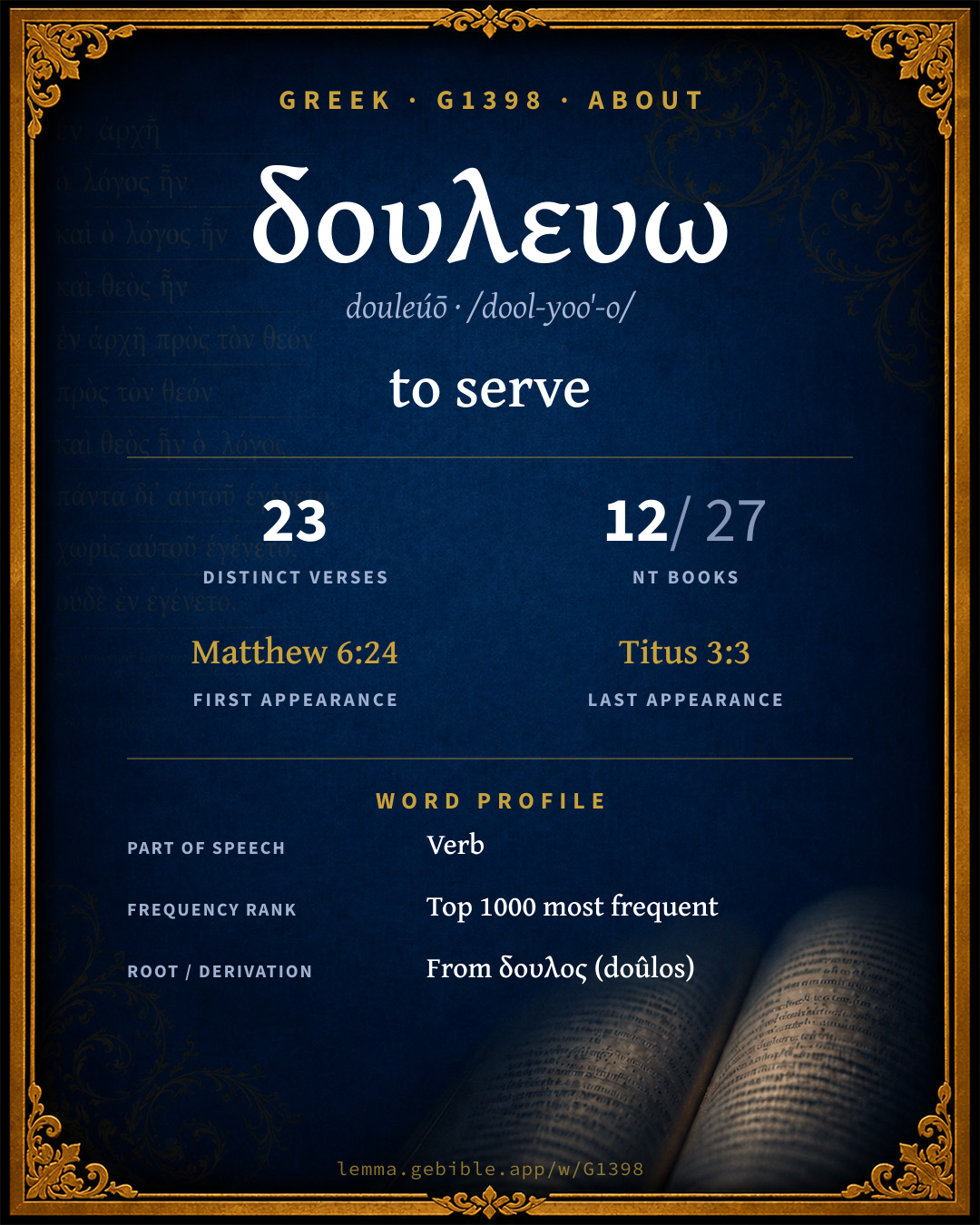
δουλεύω
to serve
‘to serve’ is one of 2 main senses fuller range ↓
Full lexicon entry — Thayer's Greek Lexicon
From Thayer's Greek Lexicon
Where this word appears
See every Present-tense verb in the Greek New Testament →
Grammar key — what these labels mean
Part of speech
- Verb
- An action or state-of-being word.
Tense
- Present
- Ongoing or general action in present time (imperfective aspect).
- Aorist
- Action viewed as a simple whole, without regard to duration — often past (perfective aspect).
- Future
- Action expected in future time.
- Perfect
- A completed past action with continuing present results.
Voice
- Active
- The subject performs the action.
Mood
- Infinitive
- A verbal noun (“to write”), unmarked for person or number.
- Participle
- A verbal adjective (“writing,” “having written”).
- Indicative
- States a fact or asks a factual question (the mood of reality).
- Imperative
- Expresses a command or request.
Case
- Nominative
- The case of the subject (and the predicate nominative).
Person
- 1st person
- The speaker (“I / we”).
- 2nd person
- The one addressed (“you”).
- 3rd person
- The one spoken about (“he / she / it / they”).
Gender
- Masculine
- Grammatically masculine.
Number
- Plural
- More than one.
- Singular
- One.
1 verse where G1398 appears in the Future tense in the Book of Romans. Filtered view — show all forms. Click any verse to open its interlinear word-by-word view. Verse text shown in the World English Bible for context — . Each verse’s Greek form is shown with its reference; the English is not keyword-highlighted, since the data carries no word-level English alignment. Use “Compare translations” on any verse to read it across multiple English versions. This concordance covers the Greek New Testament; Septuagint (Greek Old Testament) occurrences of this word are not indexed here.
Romans
About this entry
At a glance — auto-summarized from this page’s data, not written by a person. Every figure links to its source below. This summary describes the numbers; it doesn’t interpret them.
At its core, δουλευω (douleúō) means “to serve.” Scripture first uses it in Matthew 6:24. It turns up in 23 verses across 12 books, an uncommon footprint. The word gravitates to Romans (30%), then Galatians and Luke. Catalogued under 2 senses, its meaning is not single-sense. Dig into 23-verse concordance and the renderings breakdown below.
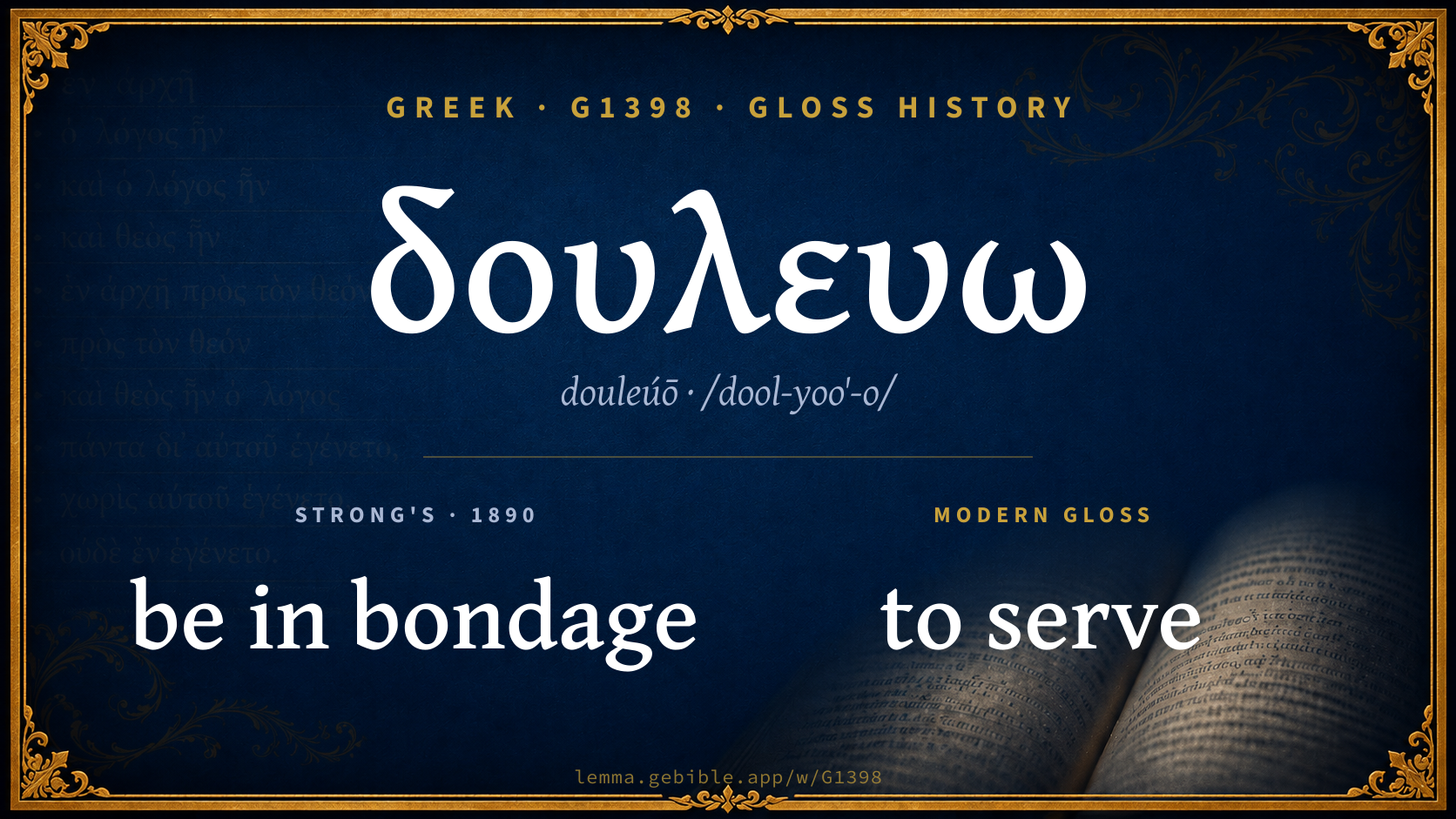
Gloss history
Strong's 1890 vs modern scholarship
About this word
Strong's G1398 catalogs a Greek word from the Greek New Testament.
These counts are not copied from any lexicon or concordance. They are computed here, from the morphology-tagged Greek New Testament. What Lemma adds →
- 23
- distinct verses
- The word appears in 23 distinct verses.
- 12 / 27
- NT books
- The word appears in 12 of 27 New Testament books.
- #530
- by frequency
- Top 1000 most frequent Greek words (rank 530 of 5,347 Greek words by occurrence).
View all 23 occurrences in the concordance →
By section of the New Testament
By traditional corpus
Conventional, traditional groupings — biblical authorship is debated, so this is a traditional corpus grouping, not an authorship claim. Some books belong to more than one corpus (Luke is in both the Gospels and the Lukan corpus, and so on), so these shares overlap and need not total 100%. Each figure is a share of the word’s 23 distinct verses.
- Pauline corpus 17 verses · 74%
- Gospels 4 verses · 17%
- Lukan (Luke–Acts) 4 verses · 17%
- Johannine 1 verse · 4%
How translations render this word
Counts come from each version’s own published word-to-Strong’s tagging or interlinear alignment — an approximate guide to how each version renders this word, not a word-level alignment the data otherwise carries. Because each total is that version’s own tagged count, the per-version totals vary from one another and need not match the appearance or distinct-verse counts above. These counts may also differ from a printed concordance because Lemma counts each distinctly tagged rendering and does not collapse phrase taggings into a single head-word total. This is a fixed set of word-tagged versions (KJV, ASV, BSB, ULT) and does not change with the reading translation you choose elsewhere. Each version’s license is shown beside its name below (and on Sources).
- King James Version: Serve 8×, Serving 3×
- American Standard Version: Serve 7×, Serving 3×, Bondage 2×
- Berean Standard Bible: Serve 9×, Serving 2×
- unfoldingWord Literal Text: Serve 7×, Serving 4×, Enslaved 2×
King James Version Public Domain
Renders G1398 across 26 tagged occurrences — most commonly:
Plus 15 renderings that appear only once — usually multi-word phrases or single function words the recovered tagging swept in, not distinct renderings. Not rendered by a distinct English word in 1 further occurrence.
American Standard Version Public Domain
Renders G1398 across 30 tagged occurrences — most commonly:
Plus 18 renderings that appear only once — usually multi-word phrases or single function words the recovered tagging swept in, not distinct renderings.
Berean Standard Bible Public Domain
Renders G1398 across 25 tagged occurrences — most commonly:
Plus 14 renderings that appear only once — usually multi-word phrases or single function words the recovered tagging swept in, not distinct renderings.
unfoldingWord Literal Text CC BY-SA 4.0
Renders G1398 across 29 tagged occurrences — most commonly:
Plus 16 renderings that appear only once — usually multi-word phrases or single function words the recovered tagging swept in, not distinct renderings.
Senses in Thayer's
The 2 senses Thayer's distinguishes for this word, in lexicon order (not ranked by frequency or importance). The full entry — with sub-senses — is in the Lexicon Entry tab.
- to be a slave, serve, do service
- metaph. to obey, submit to
Word origin
Derived from δουλος (doûlos) (G1401) — slave.
From G1401 ; to be a slave to (literally or figuratively involuntarily or voluntarily): - be in bondage (do) serve (-ice).
— Strong’s Exhaustive Concordance (1890), public domain.
Forms in the corpus
The 14 distinct written forms G1398 takes in the Greek New Testament, most frequent first — each parse links to that tense’s occurrences in the concordance.
Same root — word family
Other Thayer's entries built from the same root as G1398, grouped by Strong’s listed origin. These share a root / origin per the lexicon — not necessarily a shared meaning. Each links to that word’s own entry.
Derives from
Shares the same root
- δουλαγωγεω doulagōgéō G1396 to enslave
- δουλη doúlē G1399 female slave
- δουλον doûlon G1400 slave
- δουλοω doulóō G1402 to enslave
Derived from this word
Compare all same-root words → Showing 4 of 7 — not the complete family. They share a root, not necessarily a meaning.
Septuagint usage
The same Greek word δουλευω appears 132 times in the Greek Old Testament (Septuagint), across 120 verses in 23 books.
- 132
- LXX occurrences
- Tagged occurrences of this Greek word in the Septuagint.
- 120
- verses
- Distinct Septuagint verses containing this word.
- 23 / 39
- OT books
- The word appears in 23 of the 39 Old Testament books.
Sample Septuagint occurrences
- Genesis 14:4 δουλεύω
- Exodus 14:5 δουλεύω
- Leviticus 25:39 δουλεύω
- Deuteronomy 15:12 δουλεύω
- Judges 2:7 δουλεύω
- 1 Samuel 2:24 δουλεύω
- 2 Samuel 10:19 δουλεύω
- 1 Kings 2:46 δουλεύω
- 2 Kings 10:18 δουλεύω
- 1 Chronicles 19:19 δουλεύω
- 2 Chronicles 7:22 δουλεύω
- Ezra 19:35 δουλεύω
Septuagint occurrences (same lexeme)
Every verse where the same Strong’s number (G1398) appears in the Greek Septuagint — showing the first 50 of 120. Verse text shown in the World English Bible for context; the Greek form is the matched word — the English is not keyword-highlighted.
- Genesis 14:4 δουλεύω Twelve years they served Chedorlaomer, and in the thirteenth year, they rebelled.
- Genesis 15:14 δουλεύω I will also judge that nation, whom they will serve. Afterward they will come out with great substance.
- Genesis 25:23 δουλεύω Yahweh said to her, Two nations are in your womb, Two peoples will be separated from your body. The one people will be stronger than the other people. The elder will serve the younger.
- Genesis 27:29 δουλεύω Let peoples serve you, Nations bow down to you. Be lord over your brothers, Let your mother's sons bow down to you. Cursed be everyone who curses you, Blessed be everyone who blesses you."
- Genesis 27:40 δουλεύω By your sword will you live, and you will serve your brother. It will happen, when you will break loose, That you shall shake his yoke from off your neck."
- Genesis 29:15 δουλεύω Laban said to Jacob, "Because you are my brother, should you therefore serve me for nothing? Tell me, what will your wages be?"
- Genesis 29:18 δουλεύω Jacob loved Rachel. He said, "I will serve you seven years for Rachel, your younger daughter."
- Genesis 29:20 δουλεύω Jacob served seven years for Rachel. They seemed to him but a few days, for the love he had for her.
- Genesis 29:25 δουλεύω It happened in the morning that, behold, it was Leah. He said to Laban, "What is this you have done to me? Didn't I serve with you for Rachel? Why then have you deceived me?"
- Genesis 29:30 δουλεύω He went in also to Rachel, and he loved also Rachel more than Leah, and served with him yet seven other years.
- Genesis 30:26 δουλεύω Give me my wives and my children for whom I have served you, and let me go: for you know my service with which I have served you."
- Genesis 30:29 δουλεύω He said to him, "You know how I have served you, and how your cattle have fared with me.
- Genesis 31:6 δουλεύω You know that I have served your father with all of my strength.
- Genesis 31:41 δουλεύω These twenty years have I been in your house. I served you fourteen years for your two daughters, and six years for your flock, and you have changed my wages ten times.
- Exodus 14:5 δουλεύω It was told the king of Egypt that the people had fled; and the heart of Pharaoh and of his servants was changed towards the people, and they said, "What is this we have done, that we have let Israel go from serving us?"
- Exodus 14:12 δουλεύω Isn't this the word that we spoke to you in Egypt, saying, 'Leave us alone, that we may serve the Egyptians?' For it were better for us to serve the Egyptians, than that we should die in the wilderness."
- Exodus 21:2 δουλεύω If you buy a Hebrew servant, he shall serve six years and in the seventh he shall go out free without paying anything.
- Exodus 21:6 δουλεύω then his master shall bring him to God, and shall bring him to the door or to the door-post, and his master shall bore his ear through with an awl, and he shall serve him for ever.
- Exodus 23:33 δουλεύω They shall not dwell in your land, lest they make you sin against me, for if you serve their gods, it will surely be a snare to you."
- Leviticus 25:39 δουλεύω "'If your brother has grown poor among you, and sells himself to you; you shall not make him to serve as a slave.
- Deuteronomy 15:12 δουλεύω If your brother, a Hebrew man, or a Hebrew woman, be sold to you, and serve you six years; then in the seventh year you shall let him go free from you.
- Deuteronomy 15:18 δουλεύω It shall not seem hard to you, when you let him go free from you; for to the double of the hire of a hireling has he served you six years: and Yahweh your God will bless you in all that you do.
- Deuteronomy 28:64 δουλεύω Yahweh will scatter you among all peoples, from the one end of the earth even to the other end of the earth; and there you shall serve other gods, which you have not known, you nor your fathers, even wood and stone.
- Judges 2:7 δουλεύω The people served Yahweh all the days of Joshua, and all the days of the elders who outlived Joshua, who had seen all the great work of Yahweh that he had worked for Israel.
- Judges 3:8 δουλεύω Therefore the anger of Yahweh was kindled against Israel, and he sold them into the hand of Cushan Rishathaim king of Mesopotamia: and the children of Israel served Cushan Rishathaim eight years.
- Judges 3:14 δουλεύω The children of Israel served Eglon the king of Moab eighteen years.
- Judges 9:28 δουλεύω Gaal the son of Ebed said, Who is Abimelech, and who is Shechem, that we should serve him? Isn't he the son of Jerubbaal? and Zebul his officer? serve you the men of Hamor the father of Shechem: but why should we serve him?
- Judges 9:38 δουλεύω Then said Zebul to him, Where is now your mouth, that you said, Who is Abimelech, that we should serve him? is not this the people that you have despised? go out now, I pray, and fight with them.
- Judges 10:6 δουλεύω The children of Israel again did that which was evil in the sight of Yahweh, and served the Baals, and the Ashtaroth, and the gods of Syria, and the gods of Sidon, and the gods of Moab, and the gods of the children of Ammon, and the gods of the Philistines; and they forsook Yahweh, and didn't serve him.
- Judges 10:10 δουλεύω The children of Israel cried to Yahweh, saying, We have sinned against you, even because we have forsaken our God, and have served the Baals.
- Judges 10:13 δουλεύω Yet you have forsaken me, and served other gods: therefore I will save you no more.
- Judges 10:16 δουλεύω They put away the foreign gods from among them, and served Yahweh; and his soul was grieved for the misery of Israel.
- 1 Samuel 2:24 δουλεύω No, my sons; for it is no good report that I hear: you make Yahweh's people to disobey.
- 1 Samuel 4:9 δουλεύω Be strong, and behave yourselves like men, O you Philistines, that you not be servants to the Hebrews, as they have been to you: quit yourselves like men, and fight.
- 1 Samuel 7:3 δουλεύω Samuel spoke to all the house of Israel, saying, If you do return to Yahweh with all your heart, then put away the foreign gods and the Ashtaroth from among you, and direct your hearts to Yahweh, and serve him only; and he will deliver you out of the hand of the Philistines.
- 1 Samuel 7:4 δουλεύω Then the children of Israel did put away the Baals and the Ashtaroth, and served Yahweh only.
- 1 Samuel 8:8 δουλεύω According to all the works which they have done since the day that I brought them up out of Egypt even to this day, in that they have forsaken me, and served other gods, so do they also to you.
- 1 Samuel 11:1 δουλεύω Then Nahash the Ammonite came up, and encamped against Jabesh Gilead: and all the men of Jabesh said to Nahash, Make a covenant with us, and we will serve you.
- 1 Samuel 12:10 δουλεύω They cried to Yahweh, and said, We have sinned, because we have forsaken Yahweh, and have served the Baals and the Ashtaroth: but now deliver us out of the hand of our enemies, and we will serve you.
- 1 Samuel 12:14 δουλεύω If you will fear Yahweh, and serve him, and listen to his voice, and not rebel against the commandment of Yahweh, and both you and also the king who reigns over you are followers of Yahweh your God, [well]:
- 1 Samuel 12:20 δουλεύω Samuel said to the people, "Don't be afraid; you have indeed done all this evil; yet don't turn aside from following Yahweh, but serve Yahweh with all your heart:
- 1 Samuel 12:23 δουλεύω Moreover as for me, far be it from me that I should sin against Yahweh in ceasing to pray for you: but I will instruct you in the good and the right way.
- 1 Samuel 12:24 δουλεύω Only fear Yahweh, and serve him in truth with all your heart; for consider how great things he has done for you.
- 1 Samuel 17:9 δουλεύω If he be able to fight with me, and kill me, then will we be your servants; but if I prevail against him, and kill him, then shall you be our servants, and serve us.
- 1 Samuel 26:19 δουλεύω Now therefore, please let my lord the king hear the words of his servant. If it be Yahweh that has stirred you up against me, let him accept an offering: but if it be the children of men, cursed be they before Yahweh: for they have driven me out this day that I shouldn't cling to Yahweh's inheritance, saying, Go, serve other gods.
- 2 Samuel 10:19 δουλεύω When all the kings who were servants to Hadarezer saw that they were put to the worse before Israel, they made peace with Israel, and served them. So the Syrians feared to help the children of Ammon any more.
- 2 Samuel 16:19 δουλεύω Again, whom should I serve? Shouldn't I serve in the presence of his son? as I have served in your father's presence, so will I be in your presence.
- 2 Samuel 22:44 δουλεύω You also have delivered me from the strivings of my people; You have kept me to be the head of the nations: A people whom I have not known shall serve me.
- 1 Kings 2:46 δουλεύω So the king commanded Benaiah the son of Jehoiada; and he went out, and fell on him, so that he died. The kingdom was established in the hand of Solomon.
- 1 Kings 9:6 δουλεύω But if you shall turn away from following me, you or your children, and not keep my commandments and my statutes which I have set before you, but shall go and serve other gods, and worship them;
These are occurrences of the same Greek lexeme (G1398) in the Septuagint — not a translation of any one Hebrew word. The store carries no word-level Hebrew↔Greek alignment, so no Hebrew original is asserted here. Counts come from the recovered LXX Strong's tagging — high-frequency vocabulary is well covered, while rare or late forms may be untagged — so they reflect tagged occurrences and may slightly undercount.