
Colossians 3:24

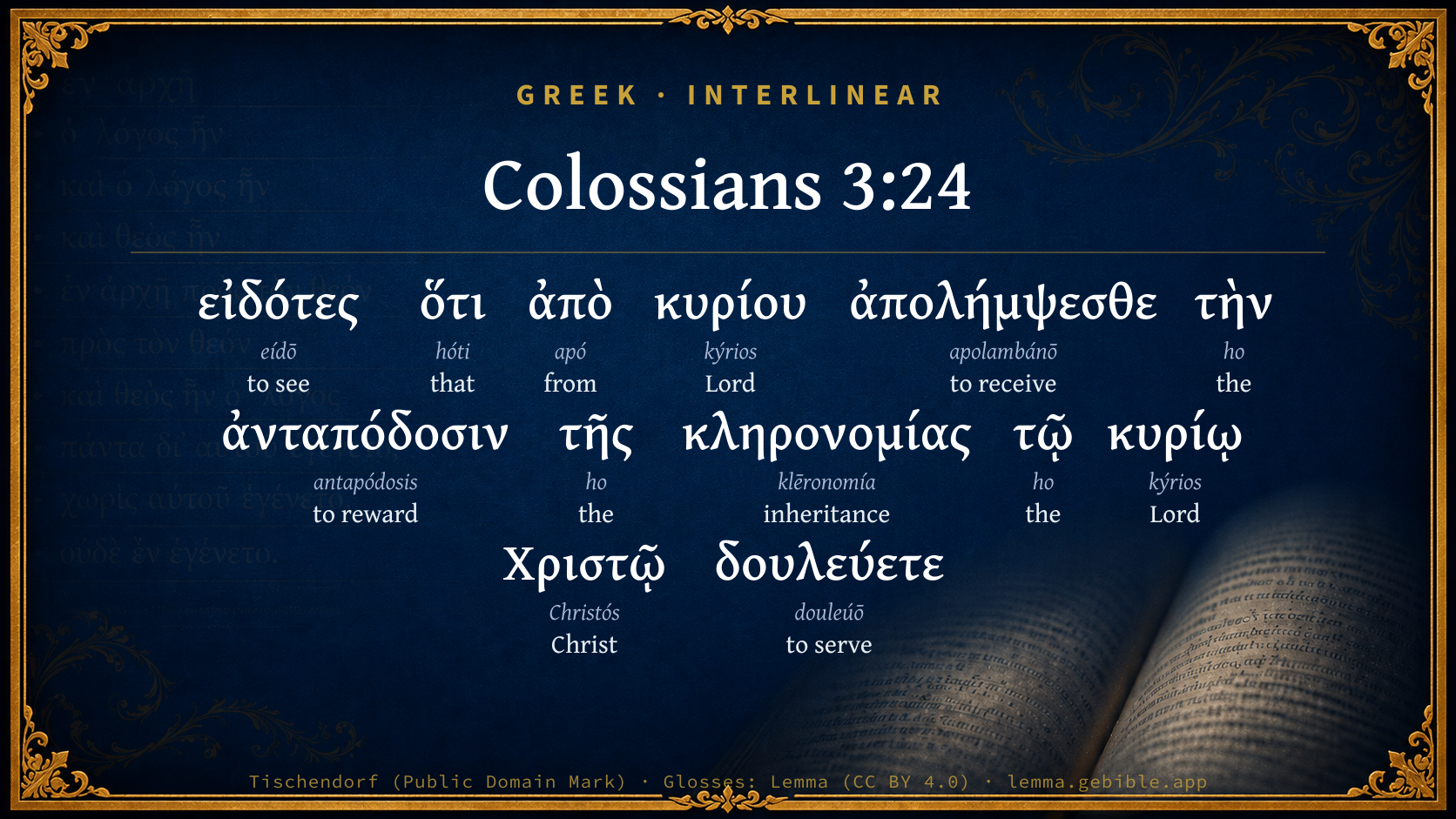
Greek (Tischendorf 8th ed.) Colossians 3:24 appears in the Greek New Testament. The text above is from the Tischendorf 8th edition. Each word links to its Strong’s number and a concise gloss. Click any word for its full Thayer’s Greek Lexicon entry.
Download image
Cite this verse

Colossians 3:24 (World English Bible). Public Domain. Lemma interlinear Bible study tool, https://lemma.gebible.app/v/colossians/3/24.

Show BibTeX & RIS
BibTeX
RIS
English Translation
knowing that from the Lord you will receive the reward of the inheritance; for you serve the Lord Christ.
World English Bible · Public Domain
Highlights
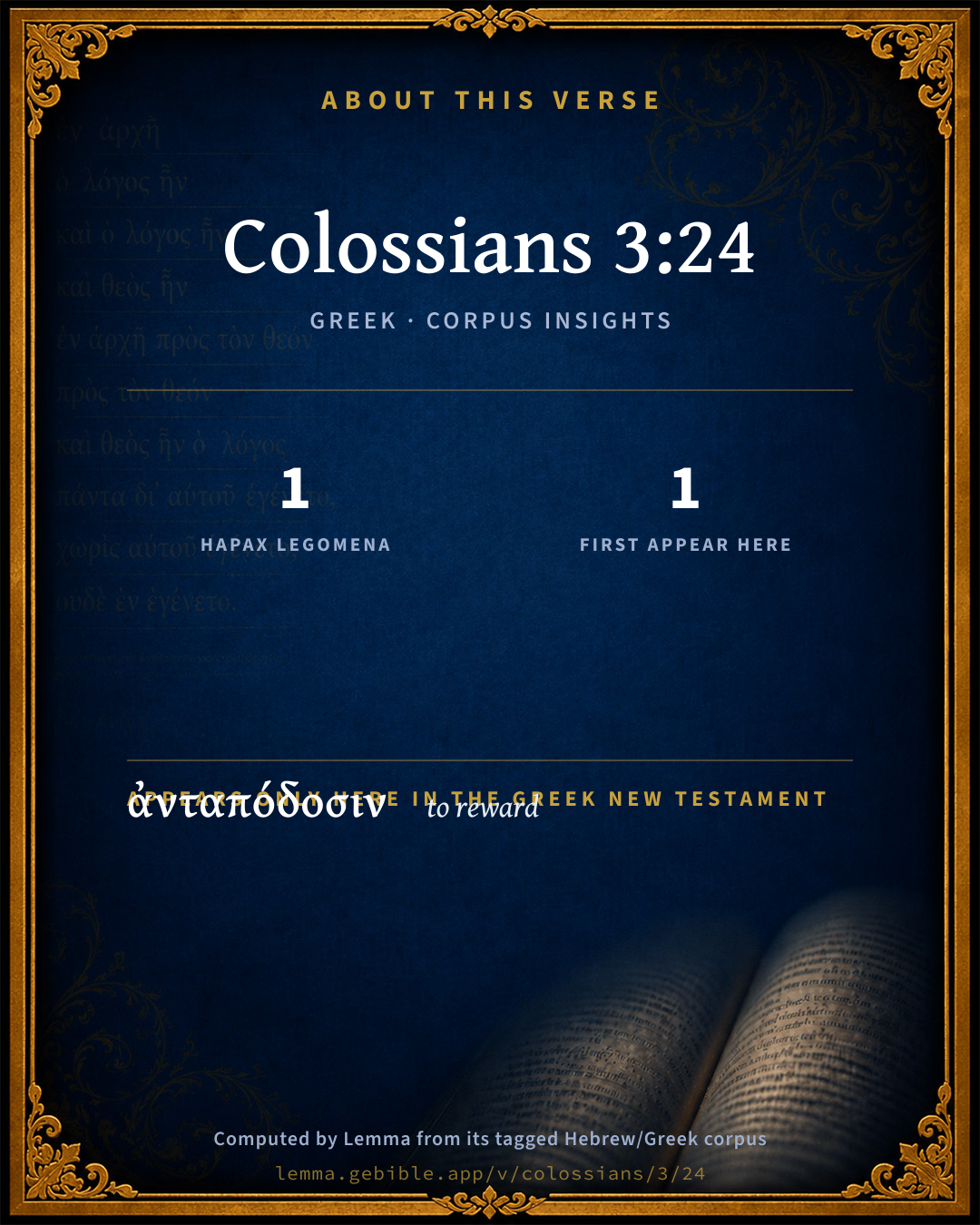
  • 1 hapax legomenon — only here in the Greek New Testament
  • 1 first appearance in the Greek New Testament
Full analysis ↓
Download a study sheet

One document with this verse’s original text, its word-by-word gloss line, the meaning frame, cross-references with their text, attributed commentary, and full source and license credits — printable, and it pastes into notes with its structure intact.

This verse Autodidact and up

Study sheet (.html) Plain text (.txt)

A passage Seminary Student

Up to 50 verses in one chapter. A passage sheet keeps up to 6 commentary sources and 12 cross-references per verse, in the order this page ranks them, and says so on the sheet whenever that leaves anything out. Ask for a single verse and you get the Autodidact verse sheet above.

Everything on this page stays free to read, with no account — the sheet is a download of what is already on screen, not access to it.

Want to remove ads? Support Godless Engineer
Compare translations 3

The same verse in 3 English versions, stacked beneath the original-language interlinear above. Click any original word for its lexicon entry.

Each is an independent rendering of the whole verse — the interlinear is not word-aligned to these translations.

Highlighted words mark where these versions differ — a whole-verse word diff, not a word-by-word alignment.

  • World English Bible Public Domain
    knowing that from the Lord you will receive the reward of the inheritance; for you serve the Lord Christ.
  • King James Version Public Domain
    Knowing that of the Lord ye shall receive the reward of the inheritance: for ye serve the Lord Christ.
  • unfoldingWord Literal Text CC BY-SA 4.0
    knowing that you will receive from the Lord the reward of the inheritance. You are serving the Lord Christ.

unfoldingWord Literal Text — © unfoldingWord, licensed CC BY-SA 4.0. Word-aligned USFM3 via Door43 (git.door43.org/unfoldingWord/en_ult).

Versions to compare (up to 4)

3 of 4 selected

Show all 19 translations

Every available English version of this verse, each an independent rendering of the whole verse.

  • World English Bible Public Domain
    knowing that from the Lord you will receive the reward of the inheritance; for you serve the Lord Christ.
  • Berean Standard Bible Public Domain
    because you know that you will receive an inheritance from the Lord as your reward. It is the Lord Christ you are serving.
  • Majority Standard Bible Public Domain
    because you know that you will receive an inheritance from the Lord as your reward. For it is the Lord Christ you are serving.
  • King James Version Public Domain
    Knowing that of the Lord ye shall receive the reward of the inheritance: for ye serve the Lord Christ.
  • American Standard Version (1901) Public Domain
    knowing that from the Lord ye shall receive the recompense of the inheritance: ye serve the Lord Christ.
  • Revised Version (1885) Public Domain
    knowing that from the Lord ye shall receive the recompense of the inheritance: ye serve the Lord Christ.
  • Geneva Bible (1599) Public Domain
    Knowing that of the Lord ye shall receiue the reward of the inheritance: for ye serue the Lord Christ.
  • Douay-Rheims (1899) Public Domain
    Knowing that you shall receive of the Lord the reward of inheritance. Serve ye the Lord Christ.
  • Young's Literal Translation Public Domain
    having known that from the Lord ye shall receive the recompense of the inheritance -- for the Lord Christ ye serve;
  • Literal Standard Version CC BY-SA 4.0
    having known that you will receive the repayment of the inheritance from the LORD—for you serve the LORD Christ;
  • Unlocked Literal Bible CC BY-SA 4.0
    You know that you will receive from the Lord the reward of the inheritance. It is the Lord Christ whom you serve.
  • unfoldingWord Literal Text CC BY-SA 4.0
    knowing that you will receive from the Lord the reward of the inheritance. You are serving the Lord Christ.
  • Darby Bible Public Domain
    knowing that of [the] Lord ye shall receive the recompense of the inheritance; ye serve the Lord Christ.
  • World Messianic Bible Public Domain
    knowing that from the Lord you will receive the reward of the inheritance; for you serve the Lord Messiah.
  • Webster's Bible Public Domain
    Knowing that from the Lord ye will receive the reward of the inheritance: for ye serve the Lord Christ.
  • Free Bible Version CC BY-SA 4.0
    because you know that the Lord will give you your reward—an inheritance! You're serving Christ the Lord!
  • Bible in Basic English Public Domain
    Being certain that the Lord will give you the reward of the heritage: for you are the servants of the Lord Christ.
  • Text-Critical English NT CC BY 4.0
    knowing that you will receive an inheritance from the Lord as your reward; for you serve the Lord Christ.
  • Tyndale New Testament (1534) Public Domain
    for as moche as ye knowe that of the lorde ye shall receave the rewarde of inheritaunce for ye serve the lorde Christ.

Literal Standard Version (2020), Covenant Press — licensed CC BY-SA 4.0. Text via the HelloAO Bible API (eBible.org). Unlocked Literal Bible (unfoldingWord) — licensed CC BY-SA 4.0. Text via the HelloAO Bible API (eBible.org). unfoldingWord Literal Text — © unfoldingWord, licensed CC BY-SA 4.0. Word-aligned USFM3 via Door43 (git.door43.org/unfoldingWord/en_ult). Free Bible Version, Dr. Jonathan Gallagher — licensed CC BY-SA 4.0. Text via the HelloAO Bible API (eBible.org).

Word by word

More ways to search: Search by grammar → Find every occurrence → Compare this word →

Practice this passage: Drill this verse → Learn its vocabulary →

ἀνταπόδοσιν
antapódosis
G469
“to reward”
Noun, Accusative, Singular, Feminine
Part of Speech
Noun
Case
Accusative
Number
Singular
Gender
Feminine
Full Thayer's Definition

Origin: from G467

TDNT: 04:49,2

1. recompence, to reward or repay someone
  1. εἰδότες eídō G1492 “to see” Verb, Perfect, Active, Participle, Nominative, Plural, Masculine
  2. ὅτι hóti G3754 “that” Conjunction
  3. ἀπὸ apó G575 “from” Preposition
  4. κυρίου kýrios G2962 “Lord” Noun, Genitive, Singular, Masculine
  5. ἀπολήμψεσθε apolambánō G618 “to receive” Verb, Future, Middle deponent, Indicative, 2nd person, Plural
  6. τὴν ho G3588 “the” Article, Accusative, Singular, Feminine
  7. τῆς ho G3588 “the” Article, Genitive, Singular, Feminine
  8. κληρονομίας klēronomía G2817 “inheritance” Noun, Genitive, Singular, Feminine
  9. τῷ ho G3588 “the” Article, Dative, Singular, Masculine
  10. κυρίῳ kýrios G2962 “Lord” Noun, Dative, Singular, Masculine
  11. Χριστῷ Christós G5547 “Christ” Noun, Dative, Singular, Masculine
  12. δουλεύετε douleúō G1398 “to serve” Verb, Present, Active, Indicative, 2nd person, Plural

About this verse

These counts appear in no published source. They are computed here, from the morphology-tagged text and Lemma’s own curated glosses. What Lemma adds →

13
words
10
distinct lemmas
Pauline Epistles
section

Notable vocabulary

1 hapax legomenon — a word that appears only here in the entire Greek New Testament:

  • ἀνταπόδοσιν to reward G469

First appearance in Scripture

This word makes its first canonical appearance in the Greek New Testament here:

  • ἀνταπόδοσιν to reward G469

Shared distinctive vocabulary

ἀπολήμψεσθε to receive G618 occurs in 10 verses of the Greek New Testament. Also found in:
Repetition

Words recur within this verse:

  • κυρίου Lord G2962 ×2
  • τὴν the G3588 ×3

Cross-references

29

Topical passages linked to Colossians 3:24 in the Treasury of Scripture Knowledge — connected by theme and wording, ordered by reader-vote popularity; previews shown in the World English Bible.

  • Ephesians 6:8 knowing that whatever good thing each one does, he will receive the same again from the Lord, whether he is bound or free.
  • Acts 20:32 Now, brothers, I entrust you to God, and to the word of his grace, which is able to build up, and to give you the inheritance among all those who are sanctified.
  • Galatians 1:10 For am I now seeking the favor of men, or of God? Or am I striving to please men? For if I were still pleasing men, I wouldn't be a servant of Christ.
  • Luke 14:14 and you will be blessed, because they don't have the resources to repay you. For you will be repaid in the resurrection of the righteous."
  • 1 Corinthians 7:22 For he who was called in the Lord being a bondservant is the Lord's free man. Likewise he who was called being free is Christ's bondservant.
  • Hebrews 10:35 Therefore don't throw away your boldness, which has a great reward.
  • Matthew 5:12 Rejoice, and be exceedingly glad, for great is your reward in heaven. For that is how they persecuted the prophets who were before you.
  • Ephesians 6:6 not in the way of service only when eyes are on you, as men-pleasers; but as servants of Christ, doing the will of God from the heart;
  • Hebrews 11:6 Without faith it is impossible to be well pleasing to him, for he who comes to God must believe that he exists, and that he is a rewarder of those who seek him.
  • Proverbs 11:18 Wicked people earn deceitful wages, But one who sows righteousness reaps a sure reward.
  • Matthew 5:46 For if you love those who love you, what reward do you have? Don't even the tax collectors do the same?
  • 1 Corinthians 3:8 Now he who plants and he who waters are the same, but each will receive his own reward according to his own labor.
  • Jude 1:1 Jude, a servant of Jesus Christ, and brother of James, to those who are called, sanctified by God the Father, and kept for Jesus Christ:
  • Ruth 2:12 Yahweh recompense your work, and a full reward be given you of Yahweh, the God of Israel, under whose wings you are come to take refuge.
  • Matthew 6:16 "Moreover when you fast, don't be like the hypocrites, with sad faces. For they disfigure their faces, that they may be seen by men to be fasting. Most assuredly I tell you, they have received their reward.
  • Luke 6:35 But love your enemies, and do good, and lend, expecting nothing back; and your reward will be great, and you will be children of the Most High; for he is kind toward the unthankful and evil.
  • Romans 4:4–5 Now to him who works, the reward is not counted as grace, but as debt.
  • Colossians 2:18 Let no one rob you of your prize by a voluntary humility and worshipping of the angels, dwelling in the things which he has not seen, vainly puffed up by his fleshly mind,
  • 2 Peter 1:1 Simon Peter, a servant and apostle of Jesus Christ, to those who have obtained a like precious faith with us in the righteousness of our God and Savior, Jesus Christ:
  • Genesis 15:1 After these things the word of Yahweh came to Abram in a vision, saying, "Don't be afraid, Abram. I am your shield, your exceedingly great reward."
  • Matthew 6:1–2 "Be careful that you don't do your charitable giving before men, to be seen by them, or else you have no reward from your Father who is in heaven.
  • Matthew 6:5 "When you pray, you shall not be as the hypocrites, for they love to stand and pray in the synagogues and in the corners of the streets, that they may be seen by men. Most assuredly, I tell you, they have received their reward.
  • 1 Corinthians 9:17–18 For if I do this of my own will, I have a reward. But if not of my own will, I have a stewardship entrusted to me.
  • Matthew 10:41 He who receives a prophet in the name of a prophet will receive a prophet's reward: and he who receives a righteous man in the name of a righteous man will receive a righteous man's reward.
  • John 12:26 If anyone serves me, let him follow me. Where I am, there will my servant also be. If anyone serves me, the Father will honor him.
  • Romans 1:1 Paul, a servant of Jesus Christ, called to be an apostle, set apart for the Gospel of God,
  • Romans 2:6–7 who "will pay back to everyone according to their works:"
  • Romans 14:18 For he who serves Christ in these things is acceptable to God and approved by men.
  • Hebrews 9:15 For this reason he is the mediator of a new covenant, since a death has occurred for the redemption of the transgressions that were under the first covenant, that those who have been called may receive the promise of the eternal inheritance.

Cross-references courtesy of OpenBible.info (CC BY 4.0).

Commentary

Notes on Colossians 3:24 from classic Christian and Jewish commentators (each source and its license shown beneath its notes). The classic Christian expositions comment on the surrounding passage and are grouped to its opening verse, so a note may address several verses; the Jewish commentaries on the Tanakh (Rashi and others) are per-verse, so they appear only where the commentator wrote on this verse.

Lemma curates 59 commentaries, every one of them public domain or Creative Commons licensed, each selected and text-cleaned for this edition rather than reprinted as found. About our sources →

Bengel's Gnomon

Johann Albrecht Bengel

Col 3:24. Τῆς κληρονομίας, of the inheritance) Although you have no inheritance in the world, but are part of an inheritance passing from your Master to His children.—Χριστῷ, Christ) who rewards them that serve Him.—δουλεύετε, ye serve) while you thus serve.

Bengel's Gnomon of the New Testament — English translation (T&T Clark, Edinburgh, 1860) — public domain. Text from a community e-Sword module.

Expositor's Greek Testament

ed. W. Robertson Nicoll

Col 3:24 . However their earthly master may reward their service, there is a Master who will give them a just recompense; although they cannot receive an earthly, He will give them a heavenly inheritance. ἀπὸ Κυρίου : in Eph 6:8 παρὰ Κ . The absence of the article is noteworthy. It emphasises the position rather than identifies the Person of Him who gives the reward ( cf. the anarthrous ἐν υἱῷ , Heb 1:1 ). Haupt thinks that there is no significance to be attached to its omission; but, as Lightfoot says, “it is studiously inserted in the context”. ἀνταπόδοσιν τῆς κληρονομίας : the “just recompense consisting in the inheritance”. κλ . is a genitive of apposition. δουλεύετε . This may be taken as an indicative (Lightf., Findl., Moule, Haupt) or as an imperative (Mey., Ell., Alf., Abb.). The indicative is defended on the ground that it is needed to explain who is meant by ἀπὸ Κυρίου (but this was surely obvious), and that the imperative seems to require ὡς τῷ Κ . But Lightfoot himself quotes Rom 12:11 , where ὡς is absent. On the other hand the indicative gives a somewhat flat sense, and the imperative seems to yield a better connexion with Col 3:25 . It is best then to take it as an imperative.

The Expositor's Greek Testament, edited by W. Robertson Nicoll (1897–1910) — public domain. Text from a community e-Sword module.

Cambridge Greek Testament for Schools and Colleges

24. εἰδότες, cf. Col 4:1; Phm 1:21; || Eph 6:8.

Especially of what is known long since, known as a fundamental proposition, e.g. Rom 5:3; 1Co 15:58; 2Co 1:7; Gal 2:16.

Here giving a reason for hearty work.

ὅτι ἀπὸ κυρίου, i.e. Christ, as everywhere in Col 3:18 to Col 4:1.

|| Eph 6:8 has παρὰ κυρίου, i.e. receiving at His hands. ἀπό is general, the direct agent or means is simply not stated.

The absence of the article is perplexing. (a) Lightfoot interprets “a master” (Col 4:1), calling attention to the fact that the article “is studiously inserted in the context, Col 3:22-24, τὸν κύριον, τῷ κυρίῳ, τῷ κυρίῳ.” (b) But κύριος so easily loses its article (e.g. Col 3:18; Col 3:20) when the English translation must still be “the Lord” that this is perhaps preferable here. Compare 1Co 7:22.

ἀπολήμψεσθε. Perhaps “receive to the full”; cf. Luk 16:25, but probably “receive as due”; cf. Luk 6:34, and, on the whole, Rom 1:27.

τὴν ἀνταπόδοσιν. Here only in N.T. but ἀνταπόδομα Luk 14:12; Rom 11:9†.

“The just recompense … the double compound involves the idea of ‘exact requital’ ” (Lightfoot). Compare the note on ἀνταναπληρῶ, Col 1:24. The point of this statement is that slaves were not, strictly speaking, paid for their work, and could have no inheritance.

τῆς κληρονομίας. Gen. of apposition. The Christian inheritance is here placed in the future. For its being also present see Hort on 1Pe 1:4. That κληρ. does not imply hereditary succession, but ‘sanctioned and settled possession,’ see (besides Hort) Dalman, Words of Jesus, p. 125.

τῷ κυρίῳ Χριστῷ. Observe (1) St Paul here first defines whom he means by “the Master.” (2) In Col 3:17 appealing to the example of our Lord’s life on earth he said κυρίον Ἰησοῦ, but here when speaking of His present majesty and authority he says τ. κυρ. Χριστῷ.

δουλεύετε. Almost certainly imperative. Recalling ὑπακούετε (Col 3:22) and ἐργάζεσθε (Col 3:23) with its appended reason (its participial clause). St Paul sums up his charge in one phrase—“Serve the Master, Christ.” He then appends a reason for this, Col 3:25.

With the right reading (no γάρ in Col 3:24, and γάρ instead of δέ in Col 3:25) δουλεύετε if indicative is insipid and even tautological. The following γάρ would then refer not to δουλεύετε but to the general command, Col 3:22-24 a.

Cambridge Greek Testament for Schools and Colleges (Cambridge University Press, 1896; 21 vols, various authors incl. Carr, Maclear, Plummer, Farrar, Lumby, Moule, M. R. James, Simcox) — public domain. Text from a community e-Sword module.

Geneva Bible (1599)

Geneva Bible translators

For that that you shall have duly obeyed your masters, the time shall come, that you shall be made sons of servants, and then shall you know this of a surety, which shall be when you are made partakers of the heavenly inheritance.

Geneva Bible (1599) marginal notes — public domain. Text via Bolls.life.

Jamieson, Fausset & Brown

Robert Jamieson, A. R. Fausset & David Brown

the reward of the inheritance--"Knowing that it is from the Lord (the ultimate source of reward), ye shall receive the compensation (or recompense, which will make ample amends for your having no earthly possession as slaves now) consisting of the inheritance" (a term excluding the notion of meriting it by works: it is all of grace, Rom 4:14; Gal 3:18).

for ye serve--The oldest manuscripts omit "for," then translate as Vulgate, "Serve ye the Lord Christ;" compare Col 3:23, "To the Lord and not unto men" (Co1 7:22-23).

Jamieson, Fausset & Brown — Commentary Critical and Explanatory on the Whole Bible (1871) — public domain (CC PDM 1.0). Text via the HelloAO Bible API.

Adam Clarke's Commentary

Verse 24. The reward of the inheritance] Here, ye have neither lands nor property; ye are servants or slaves; be not discouraged, ye have an inheritance in store; be faithful unto God and to your employers, and Christ will give you a heavenly inheritance.

Adam Clarke's Commentary on the Bible (1810–1826) — public domain. Text from a community e-Sword/MySword module.

The Cambridge Bible for Schools and Colleges

gen. ed. J. J. S. Perowne

24. knowing] as a certainty of the Gospel. So Eph_6:8. For the Christian’s prospect of “reward” cp. Mat_5:12; Mat_6:1; Mat_6:4; Mat_16:27; Luk_6:35; Luk_14:14; Rom_2:6-10; 2Co_5:10; Heb_10:35; Rev_22:12; &c. The obedience of love is infallibly remembered by Him to whom it is rendered. “Well done, good and faithful servant” (Mat_25:21; Mat_25:23), is His certain ultimate response to every true act of the will given up to Him. This, as presented in Scripture, is entirely harmonious with the sure doctrine of our justification for Christ’s Merit only, embraced by faith only (Art. xi). It is the recognition of love by love, of grace by the Giver.

receive] The Greek may be rendered, receive as your due. The reward, from one point of view mere grace and gift, is from another, because God has promised it, a debt.

the reward] The Greek implies an exact requital. See Lightfoot’s note. Even “the cup of cold water” (Mat_10:42) has its remembrance and loving recompense.

of the inheritance] That is, the reward consists in the inheritance; is involved in the bright prospect of it.—For a somewhat similar phrase cp. Col_1:12 (and notes). But the reference here is, surely, to the eternal future. So 1Pe_1:4, and Eph_1:14. That future is but the issue of the present, in which “Christ is in us, the hope of glory” (Col_1:27). But the issue is so “far better” (Php_1:21) than its prelude and embryo that it is relatively a new thing in prospect.—Lightfoot remarks that, by a beautiful paradox, the slave is here also an heir, which by human law he could not be. He is God’s heir (Gal_4:7) by Divine law. Elsewhere, in other connexions, “slave” and “heir” are contrasted: e.g. Gal_4:1.

for] Probably the word is to be omitted. It is a good note to the sentence, so to speak, pointing the meaning: “ye shall receive your reward from the Master; for Christ is the Master, and He never fails in requital.”

ye serve the Lord Christ] We may render, Christ is the Master whose bondmen ye are. Cp. Eph_6:6.—The Greek may be rendered, “serve, &c.,” imperatively. But the context favours the indicative.

The Cambridge Bible for Schools and Colleges (gen. ed. J. J. S. Perowne; Cambridge University Press, 1878–1918) — public domain. Text from a community e-Sword module.

John Gill's Exposition

Knowing that of the Lord ye shall receive the reward of the inheritance,.... This is said for the encouragement of Christian servants, who, though they may receive little or nothing from their earthly and carnal masters; yet they shall be used and treated as children by the Lord, and by whom they will be possessed of an eternal inheritance, after their work and labour is over: by "the reward of the inheritance" is meant the heavenly glory, called a reward, because the apostle is speaking to servants and therefore uses language agreeable to them; and who, though they may have no reward in this world, yet as there is a God that judgeth in the earth, there is verily one for them in the world to come: and though it is not given for working, yet it is given to those that do good, and continue in well doing; whose works follow, though they do not go before them; and is enjoyed after their work is over, as the servant receives his wages at evening and when he has done his work; though this will not be received as a reward of debt, but of grace; it cannot be of merit, as is clear from the nature of good works themselves, which are all due, to God, prior to the performance of them; and when done in the best manner, are no more than a man's duty, and are done not in his own strength, but by the grace of God; and in many things, yea in everything, he comes short of performing what is incumbent on him; and besides, there is no manner of proportion between: the best services of the saints, and eternal glory: to which may be added, that eternal life is the free gift of their heavenly Father to them, and is here called an inheritance, which never becomes the property of servants in a way of merit, but is the portion of children, from their Father's good pleasure. Wherefore the heavenly glory is such a reward as that it is an "inheritance"; or, as the Syriac version renders it, "in an inheritance"; it lies in an inheritance, an inheritance incorruptible and undefiled, that fades not away, reserved in the heavens; and which is not got by industry, or obtained by the works of the law, nor bought with a price, but is a free bequest of God as a Father to his children; for an inheritance is peculiar to children, and this to the children of God, as these believing servants were; and which comes to them by and through the death of the testator; and it may be called an inheritance, because the heavenly glory is substantial, it is substance, a better and a more enduring substance than any inheritance in this world; and is a very plentiful possession and estate, it consists of all things, yea, God himself is the portion of his people, and they that are his children are heirs of God; there is not only a glory, but riches of glory, a plenty, a fulness of it in this inheritance; the way in which they come by it, is receiving it from Christ; "of the Lord ye shall receive it". It is in a way of receiving, and so by gift, as a man can receive nothing but what is given him; and as all grace is in a way of receiving, and therefore boasting in it is excluded, so glory is enjoyed in the same way, and from the same hands, even from Christ, the righteous Judge, that will give it; it is in him they obtain this inheritance, and are in him chosen and predestinated unto it; it is by his resurrection from the dead, and in consequence of it, that they through the power of his Spirit and grace are begotten unto it; it is his grace that makes them meet for it; and he has it in his hands for them; he is a feoffee in trust on their behalf, and is able to give it to them; and will at the last day introduce them into the full possession of it. Now these Christian servants "knowing" all this, having a lively hope of this inheritance, a full persuasion, and a firm faith of right unto it, and meetness for it, and having the Spirit of God as an earnest and pledge of it; the consideration of it must greatly tend to make them quiet and easy in their present servitude, and to encourage them, to the discharge of their duty with diligence, faithfulness, and cheerfulness: since they might assure themselves of the inheritance hereafter, how small soever their reward was now:

for ye serve the Lord Christ; who is a good master, and faithful to all his engagements and promises, all whose servants are respected by him, and honoured by his Father, and shall be for ever where he is.

John Gill's Exposition of the Whole Bible (1746–1763) — public domain (CC PDM 1.0). Text via the HelloAO Bible API.

Trapp's Complete Commentary

John Trapp

24 Knowing that of the Lord ye shall receive the reward of the inheritance: for ye serve the Lord Christ.

Ver. 24. The reward of inheritance] And so be made of servants sons, whose it is to inherit.

For ye serve the Lord Christ] While godliness runneth through your whole lives as the woof doth through the web, and you seek to approve yourselves to Christ in all your actions and employments.

John Trapp, A Commentary or Exposition upon All the Books of the Old and New Testament (1647–1656) — public domain. Text from a community e-Sword module.

Matthew Poole's English Annotations

Knowing, being fully persuaded of this undoubted truth,

that of the Lord, who superintends all your services, (not for any merit of yours), Eph 6:8, the recompence which your Master in heaven hath purchased, Eph 1:14,18, shall be freely settled upon you whom he hath adopted into his family, Rom 8:17; Gal 4:7; Eph 1:5; for in those duties you Christianly perform to masters of the same mould with yourselves, he really looks upon you as his own servants, {see Eph 6:6} yea, and free-men, 1Co 7:22; so that, as Onesimus, Phm 1:10, ye may more cheerfully submit to your masters’ yoke, according to the command and for the sake of Christ, who reckons what you do upon that account as done to himself, Mat 25:40, and will instate you in that eternal inheritance, to which neither you nor any mortal man had naturally any right at all.

Matthew Poole's English Annotations on the Holy Bible (1683–1685) — public domain. Text from a community e-Sword/MySword module.

The Pulpit Commentary

Knowing that from (the) Lord you will receive the just recompense of the inheritance (Eph_6:8; Rom_2:6-11; 2Co_5:10; Rev_22:12; Psa_62:12) "Knowing" (eijdotev) that of which one is aware, not merely learning or "getting to know" (ginwskw): see both words in Eph_5:5 and Joh_14:7, Revised Text; also Rom_6:6, Rom_6:9; 1Jn_5:20. "The absence of the definite article" before Kuriou "is the more remarkable, because it is studiously inserted in the context" (Lightfoot). St. Paul virtually says, "There is a Master who will recompense you, if your earthly masters never do". (comp. Col_4:1) "Just" renders the ajnti in ajntapodosin (a word common in LXX), implying "equivalence" or "correspondence". (comp. ajntanaplhrw in Col_1:24; also Rom_11:35 Rom_12:19; 1Th_3:9; Luk_6:38 Luk_14:12, Luk_14:14) a reward in the case of each individual, and in each particular, answering to the service rendered to "the Lord". (Mat_25:14-30) The opposite truth is asserted in ver. 25; Eph_6:8 combines them both. The recompense of the faithful Christian slave is nothing less than "the inheritance" of God"s children (Col_1:12; Eph_1:5, Eph_1:11, 14 3:6 5:5; Gal_3:29; 1Co_6:9, 10 15:50; Tit_3:7; 1Pe_1:4) which the apostle has so often under other terms assured to his readers. (Col_1:5, Col_1:23, 27 2:18 3:4, 15) For a slave to be heir was "a paradox" (Lightfoot): see Gal_4:1, Gal_4:7; Rom_8:15-17. No form of praise could be more cheering and ennobling to the despised slave than this. "In Christ," Onesimus is "no longer as a slave, but a brother beloved", (Phm_1:16) and if a brother, then a joint heir with his master Philemon in the heavenly inheritance. (Col_3:11) Ye serve the Lord Christ (vers. 22, 25; Col_2:6; Eph_6:6; Rom_14:8, Rom_14:9; 1Co_6:19, 20 7:22; Joh_13:13) that is, Christ is the Lord whose bondmen ye are. "For" is probably a correct gloss, though a corrupt reading. Its insertion indicates that the sentence was read indicatively (Lightfoot, and R.V); not imperatively ("serve the Lord Christ"), as Meyer, Alford, Ellicott, with the Vulgate, construe it. The verse amounts to this: "Work as for the Lord: he will repay you; you are his servants.

Ver. 24 (last clause).

The service of Christ.

St. Paul is giving directions to bondservants. But if they serve the Lord Christ, so also must all other Christians. (Col_4:1) The principles of conduct recommended to the slaves may be taken home to ourselves by all of us.

I CHRISTIANITY IS THE SERVICE OF THE LORD CHRIST, St. Paul, the greatest of the apostles, called himself the "bond servant of Jesus Christ." Christ spoke of his disciples as "servants", (Mat_10:24) though he generously raised them above the common limitations of service by admitting them into the confidences of friendship. (Joh_15:15) The gospel first offers free gifts grace, love, forgiveness, etc. But while accepting these gifts, and neither needing nor able to make any adequate return, we are not to be nothing but recipients. The blessings are given to fit us for service.

The Church is not an almshouse for the indolent; it is a hive of industry. Christ is Master as well as Saviour. The first act of faith is to receive the grace of Christ in order that the second may be to obey his commandments. (Joh_14:15)

II THE SERVICE OF CHRIST EXTENDS TO THE WHOLE OF LIFE. It is not simply a matter of what we call religious affairs, the devotions of the sanctuary, etc. It is not merely the doing of work that is called spiritual, such as preaching, teaching, etc. The bond servants are bidden to serve Christ in their daily work. They are exhorted to work heartily as unto the Lord, in whatsoever they do (ver. 23). We must serve Christ in our daily business.

III THE SERVICE OF CHRIST MUST BE SINCERE.

1. It must not degenerate into eye service. Our work is not to please men, but to serve Christ. His eye is ever on us. It matters little whether men admire or neglect our work.

2. It must be done in singleness of heart. Christ will take no divided devotion. We must not be covertly seeking our own interests as distinct from the interests of Christ, so as to have a double, distracting, and often conflicting series of ends to be pursued. We shall gain our own blessedness in the single-eyed service of Christ, and not as a side issue.

3. It must be done from the heart. It must be no mechanical work. We must think about it and put our heart and soul into it. There is a world of difference between the obedience that simply follows the word of command as the signal rises or falls when the lever is moved, and the obedience that considers, feels, and adopts the wishes of the master, and carries them out intelligently and voluntarily, as the signalman interprets and follows the code of directions.

IV SUCH SERVICE OF CHRIST ENNOBLES ALL WORK. Work is noble or mean, not so much because of the kind of things done, as on account of the motives that inspire it. A surgeon has to do things which would be disgusting in themselves, but which are refined by the humane motives that prompt them. No task undertaken for a pure purpose can be degrading. The most menial work done for Christ"s sake is elevated to the level of the devotion of the angels.

V CHRIST WILL RECOMPENSE HIS SERVANTS ACCORDING TO THEIR SERVICE. "We shall all appear before the judgment seat of Christ." This is the judgment of Christians. We are inclined to forget this while warning publicans and sinners of their coming judgment. Christians will have to give an account of the use of their talent.

1. Then deceitful eye service will be exposed and punished.

2. Then faithful, obscure devotion will be revealed and rewarded. W.F.A.

The Pulpit Commentary (1880–1919), ed. H.D.M. Spence-Jones & Joseph S. Exell — public domain. Text from a community e-Sword module.

The People's New Testament

B. W. Johnson

24. Knowing that of the Lord. See notes on Eph. 6:8.

B. W. Johnson's The People's New Testament with Notes (1889–1891) — public domain. Electronic text from the Christian Classics Ethereal Library (CCEL) ThML edition.

Alford’s Greek Testament

Henry Alford

24.] = Eph 6:8, but more specific as to the Christian reward. εἰδότες, knowing as ye do … The ἀπὸ κυρίου is emphatically prefixed—‘that it is from the Lord that you shall …’ ἀπό, as Winer, § 47. b, is distinguished from παρά, as indicating not immediate bestowal, but that the Lord is the ultimate source and conferrer of the inheritance—from the Lord—not ‘at the hands of the Lord.’ You must look to Him, not to men, as the source of all Christian reward. (Eadie, p. 265, has represented Winer as saying the contrary of that which he does say.) ἀνταπόδοσις occurs in Thuc. iv. 81, in the sense of a mutual exchange of places taken in war: in Polyb. vi. 5. 3, in that of a compensation, τοῦτο ἱκανὸν ἀνταπόδοσιν ποιήσει ἐκείνου,—and xx. 7. 2, ὥσπερ ἐπιτηδὲς ἀνταπόδοσιν ποιουμένη ἡ τύχη: and hence in that of ‘an opposite turn,’ xxvii. 2. 4, ἀνταπόδοσιν λαμβάνει τὰ πράγματα,—iv. 43. 5, ἀνταπόδοσιν ποιεῖται ὁ ῥοῦς πρός, &c. Here the sense would appear to be, with a marked reference to their present state of slavery, the compensation.

κληρ., genitive of apposition (reff). The very word κληρονομία should have kept the Roman Catholic expositors from introducing the merit of good works here. The last clause, without the γάρ, is best taken imperatively, as a general comprehension of the course of action prescribed in the former part of the verse: serve ye the Lord Christ. So Vulg. ‘domino Christo servite,’

Henry Alford, The Greek Testament (1849–1861) — public domain. Text from a community e-Sword module.

International Critical Commentary

24. τὴν ἀνταπόδοσιν. “The full recompense.” The word is frequently used both in the Sept. and in classical writers, but not elsewhere in N.T.

τῆς κληρονομίας. Genitive of apposition, the reward which consists in the inheritance. There is a special point in the word, inasmuch as slaves could not be inheritors of an earthly possession. Comp. Rom 8:15-17; Gal 4:1-7.

τῷ Κυρίῳ Χριστῷ δουλεύετε.γάρ,which in the Rec. Text is inserted after τῷ, must be rejected.

In favour of the insertion are Dbc K L most MSS., Syr., (both), Arm., Goth.

For the omission, אABCD* 17 al., Vulg., Copt., Euthal. (Tisch. cod.).

It was clearly added to make the connexion easy. G d and Ambrosiaster have τοῦ κυρίου(ἡμῶν Ἰησοῦ) Χριστοῦ ᾧ δουλεύετε,but d and Ambr. omit the words in brackets.

γάρ being omitted, the verb is best taken as imperative, “To the Master Christ do service.” The combination Κύριος χριστός is not to be taken in the technical sense as = the Lord Jesus Christ, a use to which there is no parallel. In Rom 16:18, where we have τῷ Κυρίῳ ἡμῶν Χριστῷ, some MSS. omit ἡμῶν: but its genuineness is beyond question. In 1Pe 3:15 Κύριον is predicate of τὸν Χριστόν. This suggests that we should take Κυρίῳ here as relative to δουλεύετε. The sentence is not so much a summary of what precedes as an introduction to the fresh point added in ver. 25; Lightfoot.

Lightfoot takes δουλεύετε as indicative, on the grounds, first, that the indicative is wanted to explain the previous ἀπὸ Κυρίον (but is it?); and, secondly, that the imperative would seem to require ὡς τῷ Κυρίῳ, as in Eph 6:7. On the other hand, however, he adds, see Rom 12:11, τῷ Κυρίῳ δουλεύοντες. If the interpretation above given is correct, ὡς is rightly absent, and in any case the indicative would be very abrupt and unconnected. Moreover, with this view the connexion of ver. 25 (γάρ) would be hardly intelligible. Lightfoot passes it over in silence.

International Critical Commentary — older volumes (1896–1929), various authors — public domain. Text from a community e-Sword module.

Vincent's Word Studies in the New Testament

Marvin R. Vincent

Of the inheritance. Which consists or is in the inheritance. Compare the similar construction, ch Col 1:12. See Mt 21:35 - 38, where the doulov bond - servant and the klhronomov heir are contrasted; and Rom 8:15 - 17; Gal 4:1 - 7.

For ye serve [γαρ δουλευετε] . Omit for. Some take the verb as imperative, serve ye; but the indicative is better as explaining from the Lord.

Marvin R. Vincent, Word Studies in the New Testament (1887–1900) — public domain. Text from a community e-Sword/MySword module.

Lightfoot's Colossians and Philemon

J. B. Lightfoot

24. ἀπὸ Κυρίου ‘However you may be treated by your earthly masters, you have still a Master who will recompense you.’ The absence of the definite article here (comp. iv. 1) is the more remarkable, because it is studiously inserted in the context, vv. 22–24, τὸν Κύριον, τῷ Κυρίῳ, τῷ Κυρίῳ. In the parallel passage Ephes. vi. 8 it is παρὰ Κυρίου: for the difference between the two see Gal. i. 12.

τὴν ἀνταπόδοσιν] ‘the just recompense’, a common word both in the lxx and in classical writers, though not occurring elsewhere in the New Testament; comp. ἀνταπόδομα Luke xiv. 12, Rom. xi. 9. The double compound involves the idea of ‘exact requital’.

τῆς κληρονομίας] ‘which consists in the inheritance’, the genitive of apposition: see the note on τὴν μερίδα τοῦ κλήρου, i. 12. There is a paradox involved in this word: elsewhere the δοῦλος and the κληρονόμος are contrasted (Matt. xxi. 35–38, etc., Rom. viii. 15–17, Gal. iv. 1, 7), but here the δοῦλος is the κληρονόμος. This he is because, though δοῦλος ἀνθρώπων, he is ἀπελεύθερος Κυρίου (1 Cor. vii. 22) and thus κληρονόμος διὰ Θεοῦ (Gal. iv. 7); comp. Hermas Sim. v. 2 ἵνα συγκληρονόμος γένηται ὁ δοῦλος τῷ ὑιῷ (with the context).

τῷ Κυρίῳ κ.τ.λ.] i.e. ‘you serve as your master the great Master Christ.’ This clause is added to explain who is meant by the preceding ἀπὸ Κυρίου. For this application of Κύριος compare (besides the parallel passage, Ephes. vi. 6–9) 1 Cor. vii. 22 ὁ γὰρ ἐν Κυρίῳ κληθὲις δοῦλος ἀπελεύθερος Κυρίου ἐστίν κ.τ.λ. It seems best to take δουλεύετε here as an indicative, rather than as an imperative; for (1) The indicative is wanted to explain the previous ἀπὸ Κυρίου; (2) The imperative would seem to require ὡς τῷ Κυρίῳ, as in Ephes. vi. 7 (the correct text). On the other hand see Rom. xii. 11.

J. B. Lightfoot, St Paul's Epistles to the Colossians and Philemon: a revised text with introductions, notes and dissertations (London: Macmillan, 1875) — public domain. Electronic text from Project Gutenberg (ebook #50857). Covers Colossians and Philemon only (the verse-by-verse notes; introductions and dissertations are omitted); Lightfoot's companion Galatians and Philippians volumes are not included, as the available public-domain scans carry garbled Greek that cannot be faithfully reproduced.

Lesson kit

Teaching starters — assembled from the data on this page, not authored interpretation. Every prompt links to the verse data it draws on. Edit before teaching.

Colossians, in the Pauline Epistles, opens this verse with 13 words (10 distinct Greek lemmas). Its most distinctive word is antapódosis (“to reward”). A historical commentator’s framing appears above. Read the whole chapter for the surrounding context.

Discussion questions

  1. The word antapódosis carries the sense “to reward.” How does it shape the verse?
  2. 1 word here appears nowhere else in the Greek New Testament. Why might the author reach for such rare wording?
  3. This is the first place “to reward” appears in Scripture (first appears here). What does its debut here establish?
  4. How does Mark 7:33, which shares the word «to receive», read alongside this verse?
  5. What does the repetition of “Lord” (2× in this one verse) do in this verse?
  6. These translations render this verse differently; the difference is in the English rendering, not the original. What questions does that raise?
  7. Compare how Bengel's Gnomon and Expositor's Greek Testament read this verse. Where do they agree or differ?

Things to notice

  • 1 word in this verse appears nowhere else in the Greek New Testament.
  • 1 word makes its first canonical appearance in Scripture here.
  • These translations choose different wording for 5 words in this verse.
  • “Lord” occurs 2× in this single verse.
  • 10 distinct Greek lemmas span 13 words in this verse.

Reading settings

Reading text

Shown beneath each verse's original-language words.

Old Testament
Old Testament edition

Read the OT as the Masoretic Hebrew (MT) or the Greek Septuagint (LXX).

English shown for the Greek Septuagint (in the Hebrew ↔ Greek comparison).

Comparing translations? Open the Compare panel on any verse page to stack up to four side by side.