Romans 9:12

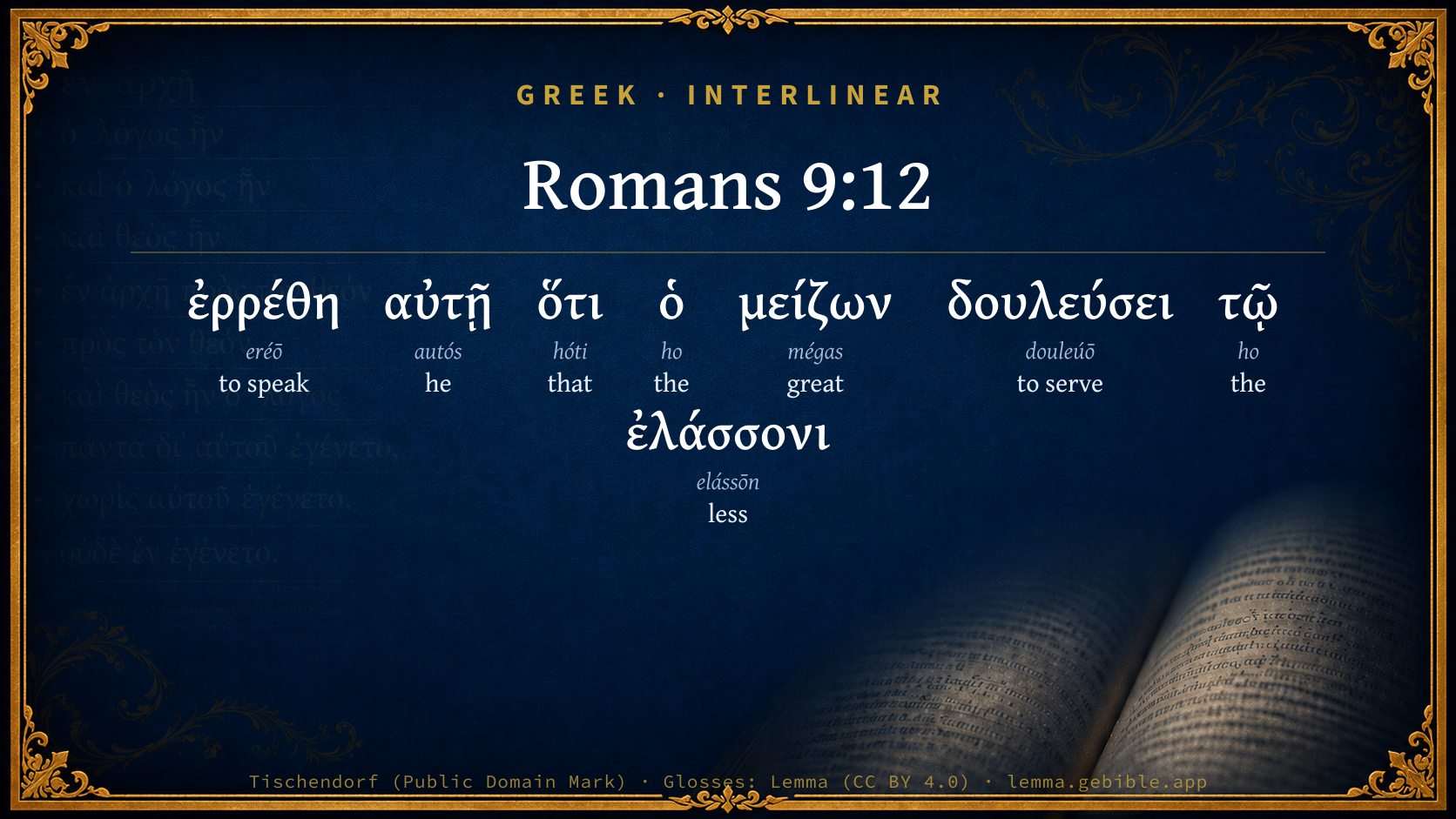
Greek (Tischendorf 8th ed.) Romans 9:12 appears in the Greek New Testament. The text above is from the Tischendorf 8th edition. Each word links to its Strong’s number and a concise gloss. Click any word for its full Thayer’s Greek Lexicon entry.
Download image
Cite this verse

Romans 9:12 (World English Bible). Public Domain. Lemma interlinear Bible study tool, https://lemma.gebible.app/v/romans/9/12.

Show BibTeX & RIS
BibTeX
RIS
English Translation
it was said to her, "The elder will serve the younger."
World English Bible · Public Domain
Download a study sheet

One document with this verse’s original text, its word-by-word gloss line, the meaning frame, cross-references with their text, attributed commentary, and full source and license credits — printable, and it pastes into notes with its structure intact.

This verse Autodidact and up

Study sheet (.html) Plain text (.txt)

A passage Seminary Student

Up to 50 verses in one chapter. A passage sheet keeps up to 6 commentary sources and 12 cross-references per verse, in the order this page ranks them, and says so on the sheet whenever that leaves anything out. Ask for a single verse and you get the Autodidact verse sheet above.

Everything on this page stays free to read, with no account — the sheet is a download of what is already on screen, not access to it.

Want to remove ads? Support Godless Engineer
Compare translations 3

The same verse in 3 English versions, stacked beneath the original-language interlinear above. Click any original word for its lexicon entry.

Each is an independent rendering of the whole verse — the interlinear is not word-aligned to these translations.

Highlighted words mark where these versions differ — a whole-verse word diff, not a word-by-word alignment.

  • World English Bible Public Domain
    it was said to her, "The elder will serve the younger."
  • King James Version Public Domain
    It was said unto her, The elder shall serve the younger.
  • unfoldingWord Literal Text CC BY-SA 4.0
    not by works, but by the one calling—it was said to her, “The older will be enslaved to the younger.”

unfoldingWord Literal Text — © unfoldingWord, licensed CC BY-SA 4.0. Word-aligned USFM3 via Door43 (git.door43.org/unfoldingWord/en_ult).

Versions to compare (up to 4)

3 of 4 selected

Show all 19 translations

Every available English version of this verse, each an independent rendering of the whole verse.

  • World English Bible Public Domain
    it was said to her, "The elder will serve the younger."
  • Berean Standard Bible Public Domain
    not by works but by Him who calls, she was told, “The older will serve the younger.”
  • Majority Standard Bible Public Domain
    not by works but by Him who calls, she was told, “The older will serve the younger.”
  • King James Version Public Domain
    It was said unto her, The elder shall serve the younger.
  • American Standard Version (1901) Public Domain
    it was said unto her, The elder shall serve the younger.
  • Revised Version (1885) Public Domain
    it was said unto her, The elder shall serve the younger.
  • Geneva Bible (1599) Public Domain
    It was said vnto her, The elder shall serue the yonger.
  • Douay-Rheims (1899) Public Domain
    Not of works, but of him that calleth, it was said to her: The elder shall serve the younger.
  • Young's Literal Translation Public Domain
    `The greater shall serve the less;'
  • Literal Standard Version CC BY-SA 4.0
    it was said to her, “The greater will serve the less”;
  • Unlocked Literal Bible CC BY-SA 4.0
    it was said to her, “The older will serve the younger.”
  • unfoldingWord Literal Text CC BY-SA 4.0
    not by works, but by the one calling—it was said to her, “The older will be enslaved to the younger.”
  • Darby Bible Public Domain
    it was said to her, The greater shall serve the less:
  • World Messianic Bible Public Domain
    it was said to her, “The elder will serve the younger.”
  • Webster's Bible Public Domain
    It was said to her, The elder shall serve the younger.
  • Free Bible Version CC BY-SA 4.0
    she was told, “The older brother will serve the younger one.”
  • Bible in Basic English Public Domain
    It was said to her, The older will be the servant of the younger.
  • Text-Critical English NT CC BY 4.0
    she was told, “The older will serve the younger.”
  • Tyndale New Testament (1534) Public Domain
    the elder shall serve the yonger.

Literal Standard Version (2020), Covenant Press — licensed CC BY-SA 4.0. Text via the HelloAO Bible API (eBible.org). Unlocked Literal Bible (unfoldingWord) — licensed CC BY-SA 4.0. Text via the HelloAO Bible API (eBible.org). unfoldingWord Literal Text — © unfoldingWord, licensed CC BY-SA 4.0. Word-aligned USFM3 via Door43 (git.door43.org/unfoldingWord/en_ult). Free Bible Version, Dr. Jonathan Gallagher — licensed CC BY-SA 4.0. Text via the HelloAO Bible API (eBible.org).

Word by word

More ways to search: Search by grammar → Find every occurrence → Compare this word →

Practice this passage: Drill this verse → Learn its vocabulary →

About this verse

These counts appear in no published source. They are computed here, from the morphology-tagged text and Lemma’s own curated glosses. What Lemma adds →

8
words
7
distinct lemmas
Pauline Epistles
section

Notable vocabulary

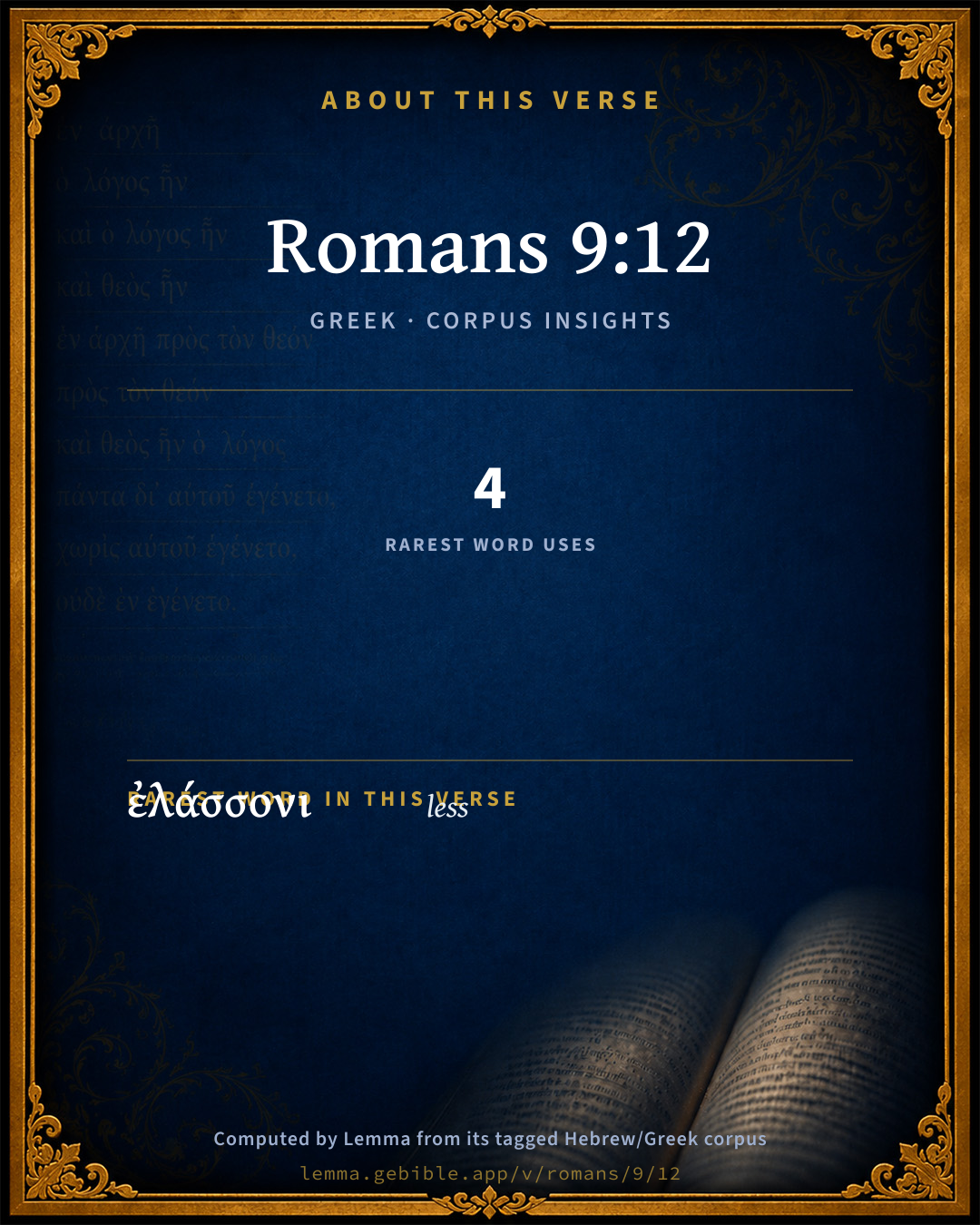
The rarest word here is ἐλάσσονι less G1640 — appearing just 4 times in the whole Greek New Testament.

Shared distinctive vocabulary

ἐλάσσονι less G1640 occurs in 4 verses of the Greek New Testament. Also found in:

Repetition

A word recurs within this verse:

Cross-references

3

Topical passages linked to Romans 9:12 in the Treasury of Scripture Knowledge — connected by theme and wording, ordered by reader-vote popularity; previews shown in the World English Bible.

  • Genesis 25:22–23 The children struggled together within her. She said, "If it be so, why do I live?" She went to inquire of Yahweh.
  • 2 Samuel 8:14 He put garrisons in Edom; throughout all Edom put he garrisons, and all the Edomites became servants to David. Yahweh gave victory to David wherever he went.
  • 1 Kings 22:47 There was no king in Edom: a deputy was king.

Cross-references courtesy of OpenBible.info (CC BY 4.0).

Commentary

Notes on Romans 9:12 from classic Christian and Jewish commentators (each source and its license shown beneath its notes). The classic Christian expositions comment on the surrounding passage and are grouped to its opening verse, so a note may address several verses; the Jewish commentaries on the Tanakh (Rashi and others) are per-verse, so they appear only where the commentator wrote on this verse.

Lemma curates 59 commentaries, every one of them public domain or Creative Commons licensed, each selected and text-cleaned for this edition rather than reprinted as found. About our sources →

Tyndale Open Study Notes

Tyndale Open Resources

9:12 “Your older son will serve your younger son”: God spoke these words to Rebekah before the twins were born (Gen 25:23). As the older of the twins, Esau was Isaac’s natural heir. But Esau sold his birthright to Jacob and ceded his position to his brother in fulfillment of God’s promise.

Tyndale Open Study Notes — © Tyndale Open Resources, licensed CC BY-SA 4.0. Text via the HelloAO Bible API.

Bengel's Gnomon

Johann Albrecht Bengel

Rom 9:12. Αὐτῇ, to her) It was often foretold to mothers before conception or birth, what would happen to their sons.—ὅτι ὁ—ἐλάσσονι) Gen 25:23, LXX., καὶ ὁ—ἐλάσσονι.—ὁ μείζων) the elder, who, it might be reasonably thought, should command, as the younger should obey.—δουλεύσει, shall serve) and yet not so for ever, Gen 27:40.

Bengel's Gnomon of the New Testament — English translation (T&T Clark, Edinburgh, 1860) — public domain. Text from a community e-Sword module.

Hodge's Commentary on Romans, Ephesians & First Corinthians

Charles Hodge

Rom_9:12

It was said to her, the elder shall serve the younger. These words are to be connected with the 10th verse, according to our version, in this manner, Not only this, but Rebecca also, when she had conceived, etc., it was said to her, etc. According to this view, although the construction is irregular, the sense is sufficiently obvious. As it was said to Rebecca that the elder of her sons should serve the younger, prior to the birth of either, it is evident that the choice between them was not on account of their works. It has been said that this declaration relates not to Jacob and Esau personally, but to their posterity,

1. Because in Gen_25:23 whence the quotation is made, it is said, Two nations are within thy womb, and the one people shall be stronger than the other people; and the elder shall serve the younger.

2. Because Esau did not personally serve Jacob, although the descendants of the one were subjected to those of the other. It is no doubt true that the prediction contained in this passage has reference not only to the relative standing of Jacob and Esau as individuals, but also to that of their descendants. It may even be allowed that the latter was principally intended in the annunciation to Rebecca. But it is too clear to be denied,

1. That this distinction between the two races presupposed and included a distinction between the individuals. Jacob was made the special heir to his father Isaac, obtained as an individual the birth-right and the blessing, and Esau as an individual was cast off. The one, therefore, was personally preferred to the other.

2. In Pauls application of this event to his argument, the distinction between the two as individuals, was the very thing referred to. This is plain from the 11th verse, in which he says, The children being not yet born, neither having done any good or evil, etc. It is, therefore, the nature of the choice between the children that is the point designed to be presented.

As to the objection that Esau never personally served Jacob, it is founded on the mere literal sense of the words. Esau did acknowledge his inferiority to Jacob, and was in fact postponed to him on various occasions. The main idea, however, is that Esau forfeited his birthright. Jacob was preferred to his elder brother, and constituted head of the theocracy. In a spiritual or religious sense, and therefore in the highest sense, or in reference to the highest interests, Esau was placed below Jacob, as much as Ishmael was below Isaac. This is the real spirit of the passage. This prophecy, as is the case with all similar predictions, had various stages of fulfillment. The relation between the two brothers during life; the loss of the birthright blessing and promises on the part of Esau; the temporary subjugation of his descendants to the Israelites under David, their final and complete subjection under the Maccabees; and especially their exclusion from the peculiar privileges of the people of God, through all the early periods of their history, are all included. Compare the prediction of the subjection of Ham to his brethren; and of Japheths dwelling in the tents of Shem, Gen_9:25-27.

Charles Hodge — Commentary on Romans (1835), First Corinthians (1857), and Ephesians (1856) — public domain. Text from a community e-Sword module.

Geneva Bible (1599)

Geneva Bible translators

He proveth the casting away of Esau by that, that he was made servant to his brother: and proveth the choosing of Jacob by that that he was made Lord of his brother, although his brother were the first begotten. And lest that any man might take this saying of God, and refer it to external things, the Apostle showeth out of Malachi, who is a good interpreter of Moses, that the servitude of Esau was joined with the hatred of God, and the Lordship of Jacob with the love of God.

Geneva Bible (1599) marginal notes — public domain. Text via Bolls.life.

Adam Clarke's Commentary

Verse 12. The elder shall serve the younger] These words, with those of Malachi, Jacob have I loved, and Esau have I hated, are cited by the apostle to prove, according to their typical signification, that the purpose of God, according to election, does and will stand, not of works, but of him that calleth; that is, that the purpose of God, which is the ground of that election which he makes among men, unto the honour of being Abraham's seed, might appear to remain unchangeable in him; and to be even the same which he had declared unto Abraham. That these words are used in a national and not in a personal sense, is evident from this: that, taken in the latter sense they are not true, for Jacob never did exercise any power over Esau, nor was Esau ever subject to him. Jacob, on the contrary, was rather subject to Esau, and was sorely afraid of him; and, first, by his messengers, and afterwards personally, acknowledged his brother to be his lord, and himself to be his servant; see Ge 32:4; Ge 33:8, Ge 33:13. And hence it appears that neither Esau nor Jacob, nor even their posterities, are brought here by the apostle as instances of any personal reprobation from eternity: for, it is very certain that very many, if not the far greatest part, of Jacob's posterity were wicked, and rejected by God; and it is not less certain that some of Esau's posterity were partakers of the faith of their father Abraham.

From these premises the true sense of the words immediately following, Jacob have I loved, and Esau have I hated, Mal 1:2, Mal 1:3, fully appears; that is, that what he had already cited from Moses concerning the two nations, styled by the names of their respective heads, Jacob and Esau, was but the same in substance with what was spoken many years after by the Prophet Malachi. The unthankful Jews had, in Malachi's time, either in words or in their heart, expostulated with God, and demanded of him wherein he had loved them? I have loved you, saith the Lord: yet ye say, Wherein hast thou loved us? Mal 1:2-5. To this the Lord answers: Was not Esau Jacob's brother? Yet I loved Jacob and hated Esau, and laid his mountains and his heritage waste for the dragons of the wilderness. Whereas Edom saith, We are impoverished, but we will return and build the desolate places; thus saith the Lord of hosts, They shall build, but I will throw down; and they shall call them, The border of wickedness, and, The people against whom the Lord hath indignation for ever. And your eyes shall see, and ye shall say, The Lord will be magnified from the border of Israel.

1. It incontestably appears from these passages that the prophet does not speak at all of the person of Jacob or Esau, but of their respective posterities. For it was not Esau in person that said, We are impoverished; neither were his mountains nor heritage laid waste. Now, if the prophet speaks neither of the person of the one nor of the person of the other, but of their posterity only, then it is evident that the apostle speaks of them in the same way.

2. If neither the prophet nor the apostle speaks of the persons of Jacob or Esau, but of their posterity, then it is evident that neither the love of God to Jacob, nor the hatred of God to Esau, were such, according to which the eternal states of men, either in happiness or misery, are to be determined; nor is there here any Scriptural or rational ground for the decree of unconditional personal election and reprobation, which, comparatively, modern times have endeavoured to build on these scriptures. For,

1. It is here proved that Esau is not mentioned under any personal consideration, but only as the head of his posterity.

2. The testimony of Scripture amply proves that all Esau's posterity were not, even in this sense, reprobated; nor all Jacob's posterity elected.

3. Neither does that service, or subjugation to Jacob, which the Divine oracle imposed on Esau, import any such reprobation as some contend for; as the servant may be elected, while the master himself is in a state of reprobation.

4. Were it even granted that servitude did import such a reprobation, yet it is certain that Esau, in person, never did serve Jacob.

5. Nor does the hatred of God against Esau import any such reprobation of the person of Esau, because it is demonstrable that it related, not to Esau personally, but to his posterity.

6. The scope of the apostle's reasoning is to show that God is the sovereign of his own ways, has a right to dispense his blessings as he chooses, and to give salvation to mankind, not in the ways of their devising, but in that way that is most suitable to his infinite wisdom and goodness.

Therefore,

(1) He chose the Jewish people from all others, and revealed himself to them. Thus they were the elect, and all the nations of mankind reprobate.

(2) When the fulness of the time came he revealed himself also to the Gentiles, who gladly received the Gospel: and the Jews rejecting it, were cast off. Thus the elect became reprobate, and the reprobate, elect.

(3) He published to all mankind that the pardon of sin could and should be obtained ONLY by faith in his Son Jesus, and not by any obedience to any law. And the Jews, the descendants of Jacob, who rejected this way of salvation, became precisely like the Edomites, the descendants of Esau; they builded, but God pulled down; their mountains and heritage are NOW laid waste for the dragons of the wilderness; and they properly may now be called the border of wickedness, a people against whom the Lord hath indignation for ever: they have rejected the Lord that bought them, and so have brought upon themselves swift destruction.

7. That no personal, absolute, eternal reprobation of Esau can have been intended, we learn from this; that he was most amply reconciled to his brother, who had so deeply wronged and offended him, by depriving him of his birthright and his blessing: and his having forgiven his brother his trespasses, was no mean proof that God had forgiven him. See our Lord's words, Mt 6:14. Therefore there can be assigned no competent ground of his damnation, much less of his personal reprobation from all eternity.

8. And were such a personal reprobation intended, is it not shocking to suppose that the God of endless mercy, in whose sight his pious parents had found favour, should inform them, even before their child was born, that he had absolutely consigned him, by an irrevocable decree to eternal damnation? A message of such horrid import coming immediately from the mouth of God, to a tender, weak, and delicate woman, whose hour of travail with two children was just at hand, could not have failed to produce abortion, and destroy her life. But the parents perfectly understood their God, and saw no decree of reprobation in his message; two manner of nations are in thy womb-and the elder shall serve the younger.

9. There is no reason, worthy the most wise and gracious God, why he should make known to the world such a thing concerning Esau, who was yet unborn, that he had reprobated him from all eternity. Such a revelation could be of no spiritual advantage or edification to mankind, but rather of a malignant influence, as directly occasioning men to judge hardly of their Maker, and to conceive of him as no faithful Creator; as having no care, no love, no bowels of compassion towards the workmanship of his own hands. See Goodwin's Exposition: and see my notes on Gen. 27.

Adam Clarke's Commentary on the Bible (1810–1826) — public domain. Text from a community e-Sword/MySword module.

John Calvin's Commentaries

12. The elder shall serve the younger See how the Lord makes a difference between the sons of Isaac, while they were as yet in their mother’s womb; for this was the heavenly answer, by which it appeared that God designed to show to the younger peculiar favor, which he denied to the elder. Though this indeed had reference to the right of primogeniture, yet in this, as the symbol of something greater, was manifested the will of God: and that this was the case we may easily perceive, when we consider what little benefit, according to the flesh, Jacob derived from his primogeniture. For he was, on its account, exposed to great danger; and to avoid this danger, he was obliged to quit his home and his country, and was unkindly treated in his exile: when he returned, he tremblingly, and in doubt of his life, prostrated himself at the feet of his brother, humbly asked forgiveness for his offence, and lived through the indulgence shown to him. Where was his dominion over his brother, from whom he was constrained to seek by entreaty his life? There was then something greater than the primogeniture promised in the answer given by the Lord.

John Calvin's Commentaries (1540-1563) — public domain. Text from the Calvin Translation Society English edition (1840s-50s) via the Christian Classics Ethereal Library (ccel.org). Calvin's coverage is partial (roughly two-thirds of the Bible); uncommented books and verses are honest gaps, never fabricated. The 19th-century editor's footnotes and remarks are omitted so the notes are faithfully Calvin's own voice.

Ellicott's Commentary for English Readers

(12) The elder shall serve the younger.—The margin gives as an alternative rendering, “the greater shall serve the lesser.” The quotation is taken from the LXX., in which there is the same ambiguity.

This ambiguity also appears to exist in the Hebrew, where it is a disputed question whether the words refer to age or to the comparative strength of the two peoples. In either case, it is the nations that should spring from Esau and Jacob that are meant.

A Bible Commentary for English Readers, edited by Charles John Ellicott (1878–1897) — public domain. Text from a community e-Sword module.

The Cambridge Bible for Schools and Colleges

gen. ed. J. J. S. Perowne

12. The elder, &c.] Verbatim as LXX. of Gen_25:23—Of both Hebrew and Greek the literal rendering is The greater shall he bondsman to the less.

shall serve] In the personal history of Esau and Jacob this was not literally fulfilled; but it was so in spirit, in the subjection of Esau’s interests and privileges to those of Jacob. In the history of their descendants it was repeatedly fulfilled to the letter; and prophecy (as in other cases, e.g. that of Abraham,) regarded the ancestor and his descendants as solidaire.

The Cambridge Bible for Schools and Colleges (gen. ed. J. J. S. Perowne; Cambridge University Press, 1878–1918) — public domain. Text from a community e-Sword module.

John Gill's Exposition

As it is written,.... In Mal 1:2;

Jacob have I loved, but Esau have I hated. These words are explanative of the former; they are of like import, and the one interpret the other; and show, that the former are to be understood in a spiritual, and not in a temporal sense, and of the persons, and not the posterity of Jacob and Esau; for though Malachi prophesied long after Jacob and Esau were personally dead, yet the Lord in that prophecy manifestly directs the murmuring Jews to the personal regard he had had to Jacob and Esau, and which had continued in numberless instances to their respective posterities, in order to stop their mouths, and reprove their ingratitude; and though he speaks of the nation of the Edomites, and to the posterity of Israel, yet it is evident, that he has a respect to the persons of Jacob and Esau, from whence they sprung, when he says, "was not Esau Jacob's brother?" Mal 1:2, now though an Edomite may be said to be brother to an Israelite, yet Esau is never said, nor can he with any propriety be said to be the brother of Jacob's posterity: it remains, that these words regard their persons, and express the true spring and source of the choice of the one, and the rejection of the other; and which holds true of all the instances of either kind: everlasting and unchangeable love is the true cause and spring of the choice of particular persons to eternal salvation; and hatred is the cause of rejection, by which is meant not positive hatred, which can only have for its object sin and sinners, or persons so considered; but negative hatred, which is God's will, not to give eternal life to some persons; and shows itself by a neglect of them, taking no notice of them, passing them by, when he chose others; so the word "hate" is used for neglect, taking no notice, where positive hatred cannot be thought to take place, in Luk 14:26.

John Gill's Exposition of the Whole Bible (1746–1763) — public domain (CC PDM 1.0). Text via the HelloAO Bible API.

Trapp's Complete Commentary

John Trapp

12 It was said unto her, The elder shall serve the younger.

Ver. 12. Shall serve] Servitude came in with a curse, and figureth reprobation, Gen 9:25; Joh 8:34-35 Gal 4:30.

John Trapp, A Commentary or Exposition upon All the Books of the Old and New Testament (1647–1656) — public domain. Text from a community e-Sword module.

Albert Barnes' Notes on the Bible

It was said unto her - By Yahweh; see Gen 25:23.

The elder - The oldest son, which was Esau. By the law of primogeniture among the Hebrews, he would have been entitled to special honors and privileges. But it was said that in his case this custom should be reversed, and that he should take the rank of the younger.

Should serve - Shall be subject to; shall not have the authority and priority, but should be inferior to. The passage in Genesis Gen 25:23 shows that this had reference particularly to the posterity of Esau, and not to him as an individual. The sense is, that the descendants of Esau, who were Edomites, should be inferior to, and subject to the descendants of Jacob. Jacob was to have the priority; the promised land; the promises; and the honor of being regarded as the chosen of God. There was reference here, therefore, to the whole train of temporal and spiritual blessings which were to be connected with the two races of people. If it be asked how this bears on the argument of the apostle, we may reply,

(1) That it settles “the principle” that God might make a distinction among people, in the same nation, and the same family, without reference to their works or character.

(2) That he might confer his blessings on such as he pleased.

(3) If this is done in regard to nations, it may be in regard to individuals. The principle is the same, and the justice the same. If it be supposed to be unjust in God to make such a distinction in regard to individuals, it is surely not less so to make a distinction in nations. The fact that numbers are thus favored, does not make it the more proper, or remove any difficulty.

(4) If this distinction may be made in regard to temporal things, why not in regard to spiritual things? The principle must still be the same. If unjust in one case, it would be in the other. The fact that it is done in one case proves also that it will be in the other; for the same great principle will run through all the dealings of the divine government. And as people do not and cannot complain that God makes a distinction among them in regard to talents, health, beauty, prosperity, and rank, neither can they complain if he acts also as a sovereign in the distribution of his spiritual favors. They, therefore, who regard this as referring only to temporal and national privileges, gain no relief in respect to the real difficulty in the case, for the unanswerable question would still be asked, why has not God made all people equal in everything? Why has he made any distinction among people? The only reply to all such inquiries is, “Even so, Father, for so it seemeth good in thy sight;” Mat 11:26.

Albert Barnes' Notes on the Bible (1834–1885) — public domain. Text from a community e-Sword/MySword module.

Matthew Poole's English Annotations

This verse is to be read with Rom 9:10,11 being a parenthesis. Then when she resorted to the Lord for counsel, about the struggling of the children in her womb, it was told her, or revealed to her of God, that

the elder should serve the younger: of the sense of which words, sea annotations on Gen 25:23, where they are recorded.

Matthew Poole's English Annotations on the Holy Bible (1683–1685) — public domain. Text from a community e-Sword/MySword module.

Whedon's Commentary on the Bible

Daniel D. Whedon

12. Said unto her—(Gen_25:23.) Disquieted by the commotion of her unborn twins, Rebecca makes inquiry of Jehovah as to the reason, who replies: “Two nations are in thy womb, and two manners of people; and the one people shall be stronger than the other people, and the elder shall serve the younger.” By these impressive words the two entire races are figured as being embodied in the little persons of the unborn infants: Edomites in Esau, Israelites in Jacob.

The elder… younger—Reversing the law of primogeniture, by which the younger was the inferior.

Shall—Will; the simple future tense. The sentence is a prediction, not a decree. (Note on Act_28:26.) It was fulfilled, not in the persons of the twin brothers, but in their descendants, the Edomites being finally destroyed.

Daniel D. Whedon (gen. ed.), Commentary on the Old and New Testaments (1874–1909) — public domain. Text from a community e-Sword module.

John Wesley's Explanatory Notes

The elder - Esau. Shall serve the younger - Not in person, for he never did; but in his posterity. Accordingly the Edomites were often brought into subjection by the Israelites. Gen. xxv, 23.

John Wesley, Explanatory Notes Upon the Whole Bible (1754–1765) — public domain. Text via the GEBible commentary corpus.

Godbey's Commentary on the New Testament

William B. Godbey

12. “It was said to her that the elder shall serve the younger.” While this primarily means the election of Isaac to the progenitorship, and the reprobation of Esau to the same, it has here a potent symbolic meaning which is not to be overlooked, i. e., that the old Adamic nature in us is to serve the new creature imparted by the Holy Ghost in regeneration. The word “serve” means a slave, involving the perfect submission of the old man.

William B. Godbey, Commentary on the New Testament (1896–1900) — public domain. Text from a community e-Sword module.

McGarvey & Pendleton's Commentaries

J. W. McGarvey

it was said unto her, The elder shall serve ["Servitude," says Trapp, "came in with a curse, and figureth reprobation-- Gen_9:25; Joh_8:34-35 ; Gal_4:30 "] the younger . [I. e., Esau shall serve Jacob. It is evident from these words that Jacob and Esau do not figure personally, but as the heads of elect and non-elect nations, for personally Esau never served Jacob. On the contrary, he lived the life of a prince or petty king, while Jacob was a hireling, and Jacob feared Esau as the man of power. But the nation sprung of the elder son did serve the nation descended from the younger. "History," says Alford, "records several subjugations of Edom by the kings of Judah; first by David ( 2Sa_8:14 )--under Joram they rebelled ( 2Ki_8:20 ), but were defeated by Amaziah ( 2Ki_14:7 ), and Elath taken from them by Uzziah ( 2Ki_14:22 ); under Ahaz they were again free, and troubled Judah ( 2Ch_28:16-17 ; comp. 2Ki_16:6-7 )--and continued free as prophesied in Gen 27:40; till the time of John Hyrcanus, who (Jos. Ant. 13:9, 1) reduced them finally, so that thenceforward they were incorporated among the Jews."]

J. W. McGarvey (with Philip Y. Pendleton), Commentaries on the New Testament (The Fourfold Gospel, 1914; Acts; and the epistles) — public domain. Text from a community e-Sword/MySword module.

The People's New Testament

B. W. Johnson

12. It was said unto her, The elder shall serve the younger. See Gen. 25:23. It was said to Rebecca, “Two nations are in thy womb, … one people shall be stronger than the other, and the elder (people) shall serve the younger” Esau never served Jacob, but the Edomites, descended from Jacob, served the Israelites. The election here is that of a race.

B. W. Johnson's The People's New Testament with Notes (1889–1891) — public domain. Electronic text from the Christian Classics Ethereal Library (CCEL) ThML edition.

Cambridge Greek Testament for Schools and Colleges

12. ὁ μείζων κ.τ.λ., Gen 25:23, where it is the nations represented by their founders rather than or at least as much as the founders themselves that are under consideration: throughout S. Paul is speaking of GOD’S purpose as dealing with nations; cf. S. H. ad lo[181].

[181] ad loc ad locum

Cambridge Greek Testament for Schools and Colleges (Cambridge University Press, 1896; 21 vols, various authors incl. Carr, Maclear, Plummer, Farrar, Lumby, Moule, M. R. James, Simcox) — public domain. Text from a community e-Sword module.

International Critical Commentary

12. ὁ μείζων κ.τ.λ. The quotation is made accurately from the LXX of Gen 25:23 καὶ εἶπε Κύριος αὐτῇ Δύο ἔθνη ἐν τῇ γαστρί σού εἰσιν, καὶ δύο λαοὶ ἐκ τῆς κοιλίας σου διασταλήσονται· καὶ λαὸς λαοῦ ὑπερέξει, καὶ ὁ μείζων δουλεύσει τῷ ἐλάσσονι (cf. Hatch, Essays in Biblical Greek, p. 163). God’s election or rejection of the founder of the race is part of the process by which He elects or rejects the race. In either case the choice has been made independently of merits either of work or of ancestry. Both were of exactly the same descent, and the choice was made before either was born.

ὁ μείζων … τῷ ἐλάσσονι: ‘the elder,’ ‘the younger.’ This use of the words seems to be a Hebraism; see Gen 10:21 καὶ τῷ Σὴμ ἐγενήθη … ἀδελφῷ Ἰάφεθ τοῦ μείζονος: ib. 29:16 ὄνομα τῇ μείζονι Λεία, καὶ ὄνομα τῇ νεωτέρᾳ Ῥαχήλ. But the dictionaries quote in support of the use Σκιπίων ὁ μέγας Pol. XVIII. 18:9. The instances quoted of μικρός (Mar 15:40; Mat 18:6, Mat 18:10, Mat 18:14, &c.) are all equally capable of being explained of stature.

International Critical Commentary — older volumes (1896–1929), various authors — public domain. Text from a community e-Sword module.

Vincent's Word Studies in the New Testament

Marvin R. Vincent

Elder - younger [μειζων - ελασσονι] . Lit., greater - smaller. Compare Gen 27:1, here the Hebrew is : "Esau his great son;" Sept., presbuteron elder. Gen 29:16, Sept., "The name of the greater was Leah, and the name of the younger [τη νεωτερα] Rachel." See a similar use in Aeschylus, "Agamemnon," 349, "Neither old [μεγαν] nor young [νεαρων] could escape the great net of slavery." While in these cases "greater" and "smaller" are evidently used as older and younger, yet the radical meaning is greater and less, and the reference is not to age, but to their relative position in the theocratic plan. Meizwn greater, occurs in forty - four passages in the New Testament, and in no case with the meaning elder. Compare Gen 25:23 be stronger; Sept., uJperexei; shall surpass. The reference, if to the persons of Jacob and Esau, is to them as representatives of the two nations. See Gen 25:23.

Historically the Edomites, represented by Esau, were for a time the greater, and surpassed the Israelites in national and military development. Moses sent envoys to the king of Edom from Kadesh, asking permission to pass through his country, which was refused, and the Edomite army came out against Israel (Num 20:14 - 21). Later they were "vexed" by Saul (1Sa 14:47), and were conquered and made tributary by David (2Sa 8:14). Their strength was shown in their subsequent attempts to recover independence (2Ki 8:20, 21; 2Ki 14:7; 2Ch 28:17). Their final subjugation was effected by John Hyrcanus, who incorporated them into the Jewish nation and compelled them to be circumcised.

Marvin R. Vincent, Word Studies in the New Testament (1887–1900) — public domain. Text from a community e-Sword/MySword module.

Godet's Commentaries

Frédéric Louis Godet

Vv. 12. The oracle quoted is taken from Gen 25:23. The question whether it refers to the two brothers personally, or to the two peoples who shall spring from them, is settled by the words preceding: “Two nations are in thy womb, and two manner of people shall issue from thee.” Hence it follows that the oracle speaks neither of the two peoples separately from their fathers, nor of the two fathers separately from their descendants. Possibly Genesis gives greater weight to the idea of the two peoples, whereas Paul (Rom 9:11) thinks chiefly of the two fathers. It matters little; for a profound solidarity, at once physical and moral, connects the character of the race with that of the father.

The theocratic inferiority of Esau resulted historically from his profane spirit, which showed itself in the sale of his birthright; it was sealed by the blessing of Jacob. As to the people who sprang from Esau, this same inferiority appeared, first, in the fact that their dwelling-place was assigned outside the promised land properly so called, then in their submission to Israel under David, and finally, after several alternations of subjection and independence, in their final incorporation with the Jewish state under John Hyrcanus, and their obliteration from the number of the nations.

The translation of the words μείζων and ἐλάσσων by elder and younger, is rejected by Meyer as opposed to the natural meaning of the two terms. But it is quite impossible to give a different meaning than elder to the word μείζων in the passage Gen 29:16, where it is contrasted with the term ἡ νεωτέρα, the younger. Even in Hebrew the meaning of the narrative is not certainly that Leah was physically greater than her younger sister. And in our passage how can Meyer hold that the term greater signifies that Esau was the stronger of the twins in their mother’s womb!

Frédéric Louis Godet — Commentaries on Luke, John, Romans, and 1 Corinthians — English translation (T&T Clark, Edinburgh, 1870s–1890s) — public domain. Text from a community e-Sword module.

Lesson kit

Teaching starters — assembled from the data on this page, not authored interpretation. Every prompt links to the verse data it draws on. Edit before teaching.

Romans, in the Pauline Epistles, opens this verse with 8 words (7 distinct Greek lemmas). Its most distinctive word is elássōn (“less”). A historical commentator’s framing appears above. Read the whole chapter for the surrounding context.

Discussion questions

  1. How does “less” (elássōn) shape what this verse is saying?
  2. John 2:10 shares the word «less» with this verse. How do the two illuminate each other?
  3. “the” occurs 2× in this one verse. What is the effect of the repetition?
  4. The translations on this page render this verse differently — a whole-verse word diff, not a word-by-word alignment. What might account for the different wordings?
  5. Reading how Tyndale Open Study Notes and Bengel's Gnomon read this verse, where do the two commentators agree and where do they part?

Things to notice

  • These translations choose different wording for 9 words in this verse.
  • “the” occurs 2× in this single verse.
  • 7 distinct Greek lemmas span 8 words in this verse.

Reading settings

Reading text

Shown beneath each verse's original-language words.

Old Testament
Old Testament edition

Read the OT as the Masoretic Hebrew (MT) or the Greek Septuagint (LXX).

English shown for the Greek Septuagint (in the Hebrew ↔ Greek comparison).

Comparing translations? Open the Compare panel on any verse page to stack up to four side by side.