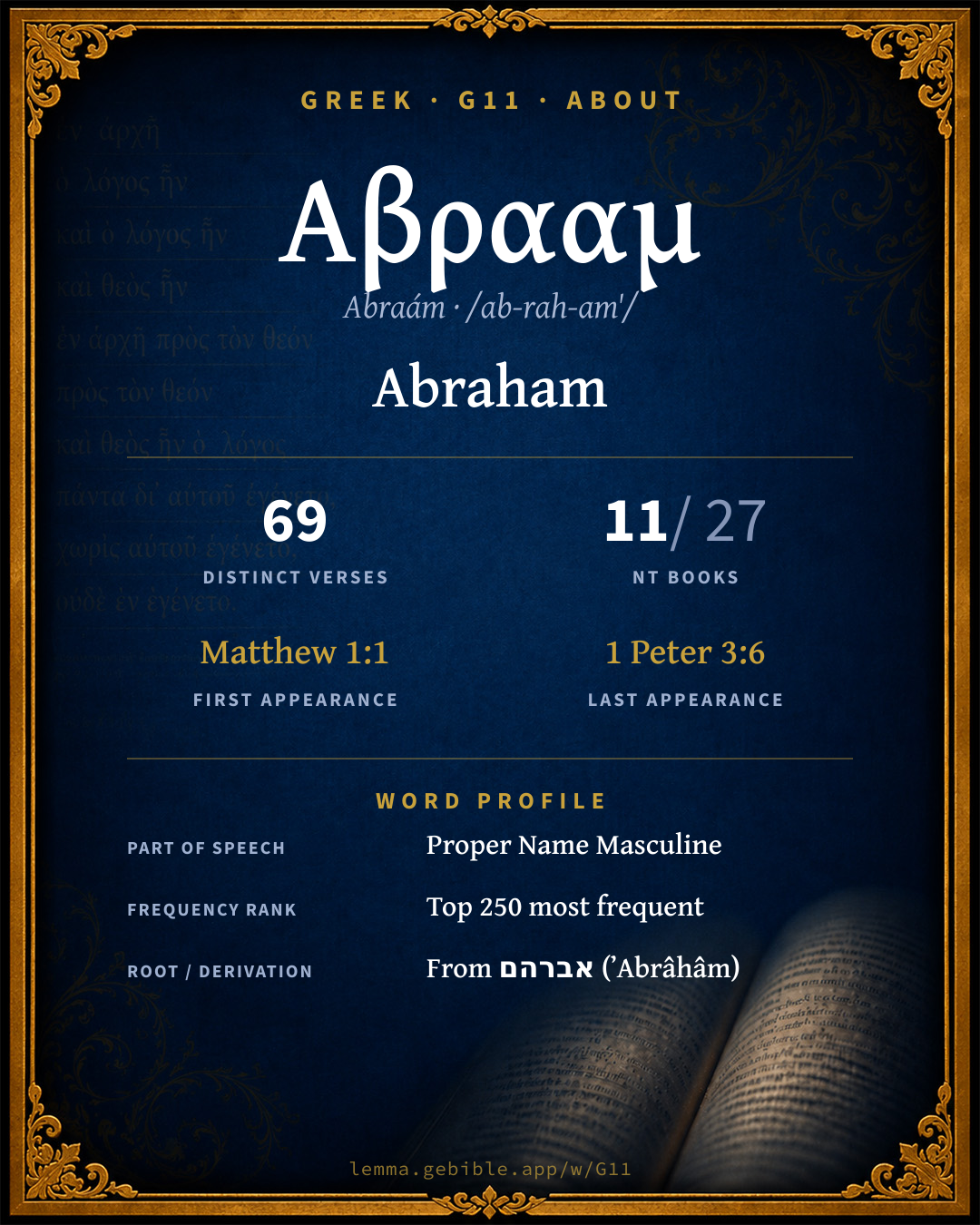
Ἀβραάμ
Abraham
Thayer's lists 2 entries for ‘Abraham’ fuller range ↓
Full lexicon entry — Thayer's Greek Lexicon
From Thayer's Greek Lexicon
Where this word appears
Every verse where G11 appears in the Book of 2 Corinthians — 1 distinct verse. Click any verse to open its interlinear word-by-word view. Verse text shown in the World English Bible for context — . Each verse’s Greek form is shown with its reference; the English is not keyword-highlighted, since the data carries no word-level English alignment. Use “Compare translations” on any verse to read it across multiple English versions. This concordance covers the Greek New Testament; Septuagint (Greek Old Testament) occurrences of this word are not indexed here.
2 Corinthians
About this entry
At a glance — auto-summarized from this page’s data, not written by a person. Every figure links to its source below. This summary describes the numbers; it doesn’t interpret them.
“Abraham” is the headline sense of the Greek name Αβρααμ (Abraám). Its earliest occurrence is Matthew 1:1. The Greek New Testament uses it across 69 verses — moderately common. See 69-verse concordance and the renderings breakdown below.
Gloss history
Strong's 1890 vs modern scholarship
About this word
Strong's G11 catalogs a Greek word from the Greek New Testament.
These counts are not copied from any lexicon or concordance. They are computed here, from the morphology-tagged Greek New Testament. What Lemma adds →
- 69
- distinct verses
- The word appears in 69 distinct verses.
- 11 / 27
- NT books
- The word appears in 11 of 27 New Testament books.
- #233
- by frequency
- Top 250 most frequent Greek words (rank 233 of 5,347 Greek words by occurrence).
View all 69 occurrences in the concordance →
By section of the New Testament
By traditional corpus
Conventional, traditional groupings — biblical authorship is debated, so this is a traditional corpus grouping, not an authorship claim. Some books belong to more than one corpus (Luke is in both the Gospels and the Lukan corpus, and so on), so these shares overlap and need not total 100%. Each figure is a share of the word’s 69 distinct verses.
- Gospels 30 verses · 43%
- Lukan (Luke–Acts) 21 verses · 30%
- Pauline corpus 19 verses · 28%
- Hebrews 10 verses · 14%
- Johannine 9 verses · 13%
- General (Catholic) Epistles 3 verses · 4%
How translations render this word
Counts come from each version’s own published word-to-Strong’s tagging or interlinear alignment — an approximate guide to how each version renders this word, not a word-level alignment the data otherwise carries. Because each total is that version’s own tagged count, the per-version totals vary from one another and need not match the appearance or distinct-verse counts above. These counts may also differ from a printed concordance because Lemma counts each distinctly tagged rendering and does not collapse phrase taggings into a single head-word total. This is a fixed set of word-tagged versions (KJV, ASV, BSB, ULT) and does not change with the reading translation you choose elsewhere. Each version’s license is shown beside its name below (and on Sources).
- King James Version: Abraham 67×, Abraham's 5×
- American Standard Version: Abraham 68×
- Berean Standard Bible: Abraham 67×, Abraham’s 6×
- unfoldingWord Literal Text: Abraham 73×
King James Version Public Domain
Renders G11 across 73 tagged occurrences — most commonly:
Plus 1 rendering that appears only once — usually multi-word phrases or single function words the recovered tagging swept in, not distinct renderings.
American Standard Version Public Domain
Renders G11 across 71 tagged occurrences — most commonly:
Plus 3 renderings that appear only once — usually multi-word phrases or single function words the recovered tagging swept in, not distinct renderings.
Berean Standard Bible Public Domain
Renders G11 across 73 tagged occurrences — most commonly:
unfoldingWord Literal Text CC BY-SA 4.0
Renders G11 across 74 tagged occurrences — most commonly:
Plus 1 rendering that appears only once — usually multi-word phrases or single function words the recovered tagging swept in, not distinct renderings.
Senses in Thayer's
The 2 senses Thayer's distinguishes for this word, in lexicon order (not ranked by frequency or importance). The full entry — with sub-senses — is in the Lexicon Entry tab.
- Abraham = "father of a multitude"
- the son of Terah and the founder of the Jewish nation
Word origin
Derived from אברהם (ʼAbrâhâm) (H85) — Abraham.
Of hebrew origin [ H85 ]; Abraham the hebrew patriarch. In Act 7:16 the text should probably read Jacob : - Abraham.
— Strong’s Exhaustive Concordance (1890), public domain.
Forms in the corpus
The 2 distinct written forms G11 takes in the Greek New Testament, most frequent first — each parse links to that case’s occurrences in the concordance.
| Form | Parsing | Example | Uses |
|---|---|---|---|
| Ἀβραὰμ Abraàm | Noun, Proper, indeclinable | Matthew 1:2 | 44 |
| Ἀβραάμ Abraám | Noun, Proper, indeclinable | Matthew 1:1 | 29 |
Bible dictionary
Public-domain dictionary articles matched to this entry by name (Abraham). A biblical name can be shared by more than one person or place, so an article may treat several.
Easton's Bible Dictionary · M. G. Easton, 1897
Father of a multitude, son of Terah, named (Gen. 11:27) before his older brothers Nahor and Haran, because he was the heir of the promises. Till the age of seventy, Abram sojourned among his kindred in his native country of Chaldea. He then, with his father and his family and household, quitted the city of Ur, in which he had hitherto dwelt, and went some 300 miles north to Haran, where he abode fifteen years. The cause of his migration was a call from God (Acts 7:2-4). There is no mention of this first call in the Old Testament; it is implied, however, in Gen. 12. While they tarried at Haran, Terah died at the age of 205 years. Abram now received a second and more definite call, accompanied by a promise from God (Gen. 12:1, 2); whereupon he took his departure, taking his nephew Lot with him, "not knowing whither he went" (Heb. 11:8). He trusted implicitly to the guidance of Him who had called him.
Abram now, with a large household of probably a thousand souls, entered on a migratory life, and dwelt in tents. Passing along the valley of the Jabbok, in the land of Canaan, he formed his first encampment at Sichem (Gen. 12:6), in the vale or oak-grove of Moreh, between Ebal on the north and Gerizim on the south. Here he received the great promise, "I will make of thee a great nation," etc. (Gen. 12:2, 3, 7). This promise comprehended not only temporal but also spiritual blessings. It implied that he was the chosen ancestor of the great Deliverer whose coming had been long ago predicted (Gen. 3:15). Soon after this, for some reason not mentioned, he removed his tent to the mountain district between Bethel, then called Luz, and Ai, towns about two miles apart, where he built an altar to "Jehovah." He again moved into the southern tract of Palestine, called by the Hebrews the Negeb; and was at length, on account of a famine, compelled to go down into Egypt. This took place in the time of the Hyksos, a Semitic race which now held the Egyptians in bondage. Here occurred that case of deception on the part of Abram which exposed him to the rebuke of Pharaoh (Gen. 12:18). Sarai was restored to him; and Pharaoh loaded him with presents, recommending him to withdraw from the country. He returned to Canaan richer than when he left it, "in cattle, in silver, and in gold" (Gen. 12:8; 13:2. Comp. Ps. 105:13, 14). The whole party then moved northward, and returned to their previous station near Bethel. Here disputes arose between Lot's shepherds and those of Abram about water and pasturage. Abram generously gave Lot his choice of the pasture-ground. (Comp. 1 Cor. 6:7.) He chose the well-watered plain in which Sodom was situated, and removed thither; and thus the uncle and nephew were separated. Immediately after this Abram was cheered by a repetition of the promises already made to him, and then removed to the plain or "oak-grove" of Mamre, which is in Hebron. He finally settled here, pitching his tent under a famous oak or terebinth tree, called "the oak of Mamre" (Gen. 13:18). This was his third resting-place in the land.
Some fourteen years before this, while Abram was still in Chaldea, Palestine had been invaded by Chedorlaomer, King of Elam, who brought under tribute to him the five cities in the plain to which Lot had removed. This tribute was felt by the inhabitants of these cities to be a heavy burden, and after twelve years they revolted. This brought upon them the vengeance of Chedorlaomer, who had in league with him four other kings. He ravaged the whole country, plundering the towns, and carrying the inhabitants away as slaves. Among those thus treated was Lot. Hearing of the disaster that had fallen on his nephew, Abram immediately gathered from his own household a band of 318 armed men, and being joined by the Amoritish chiefs Mamre, Aner, and Eshcol, he pursued after Chedorlaomer, and overtook him near the springs of the Jordan. They attacked and routed his army, and pursued it over the range of Anti-Libanus as far as to Hobah, near Damascus, and then returned, bringing back all the spoils that had been carried away. Returning by way of Salem, i.e., Jerusalem, the king of that place, Melchizedek, came forth to meet them with refreshments. To him Abram presented a tenth of the spoils, in recognition of his character as a priest of the most high God (Gen. 14:18-20).
In a recently-discovered tablet, dated in the reign of the grandfather of Amraphel (Gen. 14:1), one of the witnesses is called "the Amorite, the son of Abiramu," or Abram.
Having returned to his home at Mamre, the promises already made to him by God were repeated and enlarged (Gen. 13:14). "The word of the Lord" (an expression occurring here for the first time) "came to him" (15:1). He now understood better the future that lay before the nation that was to spring from him. Sarai, now seventy-five years old, in her impatience, persuaded Abram to take Hagar, her Egyptian maid, as a concubine, intending that whatever child might be born should be reckoned as her own. Ishmael was accordingly thus brought up, and was regarded as the heir of these promises (Gen. 16). When Ishmael was thirteen years old, God again revealed yet more explicitly and fully his gracious purpose; and in token of the sure fulfilment of that purpose the patriarch's name was now changed from Abram to Abraham (Gen. 17:4, 5), and the rite of circumcision was instituted as a sign of the covenant. It was then announced that the heir to these covenant promises would be the son of Sarai, though she was now ninety years old; and it was directed that his name should be Isaac. At the same time, in commemoration of the promises, Sarai's name was changed to Sarah. On that memorable day of God's thus revealing his design, Abraham and his son Ishmael and all the males of his house were circumcised (Gen. 17). Three months after this, as Abraham sat in his tent door, he saw three men approaching. They accepted his proffered hospitality, and, seated under an oak-tree, partook of the fare which Abraham and Sarah provided. One of the three visitants was none other than the Lord, and the other two were angels in the guise of men. The Lord renewed on this occasion his promise of a son by Sarah, who was rebuked for her unbelief. Abraham accompanied the three as they proceeded on their journey. The two angels went on toward Sodom; while the Lord tarried behind and talked with Abraham, making known to him the destruction that was about to fall on that guilty city. The patriarch interceded earnestly in behalf of the doomed city. But as not even ten righteous persons were found in it, for whose sake the city would have been spared, the threatened destruction fell upon it; and early next morning Abraham saw the smoke of the fire that consumed it as the "smoke of a furnace" (Gen. 19:1-28).
After fifteen years' residence at Mamre, Abraham moved southward, and pitched his tent among the Philistines, near to Gerar. Here occurred that sad instance of prevarication on his part in his relation to Abimelech the King (Gen. 20). (See ABIMELECH.) Soon after this event, the patriarch left the vicinity of Gerar, and moved down the fertile valley about 25 miles to Beer-sheba. It was probably here that Isaac was born, Abraham being now an hundred years old. A feeling of jealousy now arose between Sarah and Hagar, whose son, Ishmael, was no longer to be regarded as Abraham's heir. Sarah insisted that both Hagar and her son should be sent away. This was done, although it was a hard trial to Abraham (Gen. 21:12). (See HAGAR; ISHMAEL.)
At this point there is a blank in the patriarch's history of perhaps twenty-five years. These years of peace and happiness were spent at Beer-sheba. The next time we see him his faith is put to a severe test by the command that suddenly came to him to go and offer up Isaac, the heir of all the promises, as a sacrifice on one of the mountains of Moriah. His faith stood the test (Heb. 11:17-19). He proceeded in a spirit of unhesitating obedience to carry out the command; and when about to slay his son, whom he had laid on the altar, his uplifted hand was arrested by the angel of Jehovah, and a ram, which was entangled in a thicket near at hand, was seized and offered in his stead. From this circumstance that place was called Jehovah-jireh, i.e., "The Lord will provide." The promises made to Abraham were again confirmed (and this was the last recorded word of God to the patriarch); and he descended the mount with his son, and returned to his home at Beer-sheba (Gen. 22:19), where he resided for some years, and then moved northward to Hebron.
Some years after this Sarah died at Hebron, being 127 years old. Abraham acquired now the needful possession of a burying-place, the cave of Machpelah, by purchase from the owner of it, Ephron the Hittite (Gen. 23); and there he buried Sarah. His next care was to provide a wife for Isaac, and for this purpose he sent his steward, Eliezer, to Haran (or Charran, Acts 7:2), where his brother Nahor and his family resided (Gen. 11:31). The result was that Rebekah, the daughter of Nahor's son Bethuel, became the wife of Isaac (Gen. 24). Abraham then himself took to wife Keturah, who became the mother of six sons, whose descendants were afterwards known as the "children of the east" (Judg. 6:3), and later as "Saracens." At length all his wanderings came to an end. At the age of 175 years, 100 years after he had first entered the land of Canaan, he died, and was buried in the old family burying-place at Machpelah (Gen. 25:7-10).
The history of Abraham made a wide and deep impression on the ancient world, and references to it are interwoven in the religious traditions of almost all Eastern nations. He is called "the friend of God" (James 2:23), "faithful Abraham" (Gal. 3:9), "the father of us all" (Rom. 4:16).
Smith's Bible Dictionary · William Smith, 1863
(father of a multitude) was the son of Terah, and founder of the great Hebrew nation. (B.C. 1996-1822.) His family, a branch of the descendants of Shem, was settled in Ur of the Chaldees, beyond the Euphrates, where Abraham was born. Terah had two other sons, Nahor and Haran. Haran died before his father in Ur of the Chaldees, leaving a son, Lot; and Terah, taking with him Abram, with Sarai his wife and his grandson Lot, emigrated to Haran in Mesopotamia, where he died. On the death of his father, Abram, then in the 75th year of his age, with Sarai and Lot, pursued his course to the land of Canaan, whither he was directed by divine command, (Genesis 12:5) when he received the general promise that he should become the founder of a great nation, and that all the families of the earth should be blessed in him. He passed through the heart of the country by the great highway to Shechem, and pitched his tent beneath the terebinth of Moreh. (Genesis 12:6) Here he received in vision from Jehovah the further revelation that this was the land which his descendants should inherit. (Genesis 12:7) The next halting-place of the wanderer was on a mountain between Bethel and Ai, (Genesis 12:8) but the country was suffering from famine, and Abram journeyed still southward to the rich cornlands of Egypt. There, fearing that the great beauty of Sarai might tempt the powerful monarch of Egypt and expose his own life to peril, he arranged that Sarai should represent herself as his sister, which her actual relationship to him, as probably the daughter of his brother Haran, allowed her to do with some semblance of truth. But her beauty was reported to the king, and she was taken into the royal harem. The deception was discovered, and Pharaoh with some indignation dismissed Abram from the country. (Genesis 12:10-20) He left Egypt with great possessions, and, accompanied by Lot, returned by the south of Palestine to his former encampment between Bethel and Ai. The increased wealth of the two kinsmen was the ultimate cause of their separation. Lot chose the fertile plain of the Jordan near Sodom, while Abram pitched his tent among the groves of Mamre, close to Hebron. (Genesis 13:1) ... Lot with his family and possessions having been carried away captive by Chedorlaomer king of Elam, who had invaded Sodom, Abram pursued the conquerors and utterly routed them not far from Damascus. The captives and plunder were all recovered, and Abram was greeted on his return by the king of Sodom, and by Melchizedek king of Salem, priest of the most high God, who mysteriously appears upon the scene to bless the patriarch and receive from him a tenth of the spoil. (Genesis 14:1) ... After this the thrice-repeated promise that his descendants should become a mighty nation and possess the land in which he was a stranger was confirmed with all the solemnity of a religious ceremony. (Genesis 15:1) ... Ten years had passed since he had left his father's house, and the fulfillment of the promise was apparently more distant than at first. At the suggestion of Sarai, who despaired of having children of her own, he took as his concubine Hagar, her Egyptian main, who bore him Ishmael in the 86th year of his age. (Genesis 16:1) ... [Hagar; Ishmael] But this was not the accomplishment of the promise. Thirteen years elapsed, during which Abram still dwelt in Hebron, when the covenant was renewed, and the rite of circumcision established as its sign. This most important crisis in Abram's life, when he was 99 years old, is marked by the significant change of his name to Abraham, "father of a multitude;" while his wife's from Sarai became Sarah. The promise that Sarah should have a son was repeated in the remarkable scene described in ch. 18. Three men stood before Abraham as he sat in his tent door in the heat of the day. The patriarch, with true Eastern hospitality, welcomed the strangers, and bade them rest and refresh themselves. The meal ended, they foretold the birth of Isaac, and went on their way to Sodom. Abraham accompanied them, and is represented as an interlocutor in a dialogue with Jehovah, in which he pleaded in vain to avert the vengeance threatened to the devoted cities of the plain. (Genesis 18:17-33) In remarkable contrast with Abraham's firm faith with regard to the magnificent fortunes of his posterity stand the incident which occurred during his temporary residence among the Philistines in Gerar, whither he had for some cause removed after the destruction of Sodom. It was almost a repetition of what took place in Egypt a few years before. At length Isaac, the long-looked for child, was born. Sarah's jealousy aroused by the mockery of Ishmael at the "great banquet" which Abram made to celebrate the weaning of her son, (Genesis 21:9) demanded that, with his mother Hagar, he should be driven out. (Genesis 21:10) But the severest trial of his faith was yet to come. For a long period the history is almost silent. At length he receives the strange command to take Isaac, his only son, and offer him for a burnt offering at an appointed place Abraham hesitated not to obey. His faith, hitherto unshaken, supported him in this final trial, "accounting that God was able to raise up his son, even from the dead, from whence also he received him in a figure." (Hebrews 11:19) The sacrifice was stayed by the angel of Jehovah, the promise of spiritual blessing made for the first time, and Abraham with his son returned to Beersheba, and for a time dwelt there. (Genesis 22:1) ... But we find him after a few years in his original residence at Hebron, for there Sarah died, (Genesis 23:2) and was buried in the cave of Machpelah. The remaining years of Abraham's life are marked by but few incidents. After Isaac's marriage with Rebekah and his removal to Lahai-roi, Abraham took to wife Keturah, by whom he had six children, Zimran, Jokshan, Medan, Midian, Ishbok and Shuah, who became the ancestors of nomadic tribes inhabiting the countries south and southeast of Palestine. Abraham lived to see the gradual accomplishment of the promise in the birth of his grandchildren Jacob and Esau, and witnessed their growth to manhood. (Genesis 25:26) At the goodly age of 175 he was "gathered to his people," and laid beside Sarah in the tomb of Machpelah by his sons Isaac and Ishmael. (Genesis 25:7-10)
Hitchcock's Bible Names Dictionary · Roswell D. Hitchcock, 1869
father of a great multitude
Classic public-domain reference works; full attribution on Sources.
Septuagint usage
The same Greek word Αβρααμ appears 183 times in the Greek Old Testament (Septuagint), across 166 verses in 17 books.
- 183
- LXX occurrences
- Tagged occurrences of this Greek word in the Septuagint.
- 166
- verses
- Distinct Septuagint verses containing this word.
- 17 / 39
- OT books
- The word appears in 17 of the 39 Old Testament books.
Sample Septuagint occurrences
- Genesis 17:5 αβρααμ
- Exodus 2:24 αβρααμ
- Leviticus 26:42 ἀβραάμ
- Numbers 32:11 ἀβραάμ
- Deuteronomy 1:8 ἀβραάμ
- Joshua 24:2 ἀβραάμ
- 1 Kings 18:36 ἀβραάμ
- 2 Kings 13:23 ἀβραάμ
- 1 Chronicles 1:15 ἀβραάμ
- 2 Chronicles 20:7 ἀβραάμ
- Ezra 19:7 ἀβραάμ
- Job 42:17 ἀβραάμ
Septuagint occurrences (same lexeme)
Every verse where the same Strong’s number (G11) appears in the Greek Septuagint — showing the first 50 of 166. Verse text shown in the World English Bible for context; the Greek form is the matched word — the English is not keyword-highlighted.
- Genesis 17:5 αβρααμ Neither will your name any more be called Abram, but your name will be Abraham; for the father of a multitude of nations have I made you.
- Genesis 17:9 αβρααμ God said to Abraham, "As for you, you will keep my covenant, you and your seed after you throughout their generations.
- Genesis 17:15 αβρααμ God said to Abraham, "As for Sarai your wife, you shall not call her name Sarai, but her name will be Sarah.
- Genesis 17:17 αβρααμ Then Abraham fell on his face, and laughed, and said in his heart, "Will a child be born to him who is one hundred years old? Will Sarah, who is ninety years old, give birth?"
- Genesis 17:18 αβρααμ Abraham said to God, "Oh that Ishmael might live before you!"
- Genesis 17:19 αβρααμ God said, "No, but Sarah, your wife, will bear you a son. You shall call his name Isaac. I will establish my covenant with him for an everlasting covenant for his seed after him.
- Genesis 17:22 αβρααμ When he finished talking with him, God went up from Abraham.
- Genesis 17:23 αβρααμ Abraham took Ishmael his son, all who were born in his house, and all who were bought with his money; every male among the men of Abraham's house, and circumcised the flesh of their foreskin in the same day, as God had said to him.
- Genesis 17:24 αβρααμ Abraham was ninety-nine years old, when he was circumcised in the flesh of his foreskin.
- Genesis 17:26 αβρααμ In the same day both Abraham and Ishmael, his son, were circumcised.
- Genesis 18:6 αβρααμ Abraham hurried into the tent to Sarah, and said, "Quickly make ready three measures of fine meal, knead it, and make cakes."
- Genesis 18:7 αβρααμ Abraham ran to the herd, and fetched a tender and good calf, and gave it to the servant. He hurried to dress it.
- Genesis 18:11 αβρααμ Now Abraham and Sarah were old, well advanced in age. It had ceased to be with Sarah after the manner of women.
- Genesis 18:13 αβρααμ Yahweh said to Abraham, "Why did Sarah laugh, saying, 'Will I really bear a child, yet I am old?'
- Genesis 18:16 αβρααμ The men rose up from there, and looked toward Sodom. Abraham went with them to see them on their way.
- Genesis 18:17 αβρααμ Yahweh said, "Will I hide from Abraham what I do,
- Genesis 18:18 αβρααμ seeing that Abraham has surely become a great and mighty nation, and all the nations of the earth will be blessed in him?
- Genesis 18:19 αβρααμ For I have known him, to the end that he may command his children and his household after him, that they may keep the way of Yahweh, to do righteousness and justice; to the end that Yahweh may bring on Abraham that which he has spoken of him."
- Genesis 18:22 αβρααμ The men turned from there, and went toward Sodom, but Abraham stood yet before Yahweh.
- Genesis 18:23 αβρααμ Abraham drew near, and said, "Will you consume the righteous with the wicked?
- Genesis 18:27 αβρααμ Abraham answered, "See now, I have taken it on myself to speak to the Lord, who am but dust and ashes.
- Genesis 18:33 αβρααμ Yahweh went his way, as soon as he had finished communing with Abraham, and Abraham returned to his place.
- Genesis 19:27 αβρααμ Abraham got up early in the morning to the place where he had stood before Yahweh.
- Genesis 19:29 αβρααμ It happened, when God destroyed the cities of the plain, that God remembered Abraham, and sent Lot out of the midst of the overthrow, when he overthrew the cities in which Lot lived.
- Genesis 20:1 αβρααμ Abraham traveled from there toward the land of the South, and lived between Kadesh and Shur. He lived as a foriegner in Gerar.
- Genesis 20:2 αβρααμ Abraham said about Sarah his wife, "She is my sister." Abimelech king of Gerar sent, and took Sarah.
- Genesis 20:9 αβρααμ Then Abimelech called Abraham, and said to him, "What have you done to us? How have I sinned against you, that you have brought on me and on my kingdom a great sin? You have done deeds to me that ought not to be done!"
- Genesis 20:10 αβρααμ Abimelech said to Abraham, "What did you see, that you have done this thing?"
- Genesis 20:11 αβρααμ Abraham said, "Because I thought, 'Surely the fear of God is not in this place. They will kill me for my wife's sake.'
- Genesis 20:14 αβρααμ Abimelech took sheep and oxen, men-servants and women-servants, and gave them to Abraham, and restored Sarah, his wife to him.
- Genesis 20:15 αβρααμ Abimelech said, "Behold, my land is before you. Dwell where it pleases you."
- Genesis 20:17 αβρααμ Abraham prayed to God. God healed Abimelech, and his wife, and his maid-servants, and they bore children.
- Genesis 20:18 αβρααμ For Yahweh had closed up tight all the wombs of the house of Abimelech, because of Sarah, Abraham's wife.
- Genesis 21:2 αβρααμ Sarah conceived, and bore Abraham a son in his old age, at the set time of which God had spoken to him.
- Genesis 21:3 αβρααμ Abraham called his son who was born to him, whom Sarah bare to him, Isaac.
- Genesis 21:4 αβρααμ Abraham circumcised his son, Isaac, when he was eight days old, as God had commanded him.
- Genesis 21:5 αβρααμ Abraham was one hundred years old when his son, Isaac, was born to him.
- Genesis 21:7 αβρααμ She said, "Who would have said to Abraham, that Sarah would nurse children? For I have borne him a son in his old age."
- Genesis 21:8 αβρααμ The child grew, and was weaned. Abraham made a great feast on the day that Isaac was weaned.
- Genesis 21:9 αβρααμ Sarah saw the son of Hagar the Egyptian, whom she had borne to Abraham, mocking.
- Genesis 21:10 αβρααμ Therefore she said to Abraham, "Cast out this handmaid and her son! For the son of this handmaid will not be heir with my son, even with Isaac."
- Genesis 21:11 αβρααμ The thing was very grievous in Abraham's sight on account of his son.
- Genesis 21:12 αβρααμ God said to Abraham, "Don't let it be grievous in your sight because of the boy, and because of your handmaid. In all that Sarah says to you, listen to her voice. For from Isaac will your seed be called.
- Genesis 21:14 αβρααμ Abraham rose up early in the morning, and took bread and a bottle of water, and gave it to Hagar, putting it on her shoulder, and gave her the child, and sent her away. She departed, and wandered in the wilderness of Beersheba.
- Genesis 21:22 αβρααμ It happened at that time, that Abimelech and Phicol the captain of his host spoke to Abraham, saying, "God is with you in all that you do.
- Genesis 21:24 αβρααμ Abraham said, "I will swear."
- Genesis 21:25 αβρααμ Abraham complained to Abimelech because of a water well, which Abimelech's servants had violently taken away.
- Genesis 21:27 αβρααμ Abraham took sheep and oxen, and gave them to Abimelech. Those two made a covenant.
- Genesis 21:28 αβρααμ Abraham set seven ewe lambs of the flock by themselves.
- Genesis 21:29 αβρααμ Abimelech said to Abraham, "What do these seven ewe lambs which you have set by themselves mean?"
These are occurrences of the same Greek lexeme (G11) in the Septuagint — not a translation of any one Hebrew word. The store carries no word-level Hebrew↔Greek alignment, so no Hebrew original is asserted here. Counts come from the recovered LXX Strong's tagging — high-frequency vocabulary is well covered, while rare or late forms may be untagged — so they reflect tagged occurrences and may slightly undercount.