
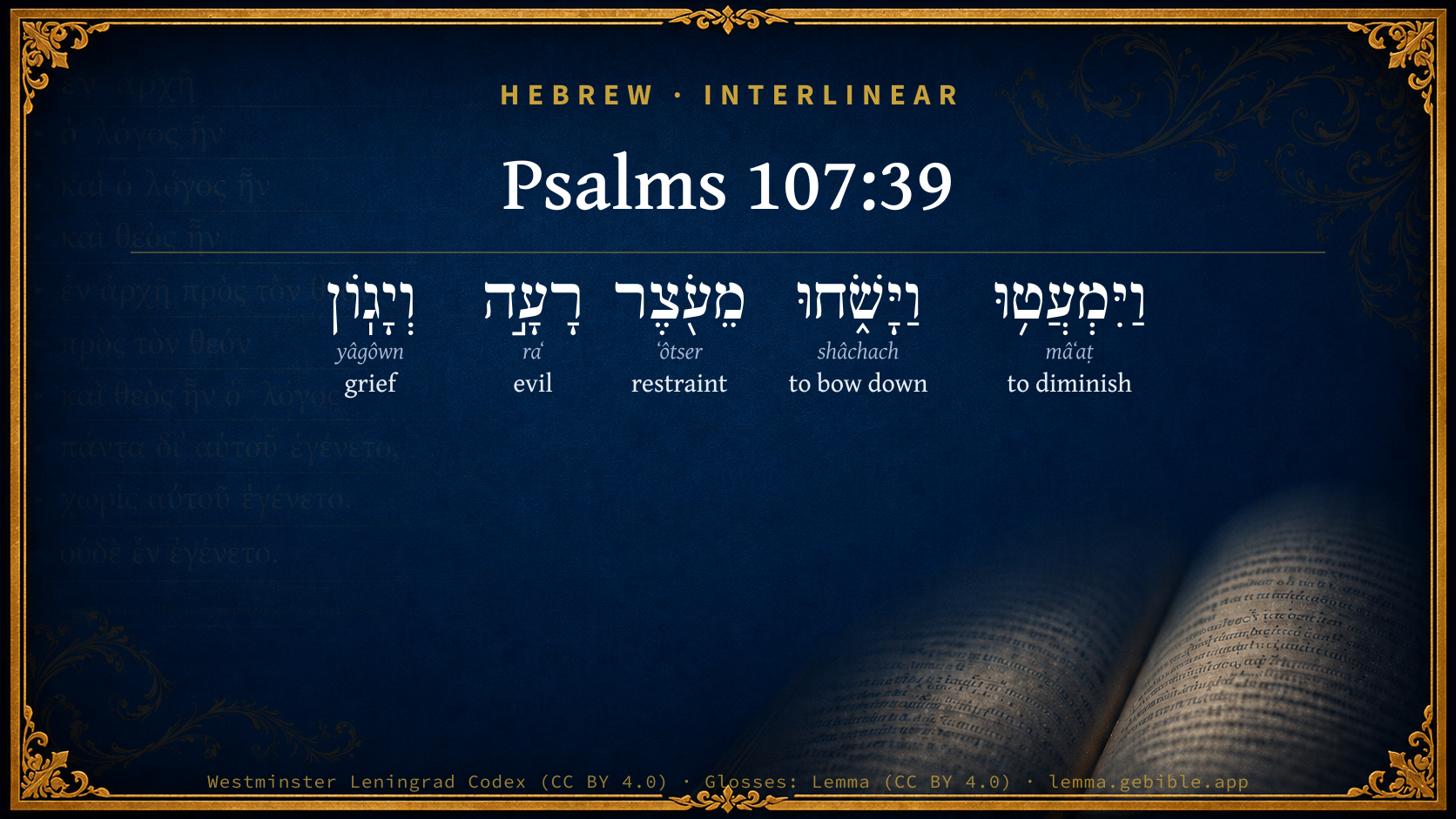
Psalms 107:39

Hebrew (Westminster Leningrad Codex) Psalms 107:39 appears in the Hebrew Old Testament. The text above is from the Westminster Leningrad Codex. Each word links to its Strong’s number, a concise gloss, and parsing drawn from the Open Scriptures Hebrew Bible morphology. Click any word for its full Brown-Driver-Briggs (BDB) entry.
Download image
Cite this verse

Psalms 107:39 (World English Bible). Public Domain. Lemma interlinear Bible study tool, https://lemma.gebible.app/v/psalms/107/39.

Show BibTeX & RIS
BibTeX
RIS
English Translation
Again, they are diminished and bowed down Through oppression, trouble, and sorrow.
World English Bible · Public Domain
Highlights
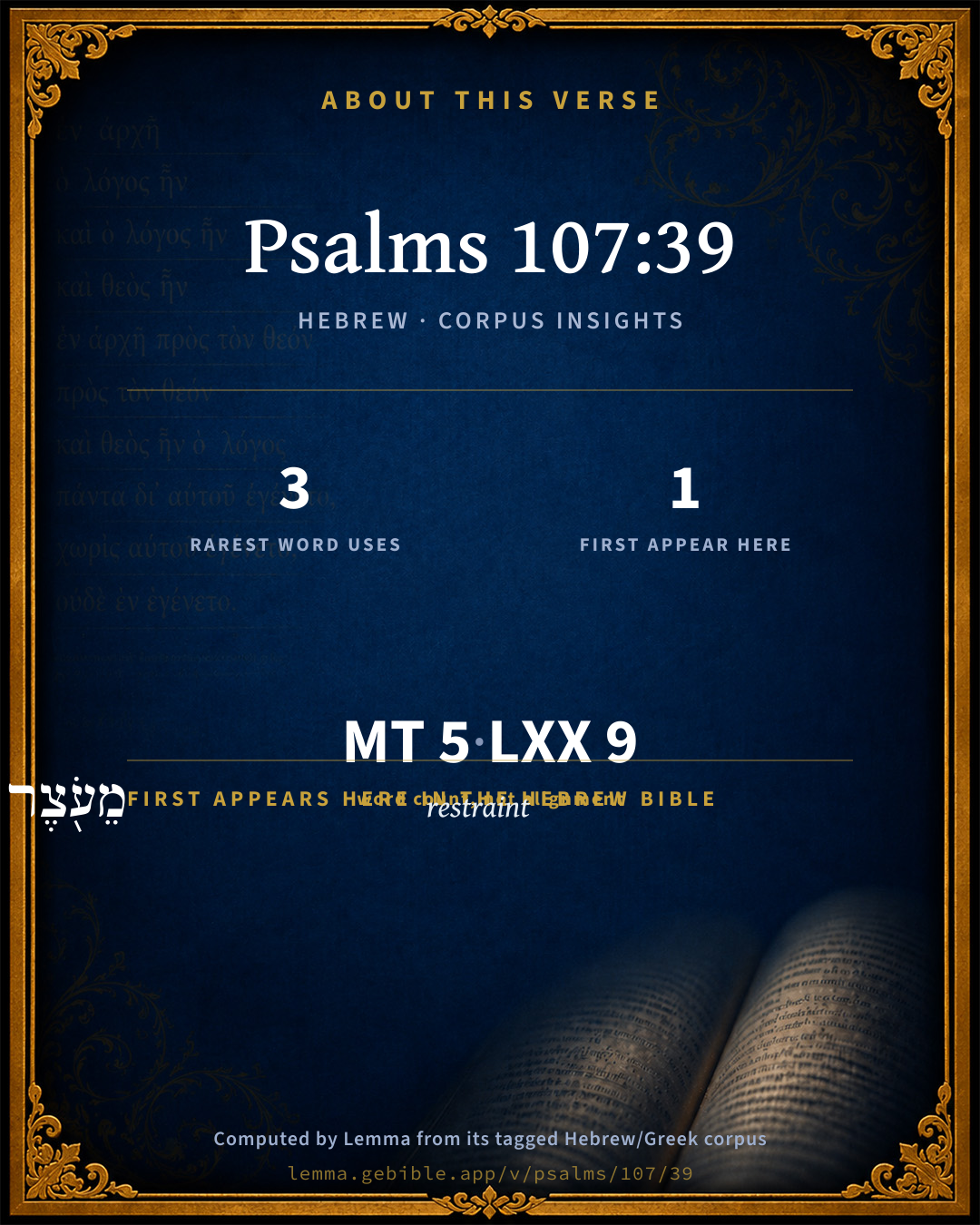
  • 1 first appearance in the Hebrew Bible
Full analysis ↓
Download a study sheet

One document with this verse’s original text, its word-by-word gloss line, the meaning frame, cross-references with their text, attributed commentary, and full source and license credits — printable, and it pastes into notes with its structure intact.

This verse Autodidact and up

Study sheet (.html) Plain text (.txt)

A passage Seminary Student

Up to 50 verses in one chapter. A passage sheet keeps up to 6 commentary sources and 12 cross-references per verse, in the order this page ranks them, and says so on the sheet whenever that leaves anything out. Ask for a single verse and you get the Autodidact verse sheet above.

Everything on this page stays free to read, with no account — the sheet is a download of what is already on screen, not access to it.

Want to remove ads? Support Godless Engineer
Compare translations 3

The same verse in 3 English versions, stacked beneath the original-language interlinear above. Click any original word for its lexicon entry.

Each is an independent rendering of the whole verse — the interlinear is not word-aligned to these translations.

Highlighted words mark where these versions differ — a whole-verse word diff, not a word-by-word alignment.

  • World English Bible Public Domain
    Again, they are diminished and bowed down Through oppression, trouble, and sorrow.
  • King James Version Public Domain
    Again, they are minished and brought low through oppression, affliction, and sorrow.
  • unfoldingWord Literal Text CC BY-SA 4.0
    Then they become few and become low from distress of evil and sorrow.

unfoldingWord Literal Text — © unfoldingWord, licensed CC BY-SA 4.0. Word-aligned USFM3 via Door43 (git.door43.org/unfoldingWord/en_ult).

Versions to compare (up to 4)

3 of 4 selected

Show all 18 translations

Every available English version of this verse, each an independent rendering of the whole verse.

  • World English Bible Public Domain
    Again, they are diminished and bowed down Through oppression, trouble, and sorrow.
  • Berean Standard Bible Public Domain
    When they are decreased and humbled by oppression, evil, and sorrow,
  • Majority Standard Bible Public Domain
    When they are decreased and humbled by oppression, evil, and sorrow,
  • King James Version Public Domain
    Again, they are minished and brought low through oppression, affliction, and sorrow.
  • American Standard Version (1901) Public Domain
    Again, they are diminished and bowed down Through oppression, trouble, and sorrow.
  • Revised Version (1885) Public Domain
    Again, they are minished and bowed down through oppression, trouble, and sorrow.
  • Geneva Bible (1599) Public Domain
    Againe men are diminished, and brought lowe by oppression, euill and sorowe.
  • Douay-Rheims (1899) Public Domain
    Then they were brought to be few: and they were afflicted through the trouble of evils and sorrow.
  • Young's Literal Translation Public Domain
    And they are diminished, and bow down, By restraint, evil, and sorrow.
  • Literal Standard Version CC BY-SA 4.0
    And they are diminished, and bow down, || By restraint, evil, and sorrow.
  • Unlocked Literal Bible CC BY-SA 4.0
    They were diminished and brought low by painful distress and suffering.
  • unfoldingWord Literal Text CC BY-SA 4.0
    Then they become few and become low from distress of evil and sorrow.
  • Darby Bible Public Domain
    And they are diminished and brought low, through oppression, adversity, and sorrow:
  • World Messianic Bible Public Domain
    Again, they are diminished and bowed down through oppression, trouble, and sorrow.
  • Webster's Bible Public Domain
    Again, they are diminished and brought low through oppression, affliction, and sorrow.
  • Free Bible Version CC BY-SA 4.0
    When they become few, brought low by oppression, misery, and sorrow,
  • Bible in Basic English Public Domain
    And when they are made low, and crushed by trouble and sorrow,
  • JPS Tanakh (1917) Public Domain
    Again, they are minished and dwindle away through oppression of evil and sorrow.

Literal Standard Version (2020), Covenant Press — licensed CC BY-SA 4.0. Text via the HelloAO Bible API (eBible.org). Unlocked Literal Bible (unfoldingWord) — licensed CC BY-SA 4.0. Text via the HelloAO Bible API (eBible.org). unfoldingWord Literal Text — © unfoldingWord, licensed CC BY-SA 4.0. Word-aligned USFM3 via Door43 (git.door43.org/unfoldingWord/en_ult). Free Bible Version, Dr. Jonathan Gallagher — licensed CC BY-SA 4.0. Text via the HelloAO Bible API (eBible.org).

Word by word

More ways to search: Search by grammar → Find every occurrence → Compare this word →

Practice this passage: Drill this verse → Learn its vocabulary →

About this verse

These counts appear in no published source. They are computed here, from the morphology-tagged text and Lemma’s own curated glosses. What Lemma adds →

5
words
5
distinct lemmas
Wisdom
section

Notable vocabulary

The rarest word here is מֵעֹ֖צֶר restraint H6115 — appearing just 3 times in the whole Hebrew Bible.

First appearance in Scripture

This word makes its first canonical appearance in the Hebrew Bible here:

  • מֵעֹ֖צֶר restraint H6115

Shared distinctive vocabulary

מֵעֹ֖צֶר restraint H6115 occurs in 3 verses of the Hebrew Bible. Also found in:

Grammatical profile

  • 2 verbs
  • 3 nouns

Verb forms

  • וַיִּמְעֲט֥וּ Qal · Sequential Imperfect
  • וַיָּשֹׁ֑חוּ Qal · Sequential Imperfect

Hebrew & Septuagint length

In English translation the verse runs 12 words from the Hebrew and 15 from the Septuagint (LXX English) — closely comparable.

A rough comparison of the two English renderings, which tokenize alike — not a word-level alignment.

Word counts can differ between the Hebrew and the Greek without any difference in meaning — e.g. the Hebrew direct-object marker אֵת has no separate Greek word, and Greek often adds the article ὁ.

In the original languages it is 5 Hebrew tokens and 9 Greek tokens — but the two are counted differently (Hebrew bundles its prefixes and suffixes into one token; the Greek is in lemma form), so that isn’t a like-for-like length.

Cross-references

16

Topical passages linked to Psalms 107:39 in the Treasury of Scripture Knowledge — connected by theme and wording, ordered by reader-vote popularity; previews shown in the World English Bible.

  • Exodus 2:23–24 It happened in the course of those many days, that the king of Egypt died, and the children of Israel sighed because of the bondage, and they cried, and their cry came up to God because of the bondage.
  • 2 Kings 10:32 In those days Yahweh began to cut off from Israel: and Hazael struck them in all the borders of Israel;
  • Judges 6:3–6 So it was, when Israel had sown, that the Midianites came up, and the Amalekites, and the children of the east; they came up against them;
  • 2 Kings 14:26 For Yahweh saw the affliction of Israel, that it was very bitter; for there was none shut up nor left at large, neither was there any helper for Israel.
  • 2 Chronicles 15:5–6 In those times there was no peace to him who went out, nor to him who came in; but great vexations were on all the inhabitants of the lands.
  • Genesis 45:11 There I will nourish you; for there are yet five years of famine; lest you come to poverty, you, and your household, and all that you have."'
  • Exodus 1:13–14 The Egyptians ruthlessly made the children of Israel serve,
  • Ruth 1:20–21 She said to them, "Don't call me Naomi, call me Mara; for the Almighty has dealt very bitterly with me.
  • 1 Samuel 2:5–7 Those who were full have hired out themselves for bread; Those who were hungry have ceased [to hunger]: Yes, the barren has borne seven; She who has many children languishes.
  • 2 Kings 4:8 It fell on a day, that Elisha passed to Shunem, where was a great woman; and she constrained him to eat bread. So it was, that as often as he passed by, he turned in there to eat bread.
  • 2 Kings 8:3 It happened at the seven years' end, that the woman returned out of the land of the Philistines: and she went forth to cry to the king for her house and for her land.
  • 2 Kings 13:7 For he didn't leave to Jehoahaz of the people save fifty horsemen, and ten chariots, and ten thousand footmen; for the king of Syria destroyed them, and made them like the dust in threshing.
  • 2 Kings 13:22 Hazael king of Syria oppressed Israel all the days of Jehoahaz.
  • Job 1:10–17 Haven't you made a hedge around him, and around his house, and around all that he has, on every side? You have blessed the work of his hands, and his substance is increased in the land.
  • Psalms 30:6–7 As for me, I said in my prosperity, "I shall never be moved."
  • Jeremiah 51:33–34 For thus says Yahweh of hosts, the God of Israel: The daughter of Babylon is like a threshing floor at the time when it is trodden; yet a little while, and the time of harvest shall come for her.

Cross-references courtesy of OpenBible.info (CC BY 4.0).

Hebrew and Greek witnesses Masoretic Hebrew ↔ Greek Septuagint

The same verse in the two great witnesses to the Old Testament, shown verse-for-verse.

You’re reading Greek Psalm 106 (Hebrew Psalm 107). The Septuagint counts the superscription, so verse numbers can differ from the Hebrew — chapter-level alignment, not verse-by-verse. Numbering follows Rahlfs.

These are two independent witnesses, not word-aligned to each other, and the Septuagint is shown in lemma (dictionary) form.

Hebrew Psalms 107:39 Masoretic · Westminster Leningrad Codex

וַיִּמְעֲט֥וּ וַיָּשֹׁ֑חוּ מֵעֹ֖צֶר רָעָ֣ה וְיָגֽוֹן

Again, they are diminished and bowed down Through oppression, trouble, and sorrow.

World English Bible · Public Domain

Greek LXX Greek Psalm 106:39 Septuagint · lemma form

καί ὀλιγόω καί κακόω ἀπό θλῖψις κακός καί ὀδύνη

Again they become few, and are brought low, by the pressure of evils and pain.

LXX2012 (modern English Septuagint) · Public Domain

Hebrew: Westminster Leningrad Codex (CC BY 4.0). Greek: Septuagint (public domain); English from LXX2012 (modern English Septuagint) (Public Domain). How the Septuagint differs from the Hebrew →

Commentary

Notes on Psalms 107:39 from classic Christian and Jewish commentators (each source and its license shown beneath its notes). The classic Christian expositions comment on the surrounding passage and are grouped to its opening verse, so a note may address several verses; the Jewish commentaries on the Tanakh (Rashi and others) are per-verse, so they appear only where the commentator wrote on this verse.

Lemma curates 59 commentaries, every one of them public domain or Creative Commons licensed, each selected and text-cleaned for this edition rather than reprinted as found. About our sources →

Trapp's Complete Commentary

John Trapp

Psa 107:39 Again, they are minished and brought low through oppression, affliction, and sorrow.

Ver. 39. Again, they are minished] Minorati sunt. This also is of the Lord, who hath treasuries of plagues, and cannot be exhausted.

John Trapp, A Commentary or Exposition upon All the Books of the Old and New Testament (1647–1656) — public domain. Text from a community e-Sword module.

Joseph Benson's Commentary

Psa 107:39. Again they are minished — When they prove ungrateful to him who had enriched and exalted them, and grow proud, insolent, and secure, as the manner of men is, he quite alters the course of his providence toward them. They suddenly sink, as they suddenly rose, and end their days in as mean a condition as they began them; and brought low through oppression, &c. — He lays them low by tyrannical oppressors, into whose hands he delivers them, by dearth, and other calamities, which make them pine away in grief and sorrow. Thus it often happens with families and individuals as well as with nations: descendants lose as fast as their progenitors gained, and scatter what the others had heaped together. For worldly wealth, honour, power, and glory are uncertain things, and it often happens that those who think themselves most secure in the possession of them, are, by unexpected and even extraordinary events, stripped of them all, and reduced to the lowest state of poverty and degradation.

Joseph Benson's Commentary on the Old and New Testaments (1811–1818) — public domain. Text from a community e-Sword module.

Keil & Delitzsch

C. F. Keil & F. Delitzsch

But is also came to pass that it went ill with them, inasmuch as their flourishing prosperous condition drew down upon them the envy of the powerful and tyrannical; nevertheless God put an end to tyranny, and always brought His people again to honour and strength. Hitzig is of opinion that Psa 107:39 goes back into the time when things were different with those who, according to Psa 107:36-38, had thriven. The modus consecutivus is sometimes used thus retrospectively (vid., Isa 37:5); here, however, the symmetry of the continuation from Psa 107:36-38, and the change which is expressed in Psa 107:39 in comparison with Psa 107:38, require an actual consecution in that which is narrated. They became few and came down, were reduced (שׁחח, cf. Pro 14:19 : to come to ruin, or to be overthrown), a coarctatione malitiae et maeroris. עצר is the restraint of despotic rule, רעה the evil they had to suffer under such restraint, and רגון sorrow, which consumed their life. מעצר has Tarcha and רעה Munach (instead of Mercha and Mugrash, vid., Accentuationssystem, xviii. 2). There is no reason for departing from this interpunction and rendering: "through tyranny, evil, and sorrow." What is stiff and awkward in the progress of the description arises from the fact that Psa 107:40 is borrowed from Job 12:21, Job 12:24, and that the poet is not willing to make any change in these sublime words. The version shows how we think the relation of the clauses is to be apprehended. Whilst He pours out His wrath upon tyrants in the contempt of men that comes upon them, and makes them fugitives who lose themselves in the terrible waste, He raises the needy and those hitherto despised and ill-treated on high out of the depth of their affliction, and makes families like a flock, i.e., makes their families so increase, that they come to have the appearance of a merrily gamboling and numerous flock. Just as this figure points back to Job 21:11, so Psa 107:42 is made up out of Job 22:19; Job 5:16. The sight of this act of recognition on the part of God of those who have been wrongfully oppressed gives joy to the upright, and all roguery (עולה, vid., Ps 92:16) has its mouth closed, i.e., its boastful insolence is once for all put to silence. In Psa 107:43 the poet makes the strains of his Psalm die away after the example of Hosea, Hosea 14:10 [9], in the nota bene expressed after the manner of a question: Who is wise - he will or let him keep this, i.e., bear it well in mind. The transition to the justice together with a change of number is rendered natural by the fact that מי חכם, as in Hos. loc. cit. (cf. Jer 9:11; Est 5:6, and without Waw apod. Jdg 7:3; Pro 9:4, Pro 9:16), is equivalent to quisquis sapeins est. חסדי ה (חסדי) are the manifestations of mercy or loving-kindness in which God's ever-enduring mercy unfolds itself in history. He who is wise has a good memory for and a clear understanding of this.

Keil & Delitzsch — Biblical Commentary on the Old Testament (1861–1891) — public domain (CC PDM 1.0). Text via the HelloAO Bible API. (Old Testament only.)

J. A. Alexander on Psalms

Joseph Addison Alexander

39. (Psa 107:39) And they were diminished and brought low, from oppression, suffering, and grief. The only grammatical construction of the verbs is that which refers them to a former time, i.e. to the condition of the people under Babylonian oppression. The sense is therefore quite mistaken in the English, though correctly given in the ancient versions. The contrast is intended to enhance the joy and thankfulness of the restored exiles. These, now so prosperous, are the very men who lately were in abject misery.

Joseph Addison Alexander, The Psalms Translated and Explained (1850) — public domain. Text from a community e-Sword module.

Tyndale Open Study Notes

Tyndale Open Resources

107:39 People often become impoverished when their rulers practice oppression.

Tyndale Open Study Notes — © Tyndale Open Resources, licensed CC BY-SA 4.0. Text via the HelloAO Bible API.

Geneva Bible (1599)

Geneva Bible translators

As God by his providence doth exalt men, so doth he also humble them by afflictions to know themselves.

Geneva Bible (1599) marginal notes — public domain. Text via Bolls.life.

Adam Clarke's Commentary

Verse 39. Again, they are minished] Sometimes by war, or pestilence, or famine. How minished and brought low was the country already spoken of, by the long and destructive war which began in 1775, and was not ended till 1783! And what desolations, minishings, and ruin have been brought on the fertile empires of Europe by the war which commenced in 1792, and did not end till 1814! And how many millions of lives have been sacrificed in it, and souls sent unprepared into the eternal world! When God makes inquisition for blood, on whose heads will he find the blood of these slaughtered millions? Alas! O, alas!

Adam Clarke's Commentary on the Bible (1810–1826) — public domain. Text from a community e-Sword/MySword module.

John Calvin's Commentaries

39. Afterwards they are lessened Ere I enter upon the consideration of the truths contained in this verse, I must make some brief verbal observations. Some make the word עוצר, otser, to signify tyranny, and certainly עצר, atsar, does signify to bear rule. But since it is used metaphorically for anguish, it appears to me that this is the meaning which is most accordant with the tenor of the passage. The last two words of the verse may be read as in the nominative case, as I have rendered them, or in the genitive, the anguish of misery and sorrow This lection appears to me preferable, through the anguish of misery, and through sorrow.

We come now to notice shortly the main things in the passage. And as we had formerly a description of the changes which these districts underwent in relation to the nature of the soil, so now we are informed that mankind do not for ever continue in the same condition; because they both decrease in number, and lose their place and property by being reduced by wars or by civil commotions, or by other casualties. Therefore, whether they are wasted by the pestilence, or are defeated in battle, or are cut off by intestine broils, it is manifest that both their rank and condition undergo alteration. And what is the occasion of this change, but that God withdraws his grace, which hitherto formed the hidden spring from which all their prosperity issued? And as there are a thousand casualties by which cities may be ruined, the prophet brings forward one species of change of all others the most palpable and remarkable. And since God’s hand is not observed in that which relates to persons living in comparative obscurity, he brings into view princes themselves, whose name and fame will not permit any memorable event which befalls them to remain in obscurity. For it seems that the world is made on their account. When God, therefore, hurls them from their lofty estate, then men, aroused as it were from their slumber, are prepared to regard his judgments. Here, too, the mode of address which is employed must be attended to; in saying, that God poured contempt upon princes, it is as if it was his pleasure, so long as they retained their dignity, that honor and respect should be paid to them. The words of Daniel are well known,

“O king, God hath put the fear of thee in the very fowls of the heaven and the beasts of the earth,” (Daniel 2:8)

And assuredly, though princes may clothe themselves with power, yet that inward honor and majesty which God has conferred upon them, is a greater safeguard than any human arm. Nor even would a single village hold out for the space of three days, did not God, by his invisible and invincible agency, put a restraint upon the hearts of men. Hence, whenever God renders princes contemptible, their magnificent power must of necessity be subverted. This is a fact corroborated by history, that mighty potentates, who have been the terror and dread of the whole world, when once denuded of their dignity and power, have become the sport even of their own dependants. And inasmuch as such a striking revolution as this should be regarded as a wonderful display of God’s power, yet such is the obtuseness of our minds, that we will not acknowledge his overruling providence. As a contrast to these reverses, the prophet afterwards shows, that the poor and ignoble are exalted, and their houses increased, and that those who were held in no estimation, suddenly increase in wealth and power. In these things men would assuredly recognize the providence of God, were it not that the perversity of their minds rendered them insensate.

John Calvin's Commentaries (1540-1563) — public domain. Text from the Calvin Translation Society English edition (1840s-50s) via the Christian Classics Ethereal Library (ccel.org). Calvin's coverage is partial (roughly two-thirds of the Bible); uncommented books and verses are honest gaps, never fabricated. The 19th-century editor's footnotes and remarks are omitted so the notes are faithfully Calvin's own voice.

The Cambridge Bible for Schools and Colleges

gen. ed. J. J. S. Perowne

39. And when they were diminished and brought low,

Through oppression, evil, and sorrow,

39–42. Though trouble may come, Jehovah scatters their oppressors and defends them, to the joy of the righteous and the chagrin of the wicked.

The Cambridge Bible for Schools and Colleges (gen. ed. J. J. S. Perowne; Cambridge University Press, 1878–1918) — public domain. Text from a community e-Sword module.

John Gill's Exposition

The righteous shall see it, and rejoice,.... Shall see the increase and prosperity of the saints, the glory of the church in the latter day, and rejoice at it; the judgments of God upon the wicked, upon antichristian princes and states, and rejoice on that account; see Rev 18:20 and the several deliverances of persons in distress before mentioned, and rejoice with them that rejoice; which is what good men ought to do, Rom 12:15.

And all iniquity shall stop her mouth; men of iniquity, very bad men, the man of sin and his followers, and all profane and atheistical persons, who will be silenced and have nothing to say against the providence of God; will be confounded, and through shame lay their hand on their mouths and be struck with admiration at the wonderful things done by the Lord for his people; nor will they have anything to say against their own condemnation.

John Gill's Exposition of the Whole Bible (1746–1763) — public domain (CC PDM 1.0). Text via the HelloAO Bible API.

Albert Barnes' Notes on the Bible

Again, they are minished ... - literally, “And they are made to decrease.” That is - all is in the hand of God. He rules and directs all things. If there is prosperity, it comes from him; if there are reverses, they occur under his hand. People are not always prosperous. There are changes, misfortunes, disappointments, sorrows. God so deals with the race as in the bests manner to secure the recognition of himself: not always sending prosperity, lest people should regard it as a thing of course, and forget that it comes from him; and not making the course of life uniformly that of disappointment and sorrow, lest they should feel that there is no God presiding over human affairs. He visits now with prosperity, and now with adversity; now with success, and now with reverses, showing that his agency is constant, and that people are wholly dependent on him. In existing circumstances - since man is what he is - it is better that there should be alternations, reverses, and changes, than that there should be a uniform course.

Through oppression - Anything that “presses” or “straitens.”

Affliction - Evil; here, in the sense of calamity.

And sorrow - Anguish, pain: of body or mind.

Albert Barnes' Notes on the Bible (1834–1885) — public domain. Text from a community e-Sword/MySword module.

Matthew Poole's English Annotations

They, these poor men, who, when they are exalted and blessed by God, kick at him, and grow insolent and secure, as the returner of men is,

are minished and brought low; are by God’s just judgment diminished in their numbers and in their blessings.

Through oppression, affliction, and sorrow; or, through wicked oppression, (by the tyranny of others, whom God sends to spoil them of their abused riches,) and by other griefs or grievous calamities which God inflicts.

Matthew Poole's English Annotations on the Holy Bible (1683–1685) — public domain. Text from a community e-Sword/MySword module.

The Treasury of David

Charles H. Spurgeon

Ver. 39. Again they are minished and brought low through oppression, affliction, and sorrow. As they change in character, so do their circumstances alter. Under the old dispensation, this was very clearly to be observed; Israel's ups and downs were the direct consequences of her sins and repentance. Trials are of various kinds; here we have three words for affliction, and there are numbers more: God has many rods and we have many smarts; and all because we have many sins. Nations and churches soon diminish in number when they are diminished in grace. If we are low in love to God, it is small wonder that he brings us low in other respects. God can reverse the order of our prosperity, and give us a diminuendo where we had a crescendo; therefore let us walk before him with great tenderness of spirit, conscious of our dependence upon his smile.

Ver. 39-41. The scene again is reversed. There is a change again from freedom to oppression; from plenty to want; from honour to contempt. Then a revival again as suddenly appears. The poor and afflicted are lifted up, and the bereaved have "families like a flock." Such are the changeful scenes through which the people of God are led; and such the experience by which they are made meet for the pure, perfect, and perpetual joys of heaven. G.R.

Psalms 107:40*

Charles H. Spurgeon's The Treasury of David (1869–1885) — public domain. Psalms only. Text from a community e-Sword/MySword module.

Whedon's Commentary on the Bible

Daniel D. Whedon

39. Again, they are minished—The abruptness of the transition obscures the sense; but it seems more natural to understand the subject of the verb to be the same as in Psa_107:38, and to translate: Yet they became few and bowed down; a sudden return to the condition of Israel as given in Psa_107:3-6

Daniel D. Whedon (gen. ed.), Commentary on the Old and New Testaments (1874–1909) — public domain. Text from a community e-Sword module.

The Pulpit Commentary

Again. There is no "again" in the original, but merely the usual yaw conjunctive. Still, in the thought, there is no doubt an abrupt transition. The writer turns to the darker side of the picture. They are minished and brought low. God shows his providence, not merely in blessing, but also in chastising. Even the very nation which has been the most highly favored may, by misconduct, fall under his displeasure and suffer at his hands. Their population is diminished; they arc "bowed down" (Revised Version), or "brought low." Calamities of various kinds befall them. Sometimes their decline is brought about through oppression, which may be either the cruel rule of a native monarch, such as Saul, or the still heavier yoke of a foreign power, like Egypt or Babylon. Sometimes it comes from such an affliction as bad harvests, plagues of locusts, or pestilence. Sometimes it is brought about by sorrow the death of a good ruler in the flower of his age, the extinction of a royal stock, the destruction of a nation"s best and bravest on battle-fields, and the like. But in all calamities alike it is God"s hand that deals the blow.

The Pulpit Commentary (1880–1919), ed. H.D.M. Spence-Jones & Joseph S. Exell — public domain. Text from a community e-Sword module.

John Wesley's Explanatory Notes

They - These men, who when they are exalted by God, grow insolent and secure. Low - By God's just judgment.

John Wesley, Explanatory Notes Upon the Whole Bible (1754–1765) — public domain. Text via the GEBible commentary corpus.

Kretzmann's Popular Commentary

Paul E. Kretzmann

The final paragraph refers to such as are suffering under misrule and tyranny.

v. 39. Again, they are minished, their prosperity being reduced by adverse circumstances, and brought low through oppression, affliction, and sorrow, brought upon them on account of the jealousy of those in power.

v. 40. He poureth contempt upon princes and causeth them to wander in the wilderness, where there is no way, in pitiful exile.

v. 41. Yet setteth He the poor on high from affliction, far from the reach of suffering, and maketh him families like a flock, this feature occurring time and again as an outstanding characteristic of God’s blessing.

v. 42. The righteous, those who are upright in heart, shall see it and rejoice; and, on the other hand, all iniquity shall stop her mouth, the arrogant for once being obliged to maintain silence at this evidence of God’s favor.

v. 43. Whoso is wise and will observe these things, he who will take note of these facts, profit by the example of others, even they shall understand the loving kindness of the Lord, they will keep His merciful dealings in mind always. It is a lesson which cannot be learned too well or repeated too often, a lesson which all true Christians hold before their eyes every day, lest they forget their debt to the Lord and become lax in His service.

Paul E. Kretzmann, Popular Commentary of the Bible (1921–1924) — public domain. Text from a community e-Sword module.

unfoldingWord translationNotes

Door43 World Missions Community

They

The word "They" refers to the people who were hungry that Yahweh had settled in the land. This sentence describes how they were before Yahweh settled them in the land.

They were diminished and brought low

This can be stated in active form. AT: "Their leaders diminished their number and brought them low" (See: Active or Passive)

were diminished

"became fewer in number"

brought low

This means to be humiliated. AT: "humiliated" (See: Idiom)

pours contempt on

Here David speaks of Yahweh showing contempt for the leaders as if contempt were a liquid he poured out on them. AT: "shows contempt for" (See: Metaphor)

the leaders

"the nobles." This refers to the leaders who oppressed the people. AT: "the leaders who oppressed them" (See: Assumed Knowledge and Implicit Information)

where there are no roads

"where people never go"

translationWords

suffer

contempt

desert

unfoldingWord translationNotes — © Distant Shores Media and the Door43 World Missions Community, licensed CC BY-SA 4.0. Source: git.door43.org/Door43/en_tn.

Rashi

Rabbi Shlomo Yitzchaki (Rashi)

Whereas they were few and they sank down But they, from the beginning, sank down and were few because of dominion, trouble, and sorrow.

Rashi on the Tanakh — English translations: “The Judaica Press complete Tanach with Rashi, translated by A. J. Rosenberg” (CC BY 4.0); “Pentateuch with Rashi's commentary by M. Rosenbaum and A.M. Silbermann, 1929-1934” (public domain); “The Metsudah Tanach series, Lakewood, N.J” (CC BY 4.0); and “The Book of Joshua, Metsudah Publications, 1997” (CC BY 4.0). Text via Sefaria.

Lesson kit

Teaching starters — assembled from the data on this page, not authored interpretation. Every prompt links to the verse data it draws on. Edit before teaching.

Psalms, in the Wisdom, opens this verse with 5 words (5 distinct Hebrew lemmas). Its most distinctive word is ʻôtser (“restraint”). A historical commentator’s framing appears above. Read the whole chapter for the surrounding context.

Discussion questions

  1. The word ʻôtser carries the sense “restraint.” How does it shape the verse?
  2. The word “restraint” first appears here in Scripture. What is being introduced at this debut?
  3. Proverbs 30:16 shares the word «restraint» with this verse. How do the two illuminate each other?
  4. These translations render this verse differently; the difference is in the English rendering, not the original. What questions does that raise?
  5. The verb «וַיִּמְעֲט֥וּ» is Qal Sequential Imperfect. How does its form color the action?
  6. Reading how Trapp's Complete Commentary and Joseph Benson's Commentary read this verse, where do the two commentators agree and where do they part?

Things to notice

Reading settings

Reading text

Shown beneath each verse's original-language words.

Old Testament
Old Testament edition

Read the OT as the Masoretic Hebrew (MT) or the Greek Septuagint (LXX).

English shown for the Greek Septuagint (in the Hebrew ↔ Greek comparison).

Comparing translations? Open the Compare panel on any verse page to stack up to four side by side.