
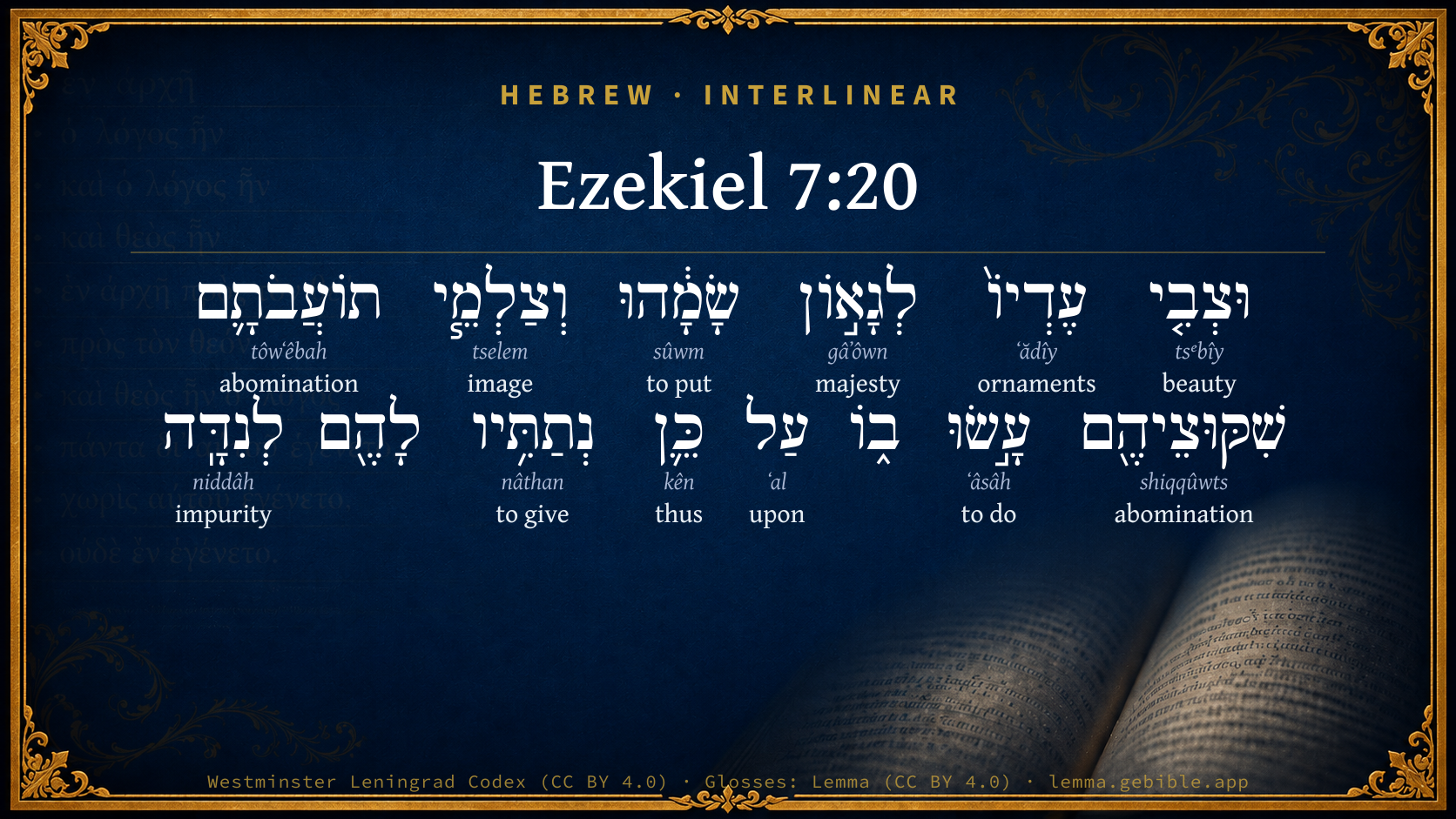
Ezekiel 7:20

Hebrew (Westminster Leningrad Codex) Ezekiel 7:20 appears in the Hebrew Old Testament. The text above is from the Westminster Leningrad Codex. Each word links to its Strong’s number, a concise gloss, and parsing drawn from the Open Scriptures Hebrew Bible morphology. Click any word for its full Brown-Driver-Briggs (BDB) entry.
Download image
Cite this verse

Ezekiel 7:20 (World English Bible). Public Domain. Lemma interlinear Bible study tool, https://lemma.gebible.app/v/ezekiel/7/20.

Show BibTeX & RIS
BibTeX
RIS
English Translation
As for the beauty of his ornament, he set it in majesty; but they made the images of their abominations [and] their detestable things therein: therefore have I made it to them as an unclean thing.
World English Bible · Public Domain
Download a study sheet

One document with this verse’s original text, its word-by-word gloss line, the meaning frame, cross-references with their text, attributed commentary, and full source and license credits — printable, and it pastes into notes with its structure intact.

This verse Autodidact and up

Study sheet (.html) Plain text (.txt)

A passage Seminary Student

Up to 50 verses in one chapter. A passage sheet keeps up to 6 commentary sources and 12 cross-references per verse, in the order this page ranks them, and says so on the sheet whenever that leaves anything out. Ask for a single verse and you get the Autodidact verse sheet above.

Everything on this page stays free to read, with no account — the sheet is a download of what is already on screen, not access to it.

Want to remove ads? Support Godless Engineer
Compare translations 3

The same verse in 3 English versions, stacked beneath the original-language interlinear above. Click any original word for its lexicon entry.

Each is an independent rendering of the whole verse — the interlinear is not word-aligned to these translations.

Highlighted words mark where these versions differ — a whole-verse word diff, not a word-by-word alignment.

  • World English Bible Public Domain
    As for the beauty of his ornament, he set it in majesty; but they made the images of their abominations [and] their detestable things therein: therefore have I made it to them as an unclean thing.
  • King James Version Public Domain
    As for the beauty of his ornament, he set it in majesty: but they made the images of their abominations and of their detestable things therein: therefore have I set it far from them.
  • unfoldingWord Literal Text CC BY-SA 4.0
    In their pride they took the beauty of his jeweled ornaments, and with them they made their idolatrous figures, and their detestable things. Therefore, I am turning these into an unclean thing to them.

unfoldingWord Literal Text — © unfoldingWord, licensed CC BY-SA 4.0. Word-aligned USFM3 via Door43 (git.door43.org/unfoldingWord/en_ult).

Versions to compare (up to 4)

3 of 4 selected

Show all 18 translations

Every available English version of this verse, each an independent rendering of the whole verse.

  • World English Bible Public Domain
    As for the beauty of his ornament, he set it in majesty; but they made the images of their abominations [and] their detestable things therein: therefore have I made it to them as an unclean thing.
  • Berean Standard Bible Public Domain
    His beautiful ornaments they transformed into pride and used them to fashion their vile images and detestable idols. Therefore I will make these into something unclean for them.
  • Majority Standard Bible Public Domain
    His beautiful ornaments they transformed into pride and used them to fashion their vile images and detestable idols. Therefore I will make these into something unclean for them.
  • King James Version Public Domain
    As for the beauty of his ornament, he set it in majesty: but they made the images of their abominations and of their detestable things therein: therefore have I set it far from them.
  • American Standard Version (1901) Public Domain
    As for the beauty of his ornament, he set it in majesty; but they made the images of their abominations `and' their detestable things therein: therefore have I made it unto them as an unclean thing.
  • Revised Version (1885) Public Domain
    As for the beauty of his ornament, he set it in majesty: but they made the images of their abominations and their detestable things therein: therefore have I made it unto them as an unclean thing.
  • Geneva Bible (1599) Public Domain
    He had also set the beautie of his ornament in maiestie: but they made images of their abominations, and of their idoles therein: therefore haue I set it farre from them.
  • Douay-Rheims (1899) Public Domain
    And they have turned the ornament of their jewels into pride, and have made of it the images of their abominations, and idols: therefore I have made it an uncleanness to them.
  • Young's Literal Translation Public Domain
    As to the beauty of his ornament, For excellency He set it, And the images of their abominations, Their detestable things -- they made in it, Therefore I have given it to them for impurity,
  • Literal Standard Version CC BY-SA 4.0
    As for the beauty of his ornament, || He set it for excellence, || And the images of their abominations, || Their detestable things—they made in it, || Therefore I have given it to them for impurity,
  • Unlocked Literal Bible CC BY-SA 4.0
    In their pride they took the beauty of his jeweled ornaments, and with them they made their idolatrous figures, and their detestable things. Therefore, I am turning these into an unclean thing to them.
  • unfoldingWord Literal Text CC BY-SA 4.0
    In their pride they took the beauty of his jeweled ornaments, and with them they made their idolatrous figures, and their detestable things. Therefore, I am turning these into an unclean thing to them.
  • Darby Bible Public Domain
    And he set in majesty his beautiful ornament; but they made therein the images of their abominations [and] of their detestable things: therefore have I made it an impurity unto them.
  • World Messianic Bible Public Domain
    As for the beauty of his ornament, he set it in majesty; but they made the images of their abominations and their detestable things therein. Therefore I have made it to them as an unclean thing.
  • Webster's Bible Public Domain
    As for the beauty of his ornament, he set it in majesty: but they made the images of their abominations and of their detestable things therein: therefore have I set it far from them.
  • Free Bible Version CC BY-SA 4.0
    They were so proud of their beautiful jewelry that they used it to make their disgusting images and decorate their offensive idols. So I'm going to turn these idols into unclean things for them.
  • Bible in Basic English Public Domain
    As for their beautiful ornament, they had put it on high, and had made the images of their disgusting and hated things in it: for this cause I have made it an unclean thing to them.
  • JPS Tanakh (1917) Public Domain
    And as for the beauty of their ornament, which was set for a pride, they made the images of their abominations and their detestable things thereof; therefore have I made it unto them as an unclean thing.

Literal Standard Version (2020), Covenant Press — licensed CC BY-SA 4.0. Text via the HelloAO Bible API (eBible.org). Unlocked Literal Bible (unfoldingWord) — licensed CC BY-SA 4.0. Text via the HelloAO Bible API (eBible.org). unfoldingWord Literal Text — © unfoldingWord, licensed CC BY-SA 4.0. Word-aligned USFM3 via Door43 (git.door43.org/unfoldingWord/en_ult). Free Bible Version, Dr. Jonathan Gallagher — licensed CC BY-SA 4.0. Text via the HelloAO Bible API (eBible.org).

Word by word

More ways to search: Search by grammar → Find every occurrence → Compare this word →

Practice this passage: Drill this verse → Learn its vocabulary →

עֶדְיוֹ֙
ʻădîy
H5716
“ornaments · his”
Noun, Common, Masculine, Singular, Construct + Suffix, Personal, 3rd Person, Masculine, Singular
Part of Speech
Noun
Type
Common
Gender
Masculine
Number
Singular
State
Construct
Full BDB Definition

Origin: from H5710 in the sense of trappings

TWOT: 1566a

ornaments - ornaments - trappings (of horses)
  1. וּצְבִ֤י tsᵉbîy H6643 “and · beauty of” Conjunction + Noun, Common, Masculine, Singular, Construct
  2. לְגָא֣וֹן gâʼôwn H1347 “to/for · majesty” Preposition + Noun, Common, Masculine, Singular, Absolute
  3. שָׂמָ֔הוּ sûwm H7760 “to put · him” Verb, Qal, Perfect, 3rd Person, Masculine, Singular + Suffix, Personal, 3rd Person, Masculine, Singular
  4. וְצַלְמֵ֧י tselem H6754 “and · images of” Conjunction + Noun, Common, Masculine, Plural, Construct
  5. תוֹעֲבֹתָ֛ם tôwʻêbah H8441 “abominations · their” Noun, Common, Feminine, Plural, Construct + Suffix, Personal, 3rd Person, Masculine, Plural
  6. שִׁקּוּצֵיהֶ֖ם shiqqûwts H8251 “abominations · their” Noun, Common, Masculine, Plural, Construct + Suffix, Personal, 3rd Person, Masculine, Plural
  7. עָ֣שׂוּ ʻâsâh H6213 “to do” Verb, Qal, Perfect, 3rd Person, Common, Plural
  8. עַל ʻal H5921 “upon” Preposition
  9. כֵּ֛ן kên H3651 “thus” Particle, Demonstrative
  10. נְתַתִּ֥יו nâthan H5414 “to give · him” Verb, Qal, Perfect, 1st Person, Common, Singular + Suffix, Personal, 3rd Person, Masculine, Singular
  11. לְנִדָּֽה niddâh H5079 “to/for · impurity” Preposition + Noun, Common, Feminine, Singular, Absolute

About this verse

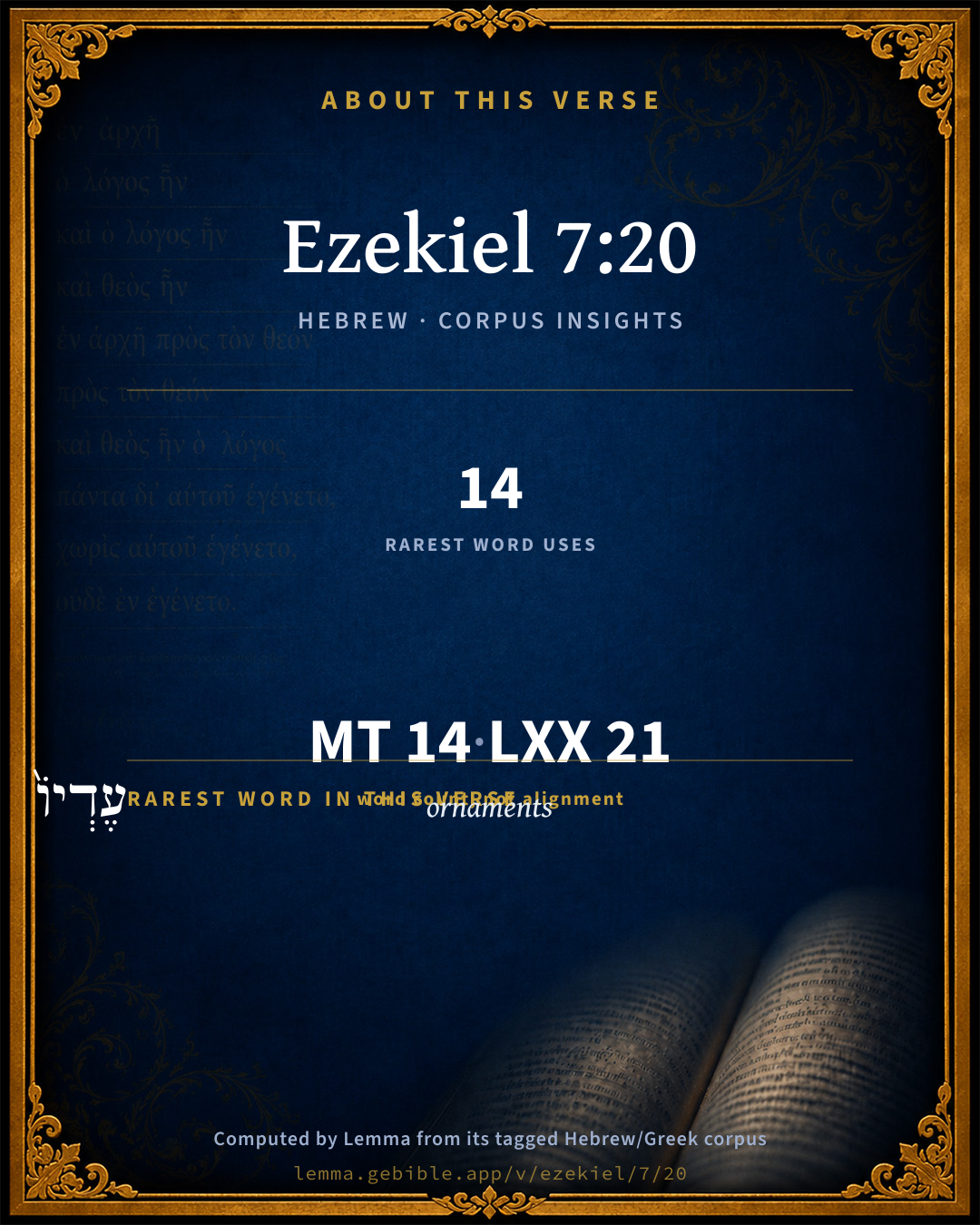
These counts appear in no published source. They are computed here, from the morphology-tagged text and Lemma’s own curated glosses. What Lemma adds →

14
words
12
distinct lemmas
Prophets
section

Notable vocabulary

The rarest word here is עֶדְיוֹ֙ ornaments H5716 — appearing just 14 times in the whole Hebrew Bible.

Shared distinctive vocabulary

עֶדְיוֹ֙ ornaments H5716 occurs in 13 verses of the Hebrew Bible. Also found in:

Grammatical profile

  • 3 verbs
  • 7 nouns
  • 3 prepositions
  • 1 particle

Verb forms

  • שָׂמָ֔הוּ Qal · Perfect
  • עָ֣שׂוּ Qal · Perfect
  • נְתַתִּ֥יו Qal · Perfect

Hebrew & Septuagint length

In English translation the verse runs 36 words from the Hebrew and 27 from the Septuagint (LXX English) — closely comparable.

A rough comparison of the two English renderings, which tokenize alike — not a word-level alignment.

Word counts can differ between the Hebrew and the Greek without any difference in meaning — e.g. the Hebrew direct-object marker אֵת has no separate Greek word, and Greek often adds the article ὁ.

In the original languages it is 14 Hebrew tokens and 21 Greek tokens — but the two are counted differently (Hebrew bundles its prefixes and suffixes into one token; the Greek is in lemma form), so that isn’t a like-for-like length.

Cross-references

25

Topical passages linked to Ezekiel 7:20 in the Treasury of Scripture Knowledge — connected by theme and wording, ordered by reader-vote popularity; previews shown in the World English Bible.

  • Ezekiel 24:21 Speak to the house of Israel, Thus says the Lord Yahweh: Behold, I will profane my sanctuary, the pride of your power, the desire of your eyes, and that which your soul pities; and your sons and your daughters whom you have left behind shall fall by the sword.
  • Jeremiah 7:30 For the children of Judah have done that which is evil in my sight, says Yahweh: they have set their abominations in the house which is called by my name, to defile it.
  • Isaiah 64:11 Our holy and our beautiful house, where our fathers praised you, is burned with fire; and all our pleasant places are laid waste.
  • Ezekiel 8:7–10 He brought me to the door of the court; and when I looked, behold, a hole in the wall.
  • Ezekiel 8:15–16 Then said he to me, Have you seen [this], son of man? you shall again see yet greater abominations than these.
  • Ezekiel 9:7 He said to them, Defile the house, and fill the courts with the slain: go you forth. They went forth, and struck in the city.
  • 2 Kings 21:4 He built altars in the house of Yahweh, of which Yahweh said, In Jerusalem will I put my name.
  • 2 Kings 21:7 He set the engraved image of Asherah, that he had made, in the house of which Yahweh said to David and to Solomon his son, In this house, and in Jerusalem, which I have chosen out of all the tribes of Israel, will I put my name forever;
  • 2 Kings 23:11–12 He took away the horses that the kings of Judah had given to the sun, at the entrance of the house of Yahweh, by the chamber of Nathan-melech the chamberlain, which was in the precincts; and he burned the chariots of the sun with fire.
  • 1 Chronicles 29:1–2 David the king said to all the assembly, Solomon my son, whom alone God has chosen, is yet young and tender, and the work is great; for the palace is not for man, but for Yahweh God.
  • 2 Chronicles 2:9 even to prepare me timber in abundance; for the house which I am about to build shall be great and wonderful.
  • 2 Chronicles 3:1–17 Then Solomon began to build the house of Yahweh at Jerusalem on Mount Moriah, where [Yahweh] appeared to David his father, which he made ready in the place that David had appointed, in the threshing floor of Ornan the Jebusite.
  • 2 Chronicles 33:4–7 He built altars in the house of Yahweh, of which Yahweh said, In Jerusalem shall my name be forever.
  • 2 Chronicles 36:14 Moreover all the chiefs of the priests, and the people, trespassed very greatly after all the abominations of the nations; and they polluted the house of Yahweh which he had made holy in Jerusalem.
  • Ezra 3:12 But many of the priests and Levites and heads of fathers' [houses], the old men who had seen the first house, when the foundation of this house was laid before their eyes, wept with a loud voice; and many shouted aloud for joy:
  • Psalms 48:2 Beautiful in elevation, the joy of the whole earth, Is Mount Zion, on the north sides, The city of the great King.
  • Psalms 50:2 Out of Zion, the perfection of beauty, God shines forth.
  • Psalms 87:2–3 Yahweh loves the gates of Zion more than all the dwellings of Jacob.
  • Jeremiah 7:14 therefore will I do to the house which is called by my name, in which you trust, and to the place which I gave to you and to your fathers, as I did to Shiloh.
  • Lamentations 1:10 The adversary has spread out his hand on all her pleasant things: For she has seen that the nations are entered into her sanctuary, Concerning whom you did command that they should not enter into your assembly.
  • Lamentations 2:1 How has the Lord covered the daughter of Zion with a cloud in his anger! He has cast down from heaven to the earth the beauty of Israel, And hasn't remembered his footstool in the day of his anger.
  • Lamentations 2:7 The Lord has cast off his altar, he has abhorred his sanctuary; He has given up into the hand of the enemy the walls of her palaces: They have made a noise in the house of Yahweh, as in the day of a solemn assembly.
  • Ezekiel 5:11 Therefore, as I live, says the Lord Yahweh, surely, because you have defiled my sanctuary with all your detestable things, and with all your abominations, therefore will I also diminish [you]; neither shall my eye spare, and I also will have no pity.
  • Ezekiel 7:22 My face will I turn also from them, and they shall profane my secret [place]; and robbers shall enter into it, and profane it.
  • Haggai 2:3 'Who is left among you who saw this house in its former glory? How do you see it now? Isn't it in your eyes as nothing?

Cross-references courtesy of OpenBible.info (CC BY 4.0).

Hebrew and Greek witnesses Masoretic Hebrew ↔ Greek Septuagint

The same verse in the two great witnesses to the Old Testament, shown verse-for-verse.

These are two independent witnesses, not word-aligned to each other, and the Septuagint is shown in lemma (dictionary) form.

Hebrew Ezekiel 7:20 Masoretic · Westminster Leningrad Codex

וּצְבִ֤י עֶדְיוֹ֙ לְגָא֣וֹן שָׂמָ֔הוּ וְצַלְמֵ֧י תוֹעֲבֹתָ֛ם שִׁקּוּצֵיהֶ֖ם עָ֣שׂוּ ב֑וֹ עַל כֵּ֛ן נְתַתִּ֥יו לָהֶ֖ם לְנִדָּֽה

As for the beauty of his ornament, he set it in majesty; but they made the images of their abominations [and] their detestable things therein: therefore have I made it to them as an unclean thing.

World English Bible · Public Domain

Greek LXX Ezekiel 7:20 Septuagint · lemma form

ἐκλεκτός κόσμος εἰς ὑπερηφανία τίθημι αὐτός καί εἰκών ὁ βδέλυγμα αὐτός ποιέω ἐκ αὐτός ἕνεκεν οὗτος δίδωμι αὐτός αὐτός εἰς ἀκαθαρσία

As for their choice ornaments, they employed them for pride, and they made of them images of their abominations: therefore have I made them uncleanness to them.

LXX2012 (modern English Septuagint) · Public Domain

Hebrew: Westminster Leningrad Codex (CC BY 4.0). Greek: Septuagint (public domain); English from LXX2012 (modern English Septuagint) (Public Domain). How the Septuagint differs from the Hebrew →

Targum (Aramaic paraphrase)

1

The Targum is the ancient Jewish Aramaic paraphrase of the Hebrew Scriptures — an interpretive translation, not the Hebrew text itself. Onkelos (literal) and Pseudo-Jonathan (expansive) render the Torah, and Jonathan the Prophets. Coverage is partial: where no permissively-licensed English translation exists for a verse, only the Aramaic is shown. This is verse-level text, not a word-by-word alignment to the Hebrew.

  1. Targum Jonathan Prophets (Joshua–Malachi)
    וְחֶדְוַת תִּקוּנֵיהּ לִיקַר יְהַבְתֵּיהּ וְאִינוּן צַלְמֵי תוֹעֲבַתְהוֹן שִׁקוּצֵיהוֹן עֲבַדוּ בֵיהּ עַל כֵּן יְהַבְתֵּיהּ לְהוֹן לְבוּסְרָן:

    (no public-domain English translation for this verse)

    Targum Jonathan — Aramaic: “Mikraot Gedolot” (public domain). English: “Sefaria Community Translation” (CC0 1.0 (public-domain dedication)); “London "Chaldee Paraphrase," 1871” (public domain). Text via Sefaria.

Commentary

Notes on Ezekiel 7:20 from classic Christian and Jewish commentators (each source and its license shown beneath its notes). The classic Christian expositions comment on the surrounding passage and are grouped to its opening verse, so a note may address several verses; the Jewish commentaries on the Tanakh (Rashi and others) are per-verse, so they appear only where the commentator wrote on this verse.

Lemma curates 59 commentaries, every one of them public domain or Creative Commons licensed, each selected and text-cleaned for this edition rather than reprinted as found. About our sources →

Trapp's Complete Commentary

John Trapp

Eze 7:20 As for the beauty of his ornament, he set it in majesty: but they made the images of their abominations [and] of their detestable things therein: therefore have I set it far from them.

Ver. 20. As for the beauty of his ornament.] That is mine ark, saith Junius; or my silver and gold, {Eze 7:10} as others.

He set it in majesty.] In superbiam posuit, placed it pride, so some render it; they were proud of their abundance - their good and their blood rose together, as the proverb is.

Therefore have I set it far from them.] I will - for their ingratitude and abuse my good things - take away mine own and begone, as Hos 2:8-9.

John Trapp, A Commentary or Exposition upon All the Books of the Old and New Testament (1647–1656) — public domain. Text from a community e-Sword module.

Joseph Benson's Commentary

Eze 7:20-22. As for the beauty of his ornament — The temple and all that pertained to it, which was the beauty and glory of the Jewish nation, and accounted so by them; he set it in majesty — God commanded that it should be a stately, beautiful, and magnificent structure; but they made the images of their abominations therein — Set up their idols in his temple, and provoked him, their Maker and their husband, with their spiritual adulteries committed before his face; therefore have I set it far from them — I have parted between it and them, have removed them far from the temple: or, I have given it into the hands of the Gentiles to profane and pollute it: see the marginal reading, and Eze 7:21. My face will I turn from them — Either from the Jews or from the Chaldeans, neither relieving the former nor restraining the latter. And they (the Chaldeans) shall pollute my secret place — My temple, and even the holy of holies. For the robbers shall enter into it — The Chaldean soldiers shall break open all doors, and rush forward, and enter there, where neither the people, nor the Levites, nor the priests, except only the high-priest, were allowed to enter.

Joseph Benson's Commentary on the Old and New Testaments (1811–1818) — public domain. Text from a community e-Sword module.

Tyndale Open Study Notes

Tyndale Open Resources

7:20-22 Their formerly precious objects were contaminated and contaminating because they were used to make detestable idols and vile images. • God would hand over his treasured land, the home of his sanctuary (Deut 12:5, 11), to brutal and ruthless pagans. Since Israel had repeatedly failed to distinguish between true and false places of worship, continued in pagan worship at the high places, and even brought idols into the Temple (Ezek 8), God would destroy the pagan centers of worship in the land and even in the Temple in Jerusalem. In the past God had defended Jerusalem against overwhelming odds (see 2 Kgs 18:1–19:37), but now he would abandon her to her well-deserved fate.

Tyndale Open Study Notes — © Tyndale Open Resources, licensed CC BY-SA 4.0. Text via the HelloAO Bible API.

Geneva Bible (1599)

Geneva Bible translators

Meaning, the Sanctuary.

Geneva Bible (1599) marginal notes — public domain. Text via Bolls.life.

Jamieson, Fausset & Brown

Robert Jamieson, A. R. Fausset & David Brown

beauty of his ornament--the temple of Jehovah, the especial glory of the Jews, as a bride glories in her ornaments (the very imagery used by God as to the temple, Eze 16:10-11). Compare Eze 24:21 : "My sanctuary, the excellency of your strength, the desire of your eyes."

images . . . therein--namely, in the temple (Eze 8:3-17).

set it far from them--God had "set" the temple (their "beauty of ornament") "for His majesty"; but they had set up "abominations therein"; therefore God, in just retribution, "set it far from them," (that is, removed them far from it, or took it away from them [VATABLUS]). The Margin translates, "Made it unto them an unclean thing" (compare Margin on Eze 7:19, "removed"); what I designed for their glory they turned to their shame, therefore I will make it turn to their ignominy and ruin.

Jamieson, Fausset & Brown — Commentary Critical and Explanatory on the Whole Bible (1871) — public domain (CC PDM 1.0). Text via the HelloAO Bible API.

Adam Clarke's Commentary

Verse 20. As for the beauty of his ornament] Their beautiful temple was their highest ornament, and God made it majestic by his presence. But they have even taken its riches to make their idols, which they have brought into the very courts of the Lord's house; and therefore God hath set it - the temple, from him - given it up to pillage. Some say it means, "They took their ornaments, which were their pride, and made them into images to worship."

Adam Clarke's Commentary on the Bible (1810–1826) — public domain. Text from a community e-Sword/MySword module.

John Calvin's Commentaries

I doubt not that Ezekiel strengthens what he had just taught by other words, namely, that the people’s silver should be cast away, because it had been unworthily abused for luxury, vain pomps and superstitions. Some explain צבי עדיו, tzebi-gnediu, of the temple; and certainly I confess that the temple was the chief glory of the Jews, so that they might boast of it, if they had rightly and properly worshipped God there. Hence God conveyed great glory to the Jews when he desired a temple to be erected among them to himself, which should be as it were his earthly dwelling-place. But I do not see why we should take these words of the temple, because the Prophet explains his own discourse: for he mentions gold and silver: he said, there should be no use for gold and silver, because every one should cast it into the mud, since they should cast away all hope of life and safety. He now continues the same sentiment; he shows the lawful use of gold and silver: it was, says he, the glory of his ornament For whatever God has given to men is a testimony of his paternal favor: therefore God’s liberality is refulgent in us when he enriches us with his gifts. If therefore riches are a glory and ornament, so also are bodily health, and honors, and things of this kind. Since therefore God wishes his favor to be conspicuous in all his gifts, by which he adorns and marks men out, the Prophet properly says that the Jews were adorned with gold and silver. But he accuses them of ingratitude because they turned such glory to pride. For גאון, gaon, I here take in a bad sense, as in many other places: it sometimes signifies excellence, but I have no doubt that the Prophet here blames the Jews, because they were proud of their wealth, which they took as a testimony of God’s favor. Therefore, says he, he turned the beauty of their ornament, he turned it to pride It follows, and the images of their abominations and of their detestable things, or of their idols, for the Hebrews thus speak sometimes of idols, they made therewith Here ב, is used as if it were מ, as often in other places, and thus it points out the material; for he says, that the Jews made their images, which were so many abominations before God, out of gold and silver This was a second profanation of God’s gifts: the former was in pride, when the Jews through wantonness and abundance began to be insolent against God, thus they profaned the glory with which they had been adorned. But another pollution is also added, namely, that they made their idols of gold and silver, and offered to them gifts and sacrifices: as God complains in Hosea, (Hosea 2:8,) that they converted whatever he had conferred upon them into impious worship. I had given, said he, my corn, and wine, and oil: but they adorned their idols: this was forsooth their thanksgiving, that blind to my liberality, they offered sacrifices to their idols of my corn and oil and wine. Of which matter Ezekiel discourses more fully in Ezekiel 16. But he now says: that they made images of their abominations out of that glory by which he had distinguished them And at the end of the verse he confirms what we have lately seen: wherefore, says he, I will appoint it, namely, that beauty, to them for a castaway We see the same sentiment repeated which he had used before: but he here relates the reasons why the Jews should disregard their gold and silver in the day of God’s wrath, since they had unworthily defiled these gifts of God in which his grace and paternal favor shone forth. I will make, therefore says he, their gold or beauty as a castaway: he had said the same thing before, but had not yet expressed the reason of God’s wrath. It follows —

John Calvin's Commentaries (1540-1563) — public domain. Text from the Calvin Translation Society English edition (1840s-50s) via the Christian Classics Ethereal Library (ccel.org). Calvin's coverage is partial (roughly two-thirds of the Bible); uncommented books and verses are honest gaps, never fabricated. The 19th-century editor's footnotes and remarks are omitted so the notes are faithfully Calvin's own voice.

Ellicott's Commentary for English Readers

(20) In majesty.—Rather, for pride. That which had been given them “for the beauty of ornament,” viz., their silver and gold (Eze_7:19), they had perverted to purposes of pride. Nay, further, they had even made their idols of it; therefore God “set it far from them.” The same strong word is used here as in Eze_7:19 = made it filth unto them. The singular and plural pronouns, “he,” “his,” “they,” “their,” “them,” all alike refer to the people.

A Bible Commentary for English Readers, edited by Charles John Ellicott (1878–1897) — public domain. Text from a community e-Sword module.

The Cambridge Bible for Schools and Colleges

gen. ed. J. J. S. Perowne

20. Read: and the beauty of their ornament they turned into pride, and they made the images … thereof; therefore will I make it unto them a thing unclean. The thing spoken of is still their silver and gold; this they not only turned into pride, but made also images of it. Hos_2:8, I multiplied unto her silver and gold, which they used for Baal; Eze_8:4, Of their silver and gold have they made them idols, that they might be cut off. Cf. ch. Eze_16:11; 2Sa_1:24; Jer_4:30.

The Cambridge Bible for Schools and Colleges (gen. ed. J. J. S. Perowne; Cambridge University Press, 1878–1918) — public domain. Text from a community e-Sword module.

John Gill's Exposition

And I will give it into the hands of the strangers for a prey,.... The Babylonians, who lived in a foreign country, and were strangers to the commonwealth of Israel; the temple was suffered of the Lord to fall into their hands as a prey; who spoiled it of all its riches and glory, and carried away the vessels of gold, of silver, and of brass, and other valuable things; see Jer 52:17;

and to the wicked of the earth for a spoil; meaning the same persons, and the same thing, and the same use they should make of it; for not the wicked of the world in general are meant, but of the land, or this land; the land of Babylon, where the prophet was:

and they shall pollute it; by entering into it and spoiling it, by pillaging and burning it.

John Gill's Exposition of the Whole Bible (1746–1763) — public domain (CC PDM 1.0). Text via the HelloAO Bible API.

Albert Barnes' Notes on the Bible

Or, And “the beauty of his ornament, he” (the people) turned “it” to pride.

Have I set it far from them - Rather, as in the margin - therefore have I made it their defilement and their disgrace.

Albert Barnes' Notes on the Bible (1834–1885) — public domain. Text from a community e-Sword/MySword module.

Haydock's Catholic Bible Commentary

And. Protestants, "As for the beauty of his ornament, he set it in majesty: but they made the," &c. The sacred ornaments of the temple, appointed by God, (Haydock) have been converted into idols, and shall be carried to Babylon, ver. 21. (Calmet)

George Leo Haydock (1774–1849), Haydock's Catholic Family Bible and Commentary, 1859 edition — public domain. Excludes Psalms (Douay-Rheims chapter numbering differs from Protestant) and Deuterocanonical books (Catholic canon only).

Matthew Poole's English Annotations

The beauty of his ornament; their riches, the ornament of a nation, their silver, gold, &c. Or rather the temple and ark, and all that pertained to it, which was the beauty and glory of that nation, and they accounted it so.

He set it in majesty; God commanded it should be stately, beautiful, and rich; very magnificent, said Solomon, great, 2Ch 2:5, and God gave the riches with which it was built, 1Ch 29:11-16.

They made the images; either set up their idols which God so much abhorred in his temple, and provoked him with spiritual adulteries to his face, as if a wife should commit adultery before the eye of her husband; or, made their idols, those abominable images, those detestable things, of the silver and gold which I adorned them with.

I have set it far from them; I have parted between them; sent them from the temple, and their gold and silver from them.

Matthew Poole's English Annotations on the Holy Bible (1683–1685) — public domain. Text from a community e-Sword/MySword module.

Whedon's Commentary on the Bible

Daniel D. Whedon

20. This is a difficult verse which should probably read, “And the beauty of their ornament, they turned it to pride, and they made the images of their abominations, of their detestable things, therefrom; therefore have I made it an impurity unto them.” The gold which they cast into the form of an idol (Eze_16:17; Hos_2:8; Hos_8:4), and worshiper as divine, is now to them like the most polluting uncleanness. They cannot purchase provisions with it while in the city, and if they seek to carry it with them it will increase the eagerness of pursuit (Eze_7:21).

Daniel D. Whedon (gen. ed.), Commentary on the Old and New Testaments (1874–1909) — public domain. Text from a community e-Sword module.

The Pulpit Commentary

As for the beauty of his ornament. The latter word is commonly used of the necklaces, armlets, etc., of women. (Exo_33:4-6; Isa_49:18; Jer_2:32 Jer_4:30) So again in Eze_16:7, 11 23:40. The singular is used of the people collectively, or of each man individually, like German man or French on. He set it in majesty; better, he or to give the sense they turned it to pride. Wealth and art had ministered, as in Isa_2:16, first to mere pride and pomp; then they made out of their ornaments the idols which they worshipped, and which were now, the same emphatic word being repeated, as a pollution to them.

Vers. 20-22. The perversion of desirable possessions punished by the deprivation of them.

for the beauty of his ornament, he set it, in majesty," etc. In these words we discover

I DESIRABLE POSSESSIONS SINFULLY PERVERTED. (Ver. 22.) This verse has been differently translated and interpreted. Hengstenberg renders it, "And his glorious ornament he has set for pride; and they made the images of their abominations and detestable idols of it: therefore have I laid it on them for uncleanness." Some refer this to the temple, which "by way of eminence was the glory and ornament of the nation." Others, connecting it with the preceding verse, refer it to the riches, or to the elegant ornaments made of gold and silver, which the Israelites possessed. Without presuming to speak dogmatically on the point, we incline to the latter view. The Israelites were an opulent people. The Prophet Isaiah said, "Their land is full of silver and gold, neither is there any end of their treasures." God had enabled them to accumulate riches. (cf. Deu_8:18) And now they misused their wealth against him.

1. Their desirable possessions they turned into an occasion of pride. "His glorious ornament he has set for pride." The "he" signifies the people, who are called either he or they. They perverted their riches into a parade of their own self-sufficient, power; they misused them for their self glorification. The prosperity, which should have enkindled their gratitude to the Lord their God, led to their presumption and self-exaltation. (cf. Isa_2:11, Isa_2:17) This is not a solitary case, but a representative one, of the way in which the gifts of God are perverted by the sin of man. When spiritual privileges lead to supercilious pharisaism; (cf. Luk_18:11) when the possession of personal gifts and abilities generate self-conceit; or when the possession of riches is made the occasion of self-laudation; (cf. Deu_7:17; Dan_4:30) when these things occur, we have a similar abuse of the gifts of God. "Thus saith the Lord, Let not the wise man glory in his wisdom," etc.. (Jer_9:23, Jer_9:24)

2. Their desirable possessions they turned into detestable idols. "They made the images of their abominations and detestable idols of it." In Isa_2:7, 8 the abundance of riches and the prevalence of idolatrystand in close connection. To a great extent the idolatry proceeded from the self-exaltation. Pride would choose even its own god, rather than accept and serve the true God as he has revealed himself and his will. "All idolatry," says Hengstenberg, "is at bottom egoism, the apotheosis of self, that sets up its god out of itself first makes and then adores." The gold and silver, which the Lord had enabled them to acquire, they abused against his express commands, and to his dishonour. Nor is this sin of perverting God"s gifts to sinful and base uses without its modern illustrations. When the poet employs his glorious gift of song for the pollution of the imagination; or the philosopher his powers for the propagation of scepticism and the destruction of faith; when riches are expended for the gratification of pride, the love of vain show, or for any sinful object; when a nation uses its power oppressively, tyrannically, or to the injury of others; when these things are done, the principle of the sin dealt with in our text receives fresh illustration.

II PERVERTED POSSESSIONS TAKEN FROM THEIR PERVERTORS AND GIVEN TO THEIR ENEMIES. "And I will give it into the hands of the strangers for a prey, and to the wicked of the earth for a spoil; and they shall pollute it." Notice:

1. The true Proprietor of man"s possessions. "I will give it into the hands of the strangers." In these words, by implication, the Most High asserts his claim to dispose of the riches of the Israelites according to his own pleasure. The richest man is but the steward or trustee of the riches. God alone is absolute Proprietor. The ablest man is indebted to God for his abilities, and is solemnly accountable to him for the use of them. "For who maketh thee to differ? and what hast thou that thou didst not receive?" etc. (1Co_4:7) God has the right to do with our gifts and goods how and what he will.

2. Man deprived of the possessions which he has abused by the true Proprietor of them. God was about to give the riches of the Israelites to the Chaldeans, who are here spoken of as "strangers, and the wicked of the earth." They could not have conquered and spoiled the Israelites but for the permission of the Lord Jehovah. The victory of the Chaldeans was his penal victory over his sinful people. Is it not reasonable and righteous that the gifts which have been perverted should be withdrawn from their pervertors? that the possessions which have been abused should be taken away from their abusers? (cf. Mat_21:33-43)

III THE PERVERSION OF DESIRABLE POSSESSIONS LEADING TO THE AVERSION OF THE DIVINE FAVOUR. "My face will I turn also from them, and they shall pollute my secret: for the robbers shall enter into it, and defile it.

1. Persistence in sin leads to the withdrawal of the favour of God. Turning the Divine face to any one is an expression denoting the favourable regards of God. (cf. Num_6:25, Num_6:26; Psa_25:16 Psa_67:1 Psa_69:16 Psa_80:3, Psa_80:7, 19 86:16) "The face of God," says Schroder suggestively, "is the consecration of our life: our free upward look to it, its gracious look on us." In his favour there is life and peace, prosperity and joy. The turning of his face from any one is a token of his displeasure. He was about to turn it away thus from Israel.

2. The withdrawal of the favour of God leaves man without adequate defence. "They shall pollute my secret: for the robbers shall enter into it, and defile it." Very different meanings are given to the words, "my secret." Some would translate it, "my treasure," and apply it to Jerusalem; others to the holy land in general. Ewald interprets it, "the treasure of my guardianship, i.e. of my country or my people." It seems to us probable that Jerusalem is meant. When God turns "away his face from any, the lace of calamity and destruction is towards them, nay, destruction is upon them. No sooner doth God turn away from a nation, but destruction steps into that nation." He is both the Sun and the Shield of his people; and if he turn his face away from them, they are in darkness, and defenceless before their enemies and dangers. And this was the punishment of idolatry most solemnly announced by Jehovah through his servant Moses: "I will hide my face from them, and they shall be devoured, and many evils and troubles shall befall them; so that they will say in that day, Are not these evils come upon us, because our God is not among us?". (Deu_31:16-18)

CONCLUSION. Here are solemn admonitions as to our use of the privileges and possessions, the gifts and goods, which God has bestowed upon us. W.J.

The Pulpit Commentary (1880–1919), ed. H.D.M. Spence-Jones & Joseph S. Exell — public domain. Text from a community e-Sword module.

John Wesley's Explanatory Notes

The beauty - The temple, and all that pertained to it, which was the beauty and glory of that nation. He set - God commanded it should be beautiful and magnificent. Images - Their idols. Far from them - I have sent them far from the temple.

John Wesley, Explanatory Notes Upon the Whole Bible (1754–1765) — public domain. Text via the GEBible commentary corpus.

unfoldingWord translationNotes

Door43 World Missions Community

General Information:

These are Yahweh's words about Israel.

with them

with the jeweled ornaments

I will give those things into the hand of strangers

The word "hand" is used to refer to control. "I will give those idols into the control of people they do not know" or "I will give those idols to people they do not know" (See: Metonymy)

plunder

things that are stolen or taken by force

they will defile them

The strangers and wicked people will defile the idols that the people of Israel had made.

I will turn my face away

"I will not pay attention" or "I will look away" or "I will not notice"

my cherished place

"the place I love." This refers to God's temple.

bandits

violent people who steal and destroy

translationWords

false god

abomination

clean

hand

defile

face

unfoldingWord translationNotes — © Distant Shores Media and the Door43 World Missions Community, licensed CC BY-SA 4.0. Source: git.door43.org/Door43/en_tn.

Rashi

Rabbi Shlomo Yitzchaki (Rashi)

And the beauty of His adornment of the Holy One, blessed be He, that He made for their pride. This is the Temple, called the pride of their might, as it is said (24:21): “Behold I profane My sanctuary, the pride of Your might.” They made in it the images of their abominations, therefore, etc.

Rashi on the Tanakh — English translations: “The Judaica Press complete Tanach with Rashi, translated by A. J. Rosenberg” (CC BY 4.0); “Pentateuch with Rashi's commentary by M. Rosenbaum and A.M. Silbermann, 1929-1934” (public domain); “The Metsudah Tanach series, Lakewood, N.J” (CC BY 4.0); and “The Book of Joshua, Metsudah Publications, 1997” (CC BY 4.0). Text via Sefaria.

Lesson kit

Teaching starters — assembled from the data on this page, not authored interpretation. Every prompt links to the verse data it draws on. Edit before teaching.

Ezekiel, in the Prophets, opens this verse with 14 words (12 distinct Hebrew lemmas). Its most distinctive word is ʻădîy (“ornaments”). A historical commentator’s framing appears above. Read the whole chapter for the surrounding context.

Discussion questions

  1. How does “ornaments” (ʻădîy) shape what this verse is saying?
  2. Exodus 33:4 shares the word «ornaments» with this verse. How do the two illuminate each other?
  3. These translations render this verse differently. What is at stake in choosing one wording over another?
  4. The verb «שָׂמָ֔הוּ» is Qal Perfect. How does its form color the action?
  5. Reading how Trapp's Complete Commentary and Joseph Benson's Commentary read this verse, where do the two commentators agree and where do they part?

Things to notice

Reading settings

Reading text

Shown beneath each verse's original-language words.

Old Testament
Old Testament edition

Read the OT as the Masoretic Hebrew (MT) or the Greek Septuagint (LXX).

English shown for the Greek Septuagint (in the Hebrew ↔ Greek comparison).

Comparing translations? Open the Compare panel on any verse page to stack up to four side by side.