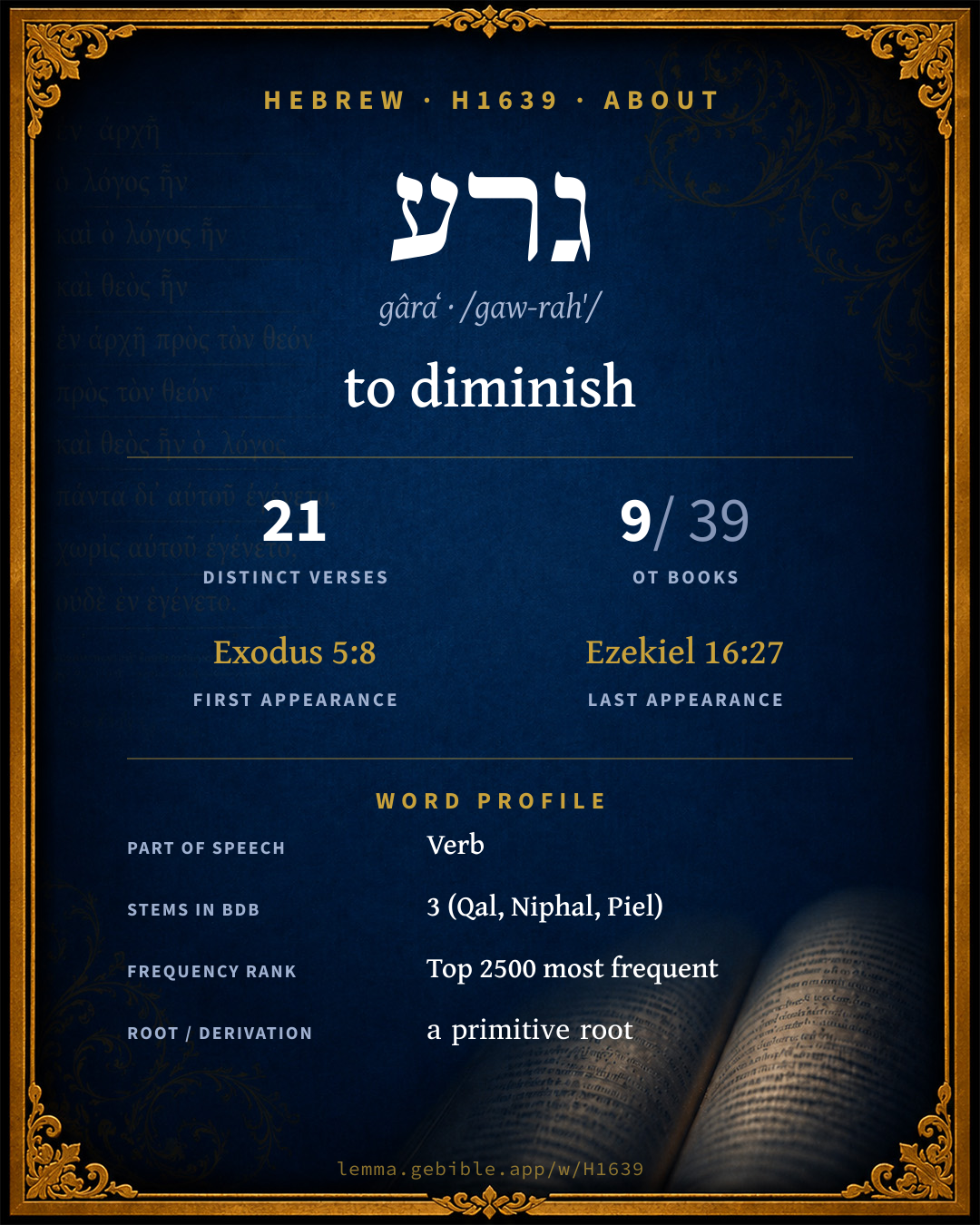
גָּרַע
to diminish
also: restrain, withdraw, abate, keep back fuller range ↓
Full lexicon entry — Brown-Driver-Briggs (BDB)
From Brown-Driver-Briggs (BDB)
Where this word appears
See every Qal verb in the Hebrew Bible →
Grammar key — what these labels mean
Part of speech
- Verb
- An action or state-of-being word.
Stem
- Niphal
- Usually the simple passive or reflexive of the Qal (“he was written”). Here: ‘be withdrawn’
- Qal
- The basic, simple active stem — the plain form of the verb (“he wrote”). Here: ‘diminish’
- Piel
- An intensive or resultative active stem.
Form
- Imperfect
- An incomplete, ongoing, or future action (“he will / would write”).
- Participle Passive
- A verbal adjective expressing action received (“written”).
- Sequential Perfect
- A perfect with prefixed waw continuing a preceding imperfect or command (waw-consecutive perfect).
- Sequential Imperfect
- An imperfect with prefixed waw — the standard past-narrative form (waw-consecutive imperfect).
- Infinitive Construct
- A bound verbal noun, frequently with prepositions (“to write / in writing”).
- Participle Active
- A verbal adjective expressing ongoing or characteristic action (“writing / one who writes”).
- Jussive
- A third- or second-person volitional form expressing wish or command (“let him write”).
State
- Absolute
- The independent form of a noun, not bound to a following word.
Person
- 3rd Person
- The one spoken about (“he / she / it / they”).
- 2nd Person
- The one addressed (“you”).
- 1st Person
- The speaker (“I / we”).
Gender
- Masculine
- Grammatically masculine.
- Feminine
- Grammatically feminine.
- Common
- Either gender — not distinguished for this form.
Number
- Singular
- One.
- Plural
- More than one (in Hebrew, generally three or more).
Grammatical forms 14 distinct
- Verb, Niphal, Imperfect, 3rd Person, Masculine, Singular 3 times (14%)
- Verb, Qal, Imperfect, 2nd Person, Masculine, Plural 3 times (14%)
- Verb, Qal, Imperfect, 2nd Person, Masculine, Singular 3 times (14%)
- Verb, Qal, Imperfect, 3rd Person, Masculine, Singular 2 times (9%)
- Verb, Qal, Participle Passive, Feminine, Singular, Absolute 2 times (9%)
- Verb, Niphal, Sequential Perfect, 3rd Person, Feminine, Singular 1 time (5%)
- Verb, Niphal, Sequential Perfect, 3rd Person, Masculine, Singular 1 time (5%)
- Verb, Qal, Sequential Imperfect, 1st Person, Common, Singular 1 time (5%)
+6 more forms (6 occurrences)
Parsed forms decoded from the imported morphology (morphhb / Westminster Leningrad Codex — WLC text public domain, morphhb tagging CC BY 4.0), counted across 22 parsed occurrences — not distinct verses.
Every verse where H1639 appears — 21 distinct verses across 9 books. Click any verse to open its interlinear word-by-word view. Verse text shown in the World English Bible for context — . Each verse’s Hebrew form is shown with its reference; the English is not keyword-highlighted, since the data carries no word-level English alignment. Use “Compare translations” on any verse to read it across multiple English versions. This concordance covers the Hebrew Bible; Septuagint (Greek Old Testament) occurrences are not indexed here.
Exodus 4 verses
- Exodus 5:8 תִגְרְע֖וּ Qal impf 2mp The number of the bricks, which they made before, you require from them. You shall not diminish anything of it, for they are idle; therefore they cry, saying, 'Let us go and sacrifice to our God.'
- Exodus 5:11 נִגְרָ֛ע Niphal ptcp.act ms Go yourselves, get straw where you can find it, for nothing of your work shall be diminished."
- Exodus 5:19 תִגְרְע֥וּ Qal impf 2mp The officers of the children of Israel saw that they were in trouble, when it was said, "You shall not diminish anything from your daily quota of bricks!"
- Exodus 21:10 יִגְרָֽע Qal impf 3ms If he takes another wife to himself, he shall not diminish her food, her clothing, and her marital rights.
Leviticus 1 verse
Numbers 4 verses
- Numbers 9:7 נִגָּרַ֗ע Niphal impf 1cp Those men said to him, "We are unclean because of the dead body of a man. Why are we kept back, that we may not offer the offering of Yahweh in its appointed season among the children of Israel?"
- Numbers 27:4 יִגָּרַ֤ע Niphal impf 3ms Why should the name of our father be taken away from among his family, because he had no son? Give to us a possession among the brothers of our father.
- Numbers 36:3 וְ/נִגְרְעָ֤ה יִגָּרֵֽעַ conj + Niphal wpf 3fs Niphal impf 3ms If they be married to any of the sons of the [other] tribes of the children of Israel, then will their inheritance be taken away from the inheritance of our fathers, and will be added to the inheritance of the tribe whereunto they shall belong: so will it be taken away from the lot of our inheritance.
- Numbers 36:4 יִגָּרַ֖ע Niphal impf 3ms When the jubilee of the children of Israel shall be, then will their inheritance be added to the inheritance of the tribe whereunto they shall belong: so will their inheritance be taken away from the inheritance of the tribe of our fathers.
Deuteronomy 2 verses
- Deuteronomy 4:2 תִגְרְע֖וּ Qal impf 2mp You shall not add to the word which I command you, neither shall you diminish from it, that you may keep the commandments of Yahweh your God which I command you.
- Deuteronomy 12:32 תִגְרַ֖ע Qal impf 2ms Whatever thing I command you, that shall you observe to do: you shall not add thereto, nor diminish from it.
Job 4 verses
- Job 15:4 וְ/תִגְרַ֥ע conj + Qal impf 2ms Yes, you do away with fear, And hinder devotion before God.
- Job 15:8 וְ/תִגְרַ֖ע conj + Qal impf 2ms Have you heard the secret counsel of God? Do you limit wisdom to yourself?
- Job 36:7 יִגְרַ֥ע Qal impf 3ms He doesn't withdraw his eyes from the righteous, But with kings on the throne, He sets them forever, and they are exalted.
- Job 36:27 יְגָרַ֣ע Piel impf 3ms For he draws up the drops of water, Which distill in rain from his vapor,
Ecclesiastes 1 verse
Isaiah 1 verse
Jeremiah 2 verses
- Jeremiah 26:2 תִּגְרַ֖ע Qal juss 2ms Thus says Yahweh: Stand in the court of Yahweh's house, and speak to all the cities of Judah, which come to worship in Yahweh's house, all the words that I command you to speak to them; don't diminish a word.
- Jeremiah 48:37 גְּרֻעָ֑ה Qal ptcp.pass fs For every head is bald, and every beard clipped: on all the hands are cuttings, and on the loins sackcloth.
Ezekiel 2 verses
- Ezekiel 5:11 אֶגְרַע֙ Qal impf 1cs Therefore, as I live, says the Lord Yahweh, surely, because you have defiled my sanctuary with all your detestable things, and with all your abominations, therefore will I also diminish [you]; neither shall my eye spare, and I also will have no pity.
- Ezekiel 16:27 וָ/אֶגְרַ֖ע conj + Qal wimpf 1cs See therefore, I have stretched out my hand over you, and have diminished your ordinary [food], and delivered you to the will of those who hate you, the daughters of the Philistines, who are ashamed of your lewd way.
About this entry
At a glance — auto-summarized from this page’s data, not written by a person. Every figure links to its source below. This summary describes the numbers; it doesn’t interpret them.
גרע (gâraʻ) is a Hebrew verb most often rendered “to diminish.” Scripture first uses it in Exodus 5:8. It turns up in 21 verses across 9 books, an uncommon footprint. Across 3 stems, its meaning turns on the binyan (Qal, Niphal). It clusters with מגרעה under a shared root. The sections below give every sense, occurrence, and version rendering.
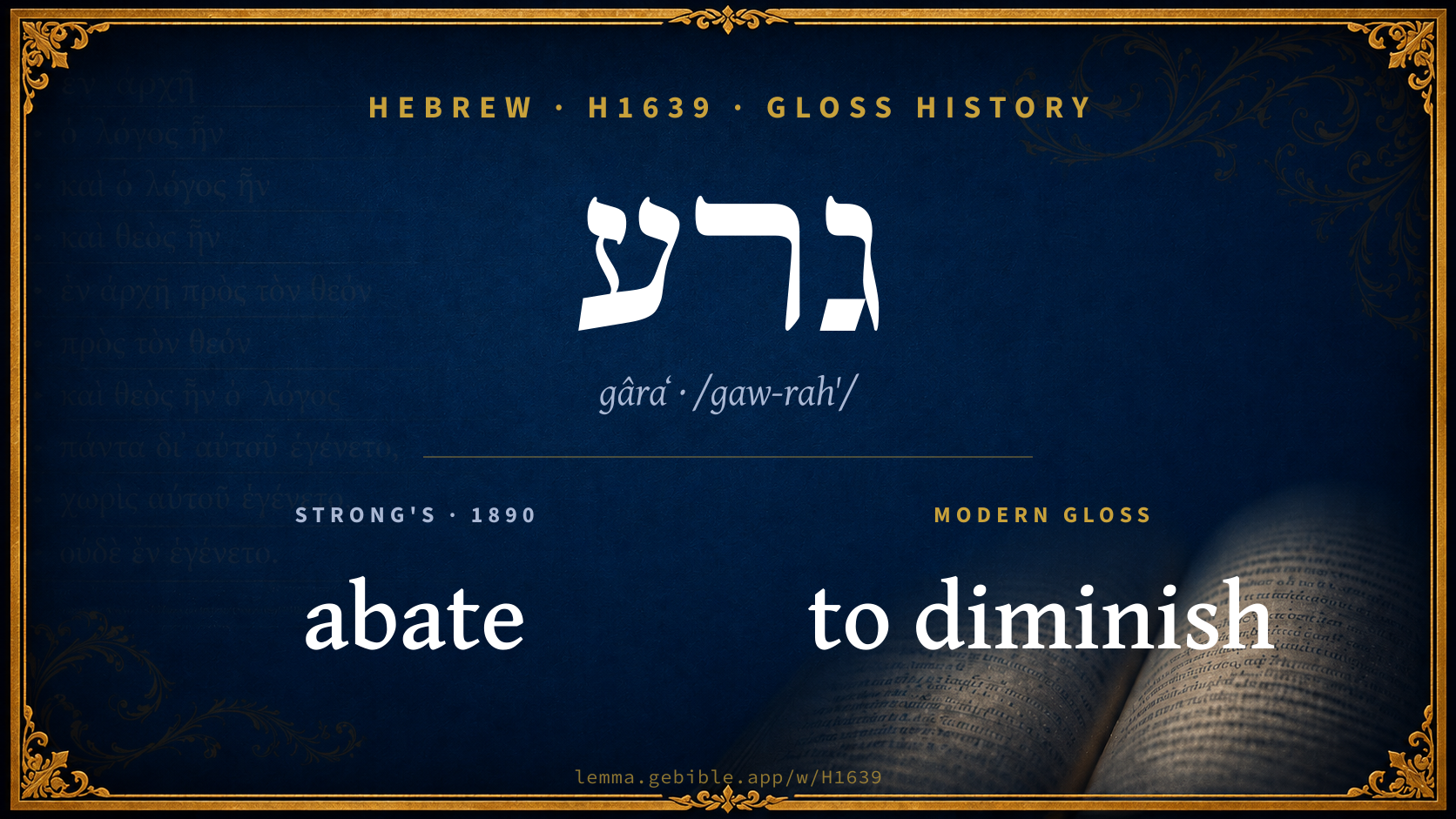
Gloss history
Strong's 1890 vs modern scholarship
About this word
Strong's H1639 catalogs a Hebrew word from the Hebrew Old Testament.
These counts are not copied from any lexicon or concordance. They are computed here, from the morphology-tagged Hebrew Old Testament. What Lemma adds →
- 21
- distinct verses
- The word appears in 21 distinct verses.
- 9 / 39
- OT books
- The word appears in 9 of 39 Old Testament books.
- #1,412
- by frequency
- Top 2500 most frequent Hebrew words (rank 1,412 of 8,640 Hebrew words by occurrence).
View all 21 occurrences in the concordance →
By section of the Old Testament
By traditional corpus
Conventional, traditional groupings — biblical authorship is debated, so this is a traditional corpus grouping, not an authorship claim. Each share is this word’s portion of its verses in that division of the Hebrew canon. Each figure is a share of the word’s 21 distinct verses.
- Torah (Pentateuch) 11 verses · 52%
- Prophets (Nevi'im) 5 verses · 24%
- Writings (Ketuvim) 5 verses · 24%
How translations render this word
Counts come from each version’s own published word-to-Strong’s tagging or interlinear alignment — an approximate guide to how each version renders this word, not a word-level alignment the data otherwise carries. Because each total is that version’s own tagged count, the per-version totals vary from one another and need not match the appearance or distinct-verse counts above. These counts may also differ from a printed concordance because Lemma counts each distinctly tagged rendering and does not collapse phrase taggings into a single head-word total. This is a fixed set of word-tagged versions (KJV, ASV, BSB, ULT) and does not change with the reading translation you choose elsewhere. Each version’s license is shown beside its name below (and on Sources).
- King James Version: Any thing taken 1×, Be done away 1×, Be taken 1×
- American Standard Version: Them 2×
- Berean Standard Bible: Or subtract 2×, Reduce 2×
- unfoldingWord Literal Text: Do 3×, Be withdrawn 2×, Diminish 2×
King James Version Public Domain
Renders H1639 across 21 tagged occurrences — most commonly:
Plus other, less common renderings.
American Standard Version Public Domain
Renders H1639 across 21 tagged occurrences — most commonly:
Plus 19 renderings that appear only once — usually multi-word phrases or single function words the recovered tagging swept in, not distinct renderings.
Berean Standard Bible Public Domain
Renders H1639 across 22 tagged occurrences — most commonly:
Plus 18 renderings that appear only once — usually multi-word phrases or single function words the recovered tagging swept in, not distinct renderings.
unfoldingWord Literal Text CC BY-SA 4.0
Renders H1639 across 30 tagged occurrences — most commonly:
Plus 21 renderings that appear only once — usually multi-word phrases or single function words the recovered tagging swept in, not distinct renderings.
Senses in the full BDB
Hebrew verbs can shift meaning by stem (binyan): Qal is the basic action, Niphal is often passive or reflexive, Piel often intensifies or makes it factitive, and Hiphil is typically causative. The senses below are grouped under the stem BDB assigns to each.
What do BDB’s symbols mean?
BDB uses these scholarly abbreviations:
| Symbol | Meaning |
|---|---|
| 𝔊 | the Septuagint (the ancient Greek translation, LXX) |
| 𝔙 | the Vulgate (the Latin translation) |
| 𝔖 | the Syriac version (the Peshitta) |
| 𝔗 | the Targum (the Aramaic translation) |
| ψ | the Psalms |
| √ | root (the underlying root or stem) |
| ‖ | parallel passage (a synonymous or contrasted parallel) |
| † | the dagger: every passage where the word occurs is cited |
The 6 senses and sub-senses the full Brown-Driver-Briggs lexicon distinguishes for this word, in lexicon order (not ranked by frequency), with BDB’s own verbatim wording and sub-sense lettering. Shown in Hebrew script with BDB’s own scholarly abbreviations. The condensed entry is in the Lexicon Entry tab. See also the Forms in the corpus table below.
Qal
- 1. diminish
- 2. restrain
- 3. withdraw
Niphal
- 1. be withdrawn
- 2. be restrained
Piel
- . withdraw = draw up
Senses from the full Brown-Driver-Briggs lexicon (Brown, Driver, Briggs; Oxford 1906 — public domain), digitized via Sefaria, supplemented by the OpenScriptures HebrewLexicon (CC BY 4.0). Full attribution on Sources.
Word origin
[ גָּרַע ] vb. diminish, restrain, withdraw
— Brown-Driver-Briggs (Oxford 1906, public domain), digitized via Sefaria, supplemented by the OpenScriptures HebrewLexicon (CC BY 4.0). See Sources.
Origin: a primitive root
Jastrow Dictionary
A second Hebrew/Aramaic lexicon for comparison, covering Aramaic and post-biblical (Talmudic, Targumic, Midrashic) usage that the biblical-Hebrew BDB does not. Matched by lemma rather than by Strong’s number, so a lemma may carry more than one Jastrow headword (shown separately below), and the entries cover usage well beyond the Bible.
גָּרַע I
- v. גרר) to scrape off, to diminish, deduct. Snh. 29ᵃ כל המוסיף גּוֹרֵעַ he who adds (to the truth) diminishes (whoever does too much does too little). R. Hash. 28ᵇ, a. fr. עובר על בל תִּגְרַע transgresses the law which prohibits diminishing from what the Law prescribes (Deut. XIII, 1, v. בַּל). Yoma 48ᵃ גּוֹרְעִין ומוסיפין ודורשין we may take away (one servile letter from one word of the text) and add it to another and thus interpret the law (e.g. מדם הפר explained as: דם מהפר); B. Bath. 111ᵇ; a. fr.—Y. Yeb. VIII, end, 9ᵈ, v. גָּלַע.—[Gen. R. s. 19, a. e. גרעה קומתו, v. גָּוַע.]—Part. pass. גָּרוּעַ inferior. Pl. גְּרוּעִים. Gen. R. s. 28. [Ber. 36ᵃ ומי גרע, read with Ms. M. גריעי.] e.g. Deuteronomy 13:1
- to deduct from, to calculate the price of redemption in proportion to the years served and those to be served, v. גֵּירוּעַ Kidd. 11ᵇ מַגְרַעַת מפדיונה she makes a deduction from her redemption money; ib. 14ᵇ מגרעת פדיונה she lessens &c.; ib. 16ᵃ מגרע פד׳ (corr. acc.). Y. Kidd. I, 58ᶜ bot.; Y. Shebu. VI, beg. 36ᵈ מגרעת (ב)מעה וכ׳ she redeems herself by deducting a M’ah for each year.
- to be deducted, to be redeemed by deducting the compensation for the time served. Y. Kidd. l. c. אם בקשה לִיגָּרֵעַ if the desires a redemption by deduction &c.; Y. Shebu. l. c. למיגרע (read: לֵהִיגָּ׳ or לִיגָּ׳). Kidd. 11ᵇ תִּיגָּרֵעַ עד פרוטה she can redeem herself by deductions until she comes down to a P’rutah.
גְּרַע
- , esp. to shave, cut the hair (dialectically interchanging with גרד). Targ. Jud. XVI, 19; II Sam. X, 4 Ar. (ed. גדע, ed. Lag. II Sam. l. c. גרע; cmp. Is. XV, 2, Jer. XLVIII, 37).—Lam. R. to I, 1 ג׳ רישיה (8 חד מאת׳) רבתי he shaved his head. Snh. 96ᵃ (prov.) גְּרַעְתֵּיה לארמאה וכ׳ Ar. (ed. גרירתיה, Ms. M. גרידתיה) if you shave a gentile, he likes it; hang fire on his beard, and you will get no end of his fun (i.e. if he finds it convenient, he will submit to indignities).—Part. pass. גְּרִיעַ, f. גְּרִיעָא e.g. 2 Samuel 10:4
- 1. shaved. Lam. R. l. c.
- 2. inferior, less. Yeb. 51ᵃ ג׳ ממאמר is inferior (as to legal power) to &c., v. מַאֲמָר. Gitt. 70ᵃ ג׳ דכולהו the worst of all.
- as preced. Hif. [Targ. Y. II, Gen. XXX, 11, read מגדעא.] Kidd. 11ᵇ מַגְרְעָה ואזלה she deducts more and more every year. Ib. [read:] מאי מגרעה what is there for her to deduct from?—Arakh. 25ᵃ, v. infra.
- as preced. Nif. Arakh. 30ᵇ מִיגְּרְעָא ואזלא his obligation grows less (every year, if he chooses to redeem her). Ib. 25ᵃ לא מִגְּרַע ליה (Rashi מיג׳) no deduction is allowed him (for fractions of a year).
גָּרַע II
- to form globules, to drop. Denom. גַּרְעִין.
- (denom. of גרעין) to form globules (one of the early stages of development of the grape). Shebi. IV, 10 גפנים מִשֶּׁיְּגָרְעוּ grape vines (must not be cut down in the Sabbath year) from the moment they form stones, Maim.; oth. opin. ovules containing moisture; Y. ib. IV, end 35ᶜ משיַגְרִיעוּ (Hif.), defined משיזחלו מים, with ref. to Job XXXVI, 27; Ber. 63ᵇ; Pes. 52ᵇ sq. משיגריעו (Ms. M. 2 משיגרעו). e.g. Job 36:27
גָּרָע
- (גרע I) scraper, barber, in gen. low class surgeon, blood-letter &c. Kidd. 82ᵃ. Kel. XII, 4; Tosef. Kel. B. Mets. II, 11 גָּרוֹעַ, v. מַסְמָר.
A Dictionary of the Targumim, the Talmud Babli and Yerushalmi, and the Midrashic Literature (Marcus Jastrow; London, Luzac, 1903) — Public Domain. Digitized via Sefaria. Digitized via Sefaria. Full attribution on Sources.
Forms in the corpus
The 21 distinct written forms H1639 takes in the Hebrew Bible, most frequent first — each parse links to that stem’s occurrences in the concordance. Hebrew forms include their vowel points and cantillation, so a single lemma takes many written forms.
Same root — word family
Other BDB entries built from the same root as H1639, grouped by Strong’s listed origin. These share a root / origin per the lexicon — not necessarily a shared meaning. Each links to that word’s own entry.
Derived from this word
Compare all same-root words → They share a root, not necessarily a meaning.
Septuagint verse parallels
This word appears in 19 verses that also exist in the Greek Old Testament (Septuagint), out of the 21 Hebrew verses it occurs in. You can read those verses in Greek by switching the Old Testament edition to the Septuagint.
Read these verses in the Septuagint
- Exodus 5:8
- Leviticus 27:18
- Numbers 9:7
- Deuteronomy 4:2
- Job 15:4
- Ecclesiastes 3:14
- Isaiah 15:2
- Jeremiah 26:2
- Ezekiel 5:11
This is a verse-level parallel only — the same verses exist in both the Hebrew and Greek Old Testaments. No word-level Hebrew↔Greek correspondence is claimed: the data carries no such alignment, so no Greek word is shown as this Hebrew word’s translation. Coverage is not total — the Septuagint omits the deuterocanon and renumbers the Psalms, so some Hebrew verses have no direct Greek parallel.