Ezekiel 11:18

Hebrew (Westminster Leningrad Codex) Ezekiel 11:18 appears in the Hebrew Old Testament. The text above is from the Westminster Leningrad Codex. Each word links to its Strong’s number, a concise gloss, and parsing drawn from the Open Scriptures Hebrew Bible morphology. Click any word for its full Brown-Driver-Briggs (BDB) entry.
Download image
Cite this verse

Ezekiel 11:18 (World English Bible). Public Domain. Lemma interlinear Bible study tool, https://lemma.gebible.app/v/ezekiel/11/18.

Show BibTeX & RIS
BibTeX
RIS
English Translation
They shall come there, and they shall take away all the detestable things of it and all the abominations of it from there.
World English Bible · Public Domain
Download a study sheet

One document with this verse’s original text, its word-by-word gloss line, the meaning frame, cross-references with their text, attributed commentary, and full source and license credits — printable, and it pastes into notes with its structure intact.

This verse Autodidact and up

Study sheet (.html) Plain text (.txt)

A passage Seminary Student

Up to 50 verses in one chapter. A passage sheet keeps up to 6 commentary sources and 12 cross-references per verse, in the order this page ranks them, and says so on the sheet whenever that leaves anything out. Ask for a single verse and you get the Autodidact verse sheet above.

Everything on this page stays free to read, with no account — the sheet is a download of what is already on screen, not access to it.

Want to remove ads? Support Godless Engineer
Compare translations 3

The same verse in 3 English versions, stacked beneath the original-language interlinear above. Click any original word for its lexicon entry.

Each is an independent rendering of the whole verse — the interlinear is not word-aligned to these translations.

Highlighted words mark where these versions differ — a whole-verse word diff, not a word-by-word alignment.

  • World English Bible Public Domain
    They shall come there, and they shall take away all the detestable things of it and all the abominations of it from there.
  • King James Version Public Domain
    And they shall come thither, and they shall take away all the detestable things thereof and all the abominations thereof from thence.
  • unfoldingWord Literal Text CC BY-SA 4.0
    Then they will go there and remove every detestable thing and every abomination from that place.

unfoldingWord Literal Text — © unfoldingWord, licensed CC BY-SA 4.0. Word-aligned USFM3 via Door43 (git.door43.org/unfoldingWord/en_ult).

Versions to compare (up to 4)

3 of 4 selected

Show all 18 translations

Every available English version of this verse, each an independent rendering of the whole verse.

  • World English Bible Public Domain
    They shall come there, and they shall take away all the detestable things of it and all the abominations of it from there.
  • Berean Standard Bible Public Domain
    When they return to it, they will remove all its detestable things and all its abominations.
  • Majority Standard Bible Public Domain
    When they return to it, they will remove all its detestable things and all its abominations.
  • King James Version Public Domain
    And they shall come thither, and they shall take away all the detestable things thereof and all the abominations thereof from thence.
  • American Standard Version (1901) Public Domain
    And they shall come thither, and they shall take away all the detestable things thereof and all the abominations thereof from thence.
  • Revised Version (1885) Public Domain
    And they shall come thither, and they shall take away all the detestable things thereof and all the abominations thereof from thence.
  • Geneva Bible (1599) Public Domain
    And they shall come thither, and they shall take away all the idoles thereof, and all the abominations thereof from thence.
  • Douay-Rheims (1899) Public Domain
    And they shall go in thither, and shall take away all the scandals, and all the abominations thereof from thence.
  • Young's Literal Translation Public Domain
    And they have gone in thither. And turned aside all its detestable things, And all its abominations -- out of it.
  • Literal Standard Version CC BY-SA 4.0
    And they have gone in there, || And turned aside all its detestable things, || And all its abominations—out of it.
  • Unlocked Literal Bible CC BY-SA 4.0
    Then they will go there and remove every detestable thing and every abomination from that place.
  • unfoldingWord Literal Text CC BY-SA 4.0
    Then they will go there and remove every detestable thing and every abomination from that place.
  • Darby Bible Public Domain
    And they shall come thither, and they shall take away from thence all its detestable things and all its abominations.
  • World Messianic Bible Public Domain
    “‘They will come there, and they will take away all its detestable things and all its abominations from there.
  • Webster's Bible Public Domain
    And they shall come thither, and they shall take away from thence all its detestable things, and all its abominations.
  • Free Bible Version CC BY-SA 4.0
    When they come back, they are going to get rid of all its offensive idols and disgusting practices from the country.
  • Bible in Basic English Public Domain
    And they will come there, and take away all the hated and disgusting things from it.
  • JPS Tanakh (1917) Public Domain
    And they shall come thither, and they shall take away all the detestable things thereof and all the abominations thereof from thence.

Literal Standard Version (2020), Covenant Press — licensed CC BY-SA 4.0. Text via the HelloAO Bible API (eBible.org). Unlocked Literal Bible (unfoldingWord) — licensed CC BY-SA 4.0. Text via the HelloAO Bible API (eBible.org). unfoldingWord Literal Text — © unfoldingWord, licensed CC BY-SA 4.0. Word-aligned USFM3 via Door43 (git.door43.org/unfoldingWord/en_ult). Free Bible Version, Dr. Jonathan Gallagher — licensed CC BY-SA 4.0. Text via the HelloAO Bible API (eBible.org).

Word by word

More ways to search: Search by grammar → Find every occurrence → Compare this word →

Practice this passage: Drill this verse → Learn its vocabulary →

שִׁקּוּצֶ֛יהָ
shiqqûwts
H8251
“abominations · her”
Noun, Common, Masculine, Plural, Construct + Suffix, Personal, 3rd Person, Feminine, Singular
Part of Speech
Noun
Type
Common
Gender
Masculine
Number
Plural
State
Construct
Full BDB Definition

Origin: from H8262

TWOT: 2459b

detestable thing or idol, abominable thing, abomination, idol, detested thing
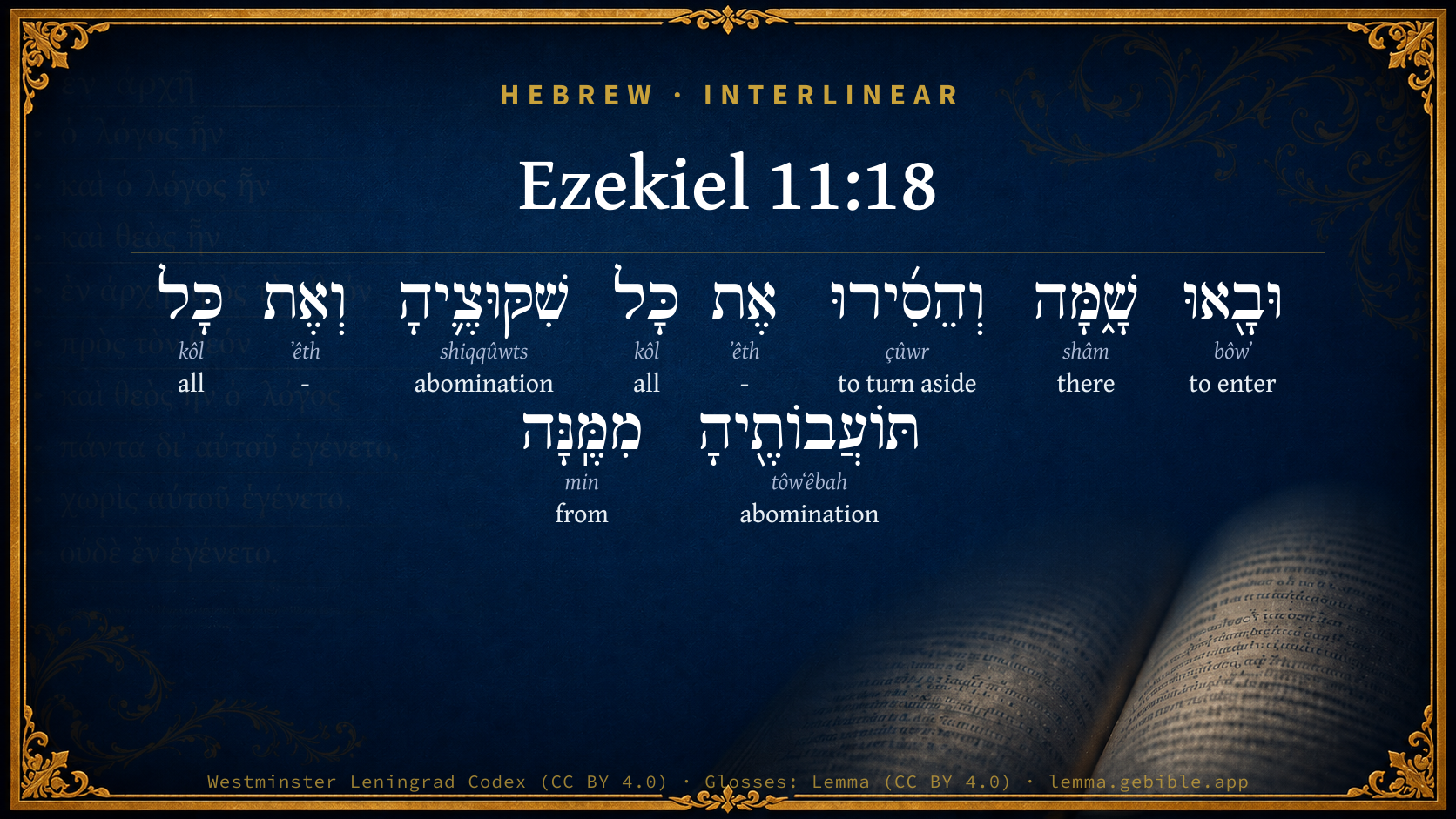
  1. וּבָ֖אוּ bôwʼ H935 “and · to enter” Conjunction + Verb, Qal, Sequential Perfect, 3rd Person, Common, Plural
  2. שָׁ֑מָּה shâm H8033 “there · toward” Adverb + Suffix, Demonstrative
  3. וְהֵסִ֜ירוּ çûwr H5493 “and · to turn aside” Conjunction + Verb, Hiphil, Sequential Perfect, 3rd Person, Common, Plural
  4. אֶת ʼêth H853 “-” Particle, Direct Object
  5. כָּל kôl H3605 “all of” Noun, Common, Masculine, Singular, Construct
  6. וְאֶת ʼêth H853 “and · -” Conjunction + Particle, Direct Object
  7. כָּל kôl H3605 “all of” Noun, Common, Masculine, Singular, Construct
  8. תּוֹעֲבוֹתֶ֖יהָ tôwʻêbah H8441 “abominations · her” Noun, Common, Feminine, Plural, Construct + Suffix, Personal, 3rd Person, Feminine, Singular
  9. מִמֶּֽנָּה min H4480 “from · her” Preposition + Suffix, Personal, 3rd Person, Feminine, Singular

About this verse

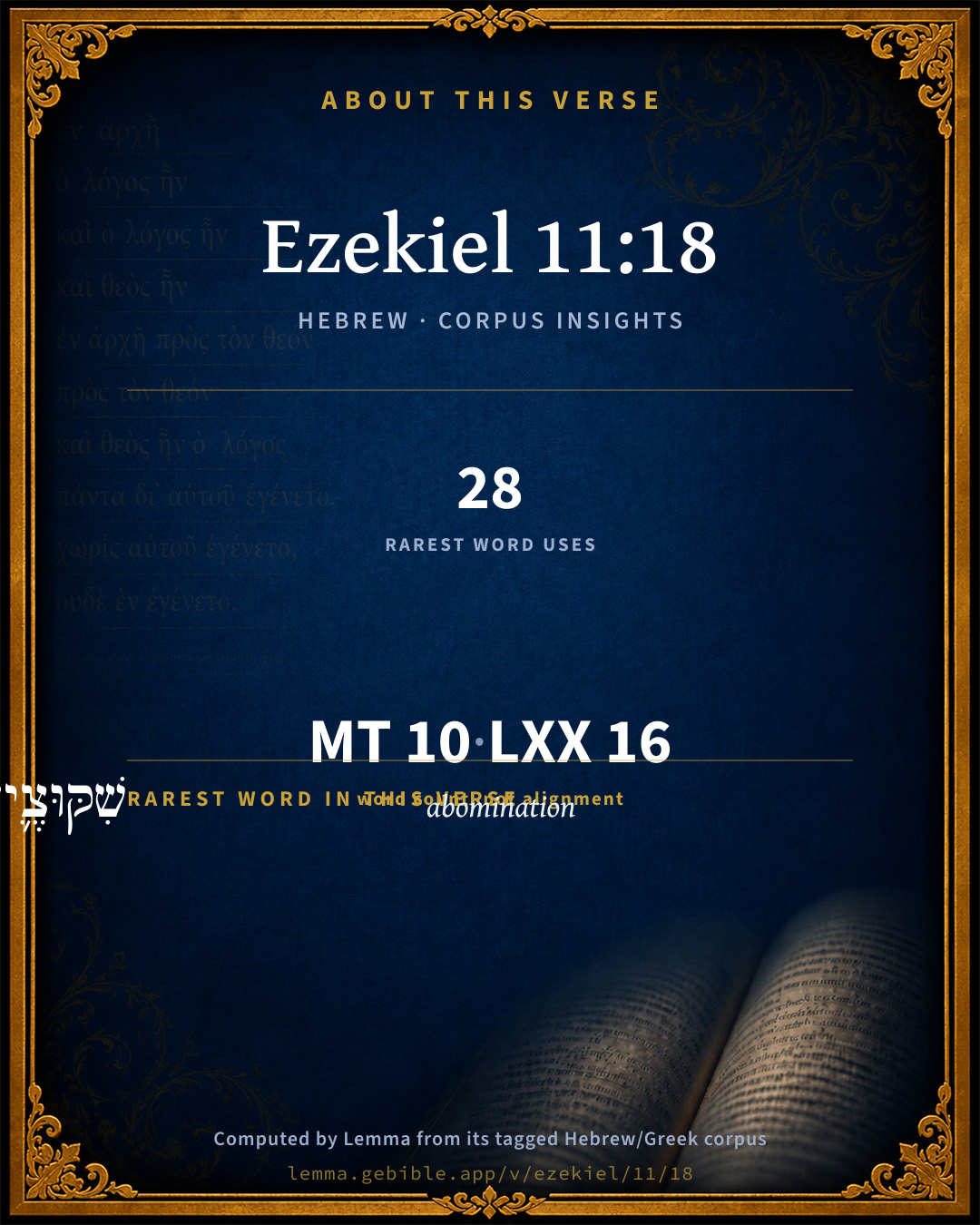
These counts appear in no published source. They are computed here, from the morphology-tagged text and Lemma’s own curated glosses. What Lemma adds →

10
words
8
distinct lemmas
Prophets
section

Shared distinctive vocabulary

שִׁקּוּצֶ֛יהָ abomination H8251 occurs in 26 verses of the Hebrew Bible. Also found in:

Grammatical profile

  • 2 verbs
  • 4 nouns
  • 1 preposition
  • 1 adverb
  • 2 particles

Verb forms

  • וּבָ֖אוּ Qal · Sequential Perfect
  • וְהֵסִ֜ירוּ Hiphil · Sequential Perfect

Repetition

A word recurs within this verse — often emphatic in Hebrew:

Hebrew & Septuagint length

In English translation the verse runs 23 words from the Hebrew and 20 from the Septuagint (LXX English) — closely comparable.

A rough comparison of the two English renderings, which tokenize alike — not a word-level alignment.

Word counts can differ between the Hebrew and the Greek without any difference in meaning — e.g. the Hebrew direct-object marker אֵת has no separate Greek word, and Greek often adds the article ὁ.

In the original languages it is 10 Hebrew tokens and 16 Greek tokens — but the two are counted differently (Hebrew bundles its prefixes and suffixes into one token; the Greek is in lemma form), so that isn’t a like-for-like length.

Cross-references

12

Topical passages linked to Ezekiel 11:18 in the Treasury of Scripture Knowledge — connected by theme and wording, ordered by reader-vote popularity; previews shown in the World English Bible.

  • Ezekiel 5:11 Therefore, as I live, says the Lord Yahweh, surely, because you have defiled my sanctuary with all your detestable things, and with all your abominations, therefore will I also diminish [you]; neither shall my eye spare, and I also will have no pity.
  • Ezekiel 37:23 neither shall they defile themselves any more with their idols, nor with their detestable things, nor with any of their transgressions; but I will save them out of all their dwelling-places, in which they have sinned, and will cleanse them: so shall they be my people, and I will be their God.
  • Ezekiel 7:20 As for the beauty of his ornament, he set it in majesty; but they made the images of their abominations [and] their detestable things therein: therefore have I made it to them as an unclean thing.
  • Ezekiel 42:7–8 The wall that was outside by the side of the chambers, toward the outer court before the chambers, the length of it was fifty cubits.
  • Isaiah 1:25–27 And I will turn my hand on you, Thoroughly purge away your dross, And will take away all your tin.
  • Isaiah 30:22 You shall defile the overlaying of your engraved images of silver, and the plating of your molten images of gold: you shall cast them away as an unclean thing; you shall tell it, Get you hence.
  • Jeremiah 16:18 First I will recompense their iniquity and their sin double, because they have polluted my land with the carcasses of their detestable things, and have filled my inheritance with their abominations.
  • Ezekiel 11:21 But as for them whose heart walks after the heart of their detestable things and their abominations, I will bring their way on their own heads, says the Lord Yahweh.
  • Hosea 14:8 Ephraim, what have I to do any more with idols? I answer, and will take care of him. I am like a green fir tree; From me your fruit is found."
  • Micah 5:10–14 "It will happen in that day," says Yahweh, "That I will cut off your horses out of the midst of you, And will destroy your chariots.
  • Colossians 3:5–8 Put to death therefore your members which are on the earth: sexual immorality, uncleanness, depraved passion, evil desire, and covetousness, which is idolatry;
  • Titus 2:12 instructing us to the intent that, denying ungodliness and worldly lusts, we would live soberly, righteously, and godly in this present world;

Cross-references courtesy of OpenBible.info (CC BY 4.0).

Hebrew and Greek witnesses Masoretic Hebrew ↔ Greek Septuagint

The same verse in the two great witnesses to the Old Testament, shown verse-for-verse.

These are two independent witnesses, not word-aligned to each other, and the Septuagint is shown in lemma (dictionary) form.

Hebrew Ezekiel 11:18 Masoretic · Westminster Leningrad Codex

וּבָ֖אוּ שָׁ֑מָּה וְהֵסִ֜ירוּ אֶת כָּל שִׁקּוּצֶ֛יהָ וְאֶת כָּל תּוֹעֲבוֹתֶ֖יהָ מִמֶּֽנָּה

They shall come there, and they shall take away all the detestable things of it and all the abominations of it from there.

World English Bible · Public Domain

Greek LXX Ezekiel 11:18 Septuagint · lemma form

καί εἰςἔρχομαι ἐκεῖ καί ἐκαἴρω πᾶς ὁ βδέλυγμα αὐτός καί πᾶς ὁ ἀνομία αὐτός ἐκ αὐτός

And they shall enter in there, and shall remove all the abominations of it, and all its iniquities from it.

LXX2012 (modern English Septuagint) · Public Domain

Hebrew: Westminster Leningrad Codex (CC BY 4.0). Greek: Septuagint (public domain); English from LXX2012 (modern English Septuagint) (Public Domain). How the Septuagint differs from the Hebrew →

Targum (Aramaic paraphrase)

1

The Targum is the ancient Jewish Aramaic paraphrase of the Hebrew Scriptures — an interpretive translation, not the Hebrew text itself. Onkelos (literal) and Pseudo-Jonathan (expansive) render the Torah, and Jonathan the Prophets. Coverage is partial: where no permissively-licensed English translation exists for a verse, only the Aramaic is shown. This is verse-level text, not a word-by-word alignment to the Hebrew.

  1. Targum Jonathan Prophets (Joshua–Malachi)
    וְיֶעֱלוּן לְתַמָן וְיַעְדוּן יַת כָּל שִׁקוּצָא וְיַת כָּל תּוֹעֲבָתָא מִנָהּ:

    (no public-domain English translation for this verse)

    Targum Jonathan — Aramaic: “Mikraot Gedolot” (public domain). English: “Sefaria Community Translation” (CC0 1.0 (public-domain dedication)); “London "Chaldee Paraphrase," 1871” (public domain). Text via Sefaria.

Commentary

Notes on Ezekiel 11:18 from classic Christian and Jewish commentators (each source and its license shown beneath its notes). The classic Christian expositions comment on the surrounding passage and are grouped to its opening verse, so a note may address several verses; the Jewish commentaries on the Tanakh (Rashi and others) are per-verse, so they appear only where the commentator wrote on this verse.

Lemma curates 59 commentaries, every one of them public domain or Creative Commons licensed, each selected and text-cleaned for this edition rather than reprinted as found. About our sources →

Trapp's Complete Commentary

John Trapp

Eze 11:18 And they shall come thither, and they shall take away all the detestable things thereof and all the abominations thereof from thence.

Ver. 18. And they shall take away all the detestable things.] So God calleth their idols and monuments of idolatry, not deigning to call them by their usual names. After the captivity the Jews would never endure idols. They chose rather to die than to suffer Caligula’s statue to be set up in their temple by Petronins. To this day they say that there is an ounce of the golden calf in all their sufferings.

John Trapp, A Commentary or Exposition upon All the Books of the Old and New Testament (1647–1656) — public domain. Text from a community e-Sword module.

Matthew Poole's English Annotations

They; the gathered, who assembled upon Cyrus’s proclamation first, and then again upon Darius’s proclamation; of which Ezr 1 and Ezr 8; they met together some where in the land of their captivity, and had a long journey to Jerusalem. Shall come thither; they shall overcome all difficulties, and escape dangers, and despatch the long journey, and come safely to their own land.

They shall take away; abolish superstition and idolatry from the temple, Jerusalem, and from the priests.

The detestable things: see Eze 11:18.

Thereof; of the land and city; and who reads Ezra, Nehemiah, and the prophets Zechariah and Haggai, will see this reformation carried on with SUCCESS.

Matthew Poole's English Annotations on the Holy Bible (1683–1685) — public domain. Text from a community e-Sword/MySword module.

Jamieson, Fausset & Brown

Robert Jamieson, A. R. Fausset & David Brown

They have eschewed every vestige of idolatry ever since their return from Babylon. But still the Shekinah glory had departed, the ark was not restored, nor was the second temple strictly inhabited by God until He came who made it more glorious than the first temple (Hag 2:9); even then His stay was short, and ended in His being rejected; so that the full realization of the promise must still be future.

Jamieson, Fausset & Brown — Commentary Critical and Explanatory on the Whole Bible (1871) — public domain (CC PDM 1.0). Text via the HelloAO Bible API.

John Calvin's Commentaries

Here he adds something more important — that when the Israelites had returned to their country they would be sincere worshippers of God, and not only offer sacrifices in the temple, but purge the land of all its pollutions. Here also the Prophet admonishes them how great and detestable was the impiety of the ten tribes, because they had contaminated the land with idols. He does not here allude to the idols of the Gentiles, but rather reproves the Israelites because they had contaminated with their defilements the land which had been dedicated to God. Hence the Prophet exhorted his countrymen to repentance, when he shows that they were not cast out of the land before it was polluted; and therefore that they were justly punished for their sacrilege. This is one point. Afterwards we must remark, that we then truly and purely enjoy God’s blessings, when we direct their use to that end which is here set before us, namely, pure and proper worship. Nothing more frequently meets us than this teaching — that we have been redeemed by God that we may celebrate his glory; that the Church was planted that in it he may be glorified, and we may make known his attributes. Hence let us learn that God’s benefits then issue in our safety, and are testimonies of his paternal favor when they excite us to worship him. Thirdly, we must remark, that we do not rightly discharge our duty towards God, unless when we purge his worship from all stain and defilement. Many so worship God, that they corrupt with vicious mixtures whatever obedience they seem to render. And to this day even, those who seem to themselves very wise, are shamefully divided between God and the devil, as if they could satisfy God with half their allegiance. Hence let us learn from this passage, that God abhors such deceivers; for when he says that the Israelites after their return should be devoted to piety, he indicates it by this mark — that they shall take away all their abominations, and all their idols from the land It afterwards follows —

John Calvin's Commentaries (1540-1563) — public domain. Text from the Calvin Translation Society English edition (1840s-50s) via the Christian Classics Ethereal Library (ccel.org). Calvin's coverage is partial (roughly two-thirds of the Bible); uncommented books and verses are honest gaps, never fabricated. The 19th-century editor's footnotes and remarks are omitted so the notes are faithfully Calvin's own voice.

Ellicott's Commentary for English Readers

(18) They shall take away.—Chastened and purified by their chastisement, they should return to the land to do away utterly with the abominations which had caused their exile. Historically, this was fully realised in the abomination in which idolatry, the great sin of the people, was ever after held among the Jews. The change of person from you to they, though so common as not necessarily to call for remark, may yet here possibly indicate that what is foretold was to belong rather to their children than to themselves.

A Bible Commentary for English Readers, edited by Charles John Ellicott (1878–1897) — public domain. Text from a community e-Sword module.

The Cambridge Bible for Schools and Colleges

gen. ed. J. J. S. Perowne

18. shall take away] i.e. remove. Cf. ch. Eze_37:22-23. The “detestable things” are the false gods (1Ki_11:5; 1Ki_11:7; 2Ki_23:13), and all the accompaniments of the debased worship (cf. ch. Eze_33:25-26).

The Cambridge Bible for Schools and Colleges (gen. ed. J. J. S. Perowne; Cambridge University Press, 1878–1918) — public domain. Text from a community e-Sword module.

John Gill's Exposition

And they shall come thither,.... That those of the captivity shall come to the land of Israel, they or their posterity:

and they shall take away all the detestable things thereof; the idols of the nations, that had been there introduced, detestable to God and all good men:

and all the abominations thereof from thence; idols, as before, even all of them, so that idolatry should be wholly rooted out; this had its accomplishment under Zerubbabel, Ezra, Haggai, &c. when the worship of God was restored, and there was a reformation of many abuses in religion; and again in the times of the Maccabees; and will have a greater fulfilment at the time of the conversion of the Jews; when everything that is detestable and abominable among that people will be removed; of which conversion the following words are a prophecy.

John Gill's Exposition of the Whole Bible (1746–1763) — public domain (CC PDM 1.0). Text via the HelloAO Bible API.

Haydock's Catholic Bible Commentary

Scandals: idols. They relapsed no more into idolatry, (Calmet) as a nation, though some fell in the persecution of Epiphanes. (Haydock)

George Leo Haydock (1774–1849), Haydock's Catholic Family Bible and Commentary, 1859 edition — public domain. Excludes Psalms (Douay-Rheims chapter numbering differs from Protestant) and Deuterocanonical books (Catholic canon only).

John Wesley's Explanatory Notes

They - They who assemble upon Cyrus's proclamation first, and then upon Darius's proclamation, shall overcome all difficulties, dispatch the journey, and come safely to their own land. Take away - They shall abolish superstition and idolatry from the temple.

John Wesley, Explanatory Notes Upon the Whole Bible (1754–1765) — public domain. Text via the GEBible commentary corpus.

Lesson kit

Teaching starters — assembled from the data on this page, not authored interpretation. Every prompt links to the verse data it draws on. Edit before teaching.

Ezekiel, in the Prophets, opens this verse with 10 words (8 distinct Hebrew lemmas). Its most distinctive word is shiqqûwts (“abomination”). A historical commentator’s framing appears above. Read the whole chapter for the surrounding context.

Discussion questions

  1. How does “abomination” (shiqqûwts) shape what this verse is saying?
  2. Deuteronomy 29:17 shares the word «abomination» with this verse. How do the two illuminate each other?
  3. “all” occurs 2× in this one verse. What is the effect of the repetition?
  4. The translations on this page render this verse differently — a whole-verse word diff, not a word-by-word alignment. What might account for the different wordings?
  5. The verb «וּבָ֖אוּ» is Qal Sequential Perfect. How does its form color the action?
  6. Reading how Trapp's Complete Commentary and Matthew Poole's English Annotations read this verse, where do the two commentators agree and where do they part?

Things to notice

Reading settings

Reading text

Shown beneath each verse's original-language words.

Old Testament
Old Testament edition

Read the OT as the Masoretic Hebrew (MT) or the Greek Septuagint (LXX).

English shown for the Greek Septuagint (in the Hebrew ↔ Greek comparison).

Comparing translations? Open the Compare panel on any verse page to stack up to four side by side.