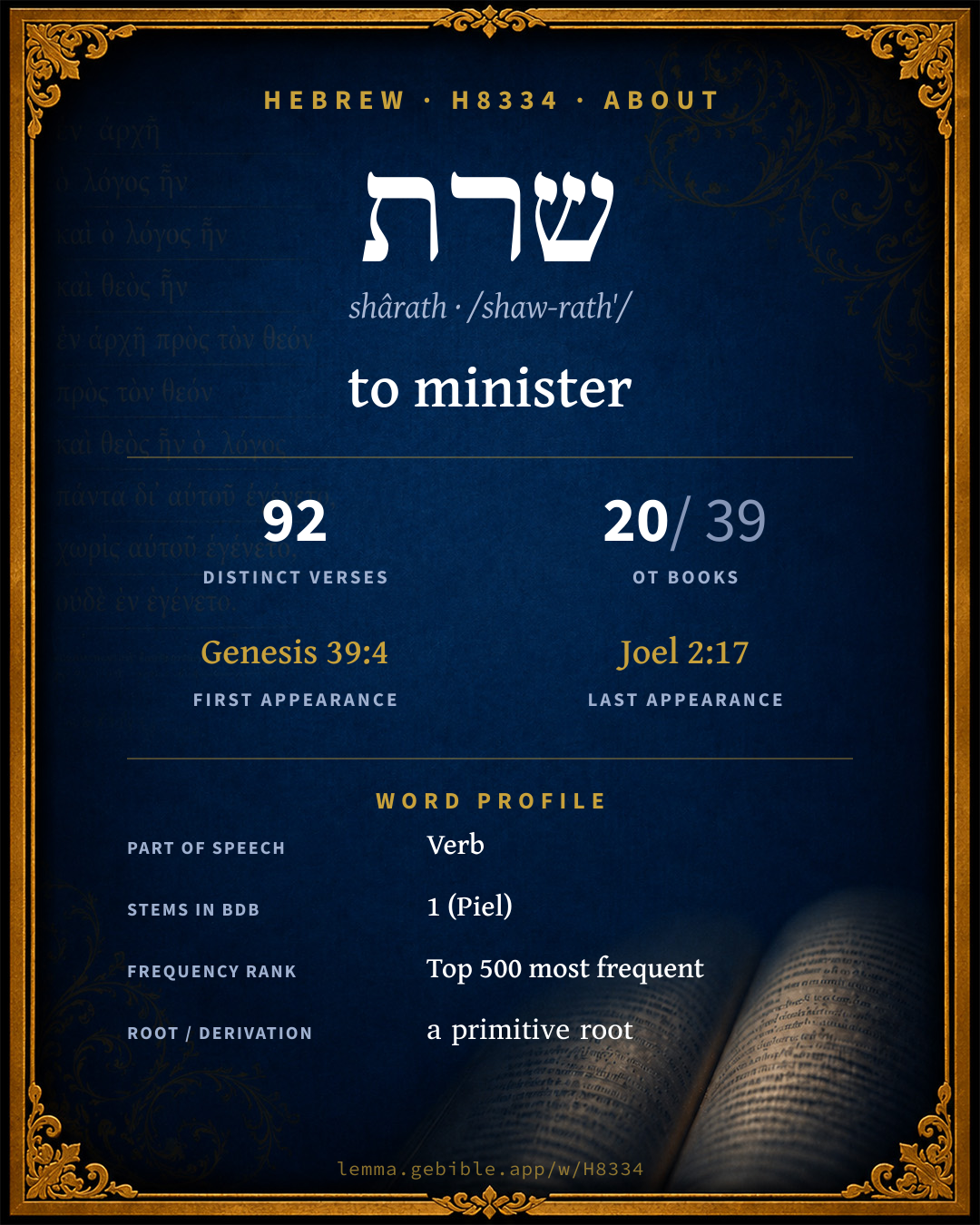
שָׁרַת
to minister
Full lexicon entry — Brown-Driver-Briggs (BDB)
From Brown-Driver-Briggs (BDB)
Where this word appears
Grammar key — what these labels mean
Part of speech
- Verb
- An action or state-of-being word.
Stem
- Piel
- An intensive or resultative active stem. Here: ‘of ministerial service’
Form
- Infinitive Construct
- A bound verbal noun, frequently with prepositions (“to write / in writing”).
- Participle Active
- A verbal adjective expressing ongoing or characteristic action (“writing / one who writes”).
- Imperfect
- An incomplete, ongoing, or future action (“he will / would write”).
- Sequential Perfect
- A perfect with prefixed waw continuing a preceding imperfect or command (waw-consecutive perfect).
- Sequential Imperfect
- An imperfect with prefixed waw — the standard past-narrative form (waw-consecutive imperfect).
State
- Construct
- A noun bound to a following noun in a possessive / “of” relationship (the construct chain).
- Absolute
- The independent form of a noun, not bound to a following word.
Person
- 3rd Person
- The one spoken about (“he / she / it / they”).
Gender
- Masculine
- Grammatically masculine.
- Common
- Either gender — not distinguished for this form.
- Feminine
- Grammatically feminine.
Number
- Plural
- More than one (in Hebrew, generally three or more).
- Singular
- One.
Every verse where H8334 appears in the Book of Esther — 3 distinct verses. Click any verse to open its interlinear word-by-word view. Verse text shown in the World English Bible for context — . Each verse’s Hebrew form is shown with its reference; the English is not keyword-highlighted, since the data carries no word-level English alignment. Use “Compare translations” on any verse to read it across multiple English versions. This concordance covers the Hebrew Bible; Septuagint (Greek Old Testament) occurrences are not indexed here.
Esther
- Esther 1:10 הַ/מְשָׁ֣רְתִ֔ים ptcl def.art + Piel ptcp.act mp On the seventh day, when the heart of the king was merry with wine, he commanded Mehuman, Biztha, Harbona, Bigtha, and Abagtha, Zethar, and Carcass, the seven chamberlains who ministered in the presence of Ahasuerus the king,
- Esther 2:2 מְשָׁרְתָ֑י/ו Piel ptcp.act mp cs + sfx pers 3ms Then said the king's servants who ministered to him, Let there be beautiful young virgins sought for the king:
- Esther 6:3 מְשָׁ֣רְתָ֔י/ו Piel ptcp.act mp cs + sfx pers 3ms The king said, What honor and dignity has been bestowed on Mordecai for this? Then the king's servants who ministered to him said, "Nothing has been done for him."
About this entry
At a glance — auto-summarized from this page’s data, not written by a person. Every figure links to its source below. This summary describes the numbers; it doesn’t interpret them.
At its core, שרת (shârath) means “to minister.” Its English rendering has broadened — “minister” classically, “serve” (unfoldingWord Literal Text) in modern versions; see the renderings breakdown. Spanning 92 verses in 20 books, it ranks among the moderately common words of the Hebrew Bible. It first appears in Genesis 39:4. Sharing its root, it stands alongside שרת. Dig into 92-verse concordance and the renderings breakdown below.
Gloss history
Strong's 1890 vs modern scholarship
About this word
Strong's H8334 catalogs a Hebrew word from the Hebrew Old Testament.
These counts are not copied from any lexicon or concordance. They are computed here, from the morphology-tagged Hebrew Old Testament. What Lemma adds →
- 92
- distinct verses
- The word appears in 92 distinct verses.
- 20 / 39
- OT books
- The word appears in 20 of 39 Old Testament books.
- #429
- by frequency
- Top 500 most frequent Hebrew words (rank 429 of 8,640 Hebrew words by occurrence).
View all 92 occurrences in the concordance →
By section of the Old Testament
By traditional corpus
Conventional, traditional groupings — biblical authorship is debated, so this is a traditional corpus grouping, not an authorship claim. Each share is this word’s portion of its verses in that division of the Hebrew canon. Each figure is a share of the word’s 92 distinct verses.
- Prophets (Nevi'im) 38 verses · 41%
- Torah (Pentateuch) 27 verses · 29%
- Writings (Ketuvim) 27 verses · 29%
How translations render this word
Counts come from each version’s own published word-to-Strong’s tagging or interlinear alignment — an approximate guide to how each version renders this word, not a word-level alignment the data otherwise carries. Because each total is that version’s own tagged count, the per-version totals vary from one another and need not match the appearance or distinct-verse counts above. These counts may also differ from a printed concordance because Lemma counts each distinctly tagged rendering and does not collapse phrase taggings into a single head-word total. This is a fixed set of word-tagged versions (KJV, ASV, BSB, ULT) and does not change with the reading translation you choose elsewhere. Each version’s license is shown beside its name below (and on Sources).
- King James Version: Minister 33×, Ministered 10×, Ministers 10×
- American Standard Version: Minister 28×, Ministers 9×, Ministered 7×
- Berean Standard Bible: Minister 20×, Ministers 6×, Ministering 5×
- unfoldingWord Literal Text: Serve 8×, Minister 7×, Serving 7×
King James Version Public Domain
Renders H8334 across 97 tagged occurrences — most commonly:
Plus other, less common renderings. Plus 16 renderings that appear only once — usually multi-word phrases or single function words the recovered tagging swept in, not distinct renderings.
American Standard Version Public Domain
Renders H8334 across 96 tagged occurrences — most commonly:
Plus other, less common renderings. Plus 20 renderings that appear only once — usually multi-word phrases or single function words the recovered tagging swept in, not distinct renderings.
Berean Standard Bible Public Domain
Renders H8334 across 93 tagged occurrences — most commonly:
Plus other, less common renderings. Plus 28 renderings that appear only once — usually multi-word phrases or single function words the recovered tagging swept in, not distinct renderings. Not rendered by a distinct English word in 4 further occurrences.
unfoldingWord Literal Text CC BY-SA 4.0
Renders H8334 across 94 tagged occurrences — most commonly:
Plus other, less common renderings. Plus 35 renderings that appear only once — usually multi-word phrases or single function words the recovered tagging swept in, not distinct renderings.
13 senses and sub-senses in the full BDB
What do BDB’s symbols mean?
BDB uses these scholarly abbreviations:
| Symbol | Meaning |
|---|---|
| 𝔊 | the Septuagint (the ancient Greek translation, LXX) |
| 𝔙 | the Vulgate (the Latin translation) |
| 𝔖 | the Syriac version (the Peshitta) |
| 𝔗 | the Targum (the Aramaic translation) |
| ψ | the Psalms |
| √ | root (the underlying root or stem) |
| ‖ | parallel passage (a synonymous or contrasted parallel) |
| † | the dagger: every passage where the word occurs is cited |
The 13 senses and sub-senses the full Brown-Driver-Briggs lexicon distinguishes for this word, in lexicon order (not ranked by frequency), with BDB’s own verbatim wording and sub-sense lettering. Shown in Hebrew script with BDB’s own scholarly abbreviations. The condensed entry is in the Lexicon Entry tab. See also the Forms in the corpus table below.
Piel
- Pf. 3 ms. שֵׁרֵת Nu 8:26; Dt 18:7; 3 mpl. שֵׁרְתוּ Nu 3:6; Impf. 3 ms. וַיְשָׁ֫רֶת Gn 39:4, 3 mpl. יְשָֽׁרְתוּ Nu 3:31 +, etc.; Inf. cstr. לְשָׁרֵת Ex 28:35 +, לְשָׁ֫רֶת שָׁם Dt 17:12, etc.; Pt. מְשָׁרֵת Nu 11:28 + (2 S 13:9 v. מַשְׂרֵת, p. 602a), f. מְשָׁרַת 1 K 1:15; etc.;—serve: e.g. Numbers 8:26
- 1. of ministerial service (opp. menial, עבד):
- a. higher domestic service: Joseph Gn 39:4; 40:4 (JE), Elisha’s chief servant 2 K 4:43; 6:15, royal domestics 2 S 13:17, 18 1 K 10:5; 2 Ch 9:4; Est 2:2; 6:3, Abishag 1 K 1:4, 15. e.g. Genesis 39:4
- b. of royal officers (late) 1 Ch 27:1; 28:1; 2 Ch 17:19; 22:8; Est 1:10; Pr 29:12. e.g. 1 Chronicles 27:1
- c. Joshua as chief assistant to Moses Ex 24:13; 13:11 (E), Nu 11:28 (J), Jos 1:1 (D), Elisha to Elijah 1 K 19:21, e.g. Exodus 24:13
- d. of angels to י׳ ψ 103:21, cf. 104:4. e.g. Psalms 103:21
- e. of kings of nations in proph. Is 60:10. e.g. Isaiah 60:10
- 2. usually of special service in worship:
- a. of Levit. priests, abs. 1 K 8:11 = 2 Ch 5:14; c. acc. י׳ Dt 10:8; 17:12; 21:5; Je 33:21 + (strangely) מְשָֽׁרְתֵי אֹתִי v 22; also Is 60:7 of animals put fig. for those sacrificing them; of foreigners admitted to priesthood Is 61:6, cf. 56:6; so prob. Samuel conceived as priest 1 S 2:11; 3:1, את פני י׳ 2:18 (פני prob. acc., cf. 𝔊 τῷ προσώπῳ v 11), שׁ׳ בְּשֵׁם י׳ Dt 18:5, 7. e.g. 1 Kings 8:11
- b. Levites (P, and late); c. acc. of Aaronic priests Nu 3:6; 8:26; 18:2, c. acc. of י׳ 1 Ch 15:2; 2 Ch 29:11a; prob. also in ref. to Lev. singer ψ 101:6; c. acc. tabern. Nu 1:50 (P), congregation 16:9 (P), people Ez 44:11 + v 12 (of idolatry); abs. 1 Ch 16:4; 2 Ch 23:6; 29:11b; 31:2 Ezr 8:17 (pt. as subst., ministers); שׁ׳ לִפְנֵי אֲרוֹן בְּרִית י׳ 1 Ch 16:37, שׁ׳ נֶגֶד הַכֹּהֲנִים 2 Ch 8:14; שׁ׳ c. ב loc. 1 Ch 26:12; especially c. בְּ, of sacred vessels Nu 3:31; 4:9, 12, 14; 2 K 25:14 = Je 52:18; בַּשִּׁיר 1 Ch 6:17. e.g. Numbers 3:6
- c. Zadokite priests (Ez), abs. Ez 42:14; 44:17, 19, 27, c. acc. י׳ 40:46; 43:19; 44:15, 16; 45:4, cstr. מְשָׁרֲתֵי before place 45:4, 5; 46:24. e.g. Ezekiel 42:14
- d. Aaronic priests, abs. Ex 28:35 + 4 times P; c. acc. י׳ 1 Ch 23:13; לי׳ 2 Ch 13:10; מְשָֽׁרְתֵי י׳ Jo 1:9, 13; 2:17, מְשָֽׁרְתֵי מזבח Jo 1:13, c. בַּקֹּדֶשׁ Ex 28:43 + 4 times P. e.g. Exodus 28:35
- e. of idolatry, c. acc. עץ ואבן Ez 20:32. e.g. Ezekiel 20:32
Senses from the full Brown-Driver-Briggs lexicon (Brown, Driver, Briggs; Oxford 1906 — public domain), digitized via Sefaria, supplemented by the OpenScriptures HebrewLexicon (CC BY 4.0). Full attribution on Sources.
Word origin
vb. Pi. minister, serve (cf. NH שֵׁרוּת (temple-) ministry, Ph. משרת ministry, and perhaps vb. שרת minister);—
— Brown-Driver-Briggs (Oxford 1906, public domain), digitized via Sefaria, supplemented by the OpenScriptures HebrewLexicon (CC BY 4.0). See Sources.
Origin: a primitive root
Jastrow Dictionary
A second Hebrew/Aramaic lexicon for comparison, covering Aramaic and post-biblical (Talmudic, Targumic, Midrashic) usage that the biblical-Hebrew BDB does not. Matched by lemma rather than by Strong’s number, so a lemma may carry more than one Jastrow headword (shown separately below), and the entries cover usage well beyond the Bible.
שָׁרַת
- , Pi. שֵׁרֵת (b. h.; [to dwell with,] to serve, minister, attend. Y. Erub. V, beg. 22ᵇ (ref. to I Sam. III, 1) והלא לא מְשָׁרֵת אלא לפני עלי but did not he minister before Eli only? ללמדך שכל שירות שש׳ וכ׳ to teach thee that all the ministrations that he rendered to Eli were accounted to him as if he had ministered before the Lord; (Midr. Sam. ch. VIII היה עומד). Ber. 63ᵇ הושע … משרת תחתיך Hoshea … shall serve in thy stead; a. e. e.g. 1 Samuel 3:1
שָׁרֵת
- (infin. Pi., preced.) service, ministration. Sot. II, 1, a. fr. כלי ש׳ vessels dedicated to the Temple service, sacred vessels.—מלאכי הש׳ ministering angels, v. מַלְאָךְ.
A Dictionary of the Targumim, the Talmud Babli and Yerushalmi, and the Midrashic Literature (Marcus Jastrow; London, Luzac, 1903) — Public Domain. Digitized via Sefaria. Digitized via Sefaria. Full attribution on Sources.
Forms in the corpus
The 72 distinct written forms H8334 takes in the Hebrew Bible, most frequent first — each parse links to that stem’s occurrences in the concordance. Hebrew forms include their vowel points and cantillation, so a single lemma takes many written forms.
| Form | Parsing | Example | Uses |
|---|---|---|---|
| לְ/שָׁרֵ֣ת | Verb, Piel, Infinitive Construct | Exodus 28:43 | 6 |
| לְ/שָׁרֵ֖ת | Verb, Piel, Infinitive Construct | Ezekiel 20:32 | 4 |
| מְשָׁרֵ֥ת | Verb, Piel, Participle Active, Masculine, Singular, Construct | Joshua 1:1 | 3 |
| לְ/שָׁ֣רְת֔/וֹ | Verb, Piel, Infinitive Construct | Deuteronomy 21:5 | 3 |
| מְשָׁרְתֵ֖י | Verb, Piel, Participle Active, Masculine, Plural, Construct | Joel 1:9 | 3 |
| הַ/מְשָׁ֣רְתִ֔ים | Verb, Piel, Participle Active, Masculine, Plural, Absolute | Esther 1:10 | 2 |
| וַ/יְשָׁ֣רֶת | Verb, Piel, Sequential Imperfect, 3rd Person, Masculine, Singular | Genesis 39:4 | 2 |
| יְשָֽׁרְתוּ | Verb, Piel, Imperfect, 3rd Person, Masculine, Plural | 2 Kings 25:14 | 2 |
| יְשָׁרְת֑וּ/נֶךְ | Verb, Piel, Imperfect, 3rd Person, Masculine, Plural | Isaiah 60:7 | 2 |
| יְשָׁרְת֥וּ | Verb, Piel, Imperfect, 3rd Person, Masculine, Plural | Ezekiel 42:14 | 2 |
| לְ/שָֽׁרְתֵ֑/נִי | Verb, Piel, Infinitive Construct | Ezekiel 43:19 | 2 |
| מְ֝שָׁרְתָ֗י/ו | Verb, Piel, Participle Active, Masculine, Plural, Construct | Psalms 103:21 | 2 |
| מְשָׁ֣רְת֔/וֹ | Verb, Piel, Participle Active, Masculine, Singular, Construct | 2 Kings 4:43 | 2 |
| מְשָׁרְתִ֥ים | Verb, Piel, Participle Active, Masculine, Plural, Absolute | 2 Chronicles 22:8 | 2 |
| מְשָׁרְתֵ֣י | Verb, Piel, Participle Active, Masculine, Plural, Construct | Isaiah 61:6 | 2 |
| מְשָׁרְתֵ֥י | Verb, Piel, Participle Active, Masculine, Plural, Construct | Ezekiel 46:24 | 2 |
| מְשָׁרְתָ֜י/ו | Verb, Piel, Participle Active, Masculine, Plural, Construct | 1 Kings 10:5 | 2 |
| בְּ/שָֽׁרְתָ֗/ם | Verb, Piel, Infinitive Construct | Ezekiel 44:17 | 1 |
| הַ/מְשָׁרְתִ֖ים | Verb, Piel, Participle Active, Masculine, Plural, Absolute | Nehemiah 10:36 | 1 |
| הַ/מְשָׁרְתִ֣ים | Verb, Piel, Participle Active, Masculine, Plural, Absolute | 2 Chronicles 17:19 | 1 |
| הַ/מְשָׁרְתִ֨ים | Verb, Piel, Participle Active, Masculine, Plural, Absolute | 1 Chronicles 27:1 | 1 |
| הַ/מְשָׁרְתִ֪ים | Verb, Piel, Participle Active, Masculine, Plural, Absolute | 1 Chronicles 28:1 | 1 |
| וְ/הַ/מְשָׁרְתִ֣ים | Verb, Piel, Participle Active, Masculine, Plural, Absolute | 2 Chronicles 23:6 | 1 |
| וְ/שֵׁרְת֖וּ | Verb, Piel, Sequential Perfect, 3rd Person, Common, Plural | Numbers 3:6 | 1 |
| וְ/שֵׁרֵ֕ת | Verb, Piel, Sequential Perfect, 3rd Person, Masculine, Singular | Deuteronomy 18:7 | 1 |
| וְ/שֵׁרֵ֨ת | Verb, Piel, Sequential Perfect, 3rd Person, Masculine, Singular | Numbers 8:26 | 1 |
| וִֽ/ישָׁרְת֑וּ/ךָ | Verb, Piel, Imperfect, 3rd Person, Masculine, Plural | Numbers 18:2 | 1 |
| וַ/יְשָׁרְתֵֽ/הוּ | Verb, Piel, Sequential Imperfect, 3rd Person, Masculine, Singular | 1 Kings 19:21 | 1 |
| וַ/תְּשָׁ֣רְתֵ֔/הוּ | Verb, Piel, Sequential Imperfect, 3rd Person, Feminine, Singular | 1 Kings 1:4 | 1 |
| וּ/לְ/שָׁרֵ֜ת | Verb, Piel, Infinitive Construct | 2 Chronicles 8:14 | 1 |
| וּ/מְשָׁ֨רְת֜/וֹ | Verb, Piel, Participle Active, Masculine, Singular, Construct | Exodus 33:11 | 1 |
| וּֽ/לְ/שָׁרְת֖/וֹ | Verb, Piel, Infinitive Construct | 1 Chronicles 15:2 | 1 |
| וּֽ/מְשָׁרְתִ֖ים | Verb, Piel, Participle Active, Masculine, Plural, Absolute | Ezekiel 44:11 | 1 |
| יְֽשָׁרְת֧וּ | Verb, Piel, Imperfect, 3rd Person, Masculine, Plural | Numbers 4:14 | 1 |
| יְשָׁרְת֖וּ | Verb, Piel, Imperfect, 3rd Person, Masculine, Plural | Numbers 3:31 | 1 |
| יְשָׁרְת֤וּ | Verb, Piel, Imperfect, 3rd Person, Masculine, Plural | Ezekiel 44:12 | 1 |
| יְשָׁרְתֵֽ/נִי | Verb, Piel, Imperfect, 3rd Person, Masculine, Singular | Psalms 101:6 | 1 |
| יְשָׁרְתֻ֑/הוּ | Verb, Piel, Imperfect, 3rd Person, Masculine, Plural | Numbers 1:50 | 1 |
| יְשָׁרְתוּ | Verb, Piel, Imperfect, 3rd Person, Masculine, Plural | Numbers 4:9 | 1 |
| לְ/שָׁ֤רֶת | Verb, Piel, Infinitive Construct | Deuteronomy 17:12 | 1 |
| לְ/שָֽׁרְת/וֹ֙ | Verb, Piel, Infinitive Construct | Deuteronomy 10:8 | 1 |
| לְ/שָֽׁרְתָֽ/ם | Verb, Piel, Infinitive Construct | Ezekiel 44:11 | 1 |
| לְ/שָׁרְת֛/וֹ | Verb, Piel, Infinitive Construct | 1 Chronicles 23:13 | 1 |
| לְ/שָׁרְתֵ֑/נִי | Verb, Piel, Infinitive Construct | Ezekiel 44:16 | 1 |
| לְ/שָׁרְתָֽ/ם | Verb, Piel, Infinitive Construct | Numbers 16:9 | 1 |
| לְ/שָׁרְתֽ/וֹ | Verb, Piel, Infinitive Construct | Ezekiel 40:46 | 1 |
| לְ/שָׁרֵ֑ת | Verb, Piel, Infinitive Construct | Exodus 28:35 | 1 |
| לְ/שָׁרֵ֔ת | Verb, Piel, Infinitive Construct | Exodus 30:20 | 1 |
| לְ/שָׁרֵ֕ת | Verb, Piel, Infinitive Construct | Exodus 39:26 | 1 |
| לְ/שָׁרֵ֞ת | Verb, Piel, Infinitive Construct | 1 Chronicles 16:37 | 1 |
| לְ/שָׁרֵ֥ת | Verb, Piel, Infinitive Construct | Exodus 29:30 | 1 |
| לְ/שָׁרֵ֧ת | Verb, Piel, Infinitive Construct | Deuteronomy 18:5 | 1 |
| לְ/שָׁרֵת֙ | Verb, Piel, Infinitive Construct | 2 Chronicles 31:2 | 1 |
| מְשָׁ֣רְתִ֔ים | Verb, Piel, Participle Active, Masculine, Plural, Absolute | Ezekiel 44:11 | 1 |
| מְשָׁ֣רְתָ֔י/ו | Verb, Piel, Participle Active, Masculine, Plural, Construct | Esther 6:3 | 1 |
| מְשָֽׁרְת/וֹ֙ | Verb, Piel, Participle Active, Masculine, Singular, Construct | 2 Samuel 13:18 | 1 |
| מְשָׁרְת֑/וֹ | Verb, Piel, Participle Active, Masculine, Singular, Construct | Exodus 24:13 | 1 |
| מְשָׁרְתִ֑ים | Verb, Piel, Participle Active, Masculine, Plural, Absolute | 1 Chronicles 16:4 | 1 |
| מְשָׁרְתִ֖ים | Verb, Piel, Participle Active, Masculine, Plural, Absolute | Ezra 8:17 | 1 |
| מְשָׁרְתִ֜ים | Verb, Piel, Participle Active, Masculine, Plural, Absolute | 1 Chronicles 6:32 | 1 |
The 60 most common forms are shown; 12 rarer forms follow in the full concordance.
Same root — word family
Other BDB entries built from the same root as H8334, grouped by Strong’s listed origin. These share a root / origin per the lexicon — not necessarily a shared meaning. Each links to that word’s own entry.
Derived from this word
Compare all same-root words → They share a root, not necessarily a meaning.
Septuagint verse parallels
This word appears in 88 verses that also exist in the Greek Old Testament (Septuagint), out of the 92 Hebrew verses it occurs in. You can read those verses in Greek by switching the Old Testament edition to the Septuagint.
Read these verses in the Septuagint
- Genesis 39:4
- Exodus 24:13
- Numbers 1:50
- Deuteronomy 10:8
- Joshua 1:1
- 1 Samuel 2:11
- 2 Samuel 13:17
- 1 Kings 1:4
- 2 Kings 4:43
- 1 Chronicles 6:32
- 2 Chronicles 5:14
- Ezra 8:17
This is a verse-level parallel only — the same verses exist in both the Hebrew and Greek Old Testaments. No word-level Hebrew↔Greek correspondence is claimed: the data carries no such alignment, so no Greek word is shown as this Hebrew word’s translation. Coverage is not total — the Septuagint omits the deuterocanon and renumbers the Psalms, so some Hebrew verses have no direct Greek parallel.